
📘 What’s Inside This CAT Para-jumble Question Post?
📝 Authentic CAT Para-jumble Question : Practice with a real CAT Para-jumble Question from a previous CAT exam.
✅ Detailed Question with Step-by-Step Solution: Each question is explained thoroughly for better understanding.
📚 Vocabulary Enhancement: Top 5 words explained from the paragraph
Para-jumble Sentences
Question 31: The four sentences (labelled 1, 2, 3, 4) given below, when properly sequenced would yield a coherent paragraph. Decide on the proper sequence of the order of the sentences and key in the sequence of the four numbers as your answer.
1. Conceptualisations of ‘women’s time’ as contrary to clock-time and clock-time as synonymous with economic rationalism are two of the deleterious results of this representation.
2. While dichotomies of ‘men’s time’, ‘women’s time’, clock-time, and caring time can be analytically useful, this article argues that everyday caring practices incorporate a multiplicity of times; and both men and women can engage in these multiple-times.
3. When the everyday practices of working sole fathers and working sole mothers are carefully examined to explore conceptualisations of gendered time, it is found that caring time is often more focused on the clock than generally theorised.
4. Clock-time has been consistently represented in feminist literature as a masculine artefact representative of a ‘time is money’ perspective.
Solution with Explanation
Correct Answer: 4132
Detailed explanation by Wordpandit:
Sentences 1, 2, and 3 cannot make the opening line as they need some prior explanation to make complete and logical sense. Sentence-4 introduces the topic of clock-time, and how it has been depicted in feminist literature. Hence, Sentence-4 must begin the paragraph.
Sentence-1 then carries forward the discussion on such representation of clock-time, and informs the reader about the two results of doing so.
Between 2 and 3, Sentence-2 gives a perfect conclusion of what “this article argues” about, and that the everyday caring practices involve a multiplicity of times. And, Sentence-3 points out the difference in the concepts of the time utilized by both the genders. So, logically, Sentence-3 must precede Sentence-2.
Hence, the correct sequence will be 4132.
Word-1: Conceptualisations

Context:
"Conceptualisations of ‘women’s time’ as contrary to clock-time and clock-time as synonymous with economic rationalism are two of the deleterious results of this representation." - Contextual Usage
Explanatory Paragraph:
“Conceptualisations” refers to the mental processes or frameworks through which we form ideas, theories, or understandings of something. It involves how a concept is imagined, interpreted, or structured in thought. In the given context, it implies the specific ways society or scholars have interpreted “women’s time” versus “clock-time,” each carrying different cultural and economic meanings. These conceptualisations can shape social narratives, policies, and even identity perceptions.
Meaning: The action or process of forming an idea or concept of something (Noun – plural)
Pronunciation: kon-SEP-choo-uh-luh-ZAY-shunz
Difficulty Level: ⭐⭐⭐⭐ Advanced
Etymology: From “conceptualise” (verb) + “-ation” (forming a noun), derived from Latin *conceptus* meaning “a thought, notion.”
Prashant Sir's Notes:
This word is common in academic writing, particularly in philosophy, sociology, and gender studies. It emphasizes how abstract ideas are framed or represented, especially in complex or critical discourse. Use it to highlight the act of defining or reinterpreting a concept in intellectual arguments.
Synonyms & Antonyms:
Synonyms: interpretations, frameworks, understandings, theories
Antonyms: realities, facts, misinterpretations, confusions
Usage Examples:
- The book presents various conceptualisations of freedom across different cultures.
- Her research critiques traditional conceptualisations of success in corporate environments.
- Conceptualisations of childhood have evolved significantly over the last century.
- Modern art challenges conventional conceptualisations of beauty and form.
Cultural Reference:
In feminist theory, scholars often explore how the conceptualisation of “women’s roles” in time and space differ from patriarchal norms — reshaping our understanding of gendered experiences.
Think About It:
How do our conceptualisations of time, gender, or success influence the way we live our lives or judge others? Can redefining a concept change society?
Quick Activity:
Pick a broad idea (e.g., freedom, work, family) and write down two different conceptualisations of it — one traditional, one modern. How do they affect behavior or attitudes?
Memory Tip:
“Conceptualisations” comes from “concept” — imagine building a mental model or ‘concept shell’ for abstract ideas.
Real-World Application:
Commonly used in academic disciplines like sociology, psychology, gender studies, and philosophy to discuss the theoretical framing of issues, identities, and systems of thought.
Word-2: Synonymous
Context:
"Conceptualisations of ‘women’s time’ as contrary to clock-time and clock-time as synonymous with economic rationalism are two of the deleterious results of this representation." - Contextual Usage
Explanatory Paragraph:
“Synonymous” describes a relationship where two things are so closely associated that one implies the other or can be used interchangeably. In language, it means two words have nearly the same meaning. In broader usage, it suggests that one concept or idea has become representative of another. In the context above, "clock-time" is presented as being synonymous with "economic rationalism" — meaning the two are closely linked in ideology or perception, even if not literally identical.
Meaning: Closely associated with or having the same or nearly the same meaning as something else (Adjective)
Pronunciation: sih-NON-uh-muhs
Difficulty Level: ⭐⭐ Intermediate
Etymology: From Latin *synonymum*, and Greek *synōnymon* — from *syn-* (together) + *onyma* (name)
Prashant Sir's Notes:
This word is especially helpful when exploring how language and ideas are shaped in academic, literary, and cultural texts. Be cautious though — synonymous doesn't always mean “exactly the same,” especially in critical writing. It often implies a strong association rather than literal equivalence.
Synonyms & Antonyms:
Synonyms: interchangeable, equivalent, closely associated, identical (contextually)
Antonyms: distinct, unrelated, dissimilar, contrasting
Usage Examples:
- His name became synonymous with integrity in the business world.
- For many, "freedom" is synonymous with "independence."
- Luxury brands are often synonymous with exclusivity and wealth.
- She wrongly assumed that “smart” is synonymous with “educated.”
Cultural Reference:
Apple Inc. is often seen as synonymous with innovation in consumer technology — a result of strategic branding and consistent product design over decades.
Think About It:
When a concept becomes synonymous with a particular value or ideology, how does it affect our ability to see that concept differently? Can strong associations limit independent thought?
Quick Activity:
Write two pairs of words or phrases that are commonly used synonymously in public discourse. Then, analyze if they truly mean the same thing.
Memory Tip:
“Synonymous” sounds like “synonym” — just remember, it means 'same name' or ‘same meaning.’ If two things are synonymous, they share meaning or identity.
Real-World Application:
Frequently used in critical thinking, academic essays, branding, linguistics, and media analysis to describe how ideas or terms become tightly linked in perception or usage.
Word-3: Deleterious
Context:
"Conceptualisations of ‘women’s time’ as contrary to clock-time and clock-time as synonymous with economic rationalism are two of the deleterious results of this representation." - Contextual Usage
Explanatory Paragraph:
“Deleterious” refers to something that causes harm, damage, or a negative effect. It is often used in formal or academic writing to describe the subtle or long-term consequences of an idea, policy, or condition. In the sentence above, it suggests that portraying "women’s time" as different from "clock-time" has harmful social or intellectual consequences — possibly reinforcing stereotypes or undermining equality. The word carries a tone of seriousness, often used when the harm is not immediately obvious but significant over time.
Meaning: Causing harm or damage, especially in a subtle or indirect way (Adjective)
Pronunciation: del-uh-TEER-ee-uhs
Difficulty Level: ⭐⭐⭐⭐ Advanced
Etymology: From Latin *delere* meaning “to destroy,” related to *deleō*, which also gave us the word “delete.”
Prashant Sir's Notes:
Use “deleterious” in formal contexts to emphasize harmful effects, particularly in discussions of policy, ideology, health, or long-term consequences. It’s a precise and impactful alternative to overused words like “bad” or “harmful.”
Synonyms & Antonyms:
Synonyms: harmful, damaging, detrimental, injurious
Antonyms: beneficial, helpful, advantageous, constructive
Usage Examples:
- Prolonged stress can have a deleterious effect on physical health.
- The new policy may seem fair, but it could have deleterious consequences for low-income families.
- Pollution has a deleterious impact on marine ecosystems.
- Social media, while connecting people, may also have deleterious effects on mental well-being.
Cultural Reference:
In environmental debates, the term "deleterious" often appears in reports and literature to emphasize the long-term ecological damage of human activities, such as deforestation or carbon emissions.
Think About It:
Can something seem beneficial in the short term but prove deleterious over time? How do we measure or detect long-term harm in societal ideas or policies?
Quick Activity:
Write down one belief, behavior, or trend you think is deleterious in modern society. Explain why it may be harmful in the long run.
Memory Tip:
“Deleterious” sounds like “delete” — think of it as something so harmful that it should be deleted or removed before it causes damage.
Real-World Application:
Commonly used in academic writing, health and policy discussions, environmental science, and critical theory to describe the negative effects of actions, systems, or ideologies.
Word-4: Multiplicity
Context:
"While dichotomies of ‘men’s time’, ‘women’s time’, clock-time, and caring time can be analytically useful, this article argues that everyday caring practices incorporate a multiplicity of times; and both men and women can engage in these multiple-times." - Contextual Usage
Explanatory Paragraph:
“Multiplicity” refers to the presence of many different elements or aspects within a single context. It emphasizes variety, diversity, and complexity. In the example above, the term highlights that daily life cannot be neatly divided into strict time categories like “men’s time” or “clock-time.” Instead, caring practices involve a multiplicity — a range of overlapping, nuanced time experiences — that both men and women navigate. The word is useful when challenging rigid binaries or highlighting layered realities.
Meaning: A large number or variety of things; the state of being multiple or various (Noun)
Pronunciation: mul-tih-PLIH-sih-tee
Difficulty Level: ⭐⭐⭐ Intermediate-Advanced
Etymology: From Latin *multiplicitas*, from *multiplex* meaning "having many folds or parts."
Prashant Sir's Notes:
This is a favorite in academic and critical writing, especially in sociology, gender studies, and philosophy. Use “multiplicity” when you want to move beyond simplified, binary views and acknowledge the richness or complexity of a subject.
Synonyms & Antonyms:
Synonyms: variety, diversity, abundance, plurality
Antonyms: singularity, uniformity, oneness, simplicity
Usage Examples:
- The city offers a multiplicity of cultural experiences.
- Her identity is shaped by a multiplicity of influences: heritage, language, and education.
- The theory accounts for the multiplicity of perspectives in modern society.
- In daily life, we manage a multiplicity of roles—parent, employee, friend, citizen.
Cultural Reference:
Philosopher Gilles Deleuze frequently used the concept of “multiplicity” to challenge fixed identities and promote fluid, ever-changing understandings of self and society.
Think About It:
How does recognizing a multiplicity of truths or perspectives affect our ability to communicate, collaborate, or resolve conflict?
Quick Activity:
List three areas in your life where you experience multiplicity (e.g., roles, emotions, time commitments). How do you manage or balance them?
Memory Tip:
“Multiplicity” = “multiple” + “-icity” (a state of being) → a state of having many parts, not just one.
Real-World Application:
Used in social sciences, literature, identity theory, and postmodern philosophy to emphasize complexity, diversity, and the rejection of one-dimensional categories.
Word-5: Artefact
Context:
"Clock-time has been consistently represented in feminist literature as a masculine artefact representative of a ‘time is money’ perspective." - Contextual Usage
Explanatory Paragraph:
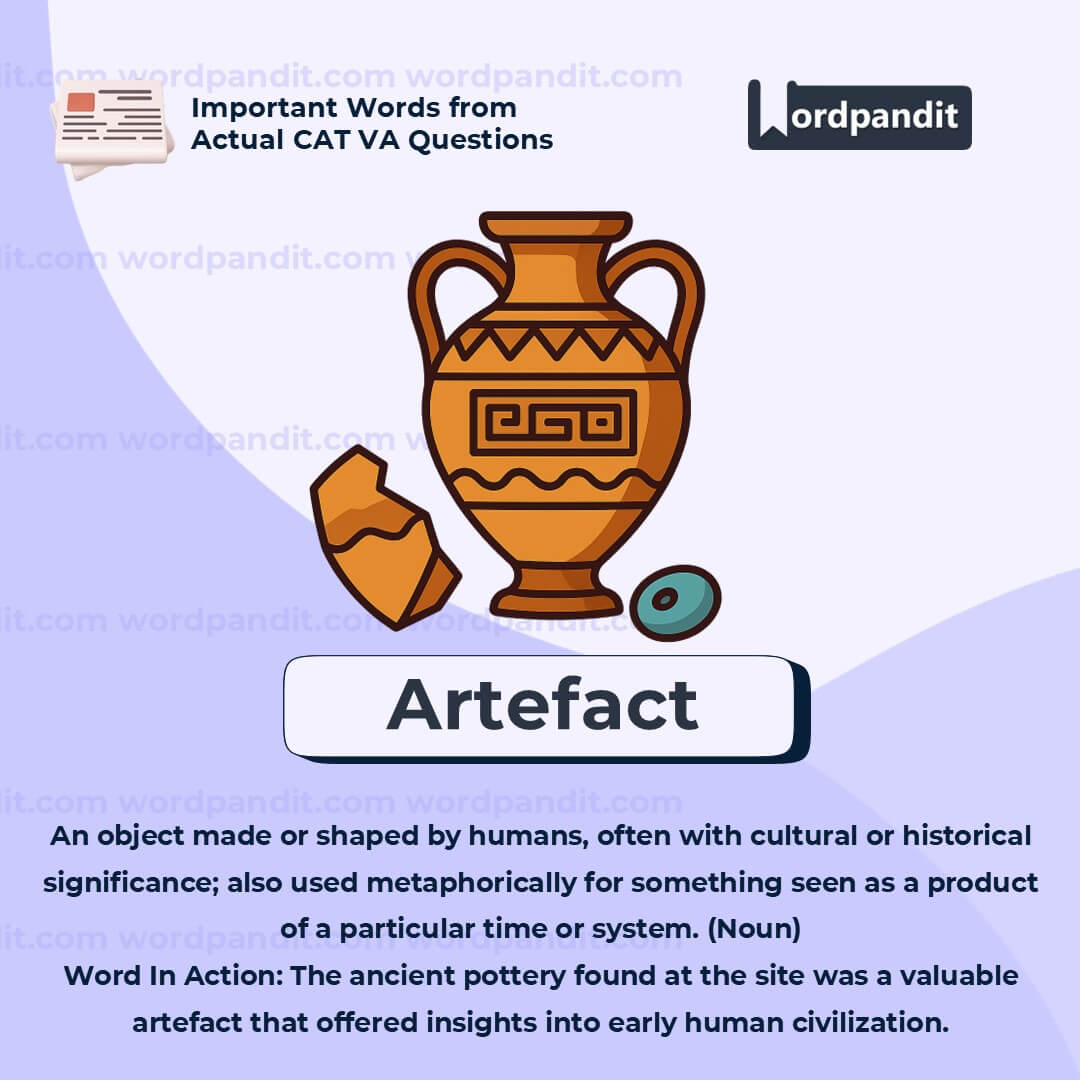
“Artefact” refers to something made or shaped by humans, often with cultural, historical, or symbolic significance. While it usually means a physical object, especially in archaeology or history, in this context, it is used metaphorically. Here, “clock-time” is described as an artefact — a product of masculine-dominated social systems — suggesting that it’s not just a neutral measure of time but a construct shaped by economic and cultural values, especially the capitalist idea of “time is money.”
Meaning: An object made by a human being, typically one of cultural or historical interest; or metaphorically, a construct shaped by human ideas (Noun)
Pronunciation: AR-tuh-fakt
Difficulty Level: ⭐⭐⭐ Intermediate
Etymology: From Latin *arte* (by skill) + *factum* (something made), meaning "something made by art or skill."
Prashant Sir's Notes:
This word is often used literally in archaeology and museums, but in critical or cultural theory, it’s used metaphorically to describe systems, technologies, or beliefs created by humans and embedded with meaning. Pay attention to how "artefact" can suggest something is constructed, not natural.
Synonyms & Antonyms:
Synonyms: construct, product, creation, relic
Antonyms: natural object, spontaneous occurrence, untouched form
Usage Examples:
- The museum displayed ancient artefacts recovered from the dig site.
- Language itself can be considered a cultural artefact.
- The legal system is an artefact of historical and political evolution.
- In this theory, gender roles are seen as social artefacts, not biological facts.
Cultural Reference:
In *Foucault’s* philosophy, systems like prisons, schools, and even timekeeping are viewed as social artefacts — created by power structures to influence human behavior and identity.
Think About It:
What modern systems or ideas do you think are artefacts of outdated values or power structures? How might they evolve if reimagined?
Quick Activity:
List two literal artefacts (physical objects) and two metaphorical artefacts (social ideas or systems). What do they reveal about the culture that created them?
Memory Tip:
“Artefact” = “art” + “fact” → something made by human skill or effort — not naturally occurring, but deliberately constructed.
Real-World Application:
Used in archaeology, anthropology, literature, sociology, and critical theory to describe both tangible historical objects and abstract human-made systems or ideologies.