
📘 What’s Inside This CAT Misfit Sentence/Odd One Out Question Post?
📝 Authentic CAT Misfit Sentence/Odd One Out Question: Practice with a real CAT Para-jumble Question from a previous CAT exam.
✅ Detailed Question with Step-by-Step Solution: Each question is explained thoroughly for better understanding.
📚 Vocabulary Enhancement: Top 5 words explained from the paragraph
Misfit Sentence/Odd One Out Question
20. Five jumbled up sentences, related to a topic, are given below. Four of them can be put together to form a coherent paragraph. Identify the odd one out and key in the number of the sentence as your answer:
1. It has taken on a warm, fuzzy glow in the advertising world, where its potential is being widely discussed, and it is being claimed as the undeniable wave of the future.
2. There is little enthusiasm for this in the scientific arena; for them marketing is not a science, and only a handful of studies have been published in scientific journals.
3. The new, growing field of neuromarketing attempts to reveal the inner workings of consumer behaviour and is an extension of the study of how choices and decisions are made.
4. Some see neuromarketing as an attempt to make the "art" of advertising into a science, being used by marketing experts to back up their proposals with some form of real data.
5. The marketing gurus have already started drawing on psychology in developing tests and theories, and advertising people have borrowed the idea of the focus group from social scientists.
Solution with Explanation
Answer: 5
Solution by Wordpandit:
Upon a preliminary examination of the sentences, the overarching theme seems to focus on the burgeoning industry of neuromarketing.
Statement 3 serves as an ideal introduction, setting the stage by presenting neuromarketing as an emerging discipline that studies how consumer decisions are made.
Statement 1 discusses how neuromarketing has been received in the advertising world—warmly and enthusiastically, being labeled “the wave of the future.”
Statement 4 provides a transitional view, noting that neuromarketing is seen by some as an attempt to bring scientific credibility to advertising, historically considered more of an art.
Statement 2 contrasts this optimism by presenting the skepticism from the scientific community, which does not regard marketing as a true science and has shown limited academic interest in the field.
Thus, the sequence 3-1-4-2 forms a coherent paragraph: introduction of neuromarketing, its acceptance in advertising, some perspectives on its scientific value, and scientific skepticism.
Statement 5, however, deviates from this narrative. It shifts the focus from neuromarketing to general trends in marketing using psychology and focus groups—topics that are only tangentially related to the core discussion of neuromarketing.
Therefore, Statement 5 is the odd one out.
Word-1: Undeniable
Context:
"It has taken on a warm, fuzzy glow in the advertising world, where its potential is being widely discussed, and it is being claimed as the undeniable wave of the future."
Explanatory Paragraph:
“Undeniable” refers to something so obvious or convincing that it cannot be disputed or questioned. In the context provided, the term emphasizes that this new advertising trend or technology is being viewed as an inevitable and powerful force that will shape the future. The use of “undeniable” adds a sense of certainty and authority to the claim, suggesting widespread agreement or overwhelming evidence in favor of it.
Meaning: Clearly true or certain; impossible to deny or dispute. (Adjective)
Pronunciation: un-duh-NY-uh-buhl
Difficulty Level: ⭐⭐ Beginner
Etymology: From the prefix “un-” (not) + “deny” (from Latin *denegare*, to reject) + “-able” (capable of). Literally means “not able to be denied.”
Prashant Sir's Notes:
“Undeniable” is a strong, persuasive word. It’s used to state something with absolute confidence—whether in personal opinion, advertising, or evidence-based reasoning. Be careful though: while the word sounds absolute, it’s often used rhetorically, especially in marketing or political speech, to influence perception more than to reflect fact.
Synonyms & Antonyms:
Synonyms: unquestionable, indisputable, irrefutable, certain, evident
Antonyms: debatable, questionable, disputable, uncertain, doubtful
Usage Examples:
- There is undeniable evidence linking smoking to lung disease.
- Her talent for storytelling is undeniable.
- It’s an undeniable fact that technology has changed how we live.
- The movie’s success was undeniable, breaking box office records worldwide.
Cultural Reference:
“It is an undeniable truth that the mere perception of power is often as influential as power itself.” – Frank Underwood, *House of Cards*
Think About It:
What beliefs or trends in society today do you think are considered “undeniable”—and are they truly beyond question?
Quick Activity:
Write two undeniable facts about yourself and two you think society assumes are undeniable—but you might disagree with.
Memory Tip:
Undeniable = “can’t deny it.” If no one can reasonably say “no,” it’s undeniable.
Real-World Application:
In law, science, marketing, and public speaking, the word “undeniable” is often used to emphasize credibility and certainty. However, critical thinking requires that we always examine what is being labeled as “undeniable.”
Word-2: Enthusiasm
Context:
"There is little enthusiasm for this in the scientific arena; for them marketing is not a science, and only a handful of studies have been published in scientific journals."
Explanatory Paragraph:
“Enthusiasm” here refers to the level of interest, excitement, or approval shown toward a particular idea or field—in this case, marketing. The sentence suggests that the scientific community does not show much interest or support for marketing as a discipline, viewing it as lacking the rigor of a true science. More broadly, enthusiasm reflects a strong feeling of eagerness or passion about something.
Meaning: Intense and eager enjoyment, interest, or approval. (Noun)
Pronunciation: en-THOO-zee-az-uhm
Difficulty Level: ⭐ Beginner
Etymology: From Greek *enthousiasmos*, meaning “divine inspiration or possession by a god,” later evolving in English to mean passionate eagerness or excitement.
Prashant Sir's Notes:
“Enthusiasm” is a lively word—it conveys more than just liking something; it’s about being energetic and genuinely excited. It’s often used to describe attitudes toward ideas, hobbies, goals, or changes. In formal contexts, the lack of enthusiasm can suggest resistance, skepticism, or apathy.
Synonyms & Antonyms:
Synonyms: excitement, eagerness, passion, zeal, interest
Antonyms: indifference, apathy, disinterest, reluctance
Usage Examples:
- Her enthusiasm for learning languages is infectious.
- The proposal was met with little enthusiasm from the board members.
- He approached the project with great enthusiasm and creativity.
- Despite the challenges, the team maintained high enthusiasm throughout the campaign.
Cultural Reference:
Walt Disney once said, “Get a good idea and stay with it. Dog it, and work at it until it’s done right. Enthusiasm makes the difference.” – *Walt Disney: An American Original*
Think About It:
What is one subject or activity that instantly sparks enthusiasm in you—and why do you think it affects you that way?
Quick Activity:
Write two short sentences: one describing something you do with enthusiasm and another describing something you approach with little enthusiasm. Compare the difference in tone.
Memory Tip:
“Enthusiasm” starts with “en” (in) + “theos” (Greek for god) → originally meant “god within.” Think of enthusiasm as the inner spark that drives you.
Real-World Application:
Enthusiasm is a key trait in interviews, leadership, and education. It can inspire others, build team morale, and demonstrate commitment—even more than skill sometimes.
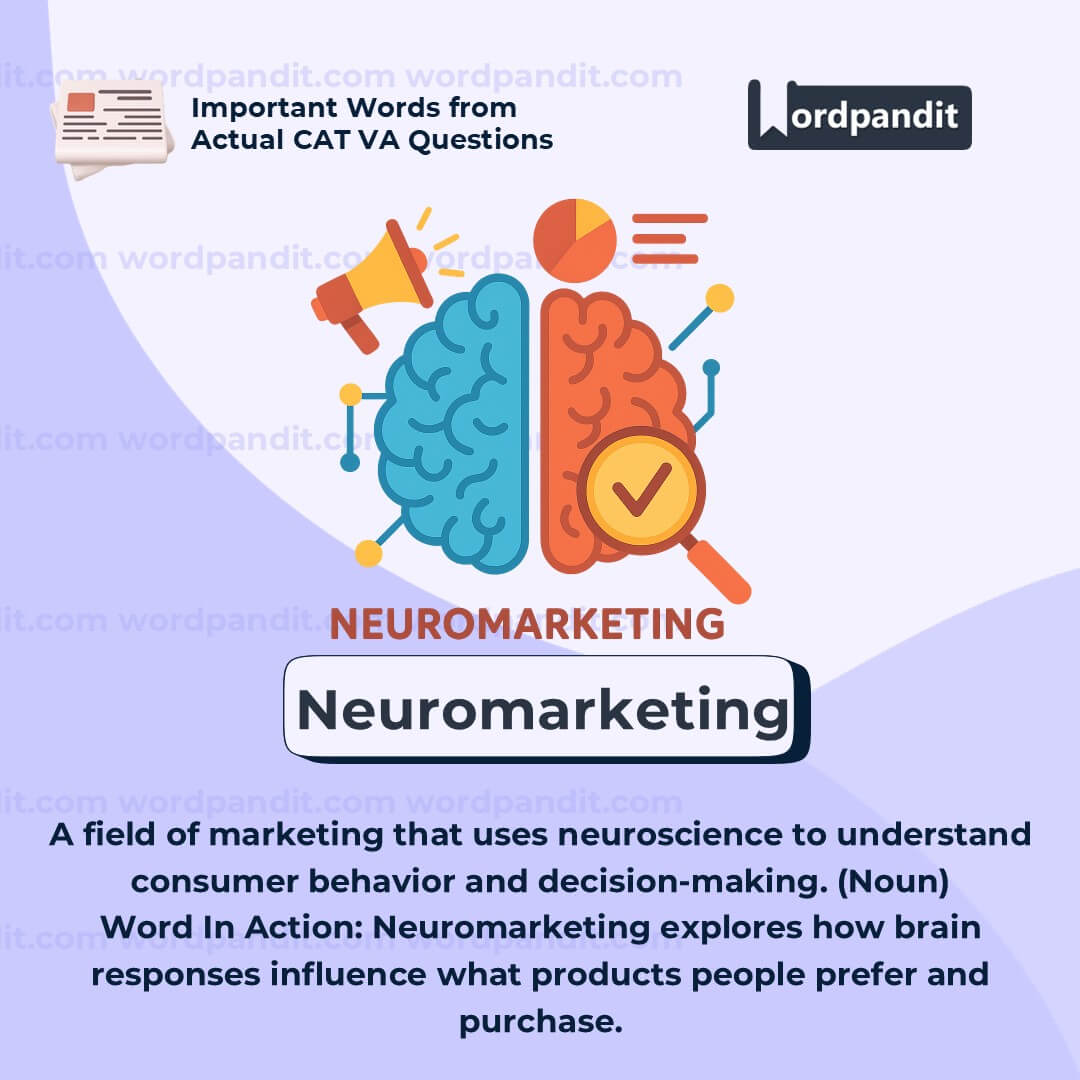
Word-3: Neuromarketing
Context:
"The new, growing field of neuromarketing attempts to reveal the inner workings of consumer behaviour and is an extension of the study of how choices and decisions are made."
Explanatory Paragraph:
“Neuromarketing” is a specialized field that combines neuroscience and marketing to understand how people’s brains respond to advertisements, branding, and product choices. The goal is to uncover subconscious preferences and decision-making processes that traditional surveys or interviews might miss. By using tools like brain imaging, eye tracking, or biometrics, neuromarketing helps companies create more effective marketing strategies based on how consumers actually think and feel.
Meaning: A field of study that applies neuroscience to marketing, examining how brain activity influences consumer behavior. (Noun)
Pronunciation: NYOO-roh-mark-uh-ting
Difficulty Level: ⭐⭐⭐ Intermediate
Etymology: Blend of “neuro-” (related to the brain or nervous system) and “marketing”; first coined in the early 2000s as technology made brain analysis more accessible for commercial use.
Prashant Sir's Notes:
Think of neuromarketing as marketing that tries to “get inside your head”—literally. It's not just about what people say they like, but what their brain activity says they respond to. While exciting and cutting-edge, it also raises ethical questions about manipulation and privacy in advertising.
Synonyms & Antonyms:
Synonyms: brain-based marketing, consumer neuroscience, neuro-advertising
Antonyms: traditional marketing, instinctive marketing, surface-level advertising
Usage Examples:
- Neuromarketing uses brain scans to understand which ads trigger emotional responses.
- Major companies are investing in neuromarketing to gain deeper insights into consumer behavior.
- Neuromarketing studies reveal that color and sound significantly affect buying decisions.
- Critics argue that neuromarketing blurs the line between persuasion and manipulation.
Cultural Reference:
In 2004, researchers from Emory University used fMRI technology in a neuromarketing experiment that showed brand preferences (like Coca-Cola vs. Pepsi) could activate different brain regions. - *Nature Neuroscience*
Think About It:
Should there be ethical limits on how much companies can use neuromarketing to influence consumers? Where do we draw the line?
Quick Activity:
Pick a product you like. Imagine you’re a neuromarketer—what brain-related factors (emotion, memory, attention) would you study to improve the ad?
Memory Tip:
Neuromarketing = “Neuro” (brain) + “Marketing” → Marketing that speaks to the brain before it speaks to the wallet.
Real-World Application:
Neuromarketing is used by major brands to test ad effectiveness, optimize packaging, and even design store layouts to maximize consumer engagement and emotional connection.
Word-4: Behaviour
Context:
"The new, growing field of neuromarketing attempts to reveal the inner workings of consumer behaviour and is an extension of the study of how choices and decisions are made."
Explanatory Paragraph:
“Behaviour” refers to the actions or reactions of a person (or animal) in response to external or internal stimuli. In this sentence, “consumer behaviour” specifically means the patterns and processes by which people decide what to buy, how much to buy, and why they prefer certain products or brands. Understanding behaviour is key to fields like psychology, marketing, and education because it helps predict and influence future actions.
Meaning: The way in which a person acts or conducts themselves, especially toward others or in response to a situation. (Noun)
Pronunciation: bih-HAY-vyur
Difficulty Level: ⭐ Beginner
Etymology: From Old French *behaveir* and Middle English *behaven*, meaning “to conduct oneself.” Related to “have” in the sense of “to hold oneself.”
Prashant Sir's Notes:
“Behaviour” is a foundational word in psychology and marketing. It isn’t just about what people do—it’s about why they do it. The British spelling is “behaviour,” while the American version drops the “u” and spells it “behavior.” In neuromarketing, it’s not enough to observe behaviour—you try to decode the brain mechanisms behind it.
Synonyms & Antonyms:
Synonyms: conduct, actions, performance, manners, response
Antonyms: misbehaviour, misconduct, disorder, inaction (contextual)
Usage Examples:
- The teacher praised the student for his respectful behaviour in class.
- Consumer behaviour is influenced by advertising, social norms, and personal preferences.
- The experiment tracked the behavioural responses of mice to various stimuli.
- She noticed a sudden change in her friend’s behaviour after the incident.
Cultural Reference:
In B.F. Skinner’s theory of behaviorism, human and animal behaviour is shaped by reinforcement and punishment, not internal thoughts or feelings. - *Psychological Review, 1938*
Think About It:
To what extent do you think your behaviour is shaped by conscious choices versus unconscious influences like emotion or advertising?
Quick Activity:
List three recent decisions you made (e.g., a purchase, a social interaction). Reflect briefly on what influenced your behaviour in each case.
Memory Tip:
“Be” + “have” = how you *have yourself* or *hold yourself* in situations — that's your behaviour!
Real-World Application:
Understanding human behaviour is crucial in fields like marketing, management, education, public policy, and mental health. It helps shape effective strategies and improve outcomes in both personal and professional settings.
Word-5: Extension

Context:
"The new, growing field of neuromarketing attempts to reveal the inner workings of consumer behaviour and is an extension of the study of how choices and decisions are made."
Explanatory Paragraph:
In this sentence, “extension” refers to something that builds on or continues an existing body of work. Neuromarketing is described as an *extension* of existing research into how people make decisions—it takes that foundation and adds a new layer by incorporating neuroscience. More broadly, the word implies expansion, continuation, or development of an idea, object, or area.
Meaning: A part that is added to something to enlarge or prolong it; a continuation or expansion. (Noun)
Pronunciation: ek-STEN-shuhn
Difficulty Level: ⭐⭐ Beginner
Etymology: From Latin *extendere* — *ex-* (out) + *tendere* (to stretch), meaning “to stretch out.”
Prashant Sir's Notes:
“Extension” is a versatile word used across many domains—academia, architecture, technology, and more. In learning or research contexts, it refers to how one idea leads to another. When something is called an “extension,” it means it’s not entirely new, but rather built on a previous structure or theory.
Synonyms & Antonyms:
Synonyms: expansion, continuation, development, addition, augmentation
Antonyms: reduction, termination, conclusion, limit, end
Usage Examples:
- The course is an extension of the basic economics program.
- They built an extension to the house to add another bedroom.
- Neuromarketing is an exciting extension of consumer psychology.
- The company plans to launch an extension of its popular app next year.
Cultural Reference:
The “University Extension” movement in the 19th century allowed working adults in Britain to access university-level courses, extending education beyond elite circles. - Oxford Continuing Education Archives
Think About It:
How do extensions—whether of technology, research, or ideas—help society grow? Are there risks in extending ideas too far?
Quick Activity:
Think of something you're currently studying or passionate about. Write one sentence describing how you could create an "extension" of it in another field or area.
Memory Tip:
Think of an “extension cord”—it lets you stretch your power further. Similarly, an extension in thought or practice stretches the original idea into new areas.
Real-World Application:
Extensions are common in education (course extensions), tech (browser extensions), and science (research extensions). They allow continued innovation while building on established knowledge.