
✨ Introduction
Mastering Reading Comprehension begins with mastering the words!
In this post, we dive deep into vocabulary taken directly from an actual CAT RC passage. Each word has been explained in a simple, easy-to-understand way, along with examples to help you grasp its usage in real contexts.
From words like "species" and "cognitive" to "subjection" and "paradise," strengthen your vocabulary one word at a time — and take your RC performance to the next level!
📚 What’s Inside This Vocabulary Post?
- 🔍 Words Sourced from an Actual CAT RC Passage: Directly pick up important vocabulary from real CAT exam material.
- 🧠 Meaningful Explanations: Understand the exact meaning and usage of each word in a simple, student-friendly way.
- ✍️ Context-Based Learning: Learn words with examples that reflect their actual usage in reading comprehension contexts.
- 🗂️ Quick Reference Format: Words are neatly listed with meanings, parts of speech, and example sentences for easy revision.
- 🚀 Boost Your RC and Verbal Ability Skills: Improve your understanding of tough passages by strengthening your vocabulary.
📝 Words Covered in This Article:
- species
- hard-wired
- cognitive
- exception
- scrawled
- papyrus
- emperor
- subjection
- era
- paradise
- mentality
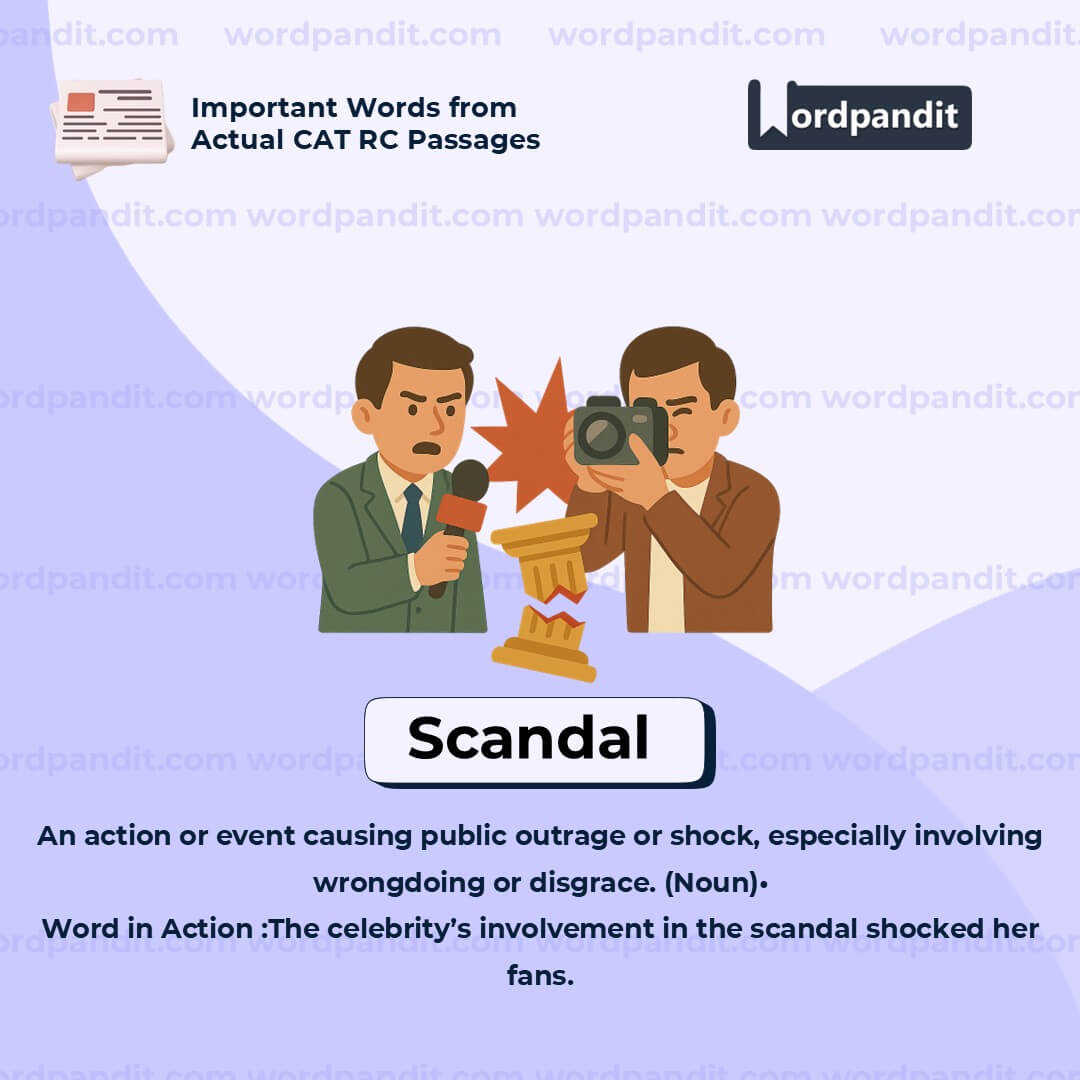
WORD-1: Scandal
Context:
"The financial scandal rocked the corporation, leading to resignations and public outrage." - The Wall Street Journal
Explanatory Paragraph:
A scandal is an event or action that causes public outrage or shock, often because it involves immoral, dishonest, or illegal behavior — especially by people in power. Scandals attract media attention, damage reputations, and can lead to serious consequences in politics, business, or entertainment. The term emphasizes both the wrongdoing and its ripple effect in society.
Meaning: A widely publicized incident involving disgraceful or improper conduct (Noun)
Pronunciation: SKAN-dl
Difficulty Level: ⭐⭐ Beginner-Intermediate
Etymology: From Latin *scandalum* (stumbling block), from Greek *skandalon*, originally meaning a trap or snare — later evolving to mean moral offense or disgrace
Prashant Sir's Notes:
Scandal = shock + shame. It's a perfect word for describing public downfall. Use it in social, political, or historical contexts to show how private actions can lead to public consequences.
Synonyms & Antonyms:
Synonyms: controversy, disgrace, uproar, outrage, corruption
Antonyms: honor, integrity, admiration, respectability, transparency
Usage Examples:
- The scandal led to the CEO's resignation and a full internal investigation.
- The celebrity’s involvement in the scandal made headlines across the globe.
- Despite the scandal, the politician was re-elected with a narrow margin.
- The documentary revealed a long-hidden scandal in the fashion industry.
Cultural Reference:
Scandals like the Watergate affair in the 1970s have become defining historical moments, exposing corruption and altering the public’s trust in leadership. - Political History
Think About It:
Why do some people recover from scandal while others are permanently disgraced? Does the public forgive, or simply forget?
Quick Activity:
Think of a recent public scandal. Write one sentence summarizing what happened, and one reflecting on its impact. Avoid naming individuals — focus on the idea.
Memory Tip:
Scandal = *scan* + *dull* → Scan the news and there’s rarely a dull moment when scandal is involved. Always drama, always public!
Real-World Application:
Scandal is a powerful concept in journalism, law, public relations, and ethics. Learning how to describe it and analyze its consequences is crucial for critical thinking and civic awareness.
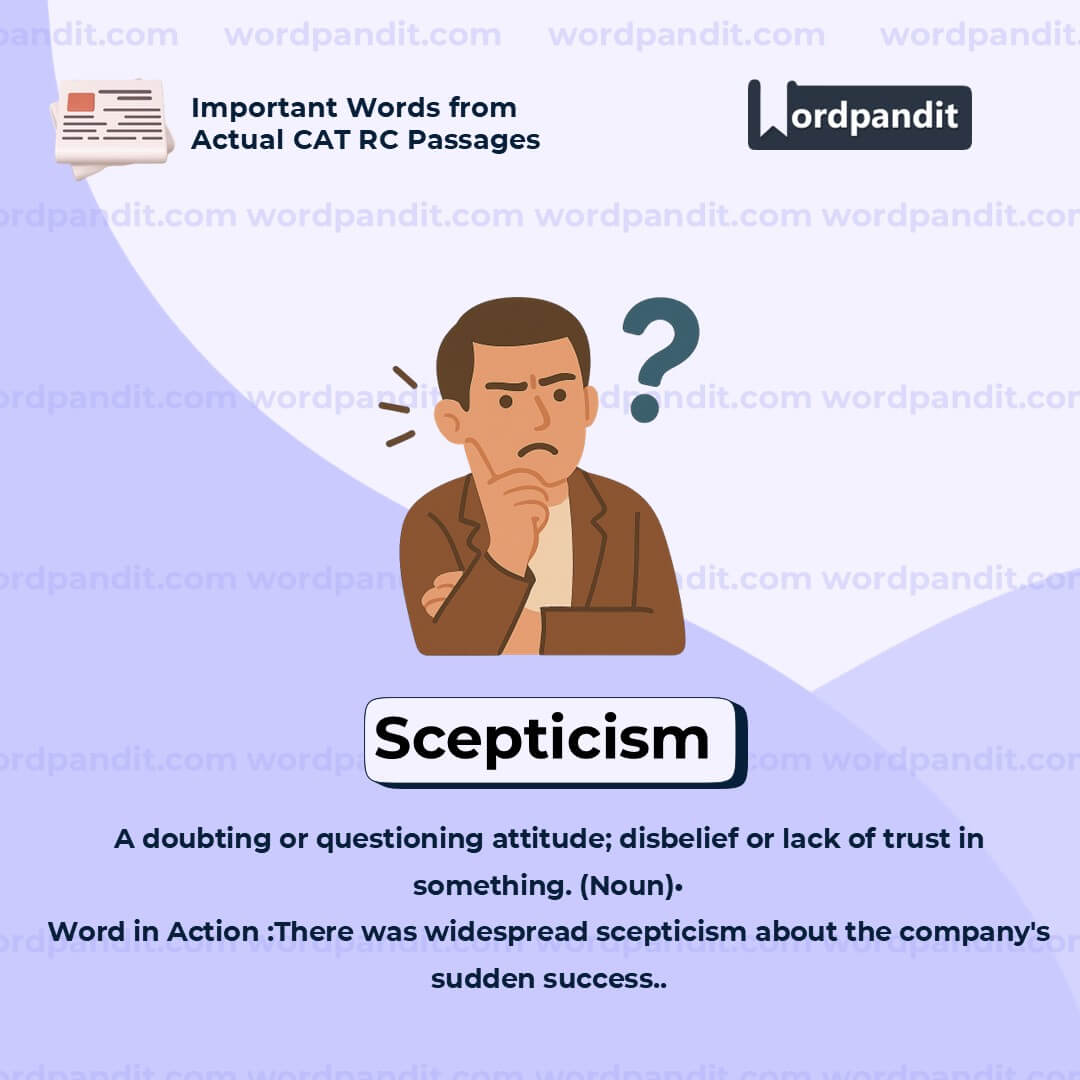
WORD-2: Scepticism
Context:
"Her claims about the miracle cure were met with scepticism from scientists and journalists alike." - The Guardian
Explanatory Paragraph:
Scepticism refers to a doubting or questioning attitude toward facts, opinions, or claims — especially those lacking evidence. It can be healthy and critical, encouraging deeper thinking, or negative and dismissive, leading to cynicism. In philosophy, scepticism is a tradition that questions whether true knowledge is even possible. In everyday life, it’s a mental habit that helps people avoid being misled or manipulated.
Meaning: A doubting or questioning attitude; lack of belief without clear proof (Noun)
Pronunciation: SKEP-ti-sizm
Difficulty Level: ⭐⭐⭐ Intermediate
Etymology: From Greek *skepsis* (inquiry, doubt), passed through Latin and Old French into English
Prashant Sir's Notes:
Scepticism is not negativity — it’s thoughtful questioning. Teach students that scepticism means asking “Why should I believe this?” — not “I refuse to believe anything.” It’s essential for both critical thinking and scientific reasoning.
Synonyms & Antonyms:
Synonyms: doubt, distrust, suspicion, questioning, disbelief
Antonyms: belief, trust, faith, certainty, conviction
Usage Examples:
- Public scepticism about the new technology slowed its widespread adoption.
- Her scepticism led her to ask critical questions during the debate.
- Scepticism is a core part of the scientific method — doubt leads to discovery.
- He was met with scepticism when he claimed to have invented a perpetual motion machine.
Cultural Reference:
Philosophers like David Hume and Pyrrho of Elis are known for their sceptical approaches, which questioned the reliability of sense perception and the certainty of knowledge. - History of Philosophy
Think About It:
Where is the line between healthy scepticism and close-minded denial? How do you stay open yet critical?
Quick Activity:
Write two sentences using “scepticism” — one showing it as wise caution, and one where it becomes an obstacle to growth or belief.
Memory Tip:
Scepticism = “skeptic” + “-ism” → Think of someone holding a magnifying glass, not taking anything at face value — that’s scepticism in action.
Real-World Application:
Scepticism is crucial in journalism, science, education, and civic life. It encourages fact-checking, guards against manipulation, and helps us make informed decisions — but must be balanced with openness and evidence-based trust.
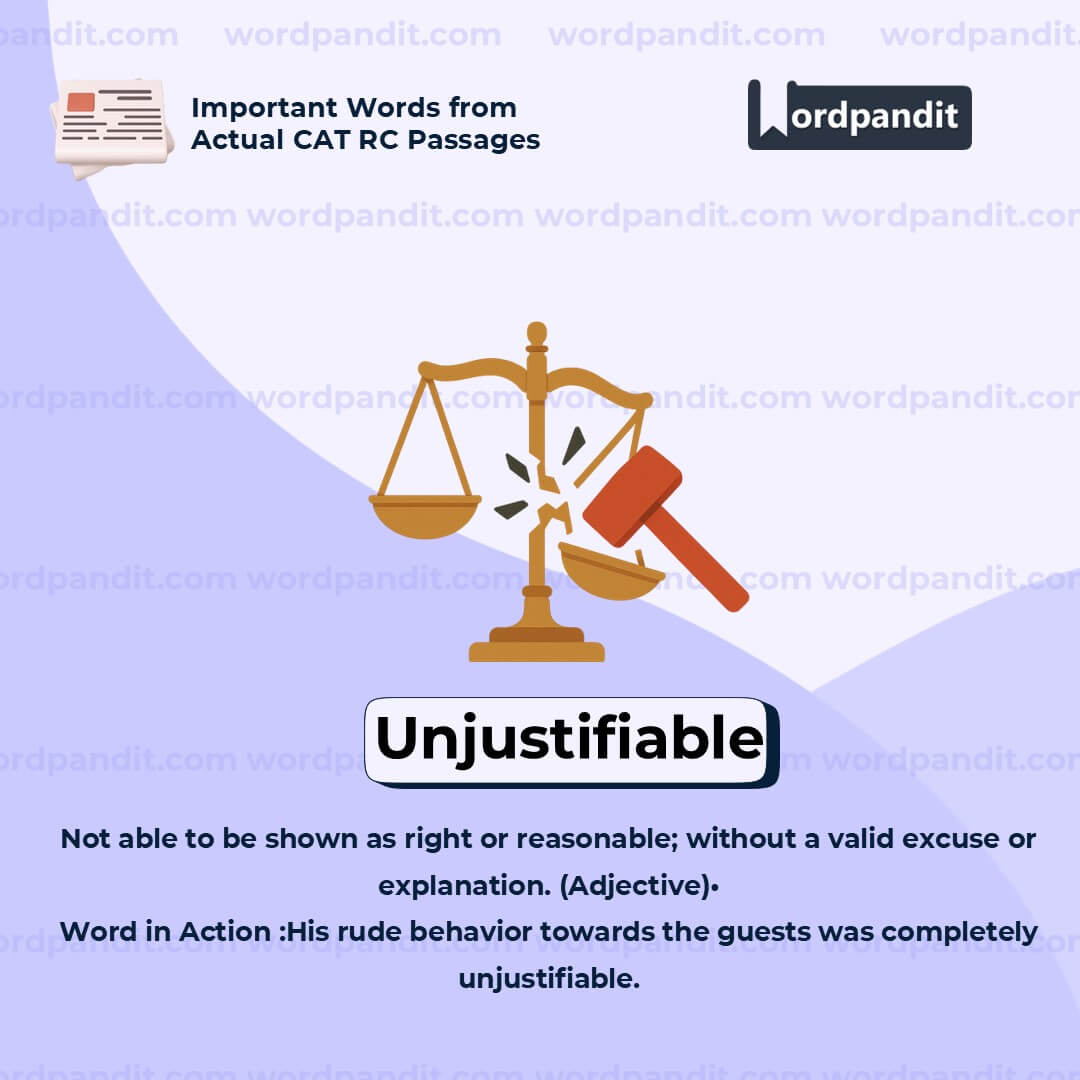
WORD-3: Unjustifiable
Context:
"The company faced heavy criticism for its unjustifiable price hikes during the crisis." - The Financial Times
Explanatory Paragraph:
Unjustifiable refers to something that cannot be defended, excused, or supported by reason, ethics, or logic. It is often used to criticize decisions, behaviors, or actions that are considered excessive, unfair, or morally wrong. The word strongly implies a lack of acceptable justification or rational explanation — whether in law, ethics, economics, or everyday judgment.
Meaning: Impossible to justify or defend as right or reasonable (Adjective)
Pronunciation: un-JUSS-tih-fy-uh-buhl
Difficulty Level: ⭐⭐⭐ Intermediate
Etymology: From Latin *in-* (not) + *justificare* (to justify), meaning “not capable of being justified”
Prashant Sir's Notes:
This is a powerful evaluative word. It’s excellent for essays, debates, and critiques. Use it when condemning decisions that go beyond ethical, legal, or logical boundaries.
Synonyms & Antonyms:
Synonyms: indefensible, inexcusable, unreasonable, unwarranted, unfair
Antonyms: justifiable, defensible, reasonable, warranted, excusable
Usage Examples:
- His outburst was completely unjustifiable given the calm tone of the discussion.
- Critics called the military intervention unjustifiable and reckless.
- Many considered the delays unjustifiable in light of the available resources.
- The use of that level of force was ruled unjustifiable by the inquiry board.
Cultural Reference:
Terms like “unjustifiable war” or “unjustifiable detention” are central in global debates about human rights, justice, and international law — especially in tribunals and investigative journalism. - Political Discourse
Think About It:
Can something that feels unjustifiable at one point in history be viewed differently in another? Who decides what's “justifiable” or not?
Quick Activity:
Write a sentence using “unjustifiable” to critique a real-world policy, decision, or behavior. Be sure your reasoning supports the judgment.
Memory Tip:
Unjustifiable = *un* (not) + *justifiable* → Not able to be justified. Imagine a courtroom where no lawyer can defend what happened — that’s unjustifiable.
Real-World Application:
This word is crucial in law, ethics, media, and education. It helps express strong moral or logical objections — especially when something crosses a line that society can’t excuse or defend.
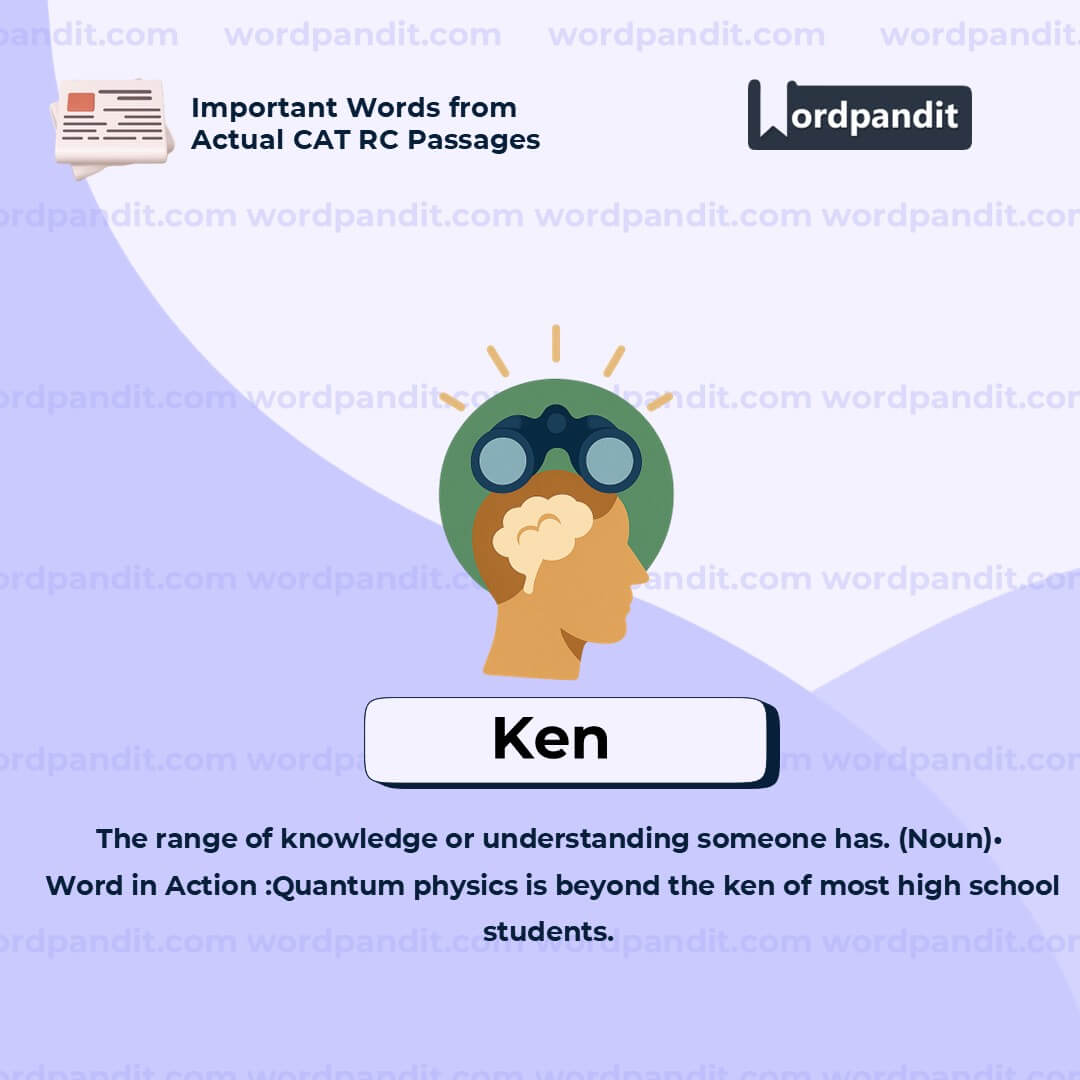
WORD-4: Ken
Context:
"The workings of the universe often lie beyond the ken of human understanding." - Scientific American
Explanatory Paragraph:
Ken refers to one’s range of knowledge, perception, or understanding. It is often used in a poetic or philosophical sense to describe what someone is mentally capable of grasping. When something is “beyond your ken,” it means it’s outside the limits of your awareness, learning, or comprehension. Though less common in modern casual speech, it remains a powerful and evocative word in formal or literary contexts.
Meaning: The range of what someone knows, understands, or is aware of (Noun)
Pronunciation: ken
Difficulty Level: ⭐⭐⭐ Intermediate
Etymology: From Middle English *kenne*, meaning “to know,” rooted in Old English *cennan* and related to Old Norse *kenna*
Prashant Sir's Notes:
This is a lovely, subtle word. “Ken” elevates your writing — especially when used in phrases like “beyond my ken.” Think of it as the invisible fence that surrounds your current knowledge or awareness.
Synonyms & Antonyms:
Synonyms: understanding, awareness, comprehension, grasp, knowledge
Antonyms: ignorance, misunderstanding, confusion, blindness, incomprehension
Usage Examples:
- The mysteries of quantum physics remain beyond the ken of most people.
- She’s well-versed in poetry, but economics is outside her ken.
- Ancient myths attempt to explain things once far beyond human ken.
- His emotional depth was hidden — far beyond the ken of casual friends.
Cultural Reference:
The phrase “beyond the ken of mortals” is common in fantasy and mythological literature, used to evoke awe or mystery — as in Tolkien’s or Lovecraft’s works. - Literary Tradition
Think About It:
What kinds of things lie beyond your ken now — and what would it take to bring them into your understanding?
Quick Activity:
Write a sentence using “ken” to describe a personal boundary — either intellectual, emotional, or spiritual. What lies just outside it?
Memory Tip:
Ken = *know* — they even sound alike. Think: your “ken” is your *mental kingdom* — everything you understand lives inside its borders.
Real-World Application:
“Ken” is ideal for formal essays, reflective writing, and literary analysis. It captures a nuanced way to express the *limits* of knowledge without sounding dismissive or harsh.
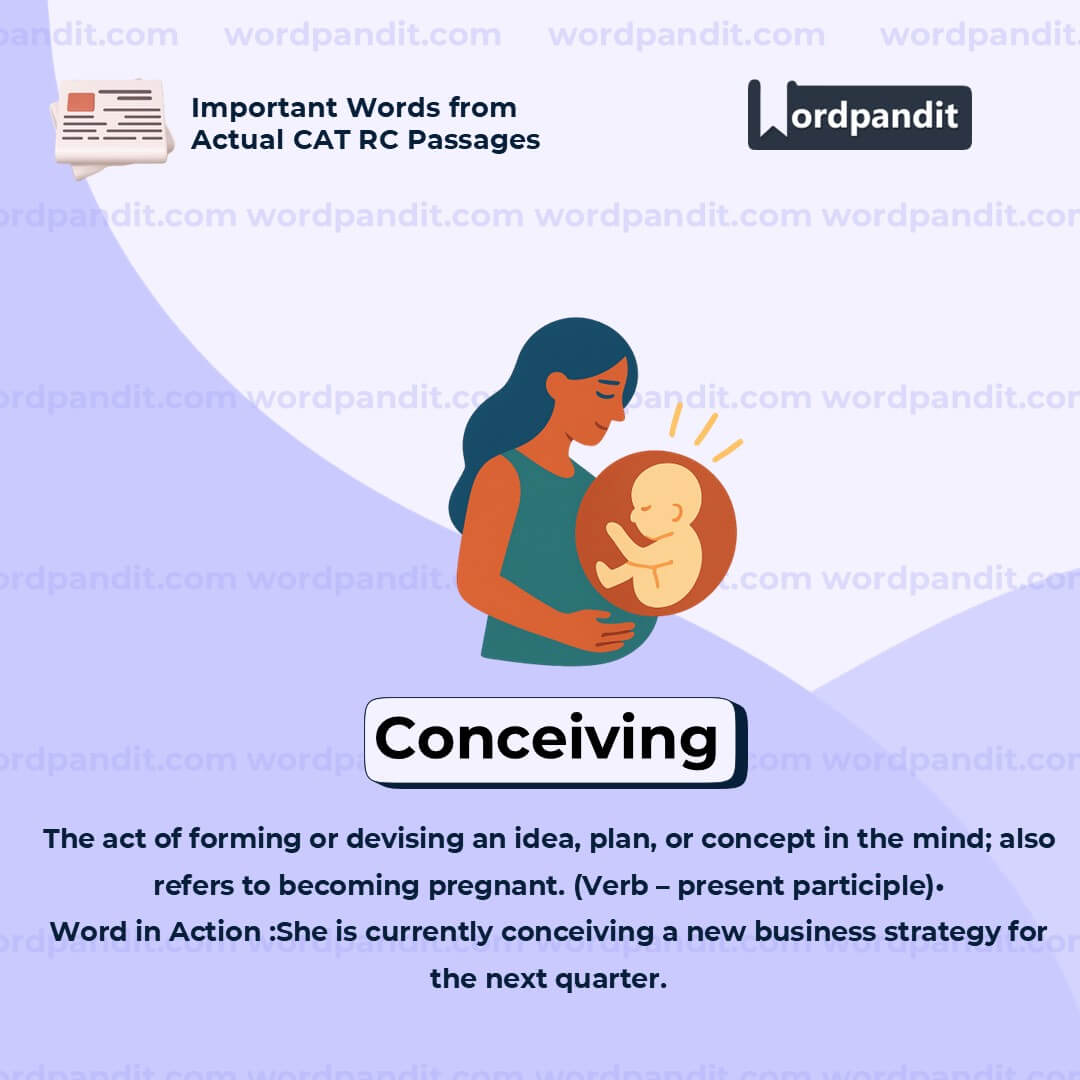
WORD-5: Conceiving
Context:
"Einstein’s genius lay not only in his equations, but in conceiving reality in ways no one had imagined before." – The New York Times
Explanatory Paragraph:
Conceiving means forming or developing an idea, plan, or image in the mind. It refers to the mental act of imagining, understanding, or initiating something — whether it's a creative project, a scientific theory, or even a new life. The word carries a sense of beginning, origin, and mental creation. It is widely used in intellectual, emotional, artistic, and biological contexts.
Meaning: Forming or developing something in the mind; imagining or originating (Verb - present participle)
Pronunciation: kun-SEE-ving
Difficulty Level: ⭐⭐⭐ Intermediate
Etymology: From Latin *concipere* (to take in, conceive), from *com-* (together) + *capere* (to take)
Prashant Sir's Notes:
“Conceiving” is a beautiful, flexible word. You can conceive a plan, a novel, a child, or even a new way of thinking. Use it when you want to show the *origin point* of a powerful idea or creation.
Synonyms & Antonyms:
Synonyms: imagining, creating, envisioning, formulating, originating
Antonyms: misunderstanding, ignoring, dismissing, forgetting, rejecting
Usage Examples:
- She had difficulty conceiving a way out of the complex situation.
- Conceiving a child had been a long-held dream for the couple.
- The architect is known for conceiving spaces that feel both modern and timeless.
- He struggled with conceiving how technology might evolve over the next century.
Cultural Reference:
In classical philosophy, Plato emphasized the mind’s power in conceiving ideal forms — perfect concepts that physical objects merely imitate. This use of "conceiving" shaped centuries of Western thought. - Philosophical Tradition
Think About It:
How often do we limit our lives by only conceiving of what is “realistic”? What might happen if we let our imaginations go further?
Quick Activity:
Write a sentence beginning with: “I am currently conceiving an idea that…” and let your imagination complete it. Is it practical or visionary?
Memory Tip:
Conceiving = “con” (together) + “ceive” (take) → To mentally *take in* and develop an idea. Imagine catching an idea in your mind like a spark.
Real-World Application:
“Conceiving” is essential in creative writing, planning, innovation, and psychology. It's the starting point of any transformation — the moment an idea takes shape and becomes actionable.
WORD-6: Credible
Context:
"Only sources with credible evidence were considered in the final report." – BBC News
Explanatory Paragraph:
Credible means believable, trustworthy, or convincing. It refers to information, people, or sources that are regarded as reliable and backed by evidence or logic. In journalism, academia, science, and public debate, credibility is crucial for building trust and making informed decisions. The word often distinguishes between truth and misinformation or between expertise and opinion.
Meaning: Able to be believed; trustworthy and convincing (Adjective)
Pronunciation: KREH-duh-buhl
Difficulty Level: ⭐⭐ Beginner-Intermediate
Etymology: From Latin *credibilis*, from *credere* meaning “to believe”
Prashant Sir's Notes:
Credible is your go-to word when judging reliability. Use it in essays, discussions, and debates to support what should (or should not) be trusted. It’s more formal and stronger than just saying “believable.”
Synonyms & Antonyms:
Synonyms: trustworthy, believable, reliable, convincing, plausible
Antonyms: doubtful, unreliable, unbelievable, untrustworthy, bogus
Usage Examples:
- The journalist only cited credible sources in her investigation.
- He gave a credible explanation for his absence from the meeting.
- The witness was not seen as credible due to past inconsistencies.
- Building a credible brand requires consistency and transparency.
Cultural Reference:
In the digital age, the rise of “fake news” has made the concept of credible journalism more critical than ever — prompting platforms like Google and Meta to develop credibility-based ranking systems. - Media Literacy Movement
Think About It:
What makes someone or something credible to you? Is it about the facts, the speaker, or your own bias?
Quick Activity:
Think of two sources you regularly rely on (news, people, websites). Write a sentence for each explaining why you find them credible — or not.
Memory Tip:
Credible = *credit-able* → Something (or someone) you can “give credit to” — because they’ve earned your belief.
Real-World Application:
Understanding and using “credible” is essential in critical thinking, research, journalism, and decision-making. It helps filter truth from noise in a world flooded with information.
WORD-7: Endorsed
Context:
"The initiative was publicly endorsed by several leading scientists and human rights organizations." – The New York Times
Explanatory Paragraph:
Endorsed means officially approved, supported, or recommended. When someone endorses an idea, product, or candidate, they publicly express agreement or encouragement. Endorsements carry weight — especially when made by experts, celebrities, or institutions — and are often used to build trust, credibility, or momentum. The word appears frequently in politics, marketing, business, and advocacy.
Meaning: Publicly supported or approved (Verb – past participle)
Pronunciation: en-DORST
Difficulty Level: ⭐⭐ Beginner-Intermediate
Etymology: From Latin *indorsare* (to write on the back), later evolving into the modern idea of “signing off” on something
Prashant Sir's Notes:
This is a powerful word for support that carries authority. Whether you’re writing about campaigns, ideas, or brands, “endorsed” shows a public declaration of approval — often with persuasive effect.
Synonyms & Antonyms:
Synonyms: supported, approved, recommended, backed, advocated
Antonyms: opposed, rejected, disapproved, condemned, criticized
Usage Examples:
- The new policy was endorsed by healthcare experts across the country.
- She endorsed the candidate who promised education reform and environmental action.
- The product was endorsed by a well-known fitness coach, boosting its sales.
- The committee unanimously endorsed the revised proposal after lengthy discussions.
Cultural Reference:
Endorsements are a central strategy in political campaigns, where figures like Barack Obama or Oprah Winfrey endorsing a candidate can significantly influence public opinion. - Political Media Culture
Think About It:
What makes an endorsement powerful — the person giving it, the platform it’s shared on, or the audience’s trust?
Quick Activity:
Think of a product or cause you support. Write a one-sentence endorsement of it. Then reflect: What gives your endorsement value?
Memory Tip:
Endorsed = “signed off” on something → Imagine a signature stamp of approval. It means: “I stand behind this.”
Real-World Application:
Understanding “endorsed” is key in media literacy, consumer culture, and persuasive writing. It shows how authority, credibility, and visibility influence decisions in politics, marketing, and public trust.
WORD-8: Unperturbed
Context:
"She remained unperturbed by the criticism, calmly continuing her work with quiet confidence." – The New Yorker
Explanatory Paragraph:
Unperturbed describes a state of calmness or composure, especially in situations that might normally cause anxiety, anger, or confusion. It refers to someone who is unaffected or undisturbed emotionally or mentally. This word is often used to admire someone's emotional resilience or poise under pressure. It is a refined, slightly formal alternative to “unbothered” or “unshaken.”
Meaning: Not disturbed, worried, or upset; remaining calm and composed (Adjective)
Pronunciation: un-per-TURBD
Difficulty Level: ⭐⭐⭐ Intermediate
Etymology: From Latin *perturbare* (“to disturb”) with the prefix *un-* indicating the opposite — “not disturbed”
Prashant Sir's Notes:
This is a great word to describe *grace under fire*. It reflects calm confidence — especially useful in writing about leaders, characters, or people handling conflict with poise.
Synonyms & Antonyms:
Synonyms: calm, composed, unshaken, unfazed, tranquil
Antonyms: disturbed, agitated, perturbed, flustered, anxious
Usage Examples:
- Despite the chaos around him, he remained completely unperturbed.
- She seemed unperturbed by the delay and waited patiently.
- The CEO was unperturbed by the media storm and addressed it with dignity.
- The cat sat unperturbed on the windowsill, ignoring the barking dog below.
Cultural Reference:
In Zen Buddhism, the ideal of remaining unperturbed is central — a mark of wisdom and detachment from worldly chaos. This theme appears in the writings of Laozi, Buddha, and Stoic philosophers alike. – Spiritual Philosophy
Think About It:
Is being unperturbed always a strength? Can it also hide emotional avoidance or disconnection?
Quick Activity:
Write a sentence describing someone in a high-pressure situation. Use “unperturbed” to highlight their response and emotional tone.
Memory Tip:
Unperturbed = *not perturbed*. Imagine a calm lake with no ripples — nothing is disturbing the surface.
Real-World Application:
“Unperturbed” is a powerful word for essays, character analysis, journalism, and leadership writing. It shows emotional strength and the ability to stay focused under pressure.
WORD-9: Western Rationalism
Context:
"The Enlightenment marked a peak in Western rationalism, placing reason above tradition and emotion as the path to truth." – Stanford Encyclopedia of Philosophy
Explanatory Paragraph:
Western rationalism refers to a philosophical tradition that emphasizes the use of reason and logic as the primary sources of knowledge and truth. Rooted in ancient Greek philosophy and developed through the Enlightenment, this worldview values evidence, critical thinking, and objectivity over faith, emotion, or intuition. It has significantly shaped science, politics, education, and ethics in Western societies — often contrasted with other cultural or spiritual epistemologies.
Meaning: A tradition of thought in Western philosophy that prioritizes reason as the main source of knowledge (Noun phrase)
Pronunciation: WES-turn RASH-uh-nuh-liz-um
Difficulty Level: ⭐⭐⭐⭐ Advanced
Etymology: “Western” refers to Europe and later North America; “rationalism” comes from Latin *ratio* (reason) + *-ism* (a system of belief)
Prashant Sir's Notes:
Use this term in academic essays or debates about philosophy, science, and culture. It pairs well with terms like “Enlightenment thinking,” “empiricism,” and “postmodern critique.” Be aware of its strengths and its historical blind spots.
Synonyms & Antonyms:
Synonyms: logical thinking, reason-based philosophy, Enlightenment thinking, analytic tradition
Antonyms: mysticism, intuitionism, emotional reasoning, faith-based worldview
Usage Examples:
- Western rationalism played a major role in the development of modern science and secular government.
- Critics argue that Western rationalism can ignore cultural wisdom and lived experience.
- Her worldview blends Eastern mysticism with Western rationalism, seeking balance between logic and intuition.
- The philosopher defended Western rationalism as essential for intellectual freedom and ethical clarity.
Cultural Reference:
Western rationalism shaped the Enlightenment and thinkers like Descartes, Kant, and Spinoza. It underpins the foundations of modern science, secularism, and liberal democracy. - Intellectual History
Think About It:
Can rationalism alone solve human problems, or do we also need imagination, empathy, and cultural insight?
Quick Activity:
Write a sentence that contrasts Western rationalism with another way of knowing — such as intuition, spirituality, or emotional intelligence.
Memory Tip:
Western rationalism = “Western” (Europe-based) + “rationalism” (reason first). Think of clear logic, structured thought, and philosophers in powdered wigs debating truth.
Real-World Application:
Understanding Western rationalism is key in fields like philosophy, global studies, literature, science, and ethics. It frames how modern Western society defines knowledge, truth, and progress — but also invites critique and dialogue with other worldviews.
WORD-10: Strenuously
Context:
"The lawyer strenuously objected to the line of questioning, calling it prejudicial and irrelevant." – The Washington Post
Explanatory Paragraph:
Strenuously is an adverb used to describe actions carried out with great energy, intensity, or determination. Whether it’s physical effort, mental exertion, or emotional resistance, “strenuously” adds a sense of force and urgency. It often appears in legal, athletic, and argumentative contexts, signaling a strong or forceful approach.
Meaning: With great effort, intensity, or determination (Adverb)
Pronunciation: STREN-yoo-uhs-lee
Difficulty Level: ⭐⭐⭐ Intermediate
Etymology: From Latin *strenuus* (active, brisk, vigorous) + English adverbial suffix *-ly*
Prashant Sir's Notes:
Use “strenuously” when you want to emphasize that something wasn’t done passively — it was full of force, resistance, or effort. It strengthens writing in debates, legal language, and character description.
Synonyms & Antonyms:
Synonyms: forcefully, intensely, vigorously, firmly, energetically
Antonyms: mildly, weakly, halfheartedly, lazily, passively
Usage Examples:
- She strenuously denied any involvement in the decision.
- The opposition strenuously fought against the new policy.
- He trained strenuously for months to prepare for the triathlon.
- The parents strenuously advocated for safer school policies.
Cultural Reference:
In legal dramas and courtrooms, characters often say, “I strenuously object!” — a phrase popularized in media like *A Few Good Men*, symbolizing passionate defense or resistance. – Legal Rhetoric in Pop Culture
Think About It:
When is it important to speak or act strenuously? Can passion and intensity help — or hurt — your argument?
Quick Activity:
Write a sentence using “strenuously” to describe a strong effort — either physical, intellectual, or emotional.
Memory Tip:
Strenuously = *strain + vigorously* → Think of someone pushing hard uphill — full of strength, no half-measures.
Real-World Application:
“Strenuously” is valuable in persuasive writing, advocacy, law, and storytelling. It adds impact when describing determined opposition, energetic effort, or bold defense of a position.


