
📘 What’s Inside This CAT Para-jumble Question Post?
📝 Authentic CAT Para-jumble Question : Practice with a real CAT Para-jumble Question from a previous CAT exam.
✅ Detailed Question with Step-by-Step Solution: Each question is explained thoroughly for better understanding.
📚 Vocabulary Enhancement: Top 5 words explained from the paragraph
Para-jumble Sentences
Question 18: The four sentences (labelled 1, 2, 3, 4) below, when properly sequenced would yield a coherent paragraph. Decide on the proper sequencing of the order of the sentences and key in the sequence of the four numbers as your answer:
1. It is regimes of truth that make certain relationships speakable - relationships, like subjectivities, are constituted through discursive formations, which sustain regimes of truth.
2. Relationships are nothing without the communication that brings them into being; interpersonal communication is connected to knowledge shared by interlocutors, and scholars should attend to relational histories in their analyses.
3. A Foucauldian approach to relationships goes beyond these conceptions of discourse and history to macrolevel regimes of truth as constituting relationships.
4. Reconsidering micropractices within relationships that are constituted within and simultaneously contributors to regimes of truth acknowledges the central position of power/knowledge in the constitution of what has come to be considered true and real.
Solution with Explanation
Answer: 2314
Solution by Wordpandit:
Upon examining the sentences, it's evident that the focus is on diverse interpretations of relationships. Sentence 2 underscores that communication holds significant weight in this domain and merits thorough examination. Venturing beyond this conventional viewpoint, sentence 3 introduces a Foucauldian perspective that encompasses more than just interpersonal dynamics, extending to macro-level "regimes of truth." Sentence 1 elaborates on the pertinence of these "regimes of truth" in comprehending relationship dynamics. Finally, sentence 4 neatly ties the discussion together, highlighting how the intricate micro-practices embedded within relationships hint at the intertwined relationship between knowledge and power. Consequently, the most coherent arrangement is 2314.
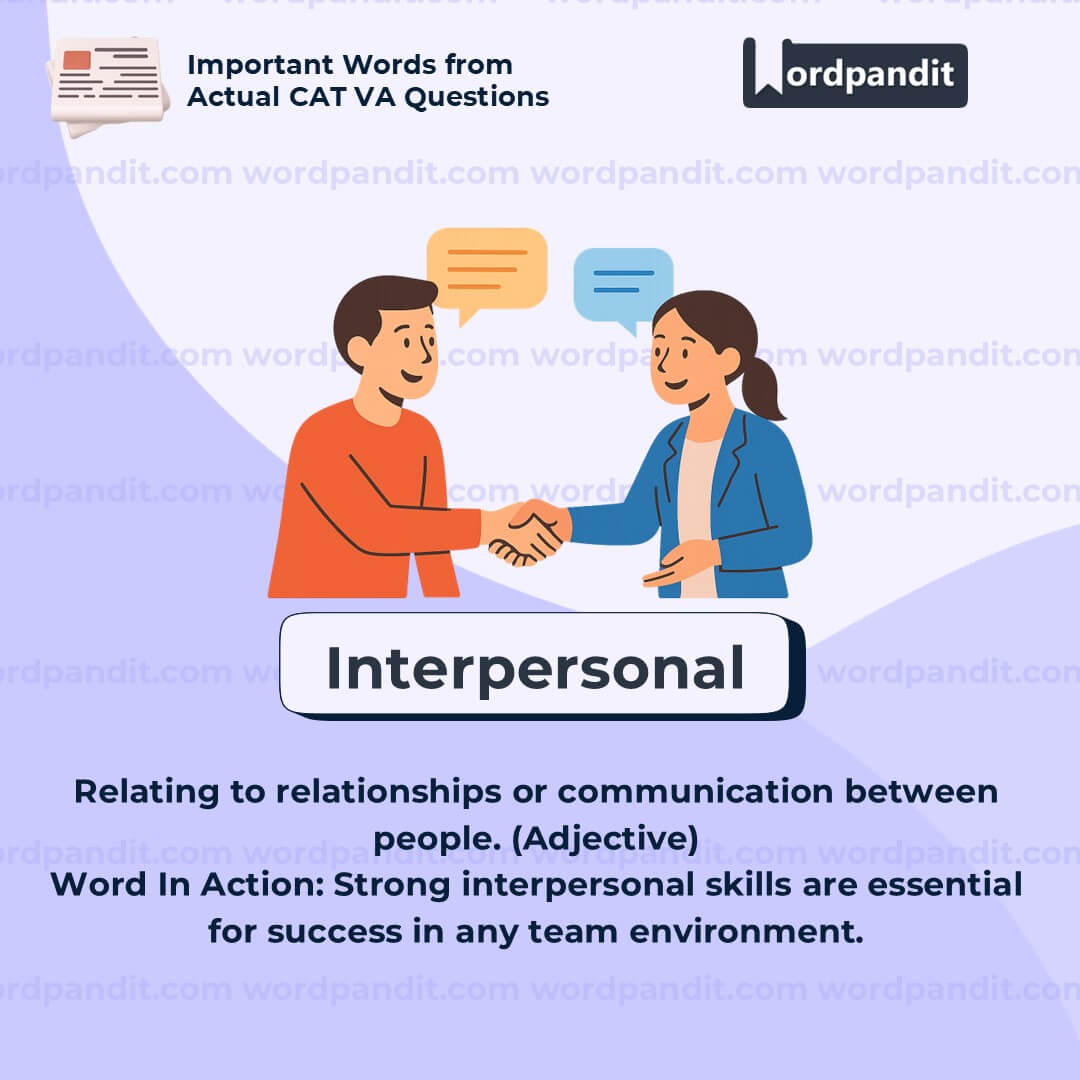
Word-1: Interpersonal
Context:
"Relationships are nothing without the communication that brings them into being; interpersonal communication is connected to knowledge shared by interlocutors, and scholars should attend to relational histories in their analyses." - Academic Journal Article
Explanatory Paragraph:
The term "interpersonal" refers to anything that happens between people, especially in the context of communication, relationships, or social interaction. Whether it's a conversation between friends, a workplace discussion, or emotional exchanges within families, "interpersonal" captures the human element of connection and interaction. In studies of psychology, communication, and sociology, this word is fundamental in analyzing how people relate to one another.
Meaning: Relating to interactions or relationships between people (Adjective)
Pronunciation: in-ter-per-suh-nl
Difficulty Level: ⭐⭐ Beginner
Etymology: From Latin *inter-* ("between") + *personalis* ("personal")
Prashant Sir's Notes:
Understand "interpersonal" as the bridge that links individuals through communication. It's a critical word in behavioral sciences, helping define how we form bonds, resolve conflicts, and share knowledge. It’s the keyword in concepts like "interpersonal skills" or "interpersonal dynamics."
Synonyms & Antonyms:
Synonyms: social, relational, communicative, interactive
Antonyms: intrapersonal, solitary, isolated
Usage Examples:
- Her strong interpersonal skills helped her quickly form connections in her new workplace.
- The training focused on improving employees’ interpersonal communication abilities.
- Interpersonal conflict in teams can often stem from miscommunication rather than real disagreements.
- Therapists often study clients' interpersonal patterns to understand their emotional struggles.
Cultural Reference:
"Interpersonal intelligence" is one of Howard Gardner's multiple intelligences, referring to the ability to understand and interact effectively with others. - Gardner, *Frames of Mind*
Think About It:
In an increasingly digital world, how has the nature of interpersonal communication changed?
Quick Activity:
Write down three scenarios where your interpersonal skills helped you resolve a problem or achieve a goal.
Memory Tip:
Think “inter” = between and “personal” = people — so “interpersonal” means between people!
Real-World Application:
The term is vital in job interviews and workplace evaluations, where “interpersonal skills” are often a key hiring criterion. It’s also frequently mentioned in relationship advice and communication workshops.
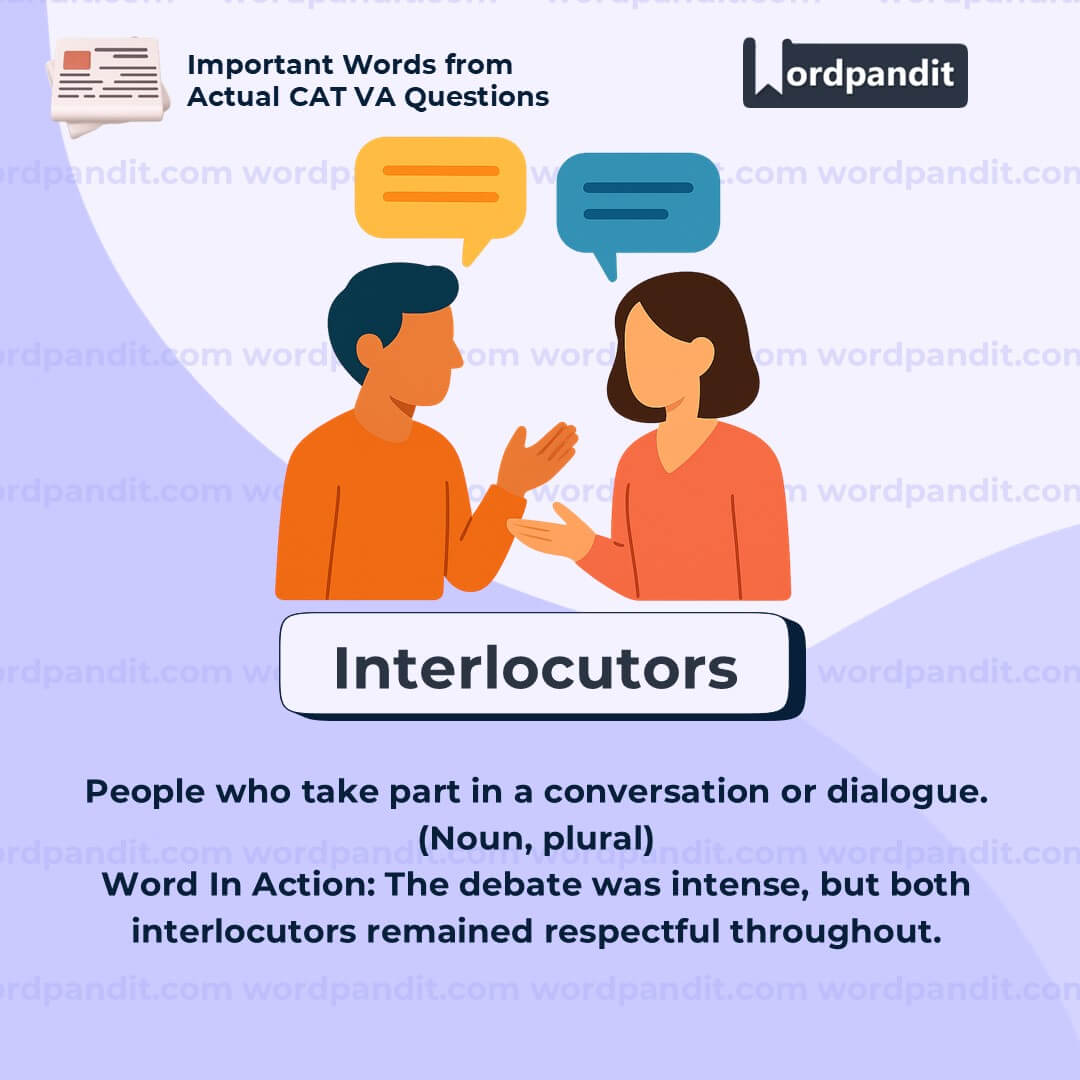
Word-2: Interlocutors
Context:
"Relationships are nothing without the communication that brings them into being; interpersonal communication is connected to knowledge shared by interlocutors, and scholars should attend to relational histories in their analyses." - Academic Journal Article
Explanatory Paragraph:
The word "interlocutors" refers to people engaged in a dialogue or conversation. In any exchange of ideas — whether casual or formal — the speakers or participants are known as interlocutors. This term emphasizes not just the act of speaking, but the role each person plays in shaping and responding during the conversation. It's often used in academic, diplomatic, or intellectual contexts to highlight the exchange of meaning between individuals.
Meaning: A person who takes part in a conversation or dialogue (Noun)
Pronunciation: in-ter-LOK-yuh-ters
Difficulty Level: ⭐⭐⭐ Intermediate
Etymology: From Latin *interloqui* ("to speak between") from *inter-* ("between") + *loqui* ("to speak")
Prashant Sir's Notes:
Think of “interlocutors” as the co-creators of any conversation. The word stresses the mutual aspect of speaking — dialogue rather than monologue. It’s a great vocabulary word for advanced reading and academic writing.
Synonyms & Antonyms:
Synonyms: conversationalist, speaker, discussant, respondent
Antonyms: bystander, listener, observer, mute
Usage Examples:
- The debate required each interlocutor to respect the other's viewpoint.
- In diplomatic negotiations, interlocutors play a key role in bridging cultural gaps.
- She was an attentive interlocutor, always asking thoughtful follow-up questions.
- Interlocutors in philosophical dialogues often push each other toward deeper understanding.
Cultural Reference:
"Socrates acted as the chief interlocutor in Plato’s dialogues, guiding his companions toward philosophical truths." - Western Philosophy Texts
Think About It:
What qualities make someone a good interlocutor, and how can those skills be developed?
Quick Activity:
Choose a partner and engage in a 5-minute conversation on any topic. Then, write down what each interlocutor contributed to the discussion.
Memory Tip:
Break it down: "inter" (between) + "locutor" (speaker) — a person who speaks between others = a participant in conversation!
Real-World Application:
Used widely in academic, journalistic, and diplomatic contexts, especially when analyzing communication patterns or dialogue roles between individuals or nations.
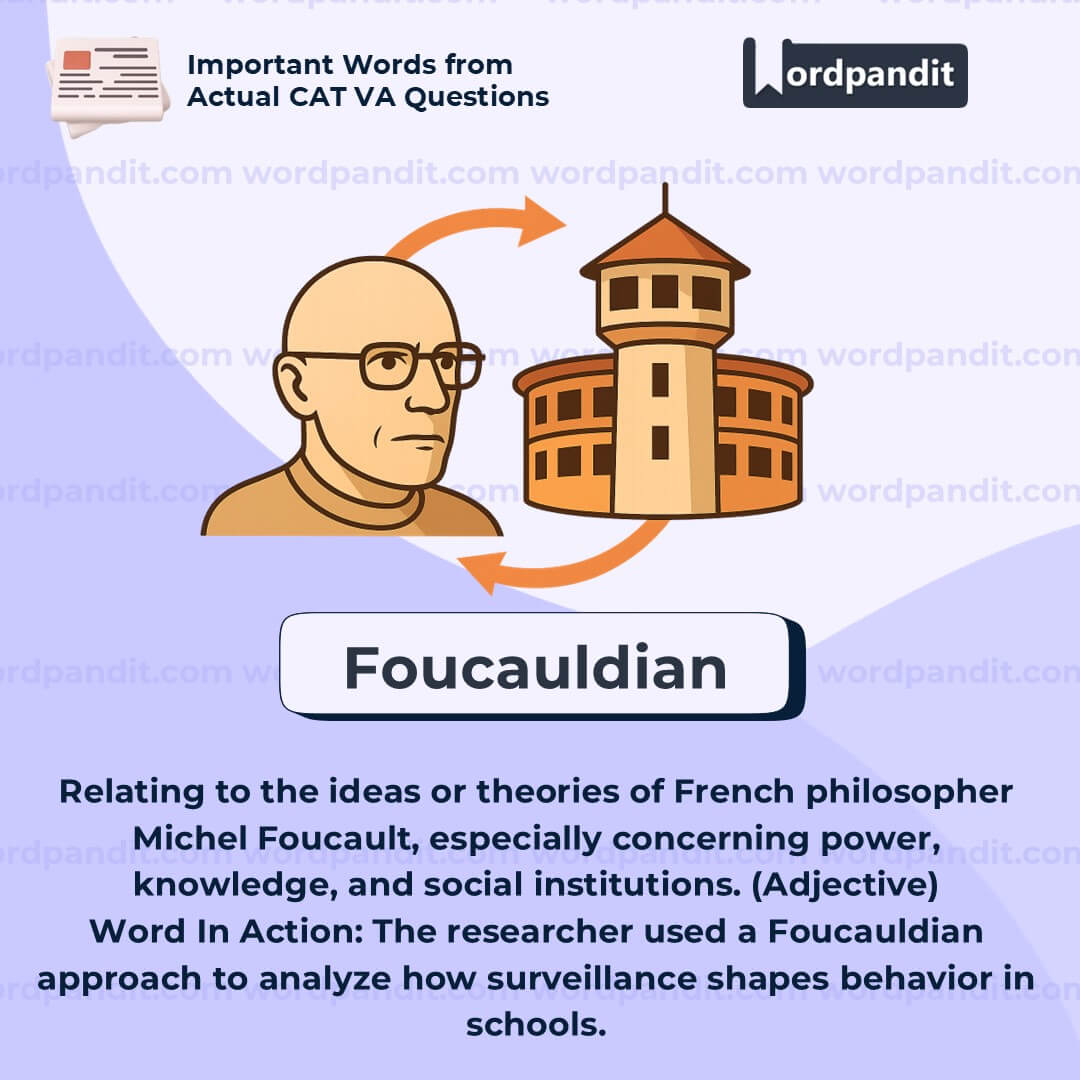
Word-3: Foucauldian
Context:
"A Foucauldian approach to relationships goes beyond these conceptions of discourse and history to macrolevel regimes of truth as constituting relationships." - Academic Journal Article
Explanatory Paragraph:
The word "Foucauldian" is an adjective that refers to the ideas and theories developed by French philosopher Michel Foucault. His work focuses on how power operates through social institutions, discourse, and knowledge. A "Foucauldian approach" typically means analyzing how systems of thought and societal structures shape what we accept as truth, normality, or morality. It often explores hidden forms of control and how power circulates in everyday life.
Meaning: Relating to the theories or philosophy of Michel Foucault, especially regarding power, knowledge, and discourse (Adjective)
Pronunciation: foo-KOHL-dee-uhn
Difficulty Level: ⭐⭐⭐⭐ Advanced
Etymology: Derived from the name Michel Foucault (1926–1984), with the suffix "-ian" or "-ianian" to denote relation
Prashant Sir's Notes:
“Foucauldian” signals a shift from surface-level explanations to deeper power structures at play. In literature, sociology, and critical theory, invoking Foucault means interrogating the frameworks that produce "truth" and "norms." It's a powerful lens for deconstructive thinking.
Synonyms & Antonyms:
Synonyms: post-structuralist, critical-theoretical, discourse-analytic
Antonyms: traditionalist, realist, positivist
Usage Examples:
- The research adopted a Foucauldian lens to examine institutional control in education systems.
- Her thesis was grounded in Foucauldian theories of surveillance and social discipline.
- A Foucauldian analysis challenges the neutrality of historical narratives.
- Foucauldian discourse analysis reveals how language shapes societal power dynamics.
Cultural Reference:
"Power is everywhere... because it comes from everywhere." — Michel Foucault. This idea encapsulates the Foucauldian view that power is not just top-down but diffused throughout society. - *The History of Sexuality*
Think About It:
How would viewing social media algorithms through a Foucauldian lens change our understanding of power and control?
Quick Activity:
Pick a social institution (e.g., school, hospital, prison) and write one sentence describing how a Foucauldian might critique its power dynamics.
Memory Tip:
Think: Foucault = Focus on hidden Forces of control. “Foucauldian” = Adjective form of this analytical lens.
Real-World Application:
Foucauldian theories are used in media studies, gender theory, criminology, and education to examine how power and knowledge intersect. It's commonly applied in critical discourse analysis and social justice critiques.
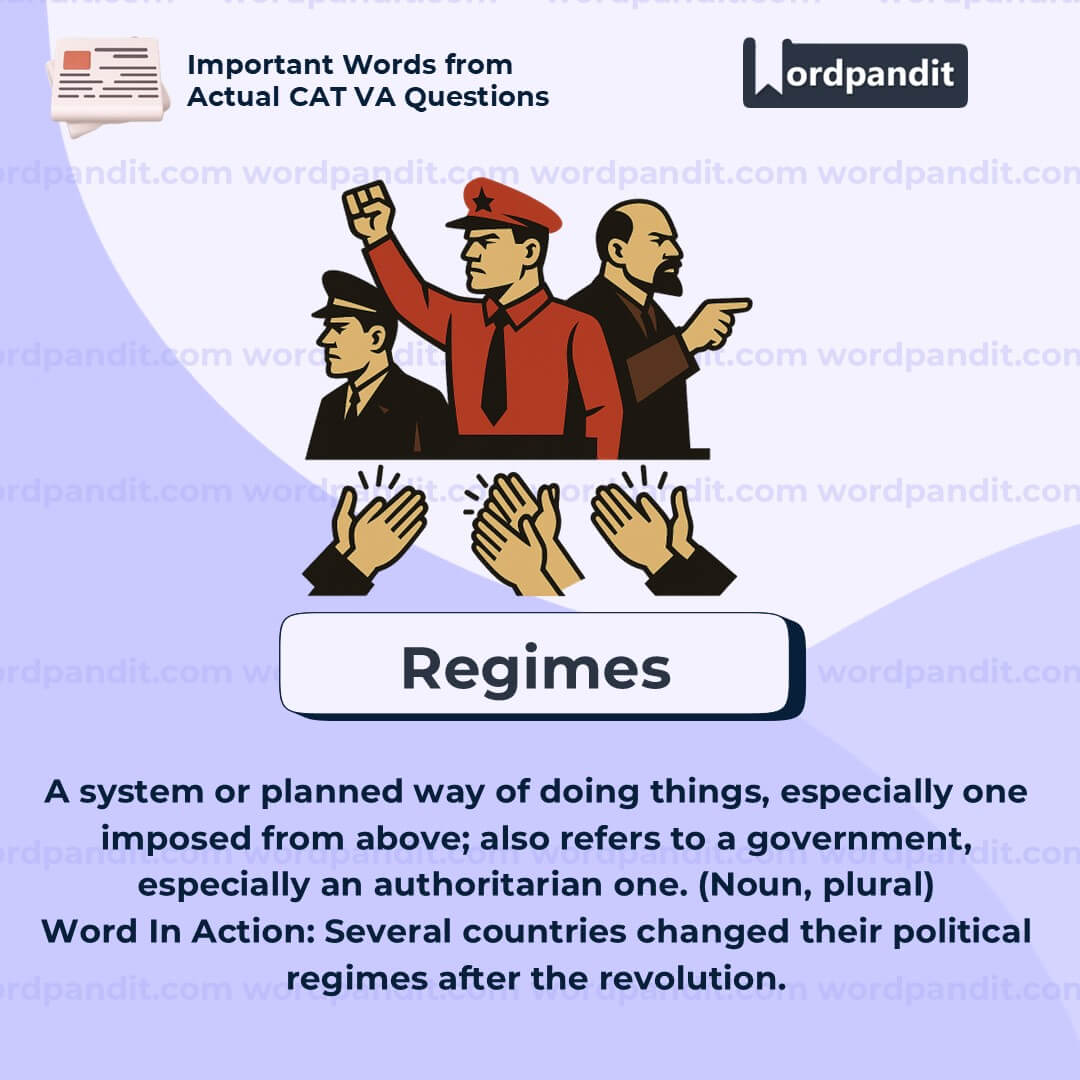
Word-4: Regimes
Context:
"A Foucauldian approach to relationships goes beyond these conceptions of discourse and history to macrolevel regimes of truth as constituting relationships." - Academic Journal Article
Explanatory Paragraph:
The word "regimes" commonly refers to systems or structures of authority, governance, or control. While in political contexts it often describes a ruling government, in theoretical or Foucauldian contexts it can refer to broader systems — such as “regimes of truth” — that organize knowledge, shape behaviors, and dictate norms in society. These regimes are not just laws or rules but the underlying frameworks that define what is seen as "true" or "acceptable."
Meaning: Systems or structures that govern or manage a particular domain, often referring to political rule or ideological frameworks (Noun – plural)
Pronunciation: ruh-ZHEEMS
Difficulty Level: ⭐⭐⭐ Intermediate
Etymology: From French *régime*, from Latin *regimen* meaning “rule” or “government”
Prashant Sir's Notes:
In vocabulary terms, “regimes” is versatile. While it may bring to mind authoritarian governments, in academic writing, especially in theory-heavy contexts like Foucault's, it has a broader meaning — systems that organize thought, behavior, or belief. Always pay attention to context!
Synonyms & Antonyms:
Synonyms: systems, orders, frameworks, authorities, structures
Antonyms: anarchy, disorder, chaos, lawlessness
Usage Examples:
- The country transitioned from a military regime to a democratic system.
- In Foucauldian theory, regimes of truth determine what is accepted as legitimate knowledge.
- Environmental regimes are needed to regulate pollution and protect ecosystems.
- The fitness coach designed a strict regime to help clients achieve their goals.
Cultural Reference:
“Regimes of truth” is a Foucauldian concept that refers to institutionalized ways of defining what is true in a society, often shaped by power structures. - Michel Foucault, *Power/Knowledge*
Think About It:
Can you identify a modern "regime of truth" that shapes how we view success or morality in today’s society?
Quick Activity:
Write down two different types of regimes: one political (e.g., a form of government) and one ideological (e.g., a belief system that influences behavior).
Memory Tip:
“Regime” sounds like “rule-gym” — imagine a structured gym rule system, or a government that runs on strict policies!
Real-World Application:
The term is widely used in political science, sociology, and health fields — from talking about political regimes in global news to fitness regimes in wellness programs, and “regimes of truth” in academic theory.
Word-5: Constitution
Context:
"Reconsidering micropractices within relationships that are constituted within and simultaneously contributors to regimes of truth acknowledges the central position of power/knowledge in the constitution of what has come to be considered true and real." - Academic Journal Article
Explanatory Paragraph:
The word "constitution" has multiple meanings depending on context. In political discourse, it refers to the foundational laws and principles of a state. However, in academic or theoretical contexts, especially in Foucauldian analysis, "constitution" refers to the act or process of forming or establishing something — such as identity, reality, or systems of knowledge. It emphasizes that what we consider "true" or "real" is not fixed, but is shaped or "constituted" through interactions of power, discourse, and social practices.
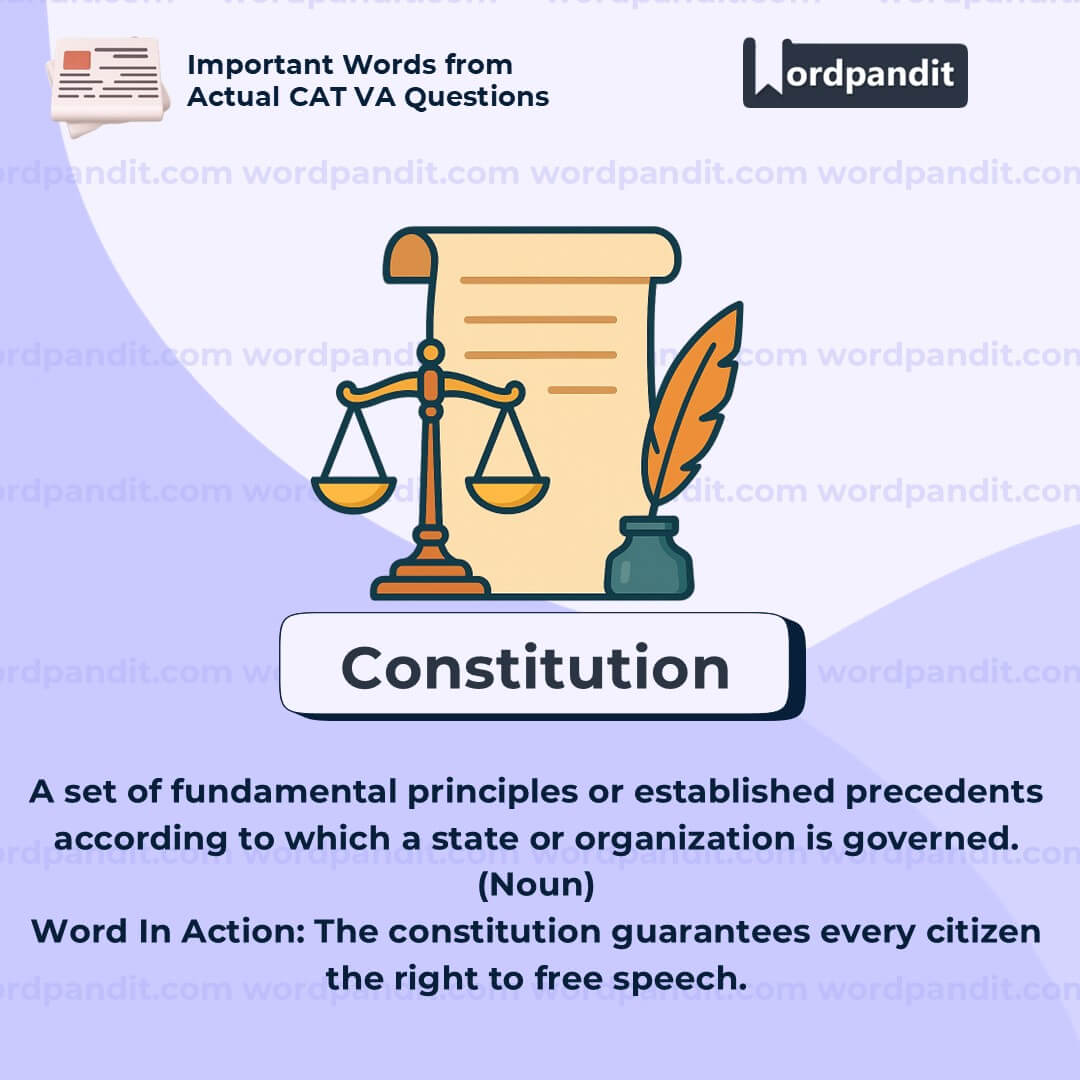
Meaning: The act of forming or establishing something; also refers to the system of fundamental principles or established precedents (Noun)
Pronunciation: kon-sti-TOO-shuhn
Difficulty Level: ⭐⭐⭐ Intermediate
Etymology: From Latin *constitutio*, meaning "a settling, regulation, or arrangement"
Prashant Sir's Notes:
In vocabulary building, always look at how the word functions in various domains. Here, “constitution” goes beyond legal or governmental meanings. It’s about how things — ideas, identities, or realities — are constructed. This is crucial in critical theory and philosophical discourse.
Synonyms & Antonyms:
Synonyms: formation, structure, framework, composition, establishment
Antonyms: disintegration, dissolution, breakdown
Usage Examples:
- The constitution of democratic societies relies heavily on citizen participation.
- Foucault emphasized the role of discourse in the constitution of social reality.
- The athlete’s strong constitution allowed her to recover quickly from injuries.
- The constitution of identity is an ongoing process influenced by language, culture, and power.
Cultural Reference:
"The Constitution of the United States" is one of the most referenced founding documents, yet in Foucauldian terms, “constitution” refers not just to laws, but to the processes by which ideas and norms are historically formed. - Political and Critical Theory texts
Think About It:
What social beliefs today might be the result of a long, hidden process of constitution rather than inherent truths?
Quick Activity:
Choose a common societal value (e.g., success, beauty, justice) and write one sentence about how its “constitution” might have been shaped by history or power structures.
Memory Tip:
Think of “constitution” like building blocks — it’s about how something is constructed or made up, not just laws!
Real-World Application:
Beyond its legal meaning, the term is crucial in academic disciplines like sociology, philosophy, and discourse analysis to explain how concepts, norms, and identities are formed and sustained over time.