
📘 What’s Inside This CAT Misfit Sentence/Odd One Out Question Post?
📝 Authentic CAT Misfit Sentence/Odd One Out Question: Practice with a real CAT Para-jumble Question from a previous CAT exam.
✅ Detailed Question with Step-by-Step Solution: Each question is explained thoroughly for better understanding.
📚 Vocabulary Enhancement: Top 5 words explained from the paragraph
Misfit Sentence/Odd One Out Question
Question 21: Five jumbled up sentences, related to a topic, are given below. Four of them can be put together to form a coherent paragraph. Identify the odd one out and key in the number of the sentence as your answer:
1. They often include a foundation course on navigating capitalism with Chinese characteristics and have replaced typical cases from US corporates with a focus on how Western theories apply to China’s buzzing local firms.
2. The best Chinese business schools look like their Western rivals but are now growing distinct in terms of what they teach and the career boost they offer.
3. Western schools have enhanced their offerings with double degrees, popular with domestic and overseas students alike—and boosted the prestige of their Chinese partners.
4. For students, a big draw is the chance to rub shoulders with captains of China’s private sector.
5. Their business courses now largely cater to the growing demand from China Inc which has become more global, richer and ready to recruit from this sinocentric student body.
Solution with Explanation
Answer: 3
Detailed explanation by Wordpandit:
Upon closely examining the sentences, it's evident that the primary focus of the paragraph revolves around Chinese business schools and their distinctive features compared to their Western counterparts. Sentence 2 highlights that, although there may be surface similarities, Chinese business schools differ in their curricular offerings and unique propositions. Sentences 1, 4, and 5 further amplify the uniqueness and distinguishing factors of Chinese business schools. In contrast, sentence 3 diverges from the main theme by zeroing in on the characteristics of Western business schools. This shift detracts from the central narrative about Chinese institutions. Therefore, incorporating sentence 3 would disrupt the continuity of the discussion centered on the distinctiveness of Chinese business schools.
Word-1: Characteristics
Context:
"They often include a foundation course on navigating capitalism with Chinese characteristics and have replaced typical cases from US corporates with a focus on how Western theories apply to China’s buzzing local firms." - Financial Times
Explanatory Paragraph:
The word "characteristics" refers to the specific features or qualities that help identify or define something. In the context above, "Chinese characteristics" implies the unique traits and adaptations that make capitalism in China distinct from its Western counterpart. This term often reflects how general principles—like economic theories—are shaped by cultural, political, or historical factors.
Meaning: Distinctive traits, features, or qualities of a person, object, or concept (Noun)
Pronunciation: kar-ik-tuh-RIS-tiks
Difficulty Level: ⭐⭐ Beginner
Etymology: From Greek *kharaktēristikos*, meaning "characterizing", from *kharaktēr* meaning "a mark or symbol".
Prashant Sir's Notes:
“Characteristics” is a high-utility word—frequently found in academic texts, competitive exams, and real-world discussions. Watch out for its plural form when describing more than one quality.
Synonyms & Antonyms:
Synonyms: features, traits, attributes, qualities, properties
Antonyms: abnormalities, deviations, exceptions
Usage Examples:
- Honesty and kindness are key characteristics of a good leader.
- The characteristics of water include being odorless and tasteless.
- Each animal species has unique characteristics that help it survive in its environment.
- Modern architecture often lacks the ornate characteristics of older buildings.
Cultural Reference:
"Socialism with Chinese characteristics" is a phrase frequently used in Chinese political discourse to describe the adaptation of socialist principles to China's unique conditions. - Xinhua News Agency
Think About It:
What characteristics do you think define a successful society, and how might they vary across cultures?
Quick Activity:
List five characteristics that you think are essential for your dream job. Write one sentence explaining each.
Memory Tip:
Think of “characteristics” as “the characters or features” that make someone or something unique—just like a movie character is defined by their traits.
Real-World Application:
In resumes and interviews, you are often asked to describe your personal characteristics—highlighting traits such as diligence, adaptability, and communication skills can make a strong impression.
Word-2: Corporates
Context:
"They often include a foundation course on navigating capitalism with Chinese characteristics and have replaced typical cases from US corporates with a focus on how Western theories apply to China’s buzzing local firms." - Financial Times
Explanatory Paragraph:
The word "corporates" is commonly used to refer to large companies or business enterprises, especially those that are legally recognized as corporations. In the given context, "US corporates" refers to well-known American companies that are typically studied in business education. The shift mentioned in the sentence highlights a move from studying Western firms to examining Chinese companies instead.
Meaning: Large companies or corporate entities, often used collectively (Noun - plural)
Pronunciation: KOR-puh-ruhts
Difficulty Level: ⭐⭐ Beginner
Etymology: From Latin *corporatus*, past participle of *corporare*, meaning "to form into a body". The modern usage of "corporate" evolved to mean a company or business entity.
Prashant Sir's Notes:
“Corporates” is often used in journalistic or financial writing to refer to businesses collectively. It’s a plural noun but should not be confused with “corporations,” which is a more formal legal term. Both are often interchangeable in everyday business contexts.
Synonyms & Antonyms:
Synonyms: companies, firms, enterprises, businesses, conglomerates
Antonyms: individuals, freelancers, sole proprietors, startups (in some contexts)
Usage Examples:
- Many corporates are adopting green policies to reduce their environmental impact.
- Startups often struggle to compete with established corporates in global markets.
- The government has introduced tax incentives to attract foreign corporates.
- Corporate culture varies widely among different corporates even within the same industry.
Cultural Reference:
“The corporates have too much influence over politics,” is a common critique heard in documentaries like *The Corporation* (2003), which examines the modern-day role and power of large companies.
Think About It:
What responsibilities should corporates have toward society beyond making profits?
Quick Activity:
Make a list of five well-known corporates from different countries. Research one unique feature or achievement of each.
Memory Tip:
Think of “corporates” as "the big corps"—a shortcut to remembering that it refers to large-scale businesses or corporations.
Real-World Application:
Understanding how corporates operate is essential in careers like management, finance, and consulting, where decision-making often involves analyzing strategies of major businesses.
Word-3: Prestige
Context:
"Western schools have enhanced their offerings with double degrees, popular with domestic and overseas students alike—and boosted the prestige of their Chinese partners." - Financial Times
Explanatory Paragraph:
The word "prestige" refers to the respect, admiration, or high status that someone or something earns due to success, quality, or importance. In the given context, it implies that partnerships with well-regarded Western schools have increased the reputation and esteem of Chinese institutions, making them more attractive in the global education market.
Meaning: Widespread respect and admiration felt for someone or something based on their achievements or quality (Noun)
Pronunciation: preh-STEEZH
Difficulty Level: ⭐⭐⭐ Intermediate
Etymology: From French *prestige* meaning "illusion, glamour", which came from Latin *praestigium* meaning "illusion or trick". Over time, it evolved to mean "influence or reputation".
Prashant Sir's Notes:
“Prestige” is a powerful word in academic and professional vocabulary. It implies not just fame but earned, often dignified, recognition. Use it carefully—prestige is always built, never bought.
Synonyms & Antonyms:
Synonyms: distinction, status, esteem, reputation, honor
Antonyms: obscurity, disgrace, disrepute, insignificance
Usage Examples:
- The university’s prestige attracted students from over 70 countries.
- Winning the Nobel Prize brings immense prestige in the scientific community.
- Luxury brands rely heavily on their prestige to justify premium prices.
- His promotion added to his professional prestige among colleagues.
Cultural Reference:
In the film *The Prestige* (2006), the title refers to the final, awe-inspiring moment of a magic trick—highlighting the idea of greatness and recognition. The word reflects the allure and reputation of excellence.
Think About It:
Can prestige sometimes become a barrier to innovation if institutions are afraid to risk their reputation?
Quick Activity:
Write a short paragraph on what brings prestige to an educational institution. Think of factors like faculty, alumni, infrastructure, or global rankings.
Memory Tip:
Think of “prestige” as the shining “stage” where respected individuals or institutions stand. Prestige puts you in the spotlight.
Real-World Application:
Understanding and using the concept of prestige is vital in branding, education, diplomacy, and leadership—any area where perception and reputation significantly influence decisions.
Word-4: Cater

Context:
"Their business courses now largely cater to the growing demand from China Inc which has become more global, richer and ready to recruit from this sinocentric student body." - Financial Times
Explanatory Paragraph:
The word "cater" means to provide what is needed or required by a particular group or audience. In the context above, it refers to how business courses have adapted or tailored their content to meet the expectations and preferences of China's increasingly influential corporate sector. The term emphasizes responsiveness and customized service.
Meaning: To provide or supply what is needed or desired, especially in terms of services (Verb)
Pronunciation: KAY-tur
Difficulty Level: ⭐⭐ Beginner
Etymology: From Middle English *catour*, meaning a buyer of provisions, from Anglo-French *acatour*, rooted in Latin *acceptare* meaning "to receive". It evolved into a service-oriented meaning over time.
Prashant Sir's Notes:
“Cater” is often associated with food services, but its broader meaning—serving specific needs—is more powerful. Use it when talking about customized solutions or tailored experiences.
Synonyms & Antonyms:
Synonyms: serve, provide for, accommodate, supply, satisfy
Antonyms: neglect, ignore, overlook, disregard
Usage Examples:
- The app was designed to cater to busy professionals looking for healthy meals.
- The hotel caters to both tourists and business travelers.
- The new curriculum caters to students interested in emerging technologies.
- Luxury brands often cater to a niche, high-end clientele.
Cultural Reference:
The phrase "catering to the masses" is often used in media and advertising to describe content designed for wide appeal, sometimes criticized for sacrificing depth or originality.
Think About It:
Is it always good to cater to popular demand, or can it lead to a loss of originality and core values?
Quick Activity:
Think of a service you use daily. Describe how it caters to your needs in one sentence. Try to use a different synonym in a second sentence.
Memory Tip:
Think of a "caterer" at a party—they serve exactly what guests want. "Cater" works the same way: it means to serve someone’s needs.
Real-World Application:
In business, education, and even tech development, success often depends on how well a product or service caters to its target audience’s specific needs and preferences.
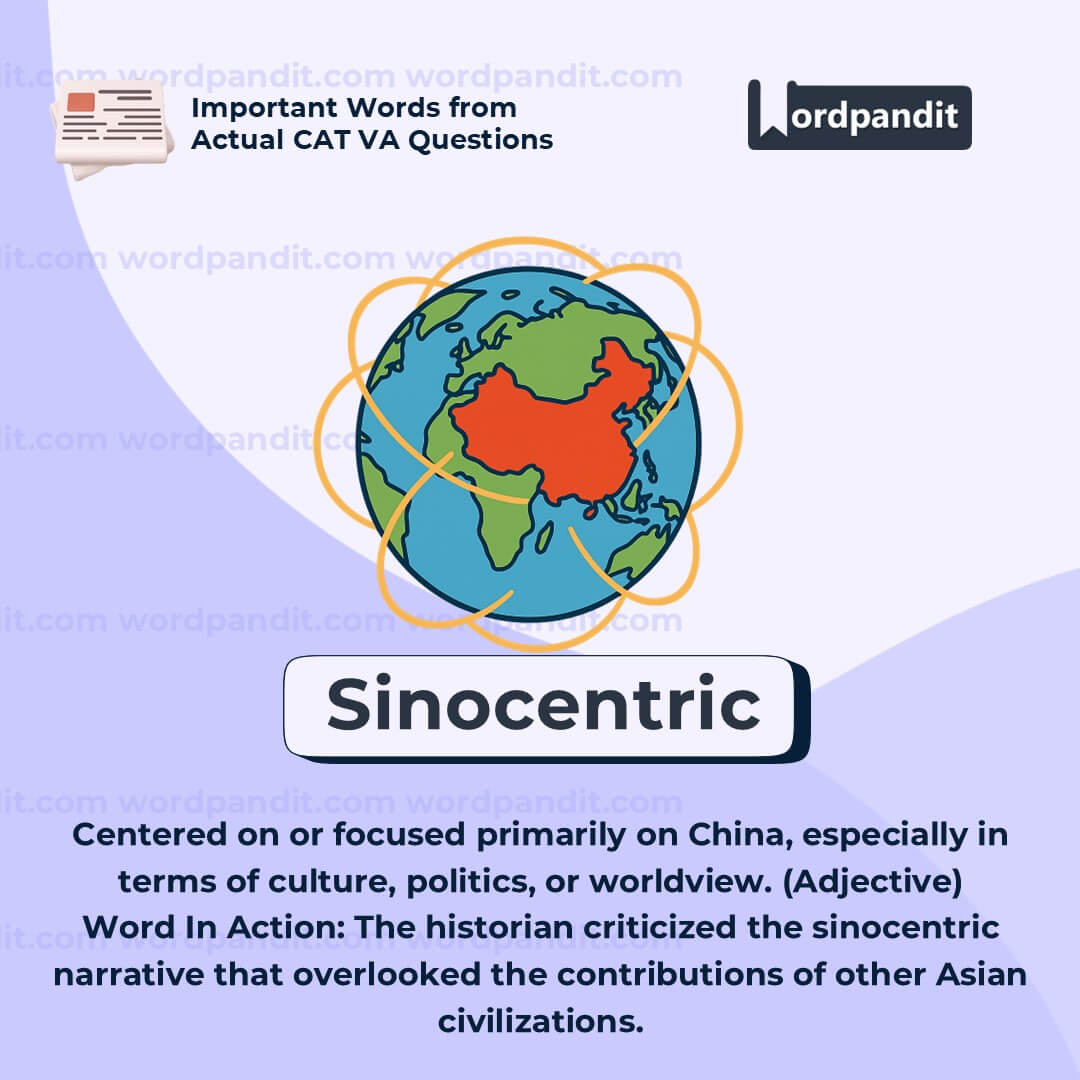
Word-5: Sinocentric
Context:
"Their business courses now largely cater to the growing demand from China Inc which has become more global, richer and ready to recruit from this sinocentric student body." - Financial Times
Explanatory Paragraph:
The term "sinocentric" describes a viewpoint, system, or ideology that is centered around China, often prioritizing Chinese culture, interests, or influence over others. In this context, the “sinocentric student body” refers to a group of students—likely both domestic and international—whose academic or cultural orientation leans heavily toward Chinese norms, business practices, or perspectives. It emphasizes China's growing centrality in global education and commerce.
Meaning: Centered on China or focused primarily on Chinese interests and perspectives (Adjective)
Pronunciation: SY-noh-sen-trik
Difficulty Level: ⭐⭐⭐⭐ Advanced
Etymology: From Latin *Sinae* meaning "China" + *centric* from Greek *kentron* meaning "center"—literally "China-centered".
Prashant Sir's Notes:
This is a niche academic or geopolitical term, used especially in discussions about China's rising influence. It’s vital in debates around education, global economics, and international relations. Understanding such terms deepens your grasp of global affairs vocabulary.
Synonyms & Antonyms:
Synonyms: China-focused, China-centric, Chinese-oriented (contextual)
Antonyms: Eurocentric, Western-centric, global, multicultural
Usage Examples:
- The curriculum shift reflects a more sinocentric approach in Asian business schools.
- Critics argue that the new policies are increasingly sinocentric in nature.
- Many media outlets are adapting to the sinocentric preferences of their expanding Chinese audiences.
- The art exhibit had a sinocentric theme, showcasing ancient Chinese dynasties.
Cultural Reference:
Historically, the "Middle Kingdom" view placed China at the center of the civilized world—a sinocentric worldview that still influences certain aspects of Chinese political and cultural rhetoric today.
Think About It:
In a globalized world, is a sinocentric or any single-nation-centric approach sustainable in higher education or policy-making?
Quick Activity:
Write a one-sentence comparison between a sinocentric and a Eurocentric worldview in either education, media, or politics.
Memory Tip:
“Sino” = China + “centric” = centered → *Sinocentric* literally means “China-centered.” Easy to decode if you remember the parts!
Real-World Application:
As China's influence grows, recognizing sinocentric trends helps businesses, educators, and policymakers better navigate partnerships, content creation, and cultural sensitivities in Asia and beyond.