

✨ Introduction
Mastering Reading Comprehension begins with mastering the words!
In this post, we dive deep into vocabulary taken directly from an actual CAT RC passage. Each word has been explained in a simple, easy-to-understand way, along with examples to help you grasp its usage in real contexts.
From words like "species" and "cognitive" to "subjection" and "paradise," strengthen your vocabulary one word at a time — and take your RC performance to the next level!
📚 What’s Inside This Vocabulary Post?
- 🔍 Words Sourced from an Actual CAT RC Passage: Directly pick up important vocabulary from real CAT exam material.
- 🧠 Meaningful Explanations: Understand the exact meaning and usage of each word in a simple, student-friendly way.
- ✍️ Context-Based Learning: Learn words with examples that reflect their actual usage in reading comprehension contexts.
- 🗂️ Quick Reference Format: Words are neatly listed with meanings, parts of speech, and example sentences for easy revision.
- 🚀 Boost Your RC and Verbal Ability Skills: Improve your understanding of tough passages by strengthening your vocabulary.
📝 Words Covered in This Article:
- Solicitous
- Painstaking
- sophisticated
- Rudimentary
- Triage
- Increasingly
- Arduous
- Ripples
- Confronted
- Constrained
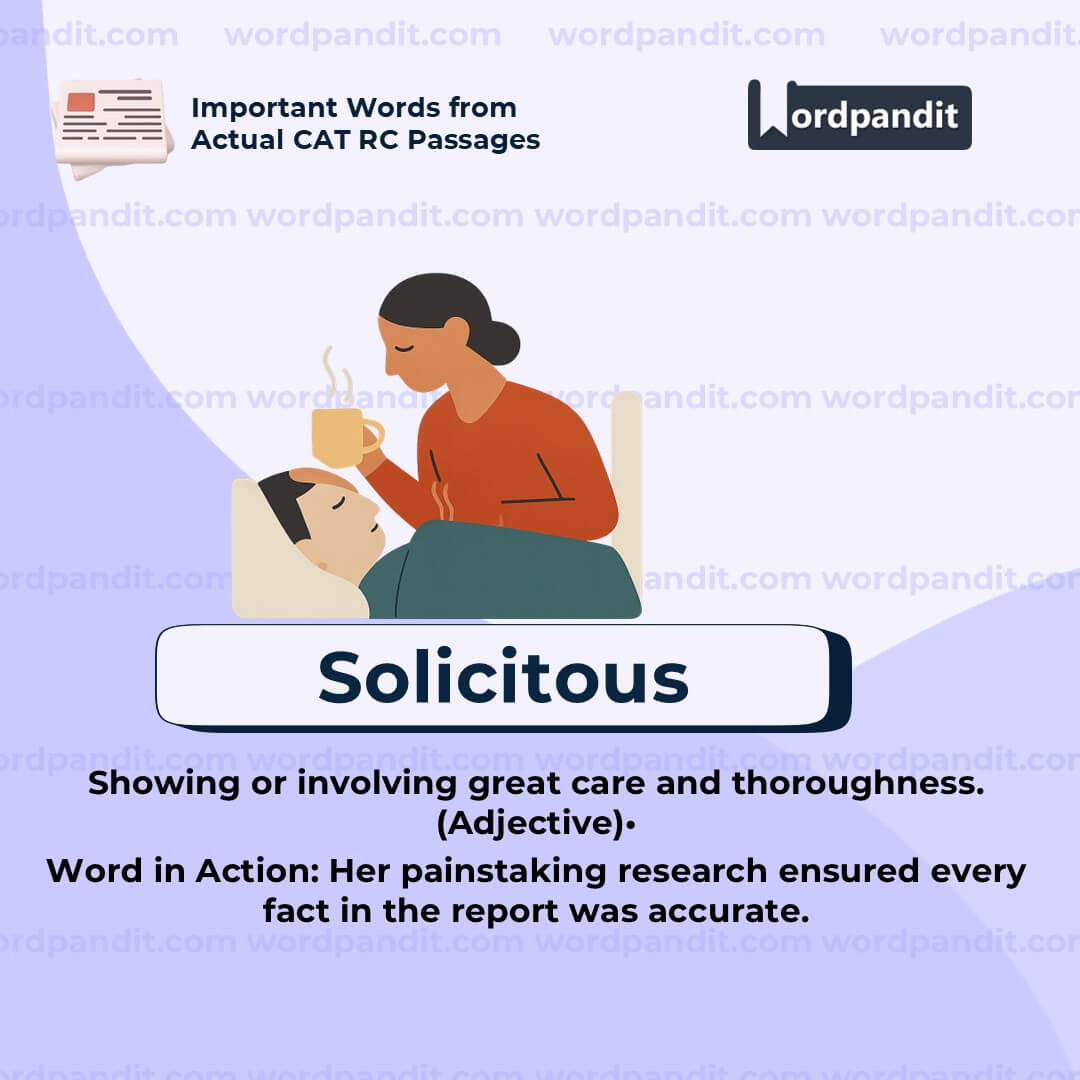
WORD-1: Solicitous
Context:
"Applications that offer lots of prompts and tips are often to blame; simpler, less solicitous programs push people harder to think, act and learn." - Source: Commentary on User Experience and Cognitive Effort
Explanatory Paragraph:
“Solicitous” describes someone or something that shows concern, care, or a strong desire to help or protect. In this context, it refers to software applications that are overly helpful—offering too many tips, prompts, and suggestions. While this behavior may seem supportive, it can unintentionally reduce a user’s need to think independently. Thus, “solicitous” is being used slightly critically here, to suggest that too much concern can actually hinder deeper learning or problem-solving.
Meaning: Showing concern, care, or attention, often to an excessive degree (Adjective)
Pronunciation: suh-LISS-ih-tuhs
Difficulty Level: ⭐⭐⭐ Intermediate
Etymology: From Latin *sollicitus*, meaning “anxious, concerned,” formed from *sollus* (“whole”) + *citare* (“to set in motion”).
Prashant Sir's Notes:
While “solicitous” can be positive—indicating thoughtfulness—it can also imply overprotectiveness or excessive interference. Always check the tone. In tech or education, it may be used to critique tools that help *too* much and discourage user independence.
Synonyms & Antonyms:
Synonyms: attentive, caring, concerned, thoughtful, overhelpful
Antonyms: indifferent, neglectful, detached, unconcerned
Usage Examples:
- The nurse was solicitous of the patient’s every need.
- Her solicitous attitude made guests feel instantly at ease.
- Parents can be too solicitous, making it hard for children to learn resilience.
- Overly solicitous apps may discourage users from problem-solving independently.
Cultural Reference:
"She was so solicitous, always asking if I was warm enough or had eaten, like a mother hen fussing over her chicks." – Common expression of endearing (or smothering) concern
Think About It:
Can being too solicitous sometimes hinder someone's growth? Where should we draw the line between helpfulness and interference?
Quick Activity:
Describe a time when someone was solicitous toward you. Was it comforting, or did it feel excessive? Use the word in your response.
Memory Tip:
Think: “solicitous” sounds like “solicitor”—always showing up, offering help, even when you didn’t ask. Sometimes it’s good, sometimes it's too much!
Real-World Application:
“Solicitous” appears in writing about care, hospitality, parenting, teaching, and increasingly, technology. It’s useful when discussing how systems or people balance support with encouraging independence.
WORD-2: Painstaking
Context:
"The goal of modern software, by contrast, is to ease our way through such challenges. Arduous, painstaking work is exactly what programmers are most eager to automate—after all, that is where the immediate efficiency gains tend to lie." - Source: Commentary on Automation and Cognitive Labor
Explanatory Paragraph:
“Painstaking” describes something done with great care, attention, and thoroughness—usually involving time-consuming or mentally demanding effort. In the context above, it highlights the kind of detailed and difficult tasks that programmers seek to eliminate through automation. While painstaking work can be productive and result in high-quality output, it’s also seen as laborious and inefficient in today’s fast-paced digital landscape.
Meaning: Done with or employing great care and thoroughness (Adjective)
Pronunciation: PAYN-stay-king
Difficulty Level: ⭐⭐⭐ Intermediate
Etymology: From the phrase “taking pains,” meaning “making a serious effort.” It dates back to the 17th century.
Prashant Sir's Notes:
Don’t confuse “painstaking” with “painful.” It’s not about suffering—it’s about diligence and care. In essays, it’s great for describing effort, research, craftsmanship, or perfectionism. Watch for tone—it can be used to praise or to point out inefficiency.
Synonyms & Antonyms:
Synonyms: meticulous, thorough, diligent, careful, detailed
Antonyms: careless, hasty, sloppy, superficial
Usage Examples:
- Restoring the ancient manuscript required painstaking attention to detail.
- Her painstaking research laid the foundation for future discoveries.
- The artwork was created through painstaking layering and hand-painting techniques.
- Painstaking manual coding is now often replaced by AI-generated scripts.
Cultural Reference:
"Genius is one percent inspiration and ninety-nine percent perspiration." – Thomas Edison, describing the value of painstaking effort in innovation.
Think About It:
In a world obsessed with speed and automation, is there still value in painstaking, manual work? When is it worth slowing down?
Quick Activity:
Describe a task (academic, artistic, or personal) you’ve completed that involved painstaking effort. What was the result? Use the word in your reflection.
Memory Tip:
“Painstaking” = taking pains (i.e., making great effort). Think of someone carefully hand-carving a sculpture—slow, detailed, deliberate.
Real-World Application:
“Painstaking” is often used in writing about research, craftsmanship, software development, historical preservation, or art. It signals the value of precision and the human touch—qualities sometimes lost in automated processes.
WORD-3: Sophisticated
Context:
"Ten years ago, information scientists at Utrecht University in the Netherlands had a group of people carry out complicated analytical and planning tasks using either rudimentary software that provided no assistance or sophisticated software that offered a great deal of aid." - Source: Study on Software and Problem Solving
Explanatory Paragraph:
“Sophisticated” describes something that is advanced, complex, or refined in design, knowledge, or behavior. In this context, it refers to software that is highly developed and capable of offering intelligent help during analytical tasks. The word often carries connotations of technological advancement, elegance, and intricacy. Depending on context, it can describe a system, tool, idea, or even a person’s manner or style.
Meaning: Highly developed, complex, or refined, especially in terms of function, design, or understanding (Adjective)
Pronunciation: suh-FIS-tuh-kay-tid
Difficulty Level: ⭐⭐ Basic
Etymology: From Latin *sophisticatus*, meaning “tampered with” or “refined”; related to Greek *sophos* (wise).
Prashant Sir's Notes:
“Sophisticated” has multiple layers: it can refer to high-tech systems, complex thinking, or refined manners. Be cautious of tone—it can be positive (advanced) or slightly critical (overly complicated or artificial) depending on the context.
Synonyms & Antonyms:
Synonyms: advanced, refined, complex, elegant, polished
Antonyms: simple, basic, crude, unsophisticated, primitive
Usage Examples:
- The robot was equipped with sophisticated sensors for detecting movement.
- Her arguments were sophisticated, blending logic with emotional appeal.
- The software's sophisticated design makes it user-friendly yet powerful.
- He wore a sophisticated suit that impressed everyone at the event.
Cultural Reference:
"James Bond is often portrayed as the epitome of sophistication—refined, worldly, and armed with high-tech gadgets." – Pop Culture Commentary
Think About It:
Is sophistication always an advantage, or can complexity sometimes make things harder to understand or use?
Quick Activity:
Pick a piece of technology, clothing, or behavior you find sophisticated. Describe what makes it appear refined or advanced.
Memory Tip:
“Sophisticated” sounds like “sophisticated = software + finesse + educated”—think of something or someone with advanced skill or elegance.
Real-World Application:
“Sophisticated” is widely used in discussions about technology (e.g., AI, tools), behavior (e.g., social etiquette), fashion, and art. It’s a versatile word that captures both intellectual depth and technical complexity.
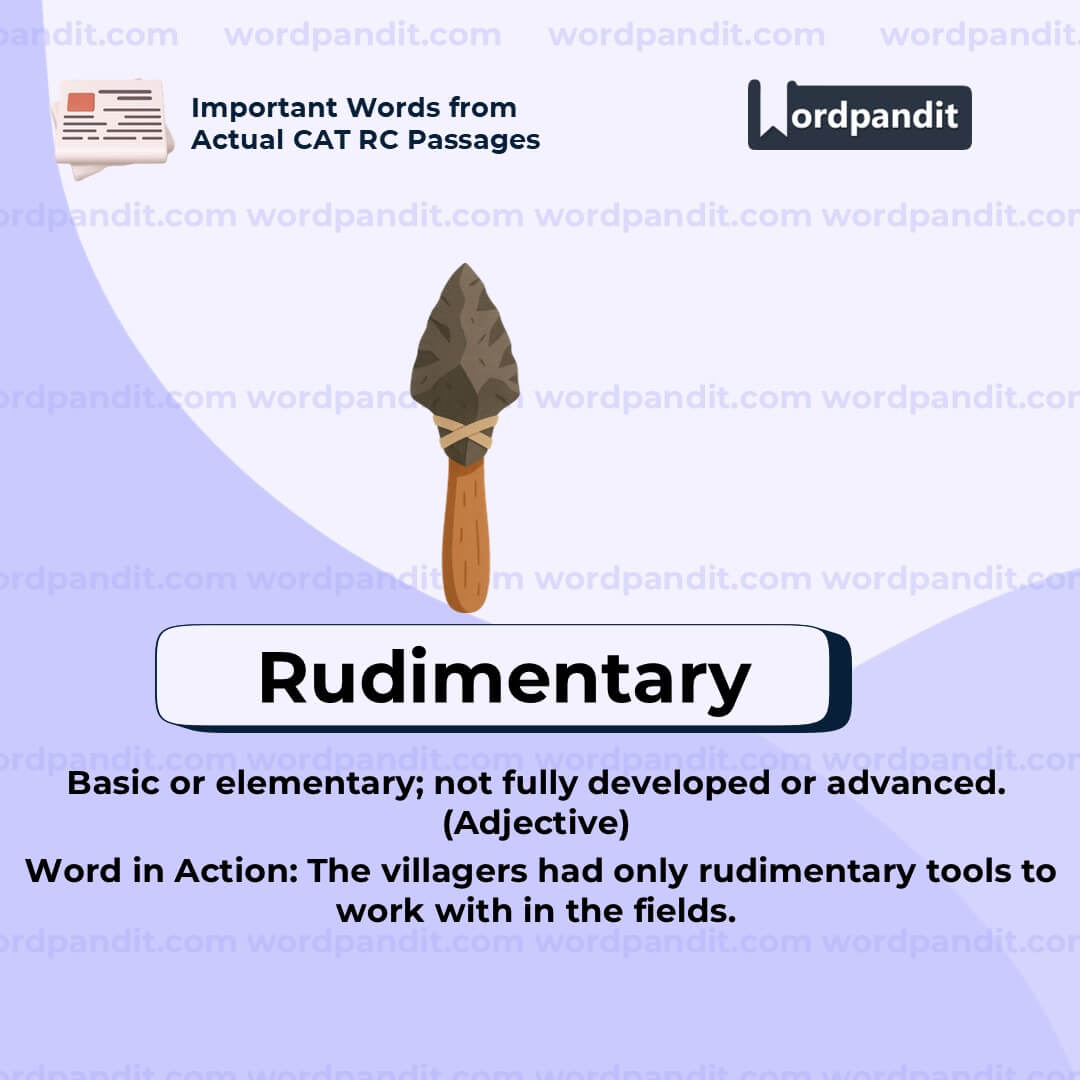
WORD-4: Rudimentary
Context:
"Ten years ago, information scientists at Utrecht University in the Netherlands had a group of people carry out complicated analytical and planning tasks using either rudimentary software that provided no assistance or sophisticated software that offered a great deal of aid." - Source: Study on Software and Cognitive Performance
Explanatory Paragraph:
“Rudimentary” refers to something that is basic, undeveloped, or at an early stage of evolution. In the context of this study, it describes software that lacked advanced features or user assistance—essentially primitive or bare-bones tools. The contrast is drawn with sophisticated software to emphasize how minimal or foundational the rudimentary option was. This word often implies simplicity, incompleteness, or something that functions in its most elementary form.
Meaning: Basic or undeveloped; involving only the most essential or elementary aspects (Adjective)
Pronunciation: roo-duh-MEN-tuh-ree
Difficulty Level: ⭐⭐⭐ Intermediate
Etymology: From Latin *rudimentum*, meaning “first principle, beginning, or foundation,” based on *rudis* (“unwrought, rough, raw”).
Prashant Sir's Notes:
“Rudimentary” is perfect for describing things that are in an early or primitive state—whether it’s a tool, idea, or skill. It’s commonly used in tech, education, and biology. Watch out—it sometimes carries a mildly negative tone, suggesting something is not yet fully developed or effective.
Synonyms & Antonyms:
Synonyms: basic, elementary, primitive, undeveloped, simple
Antonyms: advanced, developed, complex, refined, sophisticated
Usage Examples:
- The training program covered only the rudimentary aspects of coding.
- Early humans used rudimentary tools made of stone and wood.
- She had only a rudimentary understanding of the language.
- The prototype was rudimentary but showed promise for future development.
Cultural Reference:
"All great innovations begin as rudimentary ideas—rough, raw, but full of potential." – Design Thinking Manifesto
Think About It:
Can working with rudimentary tools sometimes lead to greater creativity or problem-solving skills than relying on advanced ones?
Quick Activity:
List one skill, tool, or idea you encountered in its rudimentary form and explain how it later evolved into something more sophisticated.
Memory Tip:
“Rudimentary” starts with “rude”—think of something that’s rough, raw, and unrefined—just getting started.
Real-World Application:
“Rudimentary” is used across fields—from education (rudimentary literacy) to tech (rudimentary design) to science (rudimentary organisms). It signals the beginning of development and helps frame progress or contrast.
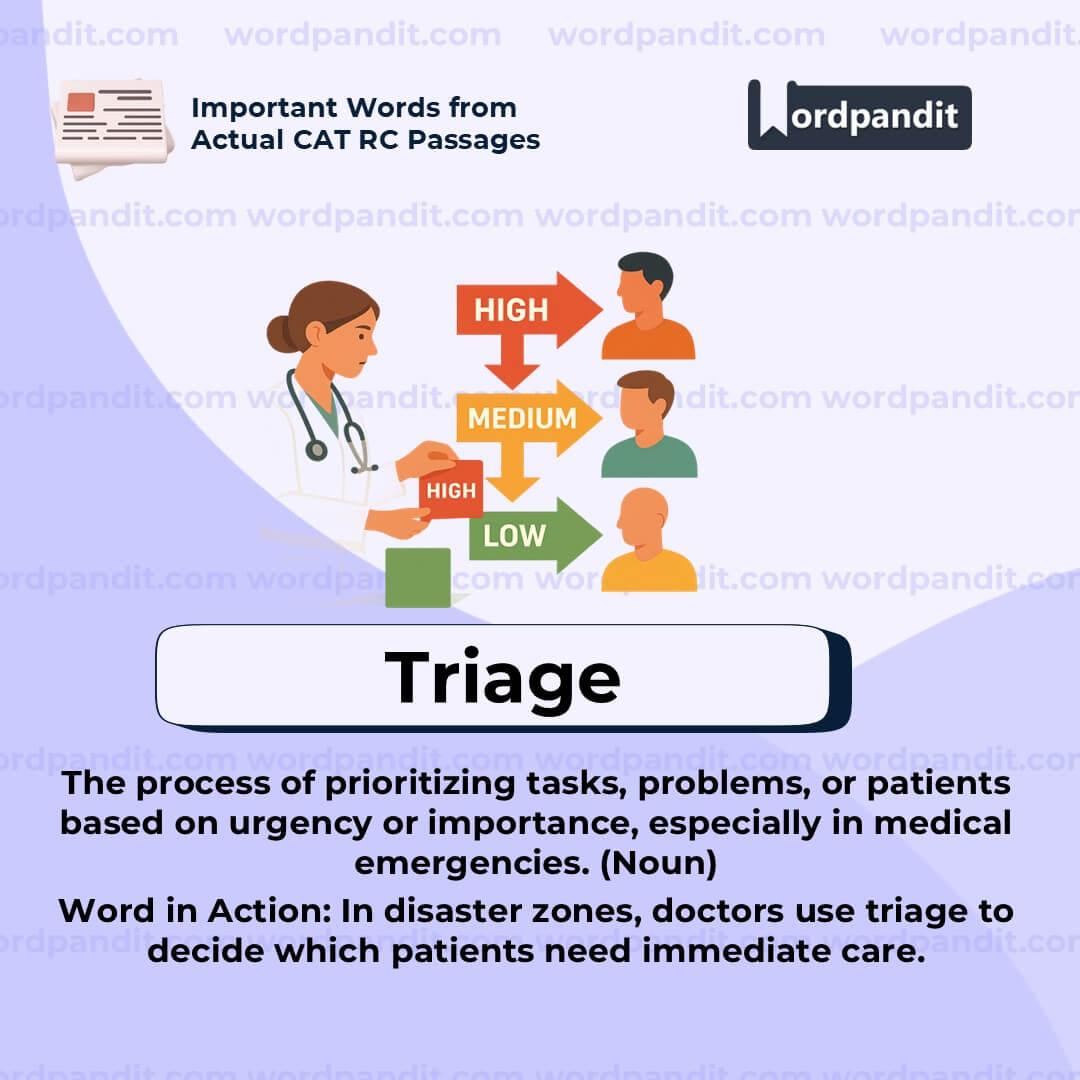
WORD-5: Triage
Context:
"These highly constrained tools,” the researchers write, “are optimized for data capture but at the expense of sacrificing their utility for appropriate triage and diagnosis, leading users to miss the forest for the trees." - Source: Research on Digital Diagnostic Tools
Explanatory Paragraph:
“Triage” is originally a medical term used in emergency care to describe the process of sorting patients based on the urgency of their condition to prioritize treatment. In broader or metaphorical use—as in this context—it refers to the evaluation and prioritization of tasks, problems, or data. The passage critiques tools that gather information efficiently but fail to help users make informed decisions about what’s most important—a failure of triage. Thus, triage here signifies intelligent filtering and prioritizing, a crucial step in problem-solving and analysis.
Meaning: The process of determining the priority of tasks, problems, or patients based on urgency or importance (Noun)
Pronunciation: TREE-ahzh
Difficulty Level: ⭐⭐⭐ Intermediate
Etymology: From French *triage* (“sorting”), from *trier* (“to sort, to choose”); first used in military medicine.
Prashant Sir's Notes:
Triage is not just a medical word anymore—it’s useful in management, data science, crisis response, and education. It’s about making quick but wise decisions on what matters most when resources (time, attention, energy) are limited. Perfect for analytical writing!
Synonyms & Antonyms:
Synonyms: prioritization, sorting, assessment, evaluation
Antonyms: neglect, mismanagement, disorganization
Usage Examples:
- In an emergency room, triage ensures that the most critical patients are treated first.
- Project managers must triage incoming requests to manage workloads efficiently.
- The app failed to offer any triage, leaving users overwhelmed with unfiltered data.
- During a disaster, proper triage can mean the difference between life and death.
Cultural Reference:
"Triage became a vital skill on battlefields and in hospitals during World War I and II, and has since spread to tech, business, and crisis management." – Medical History Review
Think About It:
How do you triage information in your own life—emails, news, tasks? Are your current systems effective, or do they need restructuring?
Quick Activity:
Write down five items from your to-do list. Now try to triage them—rank them in order of urgency and importance. Explain your reasoning using the word “triage.”
Memory Tip:
Think of “triage” as a *tri* (three-way) decision: urgent, important, or delayable. It helps you sort through chaos with purpose.
Real-World Application:
“Triage” is essential in healthcare, crisis response, tech support, and project management. Wherever choices must be made under pressure, triage helps ensure time and energy go where they're most needed.
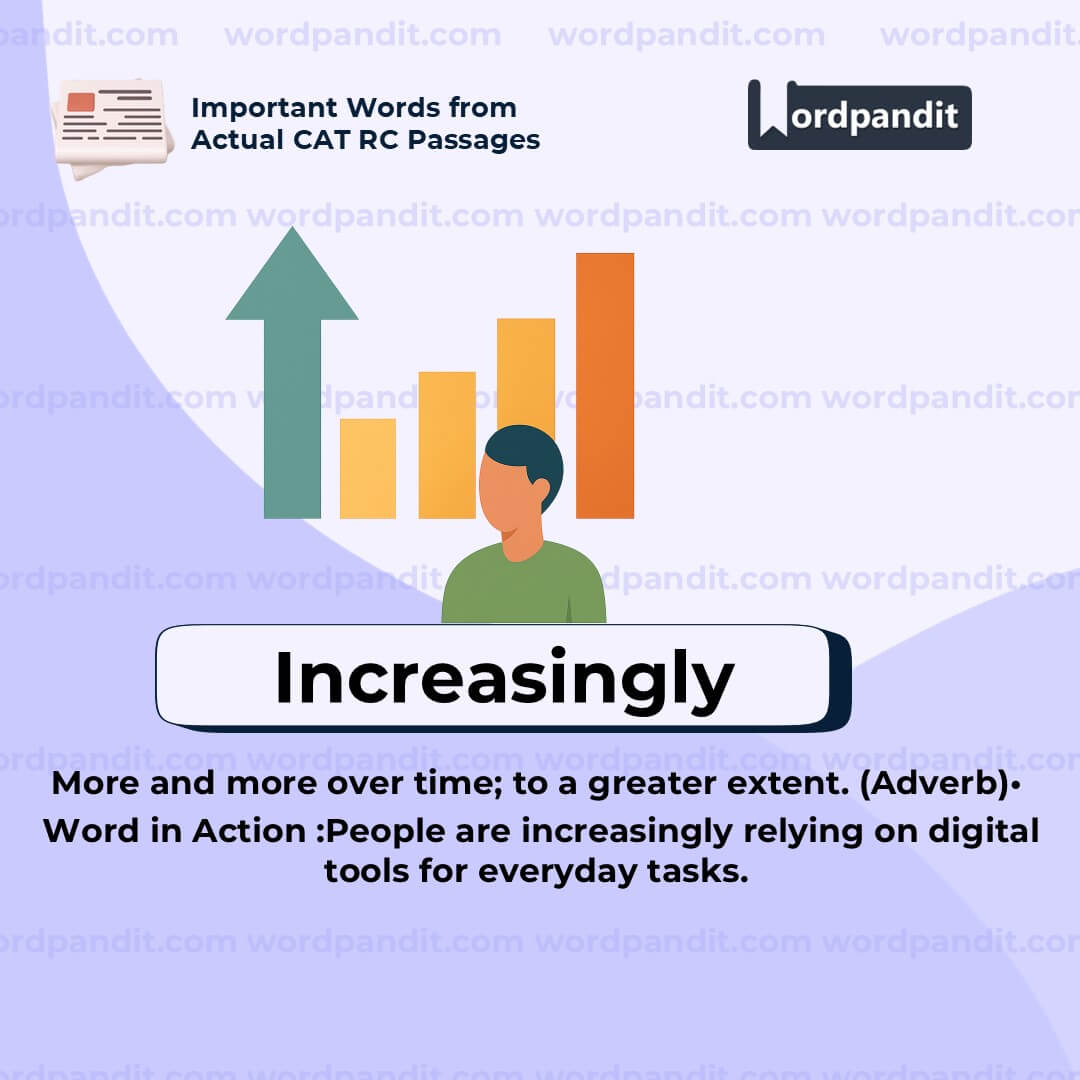
WORD-6: Increasingly
Context:
"Automation’s scope continues to widen. With the rise of electronic health records, physicians increasingly rely on software templates to guide them through patient exams." - Source: Analysis of Medical Automation Trends
Explanatory Paragraph:
“Increasingly” is an adverb that describes a rising trend or growing frequency of something happening over time. In the provided context, it highlights how doctors are more and more depending on digital tools—especially software templates—during patient examinations. This word is often used to signal changes in behavior, attitudes, technology, or societal norms that are steadily gaining momentum.
Meaning: More and more; to a greater degree or extent over time (Adverb)
Pronunciation: in-KREE-suhng-lee
Difficulty Level: ⭐ Basic
Etymology: From the verb *increase*, which comes from Latin *increscere* (“to grow”), combined with the adverbial suffix *-ly*.
Prashant Sir's Notes:
“Increasingly” is a useful connector in essays and articles. It helps describe trends or shifts over time—especially in data-driven or comparative writing. It adds nuance and shows progression, making your argument sound more dynamic and evidence-based.
Synonyms & Antonyms:
Synonyms: progressively, more and more, steadily, growingly
Antonyms: decreasingly, less and less, rarely, diminishingly
Usage Examples:
- People are increasingly working from home due to advancements in technology.
- The region is increasingly affected by unpredictable weather patterns.
- Students are increasingly turning to online platforms for exam preparation.
- Physicians increasingly rely on automated systems for patient diagnostics.
Cultural Reference:
"We are increasingly interconnected—what happens in one part of the world can affect all others within hours." – From a TED Talk on Globalization
Think About It:
What habits or technologies have you increasingly relied on in the last year? Do you see this trend continuing, or do you expect to scale back?
Quick Activity:
Write three short sentences using “increasingly” to describe trends in education, technology, and lifestyle. Example: “People are increasingly choosing plant-based diets.”
Memory Tip:
“Increasingly” comes from “increase”—just remember: it means “more and more” of something happening, building up over time.
Real-World Application:
“Increasingly” is a go-to word in essays, reports, and journalism when discussing trends, statistics, and social change. It signals that something isn’t static—it’s evolving, growing, or spreading in scope or influence.
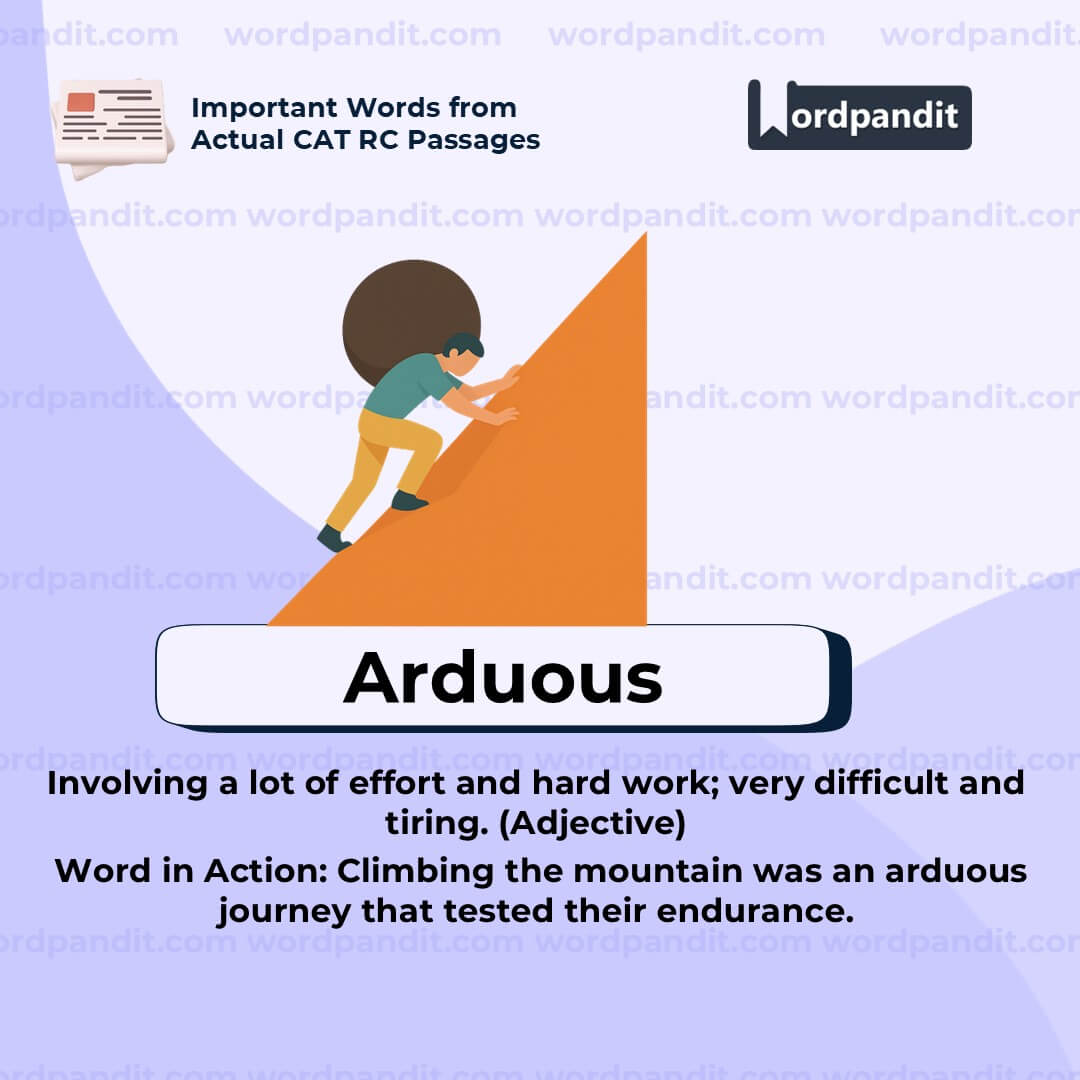
WORD-7: Arduous
Context:
"The goal of modern software, by contrast, is to ease our way through such challenges. Arduous, painstaking work is exactly what programmers are most eager to automate—after all, that is where the immediate efficiency gains tend to lie. In other words, a fundamental tension ripples between the interests of the people doing the automation and the interests of the people doing the work." - Source: Essay on Automation and Cognitive Labor
Explanatory Paragraph:
“Arduous” describes something that is extremely difficult, demanding, and requires a lot of effort—physically, mentally, or emotionally. In this context, it refers to the kind of work that is tiring, time-consuming, and intellectually intense—precisely the type of labor that modern automation seeks to eliminate. The word often carries a connotation of struggle, endurance, and hard-earned results, making it ideal for describing long or strenuous processes.
Meaning: Requiring great effort and difficulty; laborious and exhausting (Adjective)
Pronunciation: AHR-joo-uhs
Difficulty Level: ⭐⭐⭐ Intermediate
Etymology: From Latin *arduus* meaning “high, steep, difficult,” related to *ardere* (to burn), suggesting intensity or struggle.
Prashant Sir's Notes:
Use “arduous” to describe tasks that aren’t just hard—but grueling. It's especially useful in formal writing or when you want to emphasize how challenging a journey, task, or process truly is. It pairs well with words like “task,” “journey,” “process,” and “labor.”
Synonyms & Antonyms:
Synonyms: difficult, strenuous, grueling, exhausting, laborious
Antonyms: easy, effortless, simple, light, manageable
Usage Examples:
- Climbing the Himalayas is an arduous journey, even for experienced mountaineers.
- The research required an arduous review of hundreds of historical documents.
- Manual data entry can be an arduous and repetitive task.
- Recovering from the injury was an arduous process, but she stayed determined.
Cultural Reference:
"The long and arduous struggle for independence was built on the sacrifices of countless individuals." – History textbook commentary on freedom movements
Think About It:
When does arduous work help us grow, and when does it become counterproductive? How should society balance effort with efficiency?
Quick Activity:
Describe a personal experience where you had to go through an arduous task. What did you learn from the process? Use the word “arduous” in your answer.
Memory Tip:
Think of “arduous” as something so tough it “burns” your energy. The root “ard” is related to “ardent” (burning, passionate), hinting at intensity and challenge.
Real-World Application:
“Arduous” is frequently used in journalism, academic writing, project management, and motivational speech. It helps convey the emotional and physical weight of difficult but meaningful work or progress.
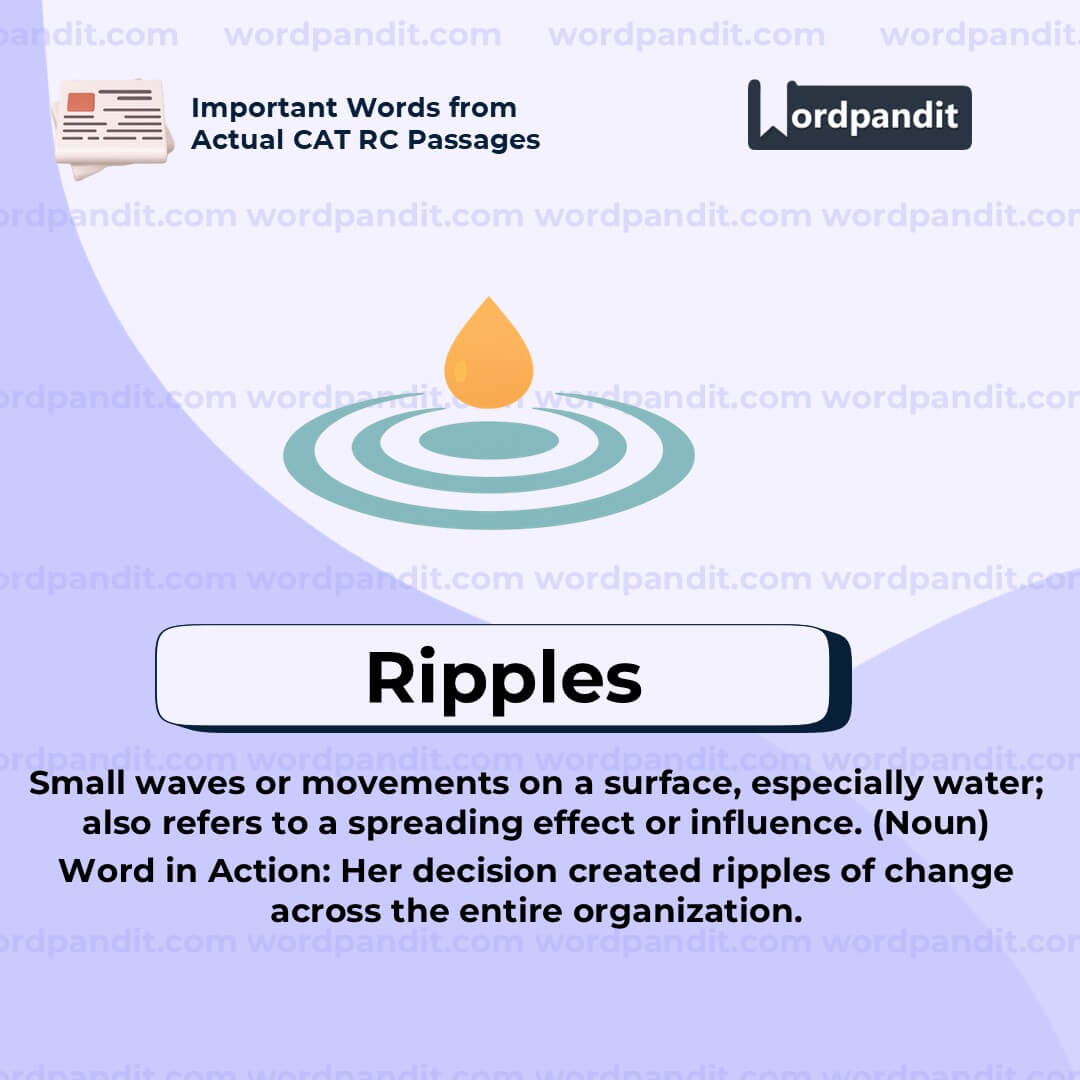
WORD-8: Ripples
Context:
"In other words, a fundamental tension ripples between the interests of the people doing the automation and the interests of the people doing the work." - Source: Commentary on the Social Impact of Automation
Explanatory Paragraph:
“Ripples” in this context is used metaphorically to describe how a force or emotion spreads subtly but powerfully through a situation or group. While “ripples” literally refer to small waves on the surface of water, here it conveys the idea that the tension between different stakeholders (those automating vs. those working) subtly influences or affects the larger environment. It suggests movement, spread, and impact—often gentle in appearance, but with lasting effects.
Meaning: To move or spread through something in small waves or undulations; to have a far-reaching but gradual effect (Verb/Noun – used here as a verb)
Pronunciation: RIP-uhlz
Difficulty Level: ⭐ Basic
Etymology: From Middle English *ripplen*, probably imitative of the sound or motion of water; related to the noun *ripple* meaning a small wave.
Prashant Sir's Notes:
“Ripples” is a powerful image-word. In essays or discussions, use it to describe how small actions or tensions gradually influence larger systems. It’s especially useful in economics, politics, sociology, and technology where consequences unfold over time.
Synonyms & Antonyms:
Synonyms: spread, radiate, undulate, reverberate, flow
Antonyms: halt, stagnate, concentrate, cease
Usage Examples:
- A nervous energy rippled through the crowd before the announcement.
- Economic instability in one region can ripple across global markets.
- His words caused ripples of discomfort in the meeting room.
- Tension ripples quietly in teams where collaboration is lacking.
Cultural Reference:
"Just as a stone creates ripples in a pond, so too do our actions spread beyond what we can see." – Popular Leadership Analogy
Think About It:
What small decisions have you made that created unexpected ripples in your life or in someone else’s? Can minor acts have major consequences?
Quick Activity:
Write two sentences using “ripples” in different ways—one literal (about water) and one metaphorical (about influence or emotion).
Memory Tip:
Imagine dropping a pebble into still water—the ripples start small but travel outward. That’s how influences work too—quiet but far-reaching.
Real-World Application:
“Ripples” is often used in leadership, education, economics, and social commentary to explain how small actions or policies can lead to broader effects over time—a concept crucial for understanding systems thinking and change-making.
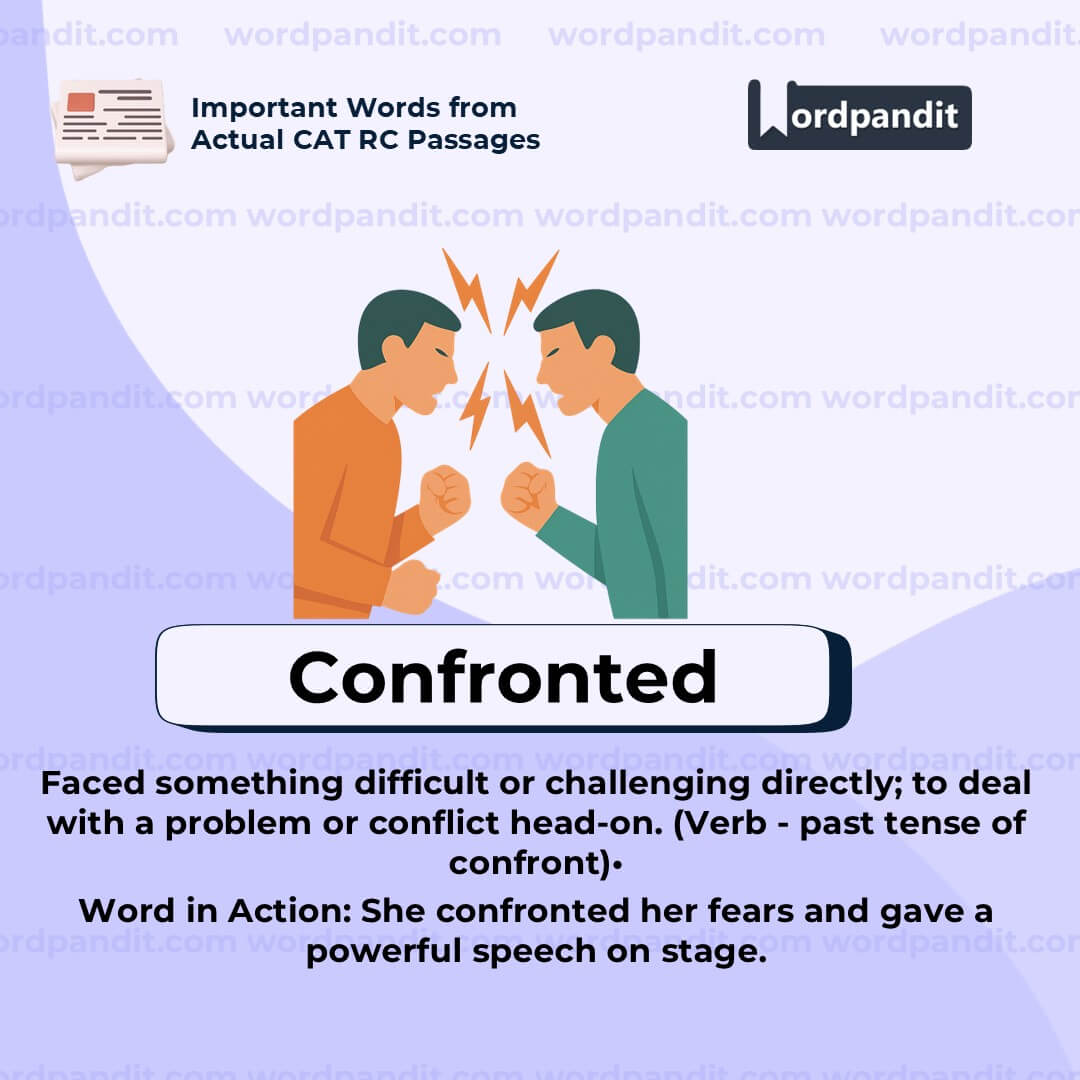
WORD-9: Confronted
Context:
"The people using the more advanced software, meanwhile, would often ‘aimlessly click around’ when confronted with a tricky problem. The supposedly helpful software actually short-circuited their thinking and learning." - Source: Study on the Cognitive Impact of Software Interfaces
Explanatory Paragraph:
“Confronted” means being faced with something—often a difficulty, challenge, or unpleasant situation—that demands attention or action. In this context, it suggests that users of the advanced software felt overwhelmed or unsure of what to do when a complex problem appeared. Instead of engaging deeply with the issue, they were passively reacting. The word implies direct exposure to a problem that cannot be ignored and typically requires a response.
Meaning: Faced or dealt with a difficult task, situation, or person (Verb – past tense)
Pronunciation: kun-FRUN-tid
Difficulty Level: ⭐⭐ Basic
Etymology: From Latin *confrontare*, meaning “to border on” or “to bring face to face,” from *com-* (“together”) + *frons* (“forehead, front”).
Prashant Sir's Notes:
Use “confronted” when describing direct encounters with obstacles or issues. It’s especially common in narratives, psychology, education, and leadership contexts. It’s a good contrast to avoidance—it means *you face it* head-on, even if unsure.
Synonyms & Antonyms:
Synonyms: faced, encountered, dealt with, opposed, challenged
Antonyms: avoided, ignored, evaded, sidestepped
Usage Examples:
- She confronted her fear of public speaking by volunteering to present.
- When confronted with the error, he immediately worked to correct it.
- Students often feel stressed when confronted with open-ended questions.
- The team was confronted by unexpected technical issues during the launch.
Cultural Reference:
"Not everything that is faced can be changed, but nothing can be changed until it is faced." – James Baldwin
Think About It:
What are some common ways people react when confronted with difficult problems? How can mindset influence the outcome?
Quick Activity:
Write a brief paragraph about a time you were confronted with a challenge—how did you respond, and what did you learn?
Memory Tip:
“Confronted” = *come front*. You’re brought face-to-face with something that demands your attention—you can’t turn away.
Real-World Application:
“Confronted” is common in personal development, news writing, psychology, and leadership training. It helps express emotional, strategic, or intellectual challenges that require active response.
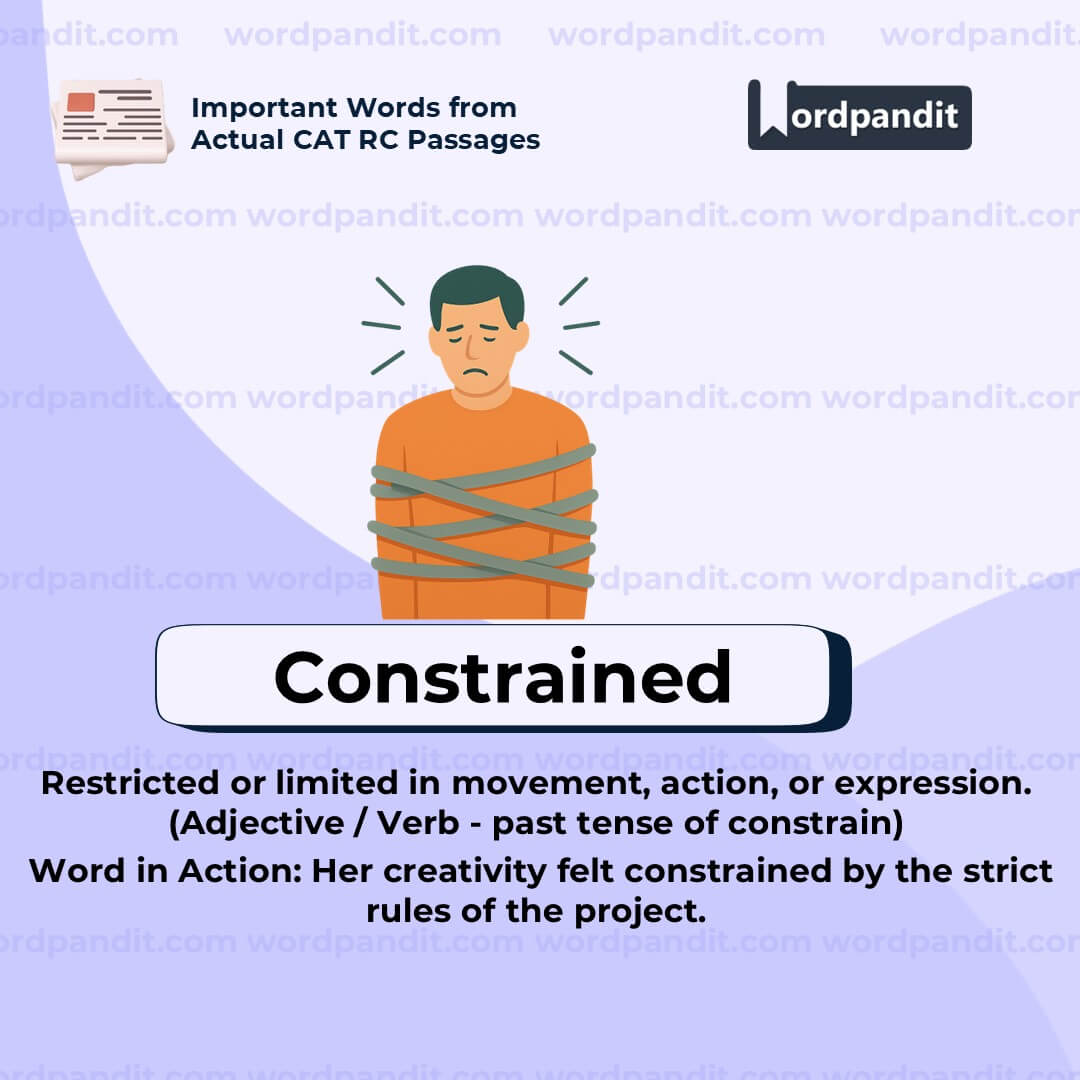
WORD-10: Constrained
Context:
"They argue that the digital templates used by the hospital’s clinicians to record patient information probably helped to induce a kind of tunnel vision. 'These highly constrained tools,' the researchers write, 'are optimized for data capture but at the expense of sacrificing their utility for appropriate triage and diagnosis.'" – Source: Study on the Cognitive Effects of Digital Health Tools
Explanatory Paragraph:
“Constrained” refers to something being limited, restricted, or held back—either physically, mentally, or functionally. In this context, it describes digital tools that are rigidly structured and allow very little flexibility. While these tools may efficiently collect data, their constrained nature limits clinicians’ ability to think holistically or make nuanced decisions. The word often implies artificial or imposed boundaries that hinder creativity, freedom, or effectiveness.
Meaning: Restricted or limited in scope, movement, or expression (Adjective – past participle form of “constrain”)
Pronunciation: kun-STREYND
Difficulty Level: ⭐⭐⭐ Intermediate
Etymology: From Latin *constringere*, meaning “to bind tightly,” from *com-* (“together”) + *stringere* (“to draw tight”).
Prashant Sir's Notes:
“Constrained” is excellent for academic or critical writing when discussing systems, structures, or ideas that limit freedom of thought or action. It's common in tech, design, and education critiques. Use it to describe mental blocks or physical restrictions caused by external design or rules.
Synonyms & Antonyms:
Synonyms: restricted, limited, bound, restrained, rigid
Antonyms: free, flexible, unrestrained, liberated, open
Usage Examples:
- The design of the form was so constrained that users couldn't input custom details.
- His creativity felt constrained by the strict rules of the competition.
- Constrained decision-making leads to blind spots in complex systems.
- The students’ choices were constrained by a limited curriculum.
Cultural Reference:
"Innovation is born not in freedom, but in constraint." – Popular startup maxim, highlighting how constraints can both hinder and inspire creativity.
Think About It:
Can constraints sometimes be useful? When do they help focus effort, and when do they stifle growth or innovation?
Quick Activity:
Write two sentences: one where "constrained" has a negative effect (e.g., blocking creativity), and one where it has a positive outcome (e.g., encouraging focus or discipline).
Memory Tip:
“Constrained” = *con + strain* — Think of being tightly pulled in or boxed in, with no room to move freely.
Real-World Application:
“Constrained” is commonly used in software design, policy-making, education, and psychology. It helps describe systems or environments where options are limited, often leading to predictable—but sometimes inefficient—outcomes.


