
✨ Introduction
Mastering Reading Comprehension begins with mastering the words!
In this post, we dive deep into vocabulary taken directly from an actual CAT RC passage. Each word has been explained in a simple, easy-to-understand way, along with examples to help you grasp its usage in real contexts.
From words like "species" and "cognitive" to "subjection" and "paradise," strengthen your vocabulary one word at a time — and take your RC performance to the next level!
📚 What’s Inside This Vocabulary Post?
- 🔍 Words Sourced from an Actual CAT RC Passage: Directly pick up important vocabulary from real CAT exam material.
- 🧠 Meaningful Explanations: Understand the exact meaning and usage of each word in a simple, student-friendly way.
- ✍️ Context-Based Learning: Learn words with examples that reflect their actual usage in reading comprehension contexts.
- 🗂️ Quick Reference Format: Words are neatly listed with meanings, parts of speech, and example sentences for easy revision.
- 🚀 Boost Your RC and Verbal Ability Skills: Improve your understanding of tough passages by strengthening your vocabulary.
📝 Words Covered in This Article:
- Deep-pocketed
- Appealing
- Impassioned
- Executives
- Stuck
- Quirks
- Non-polyglots
- Endeavour
- Fictitious
- Ageing
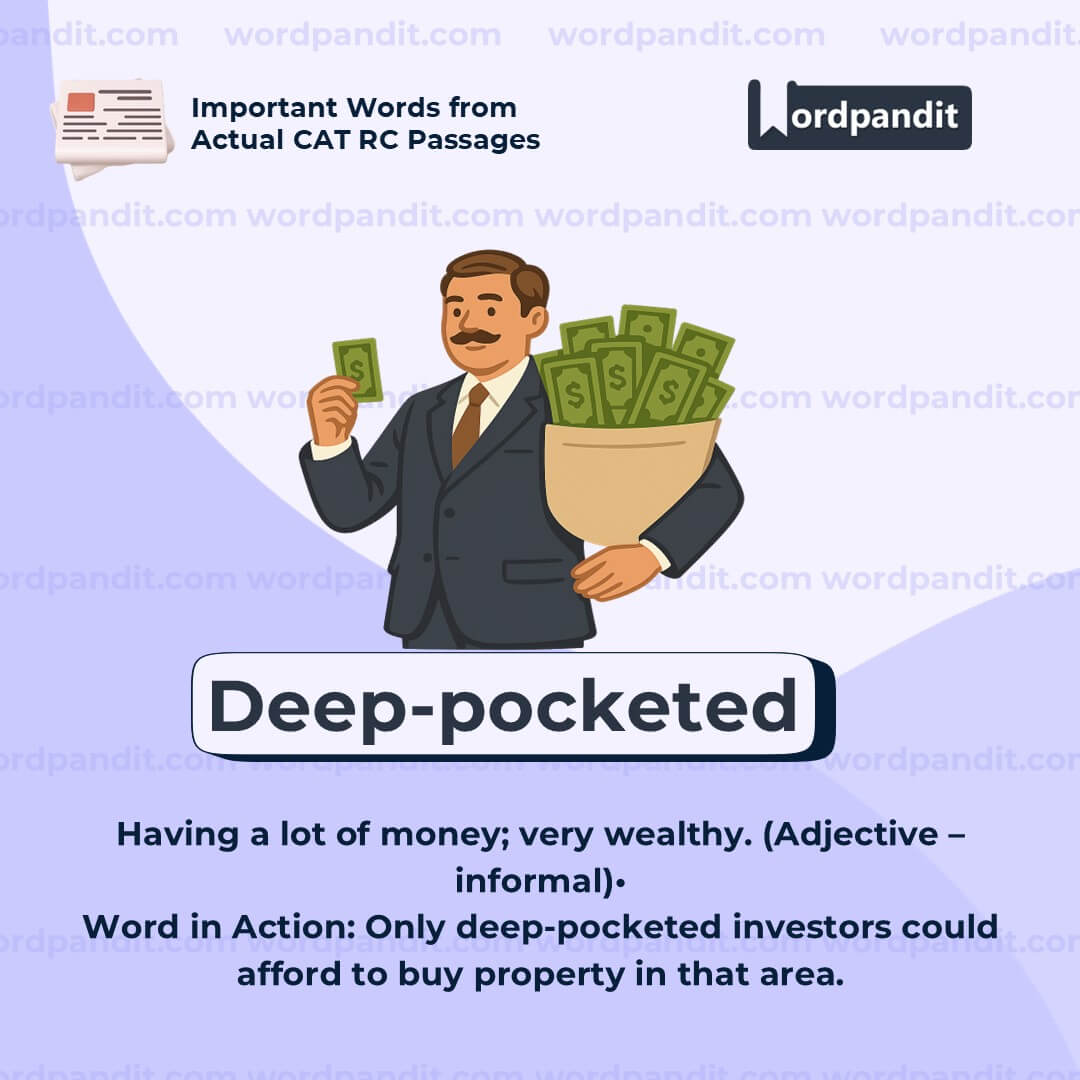
WORD-1: Deep-pocketed
Context:
"Netflix and other deep-pocketed global firms speak it well. Just as the EU employs a small army of translators and interpreters to turn intricate laws or impassioned speeches of Romanian MEPs into the EU’s 24 official languages, so do the likes of Netflix. It now offers dubbing in 34 languages and subtitling in a few more." - The Economist
Explanatory Paragraph:
The term "deep-pocketed" is often used to describe individuals or organizations that have substantial financial resources. In the context of the sentence, it emphasizes how companies like Netflix have enough capital to invest heavily in content translation and localization across many languages, a task that would otherwise be too expensive for smaller firms. Essentially, being "deep-pocketed" allows these firms to compete globally with ease.
Meaning: Wealthy; having substantial financial resources (Adjective)
Pronunciation: deep-POK-it-ed
Difficulty Level: ⭐⭐ Beginner to Intermediate
Etymology: From the metaphorical use of “deep pockets,” suggesting a lot of money stored or the ability to pay large amounts; first used in legal and business contexts in the 20th century.
Prashant Sir's Notes:
This is a classic metaphorical adjective. It is commonly used in media, finance, and business-related discussions. Think of it as describing someone who can "reach deep into their pocket" to pay for big ventures or rescue others financially.
Synonyms & Antonyms:
Synonyms: wealthy, affluent, well-funded, moneyed, well-heeled
Antonyms: broke, poor, cash-strapped, penniless, insolvent
Usage Examples:
- The lawsuit attracted a deep-pocketed investor who was willing to fund the legal battle.
- Only deep-pocketed collectors could afford to bid on the rare art pieces at the auction.
- The startup is now backed by a deep-pocketed venture capital firm.
- Deep-pocketed tech giants are reshaping global media consumption habits.
Cultural Reference:
"Deep-pocketed donors have long influenced U.S. elections through super PACs." - A common theme in political reporting
Think About It:
Does financial power always equate to influence and success in today's globalized world? What are the limits of being "deep-pocketed"?
Quick Activity:
Make a list of five industries where being deep-pocketed offers a major competitive advantage. Briefly explain why.
Memory Tip:
Imagine someone with pockets so deep, they can pull out wads of cash endlessly—easy way to recall that this term means wealthy!
Real-World Application:
This word is especially useful in business and economics-related discussions, from describing powerful corporations to influential philanthropists.
WORD-2: Appealing
Context:
"The economics of European productions are more appealing, too. American audiences are more willing than before to give dubbed or subtitled viewing a chance." - The Economist
Explanatory Paragraph:
"Appealing" is used here to describe something that is attractive or desirable. In this case, it refers to the financial aspects of European productions being more favorable or enticing, possibly because of lower production costs or higher value for money. The word suggests a positive quality that draws attention or interest.
Meaning: Attractive or interesting; desirable (Adjective)
Pronunciation: uh-PEE-ling
Difficulty Level: ⭐ Beginner
Etymology: From the verb "appeal," which comes from Latin *appellare*, meaning "to call upon" or "to address." The adjective form emerged in the 18th century to describe something that "calls to" or "attracts" someone.
Prashant Sir's Notes:
“Appealing” is a versatile word often used to describe anything that grabs positive attention—be it a movie, a proposal, or even a personality trait. Keep in mind the tone: it’s always positive or attractive in some way.
Synonyms & Antonyms:
Synonyms: attractive, inviting, enticing, engaging, charming
Antonyms: unappealing, unattractive, off-putting, repellent, distasteful
Usage Examples:
- The job offer was appealing due to its flexible hours and generous benefits.
- The dessert looked especially appealing with its glossy chocolate glaze.
- Her calm demeanor and eloquence made her an appealing candidate for the leadership role.
- Minimalist design has become increasingly appealing to younger consumers.
Cultural Reference:
"What is appealing is not always what is right." - A common moral in children's literature and ethics discussions.
Think About It:
Can something be appealing yet harmful at the same time? Think about examples in advertising or fast food.
Quick Activity:
Write down three things that you find appealing in entertainment (movies, books, or shows) and explain why they attract you.
Memory Tip:
Think of the phrase “appeals to me”—if something appeals to you, it’s appealing. They share the same root and feeling of attraction.
Real-World Application:
Use "appealing" in everyday contexts like marketing, product reviews, personal descriptions, or when expressing preferences in conversations and writing.
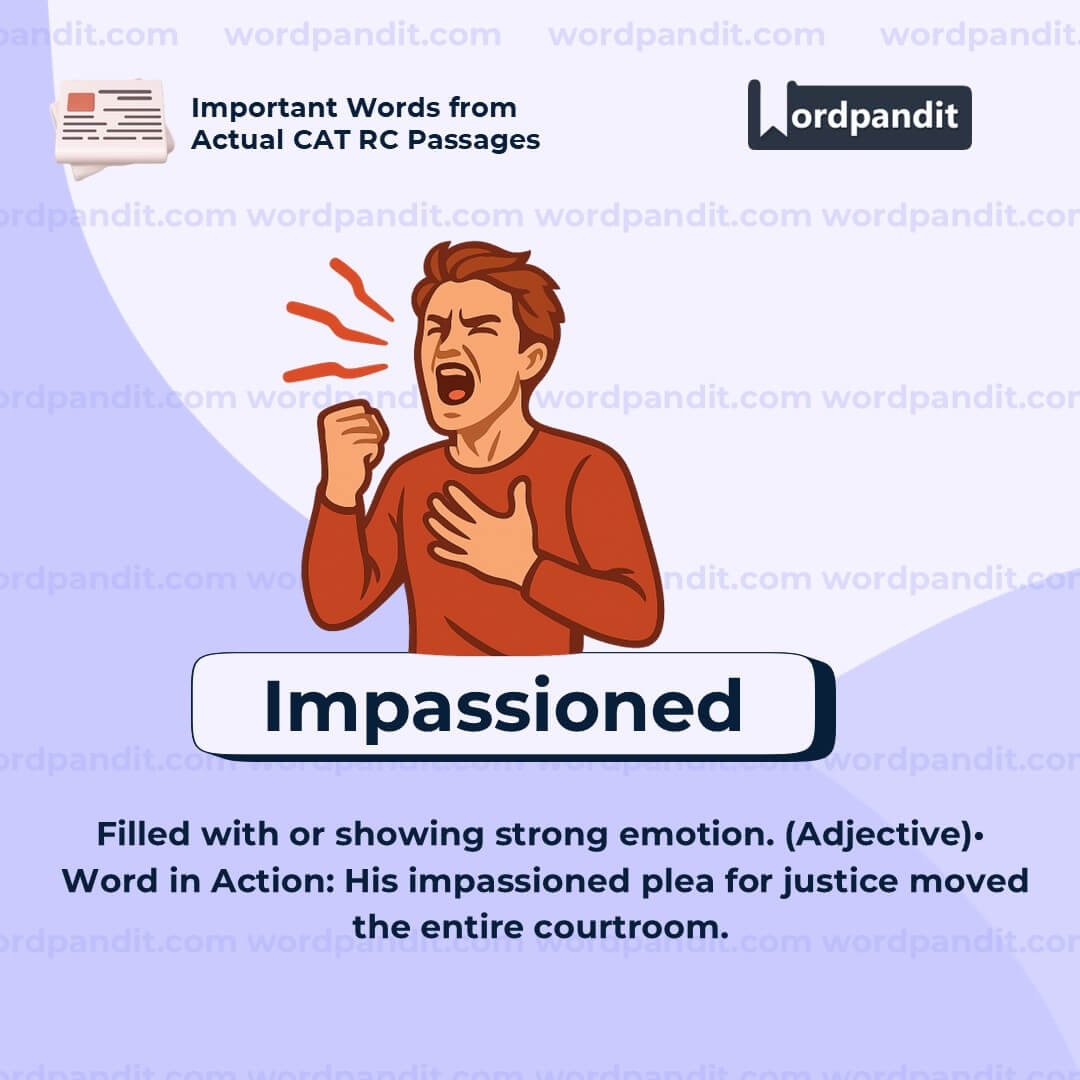
WORD-3: Impassioned
Context:
". Just as the EU employs a small army of translators and interpreters to turn intricate laws or impassioned speeches of Romanian MEPs into the EU’s 24 official languages, so do the likes of Netflix. It now offers dubbing in 34 languages and subtitling in a few more." - The Economist
Explanatory Paragraph:
"Impassioned" is used to describe speech or writing that is filled with strong emotion and conviction. In this context, the speeches by Romanian Members of the European Parliament (MEPs) are described as "impassioned" to emphasize their emotionally charged and persuasive nature. This word highlights that the content isn’t just formal or dry—it carries fervor and intensity.
Meaning: Filled with or showing great emotion (Adjective)
Pronunciation: im-PASH-und
Difficulty Level: ⭐⭐ Intermediate
Etymology: From "in-" (into) + "passion" (strong feeling or emotion), dating back to the early 17th century; literally, “into passion.”
Prashant Sir's Notes:
“Impassioned” is great for describing speeches, debates, letters, or performances where emotions run high. It carries a positive tone, unlike “emotional,” which can sometimes suggest lack of control.
Synonyms & Antonyms:
Synonyms: emotional, fervent, heartfelt, enthusiastic, zealous
Antonyms: detached, dispassionate, unemotional, indifferent, apathetic
Usage Examples:
- She delivered an impassioned plea for justice at the rally.
- His impassioned speech moved the audience to tears.
- The writer's impassioned letter to the editor gained widespread attention.
- In court, the lawyer gave an impassioned defense of his client.
Cultural Reference:
"Martin Luther King Jr.’s 'I Have a Dream' is one of the most impassioned speeches in history." - A symbol of civil rights advocacy
Think About It:
Do impassioned speeches always lead to change, or does emotion sometimes cloud judgment?
Quick Activity:
Write a short impassioned paragraph about a cause you deeply care about—climate change, education, animal rights, etc.
Memory Tip:
Think of “passion” as the fire and “impassioned” as something on fire with emotion—easy way to remember its intensity!
Real-World Application:
"Impassioned" is commonly used in journalism, literature, and politics to describe moving speeches, performances, or writings that aim to influence or inspire people.

WORD-4: Executives
Context:
"In Brussels and national capitals, the prospect of Netflix as a cultural hegemon is seen as a threat. 'Cultural sovereignty' is the watchword of European executives worried that the Americans will eat their lunch." - The Economist
Explanatory Paragraph:
The word "executives" refers to high-level officials or leaders in government, corporations, or other organizations who are responsible for making important decisions. In this context, "European executives" are likely government leaders or senior cultural policymakers who are concerned about the dominance of American media companies like Netflix. They fear that such influence could undermine local cultures and media industries.
Meaning: People with senior managerial or administrative authority in an organization (Noun – plural)
Pronunciation: egg-ZEK-yoo-tivs
Difficulty Level: ⭐⭐ Intermediate
Etymology: Derived from Latin *exsequi*, meaning "to follow out" or "carry out." The term evolved in English from “execute” (to carry out plans or duties) to refer to people responsible for doing so.
Prashant Sir's Notes:
Think of executives as the people who sit at the top of the organizational ladder—they don’t just plan, they ensure that actions are taken. They're decision-makers in both corporate and government contexts.
Synonyms & Antonyms:
Synonyms: administrators, directors, officials, managers, chiefs
Antonyms: subordinates, employees, workers, assistants, interns
Usage Examples:
- The company's top executives met to discuss their international expansion strategy.
- Government executives are under pressure to respond to public concerns about digital media regulation.
- Many tech executives have backgrounds in engineering and business management.
- The film was greenlit after a group of media executives saw its potential for global appeal.
Cultural Reference:
"Corporate executives are often portrayed as power brokers in films like *The Wolf of Wall Street* or *Succession*, highlighting both influence and moral ambiguity." - Pop Culture Insight
Think About It:
Should cultural decisions be made by executives, or should more creative voices have the final say in such matters?
Quick Activity:
Imagine you’re an executive for a new streaming platform. Write down three policies you’d implement to promote cultural diversity in content.
Memory Tip:
Executives “execute” big plans—think of them as the people who press the “Go” button on important projects!
Real-World Application:
The word "executives" is widely used in business, government, media, and nonprofit sectors to describe individuals in decision-making roles who influence major outcomes.
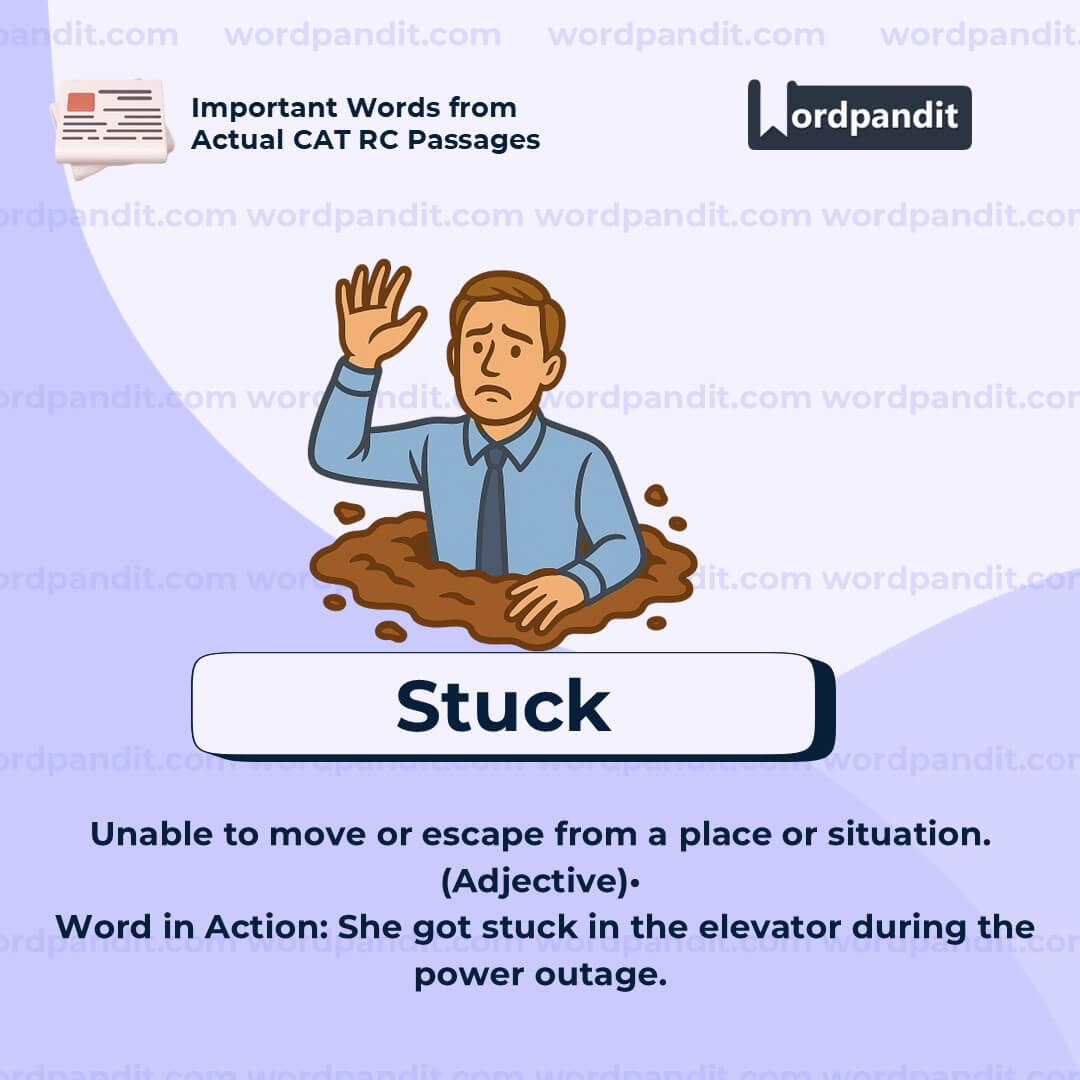
WORD-5: Stuck
Context:
". To be fair, Netflix content sometimes seems stuck in an uncanny valley somewhere in the mid-Atlantic, with local quirks stripped out." - The Economist
Explanatory Paragraph:
In this sentence, "stuck" conveys the idea of being trapped or unable to move forward from a certain position or condition. Here, it describes how Netflix’s content sometimes feels awkwardly caught between American and European styles—neither fully localized nor completely authentic—leading to a bland, generic feel. It evokes the sense of being motionless or caught in an in-between state.
Meaning: Unable to move or escape from a particular place, position, or situation (Adjective/Verb - past participle)
Pronunciation: stuk
Difficulty Level: ⭐ Beginner
Etymology: Past participle of the verb “stick,” which comes from Old English *stician*, meaning “to pierce or remain fixed.” The figurative use ("stuck in a situation") became common by the 19th century.
Prashant Sir's Notes:
“Stuck” is an everyday word but very rich in metaphorical meaning. It can describe physical, emotional, or conceptual immobility. In writing and analysis, it's often used figuratively to explain something that hasn’t evolved or is trapped between options.
Synonyms & Antonyms:
Synonyms: trapped, fixed, wedged, jammed, immobilized
Antonyms: free, released, unblocked, detached, mobile
Usage Examples:
- We got stuck in traffic for two hours on the way to the airport.
- She felt stuck in a job that offered no creative freedom.
- The idea was stuck in his mind, and he couldn't stop thinking about it.
- The car was stuck in the mud after the rainstorm.
Cultural Reference:
"Stuck in the Middle with You" – a 1972 song by Stealers Wheel, which uses “stuck” metaphorically to express discomfort in a confusing situation.
Think About It:
Have you ever felt stuck between two choices or identities? What helped you move forward?
Quick Activity:
Write a short paragraph using “stuck” in both a literal and a metaphorical sense.
Memory Tip:
Visualize being stuck in glue—physically unable to move. That same idea applies emotionally or mentally when you can’t make progress.
Real-World Application:
“Stuck” is widely used in daily conversations, therapy, decision-making, and storytelling. It helps express frustration, indecision, or inertia in a relatable way.
WORD-6: Quirks
Context:
"To be fair, Netflix content sometimes seems stuck in an uncanny valley somewhere in the mid-Atlantic, with local quirks stripped out." - The Economist
Explanatory Paragraph:
"Quirks" refers to peculiar or unique traits, often charming or characteristic of a person, culture, or system. In this context, “local quirks” refers to the distinctive cultural traits, mannerisms, or storytelling styles that make local content feel authentic and grounded. Saying they are “stripped out” suggests the content has been overly standardized, losing its uniqueness.
Meaning: Unusual or distinctive traits or behaviors (Noun – plural)
Pronunciation: kwurks
Difficulty Level: ⭐⭐ Intermediate
Etymology: Of uncertain origin; possibly from 16th-century English to mean a sudden twist or turn, later used figuratively for personal or cultural oddities.
Prashant Sir's Notes:
“Quirk” is a delightful word often used to highlight what makes something or someone stand out—in a good or curious way. In exams or essays, it can add nuance to cultural or behavioral analysis.
Synonyms & Antonyms:
Synonyms: peculiarities, oddities, eccentricities, idiosyncrasies, traits
Antonyms: norms, conventions, standards, regularities, commonalities
Usage Examples:
- One of her quirks is talking to her plants as if they’re old friends.
- The novel's charm lies in its quirky characters and unexpected plot twists.
- Every culture has its own quirks that make it fascinating to outsiders.
- Despite the software's quirks, users found it endearing and easy to use.
Cultural Reference:
“Quirky” is often used to describe independent films or sitcoms like *New Girl* or *The Grand Budapest Hotel*, known for their offbeat, lovable characters.
Think About It:
Are quirks something we should celebrate or iron out? How do they influence storytelling and identity?
Quick Activity:
List three quirks you or someone you know has. Are they cultural, personal, or professional? Reflect on whether they help or hinder.
Memory Tip:
Quirks are like “quirky fireworks”—unexpected little pops of uniqueness. Easy to recall by picturing fun, surprising traits!
Real-World Application:
Understanding quirks helps in intercultural communication, character development in fiction, and even UX design where user behaviors may vary in unexpected ways.
WORD-7: Non-polyglots
Context:
"Google Translate makes European newspapers comprehensible, even if a little clunky, for the continent’s non-polyglots. American social-media companies make it easier for Europeans to talk politics across borders." - The Economist
Explanatory Paragraph:
"Non-polyglots" refers to people who do not speak multiple languages. The prefix “non-” simply negates the root word. In the context of this sentence, it points to Europeans who are not fluent in several languages and who benefit from tools like Google Translate to access foreign-language content. This highlights the gap in multilingual abilities and the role of technology in bridging it.
Meaning: People who speak only one or a limited number of languages (Noun – plural)
Pronunciation: non-PAH-lee-glots
Difficulty Level: ⭐⭐⭐ Advanced
Etymology: "Polyglot" comes from Greek *poly* (many) + *glotta* (tongue or language). Adding the prefix *non-* turns it into its opposite: not a speaker of many languages.
Prashant Sir's Notes:
This is a great word to describe language limitations without sounding too negative. It’s useful in academic, linguistic, and cultural discussions. Remember, it's more formal and not commonly used in casual speech.
Synonyms & Antonyms:
Synonyms: monolinguals, single-language speakers
Antonyms: polyglots, multilinguals, linguists
Usage Examples:
- Non-polyglots often rely on subtitles when watching foreign films.
- The app was designed to help non-polyglots navigate multilingual environments more confidently.
- For non-polyglots, traveling abroad can be both exciting and intimidating.
- Non-polyglots may struggle in international workplaces without translation support.
Cultural Reference:
Europe is known for its linguistic diversity, and polyglots are common in many regions. However, digital tools are increasingly supporting non-polyglots in cross-border communication.
Think About It:
Should educational systems place more emphasis on multilingualism to reduce reliance on translation tools among non-polyglots?
Quick Activity:
Make a list of three benefits and three limitations non-polyglots face in a globalized world.
Memory Tip:
Break it down: "non" (not) + "poly" (many) + "glot" (tongue/language) = not many languages. Think of a person who needs Google Translate!
Real-World Application:
Use this word when discussing language barriers, global communication, or the digital divide in multilingual societies. It's especially relevant in education, tech, and cultural studies.
WORD-8: Endeavour
Context:
"Now Netflix and friends pump the same content into homes across a continent, making culture a cross-border endeavour, too." - The Economist
Explanatory Paragraph:
The word "endeavour" refers to an attempt or effort to achieve something, especially one that is meaningful or challenging. In this context, “a cross-border endeavour” describes the collective effort to create and distribute cultural content across multiple countries. It underscores how cultural exchange and media production are now collaborative actions that span national boundaries, reflecting globalization and shared creative ambition.
Meaning: A serious or determined attempt or effort to achieve something (Noun)
Pronunciation: en-DEV-er
Difficulty Level: ⭐⭐⭐ Intermediate to Advanced
Etymology: From Old French *en deveir* meaning “in duty” or “to make an effort,” later evolving into Middle English as "endevere."
Prashant Sir's Notes:
“Endeavour” is a formal and powerful word that often adds weight to writing or speech. It fits well in academic, journalistic, or ceremonial contexts. Note: "endeavour" is British spelling; the American spelling is "endeavor."
Synonyms & Antonyms:
Synonyms: effort, attempt, venture, undertaking, pursuit
Antonyms: idleness, inaction, apathy, neglect
Usage Examples:
- The scientific endeavour to explore Mars has led to incredible technological advances.
- Building a multilingual platform is a challenging but rewarding endeavour.
- Her philanthropic endeavours have helped thousands in underdeveloped regions.
- Teamwork is essential for the success of any large-scale endeavour.
Cultural Reference:
NASA’s space shuttle *Endeavour* was named to symbolize bold exploration and ambitious effort—an iconic real-world use of the word.
Think About It:
What is one personal or societal endeavour you believe deserves more support and recognition?
Quick Activity:
Write two sentences using "endeavour"—one about a personal goal and one about a global or community initiative.
Memory Tip:
Think of “Endeavour” as something you “do with effort.” It even sounds like “in-devour,” as if you're diving into a challenge with dedication!
Real-World Application:
"Endeavour" is often used in formal writing, grant proposals, global project descriptions, or anytime you want to convey purposeful effort.
WORD-9: Fictitious
Context:
". Watching fictitious northern and southern Europeans tear each other apart 2,000 years ago beats doing so in reality." - The Economist
Explanatory Paragraph:
"Fictitious" refers to something that is not real, but rather imagined or invented—typically for entertainment or illustrative purposes. In this context, it describes fictional portrayals of ancient European conflicts in historical dramas or shows. The author humorously contrasts fictional violence with the horrors of real-world conflict, suggesting that dramatized narratives are a safer and more digestible way of exploring history.
Meaning: Not real; invented or imagined, especially for storytelling or deception (Adjective)
Pronunciation: fik-TISH-us
Difficulty Level: ⭐⭐ Intermediate
Etymology: From Latin *ficticius*, meaning "feigned or artificial," which comes from *fingere*, "to shape or invent."
Prashant Sir's Notes:
“Fictitious” is different from “fictional.” While both can refer to things that aren’t real, “fictitious” often suggests a deliberate falsehood (e.g., a fictitious name or excuse), whereas “fictional” is more neutral, usually relating to literature or stories.
Synonyms & Antonyms:
Synonyms: imaginary, invented, fabricated, unreal, made-up
Antonyms: real, factual, genuine, authentic, actual
Usage Examples:
- The detective discovered that the suspect had used a fictitious identity to book the hotel room.
- Many historical novels include fictitious characters alongside real events.
- The excuse he gave for being late was clearly fictitious.
- She enjoys writing about fictitious worlds where magic and science coexist.
Cultural Reference:
Many iconic works of literature—from *Sherlock Holmes* to *Harry Potter*—are filled with beloved fictitious characters who feel real to their audiences.
Think About It:
Why do humans find comfort and meaning in fictitious stories, even when they know they aren't real?
Quick Activity:
List three fictitious characters from books, TV shows, or movies. Describe one unique trait for each that makes them memorable.
Memory Tip:
Think of “fictitious” as something from “fiction”—but often with a hint of make-believe or even deceit built in.
Real-World Application:
"Fictitious" is useful in discussions about storytelling, media, law (fictitious names or entities), and even everyday situations involving excuses or imagined scenarios.
WORD-10: Ageing
Context:
"Streaming services, such as Netflix or Disney+, account for about a third of all viewing hours, even in markets where they are well-established. Europe is an ageing continent." - The Economist
Explanatory Paragraph:
The word "ageing" refers to the process of growing older or the demographic trend of a population with an increasing average age. In this context, describing Europe as an "ageing continent" means that a significant portion of its population is elderly or nearing old age, due to lower birth rates and higher life expectancy. This trend has major implications for economics, media consumption, labor markets, and healthcare systems.
Meaning: The process of becoming older; growing old (Noun/Adjective)
Pronunciation: AY-jing
Difficulty Level: ⭐ Beginner
Etymology: Derived from the verb "age" + suffix “-ing.” The British spelling is "ageing," while the American variant is "aging."
Prashant Sir's Notes:
“Ageing” is not just about individuals—it’s also widely used in demographics and policy discussions. Watch for the context: is it describing a person, a society, or even a product (like wine or cheese)?
Synonyms & Antonyms:
Synonyms: growing old, maturing, senescing (formal), greying
Antonyms: rejuvenating, renewing, young, youthful
Usage Examples:
- Ageing populations pose challenges to healthcare and pension systems.
- He took care of his ageing parents with great dedication.
- In many rural towns, the population is ageing rapidly as young people move to cities.
- The ageing cheese developed a rich, complex flavor over time.
Cultural Reference:
“The ageing population” is a term often used in UN and WHO reports discussing global demographic shifts and their policy implications.
Think About It:
As populations age, how should societies balance the needs of the elderly with the aspirations of the younger generations?
Quick Activity:
Write two sentences—one using "ageing" in the context of people, and another using it metaphorically (e.g., ageing infrastructure).
Memory Tip:
Think of “ageing” as the gentle ticking of time—whether it’s for people, cheese, or cities. If it’s slowly getting older, it’s ageing!
Real-World Application:
"Ageing" is frequently used in policy discussions, healthcare, demographics, and even in industries like food, where it can signify quality and maturity (e.g., ageing wine or meat).


