
📘 What’s Inside This CAT Misfit Sentence/Odd One Out Question Post?
📝 Authentic CAT Misfit Sentence/Odd One Out Question: Practice with a real CAT Para-jumble Question from a previous CAT exam.
✅ Detailed Question with Step-by-Step Solution: Each question is explained thoroughly for better understanding.
📚 Vocabulary Enhancement: Top 5 words explained from the paragraph
Misfit Sentence/Odd One Out Question
Q.19 Five jumbled up sentences (labelled 1, 2, 3, 4 and 5), related to a topic, are given below. Four of them can be put together to form a coherent paragraph. Identify the odd sentence and key in the number of that sentence as your answer.
1. Although hard skills have traditionally ruled the roost, some companies are moving away from choosing prospective hires based on technical abilities alone.
2. Companies are shaking off the old definition of an ideal candidate and ditching the idea of looking for the singularly perfect candidate altogether.
3. Now, some job descriptions are frequently asking for candidates to demonstrate soft skills, such as leadership or teamwork.
4. That’s not to say that practical know-how is no longer required - some jobs still call for highly specific expertise.
5. The move towards prioritising soft skills “is a natural response to three years of the pandemic” says a senior recruiter at Cenlar FSB.
Solution with Explanation
Correct Answer: 2
Detailed explanation by Wordpandit:
The paragraph focuses on the shift in hiring practices where companies now prioritize soft skills alongside technical abilities, especially in the context of the post-pandemic job market.
- Sentence 1 introduces the shift from solely valuing technical skills to considering other qualities.
- Sentence 3 elaborates on this by mentioning that job descriptions now frequently request soft skills, such as leadership and teamwork.
- Sentence 4 clarifies that while soft skills are increasingly valued, technical expertise is still necessary for some roles.
- Sentence 5 provides context, attributing this shift towards soft skills as a natural response to the pandemic, with a recruiter’s perspective.
Sentence 2 is the odd one out because it discusses companies abandoning the idea of finding a “singularly perfect candidate,” which diverges from the main focus on balancing hard and soft skills in hiring criteria.
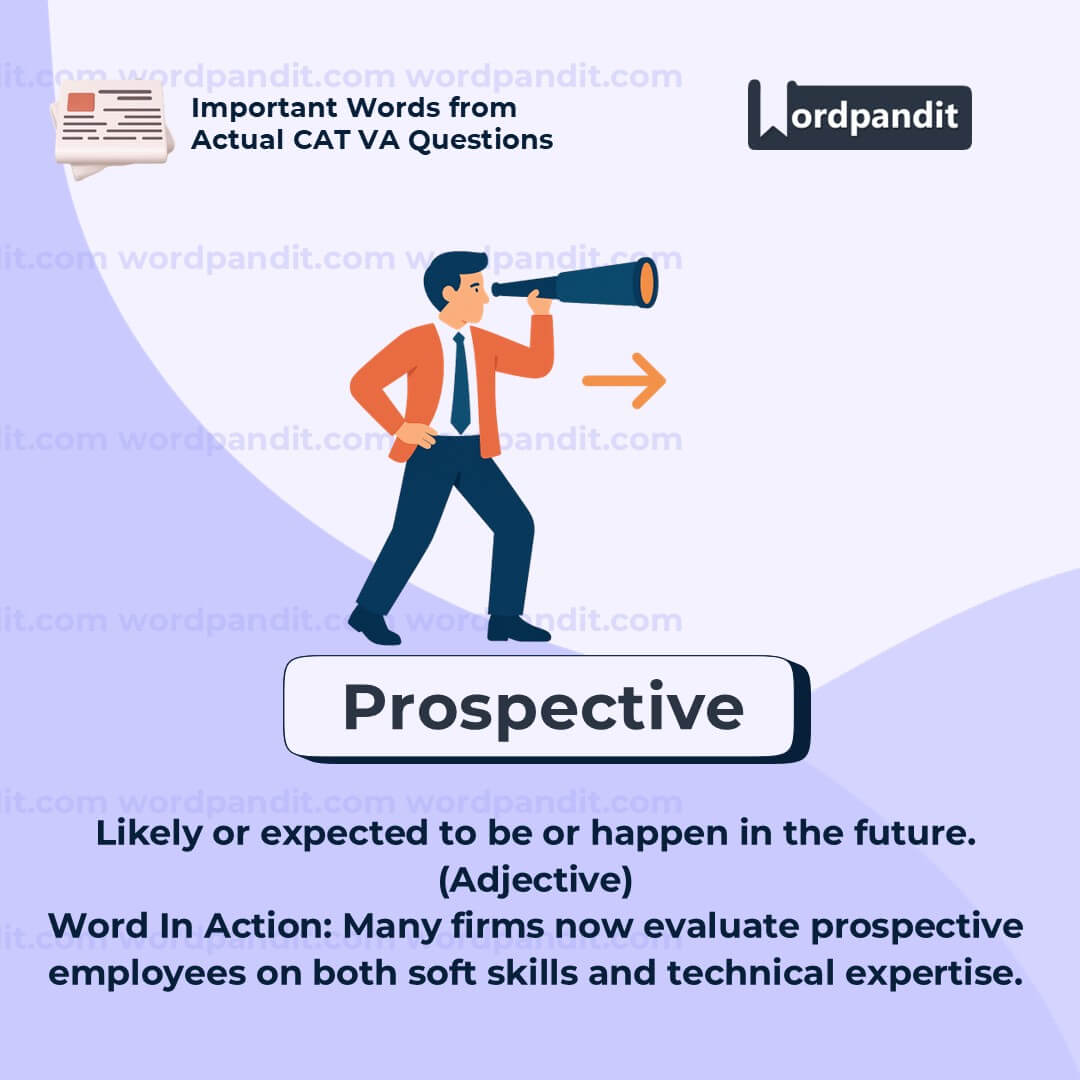
Word-1: Prospective
Context:
"Although hard skills have traditionally ruled the roost, some companies are moving away from choosing prospective hires based on technical abilities alone." - Business Article on Hiring Trends
Explanatory Paragraph:
The word “prospective” refers to something expected or likely to happen in the future. In hiring contexts, a “prospective hire” is someone being considered for a job but has not yet been employed. This term highlights the forward-looking nature of planning, recruitment, and decision-making. Companies use it to identify individuals who show potential or fit for future roles, even if the final decision hasn't been made yet.
Meaning: Likely or expected to happen or be considered in the future (Adjective)
Pronunciation: pruh-SPEK-tiv
Difficulty Level: ⭐⭐ Beginner-Intermediate
Etymology: From Latin *prospectus* meaning “a view forward,” from *pro-* (forward) + *specere* (to look)
Prashant Sir's Notes:
This word often appears in business, legal, and academic contexts. It signals anticipation or consideration about future possibilities. Be mindful not to confuse it with “perspective” (which refers to viewpoint) or “retrospective” (which looks back).
Synonyms & Antonyms:
Synonyms: potential, expected, likely, possible, probable
Antonyms: confirmed, current, past, unlikely, retrospective
Usage Examples:
- The university offers tours to prospective students and their families.
- He prepared thoroughly for the interview with his prospective employer.
- Prospective buyers must submit their offers by the end of the week.
- She was excited about the prospective opportunities in the new city.
Cultural Reference:
In college admissions and job applications, the term "prospective" is used widely—like in “prospective candidates,” “prospective students,” and “prospective clients”—to signify that something or someone is under consideration.
Think About It:
How does being labeled as a “prospective” candidate affect one's behavior and mindset in competitive situations?
Quick Activity:
Write three sentences using the word “prospective” to describe a future situation (job, plan, or person). Identify whether it reflects hope, uncertainty, or expectation.
Memory Tip:
Think of “prospective” as someone you “prospect” or look forward to—like a treasure prospector looking ahead for gold.
Real-World Application:
In human resources, marketing, and academia, the word “prospective” helps professionals plan, target, and communicate with individuals who are not yet involved but may be soon.
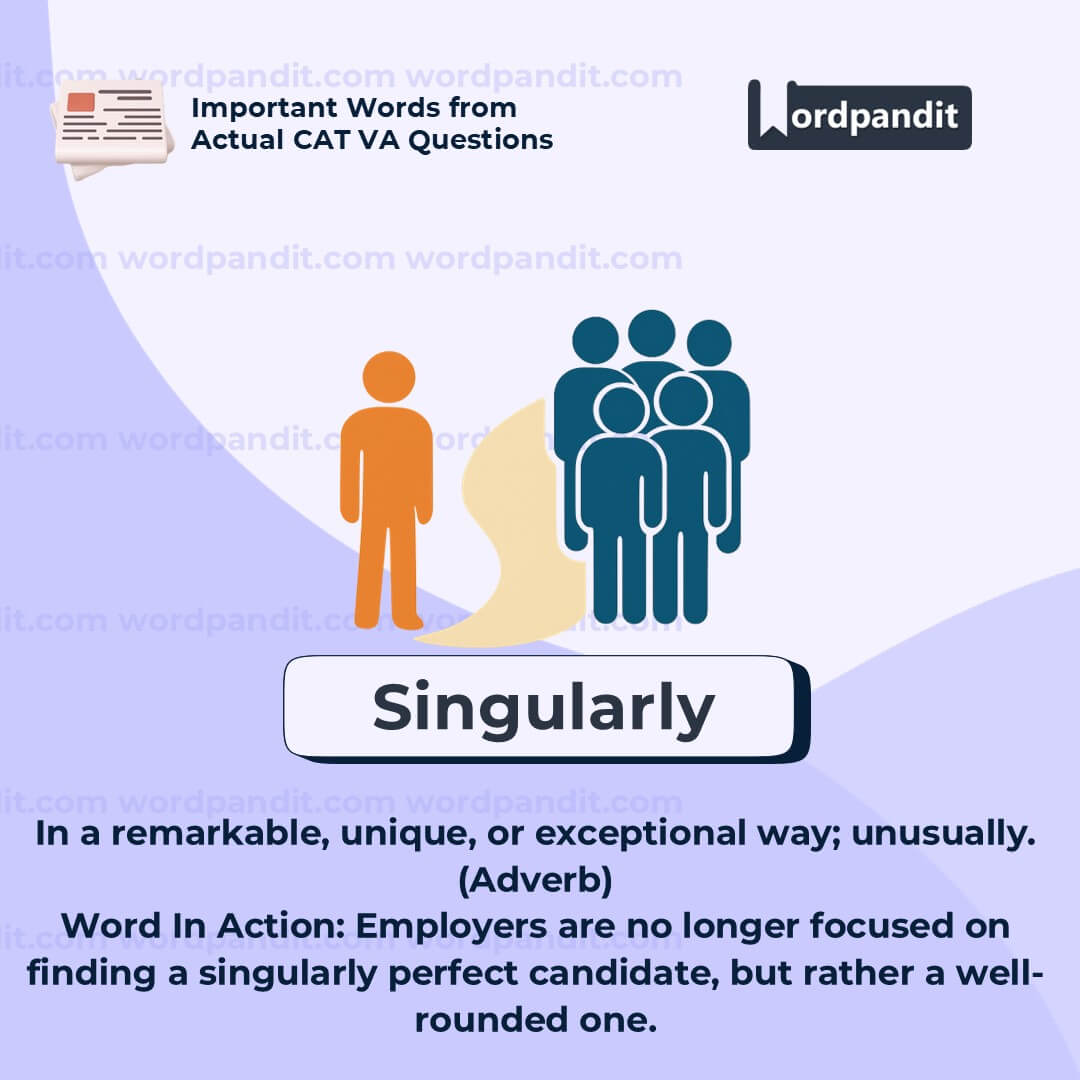
Word-2: Singularly
Context:
"Companies are shaking off the old definition of an ideal candidate and ditching the idea of looking for the singularly perfect candidate altogether." - Business Article on Hiring Trends
Explanatory Paragraph:
The adverb “singularly” is used to emphasize the uniqueness or exceptional nature of someone or something. It often means "in a unique way" or "particularly." In this context, the phrase "singularly perfect candidate" refers to a one-of-a-kind, flawless individual. The sentence suggests that companies are moving away from the unrealistic expectation of finding a perfect, all-encompassing candidate, acknowledging instead the value of diverse skill sets and potential for growth.
Meaning: In a remarkable, exceptional, or unique way; particularly or especially (Adverb)
Pronunciation: SING-gyuh-lur-lee
Difficulty Level: ⭐⭐⭐ Intermediate
Etymology: From Latin *singularis* (alone, unique) + English adverbial suffix “-ly”
Prashant Sir's Notes:
This word is great for adding emphasis in writing and speech. It often appears in formal or literary settings and should be used when you want to draw attention to something as unusually strong, weak, good, or bad. It's not about the number "one" but about being distinctive.
Synonyms & Antonyms:
Synonyms: exceptionally, particularly, uniquely, remarkably, notably
Antonyms: ordinarily, commonly, typically, generally, normally
Usage Examples:
- She was singularly focused on achieving her goals, blocking out all distractions.
- The proposal was singularly uninspiring and lacked creativity.
- He has been singularly successful in launching tech startups.
- The book was singularly important in shaping modern political theory.
Cultural Reference:
In classic literature, especially in Victorian novels, characters are often described as "singularly brave" or "singularly beautiful" to underscore their uniqueness—such as in the works of Jane Austen or Charles Dickens.
Think About It:
In a world that values collaboration and versatility, does the search for a “singularly perfect” person or solution hold us back?
Quick Activity:
Write three short descriptions using “singularly” to emphasize a quality (e.g., singularly talented, singularly flawed). Then rewrite them using a synonym.
Memory Tip:
“Singularly” comes from “singular”—think of it as spotlighting one unique trait or moment that stands out from the rest.
Real-World Application:
In performance reviews, academic feedback, or branding, “singularly” can be used to highlight standout traits or results in a sophisticated way.
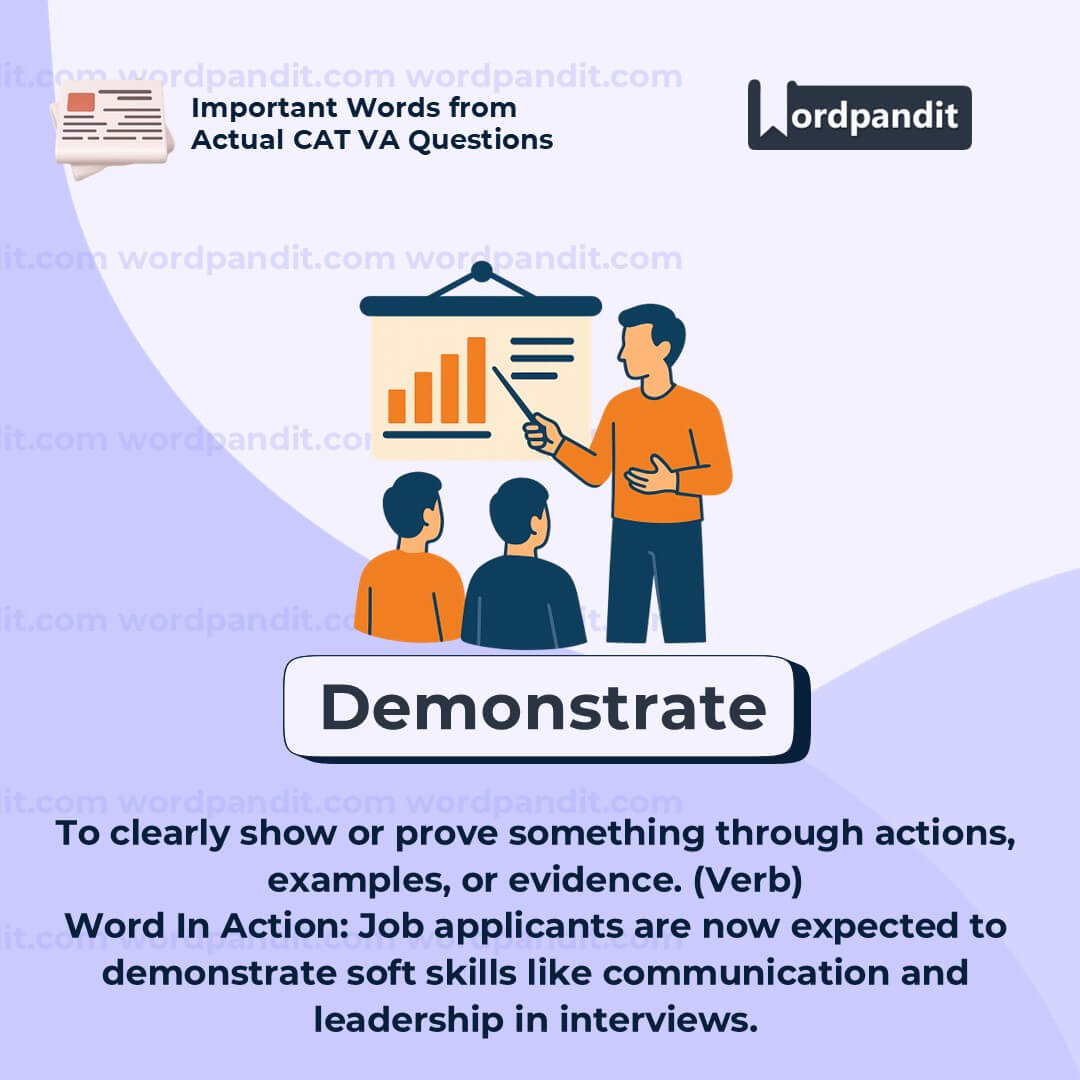
Word-3: Demonstrate
Context:
"Now, some job descriptions are frequently asking for candidates to demonstrate soft skills, such as leadership or teamwork." - Business Article on Hiring Trends
Explanatory Paragraph:
To “demonstrate” means to show or prove something clearly, often through action, behavior, or examples. In professional and academic contexts, it involves not just stating a claim but providing concrete evidence or performance that supports it. In the context of job applications, when companies ask candidates to demonstrate soft skills, they are looking for real-life examples or behaviors—like projects completed, roles played in teams, or ways they solved problems—that prove they possess those qualities.
Meaning: To show clearly through action, explanation, or example (Verb)
Pronunciation: DEM-un-strayt
Difficulty Level: ⭐⭐ Beginner-Intermediate
Etymology: From Latin *demonstrare*, meaning “to point out, show, prove,” from *de-* (completely) + *monstrare* (to show)
Prashant Sir's Notes:
“Demonstrate” is a high-utility word used across disciplines—science, business, education, and everyday communication. It reflects the shift from merely telling to showing evidence or behavior. In job interviews, the STAR (Situation-Task-Action-Result) technique is often used to demonstrate skills effectively.
Synonyms & Antonyms:
Synonyms: show, exhibit, prove, display, illustrate
Antonyms: hide, conceal, withhold, suppress
Usage Examples:
- The candidate demonstrated excellent leadership during the crisis project.
- Scientists demonstrated the effectiveness of the new vaccine through clinical trials.
- She demonstrated her problem-solving skills by redesigning the workflow process.
- The teacher asked the students to demonstrate their understanding with a presentation.
Cultural Reference:
The phrase “actions speak louder than words” reflects the idea behind “demonstrate”—what we do shows more than what we say. This is widely used in leadership training and behavioral psychology.
Think About It:
Why is it more powerful to demonstrate a quality like leadership rather than simply claiming to have it?
Quick Activity:
Think of a soft skill you possess (e.g., teamwork, adaptability). Write a short paragraph describing a real situation where you demonstrated it.
Memory Tip:
“Demonstrate” starts with “demo”—think of a product demo where you see how something works. The word always involves showing something in action.
Real-World Application:
In job interviews, education, science, and marketing, being able to demonstrate your ideas, results, or skills with clarity and evidence is a key to success and credibility.
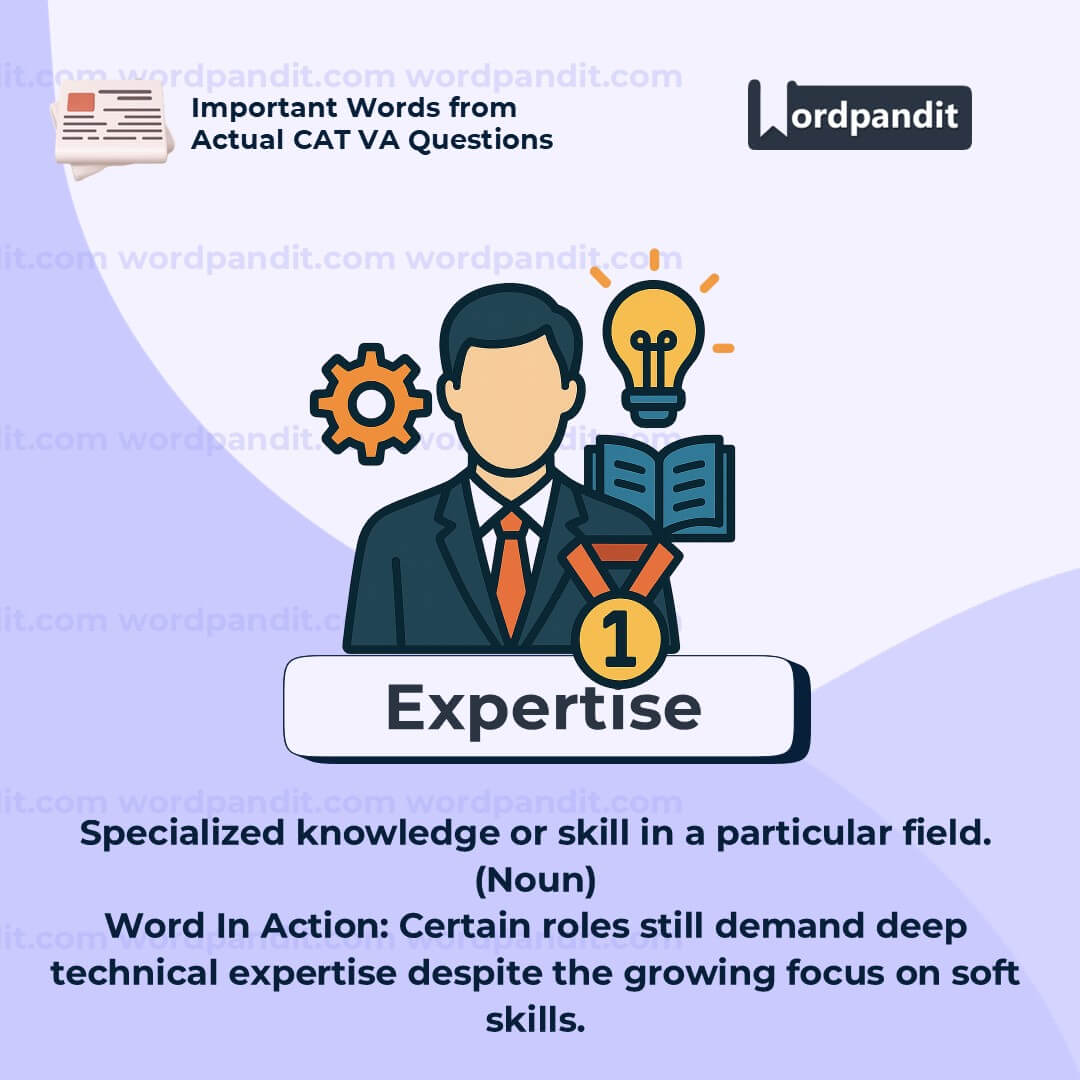
Word-4: Expertise
Context:
"That’s not to say that practical know-how is no longer required – some jobs still call for highly specific expertise." - Business Article on Hiring Trends
Explanatory Paragraph:
“Expertise” refers to advanced knowledge or skill in a particular field, typically gained through education, training, or extensive experience. When a job requires “specific expertise,” it means that only individuals with deep and focused knowledge in a certain domain can successfully perform the role. Unlike general knowledge, expertise suggests authority and proficiency, making the individual a valuable resource or specialist in that area.
Meaning: Specialized knowledge or skill in a particular field (Noun)
Pronunciation: eks-pur-TEEZ
Difficulty Level: ⭐⭐ Beginner-Intermediate
Etymology: From French *expertise* meaning “expert appraisal,” derived from *expert* (skilled) + suffix *-ise*
Prashant Sir's Notes:
“Expertise” is a power word in academic and professional environments. It’s frequently used in resumes, job descriptions, and recommendation letters. You should always be able to name a few areas where you’ve developed expertise—it reflects depth and specialization.
Synonyms & Antonyms:
Synonyms: skill, mastery, proficiency, know-how, competence
Antonyms: ignorance, inexperience, ineptitude, amateurism
Usage Examples:
- Her expertise in data analysis helped the company streamline its operations.
- The team consulted a cybersecurity expert for his technical expertise.
- He has expertise in international law and diplomatic negotiations.
- Designing complex algorithms requires a high level of mathematical expertise.
Cultural Reference:
In today’s knowledge economy, expertise is often more valued than seniority. Platforms like LinkedIn highlight users' areas of expertise, allowing professionals to build credibility through endorsements and experience.
Think About It:
Is expertise becoming more important or less important in an age where AI can perform many skilled tasks?
Quick Activity:
List three areas where you have developed expertise. For each, write one real example or achievement that showcases your skill in that domain.
Memory Tip:
Expertise comes from “expert”—so if someone calls you an expert, it’s because you have deep knowledge or practice in that area.
Real-World Application:
Expertise is often the deciding factor in hiring, consulting, or promotions—organizations rely on subject matter experts to lead critical tasks and drive innovation.
Word-5: Prioritising
Context:
"The move towards prioritising soft skills 'is a natural response to three years of the pandemic'" says a senior recruiter at Cenlar FSB. - Business Article on Hiring Trends
Explanatory Paragraph:
“Prioritising” means deciding what is most important and giving it the most attention or resources. In the given context, companies are placing more emphasis on soft skills—like communication, adaptability, and emotional intelligence—rather than solely on technical skills. This shift is described as a response to the changes brought on by the pandemic, which highlighted the need for interpersonal and collaborative abilities in remote and hybrid work environments.
Meaning: Giving something more importance or attention than other things (Verb – present participle)
Pronunciation: pry-OR-uh-ty-zing
Difficulty Level: ⭐⭐ Beginner-Intermediate
Etymology: From Latin *prior* (former, earlier) + English suffix *-ise/-ize*, meaning “to make”
Prashant Sir's Notes:
“Prioritising” is a key verb in productivity and decision-making contexts. Whether it’s project management or personal life, knowing how to prioritise helps reduce stress and improve focus. Note the spelling: “prioritising” is the British English version; “prioritizing” is American.
Synonyms & Antonyms:
Synonyms: emphasizing, favouring, ranking, giving precedence to, focusing on
Antonyms: neglecting, ignoring, downplaying, overlooking
Usage Examples:
- She is prioritising her mental health this year over career ambitions.
- The team is prioritising customer feedback in their product updates.
- During a crisis, leaders must be skilled at prioritising tasks and resources.
- Schools are now prioritising creativity and critical thinking over rote learning.
Cultural Reference:
Time management systems like the Eisenhower Matrix or the “Eat That Frog” method teach professionals the value of prioritising tasks based on urgency and importance.
Think About It:
How do your personal priorities shift in times of crisis or uncertainty—and what does that reveal about your values?
Quick Activity:
Make a list of five tasks or goals you have this week. Rearrange them by priority and explain why each holds its place on the list.
Memory Tip:
Think of “prioritising” as lining up tasks in order of importance—like a queue where the VIP gets in first!
Real-World Application:
In project management, leadership, and even daily planning, prioritising effectively is crucial for productivity, efficiency, and well-being.