
✨ Introduction
Mastering Reading Comprehension begins with mastering the words!
In this post, we dive deep into vocabulary taken directly from an actual CAT RC passage. Each word has been explained in a simple, easy-to-understand way, along with examples to help you grasp its usage in real contexts.
From words like "species" and "cognitive" to "subjection" and "paradise," strengthen your vocabulary one word at a time — and take your RC performance to the next level!
📚 What’s Inside This Vocabulary Post?
- 🔍 Words Sourced from an Actual CAT RC Passage: Directly pick up important vocabulary from real CAT exam material.
- 🧠 Meaningful Explanations: Understand the exact meaning and usage of each word in a simple, student-friendly way.
- ✍️ Context-Based Learning: Learn words with examples that reflect their actual usage in reading comprehension contexts.
- 🗂️ Quick Reference Format: Words are neatly listed with meanings, parts of speech, and example sentences for easy revision.
- 🚀 Boost Your RC and Verbal Ability Skills: Improve your understanding of tough passages by strengthening your vocabulary.
📝 Words Covered in This Article:
- Gutenberg
- Innocuous
- Dictation
- Metropolitan
- disguised
- reverberate
- Intent
- Inevitably
- Externalities
- Las Vegas
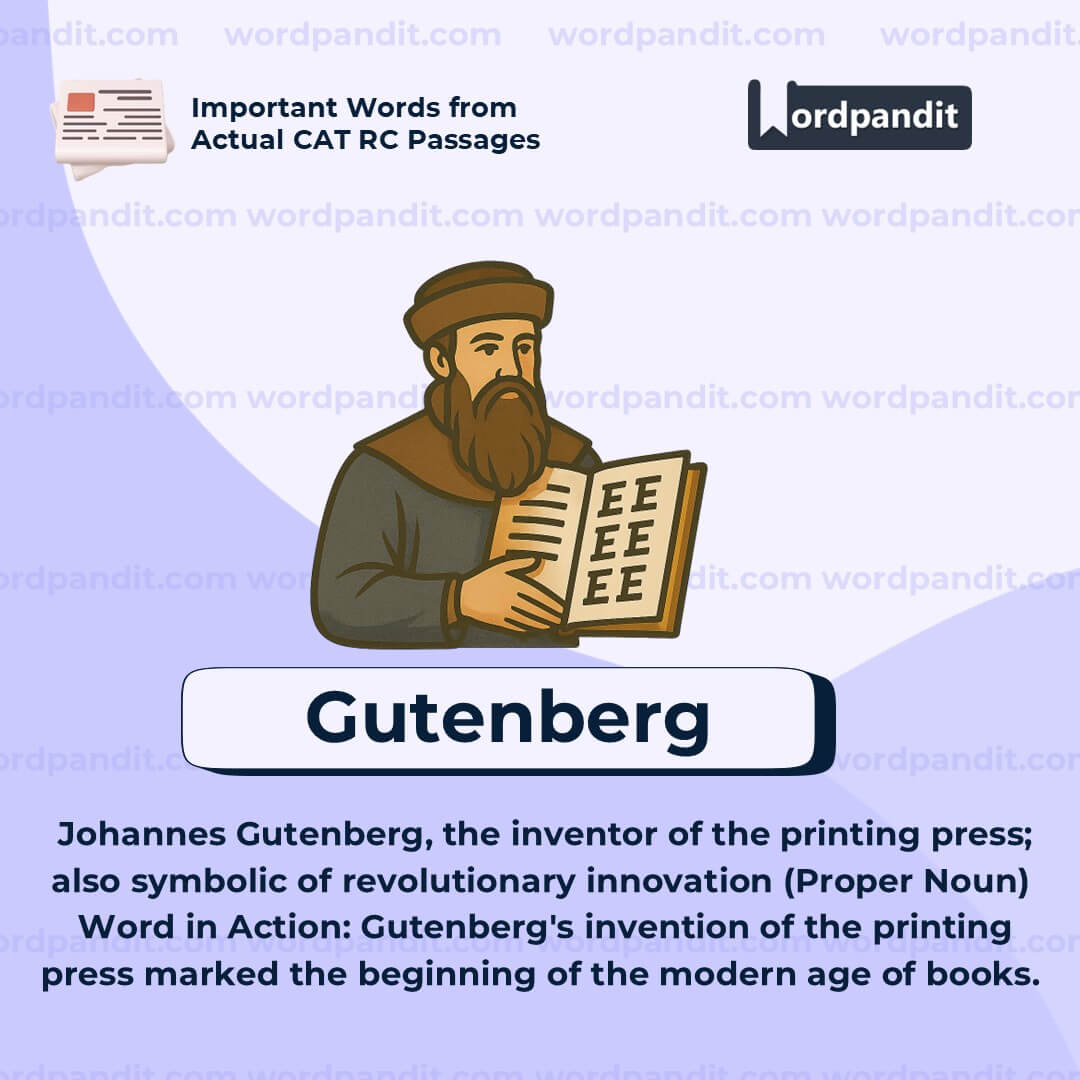
WORD-1: Gutenberg
Context:
"Sometimes those consequences are innocuous ones, or even beneficial. Gutenberg invents the printing press, and literacy rates rise, which causes a significant part of the reading public to require spectacles for the first time, which creates a surge of investment in lens-making across Europe, which leads to the invention of the telescope and the microscope."
Explanatory Paragraph:
"Gutenberg" typically refers to Johannes Gutenberg, a German inventor who revolutionized the world of communication by introducing the mechanical movable-type printing press in the 15th century. This invention had profound consequences on society, as it made books more accessible, boosted literacy rates, and indirectly accelerated scientific progress. The term is now widely associated not just with the man but also with the broader idea of technological innovation that transforms society in far-reaching ways.
Meaning: Johannes Gutenberg, the inventor of the printing press; also symbolic of revolutionary innovation (Proper Noun)
Pronunciation: GOO-ten-berg
Difficulty Level: ⭐⭐ Beginner
Etymology: Derived from Johannes Gutenberg (c. 1400–1468), a German inventor from Mainz, Germany.
Prashant Sir's Notes:
Gutenberg isn’t just a historical name; it's a symbol of monumental change brought on by technology. Understanding how one invention can create a ripple effect—like in the quote—is crucial for appreciating the broader impact of innovation.
Synonyms & Antonyms:
Synonyms: innovator, trailblazer, pioneer
Antonyms: follower, traditionalist, imitator
Usage Examples:
- Many scholars view the internet as a Gutenberg moment for the digital age.
- The impact of Gutenberg’s invention can still be felt in how we consume knowledge today.
- She compared the discovery of CRISPR to Gutenberg’s printing press—an innovation that changed everything.
- His startup aims to be the Gutenberg of online education, democratizing access to learning.
Cultural Reference:
"The printing press is the greatest weapon in the armoury of the modern commander." – T. E. Lawrence (paraphrased reference to Gutenberg’s legacy)
Think About It:
How might modern technologies like AI or blockchain be seen as the "Gutenberg press" of our time?
Quick Activity:
List three modern inventions and trace how each has led to unexpected consequences—positive or negative—just like Gutenberg's press did.
Memory Tip:
Think of “Gutenberg” as “Good-turning-berg”—his invention turned the world toward mass literacy and knowledge sharing.
Real-World Application:
The term "Gutenberg" is often used metaphorically in tech, journalism, and publishing to describe innovations that disrupt traditional ways of doing things—like WordPress’s Gutenberg editor revolutionizing web content creation.
WORD-2: Innocuous
Context:
"Sometimes those consequences are innocuous ones, or even beneficial. Gutenberg invents the printing press, and literacy rates rise, which causes a significant part of the reading public to require spectacles for the first time."
Explanatory Paragraph:
The word "innocuous" is used to describe something that is harmless or not likely to cause any adverse effects. In this context, it refers to consequences that are not dangerous or damaging—in fact, they might even be positive. It helps to understand "innocuous" as the opposite of harmful or threatening. Something innocuous might go unnoticed because it causes no trouble, but as the sentence suggests, even such subtle outcomes can lead to major changes over time.
Meaning: Not harmful or offensive (Adjective)
Pronunciation: ih-NAH-kyoo-uhs
Difficulty Level: ⭐⭐⭐ Intermediate
Etymology: From Latin *innocuus*, from *in-* (not) + *nocuus* (harmful), which comes from *nocere* meaning "to harm".
Prashant Sir's Notes:
"Innocuous" may look complex, but it's actually quite useful in academic and everyday contexts. Use it when you want to describe things that seem neutral or safe—especially when discussing consequences or behavior.
Synonyms & Antonyms:
Synonyms: harmless, inoffensive, mild, benign
Antonyms: harmful, dangerous, damaging, offensive
Usage Examples:
- The comment seemed innocuous at first, but it triggered a heated debate.
- He believed the drug to be innocuous, though further testing was required.
- What appeared to be an innocuous question revealed deeper tensions.
- Most of his jokes were innocuous, intended to make people smile without offense.
Cultural Reference:
"The most innocuous-seeming technologies can sometimes have the most unexpected consequences." — paraphrased from technology ethics discussions in academic journals.
Think About It:
Can something truly be called innocuous if it leads to significant changes over time?
Quick Activity:
Write two sentences: one using "innocuous" to describe a physical object, and another to describe a person's behavior.
Memory Tip:
Think “in-no-cause”—as in, there’s no cause for harm. That’s innocuous!
Real-World Application:
The term "innocuous" is often used in medical, legal, and tech fields to describe things like side effects, behaviors, or code that don't pose any danger or risk.
WORD-3: Dictation
Context:
"Edison famously thought his phonograph, which he sometimes called “the talking machine,” would primarily be used to take dictation….But then later innovators… discovered a much larger audience willing to pay for musical recordings made on descendants of Edison’s original invention."
Explanatory Paragraph:
"Dictation" refers to the act of speaking aloud so that someone else can write down or record your words. It’s commonly used in professional settings where secretaries or assistants transcribe spoken content, or in education when students write what a teacher says. In the context of Edison’s phonograph, dictation was seen as a practical application—allowing spoken words to be captured mechanically for later transcription. While that use was important, the device found greater success in capturing and distributing music, transforming how people experienced sound.
Meaning: The act of saying words aloud to be written down or recorded (Noun)
Pronunciation: dik-TAY-shun
Difficulty Level: ⭐⭐ Beginner
Etymology: From Latin *dictatio*, from *dictare*, meaning “to say repeatedly” or “to dictate.”
Prashant Sir's Notes:
Dictation is one of those classroom-rooted words that also has wide use in the business and legal world. Its connection to voice, speech, and authority makes it a great term to explore in multiple contexts. Think beyond writing down words—it's about voice being turned into text or memory.
Synonyms & Antonyms:
Synonyms: transcription, transcription exercise, verbal instruction
Antonyms: silence, improvisation, spontaneous speech
Usage Examples:
- He used a voice recorder to take his dictation while driving.
- In school, we practiced spelling through daily dictation exercises.
- The doctor gave a quick dictation of the patient’s symptoms to the nurse.
- With speech-to-text software, dictation has become easier and faster.
Cultural Reference:
"Dictation machines became a staple in offices by the mid-20th century, bridging the gap between human voice and documentation long before smartphones and voice assistants took over." – Business History Archives
Think About It:
As voice technology becomes more advanced, will dictation become obsolete or evolve into something even more powerful?
Quick Activity:
Record yourself reading a short paragraph aloud, then try to write it down word-for-word. That’s dictation in action!
Memory Tip:
Think “dict” = “speak” and “-ation” = the act of. Dictation is the act of speaking to be written.
Real-World Application:
Dictation is still widely used in professions like medicine, law, and journalism, and is now integrated into mobile apps and AI transcription tools for fast and accurate note-taking.
WORD-4: Metropolitan
Context:
"Enabling the rise of metropolitan areas like Phoenix and Las Vegas that barely existed when Carrier first started tinkering with the idea in the early 1900s."
Explanatory Paragraph:
The word "metropolitan" refers to a large city and its surrounding suburbs and towns, often forming a single, densely populated urban area. It highlights both the central city and the network of communities around it that are economically and socially interconnected. In the context above, the word is used to describe the rapid development of cities like Phoenix and Las Vegas into major urban centers, a growth that was significantly influenced by technological advancements such as air conditioning.
Meaning: Relating to a large city and its surrounding areas (Adjective); a person who lives in or is familiar with a large city (Noun)
Pronunciation: meh-truh-PAH-luh-tin
Difficulty Level: ⭐⭐ Beginner
Etymology: From Late Latin *metropolitanus*, from Greek *mētropolis* meaning "mother city" (mētēr = mother + polis = city)
Prashant Sir's Notes:
"Metropolitan" is more than just a word for a big city. It reflects the idea of interconnectedness—how cities function not just as centers, but as hubs for regions. It’s a word of scale, movement, and human settlement patterns.
Synonyms & Antonyms:
Synonyms: urban, city-based, cosmopolitan, civic
Antonyms: rural, provincial, countryside, rustic
Usage Examples:
- The metropolitan area has seen a population boom over the last decade.
- She enjoys the vibrant energy of metropolitan life but escapes to the mountains on weekends.
- Public transport in the metropolitan region is undergoing a major upgrade.
- Metropolitan influences can be seen in the city's modern architecture and diverse culture.
Cultural Reference:
"Metropolitan" is often used in media titles, such as *The Metropolitan Museum of Art*, reflecting the urban sophistication and global connectivity associated with large cities.
Think About It:
How do metropolitan areas shape the identities and opportunities of the people who live in them?
Quick Activity:
Name three metropolitan cities in your country and list two unique features of each.
Memory Tip:
Think of “metro” (subway) + “politics” = a place where many people live and decisions are made—a large city and its vibe!
Real-World Application:
"Metropolitan" is a key term in urban planning, real estate, and transportation policy, often used to describe areas that require coordinated development and infrastructure support across multiple cities and towns.
WORD-5: Disguised
Context:
"But then later innovators… discovered a much larger audience willing to pay for musical recordings made on descendants of Edison’s original invention. In other cases, the original innovation comes into the world disguised as a plaything…the way the animatronic dolls of the mid-1700s inspired Jacquard to invent the first 'programmable' loom."
Explanatory Paragraph:
"Disguised" refers to something being hidden or altered in appearance so that its true nature is not immediately obvious. In the context above, it suggests that what seemed like a toy—animatronic dolls—was actually a precursor to a revolutionary invention. The word emphasizes the surprising or deceptive simplicity of innovations that later turn out to be highly significant. It captures the idea that breakthroughs sometimes arrive under unexpected or playful appearances.
Meaning: Concealed or altered to prevent recognition; hidden in appearance (Adjective/Verb - past participle)
Pronunciation: dis-GYZD
Difficulty Level: ⭐⭐ Beginner
Etymology: From Old French *desguiser* (to change appearance), from *des-* (apart, away) + *guise* (manner, style).
Prashant Sir's Notes:
The beauty of the word “disguised” is in its layers. It reminds us to look beyond appearances. In history and literature, many great ideas and characters arrive in disguise. This word teaches us to stay curious about what lies beneath the surface.
Synonyms & Antonyms:
Synonyms: hidden, masked, camouflaged, cloaked
Antonyms: revealed, exposed, visible, apparent
Usage Examples:
- The spy entered the facility disguised as a janitor.
- Her sharp criticism was disguised as polite conversation.
- Genius is sometimes disguised as play, especially in childhood creativity.
- The gift came disguised in plain wrapping, but it held something priceless inside.
Cultural Reference:
In Shakespeare’s plays, characters often appear disguised—like Viola in *Twelfth Night*—to explore deeper themes of identity, love, and truth.
Think About It:
Can something disguised ever reveal more truth than what is shown openly?
Quick Activity:
Write a short story where a disguised object or person changes the outcome of the plot.
Memory Tip:
“Disguised” has “guise” in it—a word that means appearance. So something in disguise is wearing a different ‘guise’ or look.
Real-World Application:
The word "disguised" is used in security, literature, marketing, and even innovation to describe things whose real nature is hidden—like disguised threats, disguised intent, or disguised brilliance.
WORD-6: Reverberate
Context:
"As it becomes increasingly possible for individuals or small groups to create new scientific advances — through chemistry or biotechnology or materials science — setting off unintended consequences that reverberate on a global scale."
Explanatory Paragraph:
The word "reverberate" means to echo or resound, often repeatedly and across distances. While it's commonly used in a literal sense for sound (like an echo in a canyon), it also has a strong metaphorical meaning. In the context above, it refers to how certain actions or innovations—especially scientific breakthroughs—can have far-reaching, often unpredictable impacts that spread across the world like echoes. These consequences might not be immediate, but they continue to be felt long after the initial event, rippling through societies, ecosystems, and economies.
Meaning: To have continuing and serious effects; to echo or resound (Verb)
Pronunciation: reh-VER-buh-rayt
Difficulty Level: ⭐⭐⭐ Intermediate
Etymology: From Latin *reverberare*, meaning “to strike back” or “to beat back”; *re-* (back) + *verberare* (to lash or beat)
Prashant Sir's Notes:
"Reverberate" is a vivid and powerful word. It adds depth to your writing when describing lasting or widespread effects. Whether you're writing about emotions, decisions, or scientific impacts, this word brings a sense of movement and echoing consequence.
Synonyms & Antonyms:
Synonyms: echo, resound, ripple, rebound, carry over
Antonyms: fade, quiet, die away, dampen
Usage Examples:
- The explosion reverberated through the valley, shaking the windows of distant homes.
- Her words of encouragement continued to reverberate in his mind for days.
- The economic crisis reverberated across international markets.
- Innovations in one country can now reverberate globally within minutes.
Cultural Reference:
In political commentary, the term is often used to describe how decisions made by powerful nations can “reverberate” through global alliances, much like how the fall of the Berlin Wall reverberated through the political structures of Eastern Europe.
Think About It:
What actions or innovations from your lifetime do you think will continue to reverberate far into the future?
Quick Activity:
Write two sentences—one literal and one metaphorical—using the word “reverberate.”
Memory Tip:
Think of a loud “reverb” effect in music that echoes again and again—just like ideas or actions that continue to impact the world.
Real-World Application:
"Reverberate" is often used in discussions of politics, technology, environmental science, and social change to describe how initial events cause ongoing effects that spread beyond their origin.
WORD-7: Intent
Context:
"Line up a thousand of them and ask them all what they had been hoping to do with their work. Not one would say that their intent had been to deposit enough carbon in the atmosphere to create a greenhouse effect that trapped heat at the surface of the planet."
Explanatory Paragraph:
The word "intent" refers to the purpose or aim behind an action. It conveys what someone was hoping, planning, or meaning to do. In the context above, "intent" is used to highlight the difference between the goals of individuals—scientists or inventors—and the unintended consequences of their work, like environmental damage. This word emphasizes the original motivation or objective, even when the eventual outcome turns out to be very different.
Meaning: A person's purpose or aim; what someone means to do (Noun)
Pronunciation: in-TENT
Difficulty Level: ⭐ Beginner
Etymology: From Latin *intentus* (a stretching out, purpose), from *intendere* (to stretch toward, aim)
Prashant Sir's Notes:
"Intent" is a foundational word in both law and ethics. It draws a line between what was meant and what happened. It’s important in understanding human motivation and in judging actions fairly—not just by outcomes, but by intentions.
Synonyms & Antonyms:
Synonyms: purpose, aim, objective, goal, plan
Antonyms: accident, chance, coincidence, negligence
Usage Examples:
- Her intent was never to hurt anyone, only to speak honestly.
- The new policy was introduced with good intent but failed in execution.
- You must prove criminal intent for the charge to stand in court.
- Though he looked angry, his intent was simply to get attention.
Cultural Reference:
In legal systems worldwide, “intent” is a key element in determining guilt. For example, "mens rea" in criminal law refers to the intent or knowledge of wrongdoing that constitutes part of a crime.
Think About It:
Should we judge people more by their intent or by the consequences of their actions? Why?
Quick Activity:
Write two short sentences: one describing a positive intent, and the other describing an unintended consequence that followed.
Memory Tip:
Think of “intent” as what you "intend" to do—your inner compass or goal behind the action.
Real-World Application:
"Intent" plays a major role in law, education, communication, and interpersonal relationships, helping distinguish between mistakes and deliberate actions.
WORD-8: Inevitably
Context:
"The history of any major technological or industrial advance is inevitably shadowed by a less predictable history of unintended consequences and secondary effects — what economists sometimes call 'externalities.'"
Explanatory Paragraph:
"Inevitably" is an adverb used to describe something that is certain to happen and cannot be avoided. In the given context, it emphasizes that with every significant technological or industrial breakthrough, there are always going to be follow-up consequences—many of them unplanned and hard to predict. The word adds a tone of certainty, suggesting that these outcomes are a natural and unavoidable part of progress.
Meaning: In a way that cannot be avoided or prevented; unavoidably (Adverb)
Pronunciation: in-EV-it-uh-blee
Difficulty Level: ⭐⭐ Beginner
Etymology: From Latin *inevitabilis*, meaning “unavoidable,” from *in-* (not) + *evitare* (to avoid)
Prashant Sir's Notes:
"Inevitably" is a powerful word in essays and arguments. Use it when you want to express the certainty of an outcome—especially when discussing long-term effects or universal truths. It's a natural fit for scientific, historical, and philosophical discussions.
Synonyms & Antonyms:
Synonyms: unavoidably, certainly, assuredly, without fail
Antonyms: possibly, avoidably, uncertainly, optionally
Usage Examples:
- When you cut corners on safety, accidents inevitably follow.
- The team’s hard work will inevitably lead to success.
- In any conflict, misunderstandings inevitably arise.
- With rising temperatures, climate-related disasters will inevitably increase.
Cultural Reference:
In *The Matrix*, the character Agent Smith repeatedly uses the word “inevitable” to describe the unstoppable nature of fate, reinforcing the theme of determinism versus free will.
Think About It:
Is anything truly inevitable, or does human choice always offer another path?
Quick Activity:
Write a sentence about technology, relationships, or nature that uses the word “inevitably.”
Memory Tip:
Break it down: “in-evitably” = “not avoidable” → if something’s inevitable, it’s bound to happen!
Real-World Application:
"Inevitably" is frequently used in writing to predict or stress outcomes in science reports, business forecasts, historical narratives, and persuasive essays.
WORD-9: Externalities
Context:
"The history of any major technological or industrial advance is inevitably shadowed by a less predictable history of unintended consequences and secondary effects — what economists sometimes call 'externalities.'"
Explanatory Paragraph:
"Externalities" are the unintended side effects or consequences of an activity that affect other people or the environment, often without being reflected in the cost of that activity. In economics, externalities can be positive (like the benefits of education spreading through society) or negative (like pollution caused by a factory). In the context above, the author highlights how technological progress brings with it these secondary effects—unplanned, unpriced, and often unpredictable—that can impact global systems in ways we don’t always foresee.
Meaning: Unintended side effects of an activity that affect others, not accounted for in the market price (Noun – plural)
Pronunciation: ek-stur-NAL-ih-teez
Difficulty Level: ⭐⭐⭐ Intermediate
Etymology: From Latin *externus* (outside), combined with the economic suffix *-ality* to denote a quality or condition affecting external factors.
Prashant Sir's Notes:
“Externalities” is a must-know term in economics, especially when discussing policy, sustainability, and social cost. Think of it as what happens beyond the balance sheet—things people don’t pay for directly, but still feel the effects of.
Synonyms & Antonyms:
Synonyms: side effects, spillovers, by-products, ripple effects
Antonyms: core effects, direct impacts, intended outcomes
Usage Examples:
- Air pollution is one of the most common negative externalities of industrial production.
- Vaccination programs create positive externalities by protecting even the unvaccinated.
- Governments often regulate businesses to reduce harmful externalities like noise and waste.
- The rise of social media brought with it externalities such as misinformation and privacy concerns.
Cultural Reference:
The concept of externalities plays a central role in environmental policy debates, such as those surrounding carbon pricing, where the goal is to account for the external costs of emissions that are usually ignored in traditional market pricing.
Think About It:
Can technological progress ever be truly sustainable if we don’t account for its externalities?
Quick Activity:
List one positive and one negative externality of a recent innovation like electric cars or social media.
Memory Tip:
Think of “externalities” as the “extra realities” that result from an action—real effects that happen outside the main goal.
Real-World Application:
"Externalities" are central to policy-making, especially in fields like climate change, public health, education, and urban development, where governments aim to minimize harm or enhance benefits that go beyond private gain.
WORD-10: Las Vegas
Context:
"The largest migrations in the history of the United States, enabling the rise of metropolitan areas like Phoenix and Las Vegas that barely existed when Carrier first started tinkering with the idea in the early 1900s."
Explanatory Paragraph:
Las Vegas is a major city in the state of Nevada, USA, renowned for its entertainment, nightlife, casinos, and desert setting. Originally a small railroad town, it transformed into a global tourist destination during the 20th century, largely thanks to air conditioning, which made the extreme desert climate livable and allowed for the city's rapid urban development. In the context above, Las Vegas symbolizes how technological innovation—specifically, air conditioning—enabled the rise of cities in previously inhospitable environments, fueling population growth and cultural evolution.
Meaning: A large city in Nevada known for its entertainment industry, especially gambling and shows (Proper Noun)
Pronunciation: las VAY-guhs
Difficulty Level: ⭐ Beginner
Etymology: Spanish for "The Meadows," named by early Spanish explorers due to the presence of spring-fed grasses in the area.
Prashant Sir's Notes:
Las Vegas is more than a tourist hotspot. It's an example of how environment and technology intersect. Without cooling technology, this urban marvel in the desert wouldn't exist. It’s a good example of place names becoming powerful cultural and economic symbols.
Synonyms & Antonyms:
Synonyms: Sin City, The Entertainment Capital of the World
Antonyms: (none – proper noun; however, can contrast with rural or conservative areas)
Usage Examples:
- Las Vegas attracts millions of tourists each year with its dazzling lights and grand casinos.
- The city's transformation from desert to metropolis is a testament to modern engineering.
- She booked a weekend getaway to Las Vegas to celebrate her promotion.
- Las Vegas is also becoming a hub for tech conferences and digital innovation.
Cultural Reference:
Las Vegas is frequently featured in films, from *Ocean’s Eleven* to *The Hangover*, symbolizing excess, spontaneity, and high-stakes adventure.
Think About It:
How does the success of a city like Las Vegas challenge traditional ideas about where humans can comfortably live and thrive?
Quick Activity:
Research two facts about how Las Vegas overcame its harsh desert climate to become livable and successful. Summarize in a short paragraph.
Memory Tip:
Think “Las Vegas = Lights, Action, Shows”—the city that turned the desert into a playground of possibility.
Real-World Application:
Las Vegas is studied in urban planning, climate adaptation, and tourism development as a model of how infrastructure and innovation can build prosperity in unlikely places.


