

📘 What’s Inside This CAT Para-Completion Question Post?
📝 Authentic CAT Para-Completion Question Practice with a real CAT Para-Completion Question from a previous CAT exam.
✅ Detailed Question with Step-by-Step Solution Each question is explained thoroughly for better understanding.
🔍 In-Depth Paragraph Analysis Gain insights through line-by-line and paragraph-wise analysis
📚 Vocabulary Enhancement: Top 5 words explained from the paragraph
Para-Completion Questions
17. There is a sentence that is missing in the paragraph below. Look at the paragraph and decide where (option 1, 2, 3, or 4) the following sentence would best fit.
Sentence: The Europeans did not invent globalization.
Paragraph: The first phase of globalization occurred long before the introduction of either steam or electric power…Chinese consumers at all social levels consumed vast quantities of spices, fragrant woods and unusual plants. The peoples of Southeast Asia who lived in forests gave up their traditional livelihoods and completely reoriented their economies to supply Chinese consumers….___(1)___. These exchanges of the year 1000 opened some of the routes through which goods and peoples continued to travel after Columbus traversed the mid-Atlantic. ___(2)___. Yet the world of 1000 differed from that of 1492 in important ways….the travellers who encountered one another in the year 1000 were much closer technologically. ___(3)___. They changed and augmented what was already there since 1000. ___(4)___. If globalization hadn’t yet begun, Europeans wouldn’t have been able to penetrate the markets in so many places as quickly as they did after 1492.
A Option 1
B Option 4
C Option 2
D Option 3
Solution with Explanation
Correct Answer: D
Detailed explanation by Wordpandit:To determine the most appropriate position for the sentence "[T]he Europeans did not invent globalization", we need to identify the point in the paragraph where the idea of European involvement in globalization is first introduced and then qualified or elaborated.
The paragraph begins by discussing global trade patterns around the year 1000, with specific references to Chinese consumption and Southeast Asian economic shifts. These examples establish that long-distance exchange and global economic networks existed well before European colonial expansion or industrial advancements.
As the passage progresses, a comparison is drawn between the world of 1000 and that of 1492, which sets up a transition from early globalization to the period of European exploration and dominance.
The sentence in question makes a strong claim about Europe’s role in globalization—not as originators, but as late entrants or contributors to an existing system. For this message to resonate, it should be placed just before the paragraph explains how Europeans built upon and extended earlier networks. This positioning ensures the sentence functions as a thesis or pivot, introducing the idea that Europe’s role was secondary, not foundational.
This argument is explicitly picked up in the sentence: “They changed and augmented what was already there since 1000.” That line elaborates on and reinforces the idea that globalization predates European expansion, making it a logical follow-up.
Therefore, placing the sentence in Blank (3) creates a natural progression: it introduces the key idea (Europeans didn’t invent globalization) and then supports it with an explanatory statement (they merely modified and expanded what already existed).
Option-wise Analysis
- Option A: Blank (1)
This position follows the discussion about Southeast Asian economic changes due to Chinese demand. Inserting the sentence here would be abrupt and out of context, as there has been no mention of Europeans yet. The focus is squarely on early non-European trade networks. Hence, this is not a suitable fit. - Option B: Blank (4)
This blank comes after the explanation that Europeans expanded on pre-existing trade systems. By this point, the passage has already made its argument. Adding the sentence here would be redundant—it would act as a conclusion to a point that has already been concluded, weakening its rhetorical impact. Not ideal placement. - Option C: Blank (2)
This follows a mention of the continuation of ancient trade routes post-Columbus. However, at this point, the paragraph still hasn’t established a contrast between the world before and after 1492. Dropping the sentence here would be premature, as we don’t yet have enough context about European involvement to fully appreciate the claim. - Option D: Blank (3)
This is the best fit. The sentence introduces a critical idea about the European role, right before the passage states that Europeans “changed and augmented” existing systems. It acts as a thematic bridge between historical context and the argument about European expansion. This flow strengthens the paragraph’s overall coherence and argumentative structure.
Word 1: Globalization

Context:
"The first phase of globalization occurred long before the introduction of either steam or electric power…Chinese consumers at all social levels consumed vast quantities of spices, fragrant woods and unusual plants." - Historical Analysis
Explanatory Paragraph:
Globalization is the process by which people, ideas, goods, and cultures spread across national borders, creating a more interconnected and interdependent world. Historically, this has happened through trade routes, migration, and conquests, and in modern times, it's been accelerated by technology and global commerce. The context shows that globalization isn't a new phenomenon—it existed even centuries ago when exotic goods moved across continents.
Meaning: The process of interaction and integration among people, companies, and governments worldwide. (Noun)
Pronunciation: glo-buh-luh-zay-shun
Difficulty Level: ⭐⭐ Beginner-Intermediate
Etymology: From "global" (relating to the whole world) + "-ization" (a process of becoming), first popularized in the 1960s.
Prashant Sir's Notes:
Understand globalization as the world becoming a 'global village'. It is not just about economics; it touches culture, technology, language, and environment. The spice trade and Silk Road are early examples.
Synonyms & Antonyms:
Synonyms: internationalization, worldwide integration, global outreach, interconnectedness
Antonyms: isolationism, nationalism, parochialism, protectionism
Usage Examples:
- Globalization has made it possible for people to access products from nearly any country.
- The Internet is one of the major driving forces behind modern globalization.
- Many worry that globalization may erode local cultures and traditions.
- Globalization enables companies to outsource labor to countries with cheaper costs.
Cultural Reference:
"Globalization is not a monolithic force but an evolving set of consequences—some good, some bad, and some unintended." - John B. Larson
Think About It:
How has globalization personally affected the way you live, eat, communicate, or work?
Quick Activity:
List 5 items in your home that are made in different countries. Reflect on how globalization brought them to you.
Memory Tip:
Think of a “globe” spinning and connecting all parts—“globalization” means everything is connected like that spinning globe.
Real-World Application:
Understanding globalization is essential in fields like business, politics, and environmental studies, as it influences trade policies, communication strategies, and climate agreements across nations.
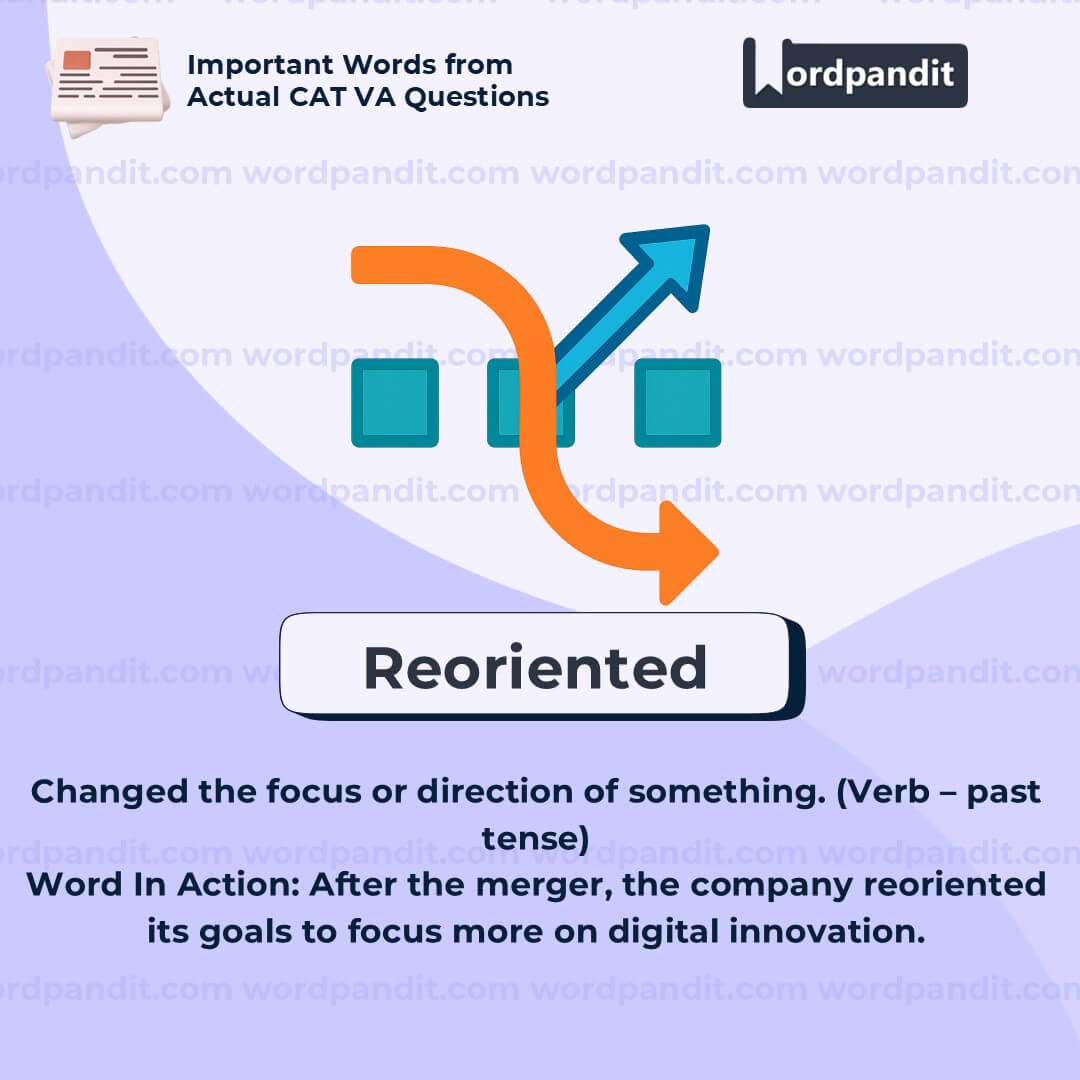
Word 2: Reoriented
Context:
"The peoples of Southeast Asia who lived in forests gave up their traditional livelihoods and completely reoriented their economies to supply Chinese consumers." - Historical Trade Narratives
Explanatory Paragraph:
“Reoriented” means changing direction or focus. In the context of the sentence, it refers to how the forest-dwelling communities in Southeast Asia shifted from their ancestral ways of living to new economic practices aimed at meeting the demands of the Chinese market. The word suggests a deliberate and often significant shift in approach, outlook, or activity, usually in response to external pressures or opportunities.
Meaning: Changed the focus or direction of something. (Verb – past tense)
Pronunciation: ree-or-ee-en-tid
Difficulty Level: ⭐⭐⭐ Intermediate
Etymology: From Latin "orientare" (to arrange or direct), re- (again) + orient (to align), used since the early 20th century to denote a shift in perspective or positioning.
Prashant Sir's Notes:
This word is particularly useful in essays or analysis where a shift in focus, perspective, or strategy is involved. Look for it in discussions on change management, economic policy, or personal development.
Synonyms & Antonyms:
Synonyms: shifted, redirected, adjusted, realigned
Antonyms: maintained, preserved, continued, sustained
Usage Examples:
- After the market crash, the company reoriented its strategy toward sustainability and long-term growth.
- She reoriented her life after moving to a new country and starting a new career.
- The school reoriented its curriculum to focus more on practical skills and critical thinking.
- Many rural economies have reoriented themselves in response to global demand.
Cultural Reference:
"Japan reoriented its post-war economy toward technology and innovation, leading to a global industrial boom." - Economic History Review
Think About It:
What factors in your life might prompt you to reorient your goals or career path?
Quick Activity:
Write down one habit or mindset you’ve reoriented recently. What caused the shift?
Memory Tip:
Think of a compass being turned to a new direction—“reoriented” means it’s now pointing somewhere different.
Real-World Application:
Reoriented is often used in professional and academic contexts to describe strategy changes in business, education, policy, or even personal development, making it a key term for analytical writing.
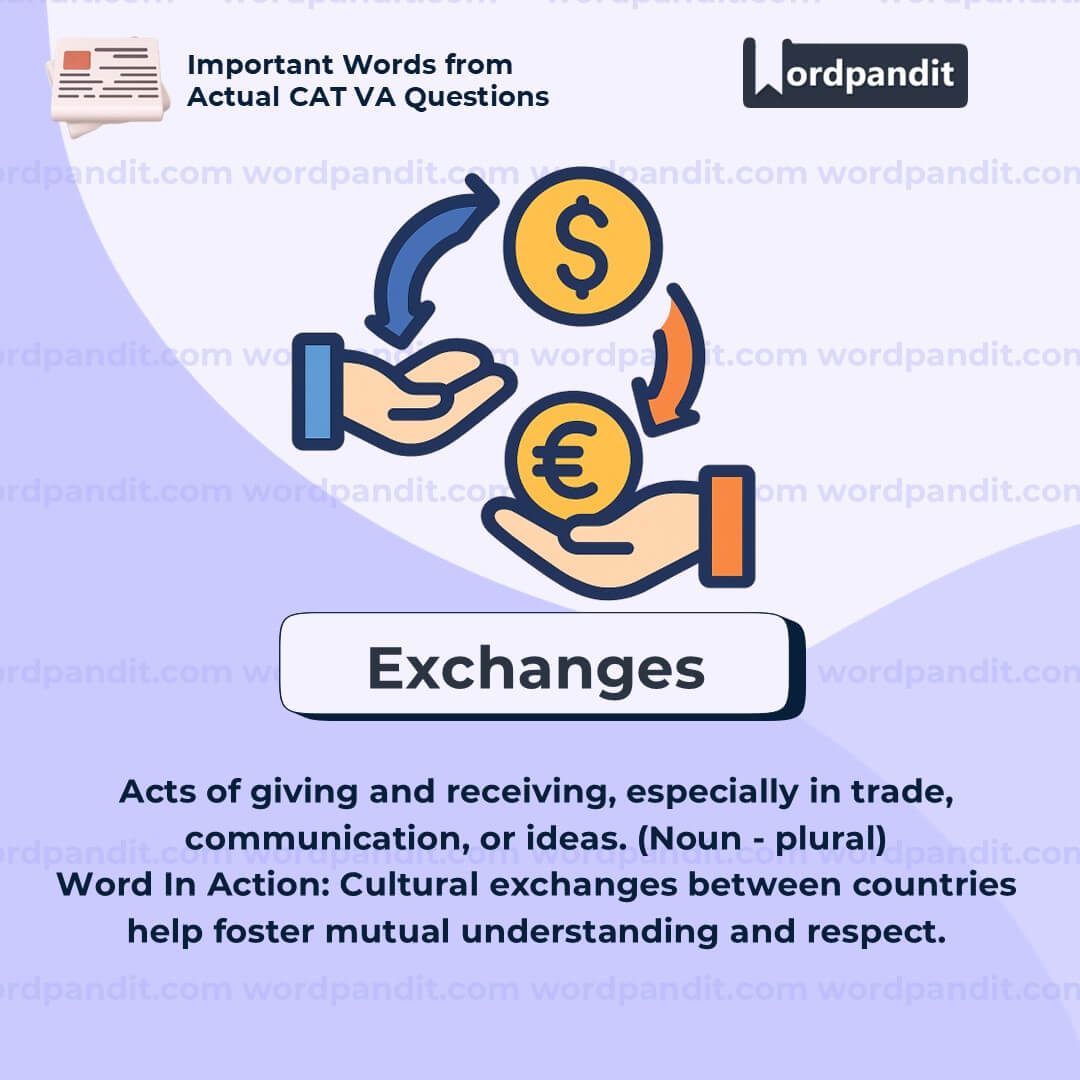
Word 3: Exchanges
Context:
"These exchanges of the year 1000 opened some of the routes through which goods and peoples continued to travel after Columbus traversed the mid-Atlantic." - Historical Trade Analysis
Explanatory Paragraph:
“Exchanges” refer to the act of giving one thing and receiving another in return. In a historical or economic sense, it often involves the movement of goods, ideas, technologies, and even people between different cultures or regions. In this context, the word highlights the early interactions between distant societies, which created trade routes and cultural connections long before Columbus's voyage.
Meaning: Acts of giving and receiving, especially in trade, communication, or ideas. (Noun - plural)
Pronunciation: eks-chan-jiz
Difficulty Level: ⭐ Beginner
Etymology: From Old French “eschange” (barter), from Latin “excambium” (exchange, barter), related to “cambiare” (to exchange or barter).
Prashant Sir's Notes:
Don’t think of “exchanges” only as financial transactions. In history and global studies, exchanges include cultural, biological, and technological interactions. Think of the Silk Road or the Columbian Exchange as key examples.
Synonyms & Antonyms:
Synonyms: trade, barter, transaction, interchange, swap
Antonyms: hoarding, isolation, retention, monopoly
Usage Examples:
- The cultural exchanges between the East and West enriched both societies.
- They participated in daily exchanges of goods at the local market.
- Academic exchanges help students understand diverse perspectives.
- These exchanges laid the groundwork for modern globalization.
Cultural Reference:
"The Columbian Exchange was a dramatic and wide-reaching set of biological exchanges between the Old and New Worlds." - Alfred W. Crosby
Think About It:
How do exchanges—of ideas, goods, or people—shape the culture you live in today?
Quick Activity:
List three items or ideas you use regularly that came to your region through historical or modern exchanges.
Memory Tip:
Think of “ex-” as “out” and “change” as swap—so “exchange” means things going out and something coming in return.
Real-World Application:
In international relations, economics, and education, the concept of “exchanges” is central—foreign exchange students, currency exchange, and cultural exchange programs all rely on this fundamental idea.
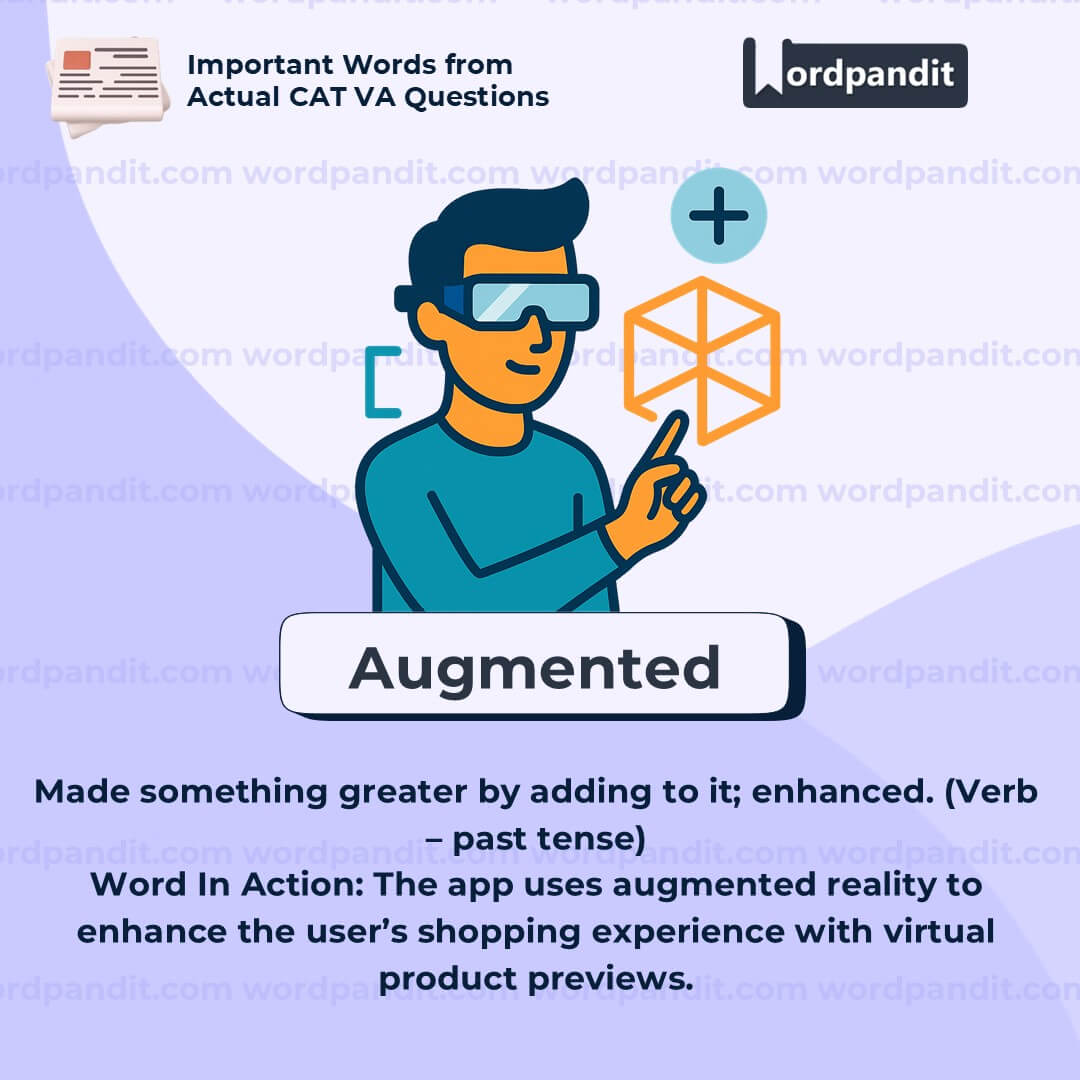
Word 4: Augmented
Context:
"They changed and augmented what was already there since 1000." - Historical Continuity Analysis
Explanatory Paragraph:
“Augmented” means to make something greater by adding to it. It’s not about replacing what exists but enhancing or improving it. In this context, it suggests that existing systems, structures, or practices from the year 1000 were built upon or expanded rather than discarded, showing a continuity of development. The word carries a sense of constructive improvement or enrichment.
Meaning: Made something greater by adding to it; enhanced. (Verb – past tense)
Pronunciation: awg-men-tid
Difficulty Level: ⭐⭐⭐ Intermediate
Etymology: From Latin “augmentare” (to increase), from “augere” (to grow, increase). Entered English via Old French in the late Middle Ages.
Prashant Sir's Notes:
Think of “augmented” in both literal and metaphorical senses. Whether it’s augmented reality (adding digital elements to the real world) or augmented income (increasing earnings), it always implies improvement through addition.
Synonyms & Antonyms:
Synonyms: enhanced, improved, increased, expanded, boosted
Antonyms: reduced, diminished, lessened, decreased, weakened
Usage Examples:
- The architect augmented the old structure with modern design elements.
- Her salary was augmented by freelance projects on the side.
- The government augmented the healthcare budget to deal with the crisis.
- They augmented the original plan with additional safety measures.
Cultural Reference:
"Augmented reality is not a replacement for reality, but a way to enrich it." - Wired Magazine
Think About It:
In what areas of your life could a small augmentation create a big difference?
Quick Activity:
Pick a sentence you wrote recently and augment it by adding one descriptive phrase or clause. See how the meaning changes.
Memory Tip:
Remember “AUGment” = “ADD Up Gradually” – both start with “AUG” and imply increasing or improving.
Real-World Application:
“Augmented” is widely used in tech (augmented reality), healthcare (augmented therapies), and even finance (augmented earnings), making it a valuable word for academic, professional, and casual contexts alike.
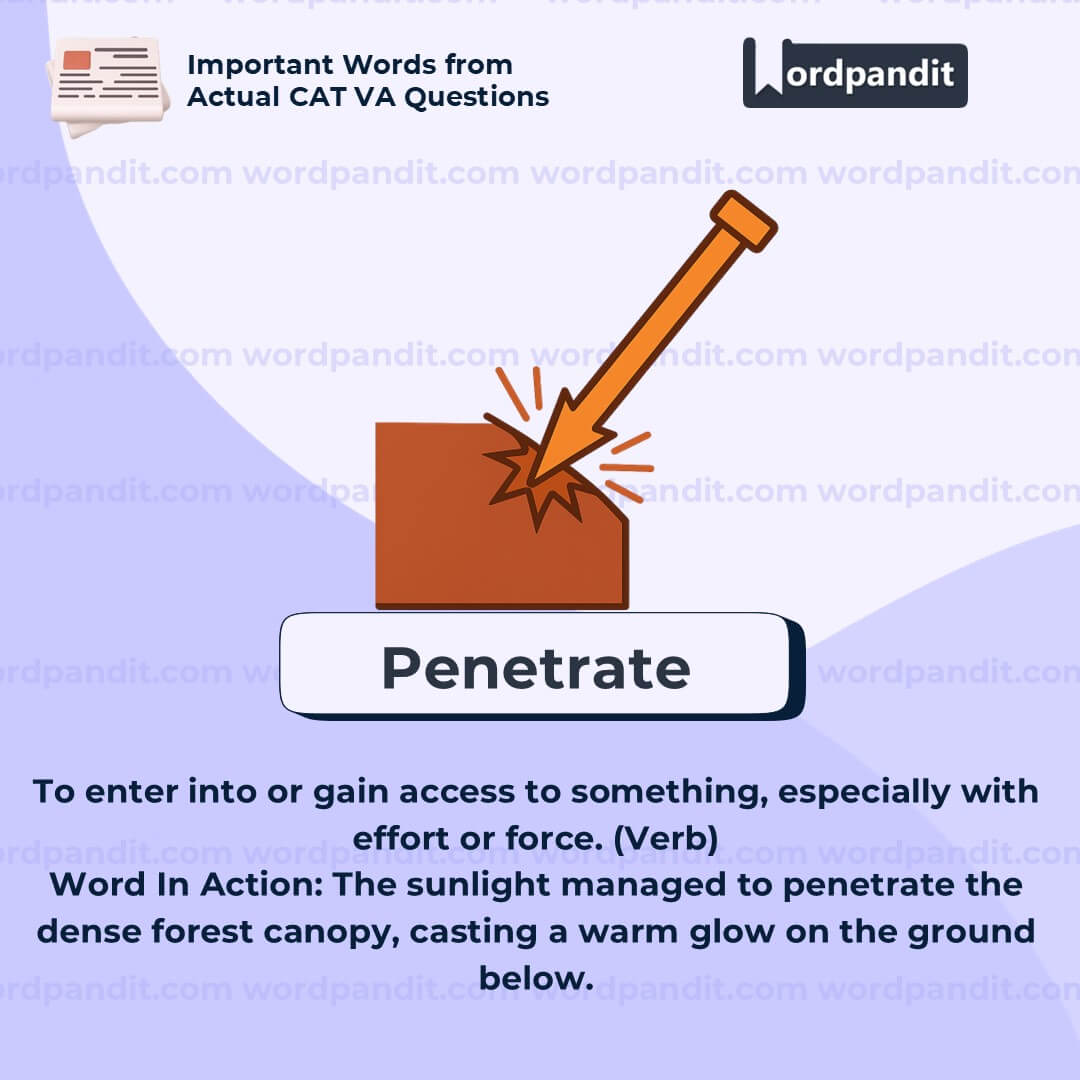
Word 5: Penetrate
Context:
"If globalization hadn’t yet begun, Europeans wouldn’t have been able to penetrate the markets in so many places as quickly as they did after 1492." - Global Trade History
Explanatory Paragraph:
“Penetrate” means to enter into or pass through something, often with effort or force. In the context of global markets and history, it refers to how European powers entered foreign markets, gaining access, influence, and control over trade and resources. The word carries a sense of forceful or strategic entry, and is often used in discussions about business expansion, military strategy, or even abstract ideas like penetrating a mystery or problem.
Meaning: To enter into or gain access to something, especially with effort or force. (Verb)
Pronunciation: pen-uh-trayt
Difficulty Level: ⭐⭐⭐ Intermediate
Etymology: From Latin “penetratus,” past participle of “penetrare” (to put or get into, enter), from “penes” (within). Adopted into Middle English via Old French.
Prashant Sir's Notes:
In academic writing, especially in economics and geopolitics, “penetrate” is often used to describe market access or influence. Be cautious—this word can have aggressive or invasive connotations depending on context, so always consider tone and setting.
Synonyms & Antonyms:
Synonyms: infiltrate, access, enter, invade, breach
Antonyms: withdraw, retreat, exit, exclude, block
Usage Examples:
- The company struggled to penetrate the Asian market due to regulatory barriers.
- The army managed to penetrate deep into enemy territory.
- With sharp insight, her questions penetrated the core of the issue.
- The sunlight barely penetrated the dense forest canopy.
Cultural Reference:
"American corporations have successfully penetrated global markets with their fast food and media products." - Cultural Globalization Report
Think About It:
What ethical considerations arise when a country or company seeks to penetrate foreign markets?
Quick Activity:
Think of an idea or movement that has “penetrated” your society or culture in recent years. Write a sentence explaining how and why it succeeded.
Memory Tip:
Think of “pen” (as in something sharp) + “rate” (as in moving) — something sharp moving in: “penetrate” = to enter or break through.
Real-World Application:
In business, “penetrate” is key when discussing market strategies—such as customer outreach, pricing, or marketing tactics that help a brand gain foothold in new areas. It's also relevant in military, cybersecurity, and scientific contexts.
