
📘 What’s Inside This CAT Para-Completion Question Post?
📝 Authentic CAT Para-Completion Question:Practice with a real CAT Para-Completion Question from a previous CAT exam.
✅ Detailed Question with Step-by-Step Solution:Each question is explained thoroughly for better understanding.
🔍 In-Depth Paragraph Analysis:Gain insights through line-by-line and paragraph-wise analysis
📚 Vocabulary Enhancement: Top 5 words explained from the paragraph
Para-Completion Questions
19. There is a sentence that is missing in the paragraph below. Look at the paragraph and decide where (option 1, 2, 3, or 4) the following sentence would best fit.
Sentence: Science has officially crowned us superior to our early-rising brethren.
Paragraph: My fellow night owls, grab a strong cup of coffee and gather around: I have great news. ___(1)___. For a long time, our kind has been unfairly maligned. Stereotyped as lazy and undisciplined. Told we ought to be morning larks. Advised to go to bed early so we can wake before 5am and run a marathon before breakfast like all high-flyers seem to do. Now, however, we are having the last laugh. ___(2)___. It may be a tad more complicated than that. A study published last week, which you may have already seen while scrolling at 1am, suggests that staying up late could be good for brain power. ___(3)___. Is this study a thinly veiled PR exercise conducted by a caffeine-pill company? Nope, it’s legit. ___(4)___. Research led by academics at Imperial College London studied data on more than 26,000 people and found that “self declared ‘night owls’ generally tend to have higher cognitive scores.”
A Option 4
B Option 3
C Option 1
D Option 2
Solution with Explanation
Correct Answer: D
Explanation:
Logical Reasoning Behind the Correct Placement
To determine where the sentence "Science has officially crowned us superior to our early-rising brethren." fits best, we need to understand the structure and flow of the paragraph. The paragraph starts by grabbing the attention of fellow night owls, expressing excitement about some good news. Then, it outlines the longstanding bias against night owls, describing how they have been viewed negatively compared to early risers.
The transition comes with “Now, however, we are having the last laugh,” indicating a reversal — a turning point where the previously maligned group is finally vindicated. Logically, the next sentence should provide the reason for this shift in perception. That’s precisely where the given sentence fits — it serves as a revelation or justification for the night owls’ vindication. The tone and structure of the sentence suggest it functions as a punchline to the idea that night owls are no longer to be looked down upon — they are now celebrated, according to scientific findings.
Option-wise Analysis
- Option A (Blank 4) Placing the sentence at the end would interrupt a smooth progression of evidence. Blank 4 is followed by a specific reference to a scientific study, including its origin and findings. Inserting a general declaration about superiority right before this detailed explanation would feel abrupt and redundant. The paragraph flows well without any new general claim here.
- Option B (Blank 3) The sentence before Blank 3 already mentions a study implying cognitive benefits for night owls. Adding a broader “superior” claim here would be awkward, as it shifts from evidence-based description back to a sweeping conclusion, which disrupts the logical build-up. The tone also becomes prematurely triumphant.
- Option C (Blank 1) Though it might seem like a good opening to deliver the “good news,” placing the sentence here skips the important background. The paragraph first needs to explain why night owls have been marginalized to give context to the claim. Without this setup, the sentence feels unsupported and lacks emotional payoff.
- Option D (Blank 2) This is the most appropriate position. The preceding sentence says, “Now, however, we are having the last laugh.” That acts as a setup for a moment of validation. Inserting the sentence here delivers the punchline — that science has declared night owls superior — making the flow natural and satisfying. It bridges the contrast between past bias and current recognition perfectly.
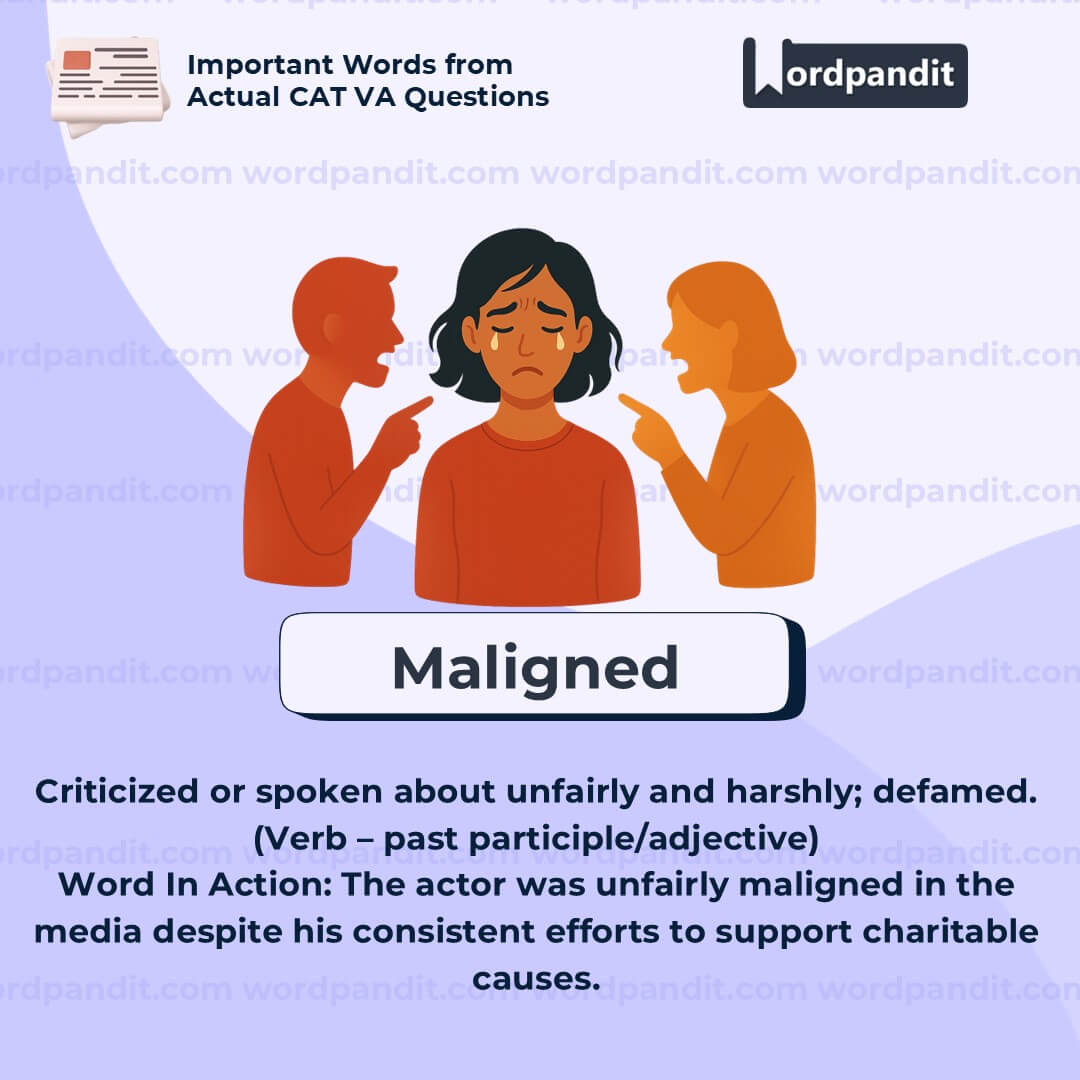
Word 1: Maligned
Context:
"For a long time, our kind has been unfairly maligned." - Character Dialogue, Fictional Narrative
Explanatory Paragraph:
“Maligned” means spoken about in a harmful, false, or unfair way. When someone or something is maligned, their reputation is attacked—often without good reason. In the given sentence, the speaker expresses a sense of injustice, emphasizing how their group has been wrongly criticized or misunderstood over time. This word carries a strong emotional charge and often appears in discussions about prejudice, misinformation, or character defamation.
Meaning: Criticized or spoken about unfairly and harshly; defamed. (Verb – past participle/adjective)
Pronunciation: muh-lined
Difficulty Level: ⭐⭐⭐ Intermediate
Etymology: From Latin “malignus” meaning “evil in nature,” from “malus” (bad) + root related to “genus” (kind, nature). Entered English via Old French “maligner.”
Prashant Sir's Notes:
“Maligned” is a powerful word to describe injustice or false portrayal. It’s useful in essays on social stereotypes, media bias, or historical revisionism. Think of it as the opposite of being praised or understood.
Synonyms & Antonyms:
Synonyms: slandered, defamed, vilified, discredited, libeled
Antonyms: praised, lauded, honored, commended
Usage Examples:
- The scientist was maligned by critics who misunderstood her research.
- Throughout history, certain groups have been maligned due to ignorance and fear.
- He felt maligned by the press after the story was published.
- The movie attempts to redeem a character who had long been maligned in public opinion.
Cultural Reference:
"Niccolò Machiavelli has long been maligned as a cynical manipulator, though many scholars argue he was simply a realist." - Renaissance Political Thought
Think About It:
Have you ever seen someone maligned unfairly? What role can you play in correcting false narratives?
Quick Activity:
Write a short sentence defending a person, group, or idea that you feel is often maligned in public discourse.
Memory Tip:
“Maligned” comes from “mal-” (bad) — think of it as being painted in a bad light.
Real-World Application:
“Maligned” is useful in journalism, history, and debates around justice and representation. Whether discussing public figures, communities, or misunderstood ideas, it highlights the harm of unfair judgment.
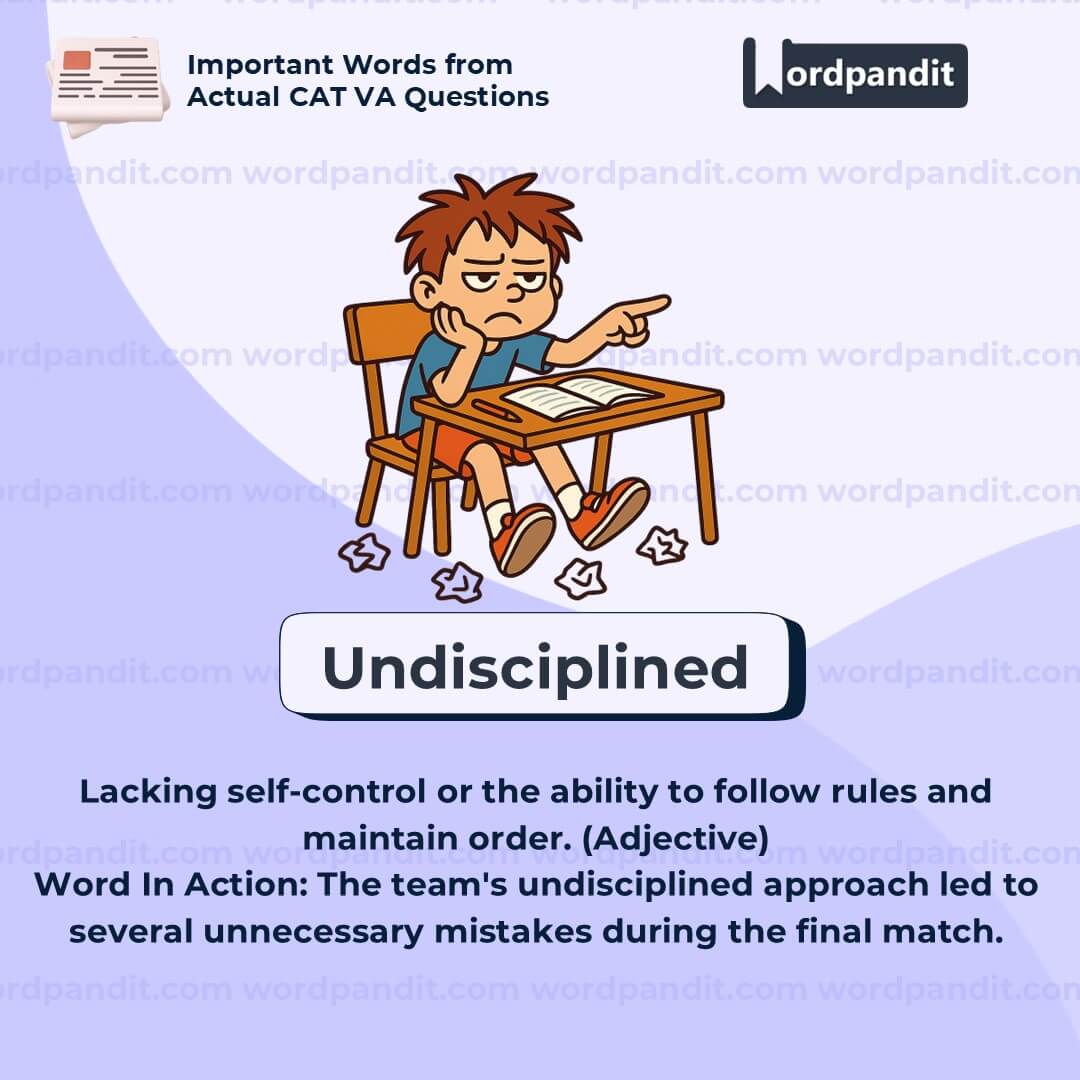
Word 2: Undisciplined
Context:
"Stereotyped as lazy and undisciplined." - Social Commentary
Explanatory Paragraph:
“Undisciplined” describes someone who lacks control, order, or proper behavior, often acting impulsively or irresponsibly. It suggests a failure to follow rules or maintain self-restraint. In the context provided, the term reflects a harmful stereotype—labeling a group unfairly as lacking structure or seriousness. This word often appears in discussions about personal habits, education, work ethic, and societal judgments.
Meaning: Lacking self-control or the ability to follow rules and maintain order. (Adjective)
Pronunciation: un-diss-uh-plind
Difficulty Level: ⭐⭐ Beginner-Intermediate
Etymology: From Latin “disciplina” (instruction, training), with the prefix “un-” meaning “not”; literally “not trained.”
Prashant Sir's Notes:
Use “undisciplined” when describing behavior that is chaotic or not guided by rules. It’s important to distinguish between being creative or free-spirited and truly lacking discipline. Also, be aware of its use in biased or stereotypical statements.
Synonyms & Antonyms:
Synonyms: unruly, chaotic, careless, impulsive, disorderly
Antonyms: disciplined, controlled, orderly, focused, obedient
Usage Examples:
- The team’s undisciplined approach led to repeated failures in the project.
- He was dismissed for his undisciplined behavior at work.
- Children who grow up without guidance may become undisciplined in school settings.
- Calling the community undisciplined is a harmful generalization not based on facts.
Cultural Reference:
"The label of 'undisciplined youth' often hides deeper social and educational issues." – The Sociology of Stereotypes
Think About It:
Is being undisciplined always negative, or can it sometimes lead to creativity and innovation?
Quick Activity:
Write two contrasting sentences: one describing an undisciplined action and one showing disciplined behavior in the same scenario.
Memory Tip:
“Un-” means “not,” and “disciplined” means controlled—so “undisciplined” = not controlled or not rule-following.
Real-World Application:
This word is relevant in workplace evaluations, education systems, and social commentaries. Recognizing when it's used as a stereotype versus a factual description is key to fair communication.
Word 3: Legit
Context:
"Nope, it’s legit." - Informal Conversation
Explanatory Paragraph:
“Legit” is a casual, informal way of saying “legitimate,” meaning real, authentic, or lawful. It is commonly used in spoken English and informal writing to express trustworthiness or truth. In the provided sentence, the speaker is confirming that something is real or not fake. Though it originates from the word “legitimate,” “legit” has taken on a life of its own, especially in pop culture, online conversations, and modern slang.
Meaning: Real, genuine, or lawful; not fake. (Adjective, informal)
Pronunciation: luh-jit
Difficulty Level: ⭐ Beginner
Etymology: Shortened form of “legitimate,” from Latin “legitimus” (lawful), made popular in American slang during the 20th century.
Prashant Sir's Notes:
This is a slang word you’ll hear a lot in modern conversations. While “legitimate” is formal, “legit” is great for dialogues, casual writing, and pop culture references. Just be cautious—avoid using it in formal essays or professional reports unless quoting someone directly.
Synonyms & Antonyms:
Synonyms: genuine, real, authentic, valid, lawful
Antonyms: fake, bogus, counterfeit, false, unlawful
Usage Examples:
- This discount code is totally legit—go ahead and use it!
- Is that website legit or a scam?
- His concern about the project timeline is legit.
- They run a legit business with proper licenses and documentation.
Cultural Reference:
"Too legit to quit." — Popular phrase from a 1991 MC Hammer song, meaning too real or capable to stop trying.
Think About It:
How do you decide whether something is “legit” online—what are your checkpoints for authenticity?
Quick Activity:
Make a short list of things you’ve recently called “legit” in conversation. Now try replacing that word with a formal equivalent (e.g., valid, authentic).
Memory Tip:
“Legit” is just a short form of “legitimate”—easy to remember and even easier to say when something is real!
Real-World Application:
“Legit” is widely used in reviews, social media, and casual conversations to assess whether something is credible or real—whether you're shopping online, watching a movie, or evaluating a claim.
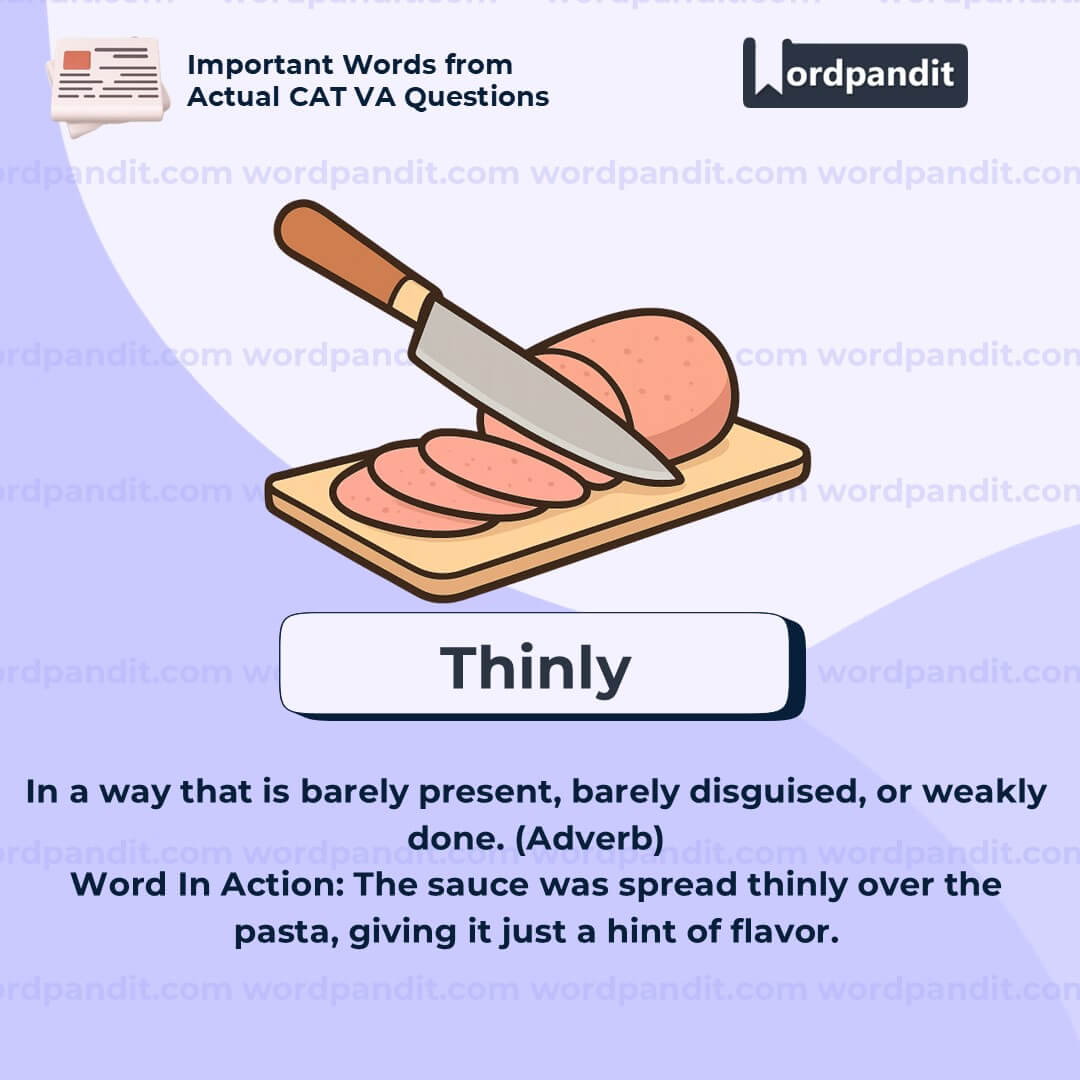
Word 4: Thinly
Context:
"Is this study a thinly veiled PR exercise conducted by a caffeine-pill company? Nope, it’s legit." - Media Critique Article
Explanatory Paragraph:
“Thinly” is an adverb that means something is done in a minimal, barely noticeable, or weak way. When used in the phrase “thinly veiled,” it suggests that something is disguised—but not very well. In the sentence above, the speaker questions whether the research is just a poorly hidden attempt at promotion. The word “thinly” emphasizes how easy it is to see through the supposed disguise. This adverb often modifies how transparently a motive, emotion, or lie is being hidden.
Meaning: In a way that is barely present, barely disguised, or weakly done. (Adverb)
Pronunciation: thin-lee
Difficulty Level: ⭐⭐ Beginner-Intermediate
Etymology: From Old English “þynne” (thin), with the adverbial suffix “-ly” to describe the manner of an action.
Prashant Sir's Notes:
“Thinly” is often used in layered expressions like “thinly veiled,” “thinly spread,” or “thinly disguised.” These idioms are common in journalism, criticism, and formal writing. Recognize its subtle tone—it often signals skepticism or criticism.
Synonyms & Antonyms:
Synonyms: barely, lightly, faintly, superficially, subtly
Antonyms: heavily, thickly, strongly, obviously, clearly
Usage Examples:
- His apology was thinly veiled sarcasm.
- The anger in her voice was only thinly disguised.
- They offered a thinly supported argument that didn’t convince the jury.
- The frosting was thinly spread across the cake, almost invisible.
Cultural Reference:
"A thinly veiled critique of the government disguised as fiction." — Review in *The New York Times Book Review*
Think About It:
Have you ever encountered a message or ad that was only “thinly veiled” in its true intention? How did you spot it?
Quick Activity:
Create a sentence using the phrase “thinly veiled” to describe a hidden intention or emotion.
Memory Tip:
“Thinly” = so thin it’s almost see-through—if something is “thinly disguised,” you can see what’s really going on underneath!
Real-World Application:
“Thinly” is useful in critical writing, news media, and opinion pieces when analyzing hidden motives, subtle expressions, or surface-level attempts to cover up intent.
Word 5: Cognitives
Context:
"Research led by academics at Imperial College London studied data on more than 26,000 people and found that 'self-declared ‘night owls’ generally tend to have higher cognitive scores'." - Scientific Research Summary
Explanatory Paragraph:
“Cognitives” is a plural noun form often used to refer to cognitive functions or abilities—mental skills like memory, reasoning, attention, problem-solving, and verbal fluency. In the context of the sentence, it refers to how well individuals perform in mental tasks. Though not commonly used as a standalone plural noun in casual speech, in academic or psychological studies, "cognitive scores" are widely used to describe performance on tests that measure thinking and mental processing abilities.
Meaning: Mental abilities related to thinking, understanding, learning, and remembering. (Noun – plural, informal/abbreviated usage of "cognitive functions")
Pronunciation: kog-ni-tivs
Difficulty Level: ⭐⭐⭐ Intermediate
Etymology: From Latin “cognoscere” meaning “to know” or “to recognize.” “Cognitive” is derived from “cognition,” which refers to the mental process of acquiring knowledge.
Prashant Sir's Notes:
Though "cognitives" isn’t standard as a noun in itself, it's often used in shorthand by professionals discussing test results or mental skills. You’ll find the word “cognitive” used far more frequently as an adjective (e.g., cognitive skills, cognitive development). Keep your ears open for its use in science and education!
Synonyms & Antonyms:
Synonyms: mental abilities, intellectual skills, reasoning powers, brain functions
Antonyms: physical skills, instinctive behavior, emotional reactions
Usage Examples:
- The students showed improved cognitives after playing strategy games regularly.
- Aging can affect certain cognitives like memory and attention span.
- Her cognitives were assessed as part of a psychological evaluation.
- The study suggests that night owls may outperform early risers in some cognitives.
Cultural Reference:
"Cognitive science combines psychology, neuroscience, and linguistics to study how the mind works." – *Cognitive Science: An Introduction to the Science of the Mind*
Think About It:
Do you believe cognitive abilities are shaped more by genetics or by environment and habits?
Quick Activity:
List three daily activities you do that exercise your cognitives (e.g., reading, solving puzzles, learning a new skill).
Memory Tip:
Link “cognitives” to “cognition”—both come from the root word for “knowing.” So, cognitives = all the ways your brain knows and thinks.
Real-World Application:
Understanding and improving cognitives is key in education, mental health, aging research, and even workplace productivity. Many apps, brain games, and learning programs are designed to enhance cognitive function.