
📘 What’s Inside This CAT Misfit Sentence/Odd One Out Question Post?
📝 Authentic CAT Misfit Sentence/Odd One Out Question: Practice with a real CAT Para-jumble Question from a previous CAT exam.
✅ Detailed Question with Step-by-Step Solution: Each question is explained thoroughly for better understanding.
📚 Vocabulary Enhancement: Top 5 words explained from the paragraph
Misfit Sentence/Odd One Out Question
20. Five jumbled up sentences (labelled 1, 2, 3, 4 and 5), related to a topic, are given below. Four of them can be put together to form a coherent paragraph. Identify the odd sentence and key in the number of that sentence as your answer.
1. The UK is a world leader in developing cultivated meat and the approval of a cultivated pet food is an important milestone.
2. If we're to realise the full potential benefits of cultivated meat the government must invest in research and infrastructure.
3. The first UK applications for cultivated meat produced for humans remain under assessment with the Food Standards Agency.
4. The previous UK government had been looking at fast-tracking the approval of cultivated meat for human consumption.
5. It underscores the potential for new innovation to help reduce the negative impacts of intensive animal agriculture.
Solution with Explanation
Answer: 4
Detailed explanation by Wordpandit:
The four coherent sentences revolve around the current landscape and future outlook of cultivated meat in the UK. They touch on themes like innovation, regulatory progress, investment needs, and environmental benefits. Sentence 4, however, diverges by referencing a past government’s attempt to fast-track approvals. This backward-looking statement disrupts the forward-focused narrative established by the others.
Option-wise Analysis
- Sentence 1: Talks about the UK’s current leadership and a recent milestone—the approval of cultivated pet food. This sets the context for cultivated meat progress.
- Sentence 2: Builds on the future prospects, emphasizing the need for government investment in research and infrastructure to unlock full benefits. It aligns well with the theme of future development.
- Sentence 3: Focuses on the present regulatory process, specifically the Food Standards Agency’s current assessment of human-consumable cultivated meat. This sentence fits neatly into the timeline of ongoing developments.
- Sentence 4: Mentions the previous government’s efforts to fast-track approval. This is both historically framed and tangential to the paragraph’s main focus on current progress and future steps. It stands out as disconnected.
- Sentence 5: Concludes with the broader benefit of cultivated meat—reducing the harm caused by intensive animal farming. This complements the earlier points about innovation and potential.
Word-1: Realise

Context:
"If we're to realise the full potential benefits of cultivated meat the government must invest in research and infrastructure." – Scientific Policy Commentary
Explanatory Paragraph:
“Realise” means to make something real, actual, or achievable. In this context, it refers to turning the potential benefits of cultivated meat into reality through action and investment. The word can also mean to become aware of something, but here it is used in the sense of making something happen. This is the British English spelling; the American spelling is “realize.” It’s a common verb in both formal writing and daily conversation.
Meaning: To make something real or actual; to achieve or fulfill something. (Verb)
Pronunciation: ree-uh-lize
Difficulty Level: ⭐⭐ Beginner-Intermediate
Etymology: From Old French *realiser*, from Late Latin *realis* (real). Adopted into English in the 17th century. British spelling is “realise”; American is “realize.”
Prashant Sir's Notes:
“Realise” is a practical and powerful verb used in academic, motivational, and strategic contexts. Be sure to distinguish its two meanings: (1) to become aware of something, and (2) to bring something into reality. In this sentence, it refers to the second meaning.
Synonyms & Antonyms:
Synonyms: achieve, fulfil, accomplish, actualize, materialize
Antonyms: abandon, ignore, overlook, dismiss, neglect
Usage Examples:
- They hope to realise their dream of building a sustainable community.
- The company needs more funding to realise its vision for the future.
- He realised that success was not just about hard work but also about timing.
- It took her years to realise her full artistic potential.
Cultural Reference:
"All our dreams can come true, if we have the courage to pursue them — and the means to realise them." – Inspired by Walt Disney
Think About It:
What goal or idea have you yet to realise, and what would it take to turn it into reality?
Quick Activity:
Write a short sentence describing something you'd like to realise in the next year. Then list two steps that would help make it happen.
Memory Tip:
Realise = make *real* + *ise* (to do). Just think: “to realise” is “to make it real.”
Real-World Application:
“Realise” is commonly used in business plans, personal development, education, and policy-making to describe the process of turning ideas and goals into practical results.
Word-2: Infrastructure
Context:
"If we're to realise the full potential benefits of cultivated meat the government must invest in research and infrastructure." – Scientific Policy Commentary
Explanatory Paragraph:
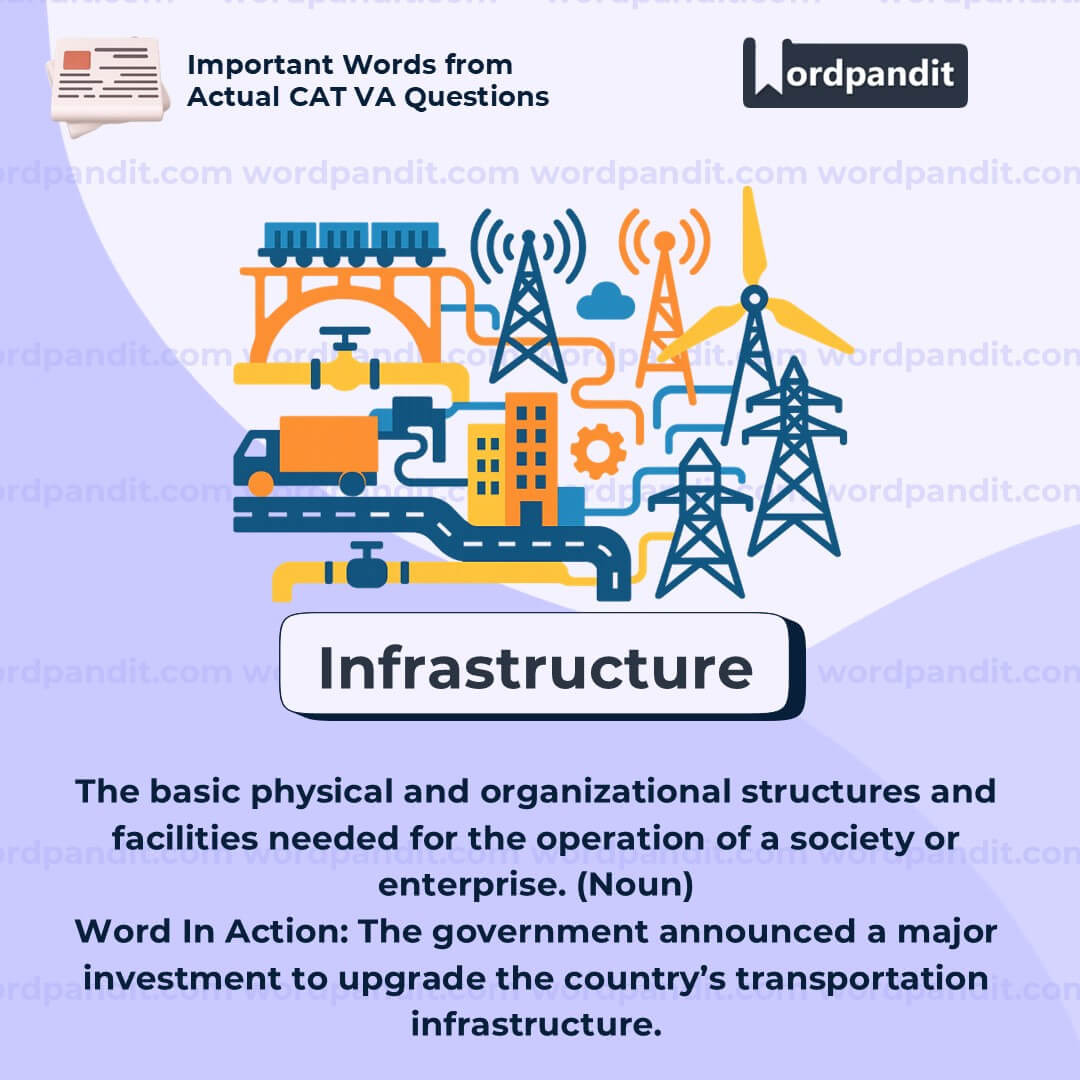
“Infrastructure” refers to the fundamental systems and facilities that support the functioning of a society or industry. This includes physical components like roads, buildings, electricity, and water supply, as well as digital and institutional structures. In the given sentence, it refers to the facilities and frameworks (like labs, supply chains, and production plants) needed to support the development and distribution of cultivated meat. Without proper infrastructure, even the best innovations can't be implemented on a large scale.
Meaning: The basic physical and organizational structures and facilities needed for the operation of a society or enterprise. (Noun)
Pronunciation: in-fruh-struhk-chur
Difficulty Level: ⭐⭐⭐ Intermediate
Etymology: From French “infrastructure,” based on Latin “infra” (below) + “structure.” Originally a military term referring to fixed installations.
Prashant Sir's Notes:
Think of infrastructure as the invisible foundation of progress—it’s what allows things to happen. In essays or policy writing, “infrastructure” is a go-to term when discussing long-term planning, development, or national priorities. It’s also very relevant in tech and environmental topics.
Synonyms & Antonyms:
Synonyms: foundation, framework, base, support systems, facilities
Antonyms: disorganization, breakdown, superstructure (in contrast), underdevelopment
Usage Examples:
- Developing nations often struggle due to a lack of proper infrastructure.
- The tech hub was made possible by investments in digital infrastructure.
- Upgrading transport infrastructure can significantly boost economic growth.
- Cultivated meat requires specialized infrastructure for mass production.
Cultural Reference:
"Infrastructure is not just about roads and bridges. It's about opportunity, connectivity, and the future." – From a U.S. Presidential Address on Economic Development
Think About It:
Which types of infrastructure are most important for a sustainable future—physical, digital, or educational? Why?
Quick Activity:
List three types of infrastructure in your city or town. Then think: how does each support your daily life?
Memory Tip:
“Infra” means “below” and “structure” means “building”—so infrastructure is what lies below or behind everything that works!
Real-World Application:
Infrastructure is a critical concept in economics, urban planning, environmental policy, and technology. From setting up clean energy grids to expanding internet access, infrastructure shapes how modern life functions and evolves.
Word-3: Assessment
Context:
"The first UK applications for cultivated meat produced for humans remain under assessment with the Food Standards Agency." – Regulatory News Report
Explanatory Paragraph:
“Assessment” refers to the process of carefully examining something in order to judge its quality, safety, value, or importance. In this context, it means that the Food Standards Agency is reviewing applications to ensure that cultivated meat is safe for human consumption. The word is used widely in academic, medical, business, and governmental fields, and often implies a formal evaluation process based on standards or criteria.
Meaning: The process of evaluating or judging something carefully and systematically. (Noun)
Pronunciation: uh-sess-ment
Difficulty Level: ⭐⭐ Beginner-Intermediate
Etymology: From Latin “assessare” (to sit by as an assistant judge), from “assidere” (to sit beside). Originally used in legal and tax contexts before broadening to general evaluation.
Prashant Sir's Notes:
Assessment is a go-to word in academic and official writing. Use it to refer to testing, evaluation, or review processes. It’s especially relevant in education, health, science, and policy contexts. Always think of it as a structured judgment based on evidence or standards.
Synonyms & Antonyms:
Synonyms: evaluation, appraisal, review, analysis, examination
Antonyms: neglect, ignorance, assumption, guesswork
Usage Examples:
- The school conducts regular assessments to track student progress.
- Environmental assessments must be completed before construction begins.
- His medical assessment revealed no serious issues.
- The product is still under assessment before it can be approved for sale.
Cultural Reference:
"Risk assessment has become a central part of global decision-making, especially in healthcare and environmental policy." — *World Health Organization Reports*
Think About It:
What qualities make an assessment fair and reliable? How can assessments sometimes be biased or misleading?
Quick Activity:
List three types of assessments you’ve experienced (e.g., academic tests, job performance reviews). What was each trying to measure?
Memory Tip:
“Assess” means to examine; so “assessment” is the result of a careful look. Think: “A+ or not? Let’s assess it!”
Real-World Application:
Assessment plays a crucial role in education, medicine, law, public safety, and business strategy. Understanding how assessments are done and what they measure can help you succeed in academic and professional environments.
Word-4: Fast-tracking
Context:
"The previous UK government had been looking at fast-tracking the approval of cultivated meat for human consumption." – Policy Development Report
Explanatory Paragraph:
“Fast-tracking” means accelerating the progress or approval of a process that would normally take longer. It is often used in governmental, business, or organizational contexts where urgent attention or priority is given to certain projects or decisions. In the sentence provided, it refers to the UK government considering a quicker approval route for cultivated meat products, bypassing or shortening standard regulatory timelines to enable faster public access.
Meaning: Speeding up a process or giving it priority to be completed more quickly than usual. (Verb – present participle / noun)
Pronunciation: fast-trak-ing
Difficulty Level: ⭐⭐⭐ Intermediate
Etymology: From the phrase “fast track,” originally referring to the inner lanes of a racetrack, which are faster. It evolved into a figurative term for prioritizing or expediting processes.
Prashant Sir's Notes:
“Fast-tracking” is a dynamic and modern expression useful in both professional and academic writing, especially in the context of policy, innovation, or crisis response. It reflects urgency and prioritization. Great for reports and discussions about reforms, approvals, and technological developments.
Synonyms & Antonyms:
Synonyms: expedite, accelerate, prioritise, hasten, advance
Antonyms: delay, postpone, hinder, obstruct, slow down
Usage Examples:
- The company is fast-tracking the launch of its new app to stay ahead of competitors.
- Governments worldwide are fast-tracking renewable energy projects.
- He was fast-tracked through training due to his exceptional performance.
- The vaccine was fast-tracked due to the global health emergency.
Cultural Reference:
"Fast-tracking legislation has become a common tool during crises, but critics warn it can reduce oversight." — *The Economist*
Think About It:
When is it justifiable to fast-track a decision or policy? What are the risks of moving too quickly?
Quick Activity:
Write a sentence about something you think should be fast-tracked in your community or country—and why.
Memory Tip:
Imagine a VIP lane at an airport—fast-tracking means skipping the line and getting approved or processed quickly.
Real-World Application:
“Fast-tracking” is often used in policy, tech, business, and healthcare to indicate speed and urgency. Understanding when and how this is applied helps you grasp the pace and priorities behind high-level decisions.
Word-5: Underscores
Context:
"It underscores the potential for new innovation to help reduce the negative impacts of intensive animal agriculture." – Sustainability Research Commentary
Explanatory Paragraph:
“Underscores” means to emphasize or highlight the importance of something. When someone or something underscores a point, they draw special attention to it, showing that it is especially significant. In this context, the sentence emphasizes how innovation can play a major role in solving the problems caused by industrial farming. The word is frequently used in academic, journalistic, and formal writing to stress key findings or arguments.
Meaning: To emphasize or give special importance to something. (Verb – present tense)
Pronunciation: un-der-skorz
Difficulty Level: ⭐⭐ Beginner-Intermediate
Etymology: From the literal idea of drawing a line under a word for emphasis. The figurative use evolved in the 19th century to mean stressing an idea or point.
Prashant Sir's Notes:
“Underscores” is a high-utility word for essays, reports, and debates. Use it when you want to show that a particular fact, trend, or insight is especially important. It’s more formal than “shows” or “highlights” and works great in conclusions or argument development.
Synonyms & Antonyms:
Synonyms: emphasize, stress, highlight, reinforce, point out
Antonyms: downplay, ignore, minimize, overlook
Usage Examples:
- This data underscores the need for stronger environmental regulations.
- The speaker’s emotional tone underscored the urgency of the crisis.
- Her success underscores the value of hard work and perseverance.
- The report underscores a clear shift in public opinion.
Cultural Reference:
"The pandemic underscores the importance of a strong public health infrastructure." – *The Lancet*
Think About It:
What is one issue in your life or society that you believe needs to be underscored more often in public conversations?
Quick Activity:
Write a sentence that underscores the importance of education, environment, or health in daily life.
Memory Tip:
Think of literally putting a line “under” something you want to highlight—“underscore” = emphasize strongly!
Real-World Application:
“Underscores” is ideal for use in analytical writing, persuasive essays, academic research, and news articles to draw attention to your most important points.