
📘 What’s Inside This CAT Para-Completion Question Post?
📝 Authentic CAT Para-Completion Question Practice with a real CAT Para-Completion Question from a previous CAT exam.
✅ Detailed Question with Step-by-Step Solution Each question is explained thoroughly for better understanding.
🔍 In-Depth Paragraph Analysis Gain insights through line-by-line and paragraph-wise analysis
📚 Vocabulary Enhancement: Top 5 words explained from the paragraph
Para-Completion Questions
Q.17 There is a sentence that is missing in the paragraph below. Look at the paragraph and decide where (option 1, 2, 3, or 4) the following sentence would best fit.
Sentence: This reality is putting stress on employees who have to pay for transport, desk lunches, more childcare, clothing and that after-work socialisation - costs they haven’t incurred for nearly two years.
Paragraph:
___(1)___. Prices are rising at their fastest rate in 40 years, consequently, return-to-office-related costs have shot up - think petrol and food, for instance. ___(2)___. Yet wages haven’t kept up with inflation even despite the salary growth many workers have enjoyed during a favourable pandemic labour market. ___(3)___. This is especially jarring for workers who were able to save during remote work, when these expenditures weren’t a factor. ___(4)___. In April 2022, Umus, a London university lecturer, told BBC Worklife that they were spending nearly a quarter of what they made every day on return-to-work costs.
A. Option 4
B. Option 3
C. Option 2
D. Option 1
Solution with Explanation
Correct Answer: B
Detailed explanation by Wordpandit:The paragraph begins by discussing rising prices and how they’ve affected return-to-office costs. It then transitions into how wages haven’t kept up with inflation, despite some salary growth. To smoothly connect these two ideas, we need a sentence that illustrates the personal financial impact of this imbalance. The given sentence does just that—it highlights how employees are burdened by costs they avoided during remote work, such as transport and childcare.
Placing this sentence in Blank 3 allows it to serve as a bridge: it follows naturally after the point about wages lagging behind inflation and leads smoothly into the next sentence, which discusses the contrast between remote work savings and the current financial strain. It deepens the reader’s understanding by bringing in the real-life consequences of the economic trends discussed.
Option-wise Analysis
- Option 1: Too early. The sentence about employee expenses would shift the focus prematurely from general inflation to individual experiences, disrupting the introductory setup.
- Option 2: Interrupts the flow. It would break the logical link between rising prices and stagnant wages, weakening the cause-effect relationship being developed.
- Option 3: Correct. It fits perfectly between the discussion of inflation and wages and the example of how remote work was financially easier. It illustrates the impact on employees and sets up the contrast that follows.
- Option 4: Redundant placement. The next sentence already gives a concrete example of an employee’s financial strain. Inserting the sentence here would feel repetitive rather than progressive.
Word 1: Consequently
Context:
"Prices are rising at their fastest rate in 40 years, consequently, return-to-office-related costs have shot up — think petrol and food, for instance." - Source Unknown
Explanatory Paragraph:
"Consequently" is a linking adverb used to show that one action or situation is a direct result of another. It functions like a bridge between cause and effect. In the given context, the sentence explains that rising prices (cause) have led to an increase in return-to-office costs (effect), especially for essentials like petrol and food. The word helps to make logical connections in writing or speech and adds clarity to sequences of events.
Meaning: As a result; therefore; because of what was just mentioned (Adverb)
Pronunciation: KON-suh-kwent-lee
Difficulty Level: ⭐⭐ Easy
Etymology: From Latin *consequentem*, from *consequi* meaning "to follow closely."
Prashant Sir's Notes:
“Consequently” is a smooth way to show cause-and-effect relationships. It's especially useful in formal writing and essays. Replace basic words like "so" or "then" with “consequently” to elevate your tone.
Synonyms & Antonyms:
Synonyms: therefore, thus, as a result, hence, accordingly
Antonyms: nevertheless, however, regardless, although (used for contrast)
Usage Examples:
- She missed several deadlines; consequently, she was removed from the project.
- The region received no rainfall for months. Consequently, crop failures became widespread.
- He didn’t study for the exam and, consequently, failed.
- The product was poorly reviewed. Consequently, sales dropped dramatically.
Cultural Reference:
In academic and policy writing, words like "consequently" are critical for expressing logical reasoning. Economists and climate scientists use it often when presenting findings (e.g., “Temperatures rose. Consequently, ice sheets began to melt”).
Think About It:
Can the overuse of cause-effect language like “consequently” lead us to oversimplify complex issues? What other factors might we overlook?
Quick Activity:
Write a sentence using “consequently” to describe a personal or school-related experience that involved cause and effect.
Memory Tip:
“Consequently” sounds like “sequence” — it helps show what comes *next* as a result of something else.
Real-World Application:
“Consequently” is widely used in essays, news articles, professional emails, and speeches. It strengthens arguments by showing logical progression, helping the reader or listener follow the chain of reasoning.
Word 2: Incurred
Context:
"This reality is putting stress on employees who have to pay for transport, desk lunches, more childcare, clothing and that after-work socialisation — costs they haven’t incurred for nearly two years." - Source Unknown
Explanatory Paragraph:
"Incurred" means to become responsible for or experience something, usually something unpleasant or costly. It’s commonly used when referring to expenses, debts, or consequences. In the context of employees returning to offices, “incurred” highlights the financial burden they now face—costs like commuting, eating out, or childcare—that they avoided while working remotely. The word often carries a sense of unplanned or unavoidable obligation.
Meaning: To become subject to something unwelcome or costly, especially expenses or consequences (Verb – past tense)
Pronunciation: in-KURD
Difficulty Level: ⭐⭐⭐ Intermediate
Etymology: From Latin *incurrere*, meaning "to run into" — *in-* (into) + *currere* (to run).
Prashant Sir's Notes:
“Incurred” is a formal, precise word—perfect for writing about costs, responsibility, or consequences. It often appears in business, legal, and insurance language, but works just as well in real life situations like unexpected bills or fines.
Synonyms & Antonyms:
Synonyms: suffered, experienced, accumulated, brought upon oneself, encountered
Antonyms: avoided, saved, escaped, dodged, relieved
Usage Examples:
- They incurred heavy medical expenses after the accident.
- The company incurred losses due to the unexpected drop in sales.
- She incurred the wrath of her team by ignoring their concerns.
- Returning to office work meant employees incurred costs they hadn’t dealt with during remote work.
Cultural Reference:
In financial and legal documents, you’ll often find clauses like “all costs incurred will be borne by the client,” placing clear responsibility on someone for any future obligations.
Think About It:
Is it fair to expect employees to incur expenses again for office work when remote work proved efficient for many companies?
Quick Activity:
Write a sentence using “incurred” to describe a cost or consequence you’ve experienced recently—financial or emotional.
Memory Tip:
“Incurred” = “ran into” something unpleasant. Picture literally “running into” a bill or penalty you didn’t expect.
Real-World Application:
"Incurred" is frequently used in accounting, budgeting, law, and even insurance. Whether you're calculating taxes, tracking business expenses, or handling customer refunds, this word formalizes the idea of responsibility for costs or outcomes.
Word 3: Inflation
Context:
"Yet wages haven’t kept up with inflation even despite the salary growth many workers have enjoyed during a favourable pandemic labour market." - Source Unknown
Explanatory Paragraph:
"Inflation" refers to the general increase in prices of goods and services over time, which decreases the purchasing power of money. In other words, when inflation rises, each unit of currency buys fewer items. In the given context, even though salaries increased during the pandemic, inflation rose faster, making everyday expenses harder to afford. Inflation affects everything from groceries to housing, and when wages don’t rise at the same rate, people effectively earn less in real terms.
Meaning: A sustained increase in the general price level of goods and services, reducing the purchasing power of money (Noun)
Pronunciation: in-FLAY-shun
Difficulty Level: ⭐⭐⭐ Intermediate
Etymology: From Latin *inflare* meaning "to blow into or puff up," evolving into the financial sense of price 'swelling.'
Prashant Sir's Notes:
“Inflation” is a key term in economics. It affects savings, spending, and wage expectations. When teaching or learning about money, inflation is one of the most practical and impactful concepts to understand—it touches everyone’s wallet.
Synonyms & Antonyms:
Synonyms: price rise, cost surge, economic escalation, monetary expansion
Antonyms: deflation, price drop, cost reduction, economic contraction
Usage Examples:
- Inflation has made basic groceries more expensive for everyone.
- The central bank raised interest rates to control inflation.
- High inflation can erode the value of savings over time.
- Despite pay raises, workers are still struggling to keep up with inflation.
Cultural Reference:
One of the most infamous examples of inflation occurred in Zimbabwe in the 2000s, where hyperinflation led to trillion-dollar banknotes and a complete collapse of the currency’s value.
Think About It:
Is inflation always bad? When might a small amount of inflation be necessary for a healthy economy?
Quick Activity:
Think of a product you regularly buy. Research how much it cost five years ago versus today. Calculate the percentage increase—how does it reflect inflation?
Memory Tip:
“Inflation” sounds like something puffing up or expanding—just like prices rising over time and making your money feel smaller.
Real-World Application:
"Inflation" affects interest rates, wages, pensions, investment returns, and government policy. Understanding inflation is critical for budgeting, saving, and making informed economic decisions—both individually and nationally.
Word 4: Expenditures
Context:
"This is especially jarring for workers who were able to save during remote work, when these expenditures weren’t a factor." - Source Unknown
Explanatory Paragraph:
"Expenditures" refer to the amounts of money spent on various goods or services. They can be personal (like rent or groceries) or institutional (such as a company’s operating costs). In the given context, the word highlights the everyday costs—like commuting, food, and childcare—that employees didn't have to worry about during remote work. Now that they're returning to office life, these expenditures are once again impacting their budgets, making the transition financially difficult.
Meaning: The act of spending money; amounts of money spent (Noun – plural)
Pronunciation: iks-PEN-di-churz
Difficulty Level: ⭐⭐⭐ Intermediate
Etymology: From Latin *expendere* meaning "to pay out," combining *ex-* (out) and *pendere* (to weigh or pay).
Prashant Sir's Notes:
“Expenditures” is a formal, financial word. Use it in place of everyday terms like “spending” when you want to sound more precise or professional. It's especially useful in writing about budgets, planning, or economic impact.
Synonyms & Antonyms:
Synonyms: expenses, costs, outlays, disbursements, payments
Antonyms: savings, income, revenue, profit
Usage Examples:
- The company reviewed its expenditures to find areas for cost-cutting.
- Medical expenditures can place a heavy burden on low-income families.
- Her monthly expenditures increased significantly after moving to a larger city.
- During remote work, many saw their daily expenditures drop sharply.
Cultural Reference:
Governments publish annual expenditure reports to show how taxpayer money is used—on healthcare, defense, education, and infrastructure. These figures often spark public debate during elections and budget announcements.
Think About It:
Which types of expenditures are essential, and which are optional? How do our spending habits reflect our priorities and values?
Quick Activity:
List your top 5 personal expenditures each month. Which one could you reduce without greatly affecting your lifestyle?
Memory Tip:
Think of “expenditures” as everything your money *exits* for—what it flows out to cover each month or year.
Real-World Application:
"Expenditures" is used in business, government, budgeting, and economics. Tracking expenditures is crucial for financial health—whether it’s a country managing public funds or an individual creating a personal budget.
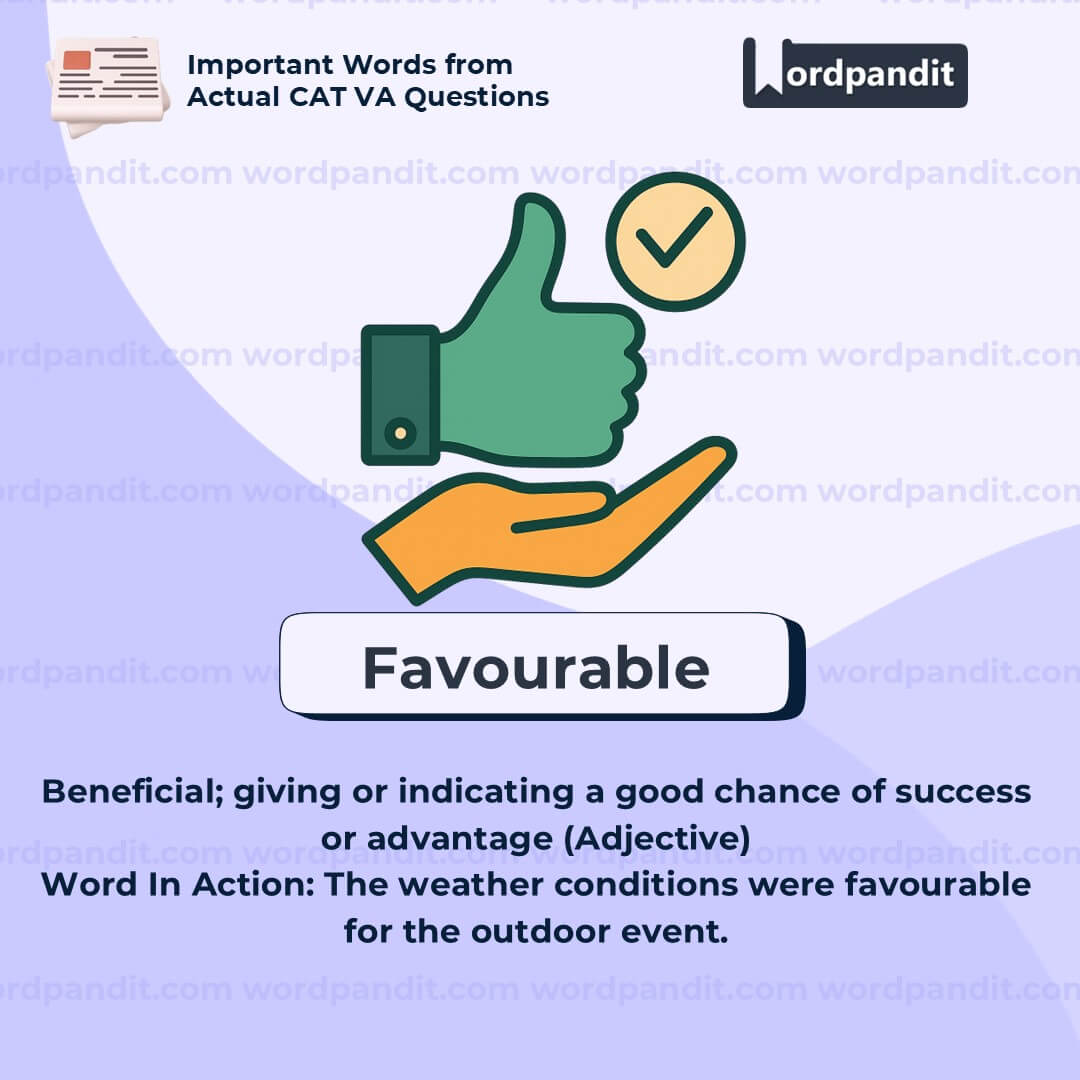
Word 5: Favourable
Context:
"Yet wages haven’t kept up with inflation even despite the salary growth many workers have enjoyed during a favourable pandemic labour market." - Source Unknown
Explanatory Paragraph:
"Favourable" refers to conditions or circumstances that are beneficial, advantageous, or likely to produce a good result. In the given context, the "favourable pandemic labour market" implies a job market that worked in workers’ favour—perhaps offering higher wages, flexible hours, or more opportunities due to worker shortages. Even though those conditions were helpful, rising inflation still outweighed the benefits, showing that even favourable situations can be overshadowed by broader economic forces.
Meaning: Beneficial; giving or indicating a good chance of success or advantage (Adjective)
Pronunciation: FAY-vuh-ruh-buhl (British) / FAY-ver-uh-buhl (American: "favorable")
Difficulty Level: ⭐⭐ Easy
Etymology: From Old French *favorable*, from Latin *favorabilis*, from *favere* meaning “to show kindness or support.”
Prashant Sir's Notes:
“Favourable” is a versatile word used in many contexts—from weather forecasts to political conditions to exam results. It’s a positive signal, but remember: a favourable moment doesn’t guarantee lasting success—it just improves the odds.
Synonyms & Antonyms:
Synonyms: advantageous, beneficial, positive, supportive, encouraging
Antonyms: unfavourable, hostile, discouraging, disadvantageous, negative
Usage Examples:
- The weather forecast is favourable for the outdoor event this weekend.
- Her application was reviewed in a highly favourable light by the committee.
- The pandemic created a favourable job market for remote tech workers.
- They secured a loan on favourable terms compared to other applicants.
Cultural Reference:
In politics and media, surveys often speak of a candidate’s “favourability rating”—a measurement of how positively the public views them. High favourability can influence election outcomes, funding, and media attention.
Think About It:
When something is described as “favourable,” who benefits—and might others be disadvantaged by the same condition?
Quick Activity:
List three favourable conditions you need to succeed in your current goals—academic, professional, or personal.
Memory Tip:
“Favourable” contains “favour”—think of it as conditions that are in your favour, helping things go your way.
Real-World Application:
"Favourable" is commonly used in economics, weather, sports, education, and business negotiations. Whether it’s a favourable deal, a favourable environment, or a favourable opportunity, it often signals a green light worth acting on.