

📘 What’s Inside This CAT Paragraph Summary Question Post?
📝 Authentic CAT Paragraph Summary Question:Practice with a real CAT Paragraph Summary Question from a previous CAT exam.
✅ Detailed Question with Step-by-Step Solution:Each question is explained thoroughly for better understanding.
🔍 In-Depth Paragraph Analysis:Gain insights through line-by-line and paragraph-wise analysis
📚 Vocabulary Enhancement: Top 5 words explained from the paragraph
Paragraph Summary Questions
22. The passage given below is followed by four alternate summaries. Choose the option that best captures the essence of the passage.
When the tradwife puts on that georgic, pinstriped dress, she is not just admiring the visual cues of a fantastical past. She takes these dreams of storybook bliss literally, tracing them backward in time until she reaches a logical conclusion that satisfies her. And by doing so, she ends up delivering an unhappy reminder of just how much our lives consist of artifice and playacting. The tradwife outrages people because of her deliberately regressive ideals. And yet her behaviour is, on some level, indistinguishable from the non tradwife’s. The tradwife’s trollish genius is to beat us at our own dress-up game. By insisting that the idyllic cottage daydream should be real, right down to the primitive gender roles, she leaves others feeling hollow, cheated. The hullabaloo and headaches she causes may be the price we pay for taking too many things at face value: our just deserts, served Instagram-perfect by a manicured hand on a gorgeous ceramic dish, with fat, mouth watering maraschino cherries on top.
Options:
A. The tradwife’s commitment to outdated gender roles and retro fashion critiques the superficiality of today's societal ideals.
B. By promoting an idealized past, the tradwife exposes the artifice of contemporary values and mocks societal norms.
C. The tradwife, with her vintage dress and traditional roles, highlights the superficiality of modern life and challenges current societal norms.
D. The tradwife’s vintage dress and adherence to traditional roles reveal the artificial nature of modern life and its superficial values.
Solution with Explanation
Correct Answer: C
The passage explores the phenomenon of the tradwife—a woman who adopts traditional gender roles and vintage aesthetics—not as someone issuing a direct critique of modern society, but as someone whose lifestyle implicitly challenges contemporary norms. By fully embracing the idealized past, complete with its outdated roles and aesthetics, the tradwife creates a sharp contrast with the artifice and performance of modern life. Her adherence to these regressive ideals is unsettling to others because it reflects how superficial and constructed our current values can be. She doesn’t explicitly attack modernity, but her choices provoke discomfort and reflection.Option-wise Analysis:
- Option A: Incorrect. This option frames the tradwife as actively critiquing society, which is not supported by the passage. Her challenge to societal norms is more passive and implicit, rooted in her lifestyle rather than in conscious social commentary.
- Option B: Incorrect. This summary claims the tradwife mocks societal norms and exposes the artifice of values, suggesting intentionality that the passage does not attribute to her. Her actions may provoke such reactions, but mocking is not her purpose.
- Option C: Correct. This captures the core idea: the tradwife, through her adoption of traditional roles and vintage style, unintentionally highlights the performative and shallow nature of modern life. It reflects the passage’s theme that her lifestyle causes others to question their own values and assumptions.
- Option D: Incorrect. While close, this option overstates the tradwife’s role as someone who “reveals” the artificiality of modern life. The passage implies that others come to this realization in reaction to her, not because she sets out to expose it.
Word 1: Artifice
Context:
"And by doing so, she ends up delivering an unhappy reminder of just how much our lives consist of artifice and playacting." - Source Unknown
Explanatory Paragraph:
"Artifice" refers to clever but often deceptive strategy, trickery, or the use of pretense. It can also suggest artificiality—something lacking in genuineness or sincerity. In the context of the quote, "artifice" points to the constructed or performed nature of modern life, where authenticity is often replaced with role-playing and social masks. It reminds us that many parts of life, from social interactions to professional roles, are shaped by performance rather than truth.
Meaning: Deceptive or insincere behavior; clever trick or pretense (Noun)
Pronunciation: AHR-tuh-fis
Difficulty Level: ⭐⭐⭐ Intermediate
Etymology: From Latin "artificium" meaning "craftsmanship" or "skill", from "ars" (art) + "facere" (to make).
Prashant Sir's Notes:
"Artifice" is a layered word—it can admire cleverness or criticize insincerity. When you sense someone is being overly polished, rehearsed, or manipulative, you're likely witnessing artifice in action.
Synonyms & Antonyms:
Synonyms: trickery, deception, pretense, cunning, facade
Antonyms: honesty, sincerity, genuineness, transparency
Usage Examples:
- The politician's charm was dismissed as mere artifice by his critics.
- The film brilliantly exposes the artifice behind celebrity culture.
- She used emotional artifice to manipulate the conversation in her favor.
- Despite the artifice of his public persona, he longed for authentic connection.
Cultural Reference:
In Shakespeare’s plays, especially in *Hamlet* and *Macbeth*, characters often use artifice—deception and manipulation—to gain power or conceal truth, making the term deeply tied to themes of performance and illusion.
Think About It:
In a world of social media and curated personas, how can we distinguish between authenticity and artifice?
Quick Activity:
Identify a scene in a film, advertisement, or public speech where artifice is clearly being used. Briefly explain how it affects the audience's perception.
Memory Tip:
“Artifice” contains “art”—think of a staged or painted version of reality, something crafted rather than real.
Real-World Application:
"Artifice" is often used in politics, literature, marketing, and interpersonal communication to describe behavior that is calculated, manipulative, or constructed—whether in leadership, branding, or public image.
Word 2: Regressive
Context:
"The tradwife outrages people because of her deliberately regressive ideals." - Source Unknown
Explanatory Paragraph:
"Regressive" refers to moving backward to an earlier, often less advanced or less progressive state. It is typically used to describe ideas, policies, or behaviors that resist change or return to outdated norms. In this context, the term criticizes the “tradwife” (traditional wife) movement for promoting values that many perceive as outdated or contrary to gender equality, suggesting a step backward in terms of social progress and modern thinking.
Meaning: Returning to a former or less developed state; opposed to progress (Adjective)
Pronunciation: rih-GRES-iv
Difficulty Level: ⭐⭐⭐ Intermediate
Etymology: From Latin "regressus" meaning "a return", from "regredi" (to go back).
Prashant Sir's Notes:
Use “regressive” to critique anything that feels like a step backward—whether in politics, education, or culture. It’s a strong, evaluative word often used in debates around social reform, taxes, or gender roles.
Synonyms & Antonyms:
Synonyms: backward, reactionary, outdated, traditionalist, conservative (in some contexts)
Antonyms: progressive, forward-thinking, advanced, liberal, modern
Usage Examples:
- The proposed law was criticized for its regressive stance on women's rights.
- Many viewed the dress code policy as regressive and out of touch with contemporary values.
- Instead of fostering innovation, the curriculum changes felt regressive and restrictive.
- The tax system is regressive if it places a higher burden on the poor than the rich.
Cultural Reference:
Debates over regressive policies often surface in discussions about feminism, LGBTQ+ rights, or racial equality—where any rollback of rights is labeled as regressive by advocates for social justice.
Think About It:
Is every return to traditional values necessarily regressive, or can some traditions coexist with progressive ideals?
Quick Activity:
Identify a policy or idea you consider regressive. Then rewrite it with a progressive perspective that fits today’s world.
Memory Tip:
Think of “re-” as “back” and “-gressive” like “progress.” Regressive = going backward from progress.
Real-World Application:
"Regressive" is widely used in socio-political contexts, especially in policy critique. For example, regressive tax systems impose a heavier burden on low-income groups, and regressive ideologies often resist cultural evolution or inclusivity.
Word 3: Idyllic
Context:
"The tradwife’s trollish genius is to beat us at our own dress-up game. By insisting that the idyllic cottage daydream should be real, right down to the primitive gender roles, she leaves others feeling hollow, cheated." - Source Unknown
Explanatory Paragraph:
"Idyllic" refers to something that is extremely pleasant, peaceful, and picturesque—often in a romanticized or unrealistic way. It’s commonly used to describe rural scenes, simple lifestyles, or idealized moments that feel perfect and untouched by hardship. In the given context, the "idyllic cottage daydream" refers to an idealized vision of domestic life that looks charming on the surface but may mask outdated or problematic social roles. The word here emphasizes the deceptive beauty of a fantasy that doesn't reflect the complexities of real life.
Meaning: Extremely happy, peaceful, or picturesque in a romanticized or unrealistic way (Adjective)
Pronunciation: ih-DIL-ik
Difficulty Level: ⭐⭐ Easy
Etymology: From Greek "eidyllion" meaning "short, picturesque poem or scene"; entered English through Latin and French.
Prashant Sir's Notes:
Use "idyllic" to describe moments, places, or lifestyles that seem perfect—but be aware that it often carries a tone of fantasy or oversimplification. It’s about beauty, but sometimes too good to be true.
Synonyms & Antonyms:
Synonyms: picturesque, perfect, peaceful, charming, romanticized
Antonyms: harsh, grim, chaotic, urban, troubled
Usage Examples:
- The cabin by the lake offered an idyllic retreat from the chaos of city life.
- They spent an idyllic summer in the countryside, far from responsibilities.
- Social media often promotes an idyllic version of parenthood that ignores its challenges.
- Her novel paints an idyllic portrait of rural England, full of flowers and afternoon teas.
Cultural Reference:
The phrase “idyllic countryside” is a common trope in literature and film—from Jane Austen’s rural England to Studio Ghibli’s pastoral landscapes—celebrating nature and simplicity as ideal forms of life.
Think About It:
Can an idyllic fantasy be harmful if it distracts people from real issues or promotes outdated values?
Quick Activity:
Write a few lines describing your version of an “idyllic” day. Then, ask yourself—how realistic is it? What might be hidden beneath the surface?
Memory Tip:
“Idyllic” sounds like “ideal” — just remember that what’s ideal isn’t always what’s real.
Real-World Application:
"Idyllic" is often used in travel writing, advertising, and lifestyle media to evoke a sense of perfection—though it can also be used critically to question whether such perfection is manufactured or misleading.
Word 4: Superficiality
Context:
"The tradwife’s commitment to outdated gender roles and retro fashion critiques the superficiality of today's societal ideals." - Source Unknown
Explanatory Paragraph:
"Superficiality" refers to the quality of being concerned only with outward appearances or surface-level aspects, rather than with deeper meaning, substance, or truth. It suggests a lack of depth, seriousness, or authenticity. In the context of the quote, the "superficiality of today's societal ideals" points to modern norms and values that prioritize appearance, image, or trends over genuine thought, emotion, or ethical substance. The tradwife, through her retro aesthetic and behavior, is portrayed as holding up a mirror to these shallow tendencies in modern culture.
Meaning: Lack of depth, seriousness, or thoroughness; concern with surface-level appearance (Noun)
Pronunciation: soo-per-fish-ee-AL-i-tee
Difficulty Level: ⭐⭐⭐ Intermediate
Etymology: From Latin "superficialis" (of or pertaining to the surface), derived from "super-" (above) + "facies" (face).
Prashant Sir's Notes:
“Superficiality” is a key word in social commentary. Use it to critique anything that values show over substance—whether it's beauty standards, politics, or social media culture.
Synonyms & Antonyms:
Synonyms: shallowness, emptiness, gloss, triviality, pretension
Antonyms: depth, substance, authenticity, sincerity, profundity
Usage Examples:
- Many critics blame social media for promoting superficiality over meaningful connection.
- The film was visually stunning but criticized for its emotional superficiality.
- She was tired of the superficiality of small talk and yearned for deeper conversations.
- The marketing campaign masked the product’s flaws with glitzy superficiality.
Cultural Reference:
Philosophers like Søren Kierkegaard and social critics such as Neil Postman have warned against cultural superficiality, arguing that an overemphasis on image erodes meaning and depth in human life.
Think About It:
Do you think modern technology encourages superficiality in human relationships, or can it also support deeper connections?
Quick Activity:
List two examples from your daily life where you encounter superficiality. Then suggest one way to bring more depth or meaning into each.
Memory Tip:
“Superficiality” = “surface + reality.” It’s when surface-level appearance becomes more important than reality itself.
Real-World Application:
The word is often used in cultural criticism, psychology, media analysis, and even product reviews—anywhere there's a need to challenge appearances and demand authenticity.
Word 5: Performative
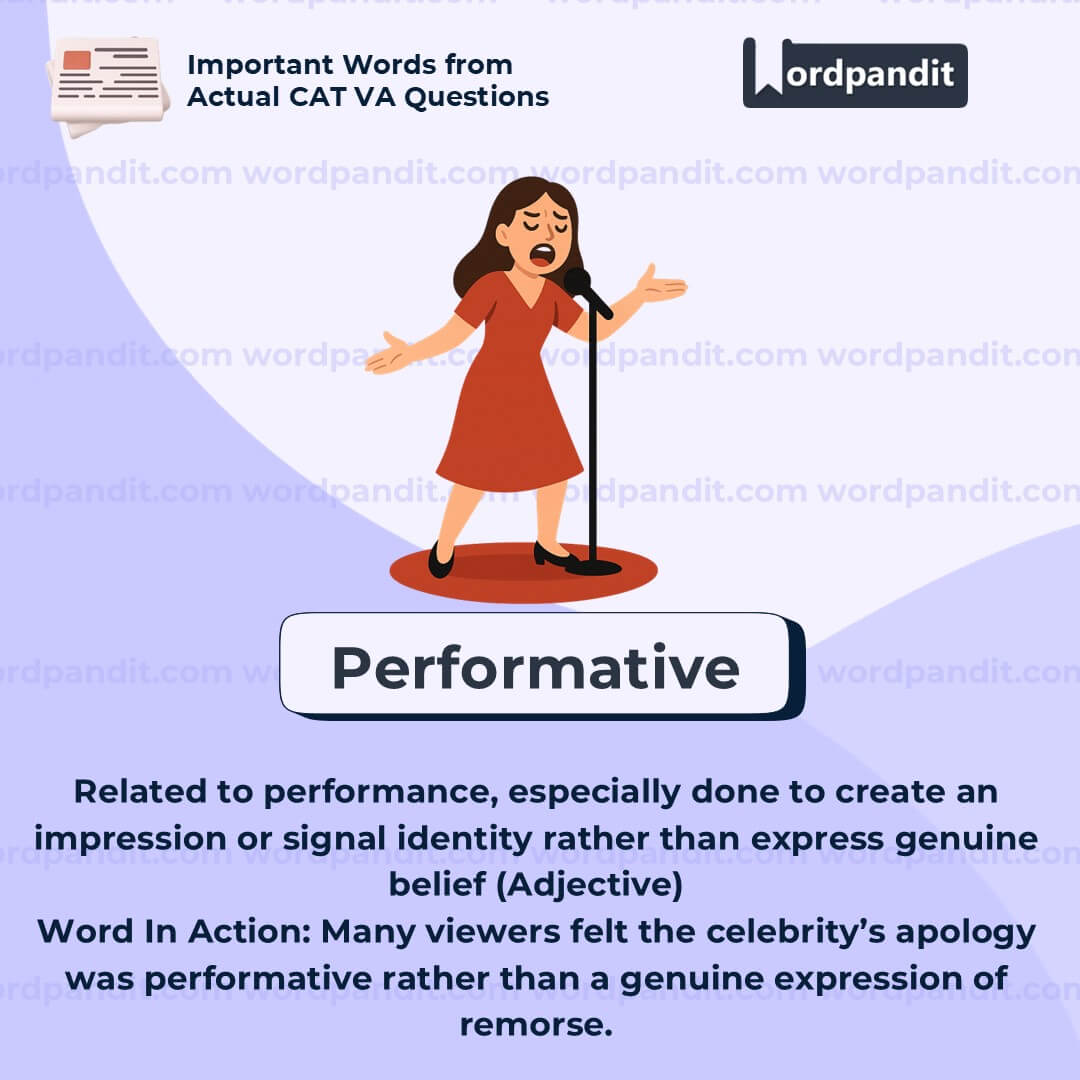
Context:
"This captures the core idea: the tradwife, through her adoption of traditional roles and vintage style, unintentionally highlights the performative and shallow nature of modern life." - Source Unknown
Explanatory Paragraph:
"Performative" refers to actions or behaviors that are done more to display or signal something—often to others—than out of genuine belief or necessity. It’s commonly used in social and cultural discussions to describe how people 'perform' roles or identities for validation or image. In the context of the tradwife, her embrace of hyper-traditional aesthetics ironically reveals how much of modern life, including values and appearances, is based on performance and display rather than authenticity or substance.
Meaning: Related to performance, especially done to create an impression or signal identity rather than express genuine belief (Adjective)
Pronunciation: per-FOR-muh-tiv
Difficulty Level: ⭐⭐⭐ Intermediate
Etymology: From Latin “performare” (to form thoroughly); developed through linguistic theory (J.L. Austin) where “performative” describes statements that enact what they say (e.g., “I apologize”).
Prashant Sir's Notes:
In modern usage, "performative" often critiques insincerity—think “performative activism” or “performative morality.” It questions whether an action is meaningful or just for show.
Synonyms & Antonyms:
Synonyms: theatrical, insincere, pretentious, symbolic, staged
Antonyms: genuine, authentic, heartfelt, sincere, spontaneous
Usage Examples:
- Critics accused the celebrity of performative activism during the protest.
- Her concern for the environment felt more performative than practical.
- In social media, much of what we post is performative rather than reflective of our real lives.
- The politician’s performative empathy didn’t lead to any real policy changes.
Cultural Reference:
The philosopher Judith Butler used "performative" in gender theory to argue that gender is not something we are but something we *do*—performed through repeated actions and expressions.
Think About It:
In what areas of your life do you feel pressure to act in a performative way? What might be the cost of not performing?
Quick Activity:
Write two short sentences: one that shows a performative act and another that expresses the same idea sincerely. Compare the tone and effect.
Memory Tip:
Think of “performative” like a stage act—it looks good on the outside, but may not be true on the inside.
Real-World Application:
"Performative" is used in discussions of social justice, marketing, politics, and identity—anywhere image and intent might clash. It helps us ask: Is this real, or just for show?
