

Daily Vocabulary from Indian Newspapers and Publications
Welcome to Wordpandit’s Indian Vocabulary Hub
At Wordpandit, we understand the importance of staying rooted in the local context while expanding your language skills. This section focuses on enriching your vocabulary with words and phrases drawn from India’s leading newspapers and publications, ensuring you're learning vocabulary that is practical, relevant, and uniquely Indian.
Why Indian Sources Matter
We believe that the best way to master any language is by immersing yourself in local content. That’s why we carefully curate vocabulary from top Indian publications, including:
- The Hindu
- The Times of India
- The Economic Times
- Hindustan Times
- Live Mint
- The Indian Express
- And many others...
Stay Updated, Stay Relevant
With daily updates from Indian news sources, you’ll be consistently learning words that reflect the trends and shifts in Indian society and culture. Our focus is to provide vocabulary that enhances your understanding of the language in an Indian context.
How Wordpandit Supports Your Goals
Whether you’re preparing for exams, aiming to improve your professional communication, or simply want to stay connected with the latest Indian vocabulary, Wordpandit is here to guide you every step of the way.
Learn with a Practical Approach
Our interactive learning methodology includes real-world examples, engaging activities, and context-specific usage to ensure that every word becomes part of your active vocabulary.
Dive into Indian Vocabulary Today!

Why Choose Wordpandit?
Practical Learning: Focus on words you'll actually encounter in real-world reading, enhancing your comprehension and communication skills.
Diverse Content: From current affairs to scientific breakthroughs, our varied sources expose you to vocabulary across multiple domains.
Effortless Integration: Make Wordpandit a part of your daily routine. Just a few minutes each day can significantly boost your lexicon over time.
Your Path to Vocabulary Mastery
- Visit our Daily Vocabulary section regularly
- Explore new words and their usage in context
- Practice incorporating these words into your own writing and speech
- Track your progress as your vocabulary expands
Start Your Journey Today
Embark on your vocabulary enhancement journey with Wordpandit. By consistently engaging with our daily posts, you'll build a robust vocabulary that serves you well in academic, professional, and personal contexts.
Remember, a word a day keeps linguistic limitations at bay. Make Wordpandit your daily companion in the quest for vocabulary excellence!
WORD-1: Sentimental
Context:
"When words began to be translated into codes and human messengers got replaced by mechanical ones, efficiency gains in communication were widely viewed with a sentimental lens." - The Times of India
Explanatory Paragraph:
"Sentimental" refers to an emotional perspective, often driven by feelings rather than logic. It suggests a tendency to view events, people, or things with tenderness, nostalgia, or affection, especially when recalling the past or dealing with change. In the context of technology replacing human messengers, people may react not purely on practical grounds but from a place of emotional attachment or longing for human touch and tradition.
Meaning: Guided more by emotion than reason; nostalgic or emotionally tender (adjective)
Pronunciation: sen-tuh-men-tl
Difficulty Level: ⭐⭐ Beginner
Etymology: Derived from the Latin word “sentire,” meaning “to feel.” It evolved through French “sentimental” in the 18th century to mean emotional or full of feeling.
Prashant Sir's Notes:
"Sentimental" is not always about tears—it’s about any feeling-driven reaction. When people resist change, like replacing letters with emails, it’s often due to sentimental values tied to memory and tradition.
Synonyms & Antonyms:
Synonyms: emotional, tender, nostalgic, affectionate, heartfelt
Antonyms: rational, indifferent, unemotional, pragmatic, cold
Usage Examples:
- She grew sentimental while looking through her childhood photo albums.
- His farewell speech was deeply sentimental and touched everyone’s heart.
- Some critics felt the movie was overly sentimental, relying too much on emotional scenes.
- He kept the old typewriter out of sentimental attachment, even though he never used it.
Cultural Reference:
Classic Bollywood songs often evoke a sentimental mood, celebrating themes of love, loss, and nostalgia that deeply connect with audiences across generations.
Think About It:
Is being sentimental a strength that preserves human connection, or a weakness that resists necessary change?
Quick Activity:
Write 3 sentences about an object or memory that makes you feel sentimental. Use the word “sentimental” in at least one of them.
Memory Tip:
“Sentimental” starts with “sent”—like “sensitive” or “sense”—which helps you link it to feelings and emotions.
Real-World Application:
Understanding “sentimental” is key in literature, advertising, and psychology. Emotional appeal is often used in media and branding to create lasting impressions or influence consumer behavior.
WORD-2: Fallacy
Context:
"In the decades to come, radio and telephone acolytes similarly thought these new technologies would bring nations together and end war. That WW I onwards the 20th century would be the bloodiest one ever proved, the book says, that we had been telling ourselves lies about communication – and about ourselves. Still, with the internet, the smartphone, social media, LLMs, again and again the peace fallacy, as much as the ‘democratisation’ one, would resurface." - The Times of India
Explanatory Paragraph:
The word "fallacy" refers to a mistaken belief or idea, often one that is based on unsound reasoning or logic. It’s commonly used to point out flaws in arguments or assumptions that people accept as true without critical analysis. In the given context, the “peace fallacy” refers to the unrealistic belief that advancements in communication technology would naturally lead to global peace. Despite hopeful assumptions, history has repeatedly shown that technology alone does not eliminate conflict.
Meaning: A mistaken belief, especially one based on unsound argument or logic. (Noun)
Pronunciation: fa-luh-see
Difficulty Level: ⭐⭐⭐ Intermediate
Etymology: From Latin “fallacia,” meaning “deception,” from “fallere” meaning “to deceive or trick.”
Prashant Sir's Notes:
“Fallacy” is a word you’ll hear often in debates and logical reasoning. It helps you identify errors in arguments. Remember: a fallacy isn’t just a lie—it’s a false belief, sometimes sincere but logically flawed.
Synonyms & Antonyms:
Synonyms: misconception, illusion, delusion, error, falsehood
Antonyms: truth, fact, certainty, reality, sound reasoning
Usage Examples:
- Believing that more money automatically brings happiness is a common fallacy.
- The politician’s argument was full of logical fallacies and emotional manipulation.
- The peace fallacy assumes that better communication will eliminate conflict, which history contradicts.
- It’s a fallacy to think that popularity equals quality.
Cultural Reference:
The “slippery slope” fallacy is a popular concept in debates and critical thinking courses. It refers to the flawed argument that a small step will inevitably lead to a chain of related negative events.
Think About It:
Why do certain fallacies—like the belief that technology will bring world peace—continue to resurface despite being historically disproven?
Quick Activity:
Identify a fallacy you’ve encountered in a recent news story or social media post. Briefly explain why it’s a fallacy in 2–3 lines.
Memory Tip:
“Fallacy” sounds like “false-see”—helping you remember it’s about seeing something falsely or incorrectly.
Real-World Application:
Recognizing fallacies is essential in debates, critical thinking, legal arguments, and media literacy. It sharpens your ability to detect misleading claims and think logically.
WORD-3: Democratisation
Context:
"In the decades to come, radio and telephone acolytes similarly thought these new technologies would bring nations together and end war. That WW I onwards the 20th century would be the bloodiest one ever proved, the book says, that we had been telling ourselves lies about communication – and about ourselves. Still, with the internet, the smartphone, social media, LLMs, again and again the peace fallacy, as much as the ‘democratisation’ one, would resurface." - The Times of India
Explanatory Paragraph:
The word "democratisation" refers to the process of making something accessible or available to all people, much like the ideals of democracy. It implies spreading power, access, or control from a central or elite group to a broader population. In modern times, this term is frequently used to describe the spread of technology, information, education, and resources to wider communities, removing traditional barriers of privilege or exclusivity.
Meaning: The process of making something accessible to everyone, giving equal rights or power. (Noun)
Pronunciation: dih-mok-ruh-tie-zay-shun
Difficulty Level: ⭐⭐⭐ Intermediate
Etymology: From the word "democratise" (British spelling of "democratize") + suffix "-ation", from Greek *dēmokratia* ("rule of the people")
Prashant Sir's Notes:
This word often appears in discussions around technology, governance, and education. It reflects an idealistic belief that spreading access leads to empowerment — but as the context suggests, it can be misleading if not accompanied by structural change.
Synonyms & Antonyms:
Synonyms: liberalization, equalization, empowerment, enfranchisement
Antonyms: centralization, monopolization, authoritarianism, elitism
Usage Examples:
- The democratisation of education through online courses has enabled students from rural areas to access quality learning.
- Technological innovations have led to the democratisation of media production and distribution.
- Critics argue that mere access does not guarantee true democratisation of power.
- Cloud computing is accelerating the democratisation of AI tools among startups and individuals.
Cultural Reference:
"The internet promised democratisation of knowledge, but it also amplified misinformation and division." - Paraphrased from various digital culture critiques
Think About It:
Can true democratisation exist in a system still controlled by a few powerful entities?
Quick Activity:
List three areas of life (e.g., education, healthcare, technology) where you think democratisation is occurring. Then reflect on whether this access is truly equal.
Memory Tip:
Think of “democracy” + “-isation” — turning something into a democracy-like state where all get a say or share.
Real-World Application:
"Democratisation" is widely used in tech and policy discussions — e.g., when a government provides free internet to rural areas, it is an effort toward the democratisation of information.
WORD-4: Tactician
Context:
"Vladimir Lenin was not merely the tactician of the 1917 October Revolution, he was among the finest Marxist theoreticians of the 20th century. His contributions significantly deepened and sharpened revolutionary thought." - The Indian Express
Explanatory Paragraph:
A "tactician" is someone who is skilled at developing and executing strategies, especially in challenging situations such as military, political, or competitive contexts. The term implies not just planning, but an ability to make precise, effective decisions that lead to desired outcomes. In the given context, Lenin is praised as a tactician for his strategic brilliance in orchestrating the Russian Revolution, demonstrating his ability to maneuver within volatile political landscapes.
Meaning: A person who is adept at planning and executing tactics or strategies (noun)
Pronunciation: tak-ti-shun
Difficulty Level: ⭐⭐⭐ Intermediate
Etymology: Derived from the Greek word “taktikē” meaning “art of arrangement,” from “taktikos” (fit for ordering or arranging).
Prashant Sir's Notes:
A tactician focuses on how to win the game, whether it’s politics, war, or sports. Think of chess—every move counts. A tactician doesn’t just react, they plan several steps ahead with sharp awareness of timing and positioning.
Synonyms & Antonyms:
Synonyms: strategist, planner, schemer, manipulator, organizer
Antonyms: amateur, novice, bungler, improviser
Usage Examples:
- The general was known as a brilliant tactician who outsmarted his opponents with minimal loss of life.
- As a political tactician, she orchestrated one of the most surprising election victories in recent history.
- In chess, being a good tactician requires not only skill but foresight and precision.
- The CEO acted as a shrewd tactician during the company’s financial restructuring.
Cultural Reference:
“Napoleon Bonaparte is often cited as one of history’s greatest military tacticians, known for his bold strategies and battlefield mastery.” – History Channel
Think About It:
Is it better to be a bold visionary or a skilled tactician in achieving success—and can a person be both?
Quick Activity:
Think of a famous tactician (real or fictional). Write a 2–3 line description of a moment that showed their tactical brilliance.
Memory Tip:
“Tactician” comes from “tactics”—just like in war games or sports, where each move is part of a bigger plan. A tactician is the brain behind the operation.
Real-World Application:
In leadership, business, sports, and activism, tacticians are valued for their ability to think strategically and act decisively. Recognizing tactical thinking can help you plan more effectively in competitive or high-stakes situations.
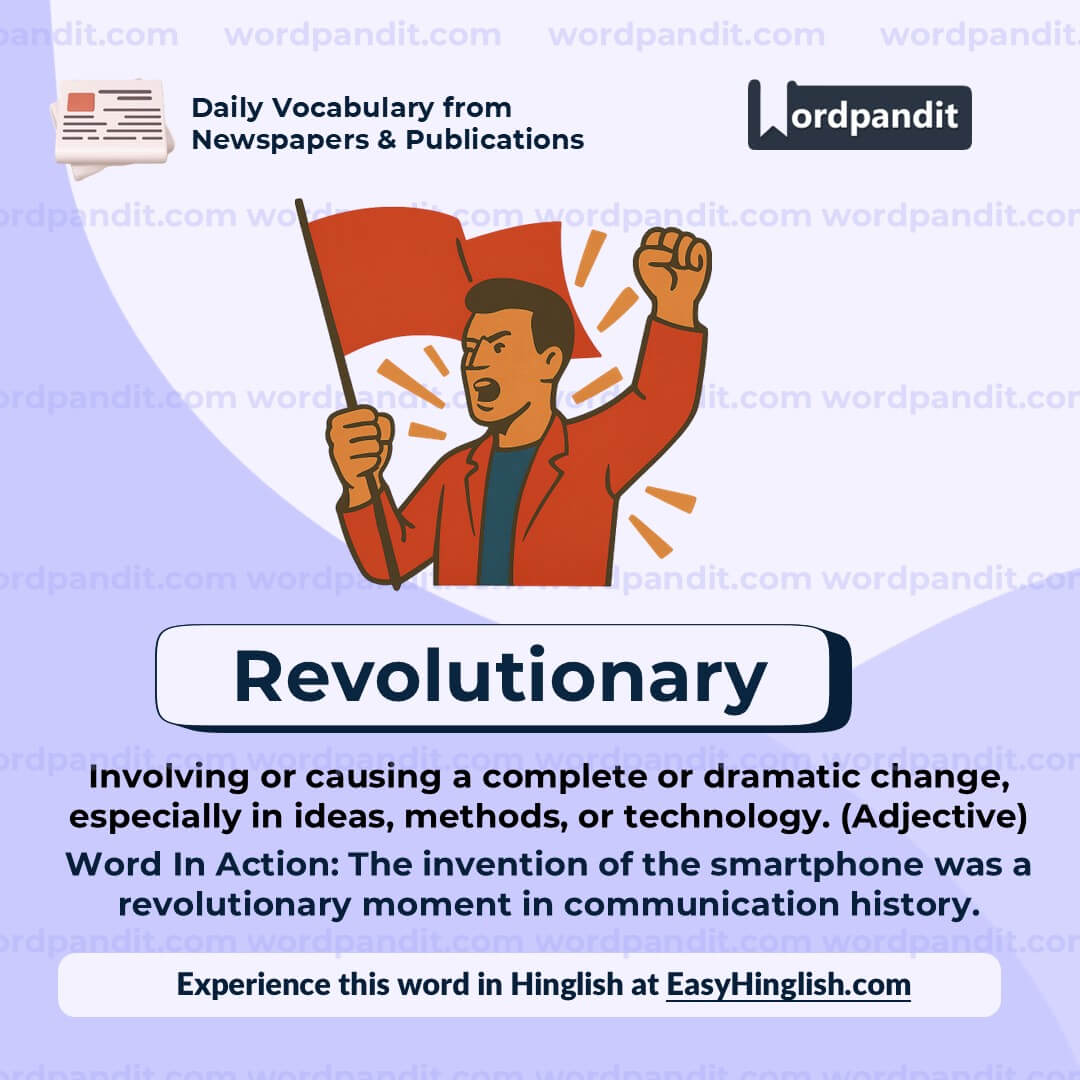
WORD-5: Revolutionary
Sandarbh (Context):
"Vladimir Lenin was not merely the tactician of the 1917 October Revolution, he was among the finest Marxist theoreticians of the 20th century. His contributions significantly deepened and sharpened revolutionary thought." - The Indian Express
Vyakhya (Explanatory Paragraph):
"Revolutionary" ka matlab hota hai aisa vyakti ya idea jo purane system ko badalne ke liye bade level par change lata hai. Yeh word un logon ke liye bhi use hota hai jo social, political ya ideological revolutions ke leader hote hain. Lenin ko revolutionary isliye kaha gaya kyunki usne 1917 ki October Revolution mein ek major role play kiya aur Marxist ideas ko naye tareeke se samjhaaya.
Arth (Meaning): involving or causing a complete or dramatic change, especially in ideas, methods, or technology. (Adjective)
Uccharan (Pronunciation): rev-uh-LOO-shuh-nair-ee
Kathinai Star (Difficulty Level): ⭐⭐
Utpatti (Etymology): Latin word "revolutio" se aaya hai, jiska arth hai "a turn around" — yani ek complete change
Prashant Sir Ke Tathya (Prashant Sir's Notes):
"Revolutionary" sirf political ya historical context mein nahi, balki technology, art aur ideas ke context mein bhi use hota hai. Jab koi innovation ya thought kisi cheez ko jadh se badal de, toh use bhi revolutionary kaha ja sakta hai. Example: "The smartphone was a revolutionary invention."
Samanarthi & Vipritarthi (Synonyms & Antonyms):
Samanarthi (Synonyms): Radical, Reformist, Trailblazer
Vipritarthi (Antonyms): Conservative, Traditionalist
Udaharan (Usage Examples):
- Steve Jobs ko ek revolutionary innovator mana jaata hai jinhone tech industry ko badal diya.
- Bhagat Singh ek sachche revolutionary the jo British rule ke khilaaf ladhe.
Sanskritik Sandarbh (Cultural Reference):
"Rang De Basanti movie mein naye zamane ke revolutionaries ko dikhaya gaya hai jo system se ladaai karte hain." - Bollywood Cinema
Sochiye (Think About It):
Kya aaj ke digital age mein koi revolutionary idea hai jo society ko puri tarah se badal raha hai?
Chhoti Kriya (Quick Activity):
Ek aise vyakti ya invention ka naam likhiye jo aapke nazar mein revolutionary hai aur uska reason batayein.
Yaad Karne Ka Tarika (Memory Tip):
Revolutionary = Re+Volcano+Change — Sochiye ek volcano jaisa bada change jo pura system hila de.
Vastavik Jeevan Me Upyog (Real-World Application):
Jab kisi new policy, invention, ya idea se pura structure badal jaye — jaise online education ka rise — toh use hum revolutionary keh sakte hain. Yeh word leadership, innovation aur bold thinking dikhata hai.


