


Daily Vocabulary from Indian Newspapers and Publications
Welcome to Wordpandit’s Indian Vocabulary Hub
At Wordpandit, we understand the importance of staying rooted in the local context while expanding your language skills. This section focuses on enriching your vocabulary with words and phrases drawn from India’s leading newspapers and publications, ensuring you're learning vocabulary that is practical, relevant, and uniquely Indian.
Why Indian Sources Matter
We believe that the best way to master any language is by immersing yourself in local content. That’s why we carefully curate vocabulary from top Indian publications, including:
- The Hindu
- The Times of India
- The Economic Times
- Hindustan Times
- Live Mint
- The Indian Express
- And many others...
Stay Updated, Stay Relevant
With daily updates from Indian news sources, you’ll be consistently learning words that reflect the trends and shifts in Indian society and culture. Our focus is to provide vocabulary that enhances your understanding of the language in an Indian context.
How Wordpandit Supports Your Goals
Whether you’re preparing for exams, aiming to improve your professional communication, or simply want to stay connected with the latest Indian vocabulary, Wordpandit is here to guide you every step of the way.
Learn with a Practical Approach
Our interactive learning methodology includes real-world examples, engaging activities, and context-specific usage to ensure that every word becomes part of your active vocabulary.
Dive into Indian Vocabulary Today!

Why Choose Wordpandit?
Practical Learning: Focus on words you'll actually encounter in real-world reading, enhancing your comprehension and communication skills.
Diverse Content: From current affairs to scientific breakthroughs, our varied sources expose you to vocabulary across multiple domains.
Effortless Integration: Make Wordpandit a part of your daily routine. Just a few minutes each day can significantly boost your lexicon over time.
Your Path to Vocabulary Mastery
- Visit our Daily Vocabulary section regularly
- Explore new words and their usage in context
- Practice incorporating these words into your own writing and speech
- Track your progress as your vocabulary expands
Start Your Journey Today
Embark on your vocabulary enhancement journey with Wordpandit. By consistently engaging with our daily posts, you'll build a robust vocabulary that serves you well in academic, professional, and personal contexts.
Remember, a word a day keeps linguistic limitations at bay. Make Wordpandit your daily companion in the quest for vocabulary excellence!
WORD-1: Blurring away
Context:
"As one progresses through one’s 50s, a few things start blurring away slowly from your life’s rear-view mirror. e.g. The ability to read at length. Books, which you once stopped reading only to shift position if alerted of an imminent meteor strike, now tease your concentration after a few pages." - The Times of India
Explanatory Paragraph:
“Blurring away” is a figurative expression used to describe how certain things in life—memories, habits, abilities—fade gradually over time, especially with aging. It suggests a slow, almost imperceptible decline in clarity, presence, or sharpness, whether in thought, vision, or lifestyle. Just like distant scenery becomes less defined in a rear-view mirror, so too do past capabilities and experiences as we move forward in life.
Meaning: To gradually fade or become less distinct (Phrasal verb/expression)
Pronunciation: blur-ing uh-way
Difficulty Level: ⭐⭐ Beginner
Etymology: From the word "blur" (early 19th century), meaning to make or become unclear, and "away", used to indicate fading or disappearance.
Prashant Sir's Notes:
“Blurring away” combines a visual metaphor with emotional resonance—great for essays or reflective writing. It can convey both the physical (sight, memory) and metaphorical fading of habits, emotions, or routines. Notice how it’s used with a poetic tone here to describe the soft erosion of past capacities.
Synonyms & Antonyms:
Synonyms: fading away, dissolving, vanishing, dimming, obscuring
Antonyms: sharpening, clarifying, intensifying, emerging, crystallizing
Usage Examples:
- Over time, his childhood memories began blurring away like colors in a watercolor painting.
- The vivid excitement of the vacation started blurring away as the routine of daily life resumed.
- Her passion for writing never blurred away, even as her career shifted to new paths.
- The old photograph was slowly blurring away with age, its edges eaten by time.
Cultural Reference:
"Memories warm you up from the inside. But they also tear you apart." - Haruki Murakami. This resonates with the idea of things blurring away over time. - *Kafka on the Shore*
Think About It:
What aspects of your life do you feel are slowly “blurring away”? How can you preserve them or let go mindfully?
Quick Activity:
Write a short paragraph (3-4 lines) describing a personal memory that feels like it's blurring away. Try to use at least two sensory details.
Memory Tip:
Think of “blur” as what happens to a camera image when it’s out of focus—and "blurring away" as when something gradually vanishes from that frame. Picture a foggy window slowly erasing a view.
Real-World Application:
“Blurring away” is a vivid expression often used in personal essays, memoirs, or even self-reflective emails and blogs to express the gentle loss of past clarity—whether in vision, memory, or habit. Writers often use it to create a nostalgic or contemplative tone.
WORD-2: Imminent
Sandarbh (Context):
"As one progresses through one’s 50s, a few things start blurring away slowly from your life’s rear-view mirror. e.g. The ability to read at length. Books, which you once stopped reading only to shift position if alerted of an imminent meteor strike, now tease your concentration after a few pages." - The Times of India
Vyakhya (Explanatory Paragraph):
"Imminent" ka matlab hota hai koi cheez jo bahut hi jald hone waali hai, jo bilkul nazdeek hai. Jaise agar ek meteor strike hone wali ho, aur uska time bas aanay wala ho, toh hum kehte hain ki meteor strike "imminent" hai. Iska istemal zyada tar emergency ya time-sensitive situations mein hota hai.
Arth (Meaning): Koi cheez jo bas hone hi wali ho (Adjective)
Uccharan (Pronunciation): IM-uh-nuhnt
Kathinai Star (Difficulty Level): ⭐⭐
Utpatti (Etymology): Latin word "imminere" se aaya hai, jiska matlab hota hai "to overhang" — matlab kuch cheez sir ke upar latak rahi ho, ya hone waali ho.
Prashant Sir Ke Tathya (Prashant Sir's Notes):
"Imminent" ek aisa word hai jo urgency ko express karta hai. Iska tone thoda serious hota hai, aur generally aise situations mein use hota hai jahan kuch important hone wala ho—acha ya bura.
Samanarthi & Vipritarthi (Synonyms & Antonyms):
Samanarthi (Synonyms): upcoming, looming, impending, approaching
Vipritarthi (Antonyms): distant, unlikely, remote, postponed
Udaharan (Usage Examples):
- Jab doctor ne bola ki operation imminent hai, toh patient aur family ne turant tayyari shuru kar di.
- Barsaat ke badal dekh kar lag raha tha ki storm imminent hai.
Sanskritik Sandarbh (Cultural Reference):
"In many disaster movies like *2012*, an imminent global catastrophe is always the central plot." - Hollywood Films
Sochiye (Think About It):
Aapki life mein koi kaam ya event hai jo imminent hai? Kya aap uske liye prepared ho?
Chhoti Kriya (Quick Activity):
Ek chhoti list banao 3 cheezon ki jo aapko lagta hai ki aapki life mein imminent hain (positive ya negative).
Yaad Karne Ka Tarika (Memory Tip):
"Imminent" = "Immediate + Moment" yaani kuch jo kisi bhi moment mein ho sakta hai!
Vastavik Jeevan Me Upyog (Real-World Application):
Jab koi project ka deadline paas ho, toh hum kehte hain ki deadline is imminent. Exams ke pehle bhi students ko lagta hai ki pressure imminent hai!
WORD-3: Dreaded
Context:
"But the one thing you don’t expect is the dreaded mail from HR with the subject just stating “Meeting”, where you and your manager are the only invitees. It feels like a wedding invitation from an ex-girlfriend who dumped you on Diwali." - The Times of India
Explanatory Paragraph:
The word “dreaded” refers to something that causes fear, anxiety, or deep apprehension—especially something unpleasant you expect or anticipate. In this context, the “dreaded mail” from HR triggers nervousness or foreboding because it implies something serious or uncomfortable is about to happen. It expresses a common workplace fear with a humorous twist.
Meaning: Regarded with great fear or apprehension (Adjective)
Pronunciation: dred-id
Difficulty Level: ⭐⭐ Beginner
Etymology: From Middle English "dreden", from Old English "drēogan" (to endure), later evolving into “dread” meaning fear, with the adjective form “dreaded” implying something feared.
Prashant Sir's Notes:
“Dreaded” often appears before nouns to exaggerate or dramatize the fear tied to everyday things—like the “dreaded exam” or “dreaded dentist appointment.” It’s useful in humorous, ironic, or exaggerated contexts. Use it sparingly for maximum impact.
Synonyms & Antonyms:
Synonyms: feared, terrifying, alarming, appalling, intimidating
Antonyms: welcome, desired, pleasant, delightful, anticipated
Usage Examples:
- She finally faced the dreaded conversation with her boss about quitting.
- The dreaded sound of the alarm clock marked the end of the weekend.
- Many students fear the dreaded math exam more than any other subject.
- He opened the letter with trembling hands—it was the dreaded tax notice.
Cultural Reference:
In the Harry Potter series, Professor Snape is often described by students as the “dreaded Potions Master,” symbolizing the fear and tension he evokes in the classroom. - *J.K. Rowling*
Think About It:
What’s something you once dreaded that turned out to be less frightening—or even rewarding—once you faced it?
Quick Activity:
List three tasks or situations you would label as “dreaded” in your daily life. Then write one sentence for each using the word.
Memory Tip:
“Dreaded” sounds like “dead-ed” — think of something so scary or stressful it makes you feel dead inside (like the dreaded Monday!).
Real-World Application:
“Dreaded” is commonly used in journalism, literature, and conversation to add emotional intensity. It emphasizes common human fears—HR emails, doctor visits, farewells—and makes them relatable with a touch of drama or humor.
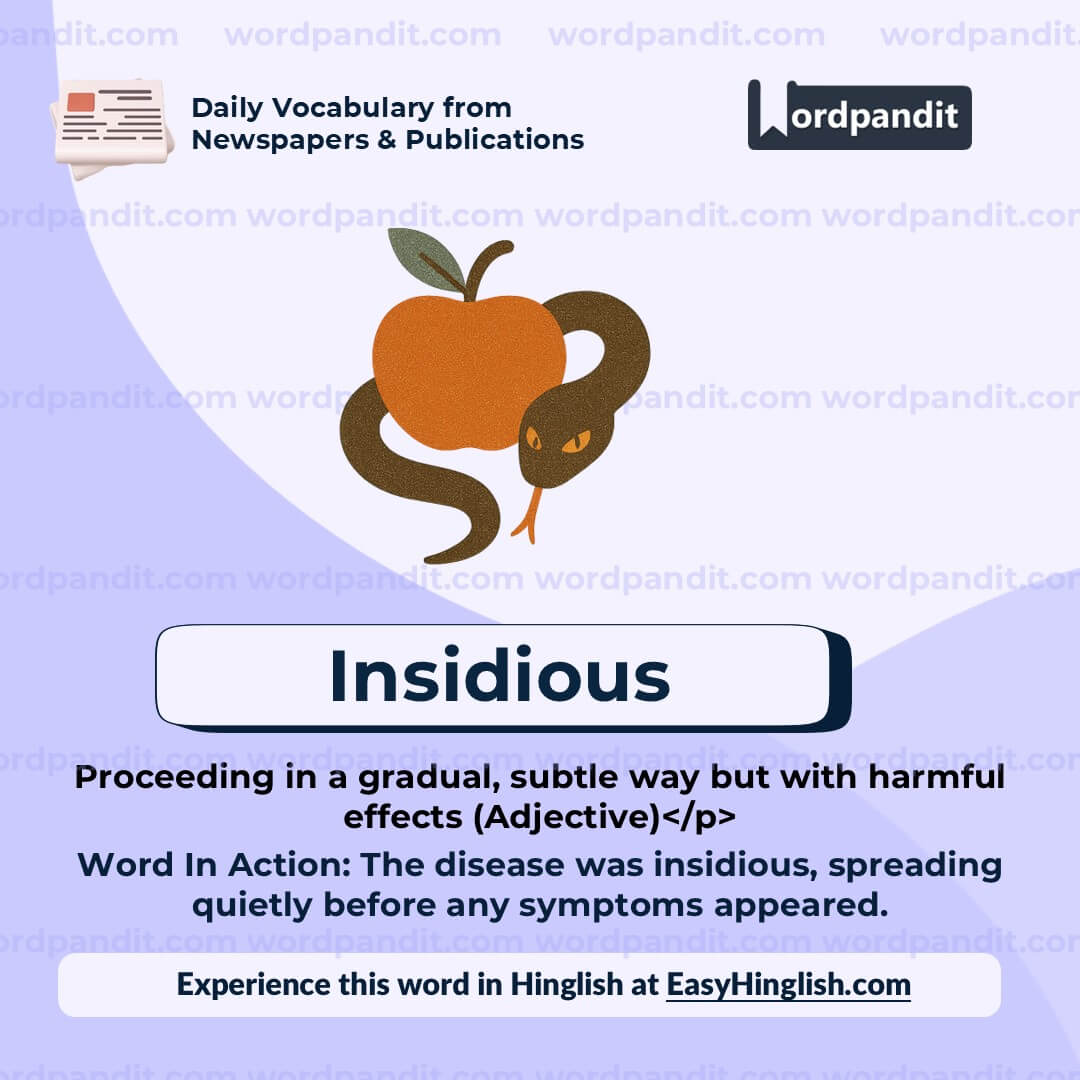
WORD-4: Insidious
Context:
"The Bharatiya Janata Party has reversed its own publicly stated policy position and agreed to an all-caste census. It is a recognition that “principled” policy positions only enjoy sanctity as long as they do not create the conditions of electoral setbacks and loss of power. Caste – perhaps the most insidious and pernicious form of social distinction known to humankind – structures Indian life in inescapably violent ways." - The Indian Express
Explanatory Paragraph:
The word “insidious” refers to something harmful that spreads gradually and subtly, often without being immediately noticed. It’s dangerous because of this slow and hidden nature. In the given context, caste is described as “insidious” because its discriminatory effects are deeply woven into social structures—operating quietly and continuously, causing harm over time without always appearing openly hostile.
Meaning: Proceeding in a gradual, subtle way but with harmful effects (Adjective)
Pronunciation: in-sid-ee-us
Difficulty Level: ⭐⭐⭐ Intermediate
Etymology: From Latin "insidiosus" (deceitful), from "insidiae" meaning ambush or plot, suggesting something treacherous and hidden.
Prashant Sir's Notes:
“Insidious” is a powerful adjective, especially for analytical or critical writing. Use it to describe slow, invisible harm—like societal problems, diseases, propaganda, or manipulation. It often pairs well with words like “threat,” “disease,” “system,” and “bias.”
Synonyms & Antonyms:
Synonyms: stealthy, sneaky, subtle, treacherous, deceptive
Antonyms: obvious, honest, open, direct, transparent
Usage Examples:
- The insidious spread of misinformation can erode trust in democratic institutions.
- Corruption is often insidious, embedding itself quietly into everyday operations.
- Her illness was insidious—showing no symptoms until it had already advanced significantly.
- He spoke with calm authority, masking the insidious nature of his intentions.
Cultural Reference:
In the 2010 horror film *Insidious*, the title plays on the idea of an evil presence infiltrating a family’s home quietly, reflecting the word's meaning of something harmful working its way in unnoticed. - *Insidious (Film)*
Think About It:
What are some insidious forces in society today that operate below the surface yet shape people’s behaviors or beliefs?
Quick Activity:
Write two sentences describing an “insidious” situation—one in a social context and one in a personal or psychological context.
Memory Tip:
“Insidious” sounds like “inside us”—think of a danger creeping inside silently. Imagine a snake slithering unnoticed until it strikes.
Real-World Application:
“Insidious” is often used in academic writing, journalism, and policy critique to highlight the slow, often invisible nature of harm. It's ideal for discussing issues like systemic discrimination, manipulation in media, or the gradual effects of unhealthy habits.
WORD-5: Combat
Context:
"Last week, the world paid careful attention to the air clashes between India and Pakistan. The international interest did not stem from purely altruistic concern. Governments everywhere are keen to understand how weapons systems actually perform in the unpredictable chaos of combat." - The Indian Express
Explanatory Paragraph:
The word “combat” refers to active fighting, especially in a war or battle scenario. In the given context, it denotes the intense, chaotic, and dangerous conditions of military engagement between countries. “Combat” can also be used metaphorically to describe any struggle against a difficult challenge, but here it retains its literal sense of armed conflict.
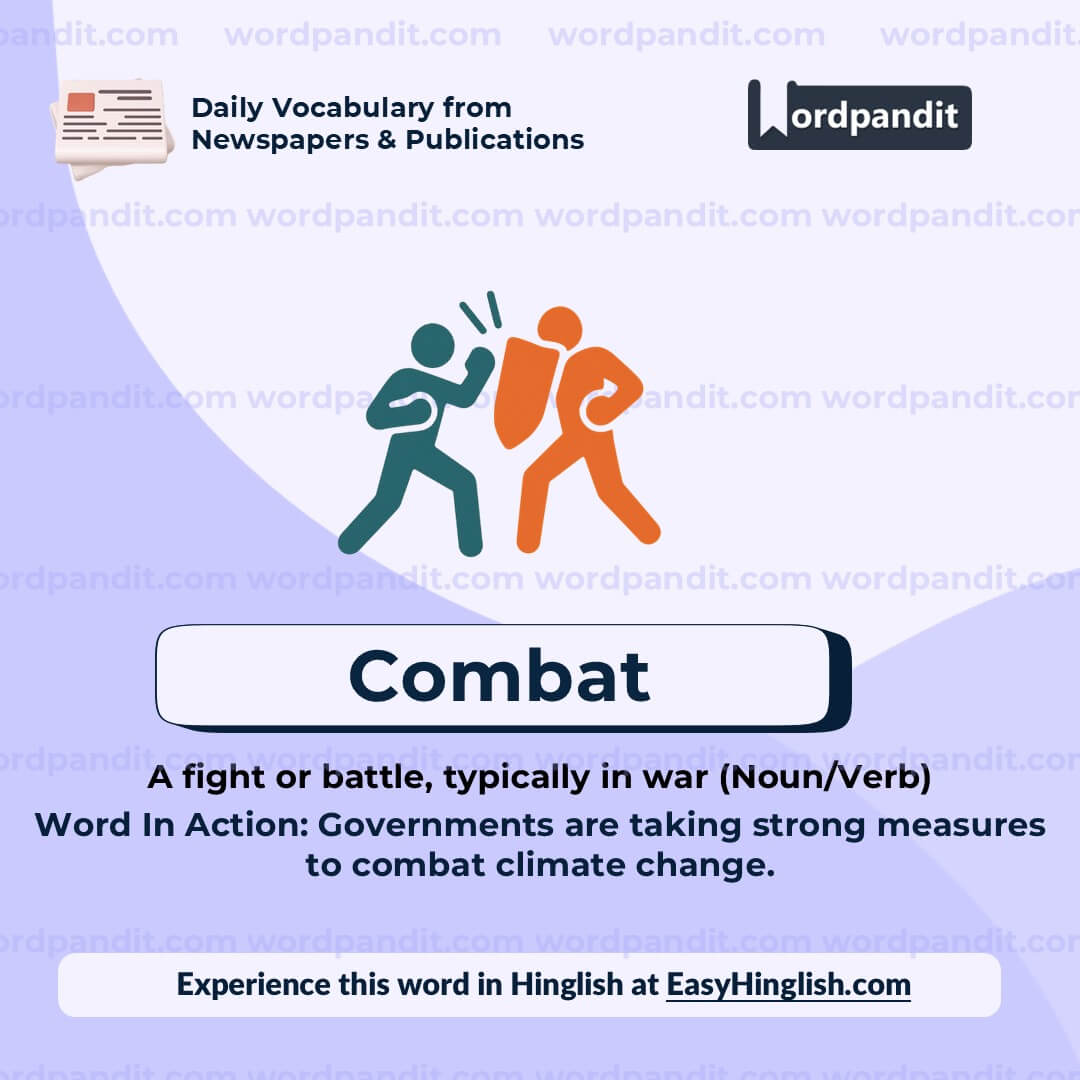
Meaning: A fight or battle, typically in war (Noun/Verb)
Pronunciation: KOM-bat (noun), kuhm-BAT (verb)
Difficulty Level: ⭐⭐ Beginner to Intermediate
Etymology: From Old French “combatre,” from Latin “com-” (together) + “battuere” (to fight or beat)
Prashant Sir's Notes:
“Combat” is a powerful word, commonly used in both military and metaphorical settings. As a noun, it refers to actual battle; as a verb, it means to fight against something — like “combat inflation” or “combat crime.”
Synonyms & Antonyms:
Synonyms: battle, fight, warfare, conflict, skirmish
Antonyms: peace, truce, harmony, reconciliation
Usage Examples:
- The soldiers were trained for urban combat scenarios.
- She dedicated her life to combating environmental degradation.
- Intense combat lasted for hours before reinforcements arrived.
- To combat rising prices, the government implemented new regulations.
Cultural Reference:
“The Art of Combat” is a recurring theme in historical texts and martial arts films, showcasing the tactical and philosophical dimensions of battle.
Think About It:
In what ways do we engage in “combat” in our daily lives, even without physical violence?
Quick Activity:
Create two sentences using “combat” — one where it means physical fighting, and another where it means tackling a non-violent issue.
Memory Tip:
Think: “Come + Bat” — you come ready with a bat to fight — that's combat!
Real-World Application:
Governments, NGOs, and individuals all combat issues like poverty, climate change, and misinformation using strategic efforts rather than weapons.


