

Daily Vocabulary from Indian Newspapers and Publications
Welcome to Wordpandit’s Indian Vocabulary Hub
At Wordpandit, we understand the importance of staying rooted in the local context while expanding your language skills. This section focuses on enriching your vocabulary with words and phrases drawn from India’s leading newspapers and publications, ensuring you're learning vocabulary that is practical, relevant, and uniquely Indian.
Why Indian Sources Matter
We believe that the best way to master any language is by immersing yourself in local content. That’s why we carefully curate vocabulary from top Indian publications, including:
- The Hindu
- The Times of India
- The Economic Times
- Hindustan Times
- Live Mint
- The Indian Express
- And many others...
Stay Updated, Stay Relevant
With daily updates from Indian news sources, you’ll be consistently learning words that reflect the trends and shifts in Indian society and culture. Our focus is to provide vocabulary that enhances your understanding of the language in an Indian context.
How Wordpandit Supports Your Goals
Whether you’re preparing for exams, aiming to improve your professional communication, or simply want to stay connected with the latest Indian vocabulary, Wordpandit is here to guide you every step of the way.
Learn with a Practical Approach
Our interactive learning methodology includes real-world examples, engaging activities, and context-specific usage to ensure that every word becomes part of your active vocabulary.
Dive into Indian Vocabulary Today!

Why Choose Wordpandit?
Practical Learning: Focus on words you'll actually encounter in real-world reading, enhancing your comprehension and communication skills.
Diverse Content: From current affairs to scientific breakthroughs, our varied sources expose you to vocabulary across multiple domains.
Effortless Integration: Make Wordpandit a part of your daily routine. Just a few minutes each day can significantly boost your lexicon over time.
Your Path to Vocabulary Mastery
- Visit our Daily Vocabulary section regularly
- Explore new words and their usage in context
- Practice incorporating these words into your own writing and speech
- Track your progress as your vocabulary expands
Start Your Journey Today
Embark on your vocabulary enhancement journey with Wordpandit. By consistently engaging with our daily posts, you'll build a robust vocabulary that serves you well in academic, professional, and personal contexts.
Remember, a word a day keeps linguistic limitations at bay. Make Wordpandit your daily companion in the quest for vocabulary excellence!
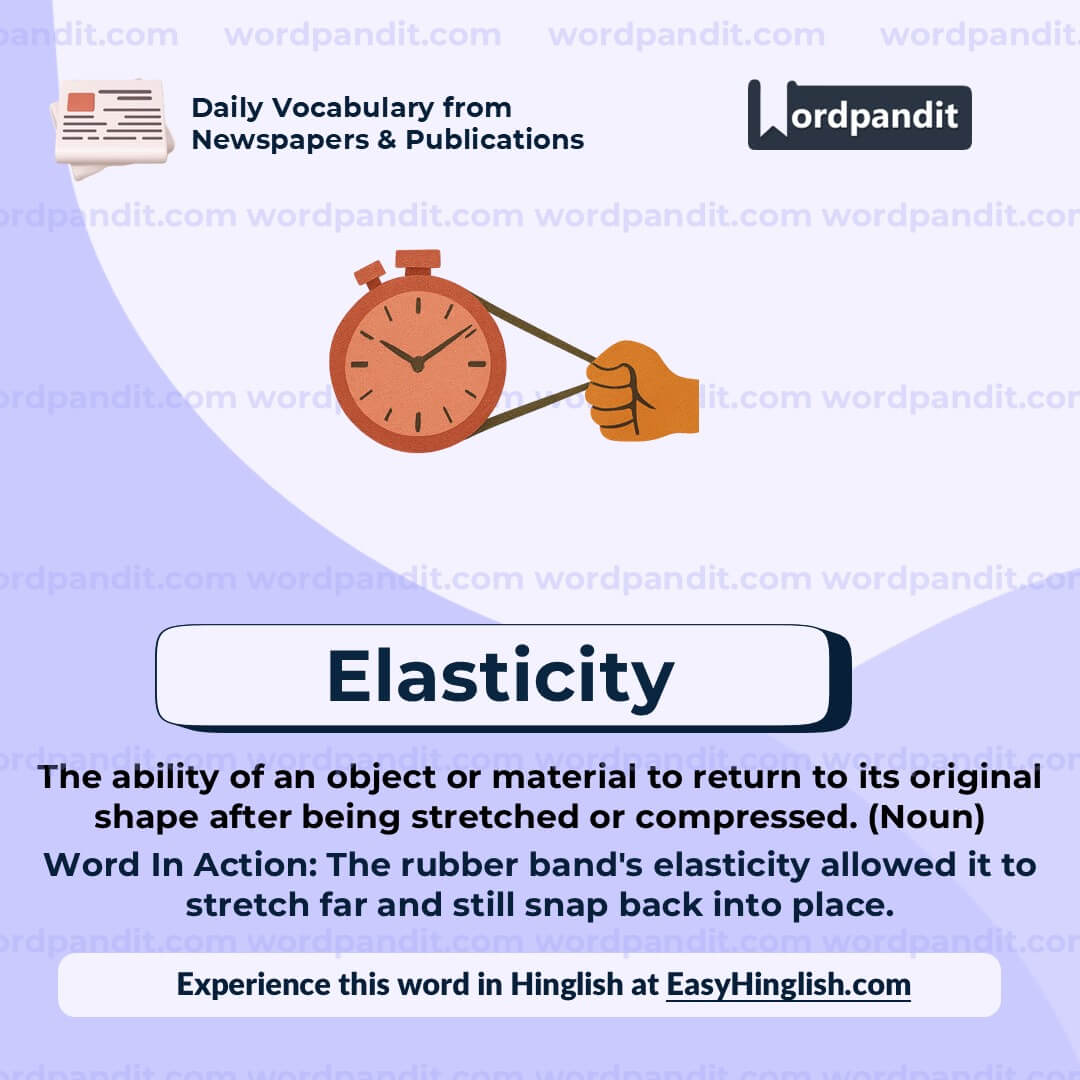
WORD-1: Elasticity
Context:
"We are living through a remarkable phase in human progress—one where the velocity of technological innovation is testing the elasticity of global institutions, economic models, and even our social contracts. From 3D-printed manufacturing to robotic automation, from the convergence of nano–bio–infotech to frictionless digital payments, these are not merely innovations. They are instruments of structural rewiring." - The Times of India
Explanatory Paragraph:
Elasticity refers to the ability of something to be stretched or adapted without breaking, and to return to its original state. While often used in physical or economic contexts, in broader terms it signifies flexibility, resilience, and adaptability. In the given sentence, it is used metaphorically to describe how current institutions and systems are being pushed and tested by rapid technological advances, and whether they can stretch or adapt to meet new challenges without collapsing.
Meaning: The ability of an object or material to return to its original shape after being stretched or compressed. (Noun)
Pronunciation: ih-las-TISS-uh-tee
Difficulty Level: ⭐⭐⭐ Intermediate
Etymology: From French *élasticité*, based on Greek *elastos* meaning “ductile, flexible”
Prashant Sir's Notes:
This word is often used in economics to describe how demand or supply responds to changes in price or income. But more broadly, it's an excellent metaphor for resilience—whether a system, person, or idea can 'stretch' without snapping.
Synonyms & Antonyms:
Synonyms: flexibility, resilience, adaptability, pliability
Antonyms: rigidity, stiffness, inflexibility, brittleness
Usage Examples:
- The elasticity of her schedule allowed her to accommodate unexpected meetings.
- Economic elasticity helps explain how consumer behavior changes with rising fuel prices.
- Yoga improves the elasticity of muscles and joints.
- The startup’s success depends on the elasticity of its business model in rapidly shifting markets.
Cultural Reference:
"The measure of intelligence is the ability to change." - Albert Einstein. This quote speaks to the intellectual elasticity needed in our rapidly evolving world.
Think About It:
In what areas of your life do you demonstrate the most elasticity, and where could you be more adaptable?
Quick Activity:
Think of three different systems (e.g., political, educational, family) and write one sentence each on how their elasticity is being tested today.
Memory Tip:
Think of an elastic band—how it stretches and bounces back. “Elasticity” works the same way for ideas, economies, or institutions.
Real-World Application:
In business, elasticity is a key metric—understanding how consumer demand changes with price shifts can guide product strategies. Similarly, in law or governance, the elasticity of rules can determine how well societies cope with change.
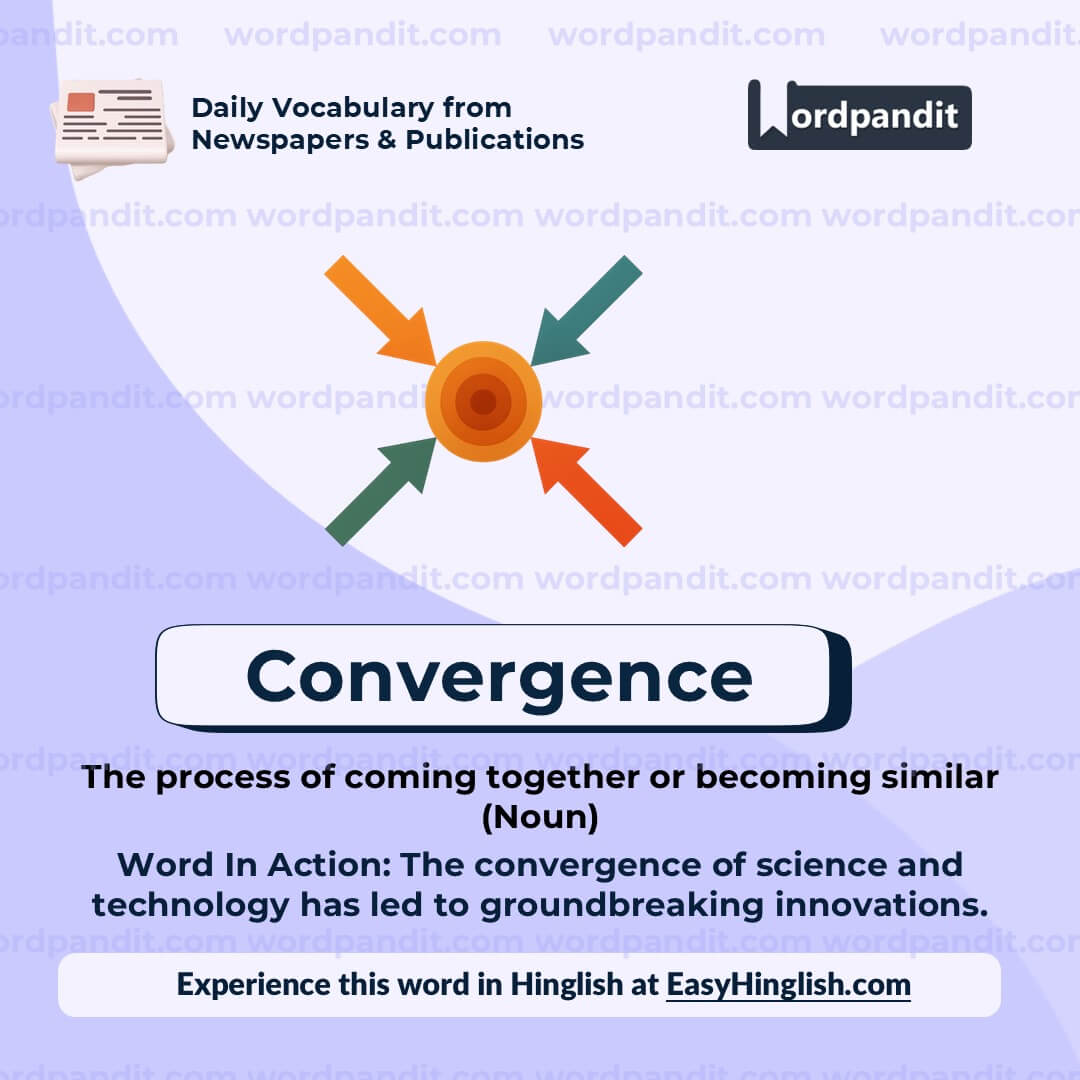
WORD-2: Convergence
Context:
"We are living through a remarkable phase in human progress—one where the velocity of technological innovation is testing the elasticity of global institutions, economic models, and even our social contracts. From 3D-printed manufacturing to robotic automation, from the convergence of nano–bio–infotech to frictionless digital payments, these are not merely innovations. They are instruments of structural rewiring." - The Times of India
Explanatory Paragraph:
Convergence refers to the coming together of different elements to form a unified whole. It often implies a blending or merging of ideas, technologies, or trends. In the context of technological innovation, it suggests that once-separate fields—like nanotechnology, biotechnology, and information technology—are now interacting and overlapping, creating new hybrid systems and capabilities that transform industries and societies.
Meaning: The process of coming together or becoming similar (Noun)
Pronunciation: kuhn-VER-jens
Difficulty Level: ⭐⭐⭐ Intermediate
Etymology: From Latin *convergere*, meaning "to incline together"; from *com-* (together) + *vergere* (to bend)
Prashant Sir's Notes:
This word is a favorite in modern innovation and interdisciplinary studies. It highlights how silos are breaking down—biology, computing, and engineering are no longer isolated fields. Understanding convergence is essential to grasping how progress is accelerating.
Synonyms & Antonyms:
Synonyms: union, merging, integration, intersection, unification
Antonyms: divergence, separation, disjunction, deviation
Usage Examples:
- The convergence of AI and healthcare is transforming diagnosis and treatment methods.
- There’s a growing convergence between Eastern and Western philosophies in modern psychology.
- Media convergence has blurred the lines between newspapers, television, and online platforms.
- During the climate summit, there was a convergence of interests among developed and developing nations.
Cultural Reference:
"We're at the convergence of two revolutions—one in energy and the other in information." - Paraphrased from various clean tech discussions
Think About It:
What are some unexpected areas in your life or work where convergence could create innovation or efficiency?
Quick Activity:
List three industries or technologies you think are converging today. Write one sentence about how each pairing is changing the world.
Memory Tip:
Think of rivers flowing from different directions and merging into one—this is convergence in nature and technology alike.
Real-World Application:
Convergence is seen in smartphones combining communication, photography, and computing; in fintech where banking and software meet; and in education where online tools converge with traditional teaching. It signals innovation at the intersections.
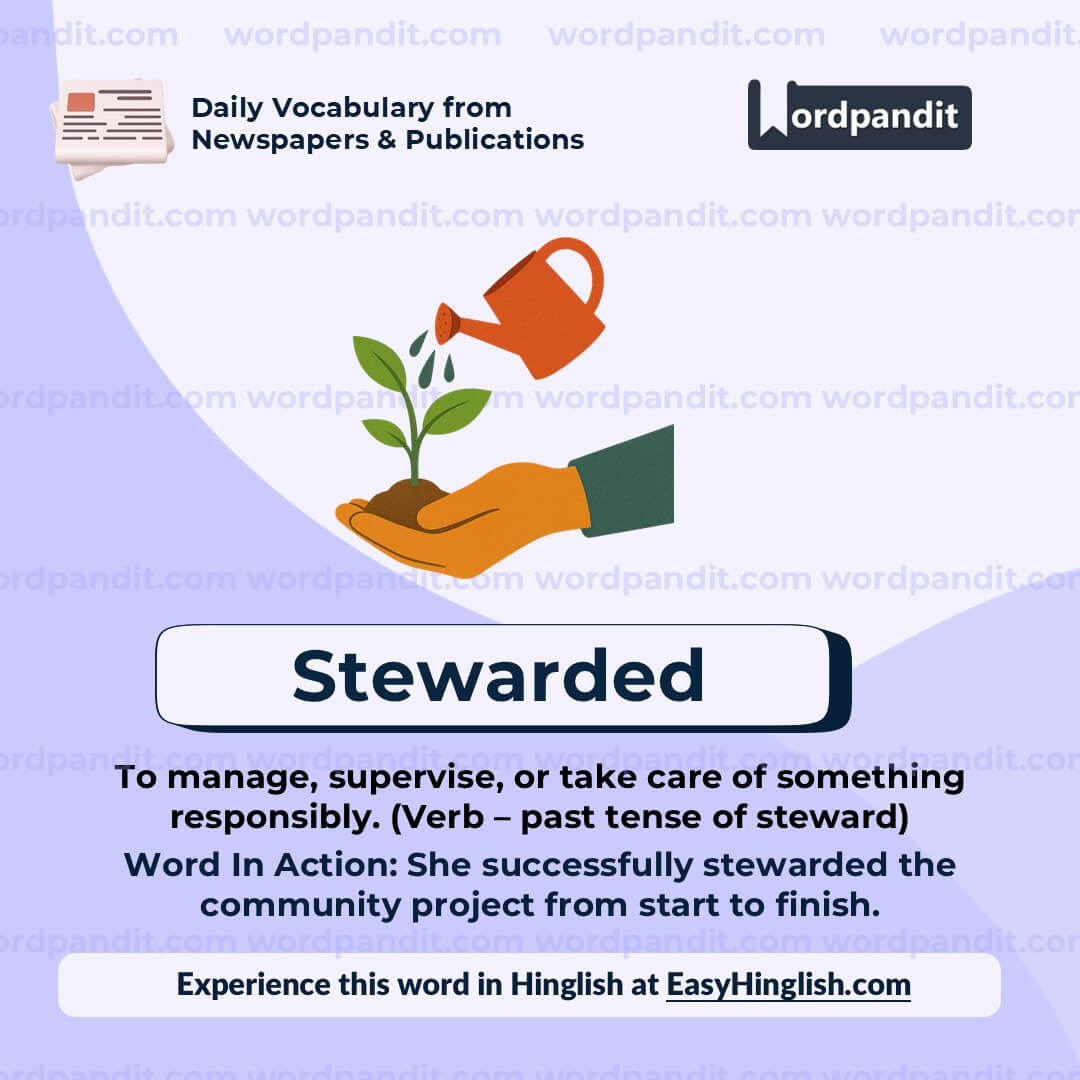
WORD-3: Stewarded
Context:
"And yet, the very technologies that promise prosperity also demand deliberate governance. If not stewarded with foresight, they could erode national interest or unravel social cohesion." - The Times of India
Explanatory Paragraph:
“Stewarded” means to have been guided, managed, or overseen with responsibility and care. It comes from the role of a steward—someone entrusted to take care of something important. In the context of technology and society, to steward innovations means to handle them wisely, ensuring they benefit society rather than cause harm. The sentence warns that without thoughtful stewardship, even promising technologies can become dangerous or divisive.
Meaning: To manage, supervise, or take care of something responsibly. (Verb – past tense of steward)
Pronunciation: STOO-er-did
Difficulty Level: ⭐⭐⭐ Intermediate
Etymology: From Old English *stiweard*, meaning “house guardian” or “keeper of the hall,” combining *stig* (hall) and *weard* (warden or guard)
Prashant Sir's Notes:
This word reminds us that leadership isn’t just about making decisions—it’s about caretaking. Use “stewarded” when referring to responsible handling of resources, ideas, or changes over time. It’s a powerful word for ethics in leadership and governance.
Synonyms & Antonyms:
Synonyms: managed, guided, governed, administered, overseen
Antonyms: neglected, mismanaged, ignored, abandoned
Usage Examples:
- The forest was stewarded by local communities who valued sustainability over profit.
- New educational reforms must be carefully stewarded to ensure long-term success.
- The nonprofit stewarded its funding with transparency and accountability.
- If AI is not stewarded wisely, it could deepen existing inequalities.
Cultural Reference:
"We do not inherit the earth from our ancestors, we borrow it from our children." - Native American Proverb. This quote reflects the spirit of stewardship across generations.
Think About It:
What is one innovation or idea you believe should be carefully stewarded for the good of future generations?
Quick Activity:
Choose an area you care about—like environment, education, or technology—and write three sentences on how it can be better stewarded in your community.
Memory Tip:
Imagine a steward on a ship—calmly managing resources, guiding the journey. To “steward” something is to keep it on the right course.
Real-World Application:
In government, corporate, or nonprofit settings, stewardship is critical for sustainability. Whether managing data privacy, public funds, or ecosystems, being properly “stewarded” ensures ethical and effective progress.
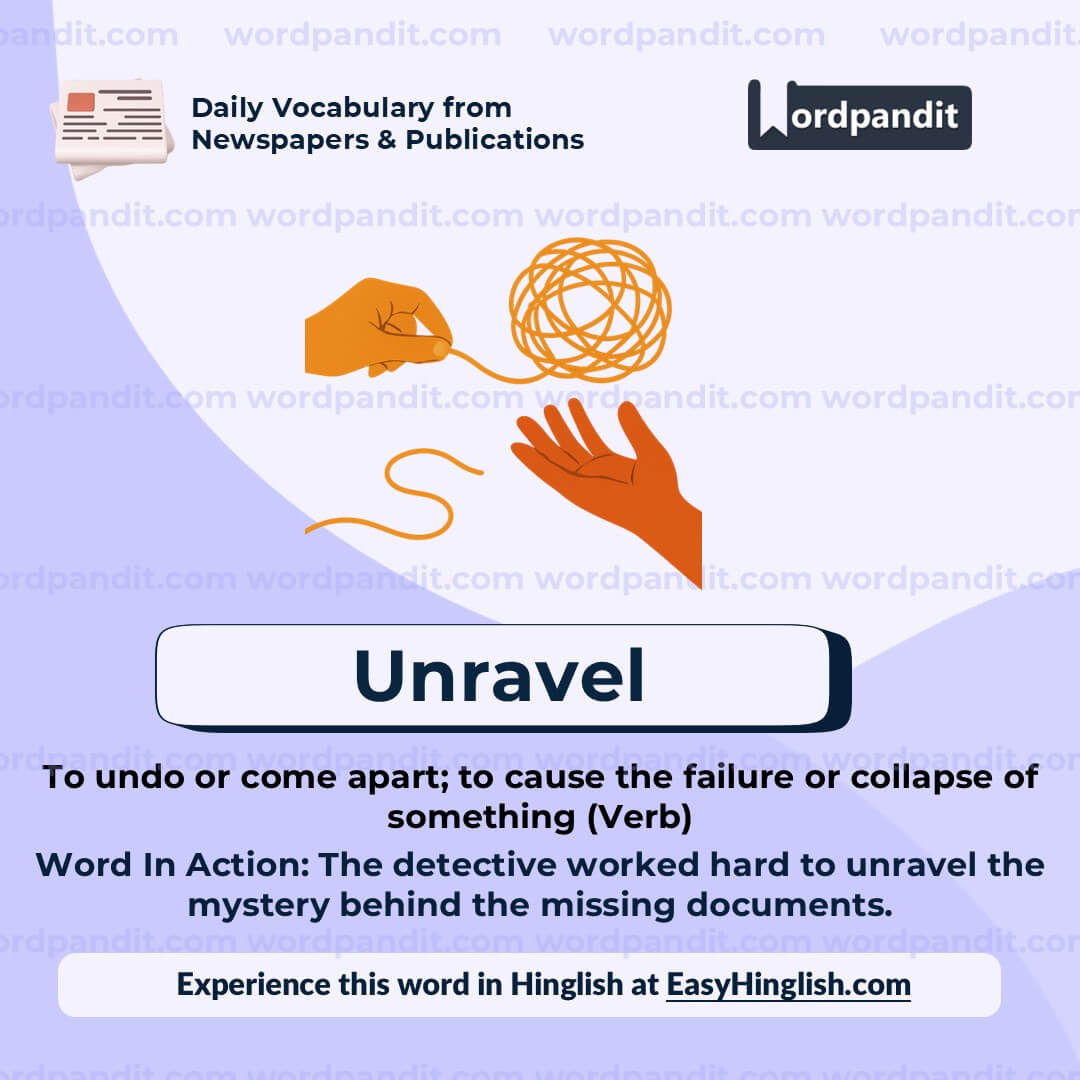
WORD-4: Unravel
Context:
"And yet, the very technologies that promise prosperity also demand deliberate governance. If not stewarded with foresight, they could erode national interest or unravel social cohesion." - The Times of India
Explanatory Paragraph:
“Unravel” means to come apart or to cause something to fall apart—physically, emotionally, or structurally. Originally used to describe threads coming loose from fabric, it is now widely used metaphorically. In this context, it warns that without wise management, social unity and cooperation could fall apart, like a thread being pulled from a tightly woven fabric, causing the whole to disintegrate.
Meaning: To undo or come apart; to cause the failure or collapse of something (Verb)
Pronunciation: un-RAV-uhl
Difficulty Level: ⭐⭐ Elementary to Intermediate
Etymology: From Middle English *unravelen*, literally "to pull apart something woven," combining *un-* (reverse) and *ravel* (entangle)
Prashant Sir's Notes:
This is a vivid word with both physical and metaphorical uses. From threads and sweaters to plans and societies, “unravel” communicates disintegration. It’s a powerful image for something complex falling apart when a single flaw is overlooked.
Synonyms & Antonyms:
Synonyms: undo, fray, untangle, disintegrate, collapse
Antonyms: weave, unite, entangle, construct, resolve
Usage Examples:
- When one thread was pulled, the entire sweater began to unravel.
- The peace agreement started to unravel after months of political tension.
- As the investigation progressed, the truth began to unravel.
- Without support, the project could quickly unravel under pressure.
Cultural Reference:
"Things fall apart; the center cannot hold." - W.B. Yeats, from *The Second Coming*. A poetic way of saying that when systems unravel, chaos often follows.
Think About It:
What’s one system in your life or community that could unravel if not actively maintained or managed?
Quick Activity:
Write a two-sentence story using the word “unravel” to describe either a physical object or an emotional moment coming apart.
Memory Tip:
Picture pulling a loose thread on a sock until the whole thing unravels—that image will help cement the meaning in your mind!
Real-World Application:
“Unravel” is commonly used in news, politics, and business to describe systems breaking down—like a company’s finances unraveling or an international treaty falling apart. It’s a critical word in evaluating risk and fragility.

WORD-5: Cohesion
Context:
"And yet, the very technologies that promise prosperity also demand deliberate governance. If not stewarded with foresight, they could erode national interest or unravel social cohesion." - The Times of India
Explanatory Paragraph:
Cohesion refers to the state of sticking together or being united. It is often used to describe the bonds that hold a group, community, or society together. In this context, “social cohesion” points to the strength of relationships and the sense of belonging among members of society. When cohesion is strong, societies are stable and resilient; when it weakens, social fragmentation and unrest can emerge.
Meaning: The action or fact of forming a united whole (Noun)
Pronunciation: koh-HEE-zhun
Difficulty Level: ⭐⭐⭐ Intermediate
Etymology: From Latin *cohaesio*, from *cohaerere* meaning "to cling together"
Prashant Sir's Notes:
In exams or writing, “cohesion” is a high-value word when discussing society, group dynamics, or even logical flow in writing. Think of cohesion as the ‘glue’—social, linguistic, or structural—that binds components into a functioning whole.
Synonyms & Antonyms:
Synonyms: unity, solidarity, harmony, connectedness
Antonyms: division, fragmentation, discord, separation
Usage Examples:
- Strong leadership helped maintain social cohesion during the crisis.
- The cohesion of the team was evident in their flawless performance.
- Good writing requires logical cohesion between ideas and paragraphs.
- Cultural festivals play a major role in enhancing community cohesion.
Cultural Reference:
"In diversity there is beauty and there is strength." - Maya Angelou. A quote that beautifully echoes the spirit of cohesion in diverse societies.
Think About It:
What builds or breaks social cohesion in your community, and how can it be strengthened?
Quick Activity:
Write two short sentences using “cohesion”—one for a social setting, and another for a professional or academic context.
Memory Tip:
Think of “cohesion” like a jigsaw puzzle—each piece fits tightly to create a complete picture. Without cohesion, the image falls apart.
Real-World Application:
Cohesion is crucial in workplaces, classrooms, neighborhoods, and nations. It supports collaboration, peace, and mutual understanding, and is often a focus in policymaking, especially in multicultural and multiethnic societies.


