

Daily Vocabulary from Indian Newspapers and Publications
Welcome to Wordpandit’s Indian Vocabulary Hub
At Wordpandit, we understand the importance of staying rooted in the local context while expanding your language skills. This section focuses on enriching your vocabulary with words and phrases drawn from India’s leading newspapers and publications, ensuring you're learning vocabulary that is practical, relevant, and uniquely Indian.
Why Indian Sources Matter
We believe that the best way to master any language is by immersing yourself in local content. That’s why we carefully curate vocabulary from top Indian publications, including:
- The Hindu
- The Times of India
- The Economic Times
- Hindustan Times
- Live Mint
- The Indian Express
- And many others...
Stay Updated, Stay Relevant
With daily updates from Indian news sources, you’ll be consistently learning words that reflect the trends and shifts in Indian society and culture. Our focus is to provide vocabulary that enhances your understanding of the language in an Indian context.
How Wordpandit Supports Your Goals
Whether you’re preparing for exams, aiming to improve your professional communication, or simply want to stay connected with the latest Indian vocabulary, Wordpandit is here to guide you every step of the way.
Learn with a Practical Approach
Our interactive learning methodology includes real-world examples, engaging activities, and context-specific usage to ensure that every word becomes part of your active vocabulary.
Dive into Indian Vocabulary Today!

Why Choose Wordpandit?
Practical Learning: Focus on words you'll actually encounter in real-world reading, enhancing your comprehension and communication skills.
Diverse Content: From current affairs to scientific breakthroughs, our varied sources expose you to vocabulary across multiple domains.
Effortless Integration: Make Wordpandit a part of your daily routine. Just a few minutes each day can significantly boost your lexicon over time.
Your Path to Vocabulary Mastery
- Visit our Daily Vocabulary section regularly
- Explore new words and their usage in context
- Practice incorporating these words into your own writing and speech
- Track your progress as your vocabulary expands
Start Your Journey Today
Embark on your vocabulary enhancement journey with Wordpandit. By consistently engaging with our daily posts, you'll build a robust vocabulary that serves you well in academic, professional, and personal contexts.
Remember, a word a day keeps linguistic limitations at bay. Make Wordpandit your daily companion in the quest for vocabulary excellence!
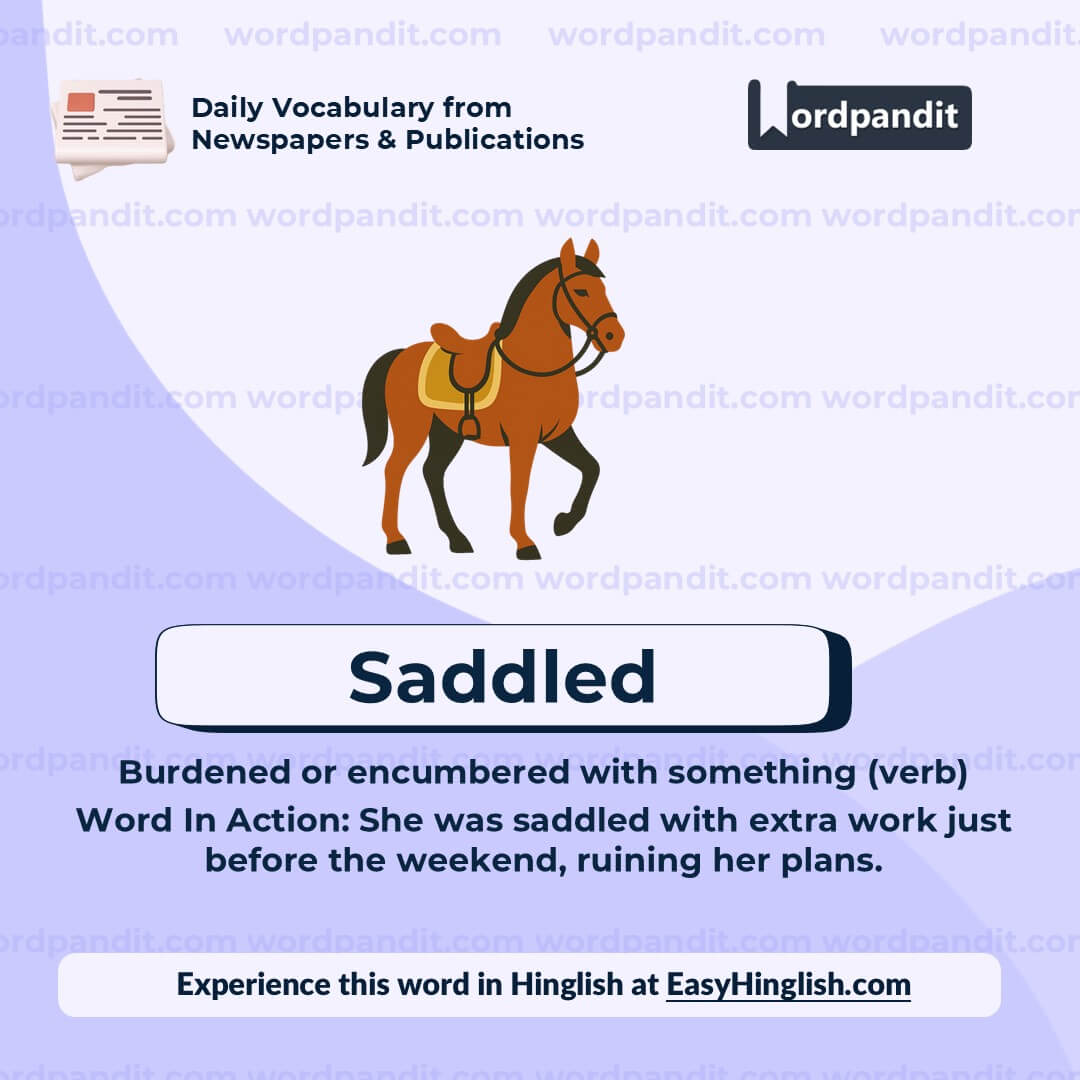
WORD-1: Saddled
Context:
"Good leaders give credit where it’s due, and focus on getting the job done. Consider yourself lucky if your organisation has one at the summit. But if you’re saddled with the leadering kind, good luck, for they are clueless." - The Times of India
Explanatory Paragraph:
The word "saddled" metaphorically refers to being burdened or weighed down by something undesirable, often a responsibility or problem. In this context, it emphasizes the idea of being stuck with a leader who lacks competence—essentially a heavy load one has to carry. The term is derived from the literal use of a saddle on a horse, implying control or burden placed upon the animal. When used about people or situations, it highlights unwanted obligations or challenging scenarios that one is forced to deal with.
Meaning: Burdened or encumbered with something (verb)
Pronunciation: SAD-uhld
Difficulty Level: ⭐⭐ Easy
Etymology: Originates from Middle English *sadelen*, from Old English *sadol*, meaning a seat for a rider. The metaphorical usage of "saddled with a burden" emerged later.
Prashant Sir's Notes:
Think of "saddled" as carrying a load you didn’t choose. If you’re “saddled with debt” or “saddled with a bad boss,” it means you’re stuck with a difficult burden. A very useful expression for real-life workplace and financial contexts.
Synonyms & Antonyms:
Synonyms: burdened, encumbered, weighed down, loaded
Antonyms: freed, unburdened, relieved, unencumbered
Usage Examples:
- After the merger, she was saddled with additional responsibilities without a pay raise.
- He found himself saddled with student debt right out of college.
- The project was saddled with unrealistic deadlines from the very beginning.
- They were saddled with an outdated system that made everyday tasks harder.
Cultural Reference:
"Saddled with debt" has become a common phrase in discussions around college education in the U.S., where rising tuition fees have left many graduates struggling financially for years. - Economic Policy Institute
Think About It:
Why do we often find ourselves "saddled" with responsibilities or situations we didn’t choose? How can we learn to navigate such burdens effectively?
Quick Activity:
List three situations in your own life where you felt "saddled" with something. Rewrite those situations by reframing them in a positive light.
Memory Tip:
Think of a horse with a saddle on its back—unable to remove it on its own. “Saddled” means being forced to carry a load you didn’t choose.
Real-World Application:
"Saddled" is often used in business, financial, and legal contexts to describe being burdened with debt, obligations, or problematic assets. It helps convey the idea of an unwanted but unavoidable responsibility.
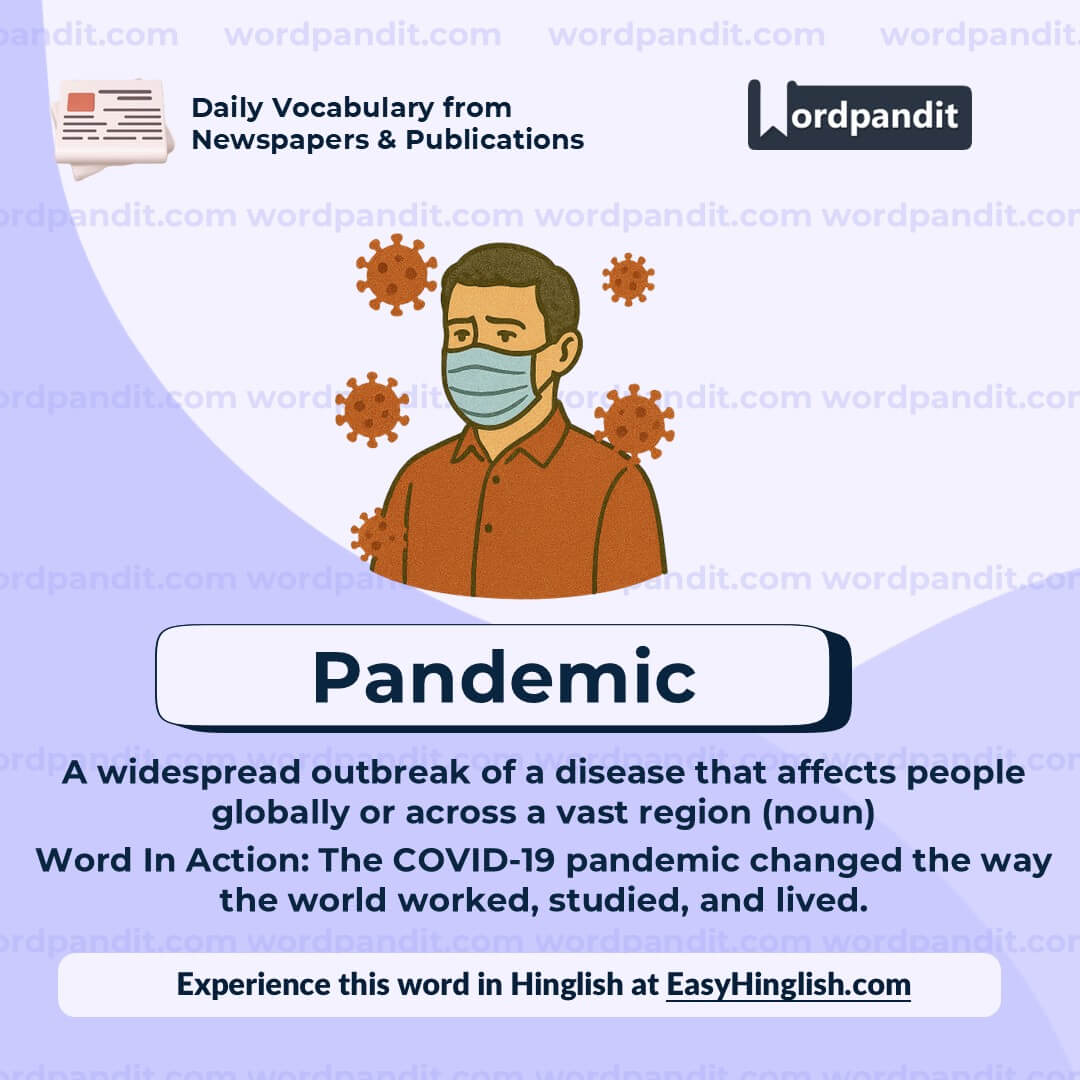
WORD-2: Pandemic
Context:
"In times of rapid change – which the third decade of the 21st century is, what with a pandemic, AI, EVs and sundry wars changing the old order – leadering types can run your ship aground. Luckily, Trump, for all his leadering, isn’t a warmonger. The real danger lies in a leader who seeks war – whether in the market or on the border – for personal glory. That type eventually finds the slippery slope of a Waterloo." - The Times of India
Explanatory Paragraph:
The word "pandemic" refers to a disease outbreak that spreads across countries or continents, affecting a large number of people. Unlike an epidemic, which is more localized, a pandemic is a global phenomenon. In the context of the sentence, it is used to highlight one of the transformative events of the 21st century that reshaped the global order, comparable in scale to technological revolutions and geopolitical shifts.
Meaning: A widespread outbreak of a disease that affects people globally or across a vast region (noun)
Pronunciation: pan-DEM-ik
Difficulty Level: ⭐⭐ Easy
Etymology: From Greek *pan-* meaning “all” and *demos* meaning “people”; first recorded in English in the 17th century to describe disease affecting a whole population.
Prashant Sir's Notes:
After COVID-19, this word became part of everyday vocabulary. It helps to know its distinction from "epidemic" and its broader, more global implications. Understanding this word is essential for discussions about health, governance, and global affairs.
Synonyms & Antonyms:
Synonyms: global outbreak, worldwide epidemic, universal contagion
Antonyms: endemic, localized outbreak, regional epidemic
Usage Examples:
- The COVID-19 pandemic changed the way we live, work, and communicate.
- Governments worldwide struggled to contain the rapid spread of the pandemic.
- The economic impact of the pandemic was felt across all sectors.
- New healthcare policies were implemented in response to the pandemic’s challenges.
Cultural Reference:
"The pandemic has magnified every existing inequality in our society." — Arundhati Roy, Indian author and activist, reflecting on COVID-19’s broader societal impact.
Think About It:
What lessons can societies learn from a pandemic, and how can these lessons shape our response to future global crises?
Quick Activity:
Make a timeline of five key events that happened globally during the COVID-19 pandemic. Reflect on how these events influenced your personal or educational journey.
Memory Tip:
Think of “pan” as “all” (like in “panorama”) and “demic” from “people” – a pandemic affects *all people* across nations.
Real-World Application:
The term “pandemic” is used in global health discussions, policymaking, media, and everyday conversation to describe and respond to public health emergencies. Understanding it is essential for participating in global dialogues around health, policy, and resilience.
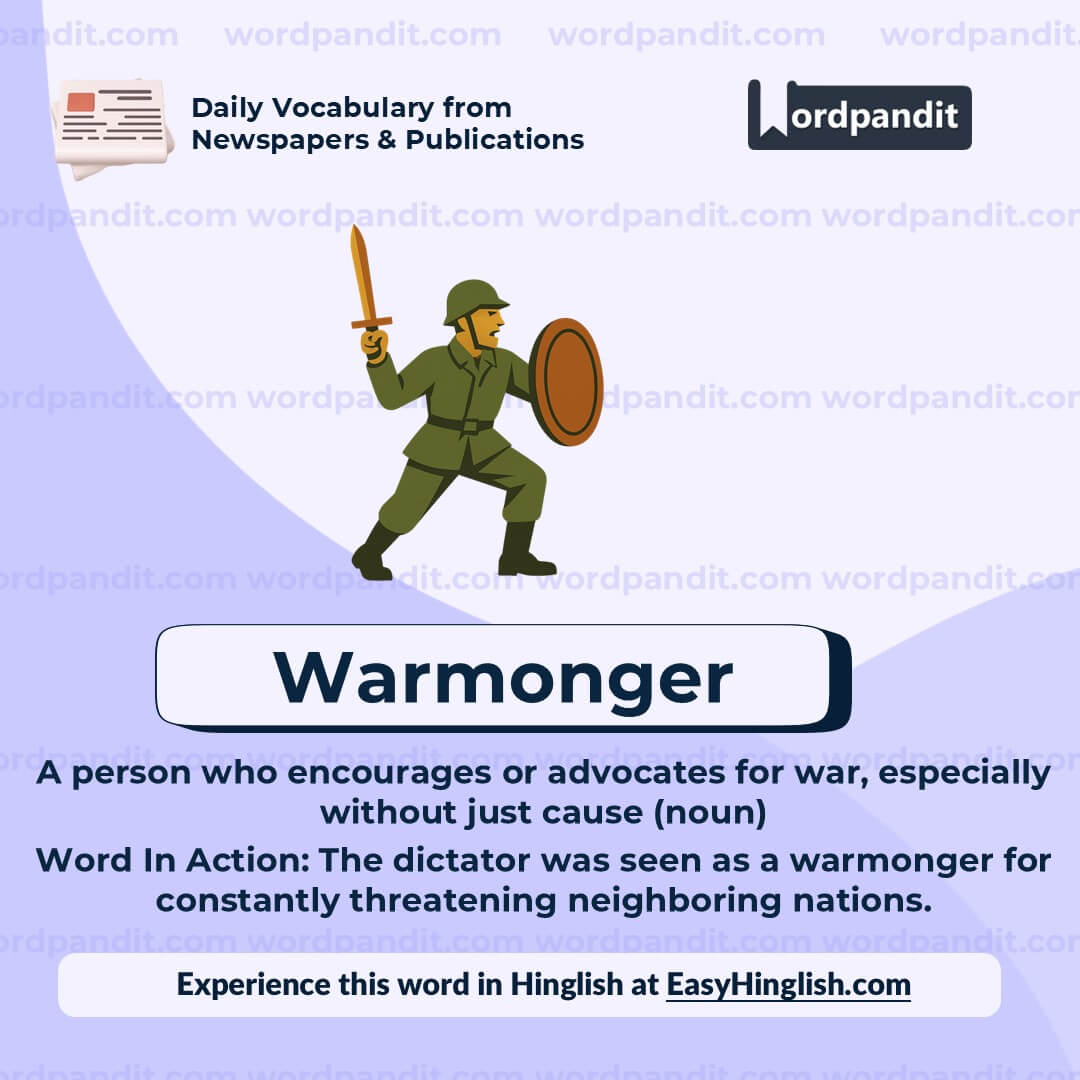
WORD-3: Warmonger
Context:
"In times of rapid change – which the third decade of the 21st century is, what with a pandemic, AI, EVs and sundry wars changing the old order – leadering types can run your ship aground. Luckily, Trump, for all his leadering, isn’t a warmonger. The real danger lies in a leader who seeks war – whether in the market or on the border – for personal glory. That type eventually finds the slippery slope of a Waterloo." - The Times of India
Explanatory Paragraph:
The term "warmonger" is used to describe someone who advocates for war or aggression, often unnecessarily or for personal or political gain. It’s typically applied to political or military figures who push for conflict instead of peace. In the context above, the word is used critically to distinguish between a leader who merely postures aggressively and one who actually seeks out war, with the latter being deemed far more dangerous. It carries a strong negative connotation, suggesting recklessness, ambition, and disregard for the human cost of conflict.
Meaning: A person who encourages or advocates for war, especially without just cause (noun)
Pronunciation: WAR-mun-gur
Difficulty Level: ⭐⭐⭐ Intermediate
Etymology: From "war" + "monger," where "monger" is an old English word for seller or promoter (from Old English *mangere*). A warmonger is literally someone who "deals in war."
Prashant Sir's Notes:
Use "warmonger" to describe those political or military figures who actively promote war, not just in literal terms but also metaphorically—like business leaders who provoke market rivalries or instigate conflicts for ego or gain. It’s a potent, critical word.
Synonyms & Antonyms:
Synonyms: hawk, militarist, aggressor, belligerent
Antonyms: pacifist, peacemaker, dove, mediator
Usage Examples:
- The senator was accused of being a warmonger for supporting multiple overseas conflicts.
- History often judges warmongers harshly, especially when wars prove futile.
- He was labeled a warmonger after suggesting military intervention without diplomatic efforts.
- In business, some CEOs act like warmongers, aggressively undercutting competitors rather than seeking partnerships.
Cultural Reference:
"I have never advocated war, but I am not afraid to face it if provoked — unlike warmongers who seek it out eagerly." — Paraphrased from political debates during the Cold War era, contrasting diplomacy with aggression.
Think About It:
Why do some leaders choose war even when peaceful alternatives exist? Is it ego, fear, strategy, or something else?
Quick Activity:
Write a short paragraph contrasting a warmonger and a peacemaker in terms of leadership style, motives, and long-term impact.
Memory Tip:
Think of a "fishmonger" selling fish. A "warmonger" similarly “sells” war—pushing conflict as if it were a product.
Real-World Application:
The word "warmonger" is often used in media, international relations, and political commentary to criticize leaders or governments that aggressively promote military actions, especially in controversial or unnecessary situations.
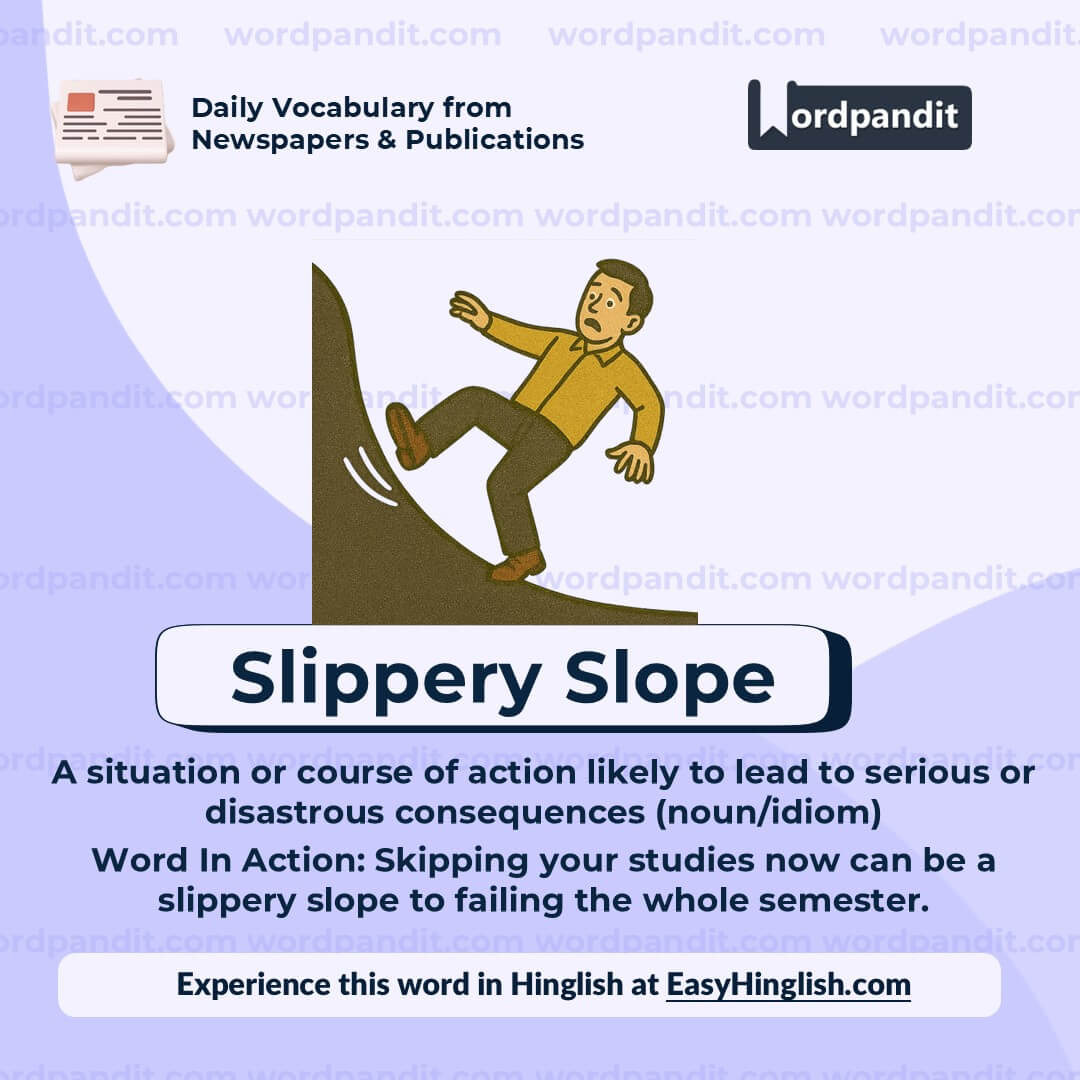
WORD-4: Slippery Slope
Context:
"In times of rapid change – which the third decade of the 21st century is, what with a pandemic, AI, EVs and sundry wars changing the old order – leadering types can run your ship aground. Luckily, Trump, for all his leadering, isn’t a warmonger. The real danger lies in a leader who seeks war – whether in the market or on the border – for personal glory. That type eventually finds the slippery slope of a Waterloo." - The Times of India
Explanatory Paragraph:
"Slippery slope" is an idiomatic expression used to describe a course of action that seems to lead inevitably to a chain of related (and often negative) events, usually with worsening consequences. Once you step onto a "slippery slope," it becomes difficult to stop or reverse the descent. In the context given, it refers to a leader who seeks war, inevitably setting off a chain of events leading to downfall—symbolically referenced as their “Waterloo,” a historic defeat.
Meaning: A situation or course of action likely to lead to serious or disastrous consequences (noun/idiom)
Pronunciation: SLIP-uh-ree SLOHP
Difficulty Level: ⭐⭐⭐ Intermediate
Etymology: Originated in the mid-20th century from the image of a slick slope where one misstep leads to an uncontrollable slide downward; commonly used in rhetoric and logic to describe flawed reasoning or risk-laden decisions.
Prashant Sir's Notes:
This phrase often appears in debates and editorials. It's useful when cautioning against minor actions that could lead to big consequences. Also be aware: in logic, "slippery slope" is sometimes considered a fallacy when used without evidence for the chain of events.
Synonyms & Antonyms:
Synonyms: domino effect, chain reaction, downhill path, snowball effect
Antonyms: stable ground, safe course, firm footing
Usage Examples:
- Allowing exceptions to the rule might put us on a slippery slope toward total deregulation.
- His constant excuses put him on a slippery slope to losing his job.
- Ignoring early signs of conflict often leads a country down a slippery slope toward war.
- Starting with a small lie can turn into a slippery slope of bigger deceptions.
Cultural Reference:
In political discourse, "slippery slope" arguments are common—for example, debates about privacy often include warnings that surveillance laws could lead us down a slippery slope to authoritarianism. - Common in American and British political analysis.
Think About It:
Can all slippery slope scenarios be prevented, or are some descents inevitable once a certain threshold is crossed?
Quick Activity:
Think of a decision you’ve made recently. Map out what could happen if you continued on that path—are there any potential “slippery slopes” you hadn’t considered?
Memory Tip:
Visualize standing on a wet hill—once you slip, it’s hard to stop rolling. That’s the essence of a slippery slope!
Real-World Application:
“Slippery slope” is widely used in journalism, law, public speaking, and education to warn against decisions that may lead to escalating consequences. It helps articulate concerns about the potential domino effect of actions.
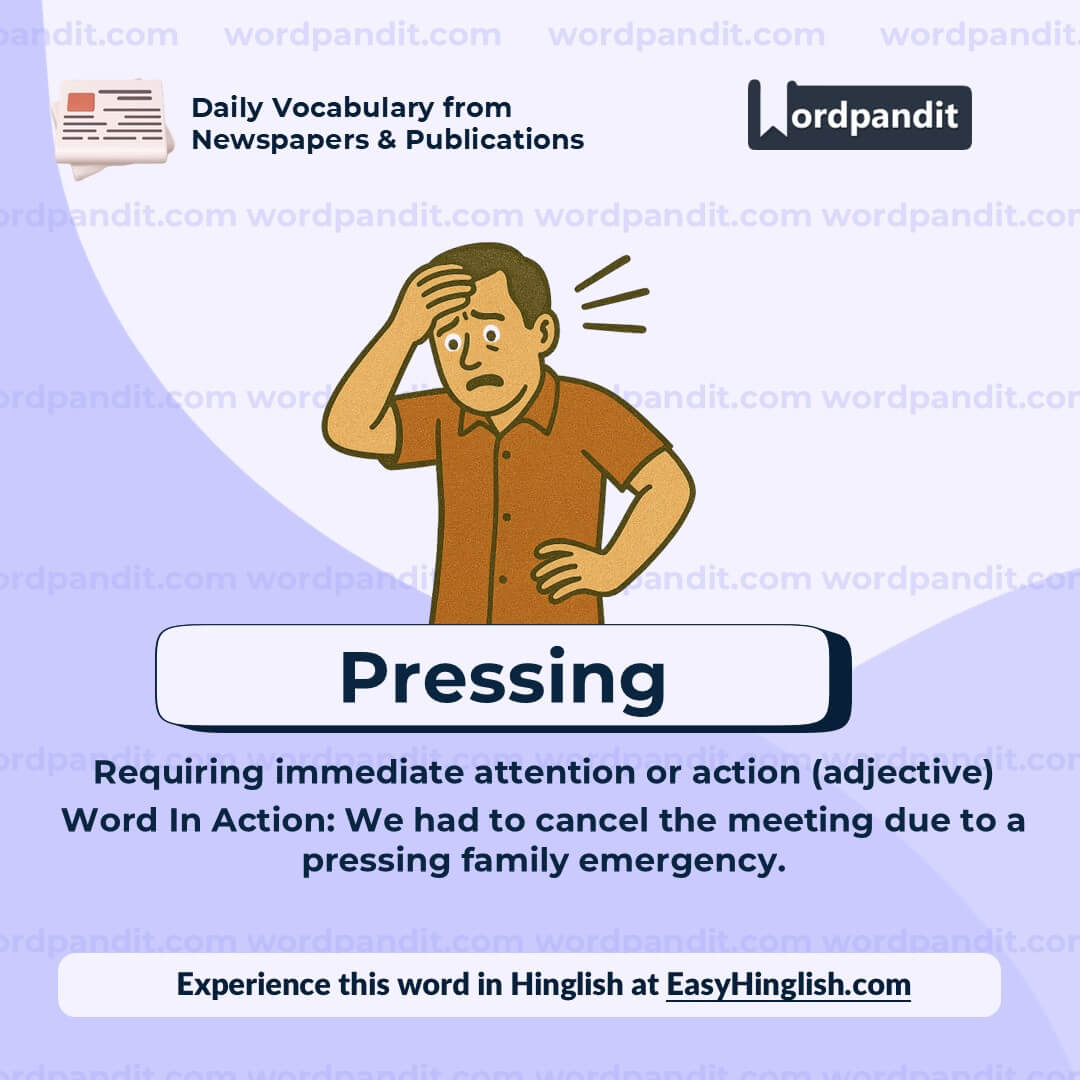
WORD-5: Pressing
Context:
"Amongst the most pressing issues that Justice Gavai will have to address is the crisis of confidence that the judiciary seems to have found itself in, after the Justice Verma scandal." - The Indian Express
Explanatory Paragraph:
The word "pressing" in this context refers to something that is urgent or requires immediate attention. It highlights the gravity or seriousness of a situation. Here, the phrase “pressing issues” indicates matters of critical concern that cannot be delayed. The adjective conveys a sense of time-sensitivity and importance, often used in both formal and informal discussions about urgent topics—whether legal, political, or personal.
Meaning: Requiring immediate attention or action (adjective)
Pronunciation: PRESS-ing
Difficulty Level: ⭐ Easy
Etymology: From the Middle English *pressen*, from Old French *presser*, based on Latin *pressare*, meaning "to press" or "to urge." The sense of urgency evolved from this physical idea of applying force.
Prashant Sir's Notes:
“Pressing” is a high-utility adjective. It's especially valuable for formal essays and editorial writing when describing matters that need urgent attention. Use it instead of “important” or “urgent” for more elegant and mature expression.
Synonyms & Antonyms:
Synonyms: urgent, critical, crucial, imperative, time-sensitive
Antonyms: trivial, minor, insignificant, non-urgent
Usage Examples:
- Climate change remains one of the most pressing global challenges.
- The manager postponed all non-pressing meetings to deal with the crisis.
- The board discussed several pressing matters during the emergency session.
- Providing clean drinking water is a pressing concern in rural areas.
Cultural Reference:
In political and media discourse, phrases like “pressing issues of our time” are commonly used to describe major concerns such as poverty, inequality, and environmental threats. - Common in editorial columns and political commentary.
Think About It:
How do we decide which issues are “pressing” in a world where so many problems compete for our attention?
Quick Activity:
Make a list of three pressing issues in your local community or country. Then suggest one action step for each to help resolve them.
Memory Tip:
Think of someone urgently pressing a button — that urgency is the feeling conveyed by “pressing.”
Real-World Application:
"Pressing" is commonly used in journalism, legal discourse, business meetings, and academia to indicate matters that are time-sensitive and high priority. It’s a powerful word to convey urgency in both spoken and written communication.


