

Daily Vocabulary from Indian Newspapers and Publications
Welcome to Wordpandit’s Indian Vocabulary Hub
At Wordpandit, we understand the importance of staying rooted in the local context while expanding your language skills. This section focuses on enriching your vocabulary with words and phrases drawn from India’s leading newspapers and publications, ensuring you're learning vocabulary that is practical, relevant, and uniquely Indian.
Why Indian Sources Matter
We believe that the best way to master any language is by immersing yourself in local content. That’s why we carefully curate vocabulary from top Indian publications, including:
- The Hindu
- The Times of India
- The Economic Times
- Hindustan Times
- Live Mint
- The Indian Express
- And many others...
Stay Updated, Stay Relevant
With daily updates from Indian news sources, you’ll be consistently learning words that reflect the trends and shifts in Indian society and culture. Our focus is to provide vocabulary that enhances your understanding of the language in an Indian context.
How Wordpandit Supports Your Goals
Whether you’re preparing for exams, aiming to improve your professional communication, or simply want to stay connected with the latest Indian vocabulary, Wordpandit is here to guide you every step of the way.
Learn with a Practical Approach
Our interactive learning methodology includes real-world examples, engaging activities, and context-specific usage to ensure that every word becomes part of your active vocabulary.
Dive into Indian Vocabulary Today!

Why Choose Wordpandit?
Practical Learning: Focus on words you'll actually encounter in real-world reading, enhancing your comprehension and communication skills.
Diverse Content: From current affairs to scientific breakthroughs, our varied sources expose you to vocabulary across multiple domains.
Effortless Integration: Make Wordpandit a part of your daily routine. Just a few minutes each day can significantly boost your lexicon over time.
Your Path to Vocabulary Mastery
- Visit our Daily Vocabulary section regularly
- Explore new words and their usage in context
- Practice incorporating these words into your own writing and speech
- Track your progress as your vocabulary expands
Start Your Journey Today
Embark on your vocabulary enhancement journey with Wordpandit. By consistently engaging with our daily posts, you'll build a robust vocabulary that serves you well in academic, professional, and personal contexts.
Remember, a word a day keeps linguistic limitations at bay. Make Wordpandit your daily companion in the quest for vocabulary excellence!

WORD-1: Embarked
Context:
"According to Buddhist tradition, soon after Gautam realised that human life is fraught with pain and suffering, he embarked on a ‘noble quest’ to find a method to permanently end human misery. Many scholars uphold that his quest was a ‘metaphysical and psychological adventure’." - The Times of India
Explanatory Paragraph:
The word "embarked" refers to the act of starting or initiating something significant, often a journey or a major endeavor. It suggests the beginning of a purposeful action, particularly one that might be challenging or transformative. In the given context, Gautam's "embarking" on a noble quest highlights the start of a profound spiritual journey, seeking enlightenment and answers to deep human concerns.
Meaning: To begin a course of action, especially one that is important or demanding. (Verb)
Pronunciation: em-BAHRKT
Difficulty Level: ⭐⭐ Beginner
Etymology: Derived from the French word "embarquer", which means "to board a ship", from "em-" (in) + "barque" (small ship).
Prashant Sir's Notes:
"Embarked" is a common yet powerful word that conveys the idea of taking the first step into something unknown or significant. Use it when describing both literal and metaphorical beginnings — like journeys, projects, or life decisions.
Synonyms & Antonyms:
Synonyms: commence, begin, start, initiate, undertake
Antonyms: end, finish, conclude, halt, cease
Usage Examples:
- She embarked on a journey across Asia to discover ancient cultures.
- The scientists embarked on a mission to develop a sustainable energy source.
- After graduation, he embarked on a new career in finance.
- We embarked on a weekend adventure through the forest trails.
Cultural Reference:
"Neil Armstrong embarked on a journey that would change history — the first manned mission to the Moon." - NASA Archives
Think About It:
What is one life goal or mission you would like to embark on, and what would be your first step?
Quick Activity:
Write a short paragraph beginning with the sentence: "Last summer, I embarked on an adventure that taught me more than I ever expected..."
Memory Tip:
Think of "embark" as "boarding a ship" — whether it's a ship, a plan, or a goal, you're setting sail on something new!
Real-World Application:
The word "embarked" is often used in business, education, and self-development contexts — for example, "The company has embarked on a digital transformation strategy."
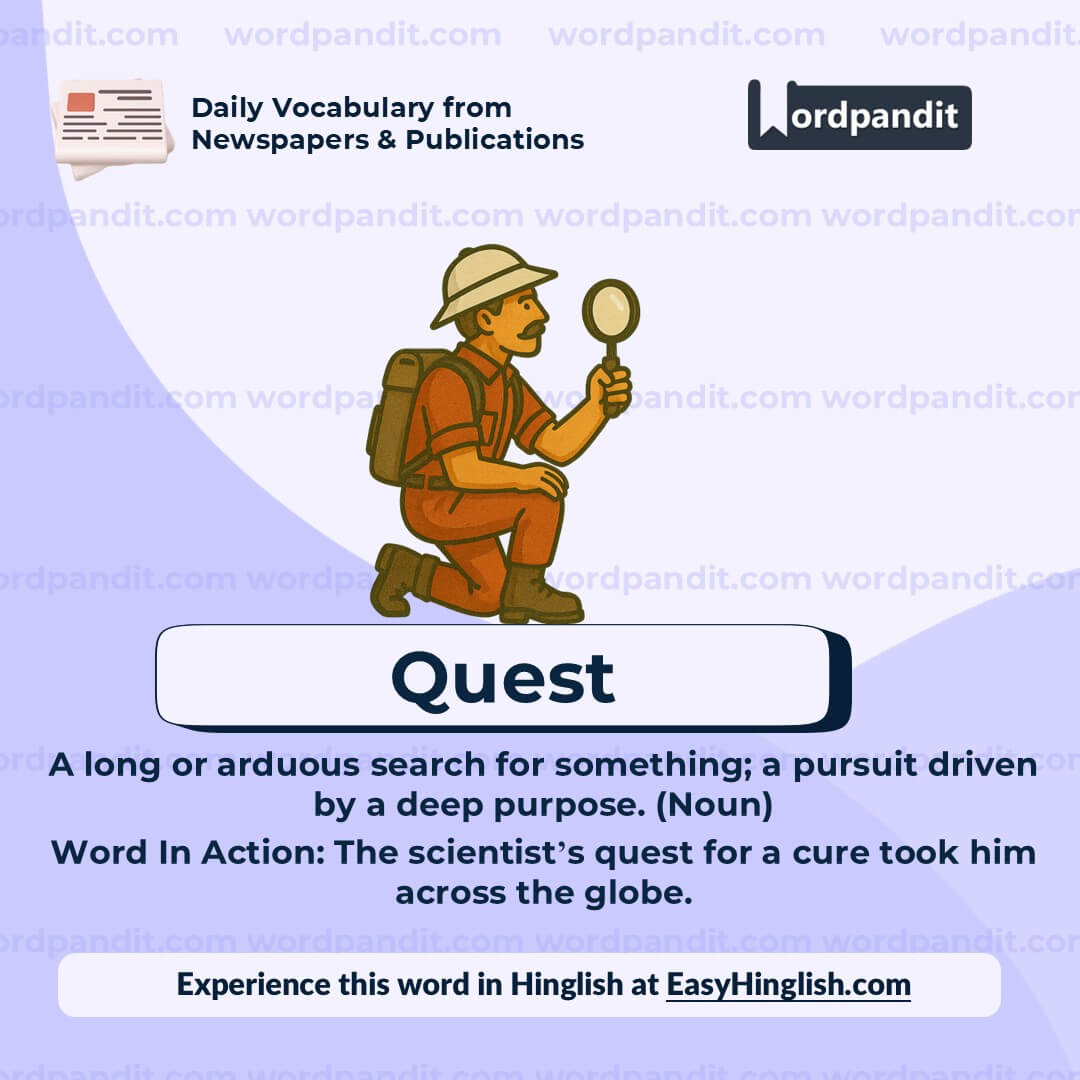
WORD-2: Quest
Context:
"According to Buddhist tradition, soon after Gautam realised that human life is fraught with pain and suffering, he embarked on a ‘noble quest’ to find a method to permanently end human misery. Many scholars uphold that his quest was a ‘metaphysical and psychological adventure’." - The Times of India
Explanatory Paragraph:
The word "quest" refers to a long or challenging journey undertaken in search of something important, often involving personal growth or transformation. It is more than a simple search — a quest usually carries deep meaning and requires perseverance, courage, and purpose. In the context of Gautam Buddha, the word emphasizes his profound inner and outer journey to seek truth and liberation from suffering.
Meaning: A long or arduous search for something; a pursuit driven by a deep purpose. (Noun)
Pronunciation: kwest
Difficulty Level: ⭐⭐ Beginner
Etymology: From Old French *queste*, from Latin *quaerere*, meaning "to seek" or "ask".
Prashant Sir's Notes:
"Quest" is a powerful word that adds depth to a simple search or journey. Use it to describe pursuits that are meaningful, transformative, or legendary — whether it’s a personal journey or an academic pursuit.
Synonyms & Antonyms:
Synonyms: pursuit, mission, expedition, journey, adventure
Antonyms: retreat, idleness, abandonment
Usage Examples:
- Her quest for truth led her to study ancient philosophies.
- The knights of the Round Table embarked on a quest for the Holy Grail.
- He is on a personal quest to improve his mental well-being.
- The scientist’s lifelong quest is to find a cure for the disease.
Cultural Reference:
"The Lord of the Rings is a classic tale of a perilous quest to destroy a powerful ring and save Middle-earth." - J.R.R. Tolkien
Think About It:
What is one 'quest' you believe every person should undertake during their life?
Quick Activity:
Write down your current personal or academic goal. Now rewrite it as a 'quest' with a meaningful title, e.g., "The Quest for Creative Mastery".
Memory Tip:
Think of "quest" as a "question" you’re trying to answer through action — both words come from the same Latin root *quaerere* (to seek).
Real-World Application:
"Quest" is used in both personal and professional contexts, such as a company’s quest for innovation, a nation’s quest for independence, or a student's quest for knowledge.
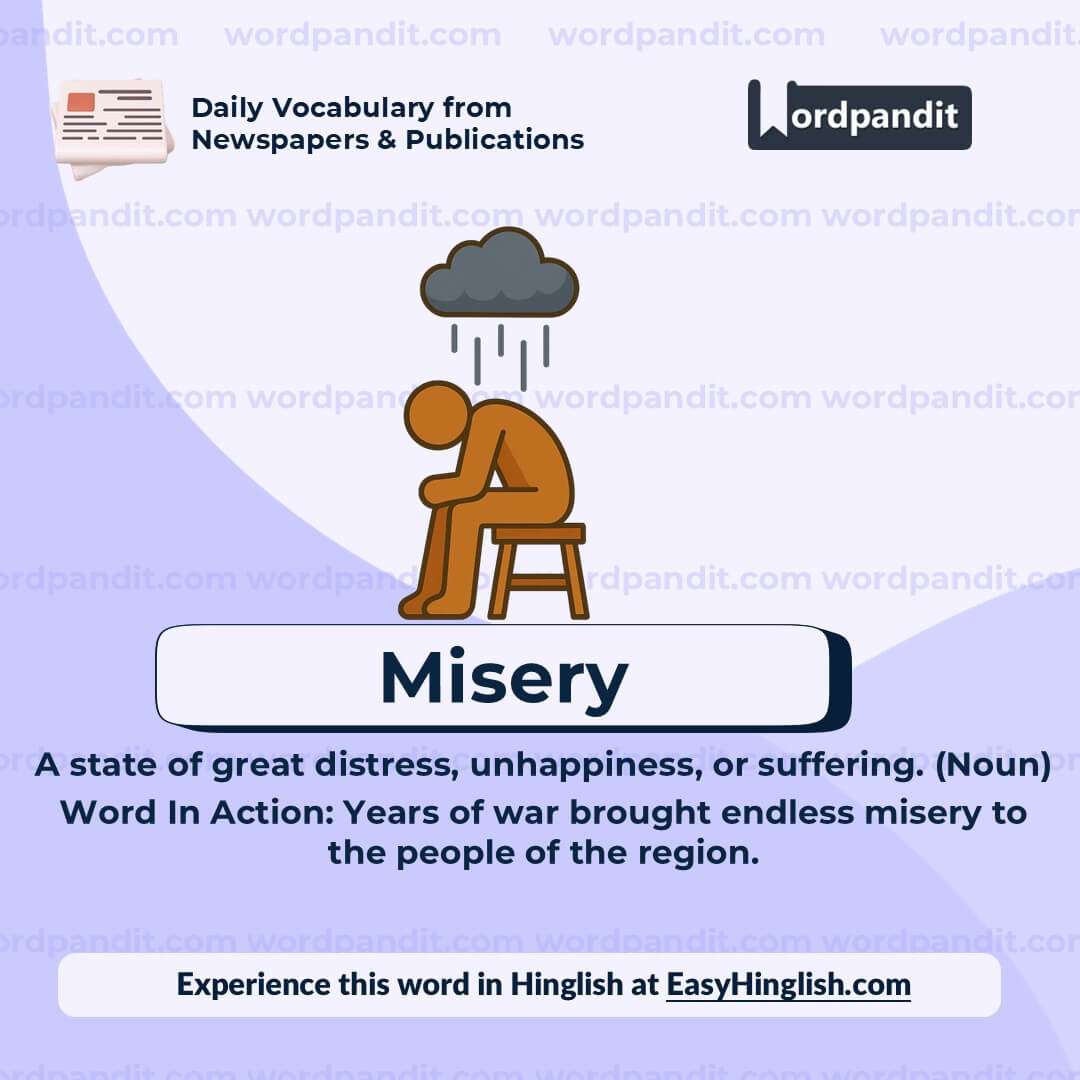
WORD-3: Misery
Context:
"According to Buddhist tradition, soon after Gautam realised that human life is fraught with pain and suffering, he embarked on a ‘noble quest’ to find a method to permanently end human misery. Many scholars uphold that his quest was a ‘metaphysical and psychological adventure’." - The Times of India
Explanatory Paragraph:
"Misery" refers to a deep state of suffering, unhappiness, or emotional pain. It captures the essence of extreme discomfort, either physical or emotional, and is often linked to hardship, loss, or despair. In the Buddhist context, misery denotes the universal suffering inherent in human life, which Gautam Buddha sought to overcome through enlightenment and spiritual discipline.
Meaning: A state of great distress, unhappiness, or suffering. (Noun)
Pronunciation: MIZ-uh-ree
Difficulty Level: ⭐⭐ Beginner
Etymology: From Old French *miserie*, from Latin *miseria* meaning "wretchedness", derived from *miser* meaning "wretched or pitiable".
Prashant Sir's Notes:
“Misery” is one of those emotional words that convey depth and intensity. Use it when describing serious or long-term suffering — whether mental, emotional, or physical. It’s more severe than words like “sadness” or “unhappiness”.
Synonyms & Antonyms:
Synonyms: suffering, anguish, despair, torment, grief
Antonyms: joy, happiness, comfort, bliss, contentment
Usage Examples:
- After losing his job and home, he lived in utter misery for months.
- The novel describes the misery of war through the eyes of a child.
- Despite his wealth, he couldn’t escape the misery caused by loneliness.
- She worked tirelessly to lift her family out of poverty and misery.
Cultural Reference:
"Misery loves company" is a popular proverb implying that people who are unhappy may seek out others who are also suffering — highlighting the communal nature of emotional experiences.
Think About It:
Can experiencing misery ever be a gateway to personal growth or a deeper understanding of life?
Quick Activity:
List three things that bring emotional misery to people and brainstorm one solution or coping strategy for each.
Memory Tip:
Think: “Misery is when you're missing merry times.” This contrast helps you remember the word’s association with unhappiness.
Real-World Application:
The term "misery" is widely used in literature, psychology, and daily life — from describing war-torn regions to emotional states in therapy or self-help discussions.

WORD-4: Scholars
Context:
"According to Buddhist tradition, soon after Gautam realised that human life is fraught with pain and suffering, he embarked on a ‘noble quest’ to find a method to permanently end human misery. Many scholars uphold that his quest was a ‘metaphysical and psychological adventure’." - The Times of India
Explanatory Paragraph:
"Scholars" refers to individuals who engage deeply in the pursuit of knowledge, often through academic or intellectual means. They are typically experts in specific fields and contribute to learning through study, research, and analysis. In the given context, scholars are those who have studied and interpreted Gautam Buddha’s journey and have offered thoughtful insights into its metaphysical and psychological dimensions.
Meaning: Learned or educated people, especially those dedicated to academic study or research. (Noun - plural)
Pronunciation: SKOL-erz
Difficulty Level: ⭐⭐ Beginner
Etymology: From Old French *escoler*, from Latin *scholaris*, meaning "of a school", from *schola* (school).
Prashant Sir's Notes:
“Scholars” aren't just people with degrees — they are thinkers, researchers, and learners who dedicate themselves to understanding a subject deeply. Use this word to describe both historical and modern academic figures.
Synonyms & Antonyms:
Synonyms: academics, researchers, intellectuals, thinkers, educators
Antonyms: laypeople, amateurs, novices, ignoramuses
Usage Examples:
- Scholars have debated the meaning of the ancient text for centuries.
- The university honored its top scholars at the annual convocation.
- Many scholars agree that climate change poses a serious global threat.
- Throughout history, scholars have preserved and transmitted cultural knowledge.
Cultural Reference:
"The Republic" by Plato has been analyzed and interpreted by scholars for over two millennia, shaping philosophical discourse around justice and governance.
Think About It:
Do scholars have a responsibility to make their knowledge accessible to the general public?
Quick Activity:
Choose a field of study (e.g., philosophy, physics, or economics) and find the name of one renowned scholar in that field. Write one interesting fact about their work.
Memory Tip:
Think: “Scholars are people who go to school — a lot!” The shared root *schol-* helps anchor the word to academic learning.
Real-World Application:
The word “scholars” is often used in academic circles, conferences, research papers, and education policy discussions — highlighting individuals whose insights shape knowledge and learning.
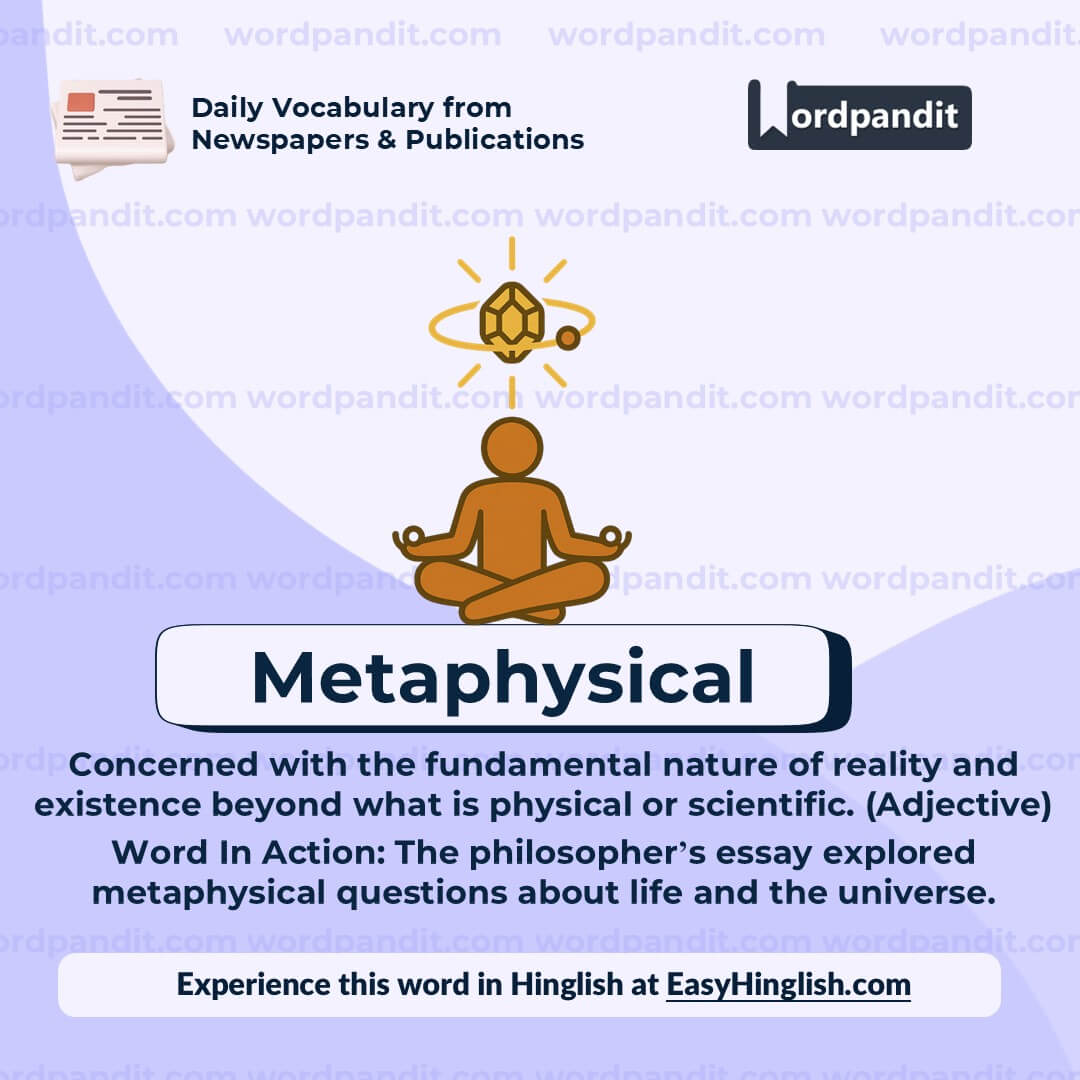
WORD-5: Metaphysical
Context:
"According to Buddhist tradition, soon after Gautam realised that human life is fraught with pain and suffering, he embarked on a ‘noble quest’ to find a method to permanently end human misery. Many scholars uphold that his quest was a ‘metaphysical and psychological adventure’." - The Times of India
Explanatory Paragraph:
The term "metaphysical" relates to concepts that go beyond the physical and observable world. It deals with fundamental questions about existence, reality, the nature of being, and the universe. In the context of Gautam Buddha’s quest, the use of "metaphysical" suggests that his journey wasn’t only about worldly suffering but also about exploring the deeper, unseen truths of human existence and consciousness.
Meaning: Concerned with the fundamental nature of reality and existence beyond what is physical or scientific. (Adjective)
Pronunciation: meh-tuh-FIZ-ih-kuhl
Difficulty Level: ⭐⭐⭐ Intermediate
Etymology: From Greek *meta* (beyond) + *physika* (physical things), originally referring to works of Aristotle that came "after the physics".
Prashant Sir's Notes:
“Metaphysical” is a word you’ll often encounter in philosophy, spirituality, and literature. Use it when referring to abstract concepts like existence, the soul, or ultimate reality. It adds depth when you're discussing things beyond the material world.
Synonyms & Antonyms:
Synonyms: philosophical, abstract, spiritual, transcendental, theoretical
Antonyms: physical, tangible, material, empirical, scientific
Usage Examples:
- The poet's work explores metaphysical questions about life and death.
- Many ancient texts combine metaphysical insight with practical wisdom.
- Her theories delve into metaphysical realms beyond scientific proof.
- Some argue that meditation opens a door to metaphysical understanding.
Cultural Reference:
"The Metaphysical Poets," a term coined by Samuel Johnson, refers to 17th-century English poets like John Donne who explored philosophical and spiritual themes using imaginative metaphors and intellectual reasoning.
Think About It:
Do metaphysical beliefs influence the way people approach life and decision-making even if they can’t be proven?
Quick Activity:
Write a sentence using "metaphysical" to describe an idea, experience, or question that goes beyond the material world.
Memory Tip:
Break it down: "Meta" means beyond, and "physical" means the material — so "metaphysical" = beyond the physical.
Real-World Application:
"Metaphysical" is often used in philosophy, theology, literature, and even pop culture to describe deeper, intangible elements of life — like purpose, the soul, or consciousness.


