

Daily Vocabulary from Indian Newspapers and Publications
Welcome to Wordpandit’s Indian Vocabulary Hub
At Wordpandit, we understand the importance of staying rooted in the local context while expanding your language skills. This section focuses on enriching your vocabulary with words and phrases drawn from India’s leading newspapers and publications, ensuring you're learning vocabulary that is practical, relevant, and uniquely Indian.
Why Indian Sources Matter
We believe that the best way to master any language is by immersing yourself in local content. That’s why we carefully curate vocabulary from top Indian publications, including:
- The Hindu
- The Times of India
- The Economic Times
- Hindustan Times
- Live Mint
- The Indian Express
- And many others...
Stay Updated, Stay Relevant
With daily updates from Indian news sources, you’ll be consistently learning words that reflect the trends and shifts in Indian society and culture. Our focus is to provide vocabulary that enhances your understanding of the language in an Indian context.
How Wordpandit Supports Your Goals
Whether you’re preparing for exams, aiming to improve your professional communication, or simply want to stay connected with the latest Indian vocabulary, Wordpandit is here to guide you every step of the way.
Learn with a Practical Approach
Our interactive learning methodology includes real-world examples, engaging activities, and context-specific usage to ensure that every word becomes part of your active vocabulary.
Dive into Indian Vocabulary Today!

Why Choose Wordpandit?
Practical Learning: Focus on words you'll actually encounter in real-world reading, enhancing your comprehension and communication skills.
Diverse Content: From current affairs to scientific breakthroughs, our varied sources expose you to vocabulary across multiple domains.
Effortless Integration: Make Wordpandit a part of your daily routine. Just a few minutes each day can significantly boost your lexicon over time.
Your Path to Vocabulary Mastery
- Visit our Daily Vocabulary section regularly
- Explore new words and their usage in context
- Practice incorporating these words into your own writing and speech
- Track your progress as your vocabulary expands
Start Your Journey Today
Embark on your vocabulary enhancement journey with Wordpandit. By consistently engaging with our daily posts, you'll build a robust vocabulary that serves you well in academic, professional, and personal contexts.
Remember, a word a day keeps linguistic limitations at bay. Make Wordpandit your daily companion in the quest for vocabulary excellence!
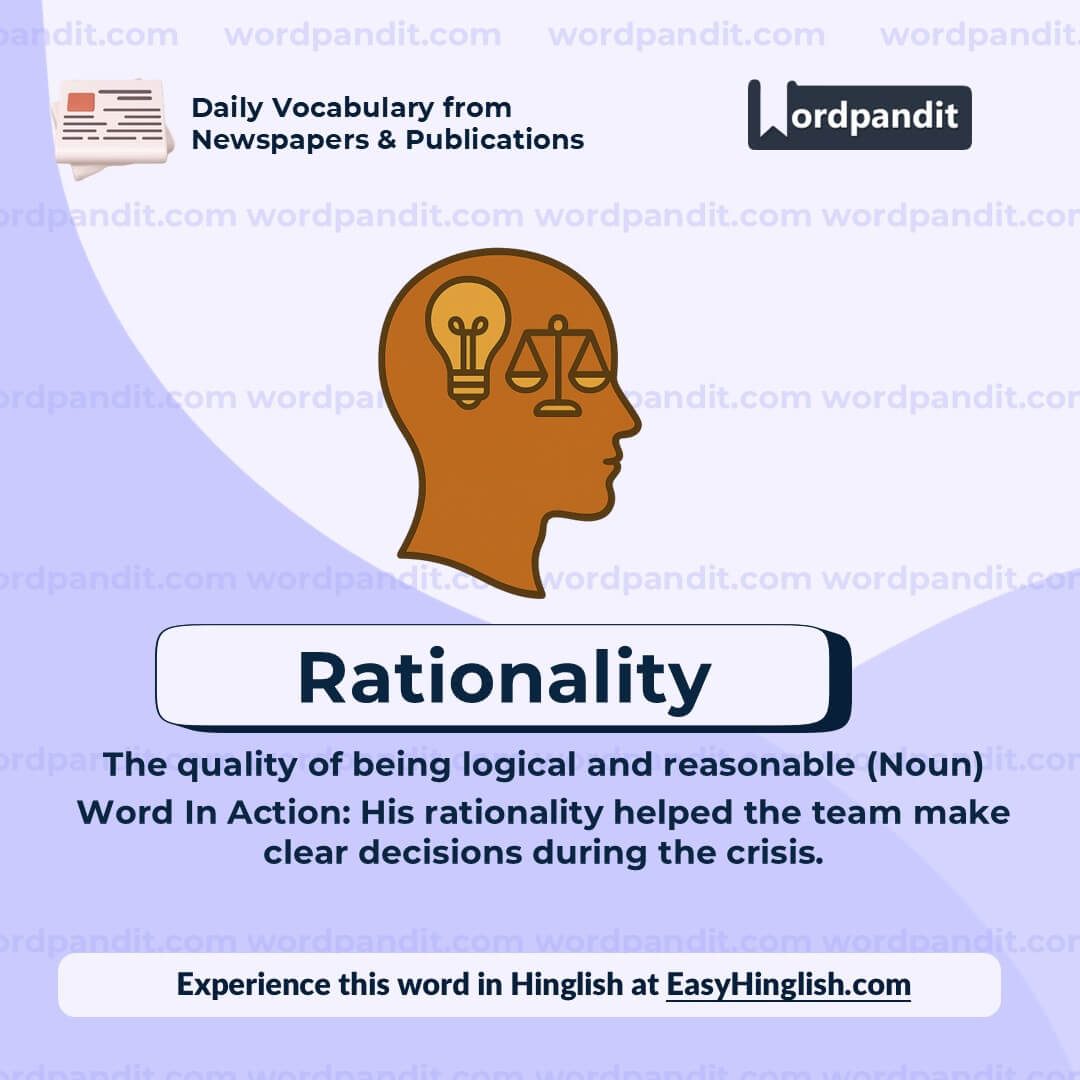
WORD-1: Rationality
Context:
"Buddhism is not based on pure logic or rationality, tradition, hearsay, revelation from God, a mysterious source, or an external person; rather, it is based on the personal endeavour and awakened understanding of Gautam, the Buddha, through shila, samadhi, and prajna." - The Times of India
Explanatory Paragraph:
Rationality is the quality or state of being reasonable, based on facts or reason rather than emotions or assumptions. It is a central pillar of critical thinking, helping individuals make sound decisions and evaluate situations logically. The quote emphasizes that Buddhism does not solely rely on rationality, but integrates deeper experiential insights, thereby highlighting the limitations of relying only on logic in understanding profound truths.
Meaning: The quality of being logical and reasonable (Noun)
Pronunciation: rash-uh-NAL-ih-tee
Difficulty Level: ⭐⭐⭐ Intermediate
Etymology: Derived from the Latin word "rationalitas," meaning "reasonableness" or "logic."
Prashant Sir's Notes:
Rationality is a thinking tool—a lens to view the world with clarity. However, it is important to recognize its limits. Emotions, intuition, and experiences often complement rational thought to form holistic understanding.
Synonyms & Antonyms:
Synonyms: logic, reason, sound judgment, coherence, sense
Antonyms: irrationality, nonsense, absurdity, illogicality
Usage Examples:
- Her argument was rooted in pure rationality, making it difficult to dispute.
- Rationality often gives way to emotion in high-stress situations.
- Public policies should ideally be grounded in rationality and evidence.
- He questioned the rationality of spending so much money on unnecessary luxury items.
Cultural Reference:
"The Enlightenment was an age of rationality, where thinkers emphasized reason over tradition and superstition." - History Textbooks
Think About It:
Can pure rationality ever fully capture the human experience, or do we need a balance of logic and emotion?
Quick Activity:
List two situations from your life where you acted based on rationality and two where emotions overpowered logic. Reflect on the outcomes.
Memory Tip:
Think of “rationality” as the ability to **"ration"** your thoughts with **logic**—cutting away what doesn’t make sense.
Real-World Application:
Rationality is vital in decision-making across fields like science, business, and law. It ensures that actions are well-reasoned and outcomes are justifiable, especially when handling data, arguments, or ethical dilemmas.
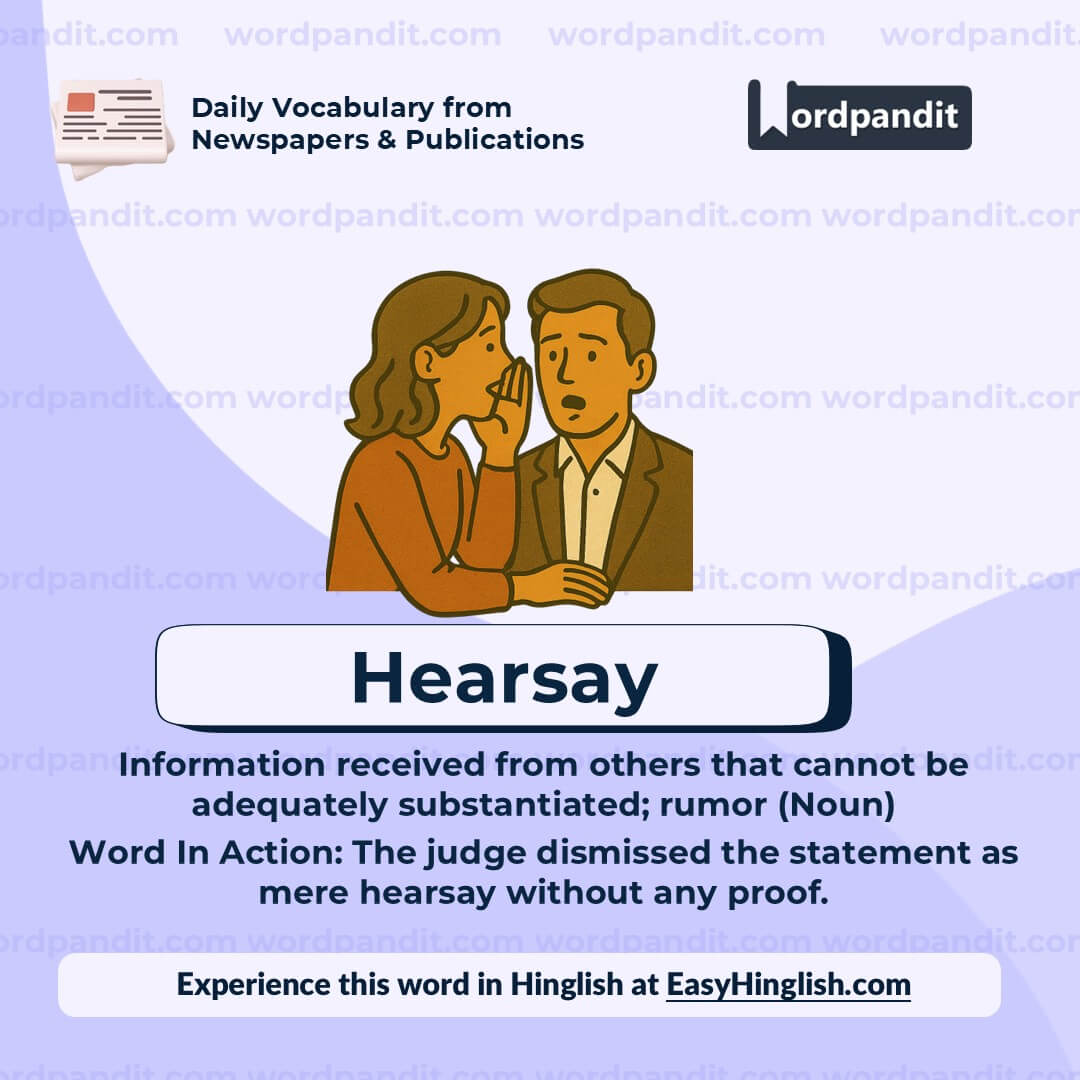
WORD-2: Hearsay
Context:
"Buddhism is not based on pure logic or rationality, tradition, hearsay, revelation from God, a mysterious source, or an external person; rather, it is based on the personal endeavour and awakened understanding of Gautam, the Buddha, through shila, samadhi, and prajna." - The Times of India
Explanatory Paragraph:
Hearsay refers to information or a claim that is passed from one person to another without definitive proof. It often carries the implication of being unreliable or secondhand, as it lacks firsthand verification. In the context of the quote, the word is used to emphasize that Buddhism encourages direct personal experience and realization over reliance on rumors or unverified teachings handed down from others.
Meaning: Information received from others that cannot be adequately substantiated; rumor (Noun)
Pronunciation: HEER-say
Difficulty Level: ⭐⭐ Basic
Etymology: Derived from the Old English phrase “here say,” meaning to hear someone say something.
Prashant Sir's Notes:
Hearsay reminds us to be careful with what we believe. Just because someone said it doesn’t make it true. For sound reasoning and decisions, rely on verified sources, not secondhand claims.
Synonyms & Antonyms:
Synonyms: rumor, gossip, unverified report, buzz, speculation
Antonyms: evidence, fact, confirmation, testimony
Usage Examples:
- The judge dismissed the statement as hearsay, lacking any supporting evidence.
- Don’t believe everything you hear—it could just be hearsay.
- His reputation was unfairly damaged by baseless hearsay.
- In journalism, relying on hearsay can be dangerous and unethical.
Cultural Reference:
"Objection! Hearsay!" is a common phrase in courtroom dramas, indicating a lawyer's challenge to testimony not based on direct knowledge. - Legal TV Shows
Think About It:
How often do we form opinions based on hearsay rather than personal experience or evidence?
Quick Activity:
Write down three things you've believed recently. Investigate and note whether they were based on hearsay or verified sources.
Memory Tip:
Think of “hearsay” as something you **hear someone say**, not something you saw or verified yourself.
Real-World Application:
In legal settings, hearsay is generally inadmissible because it lacks credibility. Similarly, in daily life, critical thinking requires us to distinguish between firsthand knowledge and secondhand assumptions.

WORD-3: Endeavour
Context:
"Buddhism is not based on pure logic or rationality, tradition, hearsay, revelation from God, a mysterious source, or an external person; rather, it is based on the personal endeavour and awakened understanding of Gautam, the Buddha, through shila, samadhi, and prajna." - The Times of India
Explanatory Paragraph:
Endeavour refers to a determined effort or attempt to achieve something, often requiring hard work and perseverance. In the quote, the term highlights that Buddhism is not a passive belief system handed down from others but is rooted in the active, conscious efforts of the individual—in this case, the Buddha’s own journey of self-realization and spiritual practice.
Meaning: A serious or strenuous attempt to accomplish something (Noun)
Pronunciation: en-DEV-er
Difficulty Level: ⭐⭐⭐ Intermediate
Etymology: From Old French “endevoir” meaning “to make an effort,” derived from “devoir” (duty).
Prashant Sir's Notes:
“Endeavour” carries a tone of nobility and purpose. It's more than just trying—it's trying with heart and dedication. This word is often used in formal or elevated contexts where the goal is meaningful and valuable.
Synonyms & Antonyms:
Synonyms: effort, attempt, venture, pursuit, enterprise
Antonyms: idleness, neglect, apathy, inaction
Usage Examples:
- He made a sincere endeavour to improve his communication skills.
- The mission to Mars is a scientific endeavour of great significance.
- Her artistic endeavour received widespread recognition.
- Despite several setbacks, their endeavour to build a school continued.
Cultural Reference:
The HMS Endeavour was the ship used by Captain James Cook during his first voyage of discovery to Australia and New Zealand. - Maritime History Archives
Think About It:
What is one personal endeavour you have committed to that reflects your values or goals?
Quick Activity:
Write a short paragraph describing an endeavour you took up in the past year. What motivated you? What did you learn?
Memory Tip:
“Endeavour” sounds like “in-devoted-effort”—use this phrase to remind yourself it’s about committed trying.
Real-World Application:
In resumes, cover letters, or interviews, using “endeavour” can emphasize dedication and proactive behavior, especially when discussing goals, projects, or long-term commitments.
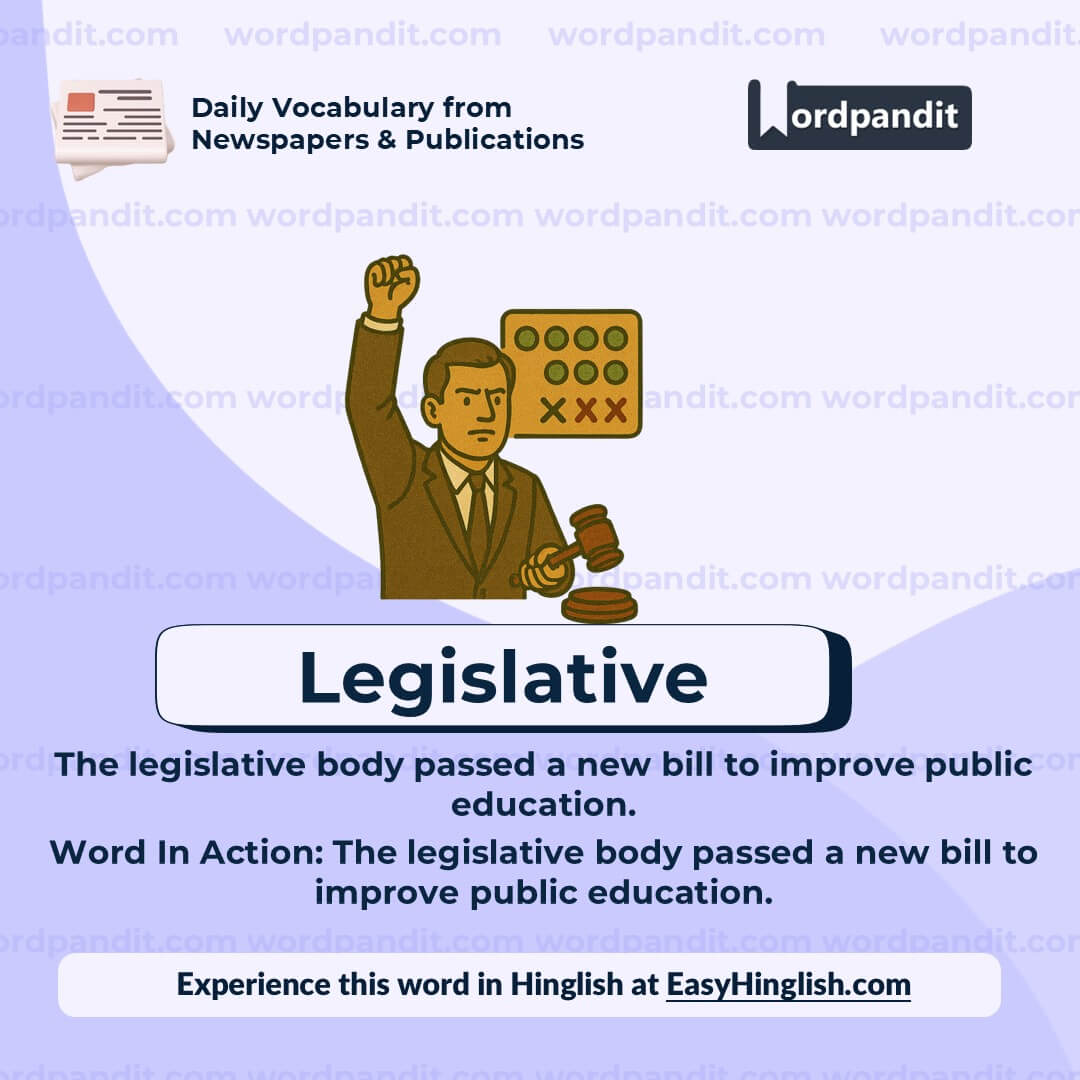
WORD-4: Legislative
Context:
"The Supreme Court, whilst expressing concern regarding the regulation of content on Over the Top (OTT) platforms and social media, urged the Centre to do “something legislative” about the obscene and indecent nature of content streamed through such platforms." - The Indian Express
Explanatory Paragraph:
The word “legislative” refers to anything related to the process of making or enacting laws. It is often used in the context of government bodies like parliaments or congresses, which have the authority to create legislation. In the quote, the Supreme Court is encouraging the government to pass laws (i.e., take legislative action) to regulate objectionable content on digital platforms.
Meaning: Relating to the making or enacting of laws (Adjective)
Pronunciation: LEJ-uh-slay-tiv
Difficulty Level: ⭐⭐⭐ Intermediate
Etymology: From Latin "legis" (law) + "lat" (carried) + "-ive" (adjective-forming suffix), relating to law-making.
Prashant Sir's Notes:
“Legislative” is one of those core civics terms that appears frequently in newspapers and exams. Always connect it with “law-making bodies” like the Parliament. Also remember: 'legislation' is the noun form and 'legislate' is the verb.
Synonyms & Antonyms:
Synonyms: legal, law-making, statutory, parliamentary
Antonyms: judicial, executive, unlawful, unauthorized
Usage Examples:
- The legislative branch of the government is responsible for drafting new laws.
- A legislative change was proposed to regulate online gambling platforms.
- The committee submitted a legislative report on cybercrime control.
- Legislative measures were introduced to protect the environment.
Cultural Reference:
"The legislative process in India involves the introduction of a bill in either house of Parliament, followed by debates, amendments, and finally, assent by the President." - Indian Polity, Laxmikanth
Think About It:
Should governments rely more on legislative action to regulate digital content, or should platforms self-regulate? Where should the line be drawn?
Quick Activity:
List three current social or technological issues that you think need legislative attention. Write a one-line explanation for each.
Memory Tip:
Think of “legislative” as something related to **legal statements**—rules made by lawmakers.
Real-World Application:
Understanding the term “legislative” is crucial for participating in civic discourse, following political developments, and preparing for exams like UPSC, CLAT, or other law-related entrance tests.
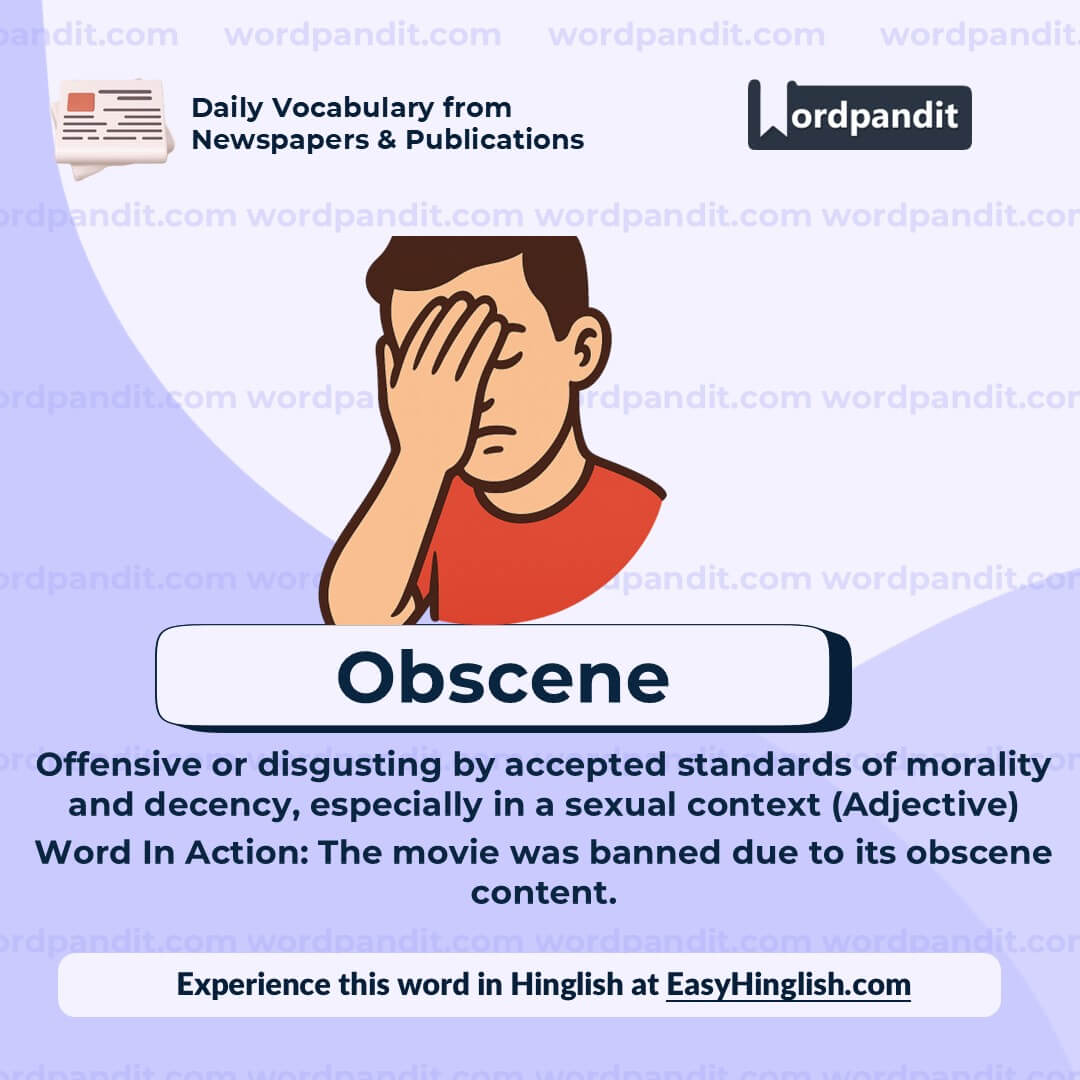
WORD-5: Obscene
Context:
"The Supreme Court, whilst expressing concern regarding the regulation of content on Over the Top (OTT) platforms and social media, urged the Centre to do “something legislative” about the obscene and indecent nature of content streamed through such platforms." - The Indian Express
Explanatory Paragraph:
“Obscene” describes something that is offensive, especially in a sexual or vulgar way, and is considered morally or socially unacceptable. The word is commonly used in legal or cultural contexts to describe material that violates standards of decency. In the quote, the Supreme Court uses the term to highlight the inappropriate and potentially harmful nature of some online content, calling for stricter regulation.
Meaning: Offensive or disgusting by accepted standards of morality and decency, especially in a sexual context (Adjective)
Pronunciation: ub-SEEN
Difficulty Level: ⭐⭐⭐ Intermediate
Etymology: From Latin "obscenus," meaning “foul, repulsive, or ill-omened.”
Prashant Sir's Notes:
Be cautious with this word—it carries strong moral and emotional weight. It's often used in discussions of media, literature, and public behavior. Also note how it overlaps with terms like “indecent,” but often carries a more serious connotation.
Synonyms & Antonyms:
Synonyms: indecent, vulgar, lewd, offensive, crude
Antonyms: decent, modest, refined, appropriate, tasteful
Usage Examples:
- The film was banned for containing obscene language and scenes.
- Some advertisements were criticized for being sexually obscene.
- The comedian’s jokes were considered obscene by the older audience.
- Publishing obscene material is a punishable offense under many laws.
Cultural Reference:
In 1973, the U.S. Supreme Court established the “Miller Test” to determine what constitutes obscene material unprotected by the First Amendment. - American Legal History
Think About It:
How do we draw the line between artistic freedom and obscenity in a multicultural society?
Quick Activity:
List three examples of content (film, ad, social media post) you’ve seen that some might find obscene. Reflect: was it offensive to you? Why or why not?
Memory Tip:
“Obscene” contains “scene”—think of an inappropriate or vulgar **scene** that shocks or offends.
Real-World Application:
The term “obscene” is frequently used in legal, media, and societal debates over censorship, decency laws, and content regulation. Understanding it helps in navigating conversations on free speech and cultural standards.


