

Daily Vocabulary from International Newspapers and Publications
Expand Your Vocabulary with Wordpandit’s Global Vocabulary Hub
At Wordpandit, we are committed to helping you develop a truly global vocabulary by drawing from some of the most respected international publications. This section is designed to keep you ahead of the curve by introducing you to words that define global conversations and trends.
The Power of Global Sources
To help you think and communicate on a global scale, we curate vocabulary from renowned international sources, such as:
- The New York Times
- The Washington Post
- BBC
- The Guardian
- The Economist
- Scientific American
- Psychology Today
- And many more...
Stay Global, Stay Competitive
Our daily updates from international publications ensure you are consistently exposed to new words that reflect global news and developments, making sure your vocabulary is not only current but also globally relevant.
Enhance Your Global Perspective
Whether you’re preparing for international exams, aiming to excel in global business communication, or want to enhance your language skills for personal growth, Wordpandit offers the resources you need to thrive in a global context.
Effective Learning, Global Reach
Our learning methodology combines global examples, memory aids, and interactive activities, allowing you to internalize new words effectively and apply them in real-world scenarios.
Begin Your Global Vocabulary Journey Now!

Why Choose Wordpandit?
Practical Learning: Focus on words you'll actually encounter in real-world reading, enhancing your comprehension and communication skills.
Diverse Content: From current affairs to scientific breakthroughs, our varied sources expose you to vocabulary across multiple domains.
Effortless Integration: Make Wordpandit a part of your daily routine. Just a few minutes each day can significantly boost your lexicon over time.
Your Path to Vocabulary Mastery
- Visit our Daily Vocabulary section regularly
- Explore new words and their usage in context
- Practice incorporating these words into your own writing and speech
- Track your progress as your vocabulary expands
Start Your Journey Today
Embark on your vocabulary enhancement journey with Wordpandit. By consistently engaging with our daily posts, you'll build a robust vocabulary that serves you well in academic, professional, and personal contexts.
Remember, a word a day keeps linguistic limitations at bay. Make Wordpandit your daily companion in the quest for vocabulary excellence!
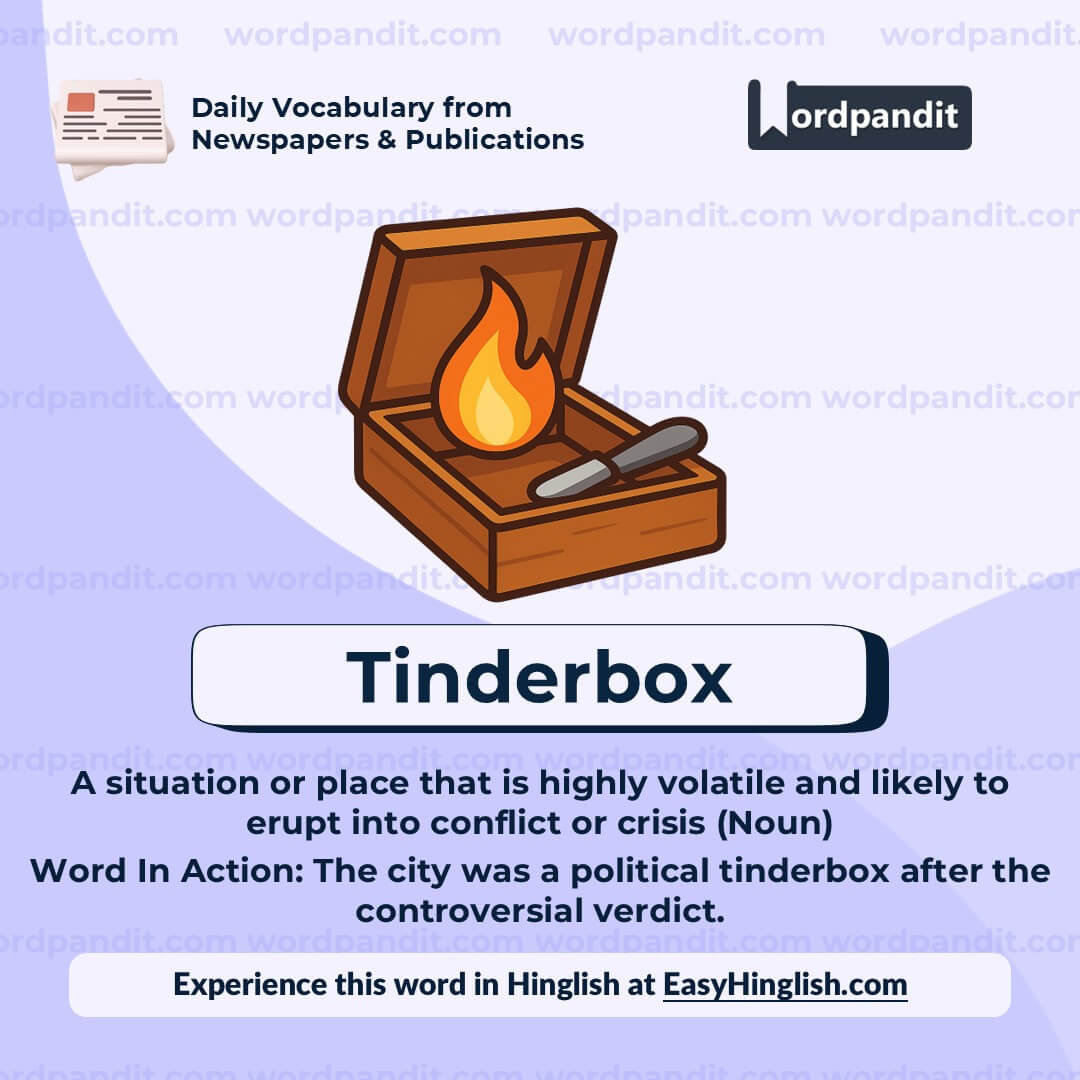
WORD-1: Tinderbox
Context:
"Immigration is a tinderbox. No one listening to voters on doorsteps in recent local elections could deny this. Nothing Labour does will satisfy those few who rate immigration as their top concern, but its new immigration plan is a serious endeavour to stop cheap labour undercutting pay." - The Guardian
Explanatory Paragraph:
A “tinderbox” is a metaphorical expression used to describe a highly volatile or sensitive situation that could easily erupt into conflict, chaos, or crisis with the slightest spark. Originally, it referred to a small container used to start fires, filled with flammable materials. In modern usage, especially in political or social discussions, it highlights issues that are emotionally charged and potentially explosive—like immigration, race relations, or economic inequality. In the given context, immigration is described as a tinderbox because it’s a topic loaded with tension, emotion, and the potential for division or unrest.
Meaning: A situation or place that is highly volatile and likely to erupt into conflict or crisis (Noun)
Pronunciation: tin-der-box
Difficulty Level: ⭐⭐⭐ Intermediate
Etymology: Originally from Middle English, a “tinderbox” was a container holding tinder and tools to start a fire. Over time, the word became a metaphor for anything that could erupt into trouble at any moment.
Prashant Sir's Notes:
This metaphor is powerful in opinion pieces, political commentary, or essays where you want to express how dangerously unstable a situation is. Use it with topics like war, protests, social unrest, or heated debates.
Synonyms & Antonyms:
Synonyms: powder keg, flashpoint, hotbed, volatile situation, boiling point
Antonyms: calm, stable environment, safe zone, peaceable situation
Usage Examples:
- The region has become a political tinderbox following the recent election.
- Social media acts like a tinderbox when misinformation spreads unchecked.
- The economic disparity turned the city into a tinderbox of civil unrest.
- Racial tensions in the area created a tinderbox that required delicate handling by authorities.
Cultural Reference:
The term “tinderbox” was widely used to describe the Balkans before World War I, often referred to as the “powder keg of Europe,” highlighting how quickly conflict could ignite from local tensions.
Think About It:
What are some topics or issues in your community or country that feel like tinderboxes? What factors make them so sensitive or explosive?
Quick Activity:
Write a sentence using “tinderbox” to describe a situation at school, work, or in politics that you believe is on edge and could erupt.
Memory Tip:
Think of a dry forest in summer—it only takes a spark to ignite a wildfire. That’s what a tinderbox is: a situation waiting to explode.
Real-World Application:
Understanding “tinderbox” helps in analyzing and discussing crises in global affairs, community issues, and even relationships—anywhere pressure is building and instability looms.
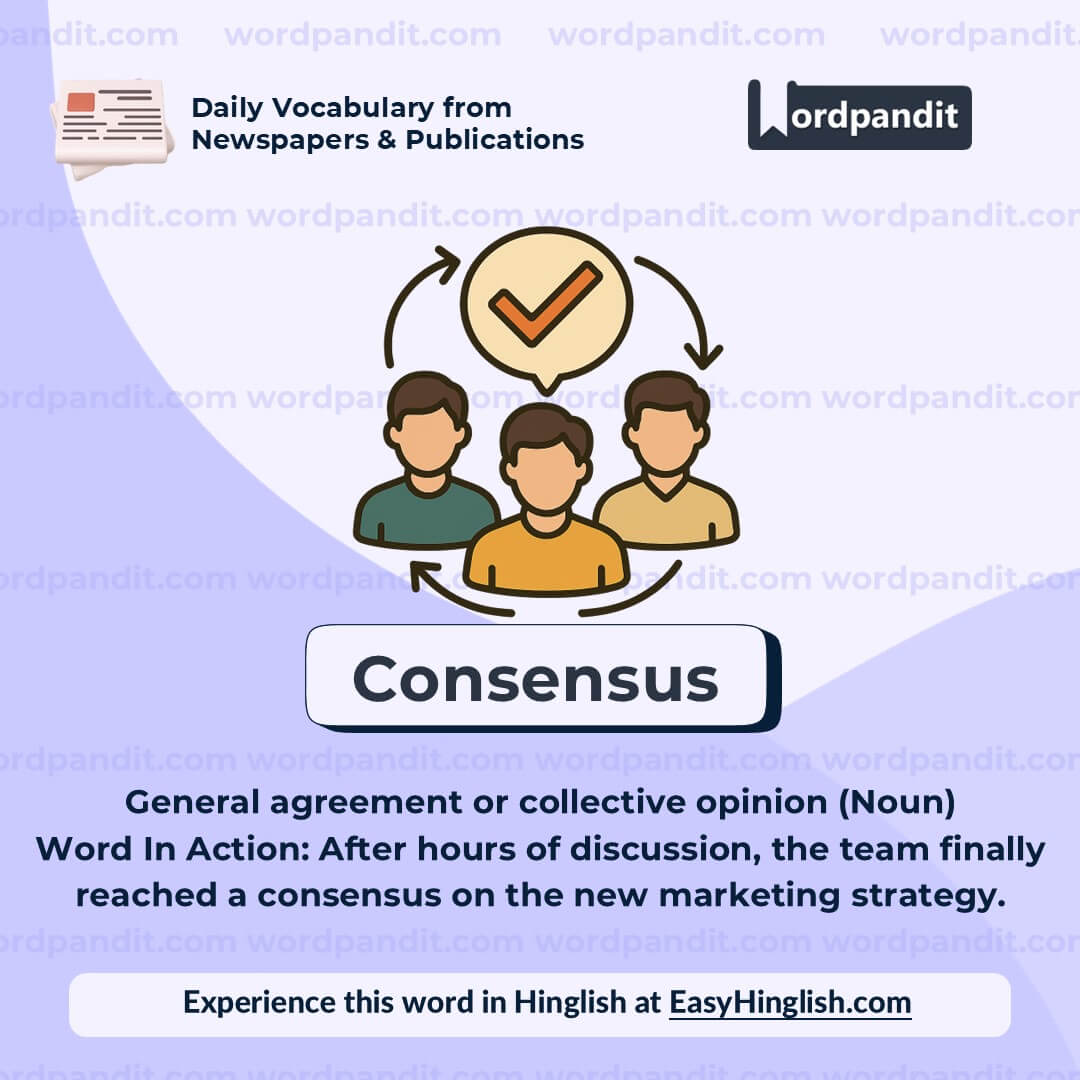
WORD-2: Consensus
Context:
"Though on May 10, India and Pakistan reached a consensus for a ‘full and immediate ceasefire’ after four days of intense military engagements, the hostilities are not going to end in the near future." - The Times of India
Explanatory Paragraph:
“Consensus” refers to a general agreement or shared decision among a group of people. It indicates unity in thought or opinion, especially after discussion or negotiation. In the context above, it means that both India and Pakistan agreed—through dialogue or diplomacy—on initiating a ceasefire. The word is frequently used in political, social, and organizational settings to signal collaborative decision-making.
Meaning: General agreement or collective opinion (Noun)
Pronunciation: kuhn-SEN-suhs
Difficulty Level: ⭐⭐ Beginner
Etymology: From Latin consensus meaning "agreement, accord," from consentire—“to agree, feel together.”
Prashant Sir's Notes:
This word appears often in decision-making contexts. While consensus is ideal, it doesn’t always mean everyone agrees 100%—it can simply mean that everyone agrees enough to move forward. Watch how it's used to convey unity and cooperation.
Synonyms & Antonyms:
Synonyms: agreement, accord, harmony, unity
Antonyms: disagreement, discord, conflict, dispute
Usage Examples:
- After hours of discussion, the team finally reached a consensus on the project direction.
- There is no consensus yet on how to address climate change globally.
- The jury reached a consensus on the verdict after two days of deliberation.
- Political leaders often struggle to build consensus in polarized environments.
Cultural Reference:
“Consensus democracy” is a concept in political science where decisions are made through broad agreement, often used in Scandinavian countries and Switzerland.
Think About It:
Is consensus always the best way to make decisions, or can it sometimes lead to watered-down outcomes?
Quick Activity:
Think of a time when your group had to reach a consensus. What made it easy or difficult? Write 3 lines describing the process.
Memory Tip:
Consensus = “con” (together) + “sens” (to feel) → to feel or think together. Remember it as “common sense” among a group!
Real-World Application:
Whether in boardrooms, parliaments, or classrooms, “consensus” plays a crucial role in collaborative decision-making. It helps resolve conflicts, build unity, and foster inclusive outcomes.

WORD-3: Undercutting
Context:
"Immigration is a tinderbox. No one listening to voters on doorsteps in recent local elections could deny this. Nothing Labour does will satisfy those few who rate immigration as their top concern, but its new immigration plan is a serious endeavour to stop cheap labour undercutting pay." - The Guardian
Explanatory Paragraph:
“Undercutting” refers to offering a lower price, wage, or cost in a way that threatens the position or value of something or someone else. In business, it often means selling goods or services at a lower rate than competitors. In the given context, “cheap labour undercutting pay” means that the availability of lower-paid workers is driving down wages for others, particularly in vulnerable job sectors. The word implies an unfair or harmful advantage that disrupts balance or fairness in economic systems.
Meaning: To offer a lower price or wage than someone else, especially in a way that harms competition or fairness (Verb – present participle of “undercut”)
Pronunciation: un-der-kut-ing
Difficulty Level: ⭐⭐⭐ Intermediate
Etymology: From Middle English “undercutten,” meaning to cut from underneath; metaphorically evolved in commerce and politics to imply lowering or weakening from beneath.
Prashant Sir's Notes:
“Undercutting” is common in economic, political, and labor discussions. It’s useful when discussing competition, exploitation, and inequality. Watch how it is used with terms like “wages,” “prices,” or “credibility” to imply strategic disadvantage or manipulation.
Synonyms & Antonyms:
Synonyms: underbid, underprice, weaken, sabotage, erode
Antonyms: support, reinforce, bolster, uphold, strengthen
Usage Examples:
- The company was accused of undercutting local competitors by paying workers extremely low wages.
- Illegal imports are undercutting domestic producers.
- His constant criticism was undercutting her authority in the team.
- Rising automation risks undercutting human labour in manufacturing sectors.
Cultural Reference:
“Undercutting” is frequently used in debates about globalization, where low-cost labor in one country may undercut wages and jobs in another, sparking protests and trade wars—seen in many discussions around NAFTA and U.S.–China trade relations.
Think About It:
Is undercutting always harmful, or can it sometimes lead to healthy competition? Where should we draw the line between competitiveness and exploitation?
Quick Activity:
Write a sentence describing how undercutting might affect a small business or a worker in your country or city.
Memory Tip:
Picture someone slicing from underneath—“undercutting” something stable, like wages or confidence, to make it collapse or fall.
Real-World Application:
“Undercutting” is a key term in economic analysis, labor rights discussions, and trade policy. It helps explain dynamics where cost-saving strategies can cause deeper societal impacts.
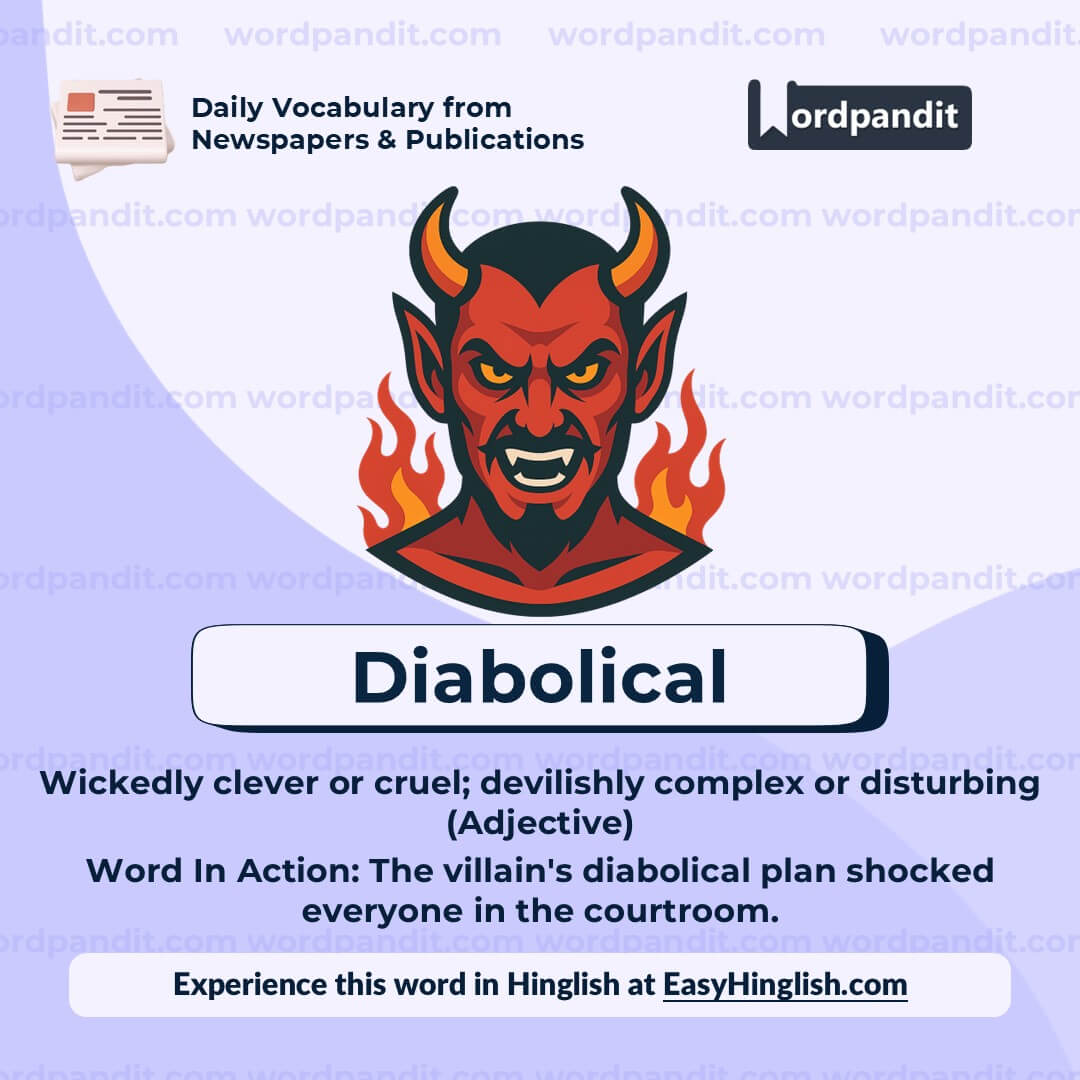
WORD-4: Diabolical
Context:
"To understand the point Schrödinger was making, we need to do a little unpacking. The nature of Schrödinger’s ‘diabolical device’ is not actually important to his argument. Its purpose is simply to amplify an atomic-scale event – the decay of a radioactive atom – and bring it up to the more familiar scale of a living cat, trapped inside a steel box." - Aeon
Explanatory Paragraph:
“Diabolical” means wicked, cruel, or extremely evil—often in a clever or dramatic way. It originates from “diablo,” the Latin and Spanish word for the devil. While it usually refers to villainous people or acts, in literary and scientific contexts it can also describe something outrageously complex, ingenious, or disturbingly effective. In this context, Schrödinger’s “diabolical device” refers not to actual evil but to the disturbing and provocative design of his thought experiment—using a machine that could potentially kill a cat to make a philosophical point about quantum mechanics.
Meaning: Wickedly clever or cruel; devilishly complex or disturbing (Adjective)
Pronunciation: die-uh-bol-i-kuhl
Difficulty Level: ⭐⭐⭐ Intermediate
Etymology: From Late Latin “diabolicus” (devilish), from Greek “diabolos” meaning “slanderer, devil.” Commonly associated with malevolent intent or shocking cleverness.
Prashant Sir's Notes:
“Diabolical” is dramatic and vivid—great for expressive writing. It can describe villainy, twisted genius, or even shockingly unethical acts. In scientific or metaphorical contexts, it adds flair to descriptions of morally or intellectually provocative ideas.
Synonyms & Antonyms:
Synonyms: wicked, evil, fiendish, malevolent, cruel, nefarious
Antonyms: angelic, kind, benevolent, good, innocent
Usage Examples:
- The villain’s diabolical plan nearly succeeded in destroying the city.
- There was something diabolical about the calm way he explained the horrific procedure.
- Schrödinger’s diabolical device forces us to question the nature of observation and reality.
- The detective uncovered a diabolical conspiracy that shocked the entire nation.
Cultural Reference:
“Diabolical” villains like Darth Vader or the Joker are staples of popular culture—characters whose clever, extreme cruelty make them unforgettable symbols of evil and complexity.
Think About It:
Can something be described as “diabolical” even if it has no intent to harm—only the power to provoke deep ethical or emotional discomfort?
Quick Activity:
Write a short sentence or two describing a fictional “diabolical invention” that sounds chilling yet brilliant.
Memory Tip:
“Diabolical” sounds like “devil”—use it for things that are devilishly cruel, clever, or disturbing in nature.
Real-World Application:
Use “diabolical” in writing that aims to evoke strong emotional reactions—whether in critiques, fiction, or commentary—especially when highlighting twisted logic, dark ethics, or shocking brilliance.
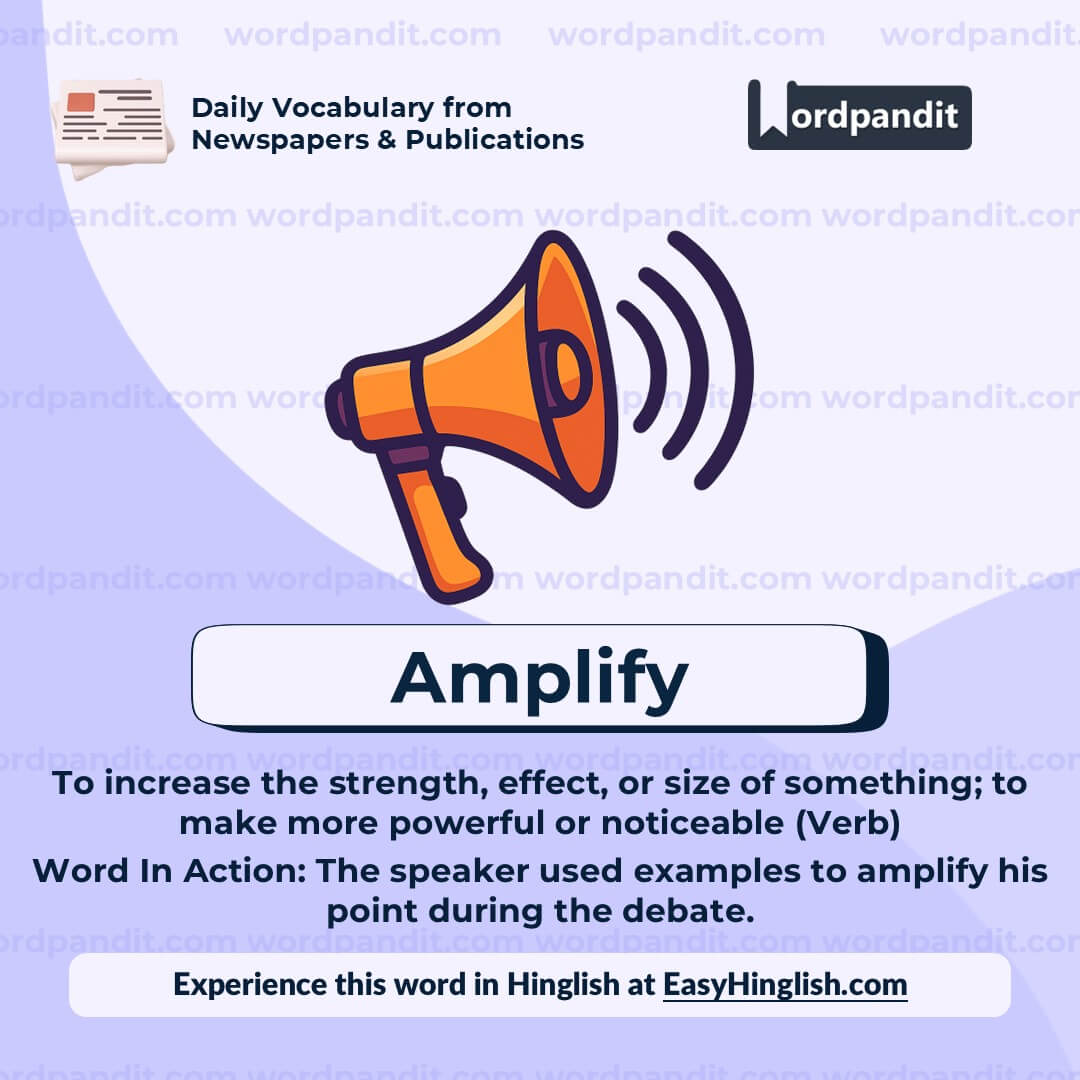
WORD-5: Amplify
Context:
"To understand the point Schrödinger was making, we need to do a little unpacking. The nature of Schrödinger’s ‘diabolical device’ is not actually important to his argument. Its purpose is simply to amplify an atomic-scale event – the decay of a radioactive atom – and bring it up to the more familiar scale of a living cat, trapped inside a steel box." - Aeon
Explanatory Paragraph:
“Amplify” means to make something larger, stronger, or more significant—either literally, like increasing sound volume, or figuratively, like expanding an idea or effect. In science and engineering, it often refers to increasing the scale or intensity of a signal or event. In the context of Schrödinger’s experiment, the device is meant to amplify a tiny quantum event (like the decay of an atom) to a visible, life-sized consequence—making the invisible observable and helping explain a complex scientific idea.
Meaning: To increase the strength, effect, or size of something; to make more powerful or noticeable (Verb)
Pronunciation: am-pli-fy
Difficulty Level: ⭐⭐ Basic to Intermediate
Etymology: From Latin “amplificare” – “to enlarge,” from “amplus” (large, spacious) + “facere” (to make)
Prashant Sir's Notes:
“Amplify” is a high-utility verb. In academic writing, use it for discussing effects, impact, or attention. It’s also powerful in digital communication, where we “amplify” voices, messages, or causes via social media.
Synonyms & Antonyms:
Synonyms: increase, boost, magnify, intensify, expand
Antonyms: reduce, weaken, diminish, lessen, minimize
Usage Examples:
- The scientist used special equipment to amplify the signal from the distant galaxy.
- Social media has the power to amplify both important messages and misinformation.
- He tried to amplify his voice so the crowd could hear him over the noise.
- This policy may unintentionally amplify existing inequalities in the education system.
Cultural Reference:
“Amplify” is a popular term in advocacy and activism—many organizations ask allies to “amplify” marginalized voices, meaning to share, promote, and give visibility to underrepresented stories and perspectives.
Think About It:
In a world full of information, what should we choose to amplify—and what responsibility comes with that choice?
Quick Activity:
Think of a cause, idea, or message you believe should be amplified. Write one sentence explaining why.
Memory Tip:
Think of an amplifier in a speaker system—it takes a small sound and makes it loud. That’s exactly what “amplify” does to ideas, effects, or signals.
Real-World Application:
“Amplify” is commonly used in science, media, marketing, education, and social movements. Whether describing physical processes or spreading messages, it's a word that signifies powerful growth or escalation.


