

📘 What’s Inside This CAT Misfit Sentence/Odd One Out Question Post?
📝 Authentic CAT Misfit Sentence/Odd One Out Question: Practice with a real CAT Para-jumble Question from a previous CAT exam.
✅ Detailed Question with Step-by-Step Solution: Each question is explained thoroughly for better understanding.
📚 Vocabulary Enhancement: Top 5 words explained from the paragraph
Misfit Sentence/Odd One Out Question
Question 19:Five jumbled up sentences, related to a topic, are given below. Four of them can be put together to form a coherent paragraph. Identify the odd one out and key in the number of the sentence as your Answer:
1. For feminists, the question of how we read is inextricably linked with the question of what we read.
2. Elaine Showalter’s critique of the literary curriculum is exemplary of this work.
3. Androcentric literature structures the reading experience differently depending on the gender of the reader.
4. The documentation of this realization was one of the earliest tasks undertaken by feminist critics.
5. More specifically, the feminist inquiry into the activity of reading begins with the realization that the literary canon is androcentric, and that this has a profoundly damaging effect on women readers.
Solution with Explanation
Answer: 3
Detailed explanation by Wordpandit:
The primary focus of the passage is to elucidate the feminist viewpoint on the mechanics of reading, as well as the critiques that come along with this perspective. When one examines the sequence (1)-(5)-(4)-(2), it becomes clear that these statements collectively form a logically coherent paragraph that revolves around the feminist lens through which reading is evaluated.
Statement (3), however, stands as a stark anomaly within this context. Unlike the other statements that delve into the particulars of the feminist perspective, Statement (3) shifts the focus unexpectedly to the realm of androcentric literature. This sudden pivot is jarring and incongruent with the overarching theme of the passage, which is devoted to explaining the intricacies of reading from a feminist standpoint. Therefore, Statement (3) diverges from the central discussion and disrupts the cohesiveness of the thematic focus.
Word-1: Feminists

Context:
"For feminists, the question of how we read is inextricably linked with the question of what we read." - Source Unknown
Explanatory Paragraph:
The term "feminists" refers to individuals who support or advocate for feminism—a belief in and advocacy for gender equality, particularly focused on women's rights and issues. Feminists challenge social norms and institutional structures that reinforce gender inequality. In the context given, feminists are not just concerned with reading as an activity, but also with what content is read, implying a critical engagement with cultural and literary narratives that shape societal values.
Meaning: Advocates or supporters of feminism and gender equality (Noun)
Pronunciation: FEM-uh-nists
Difficulty Level: ⭐⭐ Beginner
Etymology: Derived from the French word "féministe," coined in the late 19th century, from "femme" (woman) and the suffix "-iste" (one who practices or is concerned with something).
Prashant Sir's Notes:
Understanding the term "feminists" is crucial to grasping socio-political debates about equality. It’s not just about supporting women but advocating for fairness and equity across gender lines. Also, it's important to distinguish between the movement (feminism) and the individuals (feminists).
Synonyms & Antonyms:
Synonyms: gender equality advocates, women’s rights supporters, egalitarians
Antonyms: chauvinists, misogynists, anti-feminists
Usage Examples:
- Feminists have played a crucial role in advocating for equal pay in the workplace.
- Many feminists argue that literature should reflect the diverse experiences of women.
- Young feminists today are using social media to spread awareness and organize campaigns.
- Historically, feminists have challenged the patriarchal norms entrenched in society.
Cultural Reference:
"Feminism is for everybody." - bell hooks
Think About It:
Can a person be a feminist without identifying as one? What does it truly mean to advocate for equality in everyday life?
Quick Activity:
List three changes in your country that have come about due to feminist movements. Reflect on their impact.
Memory Tip:
Think of “feminists” as people fighting for "fairness"—both start with an ‘f’ and aim for equity.
Real-World Application:
The term “feminists” frequently appears in discussions around workplace policy, education reform, healthcare rights, and media representation—contexts where gender disparities are being actively addressed.
Word-2: Critique
Context:
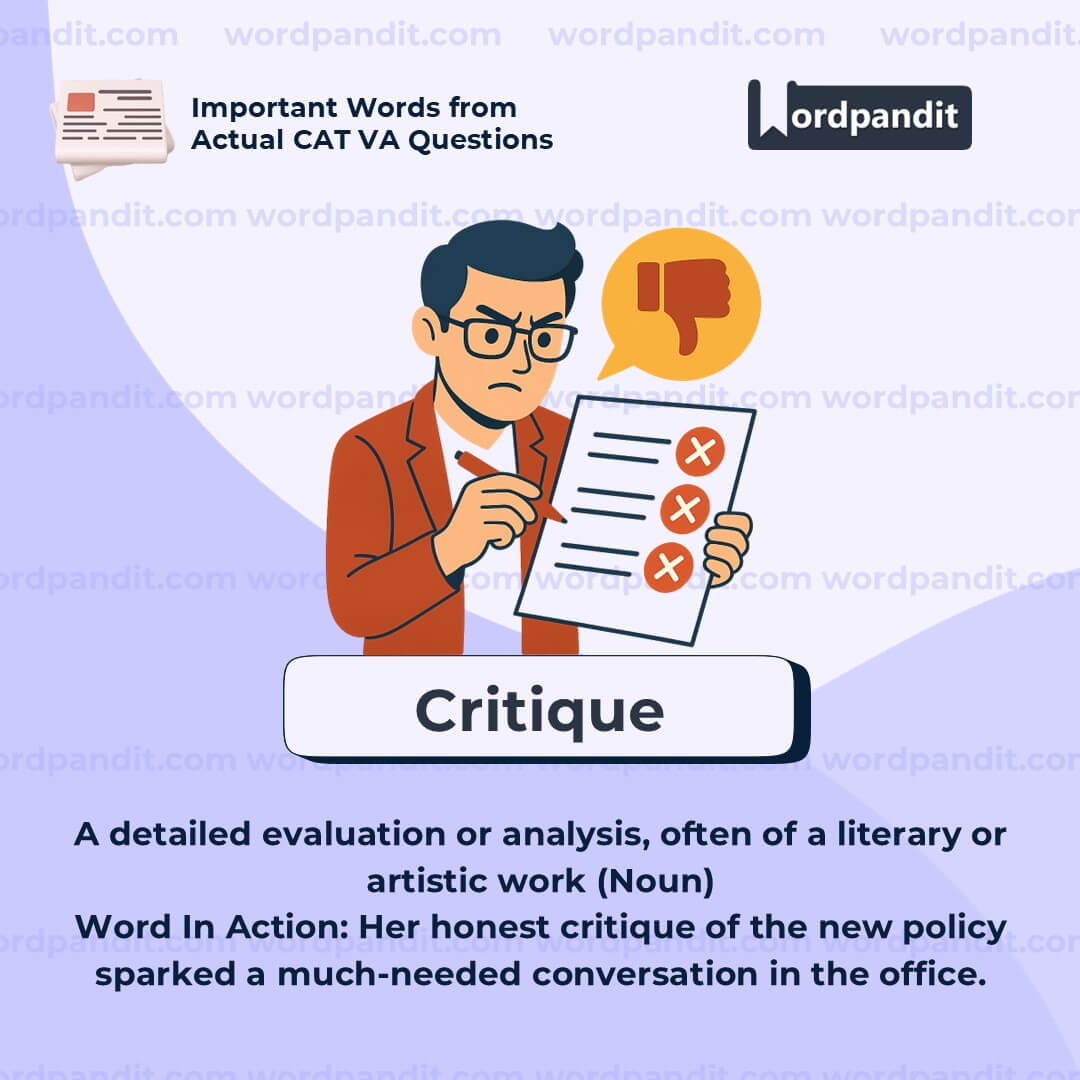
"Elaine Showalter’s critique of the literary curriculum is exemplary of this work." - Source Unknown
Explanatory Paragraph:
The word "critique" refers to a detailed analysis and assessment of something, particularly a literary, philosophical, or artistic work. It does not necessarily imply negativity—it can be balanced or appreciative. In the context of Elaine Showalter, a renowned feminist literary critic, the term refers to her intellectual examination and questioning of the traditional literary curriculum, highlighting its biases and proposing more inclusive alternatives.
Meaning: A detailed evaluation or analysis, often of a literary or artistic work (Noun)
Pronunciation: krih-TEEK
Difficulty Level: ⭐⭐⭐ Intermediate
Etymology: Borrowed from the French word “critique,” which comes from the Greek “kritikē” meaning “the art of judgment.”
Prashant Sir's Notes:
“Critique” is often confused with “criticism.” While criticism can lean toward disapproval, a critique is a structured and thoughtful analysis that may include both praise and evaluation. It's essential in academic and intellectual settings.
Synonyms & Antonyms:
Synonyms: analysis, evaluation, review, commentary, appraisal
Antonyms: praise (when used as blind approval), endorsement (without scrutiny), compliment
Usage Examples:
- The professor’s critique of the student’s essay was constructive and encouraging.
- The film received a glowing critique from major newspapers.
- Her critique focused on the outdated assumptions underlying the argument.
- He published a sharp critique of consumer culture in his new book.
Cultural Reference:
"The critique of pure reason is not a rejection of reason but a foundation for it." - Inspired by Immanuel Kant’s philosophical work
Think About It:
How can a well-crafted critique lead to personal or societal growth, and why do we often resist it?
Quick Activity:
Pick a short article or video. Write a two-paragraph critique identifying its strengths and areas of improvement.
Memory Tip:
Think of “critique” as a “critical peek” into something—an analytical look that goes beyond the surface.
Real-World Application:
Critiques are essential in professional fields like film, literature, academia, and design, where feedback and evaluation help refine ideas and output.
Word-3: Androcentric
Context:
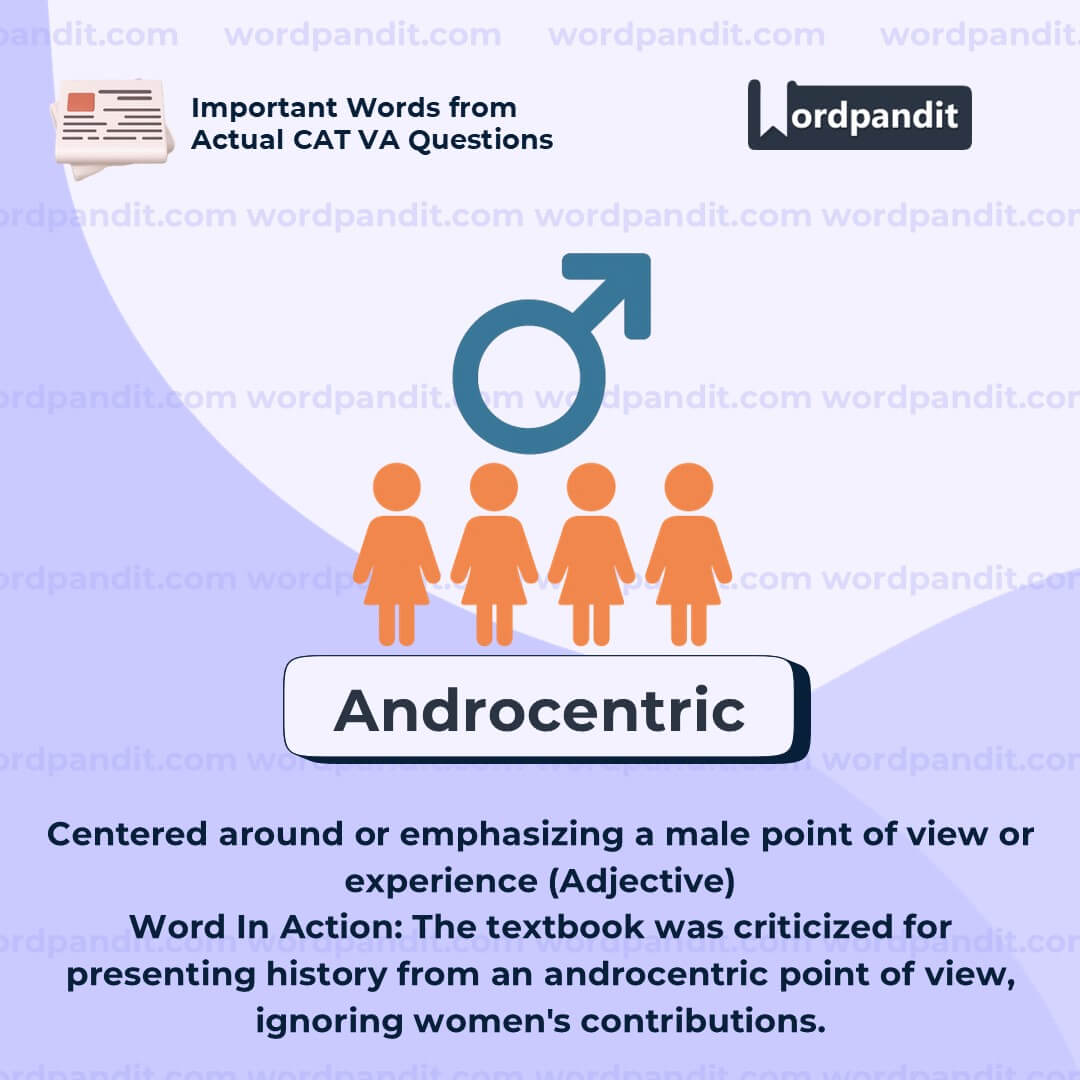
"Androcentric literature structures the reading experience differently depending on the gender of the reader." - Source Unknown
Explanatory Paragraph:
“Androcentric” refers to a worldview, system, or perspective that is centered on or biased toward men or the male experience. In literature, an androcentric perspective typically privileges male characters, experiences, and viewpoints, often relegating female voices to the margins. The quote suggests that such literature affects male and female readers differently, highlighting how gender influences both writing and interpretation.
Meaning: Centered around or emphasizing a male point of view or experience (Adjective)
Pronunciation: an-dro-SEN-trik
Difficulty Level: ⭐⭐⭐ Intermediate
Etymology: From Greek “andro” meaning “man” and “centric” meaning “centered.” The term came into use in the early 20th century in discussions of gender bias.
Prashant Sir's Notes:
This is a key term in feminist theory and literary criticism. Recognizing androcentric bias helps students and readers become aware of whose stories are told—and whose are left out. A must-know for critical readers.
Synonyms & Antonyms:
Synonyms: male-centered, patriarchal, man-oriented, gender-biased
Antonyms: gynocentric, egalitarian, inclusive, feminist
Usage Examples:
- The curriculum was criticized for being overly androcentric, ignoring significant contributions by women writers.
- Androcentric medical studies often fail to account for how diseases affect women differently.
- Her research challenged the androcentric assumptions that dominate traditional historiography.
- Literature with an androcentric focus often portrays female characters as secondary or stereotypical.
Cultural Reference:
"The androcentric world-view is not the world-view." – Charlotte Perkins Gilman, in *The Man-Made World*
Think About It:
How does an androcentric viewpoint shape the stories we grow up reading, and what might be the consequences of this on our understanding of gender roles?
Quick Activity:
Take a passage from a classic novel and analyze whether it presents an androcentric perspective. What would change if told from a female character’s point of view?
Memory Tip:
Break it down: “Andro” (man) + “centric” (centered) = focused on men. Think of “andro” like in “android,” originally meaning a man-like being.
Real-World Application:
The term is used in academic discussions about gender representation in media, history, science, and policy-making—where systems have often been designed with a male default in mind.
Word-4: Documentation
Context:
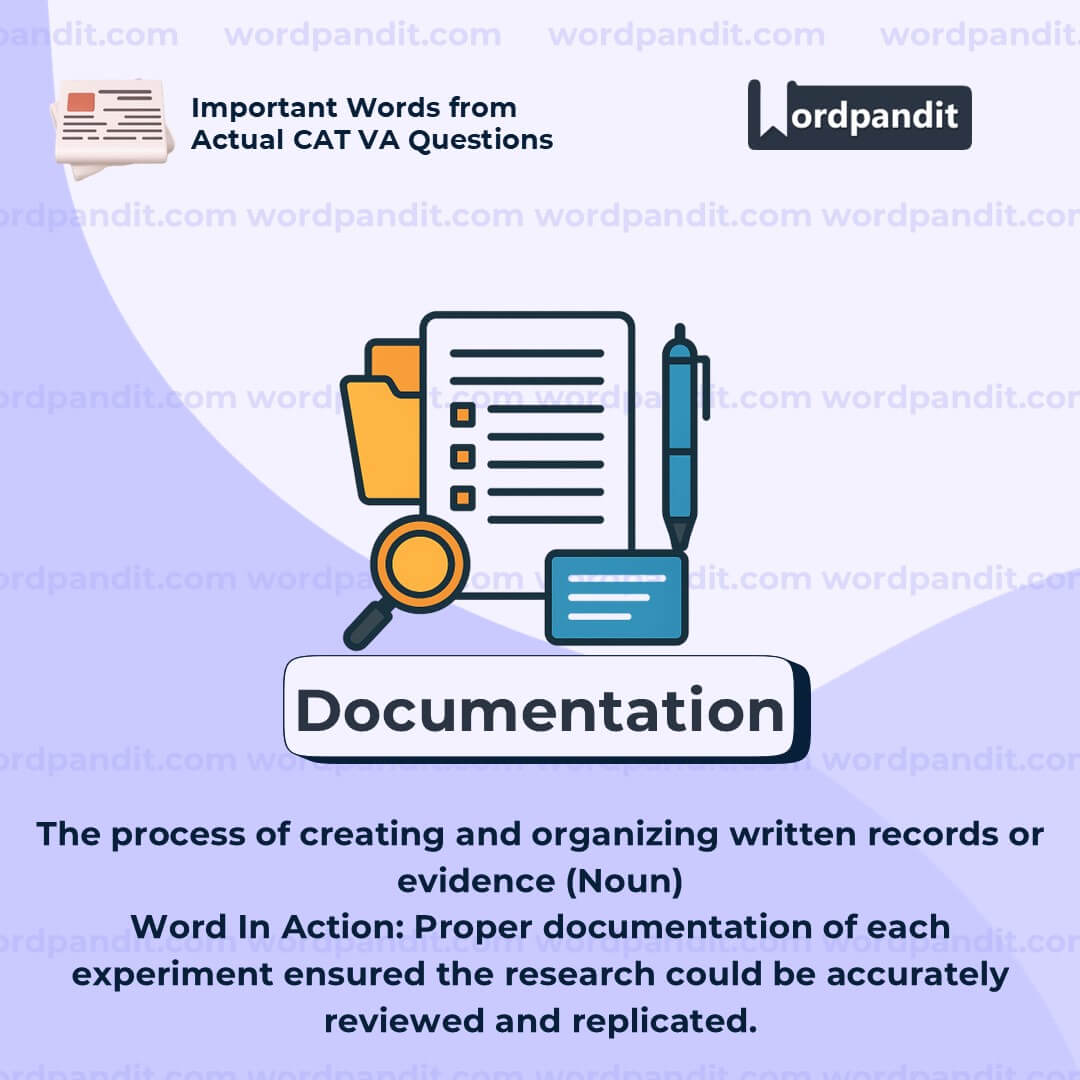
"The documentation of this realization was one of the earliest tasks undertaken by feminist critics." - Source Unknown
Explanatory Paragraph:
“Documentation” refers to the process of collecting, recording, organizing, and presenting information or evidence in a systematic way. It is commonly used in academic, legal, technical, and historical contexts. In this quote, the term highlights the critical role feminist scholars played in recording and legitimizing women's experiences, ideas, and critiques, which had often been ignored or excluded from traditional narratives.
Meaning: The process of creating and organizing written records or evidence (Noun)
Pronunciation: dok-yoo-men-TAY-shun
Difficulty Level: ⭐ Beginner
Etymology: From Latin “documentum” meaning “lesson, proof,” and “docere” meaning “to teach.” The term evolved in English through the 15th–17th centuries.
Prashant Sir's Notes:
Documentation isn't just about keeping records—it's a way of preserving voices, histories, and truths. Feminist critique emphasized how historical documentation had often silenced or ignored women’s perspectives. In that sense, documenting is an act of resistance.
Synonyms & Antonyms:
Synonyms: record, archive, report, recordkeeping, evidence
Antonyms: concealment, suppression, distortion, erasure
Usage Examples:
- The scientist ensured meticulous documentation of all experimental procedures.
- Proper documentation is vital when applying for a visa or government assistance.
- Feminist historians have contributed significantly to the documentation of women's lives.
- Without documentation, many important stories would be lost over time.
Cultural Reference:
"History is written by the victors—but documentation by the marginalized helps correct the narrative." – A paraphrased idea from Howard Zinn
Think About It:
What stories in your community or family remain undocumented, and what impact does that silence have on future generations?
Quick Activity:
Write a short paragraph documenting an experience or story from someone whose voice is often overlooked in mainstream narratives.
Memory Tip:
Think of a “document” as something you keep or file. “Documentation” is the collection of these—like gathering puzzle pieces to tell the whole story.
Real-World Application:
Documentation is essential in various fields—from academic research and legal proceedings to journalism and software development—where accurate records are the backbone of integrity and continuity.
Word-5: Inquiry
Context:
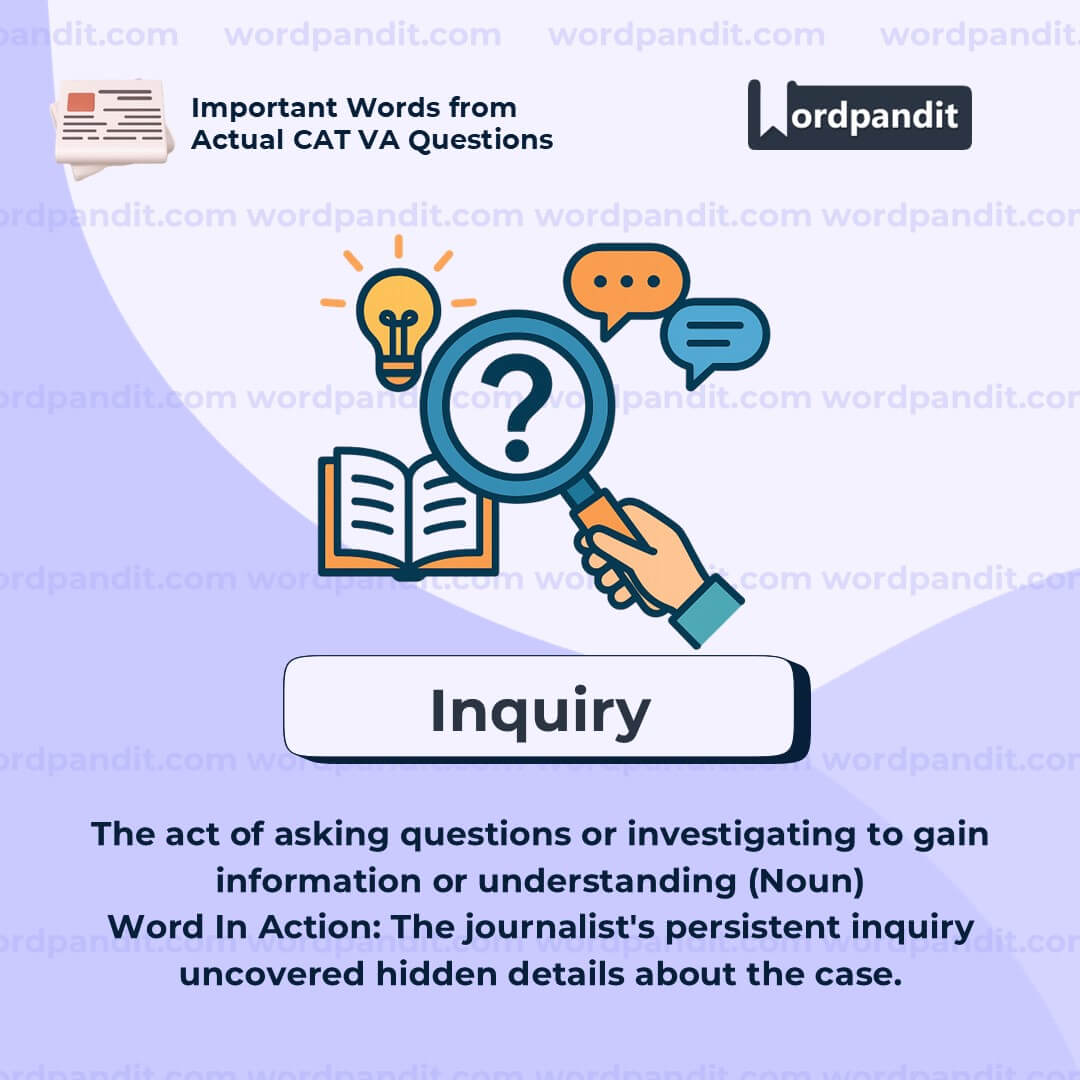
"More specifically, the feminist inquiry into the activity of reading begins with the realization that the literary canon is androcentric, and that this has a profoundly damaging effect on women readers." - Source Unknown
Explanatory Paragraph:
“Inquiry” refers to the process of seeking truth, knowledge, or information through questioning, investigation, or research. It implies a deeper intellectual pursuit that aims to understand complex ideas or problems. In this context, “feminist inquiry” signifies a focused and critical examination of how reading practices and literary traditions affect women's experiences and identities, particularly in a male-dominated cultural framework.
Meaning: The act of asking questions or investigating to gain information or understanding (Noun)
Pronunciation: in-KWAHY-ree
Difficulty Level: ⭐⭐ Beginner
Etymology: From Middle English “enquery,” derived from Latin “inquirere” — in (into) + quaerere (to seek).
Prashant Sir's Notes:
Inquiry is foundational to academic thinking—it drives us to dig deeper and challenge assumptions. In feminist theory, inquiry plays a crucial role in questioning established norms and reinterpreting texts and history through new lenses.
Synonyms & Antonyms:
Synonyms: investigation, probe, examination, exploration, research
Antonyms: neglect, disregard, indifference, disinterest
Usage Examples:
- The committee launched an inquiry into the causes of the systemic failure.
- Her lifelong inquiry into ancient cultures led her to become an archaeologist.
- Feminist inquiry challenges the assumptions underlying traditional literary criticism.
- The scientist’s inquiry uncovered patterns no one had previously noticed.
Cultural Reference:
"All inquiry is a form of risk. But not inquiring is riskier still." — Adapted from Paulo Freire’s philosophy of critical pedagogy
Think About It:
What are the barriers that prevent people from engaging in deep inquiry, and how can we overcome them to challenge dominant narratives?
Quick Activity:
Formulate three questions that reflect an inquiry into how literature influences your understanding of identity or culture.
Memory Tip:
Think of “inquiry” as a quest “in” to something—just like an explorer setting out to discover what lies beneath the surface.
Real-World Application:
Inquiry is a core component of education, journalism, legal investigations, and scientific research—helping individuals and societies question norms, discover facts, and drive progress.
