
📘 What’s Inside This CAT Para-jumble Question Post?
📝 Authentic CAT Para-jumble Question : Practice with a real CAT Para-jumble Question from a previous CAT exam.
✅ Detailed Question with Step-by-Step Solution: Each question is explained thoroughly for better understanding.
📚 Vocabulary Enhancement: Top 5 words explained from the paragraph
Para-jumble Sentences
Question 22: The four sentences (labelled 1, 2, 3, 4) below, when properly sequenced would yield a coherent paragraph. Decide on the proper sequencing of the order of the sentences and key in the sequence of the four numbers as your Answer:
1. But the attention of the layman, not surprisingly, has been captured by the atom bomb, although there is at least a chance that it may never be used again.
2. Of all the changes introduced by man into the household of nature, [controlled] large-scale nuclear fission is undoubtedly the most dangerous and most profound.
3. The danger to humanity created by the so-called peaceful uses of atomic energy may, however, be much greater.
4. The resultant ionizing radiation has become the most serious agent of pollution of the environment and the greatest threat to man’s survival on earth.
Solution with Explanation
Correct Answer: 2413
To build a coherent paragraph from the four sentences, we must establish the logical and thematic flow across scientific explanation, consequence, public perception, and critical reflection.
Sentence 2: This sentence logically opens the paragraph by introducing the topic — the powerful and dangerous implications of large-scale nuclear fission. It sets the foundation by identifying it as one of mankind’s most significant and hazardous interventions in nature.
Sentence 4: Naturally follows, explaining the key consequence of nuclear fission — ionizing radiation — and its disastrous impact on the environment and human survival. This deepens the understanding of the danger mentioned in Sentence 2.
Sentence 1: Shifts the focus from scientific to social reaction. It introduces the layman’s perception — primarily the fascination with the atom bomb — thus contrasting public attention with the more serious long-term issue introduced in the previous sentence.
Sentence 3: Brings in the concluding insight — while the destructive potential of the bomb has dominated attention, the real and more persistent threat may lie in the so-called peaceful uses of atomic energy. This ties together the scientific impact, public focus, and the greater danger from everyday applications of atomic energy.
Thus, the most coherent and logically sound sequence is 2-4-1-3.
Word-1: Layman
Context:
"But the attention of the layman, not surprisingly, has been captured by the atom bomb, although there is at least a chance that it may never be used again." - Source Unknown
Explanatory Paragraph:
“Layman” refers to a person who does not have professional or specialized knowledge in a particular subject. It’s often used to distinguish between experts (like scientists or doctors) and ordinary individuals with general understanding. In this context, the **layman** represents the general public, whose interest is drawn to the dramatic and visible threat of the atom bomb—even though more subtle and persistent dangers, such as radiation, may be equally or more harmful.
Meaning: A non-expert; someone without specialized knowledge in a particular subject (Noun)
Pronunciation: LAY-muhn
Difficulty Level: ⭐⭐ Beginner
Etymology: From Old French *lai*, from Late Latin *laicus*, meaning “non-clerical, of the people,” originally referring to someone outside the clergy.
Prashant Sir's Notes:
Use “layman” to describe how things are perceived or explained to the general public. It’s especially useful in essays when you're contrasting expert views with popular opinion or when explaining complex ideas in simple terms.
Synonyms & Antonyms:
Synonyms: non-expert, novice, outsider, amateur, general public
Antonyms: expert, professional, specialist, authority
Usage Examples:
- The professor explained quantum physics in layman’s terms.
- To a layman, the threat of radiation is less visible than that of a bomb.
- The report was written for both scientists and laypeople.
- Even a layman could sense the ethical dilemma in the situation.
Cultural Reference:
The phrase **“in layman’s terms”** is often used in science journalism, education, and politics to mean “in simple, understandable language”—bridging the gap between expert knowledge and public understanding.
Think About It:
Why is it important for experts to communicate complex ideas in terms a layman can understand? What risks arise if they don’t?
Quick Activity:
Choose a difficult topic you know (science, math, history). Try to explain it in one sentence a layman would understand.
Memory Tip:
“Layman” = someone who’s **laid back** when it comes to a subject—they don’t have specialized training but can still be interested.
Real-World Application:
Understanding and addressing the layman’s perspective is essential in public policy, journalism, healthcare, and education—where clear communication leads to informed decisions and public trust.
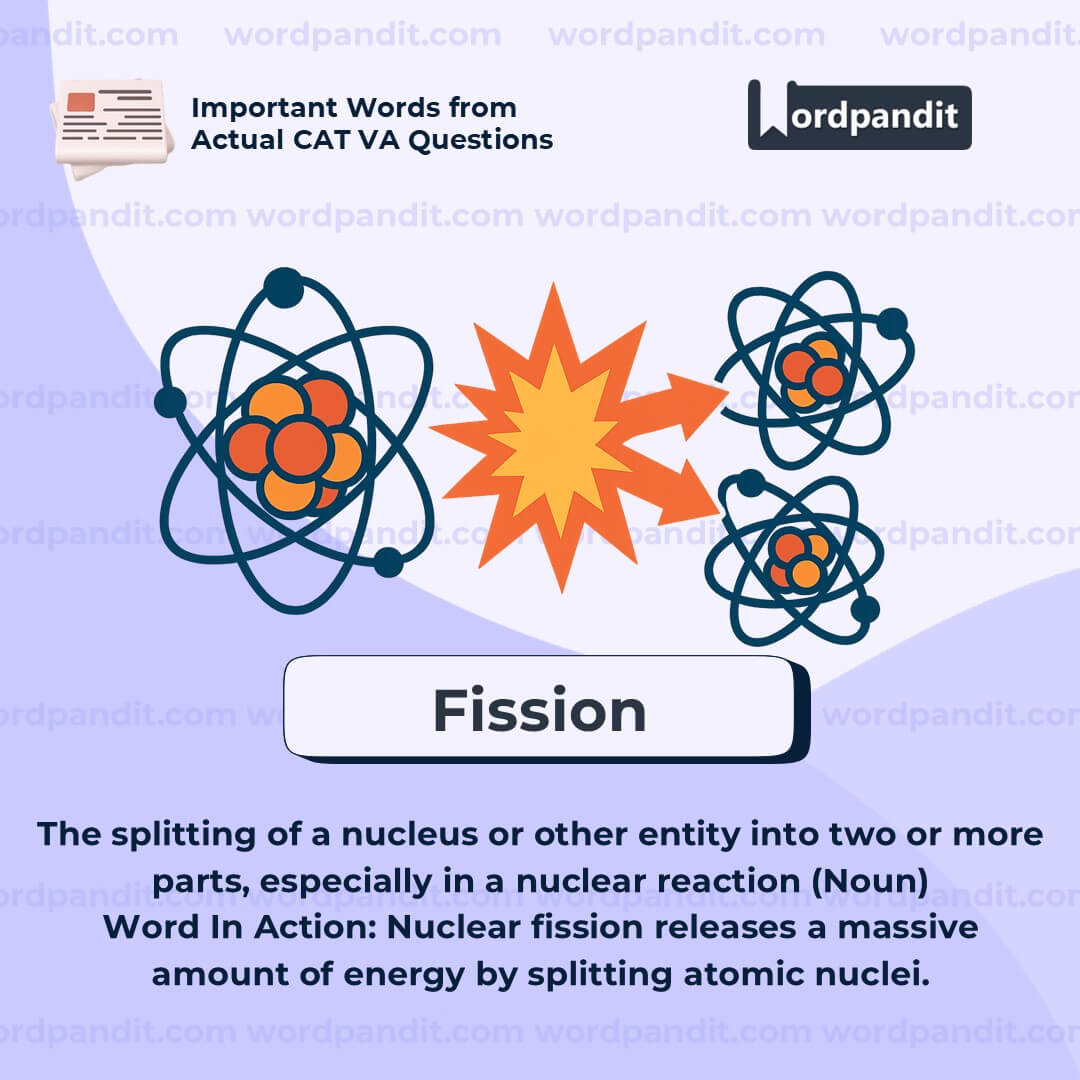
Word-2: Fission
Context:
"Of all the changes introduced by man into the household of nature, [controlled] large-scale nuclear fission is undoubtedly the most dangerous and most profound." - Source Unknown
Explanatory Paragraph:
“Fission” refers to the process of splitting something into two or more parts. In nuclear science, it specifically describes the splitting of an atomic nucleus into smaller parts, releasing a large amount of energy. This process is the basis for both nuclear power and atomic bombs. In the given context, **nuclear fission** is described as one of humanity’s most profound and dangerous interventions in nature—capable of both generating energy and causing mass destruction, depending on how it's controlled and applied.
Meaning: The splitting of a nucleus or other entity into two or more parts, especially in a nuclear reaction (Noun)
Pronunciation: FIH-shun
Difficulty Level: ⭐⭐⭐ Intermediate
Etymology: From Latin *fissio*, meaning “a splitting or cleaving,” from *findere* (to split).
Prashant Sir's Notes:
Fission is a core term in nuclear physics. Pair it with related ideas like “fusion” (joining nuclei), “atomic energy,” and “radiation.” Use it when analyzing topics like war, energy policy, or environmental impact.
Synonyms & Antonyms:
Synonyms: splitting, division, cleavage, breakdown
Antonyms: fusion, union, integration, merging
Usage Examples:
- Nuclear fission releases energy by splitting atomic nuclei.
- The bomb’s power came from an uncontrolled fission reaction.
- Controlled fission in reactors can generate electricity with low carbon emissions.
- Scientists study fission to improve both energy efficiency and nuclear safety.
Cultural Reference:
The development of nuclear fission in the 1930s and 1940s led directly to the creation of the atomic bomb and nuclear power plants—marking the beginning of the “Atomic Age.” Physicists like Otto Hahn and Lise Meitner played a major role in its discovery.
Think About It:
Should we continue to rely on nuclear fission for energy, given its potential risks? Is it possible to fully control a force with such destructive power?
Quick Activity:
Write a sentence using “fission” in a scientific or historical context. Then write another using “fusion” to contrast it.
Memory Tip:
“Fission” sounds like **‘fishin’ for a split** — think of it as splitting something apart at the core, like an atom bursting into two.
Real-World Application:
Fission is used in nuclear reactors for energy production and in weapons for destruction. Understanding it is essential in debates on sustainable energy, arms control, and environmental policy.
Word-3: Humanity
Context:
"The danger to humanity created by the so-called peaceful uses of atomic energy may, however, be much greater." - Source Unknown
Explanatory Paragraph:
“Humanity” in this context refers to all human beings collectively—the entire human race. It’s used to highlight the global and existential scope of the threat posed by atomic energy. Even when used for peaceful purposes like generating electricity, atomic energy carries the potential for catastrophic consequences. Thus, the sentence warns that the threat to **humanity**—our survival, health, and future—may be even more significant from these so-called peaceful uses than from the weapons themselves.
Meaning: All human beings collectively; the quality of being humane, kind, or compassionate (Noun)
Pronunciation: hyoo-MAN-ih-tee
Difficulty Level: ⭐ Beginner
Etymology: From Old French *humanité*, from Latin *humanitas*, from *humanus* (human).
Prashant Sir's Notes:
“Humanity” is a dual-use word—used to refer to the human species as a whole, or to the qualities of compassion and kindness. Be clear from the context which meaning applies. In science or global issues, it usually means all humankind; in ethical discussions, it might refer to moral character.
Synonyms & Antonyms:
Synonyms: humankind, mankind, people, society, the public
Antonyms: inhumanity, cruelty, barbarism (for the moral meaning)
Usage Examples:
- The threat of climate change is a challenge that affects all of humanity.
- The scientist dedicated her life to improving conditions for humanity.
- The book is a moving tribute to the resilience and humanity of refugees.
- Atomic energy, while powerful, may also pose unforeseen risks to humanity.
Cultural Reference:
Documents like the **Universal Declaration of Human Rights** emphasize the shared dignity and rights of all members of humanity—reinforcing the idea that global challenges must be addressed collectively.
Think About It:
What responsibilities do we have to protect humanity as a whole, especially in the face of technological power and environmental risk?
Quick Activity:
Write a sentence about a current global issue that poses a threat to humanity. Then write one sentence about a hope or achievement for humanity.
Memory Tip:
“Humanity” = all humans → Think of one big, diverse family called Earth’s population. Also remember it connects to “humane” (kindness).
Real-World Application:
“Humanity” is key in discussions about ethics, science, global development, and environmental sustainability. It's a term that reminds us we share a common fate and collective responsibility.
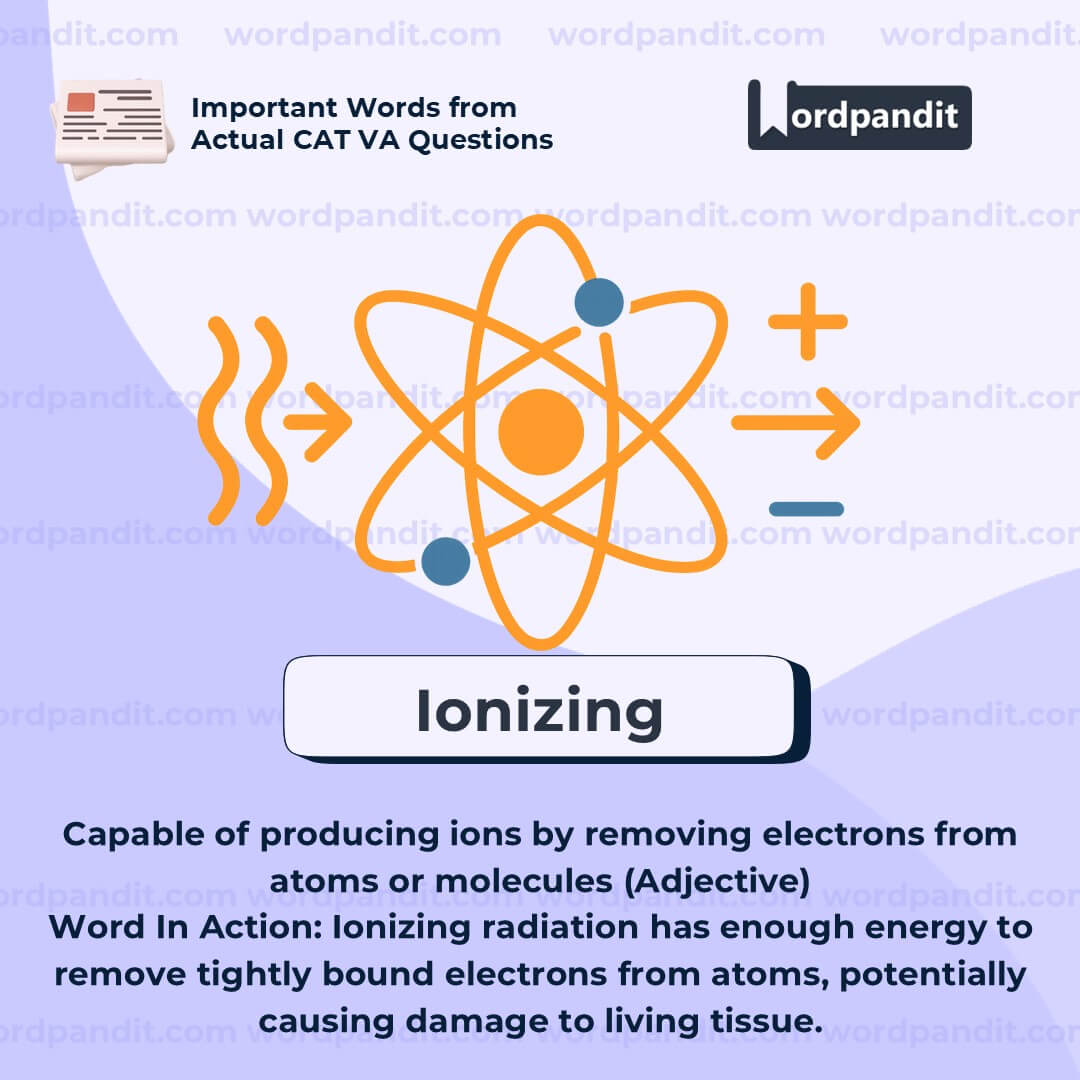
Word-4: Ionizing
Context:
"The resultant ionizing radiation has become the most serious agent of pollution of the environment and the greatest threat to man’s survival on earth." - Source Unknown
Explanatory Paragraph:
“Ionizing” refers to a type of energy that is powerful enough to remove tightly bound electrons from atoms, creating ions. This process is what makes certain forms of radiation—such as X-rays, gamma rays, or nuclear radiation—especially harmful. In this context, **ionizing radiation** is identified as a major threat to both the environment and human health, as it can damage living tissue, lead to genetic mutations, and contribute to long-term ecological and biological harm, even when used in peaceful applications like nuclear energy.
Meaning: Capable of producing ions by removing electrons from atoms or molecules (Adjective)
Pronunciation: EYE-uh-nize-ing
Difficulty Level: ⭐⭐⭐ Advanced
Etymology: From the word “ion,” coined from Greek *ienai* (to go), combined with the suffix *-ize* (to make), and *-ing* (present participle); literally meaning "making into ions."
Prashant Sir's Notes:
“Ionizing” is a scientific term frequently paired with “radiation.” Important in environmental science, physics, and health contexts. Unlike non-ionizing radiation (like visible light or microwaves), ionizing radiation has high energy and serious biological effects.
Synonyms & Antonyms:
Synonyms: radioactive, high-energy, radiative, particle-emitting (in context)
Antonyms: non-ionizing, inert, harmless (in radiation context)
Usage Examples:
- Ionizing radiation can damage DNA and increase the risk of cancer.
- The core of a nuclear reactor emits powerful ionizing radiation.
- X-rays are a form of ionizing radiation used for medical imaging, but with precautions.
- Prolonged exposure to ionizing particles from radioactive materials can be lethal.
Cultural Reference:
After events like **Chernobyl** and **Fukushima**, ionizing radiation became globally associated with nuclear disasters, reinforcing public fears about radiation exposure and its long-term environmental effects.
Think About It:
Should the benefits of technologies that involve ionizing radiation (e.g., nuclear power or medical imaging) outweigh the potential long-term risks?
Quick Activity:
List two examples of ionizing radiation and two of non-ionizing radiation. What distinguishes their energy levels and effects?
Memory Tip:
“Ionizing” = creates **ions** → High-energy radiation knocks electrons off atoms—think of it as “zapping atoms into charged particles.”
Real-World Application:
Understanding ionizing radiation is essential in healthcare (X-rays, radiation therapy), nuclear energy, environmental protection, and disaster response. It helps manage both its powerful benefits and its serious risks.
Word-5: Survival
Context:
"The resultant ionizing radiation has become the most serious agent of pollution of the environment and the greatest threat to man’s survival on earth." - Source Unknown
Explanatory Paragraph:
“Survival” refers to the act or state of continuing to live or exist, especially in difficult or dangerous conditions. In this context, the term emphasizes the extreme danger that ionizing radiation poses—not just as an environmental pollutant, but as a direct threat to the **survival** of humanity. It suggests that unchecked radiation could undermine the basic conditions necessary for life on Earth, making the issue not only ecological but existential.
Meaning: The state of continuing to live, exist, or endure, particularly in difficult conditions (Noun)
Pronunciation: sur-VY-vuhl
Difficulty Level: ⭐⭐ Beginner
Etymology: From Old French *survivre* (to live beyond), from Latin *supervivere* — *super* (over) + *vivere* (to live).
Prashant Sir's Notes:
“Survival” is a high-impact word often used in discussions of war, disaster, climate change, and health crises. It's powerful because it touches on our deepest instinct—to continue living. Pair it with terms like “threat,” “risk,” or “conditions” for a strong effect in analytical writing.
Synonyms & Antonyms:
Synonyms: endurance, continuation, existence, preservation, life
Antonyms: extinction, death, destruction, disappearance
Usage Examples:
- Access to clean water and food is essential for survival.
- The threat of nuclear fallout raises serious concerns about long-term human survival.
- Wild animals develop survival strategies to adapt to harsh climates.
- Climate change may endanger the survival of coastal communities.
Cultural Reference:
In global literature and media—from dystopian novels like The Road to survival reality shows like Survivor—the concept of **survival** captures humanity’s struggle against nature, war, or collapse. It’s a universal theme in both storytelling and real-life policy.
Think About It:
What are the biggest current threats to humanity’s survival, and how can we ensure future generations live safely on Earth?
Quick Activity:
List three situations—natural or human-made—where survival becomes a central issue. Briefly explain what is at stake in each case.
Memory Tip:
“Survival” = staying **alive** in a challenge → Think of it as life’s ongoing test: adapt, endure, continue.
Real-World Application:
“Survival” is central in fields like environmental science, healthcare, crisis management, and global development—where preserving life is the ultimate goal of policy, research, and action.