
📘 What’s Inside This CAT Para-jumble Question Post?
📝 Authentic CAT Para-jumble Question : Practice with a real CAT Para-jumble Question from a previous CAT exam.
✅ Detailed Question with Step-by-Step Solution: Each question is explained thoroughly for better understanding.
📚 Vocabulary Enhancement: Top 5 words explained from the paragraph
Para-jumble Sentences
Question 25: The four sentences (labelled 1, 2, 3, 4) below, when properly sequenced would yield a coherent paragraph. Decide on the proper sequencing of the order of the sentences and key in the sequence of the four numbers as your Answer:
1. It also has four movable auxiliary telescopes 1.8 m in diameter.
2. Completed in 2006, the Very Large Telescope (VLT) has four reflecting telescopes, 8.2 m in diameter that can observe objects 4 billion times weaker than can normally be seen with the naked eye.
3. This configuration enables one to distinguish an astronaut on the Moon.
4. When these are combined with the large telescopes, they produce what is called interferometry: a simulation of the power of a mirror 16 m in diameter and the resolution of a telescope of 200 m.
Solution with Explanation
Correct Answer: 2143
Detailed Explanation by Wordpandit:
The paragraph revolves around the Very Large Telescope (VLT), describing its components, functionality, and capabilities. A coherent sequence must begin with an introduction to the VLT and proceed logically through its structural features and technical advantages.
- Sentence 2 is the best starting point. It introduces the VLT, providing foundational information about its construction and observational power.
- Sentence 1 follows naturally by adding that the VLT includes four smaller, movable auxiliary telescopes. This builds on the structural description begun in Sentence 2.
- Sentence 4 then explains how the main telescopes and auxiliary telescopes work together using a technique called interferometry, thereby enhancing the telescope's power and resolution.
- Sentence 3 concludes the paragraph effectively by illustrating the impressive result of this combined configuration — the ability to distinguish an astronaut on the Moon.
This step-by-step structure — introduction, additional components, operational method, and finally an example — makes 2143 the most logical and coherent sequence.
Final Answer: 2143
Word-1: Auxiliary
Context:
"It also has four movable auxiliary telescopes 1.8 m in diameter." - Scientific Literature
Explanatory Paragraph:
The word "auxiliary" refers to something that provides additional help or support. In the given context, auxiliary telescopes serve a supporting role to the primary telescope system, likely enhancing the capabilities or extending the observational range. This word is commonly used in both technical and everyday language to describe supplementary components or assistance.
Meaning: Providing supplementary or additional help and support (Adjective/Noun)
Pronunciation: awg-ZIL-yuh-ree
Difficulty Level: ⭐⭐ Beginner
Etymology: From Latin "auxiliarius," from "auxilium" meaning "help" or "aid."
Prashant Sir's Notes:
Think of auxiliary as the 'extra hand' that comes in to make things easier or more efficient. Whether it's an auxiliary engine, a helper verb in grammar, or an assistant device in science, the core idea is support.
Synonyms & Antonyms:
Synonyms: supplementary, supportive, backup, assistant, ancillary
Antonyms: primary, main, principal, essential
Usage Examples:
- The hospital set up an auxiliary tent to accommodate more patients during the flu outbreak.
- In English, "do" is often used as an auxiliary verb in forming questions and negatives.
- The navy ship had an auxiliary engine to ensure backup power.
- The company hired auxiliary staff during the peak holiday season.
Cultural Reference:
"In grammar, auxiliary verbs like 'have,' 'do,' and 'be' are essential in forming different tenses and voices." - Oxford English Grammar Guide
Think About It:
Can something truly be considered 'auxiliary' if it becomes essential to the functioning of the system?
Quick Activity:
List five devices or tools in your daily life that serve an auxiliary function. For each, describe how it supports the primary function.
Memory Tip:
Remember: "AUX" is short for auxiliary in electronics—think of the AUX cable that helps your phone play music through the car speakers!
Real-World Application:
"Auxiliary" is frequently used in scientific, military, grammatical, and engineering contexts to denote systems or individuals that support a primary function—like auxiliary engines in ships, auxiliary nurses in hospitals, or auxiliary verbs in English grammar.
Word-2: Reflecting
Context:
"Completed in 2006, the Very Large Telescope (VLT) has four reflecting telescopes, 8.2 m in diameter that can observe objects 4 billion times weaker than can normally be seen with the naked eye." - Scientific Literature
Explanatory Paragraph:
The word "reflecting" in this context refers to the use of mirrors to bounce light back and focus it, which is essential in the functioning of reflecting telescopes. These instruments use curved mirrors to gather and concentrate light from distant celestial bodies. More broadly, "reflecting" can mean the act of throwing back light, heat, or sound without absorbing it, or even engaging in deep thought—depending on the context.
Meaning: Throwing back light, heat, or an image from a surface (Verb - Present Participle / Adjective)
Pronunciation: ri-FLEK-ting
Difficulty Level: ⭐⭐ Beginner
Etymology: From Latin "reflectere" meaning "to bend back"
Prashant Sir's Notes:
"Reflecting" is one of those words that serves both a physical and metaphorical function—whether you’re reflecting light in science or reflecting on your actions in life. In the case of telescopes, it’s all about bending light with precision.
Synonyms & Antonyms:
Synonyms: mirroring, bouncing, echoing, returning
Antonyms: absorbing, ignoring, overlooking
Usage Examples:
- The moon is visible at night by reflecting sunlight.
- She sat quietly, reflecting on her past decisions.
- The reflecting telescope allowed astronomers to capture clearer images of distant galaxies.
- His reflective jacket kept him visible on the dark road.
Cultural Reference:
"All that we see or seem is but a dream within a dream—reflecting our inner thoughts." - Edgar Allan Poe (Paraphrased)
Think About It:
How does the act of physical reflection in nature inspire our human capacity for introspection?
Quick Activity:
Look around you and list five things that reflect light. Then, write one sentence reflecting on your day using the metaphorical sense of the word.
Memory Tip:
Think of a mirror—it reflects your image just as a reflecting telescope bounces light to show distant objects. "Reflect" = "re" (back) + "flect" (bend).
Real-World Application:
In science, reflecting surfaces are used in telescopes, periscopes, and solar panels. In daily life, we reflect in mirrors and often reflect mentally during journaling, therapy, or meditation.
Word-3: Configuration

Context:
"This configuration enables one to distinguish an astronaut on the Moon." - Scientific Literature
Explanatory Paragraph:
The word "configuration" refers to the specific arrangement or layout of the components of a system. In the given context, it describes how the elements of a telescope or observational setup are organized in a way that allows it to detect or resolve details as small as an astronaut on the Moon. More broadly, the term can be applied to anything from computer settings to physical layouts, indicating how parts are structured to function effectively together.
Meaning: The arrangement of parts or elements in a particular form, figure, or combination (Noun)
Pronunciation: kun-fi-gyuh-RAY-shun
Difficulty Level: ⭐⭐⭐ Intermediate
Etymology: From Latin "configuratio" meaning "a shaping," from "com-" (together) + "figurare" (to form, fashion)
Prashant Sir's Notes:
Think of "configuration" as a blueprint or setup. Whether it's the layout of a room, a telescope’s arrangement, or your computer’s software settings, the word always refers to how things are organized to work together efficiently.
Synonyms & Antonyms:
Synonyms: arrangement, layout, setup, composition, structure
Antonyms: disorder, disorganization, chaos
Usage Examples:
- The new configuration of the server improved its performance significantly.
- The aircraft's wing configuration affects its speed and stability.
- He changed the configuration of the living room furniture to make it more spacious.
- Software installation often asks users to choose a preferred configuration.
Cultural Reference:
"The default configuration of most smartphones is designed for maximum accessibility." - Tech Industry White Paper
Think About It:
How does the configuration of a system—be it mechanical, digital, or social—impact its overall effectiveness?
Quick Activity:
Pick an item near you (e.g., a desk, backpack, or phone). Describe its current configuration and suggest one change to make it more efficient.
Memory Tip:
Think of "config" files in a computer—they store the configuration settings. "Configuration" = how things are 'figured' or arranged together.
Real-World Application:
"Configuration" is used in fields like technology, engineering, design, and astronomy. Whether you're customizing your phone settings, arranging a sound system, or planning a rocket launch, it all involves thoughtful configuration.
Word-4: Interferometry
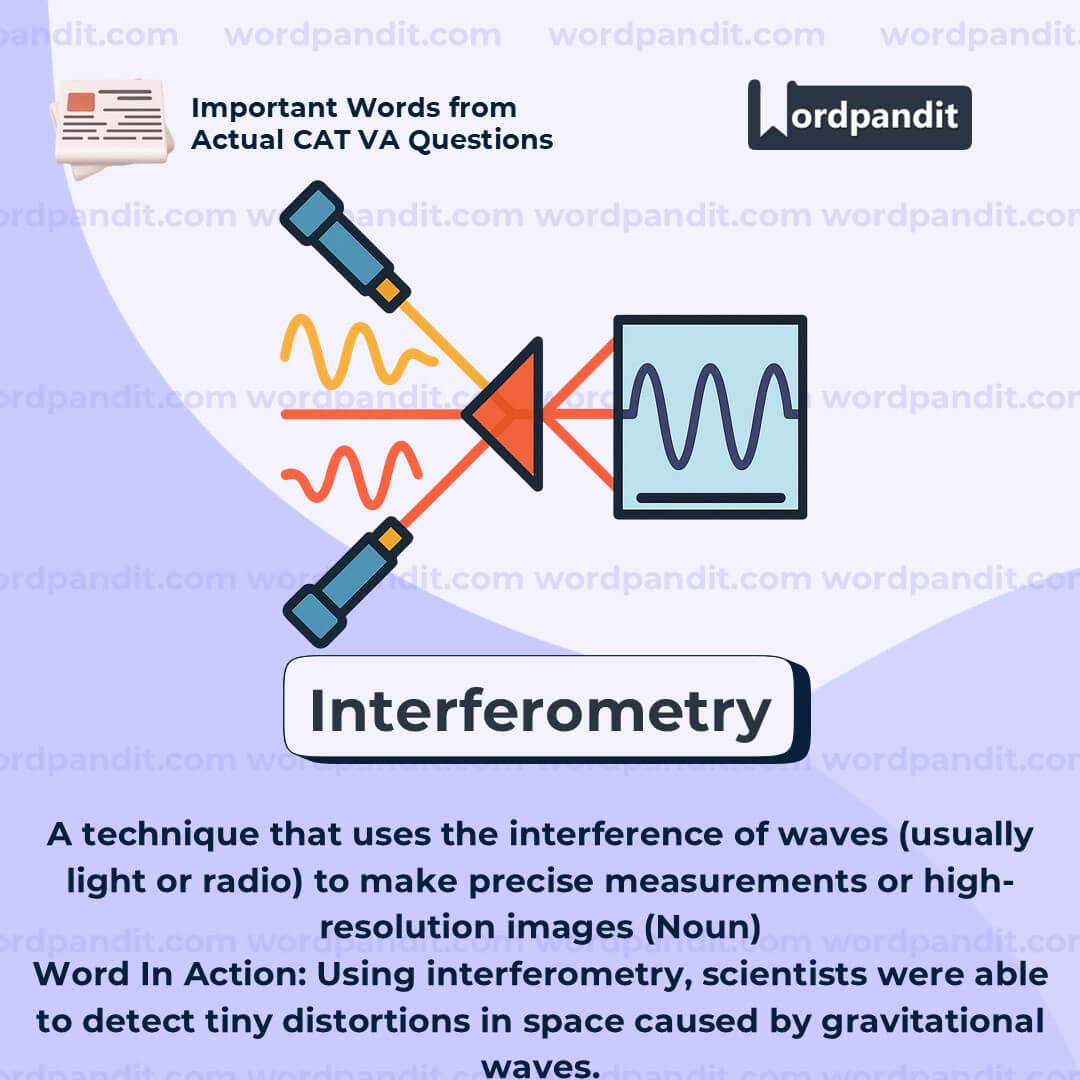
Context:
"When these are combined with the large telescopes, they produce what is called interferometry: a simulation of the power of a mirror 16 m in diameter and the resolution of a telescope of 200 m." - Scientific Literature
Explanatory Paragraph:
"Interferometry" is a technique used in physics and astronomy to superimpose waves, typically electromagnetic ones like light or radio waves, to extract precise measurements or create high-resolution images. In astronomy, interferometry combines the signals from multiple telescopes to simulate a much larger instrument. This method allows scientists to observe extremely distant or small cosmic objects with greater clarity than a single telescope could achieve.
Meaning: A technique that uses the interference of waves (usually light or radio) to make precise measurements or high-resolution images (Noun)
Pronunciation: in-ter-fuh-ROM-uh-tree
Difficulty Level: ⭐⭐⭐⭐ Advanced
Etymology: From Latin "inter-" (between) + Greek "pherein" (to carry) + "-metry" (measurement)
Prashant Sir's Notes:
Interferometry may sound complex, but at its core, it's all about combining multiple signals to get a sharper picture. Think of it like using several small eyes to create one giant, powerful one. This is how scientists "see" better in space exploration.
Synonyms & Antonyms:
Synonyms: wave superposition technique, precision measurement, signal fusion (technical usage)
Antonyms: signal isolation, independent measurement (context-specific)
Usage Examples:
- Radio astronomers use interferometry to observe distant quasars with remarkable accuracy.
- The interferometry method simulated the capabilities of a giant virtual telescope.
- By applying optical interferometry, scientists measured the star's diameter precisely.
- Modern space observatories employ interferometry to boost image resolution without increasing mirror size.
Cultural Reference:
"Interferometry was critical to the discovery of gravitational waves, as seen in the LIGO experiments." - Scientific American
Think About It:
How can the concept of combining small parts to mimic a greater whole—like in interferometry—be applied in other areas of life or technology?
Quick Activity:
Draw a diagram showing how two small telescopes could work together using interferometry. Then explain in one sentence how their signals merge to form a single image.
Memory Tip:
Break it down: "Inter" (between) + "fero" (carry) + "metry" (measure). It’s measuring between signals! Picture several overlapping flashlight beams merging into one sharp light.
Real-World Application:
Interferometry is used in radio and optical astronomy, seismic detection, and even in the development of quantum computers and medical imaging tools like MRI machines.
Word-5: Resolution
Context:
"When these are combined with the large telescopes, they produce what is called interferometry: a simulation of the power of a mirror 16 m in diameter and the resolution of a telescope of 200 m." - Scientific Literature
Explanatory Paragraph:
"Resolution" in this scientific context refers to the ability of a telescope to distinguish between two objects that are very close together in space. The higher the resolution, the clearer and more detailed the image. This is crucial in astronomy, where telescopes must detect distant objects millions or even billions of kilometers apart. The word also has broader meanings—like determination in personal traits, or a formal decision in meetings—but here it refers specifically to visual clarity and precision.
Meaning: The degree of clarity and detail visible in an image or display; the ability to distinguish fine detail (Noun)
Pronunciation: rez-uh-LOO-shun
Difficulty Level: ⭐⭐ Beginner
Etymology: From Latin "resolutio," meaning "a loosening, solution," from "resolvere" (to loosen, release)
Prashant Sir's Notes:
In science, resolution often refers to how 'sharp' or detailed an image is. In life, it can also reflect your personal clarity or determination. Always ask—what kind of resolution are we talking about: visual, personal, or political?
Synonyms & Antonyms:
Synonyms: clarity, sharpness, definition, precision
Antonyms: blurriness, fuzziness, ambiguity
Usage Examples:
- The new camera boasts a resolution high enough to capture individual strands of hair.
- Hubble's resolution allowed scientists to view distant galaxies with unprecedented detail.
- She made a resolution to improve her health in the new year.
- The board passed a resolution to expand research funding.
Cultural Reference:
"The resolution of the James Webb Space Telescope redefined what we can see in the early universe." - NASA Press Release
Think About It:
Why is resolution—both visual and personal—so essential to achieving clarity in our goals and in our understanding of the world?
Quick Activity:
Find two images: one high-resolution and one low-resolution. Compare them and list the differences. Then, write your own personal resolution for the week.
Memory Tip:
Think of a TV—when the resolution is high, you see more detail. Similarly, life’s resolutions bring sharper focus to your goals.
Real-World Application:
"Resolution" is used in photography, astronomy, medicine (e.g., MRI resolution), technology (e.g., screen resolution), and even in diplomacy or personal goal-setting—each time reflecting clarity, accuracy, or determination.