
📘 What’s Inside This CAT Misfit Sentence/Odd One Out Question Post?
📝 Authentic CAT Misfit Sentence/Odd One Out Question: Practice with a real CAT Para-jumble Question from a previous CAT exam.
✅ Detailed Question with Step-by-Step Solution: Each question is explained thoroughly for better understanding.
📚 Vocabulary Enhancement: Top 5 words explained from the paragraph
Misfit Sentence/Odd One Out Question
Question 22: Five jumbled up sentences, related to a topic, are given below. Four of them can be put together to form a coherent paragraph. Identify the odd one out and key in the number of the sentence as your answer:
1. The logic of displaying one’s inner qualities through outward appearance was based on a distinction between being a woman and being feminine.
2. 'Appearance' became a signifier of conduct - to look was to be and conformity to the feminine ideal was measured by how well women could use the tools of the fashion and beauty industries.
3. The makeover-centric media sets out subtly and not-so-subtly, ‘good’ and ‘bad’ ways to be a woman, layering these over inequalities of race and class.
4. The denigration of working-class women and women of colour often centres on their perceived failure to embody feminine beauty.
5. ‘Woman’ was considered a biological category, but femininity was a ‘process’ by which women became specific kinds of women.
Solution with Explanation
Answer: 3
Detailed explanation by Wordpandit:
Upon carefully scrutinizing the statements, it becomes apparent that Statements (1), (5), (2), and (4) coalesce to form a coherent discourse about societal perceptions of femininity and their impact on women. Statement (1) sets the stage by delineating how society has traditionally bifurcated the concept of "being a woman" from "being feminine," treating them as distinct categories that serve to evaluate a woman's worth.
Following this introductory premise, Statement (5) builds upon it by explicating the nuances between these two categories. It clarifies that 'being a woman' is largely considered a biological classification, whereas 'being feminine' is a more dynamic and socioculturally dictated process, thereby adding depth to our understanding of the initial statement.
In this constructed narrative, Statement (2) then takes the conversation further by focusing on how societal norms often hinge the 'feminine ideal' upon a woman's physical appearance. It elaborates that such societal benchmarks are used to determine the level of a woman's femininity based on superficial traits.
Subsequently, Statement (4) continues this thread by illustrating the unfortunate repercussions of this superficial evaluation. It reveals how failing to conform to this idealized version of femininity often results in the marginalization and denigration of specific groups of women, notably working-class women and women of color.
Contrary to these, Statement (3) does not align with the thematic elements established in the other four statements. It stands apart, lacking congruity with the carefully constructed discussion around societal definitions of femininity and their impact on women. Therefore, Statement (3) can be identified as the outlier in this particular arrangement.
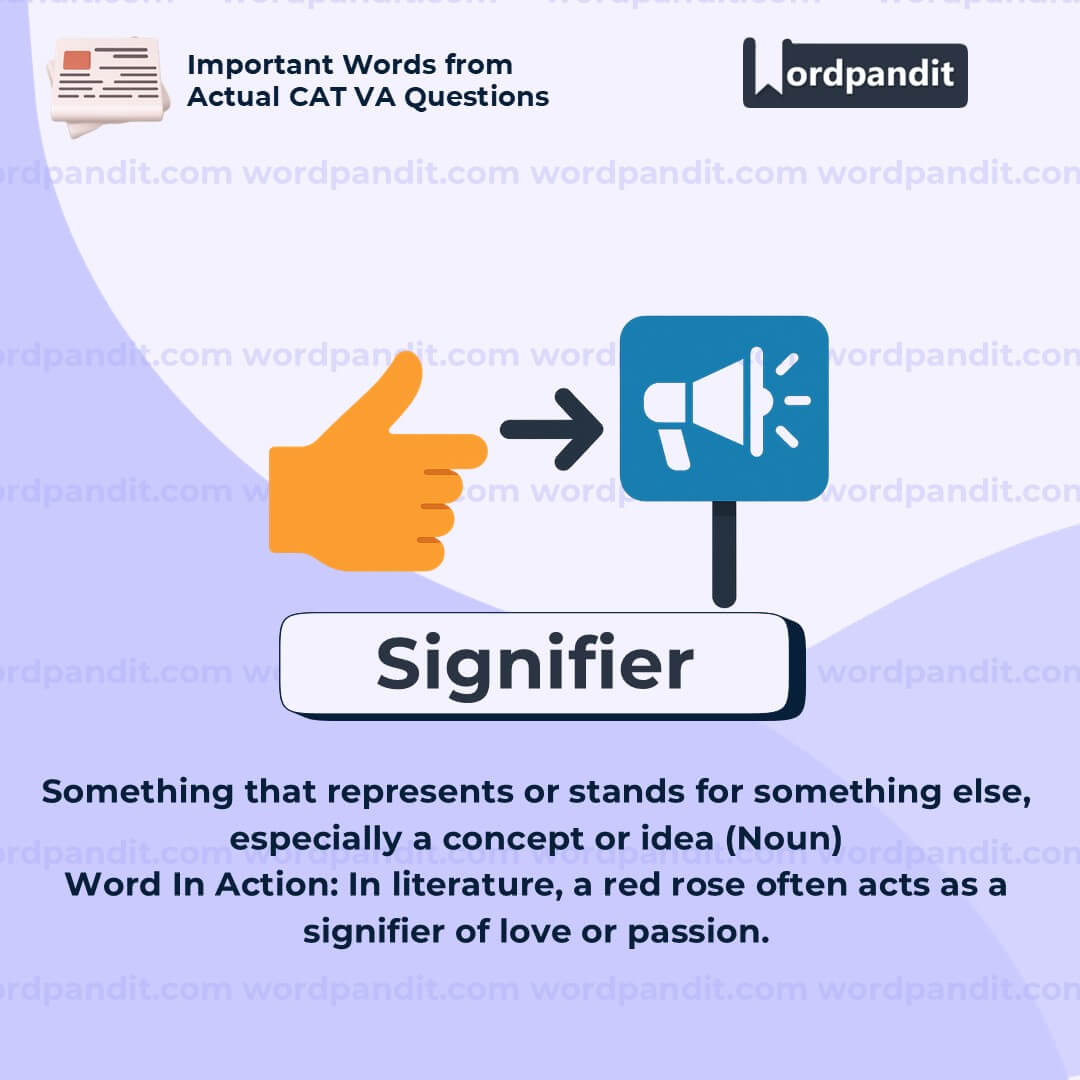
Word-1: Signifier
Context:
"'Appearance' became a signifier of conduct — to look was to be and conformity to the feminine ideal was measured by how well women could use the tools of the fashion and beauty industries." - Feminist Cultural Theory Article
Explanatory Paragraph:
"Signifier" refers to something that stands for or represents something else—especially in language, culture, or symbolism. In this context, appearance is described as a *signifier* of behavior or social worth. That means how someone looks is seen as a symbol of how they act or who they are. The term is widely used in semiotics (the study of signs and symbols) and critical theory to discuss how meanings are constructed and perceived in society.
Meaning: Something that represents or stands for something else, especially a concept or idea (Noun)
Pronunciation: SIG-nuh-fy-er
Difficulty Level: ⭐⭐⭐ Intermediate
Etymology: From Latin *significare* meaning "to signify, to indicate," and adopted into semiotic theory by French theorist Ferdinand de Saussure
Prashant Sir's Notes:
Think of a “signifier” as a pointer—it directs you to a meaning. A brand logo is a signifier of quality (or trendiness), a red rose might be a signifier of love, and appearance in this context is a signifier of social conduct. It’s not what it *is*, but what it *means* to others.
Synonyms & Antonyms:
Synonyms: symbol, representation, indicator, marker, emblem
Antonyms: literal object, unmarked element, denotation (in some contexts)
Usage Examples:
- In literature, a crown is often a signifier of authority and power.
- The uniform became a signifier of discipline and group identity.
- In advertising, color choices act as subtle signifiers of mood and emotion.
- Her polished appearance served as a signifier of professionalism.
Cultural Reference:
“In semiotics, the signifier and the signified together make up the sign.” – Ferdinand de Saussure, the father of modern linguistic theory
Think About It:
What are some modern signifiers in fashion, media, or digital life that influence how people are perceived—without them saying a word?
Quick Activity:
Choose one common object (e.g., smartphone, glasses, designer bag). Write down what it might *signify* in different social settings.
Memory Tip:
Break it down: “Signify” means “to show or stand for something.” So a *signifier* is the thing doing the showing—it’s the symbol, not the meaning itself.
Real-World Application:
"Signifier" is widely used in literary theory, branding, sociology, fashion analysis, and cultural studies to explore how signs, symbols, and appearances shape meaning and identity in society.
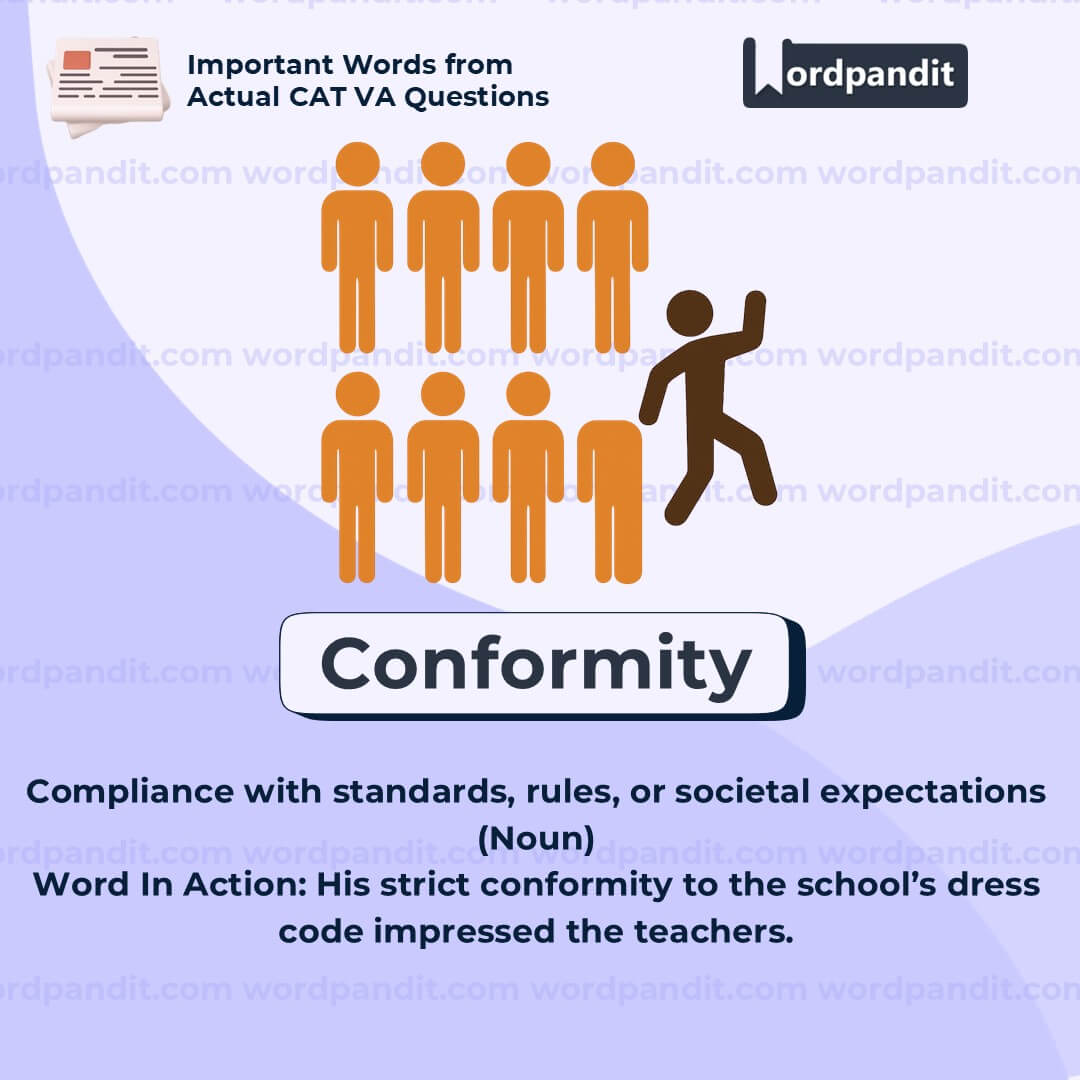
Word-2: Conformity
Context:
"'Appearance' became a signifier of conduct — to look was to be and conformity to the feminine ideal was measured by how well women could use the tools of the fashion and beauty industries." - Feminist Cultural Theory Article
Explanatory Paragraph:
"Conformity" refers to the act of matching one’s behavior, appearance, or beliefs to fit in with societal norms, expectations, or rules. In the provided context, it describes how women were expected to align their appearance with an ideal standard of femininity—measured by how well they adopted fashion and beauty norms. Conformity can reflect acceptance, pressure, or even loss of individuality, and is frequently discussed in psychology, sociology, and gender studies.
Meaning: Compliance with standards, rules, or societal expectations (Noun)
Pronunciation: kuhn-FORM-ih-tee
Difficulty Level: ⭐⭐⭐ Intermediate
Etymology: From Latin *conformare* meaning “to shape, form,” from *com-* (together) + *formare* (to form)
Prashant Sir's Notes:
Conformity is about "fitting in." It can be comforting or suffocating, depending on the context. It's important to recognize when you're conforming by choice—and when you might be doing it out of fear, pressure, or habit.
Synonyms & Antonyms:
Synonyms: compliance, obedience, adherence, alignment, conventionality
Antonyms: rebellion, nonconformity, defiance, resistance, dissent
Usage Examples:
- Social conformity often shapes how people dress, speak, or behave in public spaces.
- The school demanded strict conformity to its dress code and rules.
- Her artwork broke free from artistic conformity and embraced radical originality.
- Conformity to traditional beauty standards often limits self-expression.
Cultural Reference:
"The opposite of courage in our society is not cowardice… it is conformity." – Rollo May, existential psychologist and author
Think About It:
When does conformity create social harmony, and when does it suppress individual identity and creativity?
Quick Activity:
List two ways in which you consciously conform to societal expectations. Then, list one area where you choose to stand out or resist conformity.
Memory Tip:
“Conformity” comes from “form”—think of everyone being shaped into the same mold. When you conform, you “form together” with the group.
Real-World Application:
"Conformity" is crucial in understanding group behavior in psychology, workplace culture, educational systems, fashion, and even political movements. It helps explain both unity and loss of individuality in society.
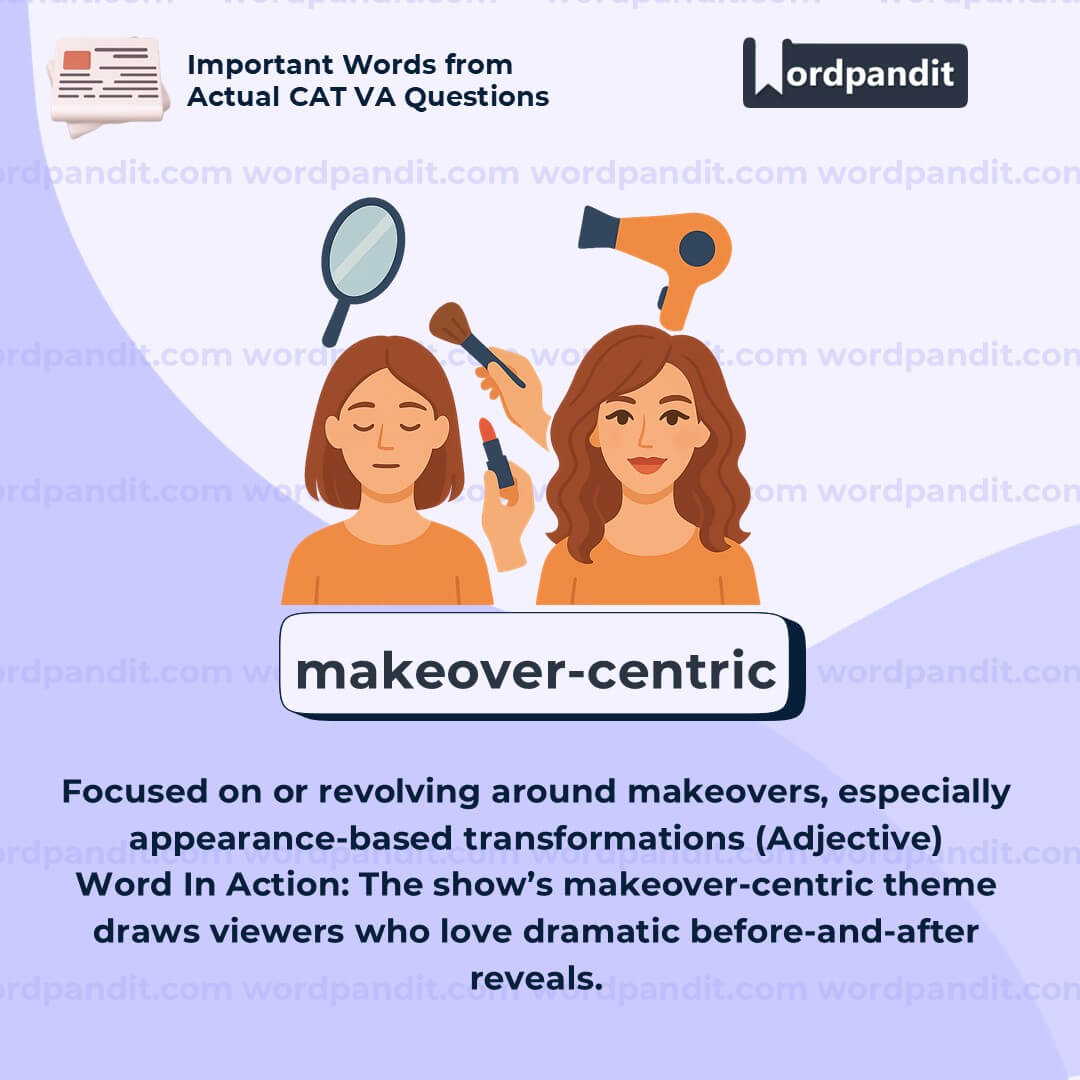
Word-3: Makeover-centric
Context:
"The makeover-centric media sets out subtly and not-so-subtly, ‘good’ and ‘bad’ ways to be a woman, layering these over inequalities of race and class." - Media and Gender Studies Commentary
Explanatory Paragraph:
"Makeover-centric" is a compound adjective that refers to media or content focused heavily on physical transformation—usually related to appearance, beauty, or lifestyle. In the given context, it criticizes media that promotes the idea that women must constantly change or ‘improve’ themselves to meet ideal standards. Such media doesn’t just focus on beauty routines or fashion tips—it embeds deeper messages about worth, identity, and social acceptability. The term often carries a negative or critical connotation in feminist and cultural studies.
Meaning: Focused on or revolving around makeovers, especially appearance-based transformations (Adjective)
Pronunciation: MAYK-oh-ver SEN-trik
Difficulty Level: ⭐⭐⭐ Intermediate
Etymology: From “makeover” (a complete transformation, especially in appearance) + “centric” (centered or focused on)
Prashant Sir's Notes:
Makeover-centric culture isn’t just about changing how you look—it’s about changing who you are to fit someone else’s idea of “acceptable.” It often tells people, especially women, that their value comes from how well they conform to visual ideals.
Synonyms & Antonyms:
Synonyms: appearance-focused, beauty-obsessed, image-driven, transformation-oriented
Antonyms: substance-focused, content-oriented, authenticity-driven
Usage Examples:
- The makeover-centric reality show reinforces narrow beauty standards.
- Critics argue that makeover-centric media reduces women's value to how well they can transform themselves.
- In a makeover-centric culture, self-worth is often tied to external validation.
- Feminist scholars have long questioned the impact of makeover-centric narratives on young girls’ self-esteem.
Cultural Reference:
"Makeover shows like *Extreme Makeover* and *What Not to Wear* have been criticized for promoting makeover-centric ideals that tie self-worth to physical transformation." – *Media & Society Journal*
Think About It:
How do makeover-centric messages in media influence how we view ourselves—and others—across lines of gender, race, and class?
Quick Activity:
Pick one media example (TV show, ad, social media trend) that promotes a makeover-centric message. Write two sentences analyzing the underlying message it sends about identity or beauty.
Memory Tip:
“Makeover-centric” = centered around makeovers. Think of it as a media world where every story revolves around changing how you look—as if transformation is the key to approval.
Real-World Application:
"Makeover-centric" is used in critiques of reality TV, beauty marketing, Instagram influencer culture, and even some wellness brands. It's a term that helps unpack how visual perfection is tied to societal approval.
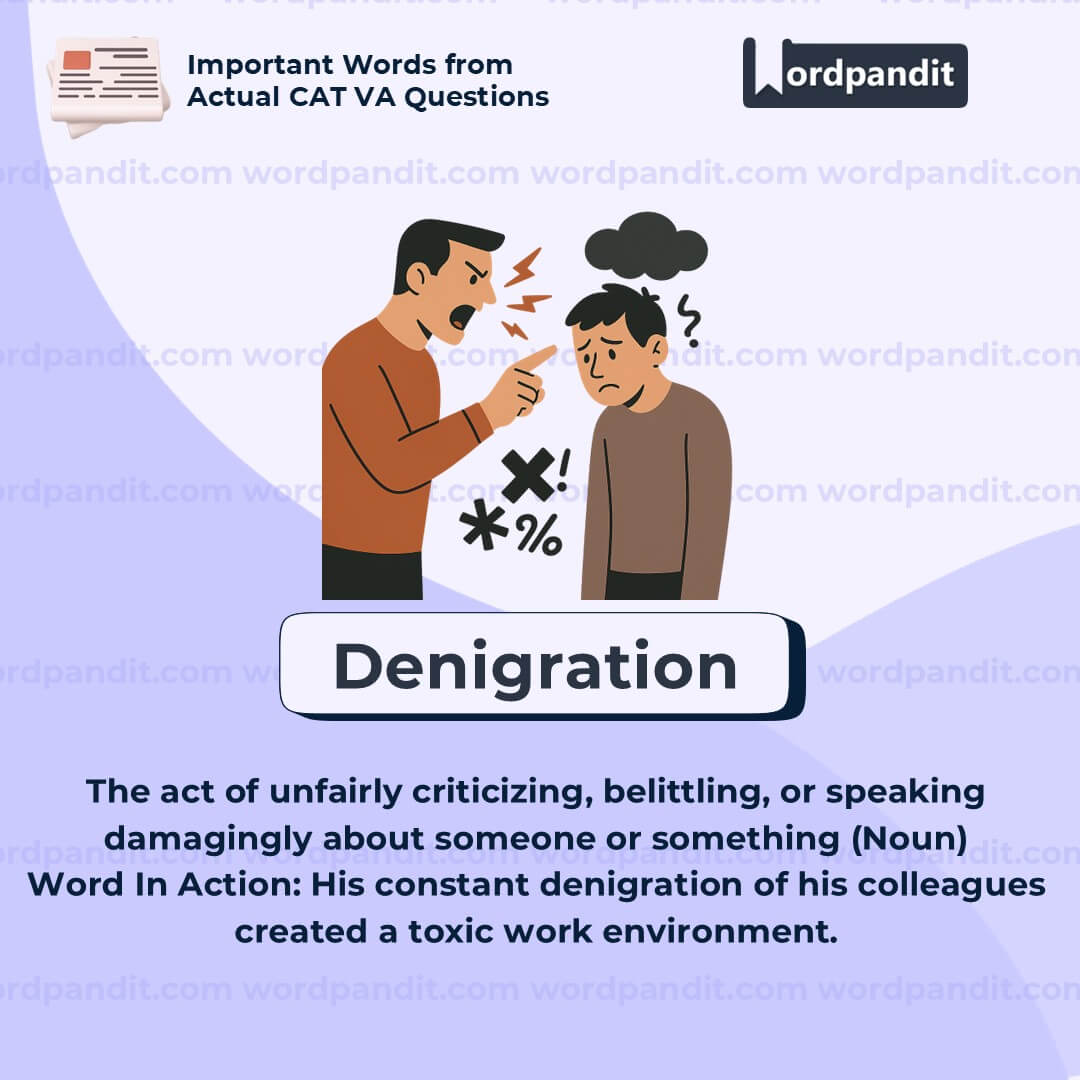
Word-4: Denigration
Context:
"The denigration of working-class women and women of colour often centres on their perceived failure to embody feminine beauty." - Feminist Cultural Analysis
Explanatory Paragraph:
"Denigration" refers to the action of unfairly criticizing or belittling someone or something, often with the intent of diminishing their value or dignity. In the context provided, it highlights how women who do not fit dominant standards of beauty are subjected to social judgment or ridicule. The term is commonly used in discussions of social justice, prejudice, media portrayal, and systemic inequality. Denigration is not just about mild disapproval—it often involves deep-seated bias and exclusion.
Meaning: The act of unfairly criticizing, belittling, or speaking damagingly about someone or something (Noun)
Pronunciation: den-uh-GRAY-shun
Difficulty Level: ⭐⭐⭐ Intermediate
Etymology: From Latin *denigrare*, meaning “to blacken” or “defame,” from *de-* (down) + *nigr-* (black)
Prashant Sir's Notes:
“Denigration” is a strong word. It implies more than simple criticism—it's often systematic, prejudiced, and tied to power. Watch for how society uses appearance and background to belittle those who don't ‘fit the mold.’
Synonyms & Antonyms:
Synonyms: belittlement, vilification, disparagement, defamation, deprecation
Antonyms: praise, celebration, admiration, upliftment, endorsement
Usage Examples:
- The denigration of marginalized voices in media often reflects deep-rooted bias.
- She spoke out against the denigration of women based on outdated beauty norms.
- The article criticized the constant denigration of public school teachers in political debates.
- Denigration can damage self-esteem and perpetuate inequality across generations.
Cultural Reference:
"Denigration of entire communities through stereotypes has been a persistent weapon of cultural dominance." – *bell hooks*, feminist scholar
Think About It:
What forms of denigration exist in modern media, and how can recognizing them help challenge societal injustices?
Quick Activity:
List two groups or individuals who are often subjected to denigration in popular culture. Reflect on one way this can be challenged or changed.
Memory Tip:
Think “de-” means “down” and “nigr-” relates to darkening or blackening—denigration is metaphorically about dragging someone down or casting them in a negative light.
Real-World Application:
"Denigration" is a key term in conversations about racism, classism, sexism, and all forms of marginalization. It's used in sociology, media analysis, education, and activism to expose how language and narratives can harm social groups.
Word-5: Embody
Context:
"The denigration of working-class women and women of colour often centres on their perceived failure to embody feminine beauty." - Feminist Cultural Analysis
Explanatory Paragraph:
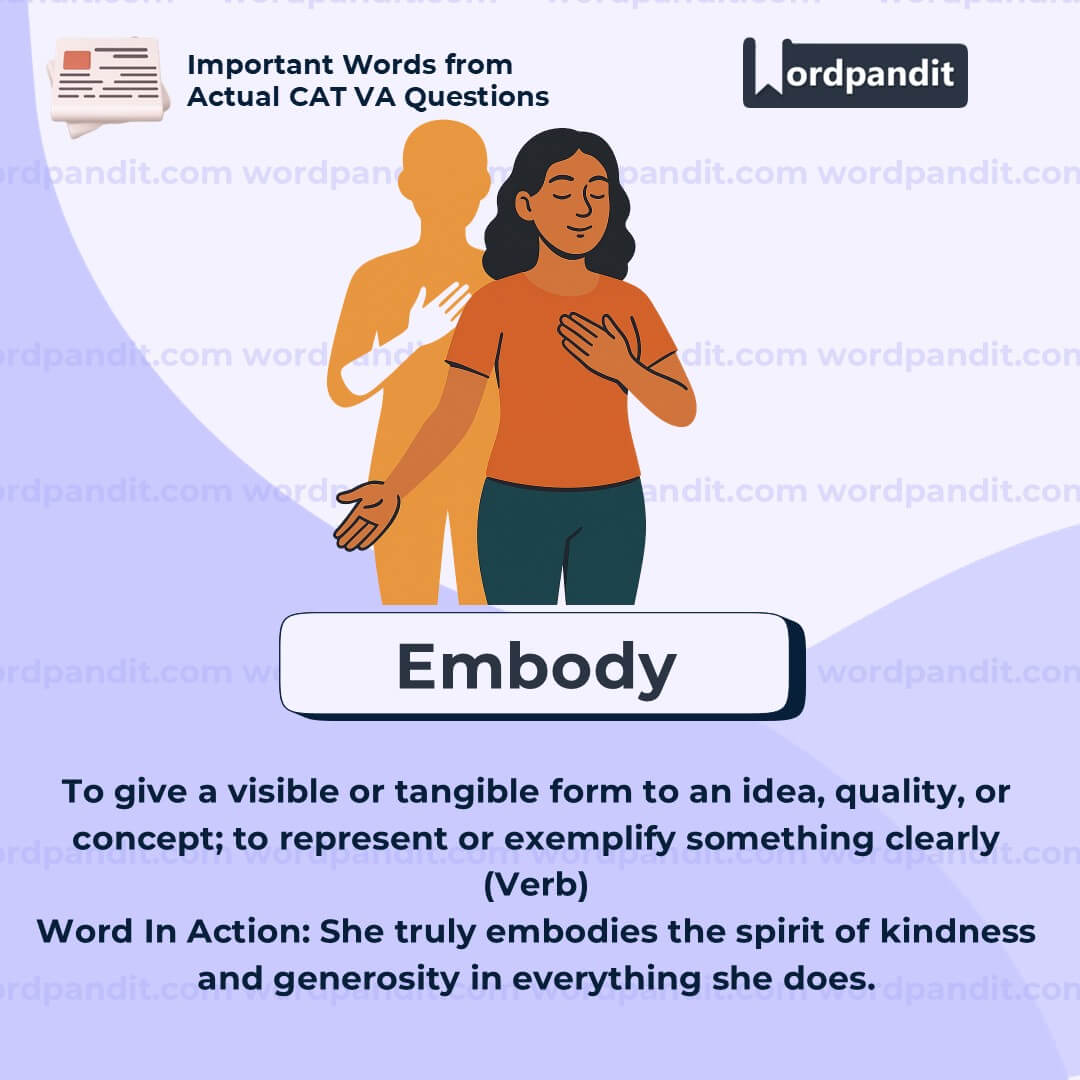
"Embody" means to represent, express, or give a tangible or visible form to an idea, quality, or concept. In the given context, it refers to the expectation that women must *physically represent* or *live out* the cultural ideal of feminine beauty. If someone is said to embody something, they don’t just talk about it—they reflect it through their appearance, actions, or being. This word is often used in social, philosophical, and artistic discussions about how abstract values are manifested in real life.
Meaning: To give a visible or tangible form to an idea, quality, or concept; to represent or exemplify something clearly (Verb)
Pronunciation: em-BO-dee
Difficulty Level: ⭐⭐ Beginner
Etymology: From Middle English *embodyen*, from “em-” (in) + “body,” meaning to give form or substance
Prashant Sir's Notes:
To “embody” something is to be its living, breathing version. You don’t just support peace—you *embody* peace if your words and actions consistently reflect it. In social discourse, this word often critiques how ideals are unfairly imposed on people’s identities or appearances.
Synonyms & Antonyms:
Synonyms: represent, personify, express, manifest, exemplify
Antonyms: disembody, obscure, distort, conceal
Usage Examples:
- She embodies grace and confidence in everything she does.
- Artists often try to embody emotion through their work.
- The leader was seen to embody the hopes of the entire movement.
- In society, women are expected to embody unrealistic beauty standards.
Cultural Reference:
"Mahatma Gandhi embodied the principle of nonviolence not just in politics but in daily life." – Indian Freedom Movement Histories
Think About It:
What values or qualities do you try to embody—and how can that shape how others see or understand you?
Quick Activity:
Write down three abstract values (e.g., honesty, kindness, strength). Then, for each, describe one real-life way a person could embody it.
Memory Tip:
“Embody” = to *put something into a body*. If courage had a body, who would it look like? That person *embodies* courage.
Real-World Application:
"Embody" is used in leadership training, branding, social criticism, and literature—anywhere there's a need to turn ideals into lived or visible action, whether through people, products, or symbols.