
✨ Introduction
Mastering Reading Comprehension begins with mastering the words!
In this post, we dive deep into vocabulary taken directly from an actual CAT RC passage. Each word has been explained in a simple, easy-to-understand way, along with examples to help you grasp its usage in real contexts.
From words like "species" and "cognitive" to "subjection" and "paradise," strengthen your vocabulary one word at a time — and take your RC performance to the next level!
📚 What’s Inside This Vocabulary Post?
- 🔍 Words Sourced from an Actual CAT RC Passage: Directly pick up important vocabulary from real CAT exam material.
- 🧠 Meaningful Explanations: Understand the exact meaning and usage of each word in a simple, student-friendly way.
- ✍️ Context-Based Learning: Learn words with examples that reflect their actual usage in reading comprehension contexts.
- 🗂️ Quick Reference Format: Words are neatly listed with meanings, parts of speech, and example sentences for easy revision.
- 🚀 Boost Your RC and Verbal Ability Skills: Improve your understanding of tough passages by strengthening your vocabulary.
📝 Words Covered in This Article:
- Reflected
- Coercive
- Anarchy
- Settlements
- Bestial
- Flourishes
- Misleading
- Reassuring
- Encompasses
- Deleteriously
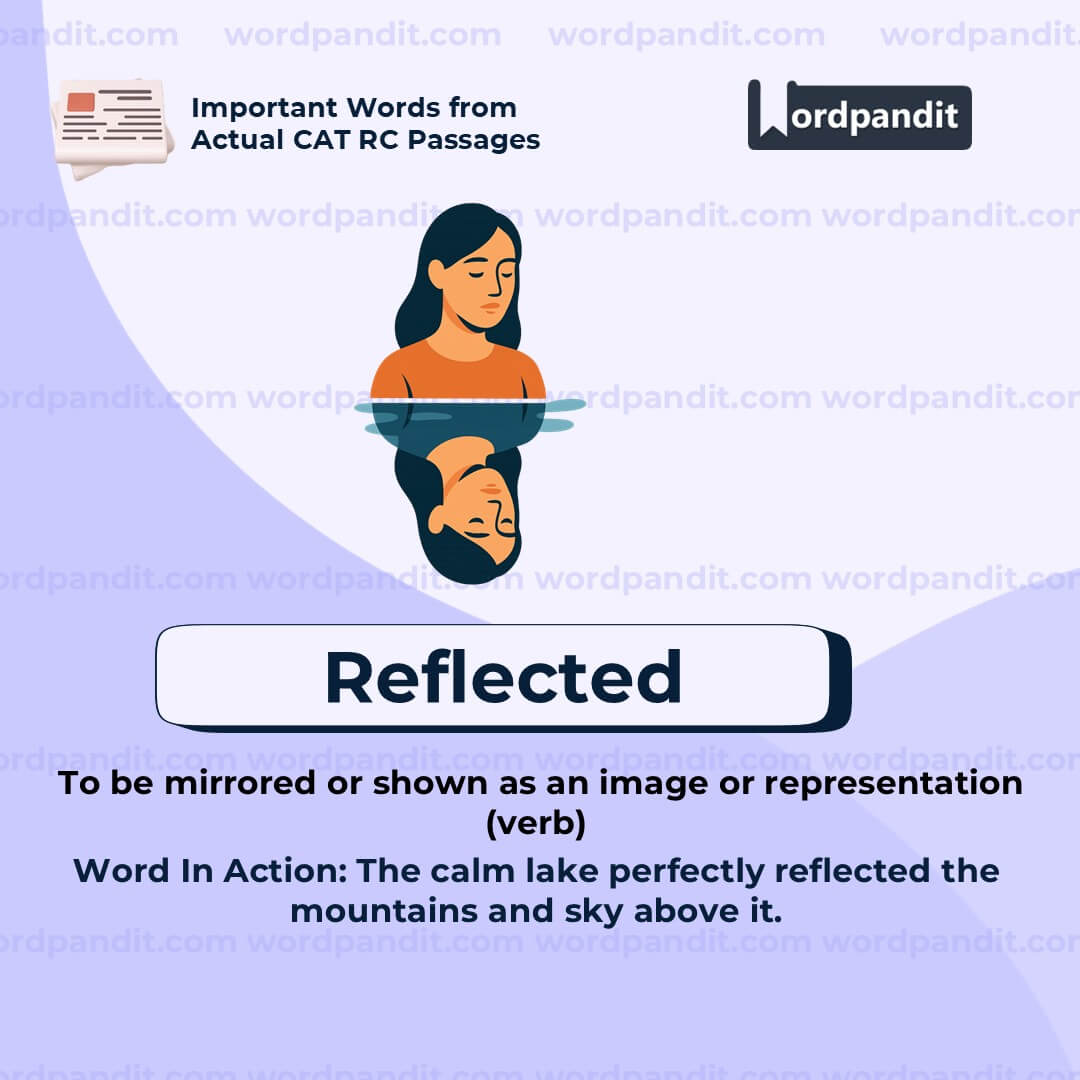
WORD-1: Reflected
Context:
"But in following Hobbes, argues Bregman, we ensure that the negative view we have of human nature is reflected back at us." - Source Unknown
Explanatory Paragraph:
The word "reflected" in this context implies that the way we view others — particularly with negativity — bounces back onto ourselves. It's as if the attitude or perception we project outward gets mirrored and shown back to us, shaping our own reality and behavior in the process.
Meaning: To be mirrored or shown as an image or representation (verb)
Pronunciation: rih-FLEK-tid
Difficulty Level: ⭐⭐ Basic
Etymology: From Latin *reflectere*, meaning "to bend back," from *re-* ("back") + *flectere* ("to bend").
Prashant Sir's Notes:
This word is often used metaphorically. Think of a mirror: what you show to it, it gives back. In life, this often happens with emotions and attitudes — what we give out is returned to us.
Synonyms & Antonyms:
Synonyms: mirrored, echoed, displayed, revealed
Antonyms: absorbed, concealed, hidden
Usage Examples:
- Her calm demeanor was reflected in her peaceful surroundings.
- The pain in his eyes reflected a deep personal loss.
- The painting beautifully reflected the artist's emotions.
- Negative energy is often reflected back to those who project it.
Cultural Reference:
"What you see in others is often a reflection of yourself." – A common theme in Eastern philosophy and self-help literature.
Think About It:
How might the way we treat others reflect our own inner state or beliefs?
Quick Activity:
Write down three recent situations where someone’s behavior reflected your mood or energy. How did it make you feel?
Memory Tip:
Imagine looking into a mirror – what you show is exactly what gets reflected. The same applies to behavior and attitude!
Real-World Application:
In psychology and social interactions, "reflected" is used to describe how people’s actions can mirror or echo others' emotions, creating feedback loops in communication and relationships.

WORD-2: Coercive
Context:
"coercive" - Context not fully provided, assumed as general usage reference.
Explanatory Paragraph:
"Coercive" refers to actions, tactics, or systems that involve using force, threats, or pressure to make someone do something against their will. It usually suggests a power imbalance where one party dominates or controls another, often through intimidation rather than mutual agreement.
Meaning: Using force or threats to make someone do something (adjective)
Pronunciation: koh-UR-siv
Difficulty Level: ⭐⭐⭐ Intermediate
Etymology: From Latin *coercere*, meaning "to restrain" or "to confine," composed of *co-* ("together") + *arcere* ("to enclose or confine").
Prashant Sir's Notes:
Watch out for this word in political or legal contexts — it's often used to describe laws, regimes, or tactics that enforce compliance through pressure rather than persuasion.
Synonyms & Antonyms:
Synonyms: forceful, intimidating, threatening, bullying, oppressive
Antonyms: voluntary, persuasive, consensual, optional
Usage Examples:
- The government faced criticism for its coercive measures during the protests.
- His coercive tone made it clear that saying no wasn’t really an option.
- Coercive parenting often leads to resentment and rebellion.
- Labor unions opposed the coercive tactics used by some corporations.
Cultural Reference:
"Big Brother is watching you" – George Orwell’s *1984* is a classic portrayal of a coercive surveillance state.
Think About It:
Can laws ever be truly just if they rely on coercive enforcement? Where should we draw the line?
Quick Activity:
Identify a situation from history or current events that involved coercive power. Briefly write down what happened and who exerted the pressure.
Memory Tip:
Think of “coerce” as “course of force” — it’s a forced path someone is made to follow.
Real-World Application:
"Coercive" is commonly used in discussions of legal systems, corporate practices, diplomacy, and social justice — anywhere force or pressure overrides choice.
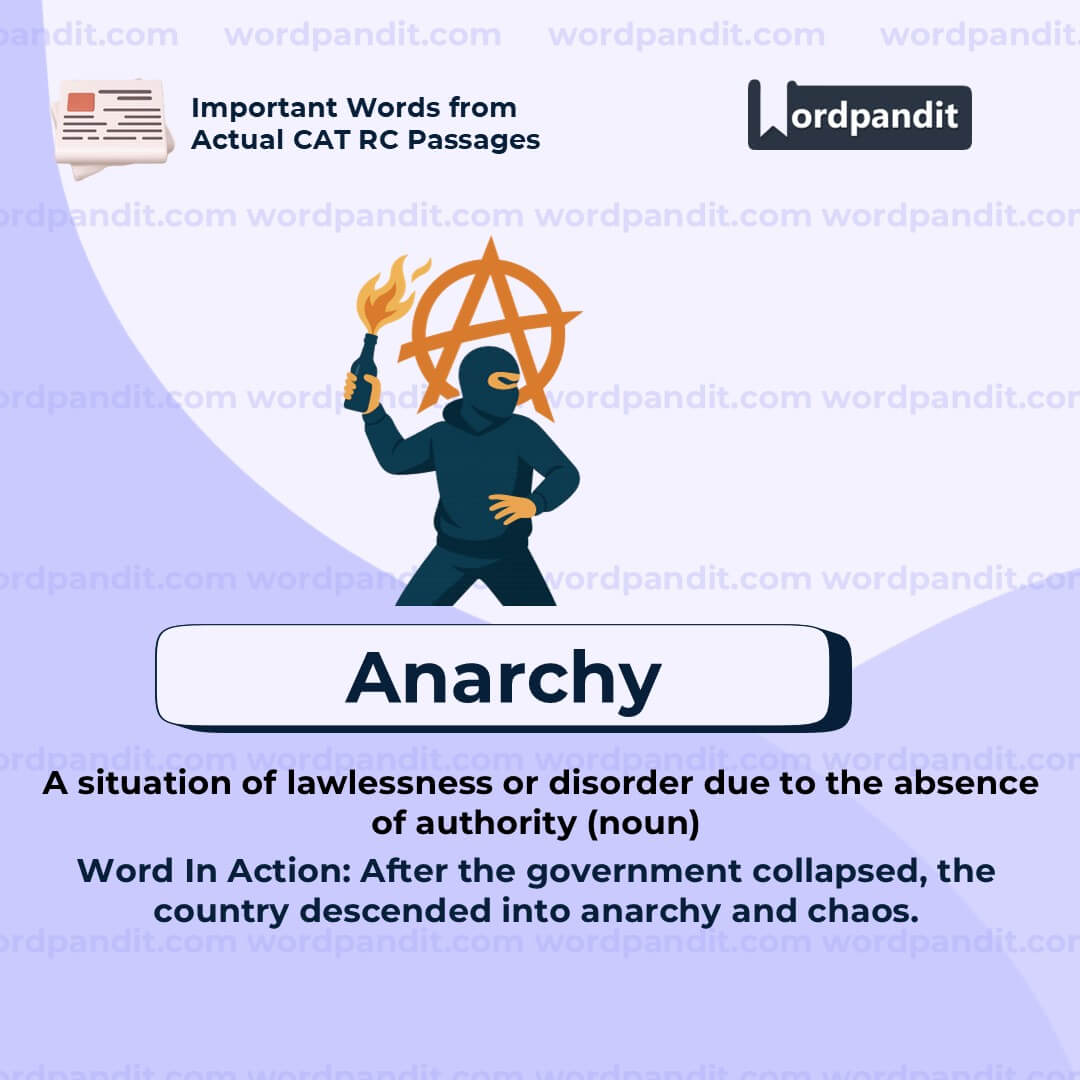
WORD-3: Anarchy
Context:
"This was how the 17th-century philosopher Thomas Hobbes conceived our natural state to be, believing that all that stood between us and violent anarchy was a strong state and firm leadership. But in following Hobbes, argues Bregman," - Source Unknown
Explanatory Paragraph:
"Anarchy" refers to a state of society without government or law, often resulting in disorder, chaos, and violence. In this context, Hobbes imagined a world without centralized authority as one descending into conflict and fear, hence describing it as violent anarchy. The term is often used both literally (in political discourse) and metaphorically (to describe any situation of uncontrolled chaos).
Meaning: A situation of lawlessness or disorder due to the absence of authority (noun)
Pronunciation: AN-ar-kee
Difficulty Level: ⭐⭐⭐ Intermediate
Etymology: From Greek *anarkhia*, meaning "lack of a leader," from *an-* ("without") + *arkhos* ("ruler").
Prashant Sir's Notes:
This word is crucial in political theory. Remember Hobbes' famous idea: without authority, life would be "solitary, poor, nasty, brutish, and short." Anarchy, in this sense, isn't freedom — it's chaos.
Synonyms & Antonyms:
Synonyms: lawlessness, chaos, disorder, turmoil
Antonyms: order, stability, government, control
Usage Examples:
- The collapse of the regime plunged the country into anarchy.
- Without rules, the classroom descended into near-anarchy.
- Some political thinkers argue that anarchy leads to natural cooperation, not violence.
- Fear of anarchy drove people to accept even harsh rulers.
Cultural Reference:
In *Lord of the Flies* by William Golding, the descent of stranded boys into savagery reflects the idea of anarchy in the absence of authority.
Think About It:
Is anarchy always violent, or can there be peaceful forms of society without formal rulers?
Quick Activity:
Debate or write a short paragraph: "Is anarchy more dangerous than tyranny?" Explain your reasoning.
Memory Tip:
“An” means “without” and “archy” means “rule” — so anarchy = without rule. Imagine a city without traffic lights!
Real-World Application:
The word is used in politics, history, and sociology to discuss revolutions, failed states, and radical ideologies like anarchism that reject centralized authority.
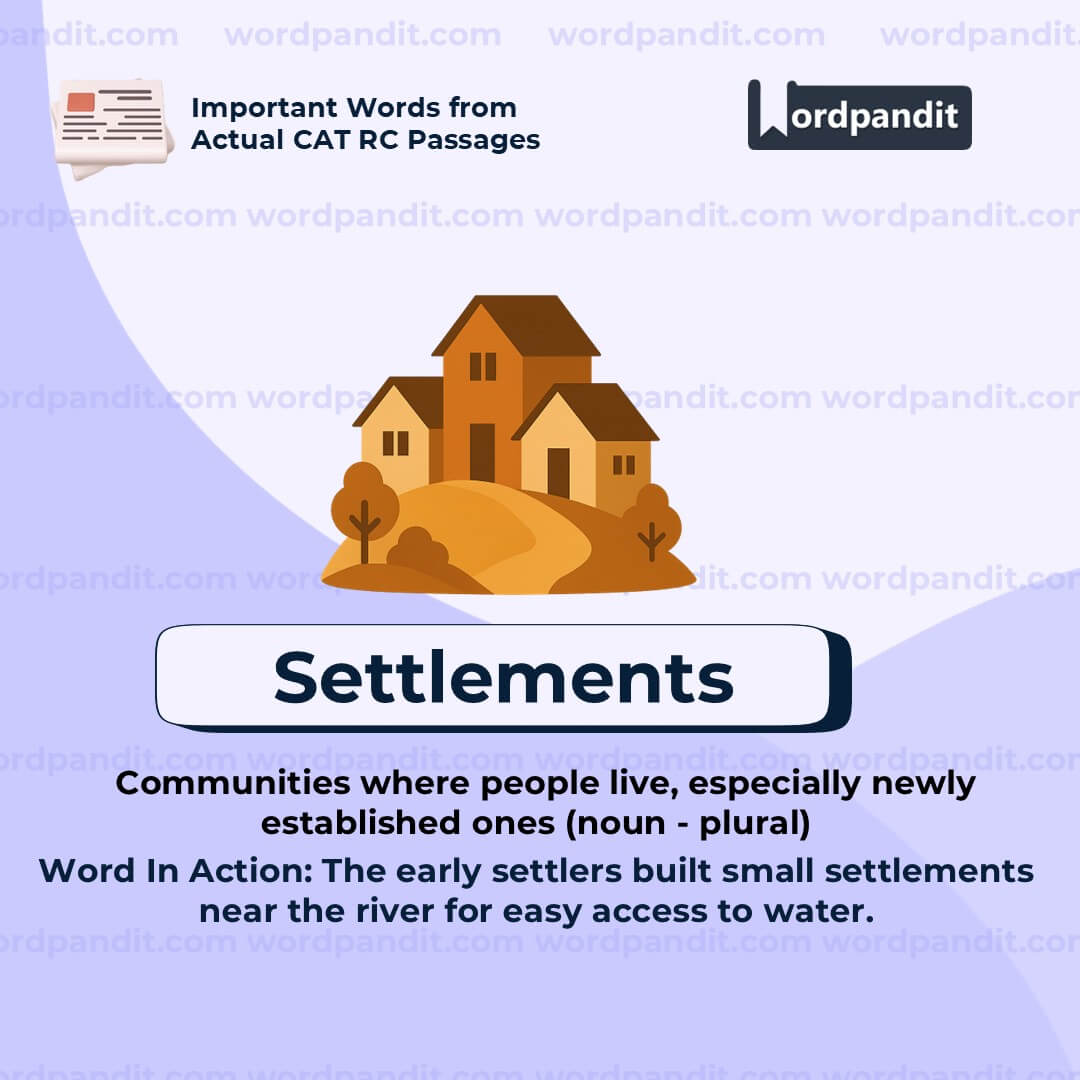
WORD-4: Settlements
Context:
"But life becomes a great deal more complex and knowledge far more extensive when there are settlements of many thousands." - Source Unknown
Explanatory Paragraph:
"Settlements" in this context refers to places where people establish communities or inhabit in organized groups. These can be villages, towns, or cities. As the number of people in these settlements increases, so does the complexity of social life, governance, and the need for structured knowledge systems, such as written laws and organized education.
Meaning: Communities where people live, especially newly established ones (noun - plural)
Pronunciation: SET-ul-ments
Difficulty Level: ⭐⭐ Basic
Etymology: From Old French *settlement*, from the verb *settle*, meaning "to place or establish."
Prashant Sir's Notes:
“Settlements” is a foundational term in history and anthropology. It marks the shift from nomadic life to organized societies — agriculture, writing, cities, and civilizations begin here.
Synonyms & Antonyms:
Synonyms: communities, colonies, habitations, dwellings
Antonyms: wilderness, uninhabited areas, nomadic zones
Usage Examples:
- Early human settlements often formed near rivers for easy access to water and trade.
- Archaeologists discovered ancient settlements buried under layers of earth.
- As the population grew, settlements expanded into neighboring valleys.
- Modern urban settlements can host millions of residents.
Cultural Reference:
Mesopotamia, often called the "Cradle of Civilization," was one of the first regions to develop permanent settlements and cities like Ur and Babylon.
Think About It:
How do the needs of a small settlement differ from those of a large city? What challenges arise as a community grows?
Quick Activity:
Draw or describe two types of settlements: one small and rural, and another large and urban. List the facilities each one would need.
Memory Tip:
Think of “settlements” as places where people have “settled down” — from tents to towns!
Real-World Application:
Understanding settlements is key in geography, urban planning, and history. Planners must design infrastructure for different sizes and types of settlements, from small villages to megacities.
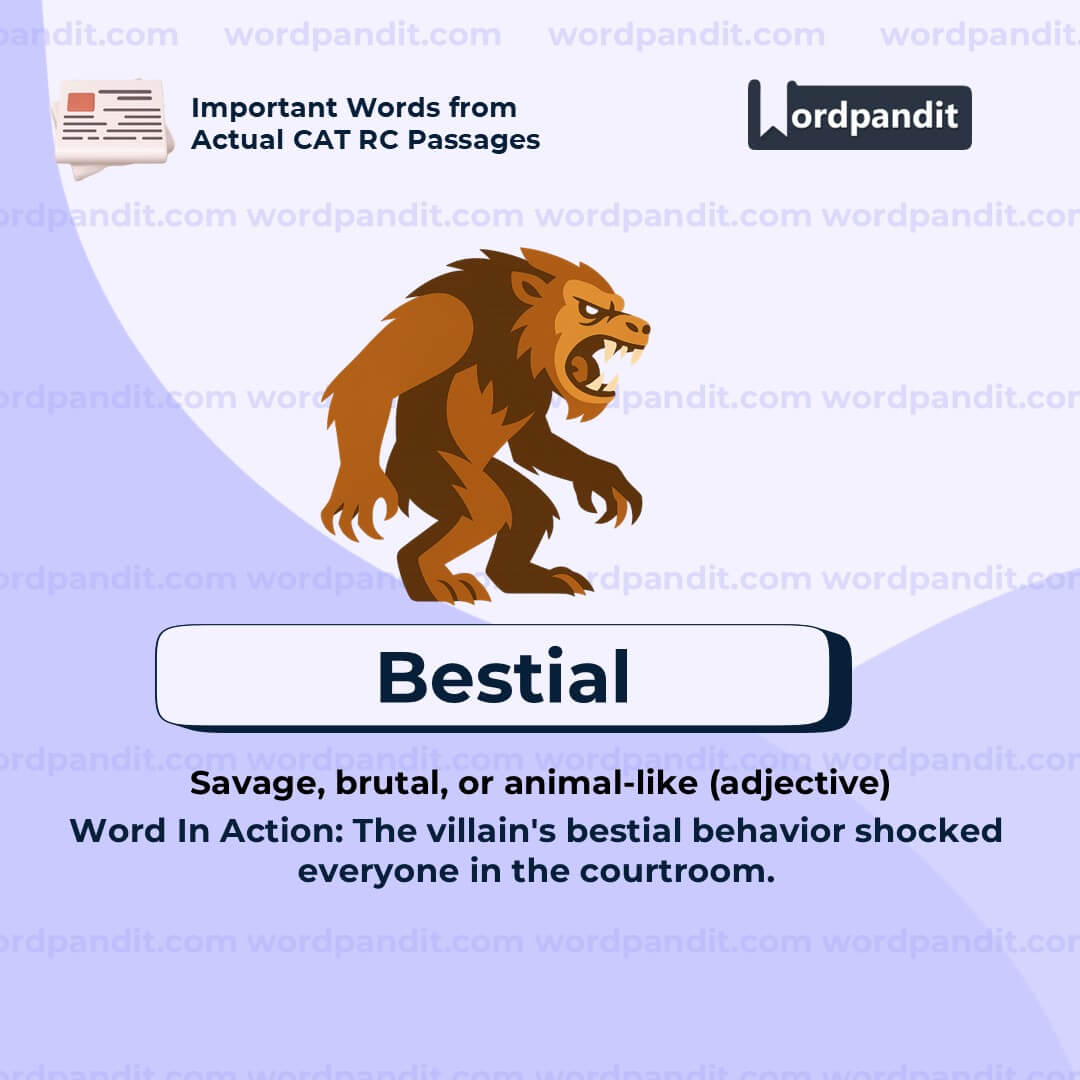
WORD-5: Bestial
Context:
"The idea that just below the surface, our bestial nature is waiting to break out..." - Source Unknown
Explanatory Paragraph:
"Bestial" refers to something savage, brutal, or lacking in reason and civility—like an animal. In the given context, it expresses the belief that beneath our civilized appearance, humans possess an untamed and violent nature, which could erupt under pressure or in the absence of social order. This concept is often explored in philosophy, psychology, and literature to reflect on human instincts and morality.
Meaning: Savage, brutal, or animal-like (adjective)
Pronunciation: BES-chul or BES-tee-uhl
Difficulty Level: ⭐⭐⭐ Intermediate
Etymology: From Latin *bestia*, meaning "beast" or "animal."
Prashant Sir's Notes:
Bestial is more than just 'animal-like' — it implies a loss of human reason and morality. It is often used in literature or moral discussions to depict the darker side of human nature.
Synonyms & Antonyms:
Synonyms: savage, brutal, barbaric, inhuman, feral
Antonyms: humane, civilized, gentle, refined
Usage Examples:
- The prison guards were accused of bestial treatment of inmates.
- The novel depicts the bestial instincts that emerge during war.
- In times of crisis, bestial fear often overtakes rational thought.
- The villain's bestial rage shocked even his most loyal followers.
Cultural Reference:
In *Heart of Darkness* by Joseph Conrad, the theme of bestial nature explores how civilization may only be a thin veneer over primal instincts.
Think About It:
Do you believe that humans are inherently bestial, or are we shaped more by our environment and culture?
Quick Activity:
List three behaviors you consider "bestial" and then rewrite them as their opposite, "civilized" behaviors.
Memory Tip:
Think of “beast” inside “bestial” — it’s the beast-like side of humans, hidden beneath the surface.
Real-World Application:
Used in legal, literary, and psychological discussions, "bestial" highlights moments when people act with extreme cruelty or instinct, often devoid of reason or empathy.
WORD-6: Deleteriously
Context:
"There’s a great deal of reassuring human decency to be taken from this bold and thought-provoking book and a wealth of evidence in support of the contention that the sense of who we are as a species has been deleteriously distorted." - Source Unknown
Explanatory Paragraph:
"Deleteriously" is an adverb describing something that causes harm or damage in a subtle or gradual way. In the context of the sentence, it suggests that our perception of human nature has been distorted in a way that is harmful, though not necessarily obvious at first glance. It's often used to describe effects that are negative and possibly long-lasting.
Meaning: In a harmful or damaging manner (adverb)
Pronunciation: del-uh-TEER-ee-uhs-lee
Difficulty Level: ⭐⭐⭐⭐ Advanced
Etymology: From Latin *deleterius*, meaning "noxious" or "destructive," from *delere* meaning "to destroy."
Prashant Sir's Notes:
This is a powerful academic word, ideal for essays and analytical writing. Use it when describing negative outcomes that aren't always immediate or obvious — the kind that build up over time.
Synonyms & Antonyms:
Synonyms: harmfully, destructively, injuriously, detrimentally
Antonyms: beneficially, constructively, helpfully, advantageously
Usage Examples:
- Prolonged stress can deleteriously affect your immune system.
- Ignoring small errors can deleteriously impact the final outcome.
- He argued that modern media has deleteriously shaped public perception.
- The policy was implemented quickly, but it deleteriously influenced the economy over time.
Cultural Reference:
In discussions on climate change, scientists often speak of carbon emissions "deleteriously impacting" ecosystems — a slow, harmful transformation of our planet.
Think About It:
Can ideas be deleteriously influential even if they seem well-intentioned at first?
Quick Activity:
Write a sentence about a personal habit you think may affect you deleteriously over time. How might you change it?
Memory Tip:
“Deleteriously” sounds like “delete” — think of it as something that slowly deletes your well-being or success.
Real-World Application:
This word is commonly used in academic writing, psychology, environmental science, and healthcare to discuss subtle but harmful effects that accumulate over time.
WORD-7: Flourishes
Context:
"He claims, see them more as a reprieve, in which the enslaved gain their freedom and culture flourishes." - Source Unknown
Explanatory Paragraph:
"Flourishes" means to grow, thrive, or prosper in a healthy or vigorous way. In the context given, it suggests that once freedom is gained, culture is not merely preserved — it actively grows, blossoms, and reaches its full potential. The word evokes positive energy, creativity, and success.
Meaning: Grows or develops in a healthy, vigorous, or successful way (verb)
Pronunciation: FLUR-ish-iz
Difficulty Level: ⭐⭐ Basic
Etymology: From Old French *flourir*, from Latin *florere* ("to bloom, blossom"), from *flos* ("flower").
Prashant Sir's Notes:
“Flourishes” is a beautiful word that signals positive growth — it applies to ideas, culture, businesses, and even individuals. Imagine a flower blooming — that’s the essence of this word.
Synonyms & Antonyms:
Synonyms: thrive, prosper, bloom, grow, succeed
Antonyms: wither, decline, fail, fade
Usage Examples:
- During the Renaissance, art and science flourished across Europe.
- With the right support, young minds flourish in challenging environments.
- Small businesses flourished in the revitalized neighborhood.
- When oppression ends, culture often flourishes anew.
Cultural Reference:
The Harlem Renaissance was a time when African-American culture flourished through literature, music, and art in 1920s America.
Think About It:
What conditions are necessary for a culture, idea, or individual to truly flourish?
Quick Activity:
List three things in your life that are currently flourishing. What actions or environments helped them grow?
Memory Tip:
Think of a flower ("flos" in Latin) — when it’s in the right soil, it flourishes. So do people and cultures.
Real-World Application:
"Flourishes" is often used in discussions about human potential, cultural development, ecosystems, economies, and even relationships — wherever thriving growth is involved.
WORD-8: Misleading
Context:
"But it seems equally misleading to offer the false choice of Rousseau and Hobbes when, clearly, humanity encompasses both." - Source Unknown
Explanatory Paragraph:
"Misleading" describes something that gives the wrong idea or impression. In the given sentence, the author suggests that presenting Rousseau and Hobbes as mutually exclusive views on human nature is deceptive because it oversimplifies a complex reality. The term implies an unintentional or intentional misrepresentation that can result in misunderstanding or incorrect conclusions.
Meaning: Giving the wrong idea or impression (adjective)
Pronunciation: mis-LEE-ding
Difficulty Level: ⭐⭐ Basic
Etymology: From Middle English *misleden*, from *mis-* ("wrongly") + *leden* ("to lead").
Prashant Sir's Notes:
This word frequently appears in discussions about media, politics, and argumentation. A misleading statement may not be a direct lie, but it subtly steers you away from the truth.
Synonyms & Antonyms:
Synonyms: deceptive, confusing, false, ambiguous, erroneous
Antonyms: clear, honest, truthful, accurate
Usage Examples:
- The headline was misleading and didn’t reflect the full story.
- Statistics can be misleading when taken out of context.
- It’s misleading to say that success comes without effort.
- Her words were carefully chosen but ultimately misleading.
Cultural Reference:
The term “misleading information” has become central in the fight against fake news, especially during election seasons or public health crises.
Think About It:
Is something still misleading if the speaker didn’t intend to deceive? Does intent matter as much as impact?
Quick Activity:
Take a sentence from a news article or ad and explain how it could be misleading. Rewrite it to make it clearer.
Memory Tip:
Break it down: “mis-” means wrong, and “leading” means guiding — so misleading = wrongly guiding someone away from the truth.
Real-World Application:
"Misleading" is essential vocabulary in media literacy, law, critical thinking, and advertising — helping us question the accuracy of what we see and hear.
WORD-9: Reassuring
Context:
"There’s a great deal of reassuring human decency to be taken from this bold and thought-provoking book and a wealth of evidence in support of the contention that the sense of who we are as a species has been deleteriously distorted." - Source Unknown
Explanatory Paragraph:
"Reassuring" refers to something that provides comfort, confidence, or relief from worry or fear. In the context of the sentence, the word describes the comforting message the book offers about the inherent decency of human beings, despite commonly held cynical beliefs. It evokes a sense of emotional security and hope.
Meaning: Giving comfort or confidence; removing doubts or fears (adjective)
Pronunciation: ree-uh-SHUR-ing
Difficulty Level: ⭐⭐ Basic
Etymology: From the verb *reassure*, which comes from Old French *rassurer* and Latin *re-* (“again”) + *assicurare* (“to make safe”).
Prashant Sir's Notes:
Use this word to describe anything that calms anxiety or restores confidence — a friend’s voice, a fact, a smile, or even a book that makes us believe in humanity again.
Synonyms & Antonyms:
Synonyms: comforting, encouraging, soothing, heartening, calming
Antonyms: alarming, unsettling, discouraging, distressing
Usage Examples:
- Her reassuring words helped calm the nervous child before the exam.
- There was something deeply reassuring in his steady presence during the crisis.
- The doctor’s tone was gentle and reassuring.
- The book offers a reassuring reminder of human kindness and resilience.
Cultural Reference:
Fred Rogers of *Mister Rogers’ Neighborhood* was known for his reassuring voice and messages, offering comfort to generations of children.
Think About It:
What makes certain people or messages feel reassuring while others do not? Is it tone, truth, familiarity, or something else?
Quick Activity:
Write a reassuring message you could give a friend who is anxious about an upcoming event. Try to use this word in your message.
Memory Tip:
Think “re-assure” — to assure someone again, to remind them it’s okay. Like a friend giving you a comforting pat on the back.
Real-World Application:
"Reassuring" is a common word in emotional support, therapy, parenting, leadership, and public speaking — where calm and confidence need to be conveyed.
WORD-10: Infectious
Context:
"It was abandoning our nomadic lifestyle and then domesticating animals, says Bregman, that brought about infectious diseases such as measles, smallpox, tuberculosis, syphilis, malaria, cholera and plague. This may be true, but what Bregman never really seems to get to grips with is that pathogens were not..." - Source Unknown
Explanatory Paragraph:
"Infectious" describes something — usually a disease — that can spread from one individual to another, typically through contact, air, water, or other means. In the given context, the word highlights how living in close quarters with domesticated animals during early human settlements led to the emergence and spread of contagious diseases. Beyond biology, "infectious" can also describe emotions like laughter or enthusiasm that spread quickly among people.
Meaning: Capable of spreading to others, especially through germs or contact (adjective)
Pronunciation: in-FEK-shus
Difficulty Level: ⭐⭐ Basic
Etymology: From Latin *infectiosus*, from *inficere* meaning "to taint, dye, or infect," from *in-* ("in") + *facere* ("to make or do").
Prashant Sir's Notes:
This word is crucial in medical and public health discussions. It’s also metaphorically powerful — an infectious smile can "spread" joy as easily as a virus spreads illness.
Synonyms & Antonyms:
Synonyms: contagious, communicable, transmittable, spreading
Antonyms: noninfectious, noncontagious, contained, isolated
Usage Examples:
- Measles is one of the most infectious diseases known to humans.
- Her infectious laughter lit up the entire room.
- The flu is highly infectious, especially during the winter months.
- Positive energy can be just as infectious as negativity — choose wisely!
Cultural Reference:
The global COVID-19 pandemic highlighted the importance of understanding how infectious diseases spread, and the role of public health measures in containing them.
Think About It:
Are ideas and emotions truly infectious? What makes something — whether biological or emotional — so easily transmitted?
Quick Activity:
List 3 things you find "infectious" in a positive way (e.g., a type of energy, laughter, creativity). Describe how they affect people around them.
Memory Tip:
Think of “infectious” like “infection” — whether it’s a virus or a vibe, it spreads!
Real-World Application:
"Infectious" is used widely in healthcare, biology, psychology, and even pop culture — describing everything from diseases to trends and emotional states.


