

Daily Vocabulary from International Newspapers and Publications
Expand Your Vocabulary with Wordpandit’s Global Vocabulary Hub
At Wordpandit, we are committed to helping you develop a truly global vocabulary by drawing from some of the most respected international publications. This section is designed to keep you ahead of the curve by introducing you to words that define global conversations and trends.
The Power of Global Sources
To help you think and communicate on a global scale, we curate vocabulary from renowned international sources, such as:
- The New York Times
- The Washington Post
- BBC
- The Guardian
- The Economist
- Scientific American
- Psychology Today
- And many more...
Stay Global, Stay Competitive
Our daily updates from international publications ensure you are consistently exposed to new words that reflect global news and developments, making sure your vocabulary is not only current but also globally relevant.
Enhance Your Global Perspective
Whether you’re preparing for international exams, aiming to excel in global business communication, or want to enhance your language skills for personal growth, Wordpandit offers the resources you need to thrive in a global context.
Effective Learning, Global Reach
Our learning methodology combines global examples, memory aids, and interactive activities, allowing you to internalize new words effectively and apply them in real-world scenarios.
Begin Your Global Vocabulary Journey Now!

Why Choose Wordpandit?
Practical Learning: Focus on words you'll actually encounter in real-world reading, enhancing your comprehension and communication skills.
Diverse Content: From current affairs to scientific breakthroughs, our varied sources expose you to vocabulary across multiple domains.
Effortless Integration: Make Wordpandit a part of your daily routine. Just a few minutes each day can significantly boost your lexicon over time.
Your Path to Vocabulary Mastery
- Visit our Daily Vocabulary section regularly
- Explore new words and their usage in context
- Practice incorporating these words into your own writing and speech
- Track your progress as your vocabulary expands
Start Your Journey Today
Embark on your vocabulary enhancement journey with Wordpandit. By consistently engaging with our daily posts, you'll build a robust vocabulary that serves you well in academic, professional, and personal contexts.
Remember, a word a day keeps linguistic limitations at bay. Make Wordpandit your daily companion in the quest for vocabulary excellence!
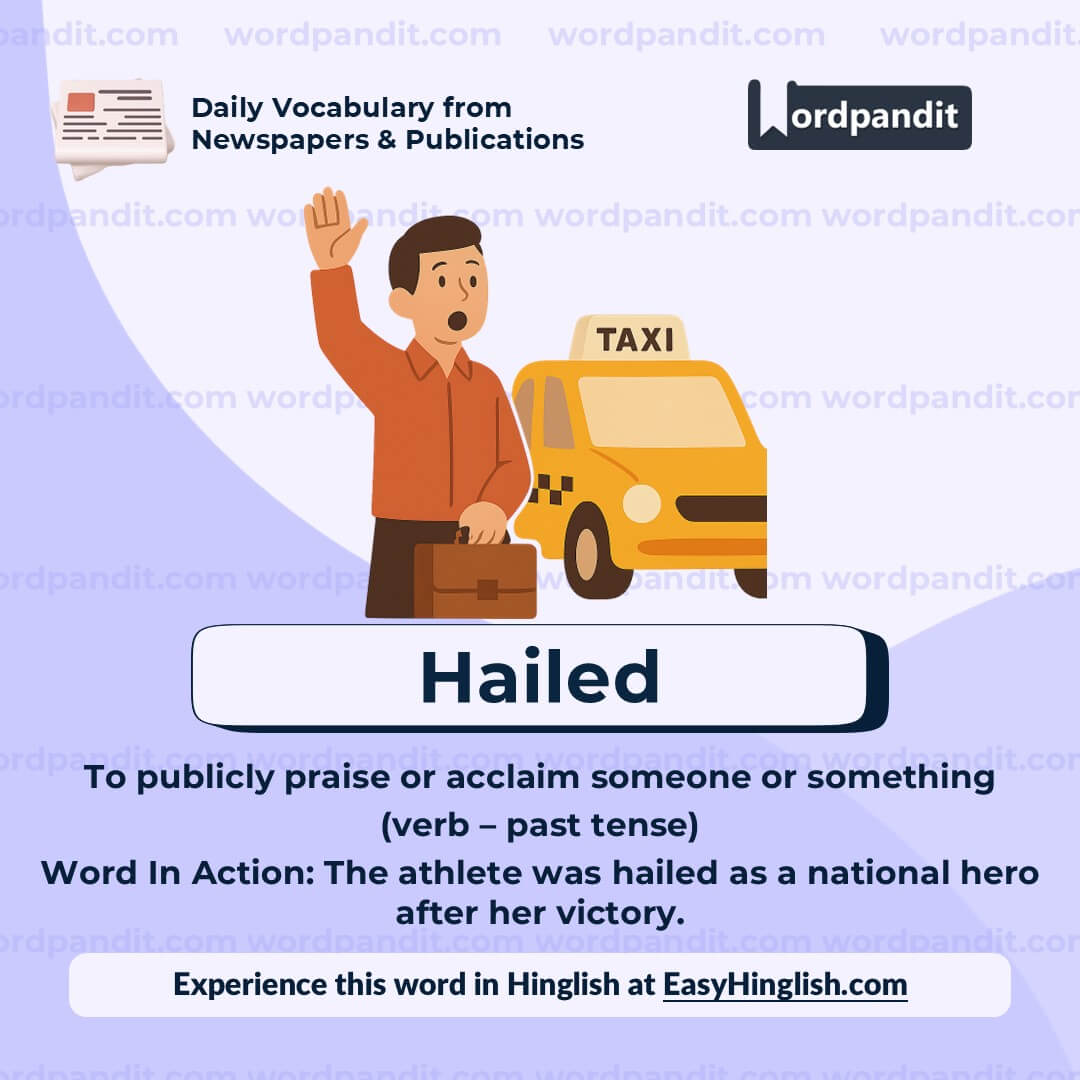
WORD-1: Hailed
Context:
"Where are all the free speech warriors on the right now? Hasan Piker, a popular streamer with 4.5 million followers across YouTube and Twitch, who has been hailed by mainstream publications such as the New Yorker and New York Times as the left’s answer to the deluge of rightwing internet influencers, says he was detained and questioned for hours by border control agents as he re-entered the US (Piker is a US citizen)." - The Guardian
Explanatory Paragraph:
"Hailed" in this context means being enthusiastically acknowledged, praised, or recognized, especially in public or formal settings. Here, Hasan Piker is being recognized by prominent media outlets as a significant figure on the left, positioned as a counterbalance to the influence of right-wing digital personalities. This kind of acknowledgment implies not just popularity, but also importance or influence in a broader cultural or political landscape.
Meaning: To publicly praise or acclaim someone or something (verb – past tense)
Pronunciation: hayld
Difficulty Level: ⭐⭐ Beginner
Etymology: From Old Norse *heill*, meaning “health” or “greeting,” originally used as a salutation before evolving into a form of public praise or acclamation.
Prashant Sir's Notes:
“Hailed” is a word often found in news articles or biographies when someone is recognized for their achievements. Be careful — it always carries a positive tone, so don’t use it for criticism or neutral announcements.
Synonyms & Antonyms:
Synonyms: praised, lauded, celebrated, applauded, acclaimed
Antonyms: criticized, condemned, ignored, dismissed
Usage Examples:
- The scientist was hailed as a pioneer in renewable energy research.
- Her performance was hailed by critics as one of the best of the year.
- The film was hailed as a modern masterpiece at international festivals.
- He was hailed for his bravery in rescuing the trapped hikers.
Cultural Reference:
"Hailed as the voice of a generation, Bob Dylan’s songwriting transformed music and culture in the 1960s." – *Rolling Stone Magazine*
Think About It:
Why do we often wait for public institutions or media to hail someone's success instead of recognizing it personally or locally?
Quick Activity:
Think of a person (famous or personal) whom you would "hail" for something. Write one sentence explaining what they did and why you’d praise them.
Memory Tip:
Remember: To “hail” someone is like calling out praise from a crowd — imagine people shouting "Hail the hero!"
Real-World Application:
"Hailed" is frequently used in journalism, awards coverage, and political commentary to highlight individuals or efforts that receive notable public recognition or acclaim.
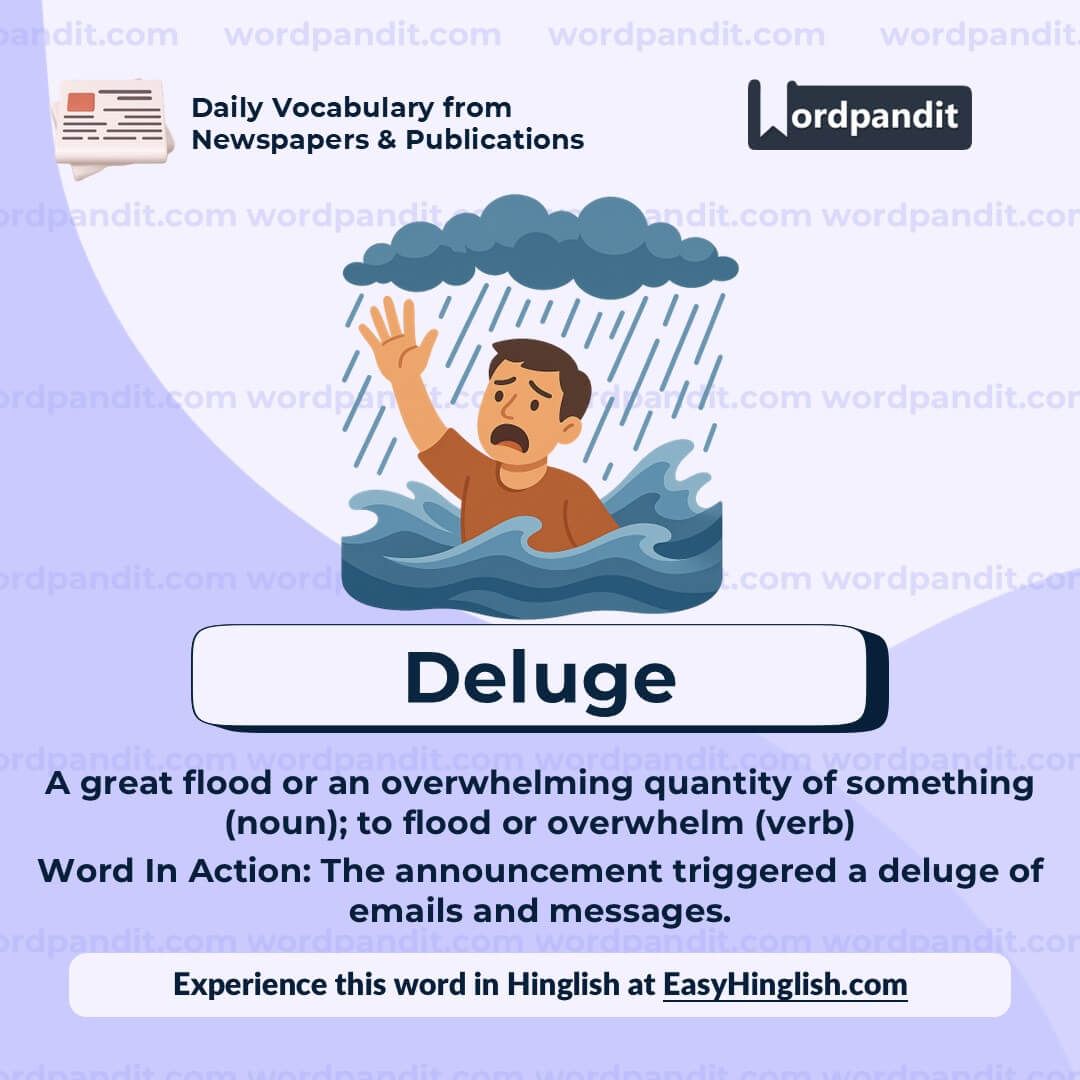
WORD-2: Deluge
Context:
"Where are all the free speech warriors on the right now? Hasan Piker, a popular streamer with 4.5 million followers across YouTube and Twitch, who has been hailed by mainstream publications such as the New Yorker and New York Times as the left’s answer to the deluge of rightwing internet influencers, says he was detained and questioned for hours by border control agents as he re-entered the US (Piker is a US citizen)." - The Guardian
Explanatory Paragraph:
"Deluge" in this sentence refers to an overwhelming flood or surge — not of water, but of people or information. It’s used metaphorically to describe the massive and possibly uncontrollable wave of right-wing internet influencers dominating the digital space. The use of “deluge” implies a sudden, intense, and perhaps excessive influx, suggesting that Hasan Piker is seen as a counterforce to this media phenomenon.
Meaning: A great flood or an overwhelming quantity of something (noun); to flood or overwhelm (verb)
Pronunciation: DEL-yooj
Difficulty Level: ⭐⭐ Beginner
Etymology: From Old French *deluge*, from Latin *diluvium*, meaning “flood” or “washing away.”
Prashant Sir's Notes:
“Deluge” is a powerful word — it adds drama to what might otherwise be described as a 'lot' or 'many'. It’s especially useful in opinion pieces or literary contexts to emphasize excess or impact.
Synonyms & Antonyms:
Synonyms: flood, torrent, overflow, surge, avalanche
Antonyms: trickle, drought, scarcity, shortage
Usage Examples:
- After the announcement, the company faced a deluge of customer complaints.
- The politician’s inbox was deluged with messages from angry constituents.
- A deluge of information online makes it difficult to distinguish fact from fiction.
- The small town was unprepared for the deluge that followed the hurricane.
Cultural Reference:
"The Deluge" is also the name of a famous novel by Henryk Sienkiewicz, depicting chaos and conflict in 17th-century Poland — a fitting metaphor for overwhelming events in both history and modern times.
Think About It:
In today’s digital world, do we face a deluge of opinions and voices — and how does that affect our ability to form our own?
Quick Activity:
Write two sentences: one using “deluge” in the context of weather, and one using it to describe too much information or emotion.
Memory Tip:
Think of “deluge” as “de-flood-you” — whether it’s rain or email, when you’re deluged, it floods over you!
Real-World Application:
“Deluge” is frequently used in media, business, and education to describe information overload, rapid market changes, or social media trends — emphasizing sudden and overwhelming volume.
WORD-3: Rightwing
Context:
"Where are all the free speech warriors on the right now? Hasan Piker, a popular streamer with 4.5 million followers across YouTube and Twitch, who has been hailed by mainstream publications such as the New Yorker and New York Times as the left’s answer to the deluge of rightwing internet influencers, says he was detained and questioned for hours by border control agents as he re-entered the US (Piker is a US citizen)." - The Guardian
Explanatory Paragraph:
"Rightwing" refers to the conservative or traditional side of a political spectrum. In this context, it describes internet influencers who advocate or align with conservative ideologies, often emphasizing nationalism, free-market capitalism, limited government, or traditional social values. The term is typically used in contrast with "leftwing," and its connotation can vary depending on the speaker’s tone and intent. In modern usage, especially online, "rightwing" is often used to group various political commentators or movements that challenge liberal or progressive ideas.
Meaning: Relating to or supporting conservative or reactionary political views (adjective)
Pronunciation: RYTE-wing
Difficulty Level: ⭐⭐ Beginner
Etymology: From the seating arrangement in 18th-century French assemblies, where conservative factions sat on the right side of the chamber.
Prashant Sir's Notes:
Use “rightwing” with care, especially in academic or journalistic writing. It’s often associated with specific ideologies — but those ideologies vary widely by country and culture. Also note: no hyphen is needed when using it as an adjective (e.g., “rightwing views”).
Synonyms & Antonyms:
Synonyms: conservative, traditionalist, nationalist, reactionary (in extreme contexts)
Antonyms: leftwing, liberal, progressive, socialist
Usage Examples:
- The candidate’s rightwing policies appealed to older, rural voters.
- Rightwing media outlets often criticize mainstream news as biased.
- He built a large following by promoting rightwing talking points on social media.
- The documentary explores the rise of rightwing populism across Europe.
Cultural Reference:
"Rightwing" politics gained mainstream visibility with movements like the Tea Party in the U.S. and Brexit support in the U.K., often tied to nationalism, immigration control, and skepticism of global institutions.
Think About It:
How do media and cultural platforms shape the perception of what it means to be "rightwing" or "leftwing" in today’s world?
Quick Activity:
Make a T-chart. On one side, list beliefs typically associated with rightwing ideology; on the other, those associated with leftwing ideology. Reflect on where your own views fall.
Memory Tip:
Imagine a political spectrum as a stage: “rightwing” sits on the right, just like the audience’s right-hand side. The term has stuck around since the French Revolution!
Real-World Application:
The term “rightwing” is frequently used in political discourse, journalism, and social commentary. Understanding its nuances is crucial when discussing elections, policy debates, or ideological movements across the globe.
WORD-4: Fabulous
Context:
"Back in my student days in late 1970s Paris, one of my favourite walks would take me to the fabulous Père Lachaise cemetery near the eastern edge of the French capital. A miniature city of monumental tombs and crypts in a lush garden setting, it has long been ‘home’ to the remains of no small number of the very special dead: Molière, Oscar Wilde, Colette, Sarah Bernhardt, Chopin … and Jim Morrison." - Aeon
Explanatory Paragraph:
The word "fabulous" in this context is used to express wonder, admiration, and aesthetic delight. It doesn't just mean "great" or "very good" — it conveys a sense of enchanting or extraordinary quality. Describing Père Lachaise cemetery as "fabulous" evokes its rich history, elegant architecture, and the mythical aura that surrounds the final resting places of iconic cultural figures. It’s a blend of visual beauty and emotional reverence.
Meaning: Remarkable, wonderful, or almost unbelievable in its excellence or charm (adjective)
Pronunciation: FAB-yuh-luss
Difficulty Level: ⭐ Beginner
Etymology: From Latin *fabula*, meaning “story” or “fable”; originally referring to something mythical or imaginary.
Prashant Sir's Notes:
“Fabulous” is a versatile adjective that can elevate ordinary descriptions to imaginative or emotional heights. It can imply magic (like in fairy tales) or simply high praise. The tone it adds is often light, enthusiastic, or poetic.
Synonyms & Antonyms:
Synonyms: marvelous, splendid, breathtaking, glorious, magical
Antonyms: dull, ordinary, unimpressive, bland
Usage Examples:
- She wore a fabulous gown that turned every head at the gala.
- The view from the mountaintop was absolutely fabulous.
- They had a fabulous time on their honeymoon in Santorini.
- The museum's collection of ancient artifacts is simply fabulous.
Cultural Reference:
"Absolutely fabulous!" — A phrase popularized by the iconic British sitcom *Absolutely Fabulous*, where over-the-top fashion and lifestyle choices are always met with unfiltered praise.
Think About It:
Does the word “fabulous” still carry its original magical connotation, or has it become diluted in everyday speech?
Quick Activity:
Think of a place or moment you’ve experienced that felt "fabulous." Write a sentence describing it using vivid, sensory language.
Memory Tip:
Think of “fabulous” as something so great it belongs in a *fable* — magical, larger-than-life, or simply awe-inspiring.
Real-World Application:
"Fabulous" is often used in travel writing, fashion, entertainment reviews, and casual conversations to highlight something that stands out as particularly impressive or joyful.
WORD-5: Crypts
Context:
"Back in my student days in late 1970s Paris, one of my favourite walks would take me to the fabulous Père Lachaise cemetery near the eastern edge of the French capital. A miniature city of monumental tombs and crypts in a lush garden setting, it has long been ‘home’ to the remains of no small number of the very special dead: Molière, Oscar Wilde, Colette, Sarah Bernhardt, Chopin … and Jim Morrison." - Aeon
Explanatory Paragraph:
“Crypts” are underground chambers or rooms, typically beneath churches or cemeteries, used as burial places. In this context, they refer to the elaborately built spaces in Père Lachaise cemetery where notable individuals are interred. Crypts often evoke a sense of solemnity, reverence, and sometimes mystery. They are not merely graves; they are architectural spaces meant to honor the dead in a dignified, sometimes majestic way.
Meaning: Underground burial chambers, often beneath churches or monuments (noun, plural)
Pronunciation: kripts
Difficulty Level: ⭐⭐ Beginner
Etymology: From Latin *crypta*, meaning “vault,” and Greek *kryptē*, meaning “hidden place.” The root *krypt-* also gives us “cryptic.”
Prashant Sir's Notes:
“Crypts” have historical, religious, and cultural significance. You’ll often encounter them in literature and travel writing. Be aware that they carry a serious, sacred tone — not to be confused with horror-only connotations.
Synonyms & Antonyms:
Synonyms: tombs, vaults, catacombs, burial chambers
Antonyms: open graves, crematoriums, mausoleums (not underground)
Usage Examples:
- The crypt beneath the church held the remains of medieval knights and nobles.
- Tourists descended into the ancient crypts to learn about early Christian martyrs.
- The museum’s newest exhibit displays artifacts uncovered from forgotten crypts.
- Legends say the crypt contains treasures hidden by a lost dynasty.
Cultural Reference:
The famous “Catacombs of Paris” contain miles of crypt-like tunnels housing the bones of over six million people — a haunting testament to the city’s layered history beneath its streets.
Think About It:
Why do societies throughout history build crypts and tombs instead of simply burying the dead — what does that say about how we view memory and legacy?
Quick Activity:
Draw or describe a crypt as you imagine it. Include details like materials, location, and atmosphere.
Memory Tip:
“Crypt” sounds like “keep” — a place where you “keep” the remains of the dead, protected and hidden underground.
Real-World Application:
“Crypts” appear in archaeology, religious studies, architecture, and even cybersecurity (in words like “encryption”). Their historical presence makes them central to cultural preservation and storytelling.


