


Daily Vocabulary from Indian Newspapers and Publications
Welcome to Wordpandit’s Indian Vocabulary Hub
At Wordpandit, we understand the importance of staying rooted in the local context while expanding your language skills. This section focuses on enriching your vocabulary with words and phrases drawn from India’s leading newspapers and publications, ensuring you're learning vocabulary that is practical, relevant, and uniquely Indian.
Why Indian Sources Matter
We believe that the best way to master any language is by immersing yourself in local content. That’s why we carefully curate vocabulary from top Indian publications, including:
- The Hindu
- The Times of India
- The Economic Times
- Hindustan Times
- Live Mint
- The Indian Express
- And many others...
Stay Updated, Stay Relevant
With daily updates from Indian news sources, you’ll be consistently learning words that reflect the trends and shifts in Indian society and culture. Our focus is to provide vocabulary that enhances your understanding of the language in an Indian context.
How Wordpandit Supports Your Goals
Whether you’re preparing for exams, aiming to improve your professional communication, or simply want to stay connected with the latest Indian vocabulary, Wordpandit is here to guide you every step of the way.
Learn with a Practical Approach
Our interactive learning methodology includes real-world examples, engaging activities, and context-specific usage to ensure that every word becomes part of your active vocabulary.
Dive into Indian Vocabulary Today!

Why Choose Wordpandit?
Practical Learning: Focus on words you'll actually encounter in real-world reading, enhancing your comprehension and communication skills.
Diverse Content: From current affairs to scientific breakthroughs, our varied sources expose you to vocabulary across multiple domains.
Effortless Integration: Make Wordpandit a part of your daily routine. Just a few minutes each day can significantly boost your lexicon over time.
Your Path to Vocabulary Mastery
- Visit our Daily Vocabulary section regularly
- Explore new words and their usage in context
- Practice incorporating these words into your own writing and speech
- Track your progress as your vocabulary expands
Start Your Journey Today
Embark on your vocabulary enhancement journey with Wordpandit. By consistently engaging with our daily posts, you'll build a robust vocabulary that serves you well in academic, professional, and personal contexts.
Remember, a word a day keeps linguistic limitations at bay. Make Wordpandit your daily companion in the quest for vocabulary excellence!
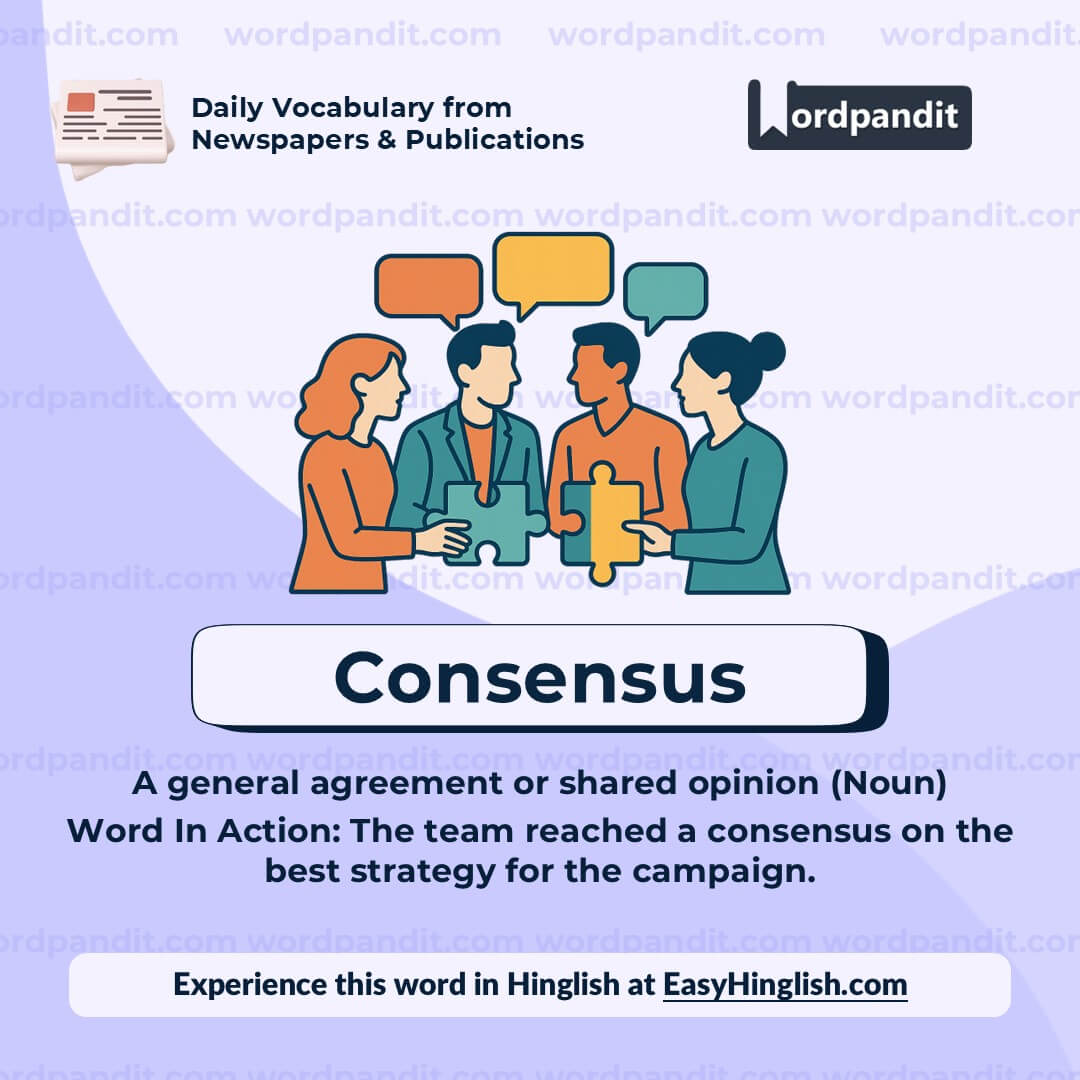
WORD-1: Consensus
Context:
"Though on May 10, India and Pakistan reached a consensus for a ‘full and immediate ceasefire’ after four days of intense military engagements, the hostilities are not going to end in the near future." - The Times of India
Explanatory Paragraph:
The word "consensus" refers to a general agreement among a group of people. It is often used in political, diplomatic, or organizational contexts where a collective decision or shared opinion is reached after discussion or negotiation. In this context, India and Pakistan arrived at a mutual understanding to cease hostilities, highlighting a temporary agreement despite underlying tensions.
Meaning: A general agreement or shared opinion (Noun)
Pronunciation: kuhn-SEN-suhs
Difficulty Level: ⭐⭐ Beginner
Etymology: From Latin *consensus*, meaning 'agreement, accord', from *consentire* (‘to agree’).
Prashant Sir's Notes:
"Consensus" is an essential term in communication and negotiation contexts. It’s a diplomatic word often used to signal that all or most stakeholders have come to a shared understanding or decision, even if it doesn't mean full unanimity.
Synonyms & Antonyms:
Synonyms: agreement, harmony, accord, unanimity, concurrence
Antonyms: disagreement, discord, dissension, conflict, opposition
Usage Examples:
- The committee finally reached a consensus on the new policy direction.
- There was general consensus that the proposal would benefit the entire community.
- Despite heated debates, a consensus emerged by the end of the meeting.
- International leaders struggled to build a consensus on climate change measures.
Cultural Reference:
"Consensus is the absence of leadership." – Margaret Thatcher. This quote reflects skepticism about consensus in politics, suggesting it can sometimes be a sign of indecision or weak leadership. - Public Speeches Archive
Think About It:
Can reaching a consensus sometimes mean compromising too much on your core values? Where should one draw the line?
Quick Activity:
List two real-life scenarios from your school, workplace, or home where reaching a consensus was necessary. Briefly describe how the agreement was reached.
Memory Tip:
Think of "con" (together) + "sense" — when everyone makes sense *together*, there is consensus!
Real-World Application:
In professional settings, consensus is crucial during team meetings, strategic planning, and conflict resolution. It helps ensure buy-in from all stakeholders and smooth implementation of decisions.
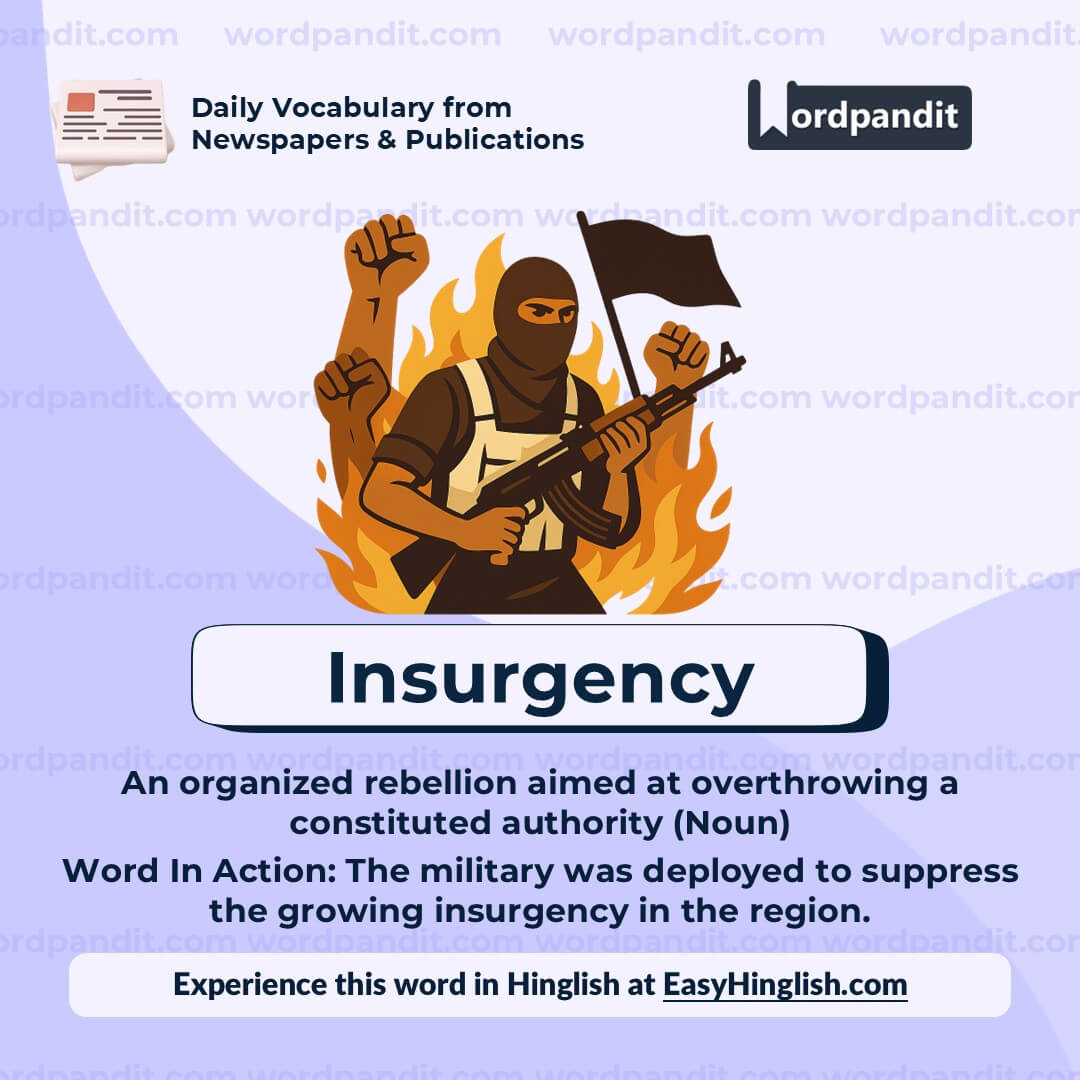
WORD-2: Insurgency
Context:
"Pakistan sought non-conventional ways to challenge India’s dominance—especially in Kashmir after losing wars to India in 1947, 1965, and 1971. Supporting insurgency and militant groups became a “low-cost, high-impact” strategy to internationalise the Kashmir issue." - The Times of India
Explanatory Paragraph:
"Insurgency" refers to a violent rebellion against an established government or authority, often involving armed conflict and organized resistance. It usually arises when a group feels politically, culturally, or economically marginalized and seeks to challenge the ruling power through non-state means. In the context above, Pakistan is described as supporting such rebel movements in Kashmir to undermine Indian control.
Meaning: An organized rebellion aimed at overthrowing a constituted authority (Noun)
Pronunciation: in-SUR-juhn-see
Difficulty Level: ⭐⭐⭐ Intermediate
Etymology: From Latin *insurgere*, meaning "to rise up"; formed from *in-* ("into") + *surgere* ("to rise").
Prashant Sir's Notes:
"Insurgency" is a powerful political term, often used in global affairs, defense studies, and international relations. It's critical to distinguish insurgency from terrorism: insurgents may target state apparatus and military forces, whereas terrorism often targets civilians to spread fear. Context determines the usage and perception of both.
Synonyms & Antonyms:
Synonyms: rebellion, revolt, uprising, mutiny, insurrection
Antonyms: peace, obedience, submission, loyalty, order
Usage Examples:
- The military was deployed to quell the growing insurgency in the northern province.
- The government blamed foreign powers for fueling the insurgency within its borders.
- Insurgency movements often thrive in regions with weak governance and economic hardship.
- The film depicts a fictional insurgency that topples an authoritarian regime.
Cultural Reference:
"Every insurgency has a story—of loss, identity, and unhealed wounds." - A paraphrased sentiment commonly reflected in conflict documentaries and literature such as *The Kite Runner* or *Behind the Beautiful Forevers*.
Think About It:
What drives individuals or communities to take up arms against their own governments? Is violence ever justified in the pursuit of political goals?
Quick Activity:
Write a short paragraph imagining a peaceful solution to an ongoing insurgency in a region of your choice. What stakeholders must be involved?
Memory Tip:
Remember: *In* + *surge* = rising within. "Insurgency" is when people *surge* up *inside* a country to challenge the rulers.
Real-World Application:
The term "insurgency" is used in geopolitical discussions, news analysis, military strategy, and political science to describe internal conflicts that disrupt state control. Understanding its causes is key to conflict resolution and international diplomacy.

WORD-3: Onomastics
Context:
"What’s in a name, but really shouldn’t be? According to the Japanese government, quite a few things. It’s tightening the rules for baby names, in a bid to stem a rising tide of flashy and obscure onomastics. A debate has been raging over such names for decades, and there’s even a term for them: Kirakira, or “sparkling” names." - The Indian Express
Explanatory Paragraph:
"Onomastics" is the study of names and their origins, meanings, use, and cultural significance. It covers personal names, place names, and even fictional naming practices. In the context above, it refers to the growing trend of giving unusual or flamboyant names to children in Japan, which has sparked societal and governmental concern. The word is especially used in linguistic and anthropological studies to explore how names reflect identity and culture.
Meaning: The study of the origin, history, and use of proper names (Noun)
Pronunciation: ah-nuh-MAS-tiks
Difficulty Level: ⭐⭐⭐⭐ Advanced
Etymology: From Greek *onomastikos*, meaning "of or belonging to naming," derived from *onoma* (name).
Prashant Sir's Notes:
This is a fantastic niche word that’s valuable in discussions of linguistics, literature, sociology, and cultural studies. "Onomastics" isn’t commonly used in daily conversation but can add depth when discussing identity, naming trends, or etymology. Use it to stand out in essays or academic writing!
Synonyms & Antonyms:
Synonyms: name study, nomenclature analysis, etymology (in some contexts)
Antonyms: There are no direct antonyms, but general ignorance of name origins or disinterest in naming culture could be considered oppositional concepts.
Usage Examples:
- She specialized in onomastics, tracing how surnames evolved across centuries in Europe.
- Onomastics reveals fascinating insights into migration, colonization, and linguistic transformation.
- His thesis in cultural anthropology focused on the onomastics of indigenous Australian tribes.
- Parents in the digital age are unknowingly participating in modern onomastics through creative baby naming.
Cultural Reference:
"Names are not just labels—they are identities." Onomastics has played a key role in TV shows like *Game of Thrones*, where names signal lineage, power, and prophecy. - Pop Culture Linguistics Blog
Think About It:
How do names influence our perception of people? Do we judge someone differently based on their name's uniqueness or cultural roots?
Quick Activity:
Pick 3 names from your friend circle or family. Try to find out their meanings or origins using an online name database or dictionary.
Memory Tip:
Think of "Onoma" (name in Greek) + "astics" (study of) = the study of names. If it sounds academic, it probably is!
Real-World Application:
Onomastics is used in branding, historical research, genealogy, and character development in writing. Understanding name origins can be critical in choosing product names, decoding historical texts, or analyzing social trends.
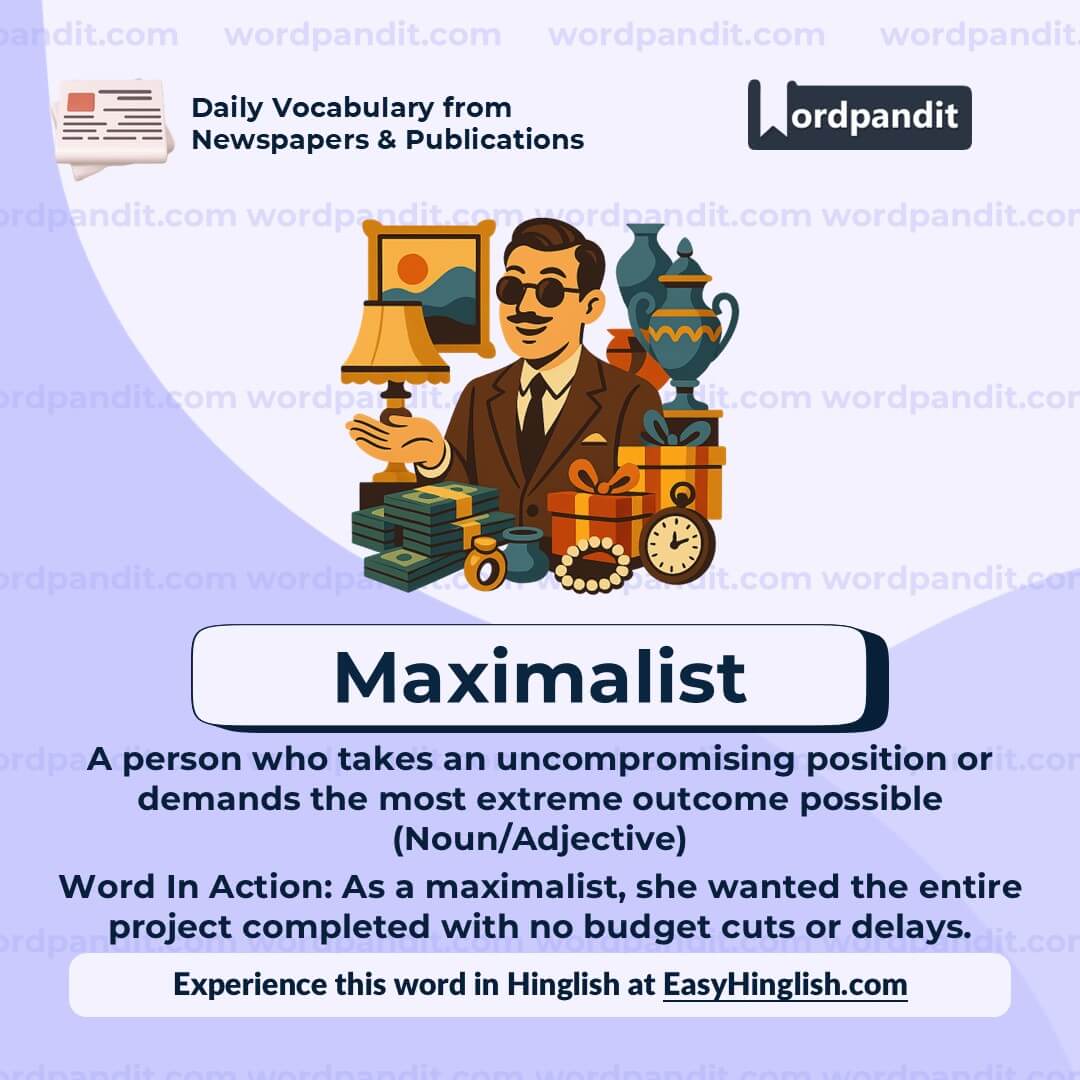
WORD-4: Maximalist
Context:
"This is the root cause for state governments to enhance, slice and dice quotas. It’s a complex situation but their remedy is wrong. It’s only going to create more social turmoil as politically influential groups will adopt maximalist positions on reservations, which have now become a zero-sum game." - The Times of India
Explanatory Paragraph:
A "maximalist" is someone who holds extreme views or demands the most extensive and uncompromising outcome in any negotiation or debate. The term is typically used in contrast to "minimalist" and is often applied in political, social, or artistic contexts. In this case, it describes groups that push for the largest possible share of benefits—such as quotas or reservations—without room for compromise, making consensus more difficult and conflicts more likely.
Meaning: A person who takes an uncompromising position or demands the most extreme outcome possible (Noun/Adjective)
Pronunciation: MAK-si-muh-list
Difficulty Level: ⭐⭐⭐ Intermediate
Etymology: From Latin *maximus* (greatest), combined with the suffix *-ist*, meaning one who practices or believes.
Prashant Sir's Notes:
"Maximalist" is often used in political commentary. It's a useful term to describe groups or individuals who refuse to compromise and seek the greatest possible advantage. This can sound powerful but often signals rigidity in thinking or negotiating.
Synonyms & Antonyms:
Synonyms: hardliner, extremist, purist, absolutist, radical
Antonyms: moderate, minimalist, pragmatist, centrist, compromiser
Usage Examples:
- The negotiator warned that a maximalist stance would derail the peace talks.
- In art, maximalist styles are characterized by rich textures, vibrant colors, and elaborate detail.
- Maximalist demands from union leaders led to a complete breakdown of the labor talks.
- Her maximalist approach to home décor meant every wall was covered with art and color.
Cultural Reference:
In U.S. politics, the term "maximalist" has been used to describe foreign policy stances that seek total military or ideological victory without compromise—such as during the Cold War. - Political Discourse Archives
Think About It:
Is being a maximalist a strength or a weakness in negotiations? Can inflexibility ever lead to better outcomes?
Quick Activity:
Think of a current debate (e.g., climate change, internet privacy, AI regulation). Identify a maximalist argument from each side. Then, propose a middle-ground solution.
Memory Tip:
Remember: *Maximalist* wants the *maximum*. They aim for the most, without settling for less!
Real-World Application:
Understanding maximalist positions is crucial in fields like politics, law, and international diplomacy, where compromise is key. Recognizing when someone is being a maximalist helps you plan better responses and foster meaningful dialogue.
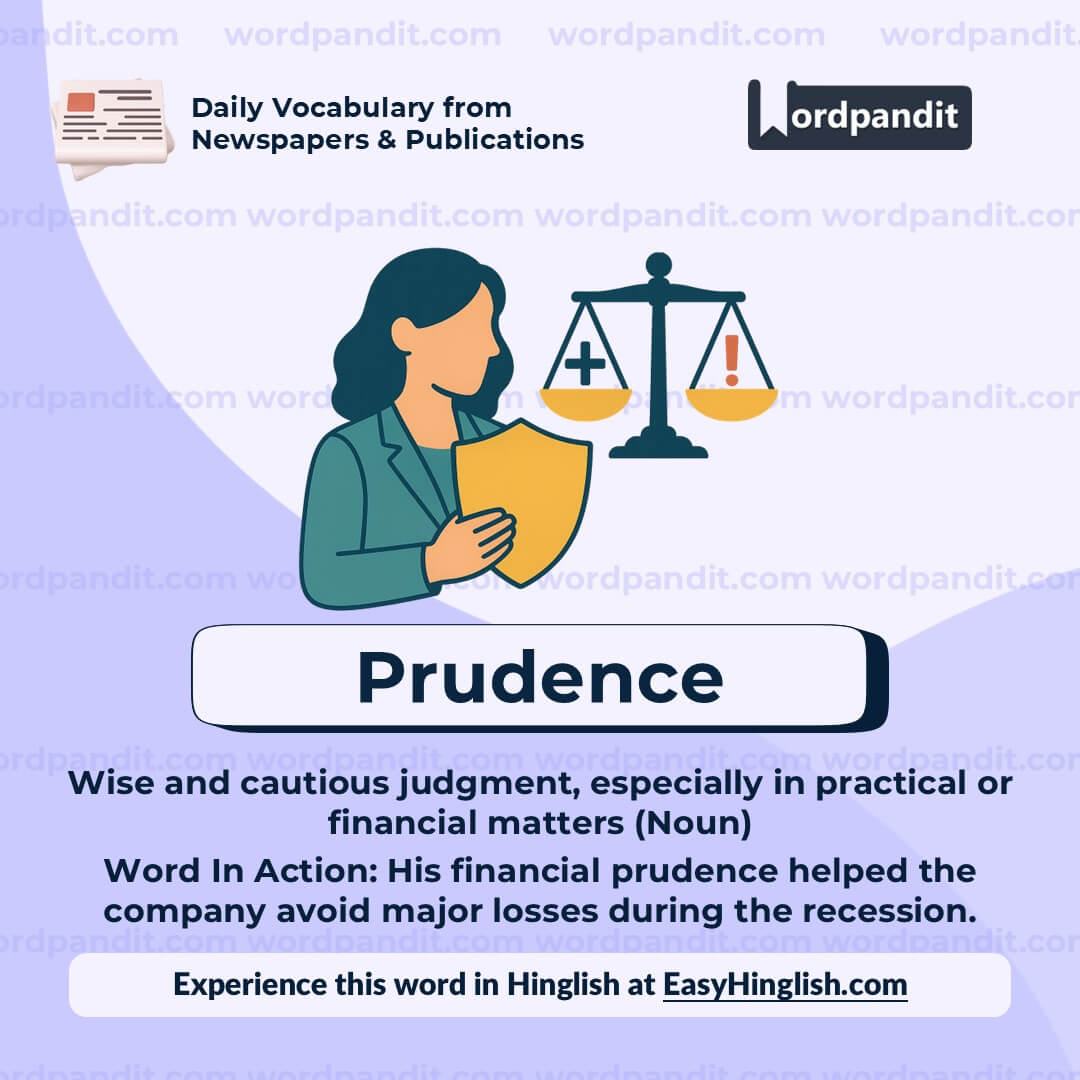
WORD-5: Prudence
Context:
"A committee will be set up under the finance secretary to evolve an approach balancing the needs of government employees without diluting fiscal prudence. It will be designed for adoption by both states and GoI. The announcement should ease the pressure on many state governments." - The Times of India
Explanatory Paragraph:
"Prudence" refers to the quality of being cautious, wise, and judicious—especially in practical matters or financial decisions. In this context, the government aims to meet employee needs while maintaining careful control over spending, ensuring that decisions don’t lead to financial instability. Prudence is often praised in leadership and policy-making for ensuring long-term sustainability.
Meaning: Wise and cautious judgment, especially in practical or financial matters (Noun)
Pronunciation: PROO-denss
Difficulty Level: ⭐⭐ Beginner
Etymology: From Latin *prudentia* meaning "foresight, sagacity," derived from *providere* ("to foresee").
Prashant Sir's Notes:
"Prudence" is a critical concept in finance and governance. It reflects the idea of being responsible with resources and thinking about long-term consequences. It’s a quiet but powerful virtue that sets apart thoughtful leaders and decision-makers.
Synonyms & Antonyms:
Synonyms: caution, wisdom, foresight, carefulness, discretion
Antonyms: recklessness, carelessness, impulsiveness, folly
Usage Examples:
- Her financial prudence helped the company survive during the economic downturn.
- In times of uncertainty, prudence is more valuable than boldness.
- The leader’s prudence was evident in her thoughtful decision-making process.
- Prudence dictates that we save money before embarking on a risky project.
Cultural Reference:
In classical philosophy, prudence is one of the four cardinal virtues, alongside justice, temperance, and fortitude. It was regarded by thinkers like Aristotle and Aquinas as essential for moral living. - Philosophy Basics
Think About It:
In today’s fast-paced world, is prudence undervalued? How can we promote it in public decision-making and personal life?
Quick Activity:
List two decisions—one from your personal life and one from a public figure—that reflect prudence. Explain why they were wise or cautious choices.
Memory Tip:
Think of a "prudent parent"—someone who plans ahead and avoids risky choices. Prudence is all about smart foresight!
Real-World Application:
Prudence is vital in finance, leadership, governance, and even personal budgeting. It's a guiding principle for responsible choices, especially when managing limited resources or navigating uncertainty.


