

Daily Vocabulary from Indian Newspapers and Publications
Welcome to Wordpandit’s Indian Vocabulary Hub
At Wordpandit, we understand the importance of staying rooted in the local context while expanding your language skills. This section focuses on enriching your vocabulary with words and phrases drawn from India’s leading newspapers and publications, ensuring you're learning vocabulary that is practical, relevant, and uniquely Indian.
Why Indian Sources Matter
We believe that the best way to master any language is by immersing yourself in local content. That’s why we carefully curate vocabulary from top Indian publications, including:
- The Hindu
- The Times of India
- The Economic Times
- Hindustan Times
- Live Mint
- The Indian Express
- And many others...
Stay Updated, Stay Relevant
With daily updates from Indian news sources, you’ll be consistently learning words that reflect the trends and shifts in Indian society and culture. Our focus is to provide vocabulary that enhances your understanding of the language in an Indian context.
How Wordpandit Supports Your Goals
Whether you’re preparing for exams, aiming to improve your professional communication, or simply want to stay connected with the latest Indian vocabulary, Wordpandit is here to guide you every step of the way.
Learn with a Practical Approach
Our interactive learning methodology includes real-world examples, engaging activities, and context-specific usage to ensure that every word becomes part of your active vocabulary.
Dive into Indian Vocabulary Today!

Why Choose Wordpandit?
Practical Learning: Focus on words you'll actually encounter in real-world reading, enhancing your comprehension and communication skills.
Diverse Content: From current affairs to scientific breakthroughs, our varied sources expose you to vocabulary across multiple domains.
Effortless Integration: Make Wordpandit a part of your daily routine. Just a few minutes each day can significantly boost your lexicon over time.
Your Path to Vocabulary Mastery
- Visit our Daily Vocabulary section regularly
- Explore new words and their usage in context
- Practice incorporating these words into your own writing and speech
- Track your progress as your vocabulary expands
Start Your Journey Today
Embark on your vocabulary enhancement journey with Wordpandit. By consistently engaging with our daily posts, you'll build a robust vocabulary that serves you well in academic, professional, and personal contexts.
Remember, a word a day keeps linguistic limitations at bay. Make Wordpandit your daily companion in the quest for vocabulary excellence!

WORD-1: Girded
Context:
"As a young woman of 20-something, raised in a household of all sorts of intellectual freedom — from questioning god to questioning the world — and very little real freedom, with lots of book-learning and very little practical knowledge, when I found myself with a little human of the male persuasion, I girded my waist and approached motherhood with the same determination and eager preparation as I did every other learning." - The Indian Express
Explanatory Paragraph:
“Girded” is a somewhat old-fashioned yet powerful word that describes the act of mentally or physically preparing oneself for a challenge. It often implies a readiness that combines emotional resolve and deliberate preparation. In historical contexts, it referred to tightening one’s belt or clothing in readiness for battle or action. In the modern sense, it is used more metaphorically, as in preparing oneself mentally or emotionally for a significant event. In the context provided, the speaker uses “girded my waist” to reflect her conscious, determined preparation for motherhood.
Meaning: To prepare oneself for action, especially something difficult or challenging (verb)
Pronunciation: gur-did
Difficulty Level: ⭐⭐⭐ Intermediate
Etymology: Derived from Old English "gyrdan," meaning to encircle or bind with a belt or girdle, often used in the context of preparing for battle or a task.
Prashant Sir's Notes:
“Girded” is a word rich with historical and literary flavor. Think of warriors in epic tales “girding their loins” before battle — this act symbolized readiness and resolve. Use this word when you want to describe not just action but determined preparation. Ideal for literary writing, speeches, or introspective essays.
Synonyms & Antonyms:
Synonyms: prepare, brace, equip, ready, fortify
Antonyms: neglect, ignore, disarm, unprepare
Usage Examples:
- She girded herself for the emotional turmoil of the court case.
- He girded his team with motivation and strategy before the big match.
- They girded for a long journey through the treacherous mountains.
- The nation girded for economic challenges in the aftermath of the policy change.
Cultural Reference:
"Gird up now thy loins like a man; for I will demand of thee, and answer thou me." — The Bible, Book of Job
Think About It:
What situations in your life have required you to “gird” yourself emotionally or mentally before facing them?
Quick Activity:
Write a short paragraph beginning with “I girded myself…” and describe a time when you prepared intensely for a difficult situation.
Memory Tip:
Think of “girdle” as a belt — when you "gird" yourself, you're metaphorically tightening your belt to get ready for something tough.
Real-World Application:
The word “girded” is useful in personal narratives, motivational writing, or storytelling, especially when emphasizing determination, preparation, or inner strength before facing a major life challenge or responsibility.
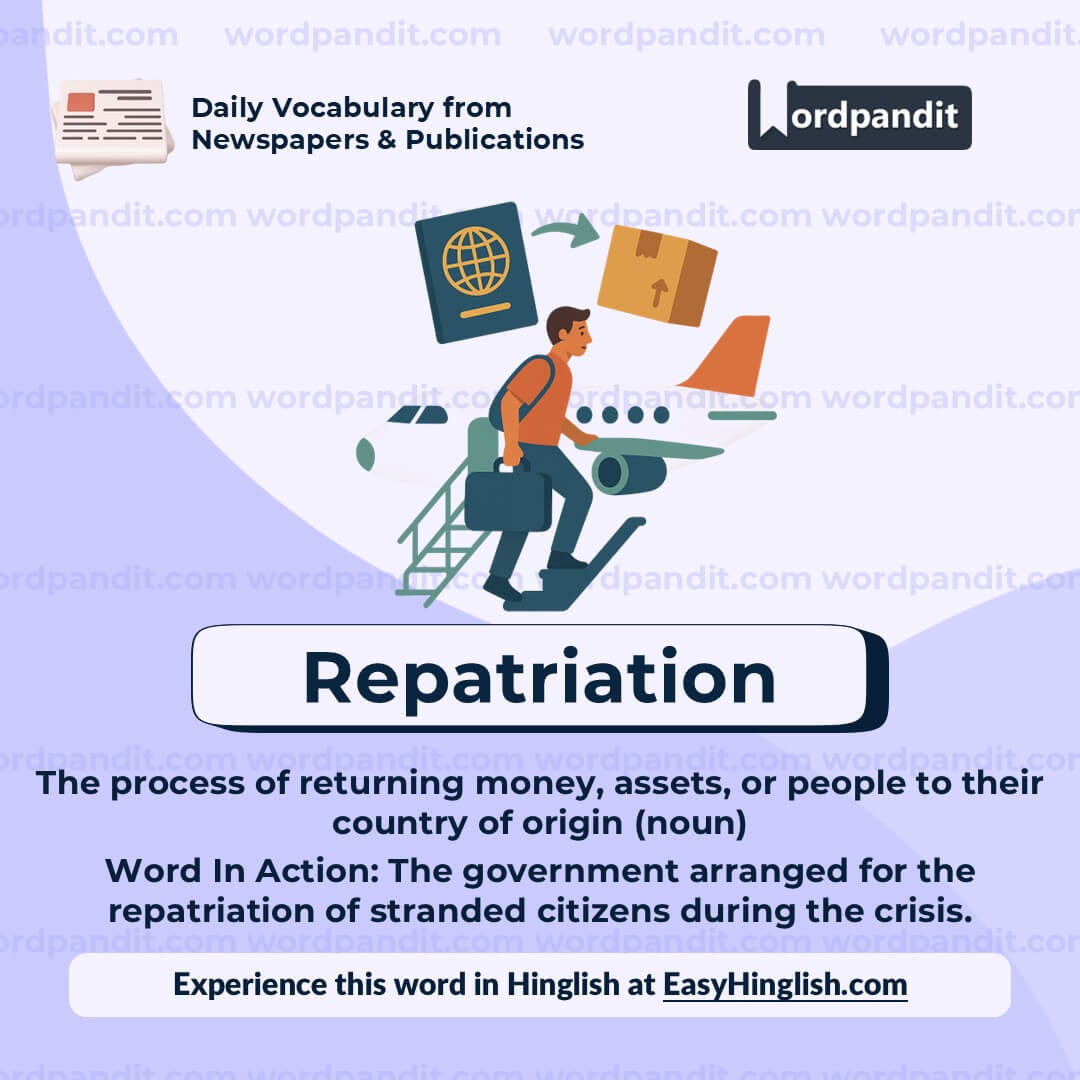
WORD-2: Repatriation
Context:
"The reasons for this stunning collapse can be traced to an increase in investments by Indian firms abroad and greater repatriation/disinvestment by foreign firms from the country." - The Indian Express
Explanatory Paragraph:
“Repatriation” refers to the act of bringing something back to its country of origin. In economic and business contexts, it typically involves the return of money or assets — such as profits or investments — from a foreign country to the home country. In the given sentence, it highlights the scenario where foreign firms are withdrawing their investments or earnings from India and returning that capital to their home countries, which contributes to a financial shift or imbalance.
Meaning: The process of returning money, assets, or people to their country of origin (noun)
Pronunciation: ree-pay-tree-ay-shun
Difficulty Level: ⭐⭐⭐ Intermediate
Etymology: From Latin "re-" (back) + "patria" (fatherland), meaning "returning to one’s homeland."
Prashant Sir's Notes:
“Repatriation” is especially useful in the context of global economics and immigration. While the financial sense refers to the return of capital or profits, the word is also used for returning people — such as refugees, prisoners, or soldiers — to their home countries. Always look at context to determine the correct usage.
Synonyms & Antonyms:
Synonyms: return, restitution, restoration, retrieval
Antonyms: expatriation, exile, deportation, investment (in financial context)
Usage Examples:
- The company announced the repatriation of $2 billion in overseas profits to strengthen its domestic operations.
- The government facilitated the repatriation of stranded citizens during the crisis.
- Tax policies can significantly affect corporate decisions on profit repatriation.
- Repatriation of cultural artifacts is a topic of international diplomatic discussions.
Cultural Reference:
"The repatriation of art looted during World War II remains a matter of international concern and negotiation." - BBC News
Think About It:
Should companies and countries be obligated to repatriate profits or cultural artifacts? Why or why not?
Quick Activity:
Write a brief opinion paragraph on whether the government should encourage repatriation of foreign earnings to boost the domestic economy.
Memory Tip:
Think of “patriation” as linked to “patriot” — repatriation means bringing something back home to the nation or homeland.
Real-World Application:
In international business, understanding repatriation is crucial for managing cross-border investments, tax planning, and foreign earnings. It also plays a key role in immigration, humanitarian, and legal contexts.
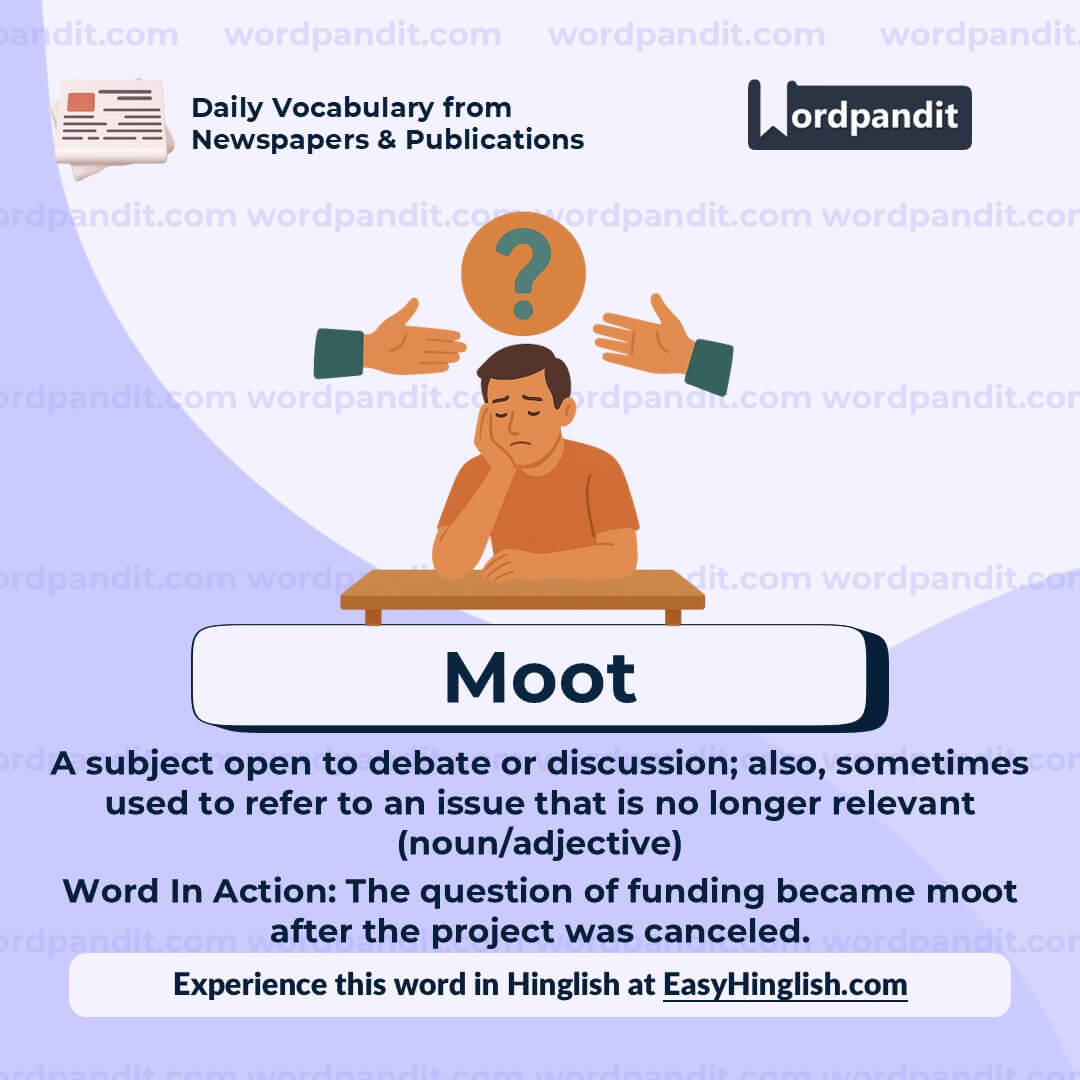
WORD-3: Moot
Context:
"India, therefore, had to send a message. If being nice doesn’t work, sometimes in diplomacy one has to act a little rough. It’s a moot point whether when it comes to India, Britain suffers from imperial delusions. Or whether London will only respond to hard power gestures." - The Times of India
Explanatory Paragraph:
“Moot” is a word with multiple meanings depending on context, but in this case, it refers to a debatable or uncertain issue. When something is described as a “moot point,” it means it's open to argument or discussion — and often suggests that the answer may not matter practically. In the context above, the author uses “moot point” to indicate that it’s uncertain (and perhaps unimportant) whether Britain still harbors imperialistic attitudes towards India; what matters more is the action India chooses to take in response.
Meaning: A subject open to debate or discussion; also, sometimes used to refer to an issue that is no longer relevant (noun/adjective)
Pronunciation: moot (rhymes with “boot”)
Difficulty Level: ⭐⭐ Basic
Etymology: From Old English “mōt,” meaning a meeting or assembly, especially for judicial or legal discussions.
Prashant Sir's Notes:
“Moot” is a very interesting word because it holds contradictory meanings in American and British English. In American English, a “moot point” is often seen as irrelevant or no longer worth debating. In British usage, it still carries the original sense of being something debatable or unresolved. Always consider the audience and context when using this term!
Synonyms & Antonyms:
Synonyms: debatable, arguable, questionable, unresolved, contentious
Antonyms: certain, settled, indisputable, resolved
Usage Examples:
- Whether the new policy will succeed is a moot point at this stage.
- The issue was rendered moot after the decision was reversed by the court.
- He mooted the idea of a regional alliance during the meeting.
- That debate is moot now — the company has already made its decision.
Cultural Reference:
In law schools, a “moot court” is an educational simulation where students argue hypothetical legal cases, emphasizing the term's original connection to debate and legal practice.
Think About It:
Do you think debating “moot points” is a waste of time, or can it still serve a purpose in understanding complex issues?
Quick Activity:
Think of a current issue in international relations that you consider a “moot point.” Write one sentence explaining why it is or isn't worth debating.
Memory Tip:
Think: “It’s up for debate!” — “Moot” sounds like “moo,” and just like cows “moo” in a herd, people can “moot” in a group discussion or court.
Real-World Application:
“Moot” is commonly used in legal, political, and academic discussions to describe issues that are either highly debatable or no longer practically significant. Knowing both meanings can help avoid confusion in cross-cultural contexts.
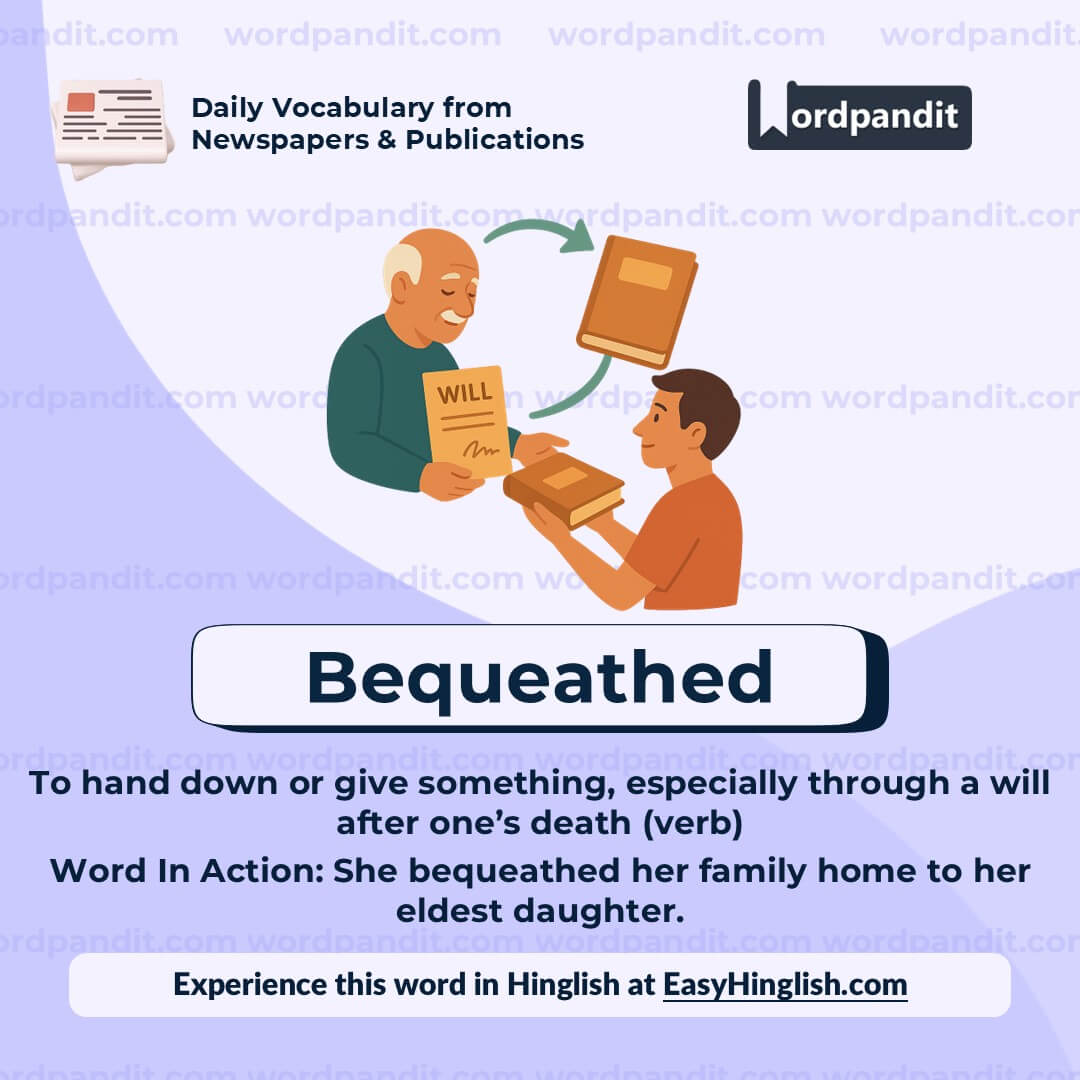
WORD-4: Bequeathed
Context:
"Yet, everyone knows, we take from the wreckage what is most dear to us, we don’t care who’s looking. In any case, even more than the stories themselves, it is the fact that my father-in-law had bequeathed them to me that gives me the tacit permission I claim I do not need. When I first met him, perhaps I had been interested in his stories because I was interested in his son." - The Indian Express
Explanatory Paragraph:
“Bequeathed” is a word that refers to the act of passing something on to someone, especially as part of a will after death. However, it can also be used more broadly to describe the act of giving or entrusting something of value — like wisdom, possessions, or stories — to another person. In the context above, the speaker’s father-in-law has passed on his stories, not necessarily through a formal will, but as a treasured inheritance, implying a bond, trust, and a symbolic gesture of acceptance or legacy.
Meaning: To hand down or give something, especially through a will after one’s death (verb)
Pronunciation: buh-kweethd
Difficulty Level: ⭐⭐⭐ Intermediate
Etymology: From Middle English “bequethen,” meaning to give by will or hand over, derived from Old English “becwethan.”
Prashant Sir's Notes:
“Bequeathed” is often found in literary, legal, and poetic contexts. While it typically refers to inheritance via wills, it can also be beautifully used in a metaphorical sense — passing on memories, traditions, or values. When you want to evoke a sense of legacy, this is a powerful choice of word.
Synonyms & Antonyms:
Synonyms: hand down, leave, pass on, endow, entrust
Antonyms: disinherit, take back, withhold, retain
Usage Examples:
- Her grandmother bequeathed her a collection of rare books and personal letters.
- He bequeathed his love for literature to all his students.
- The philanthropist bequeathed a large sum of money to the children’s hospital.
- Along with his watch, he bequeathed his stories and his silence.
Cultural Reference:
“Four score and seven years ago our fathers brought forth on this continent, a new nation... It is for us the living to be dedicated... to the great task remaining before us — that these dead shall not have died in vain.” — Abraham Lincoln’s Gettysburg Address, a powerful example of ideals bequeathed to future generations.
Think About It:
What non-material things — like values, memories, or stories — would you want to bequeath to the next generation?
Quick Activity:
Write a sentence starting with “I would like to bequeath...” and complete it with something meaningful you’d pass on to someone you care about.
Memory Tip:
Think of “bequeath” like “be + gift with a quiet whisper” — a gentle handing over of something treasured, often across generations.
Real-World Application:
“Bequeathed” is commonly used in wills, estate planning, and legacy discussions — but it's also a poetic way to speak of passing down traditions, values, and even emotional bonds in personal writing and storytelling.

WORD-5: Draconian
Context:
"That in 2023 a district was added to the Afspa list in Arunachal Pradesh as well as the limited repeal in Nagaland shows there is still some road to travel before the North-East can be free of this draconian law." - The Times of India
Explanatory Paragraph:
“Draconian” is an adjective used to describe laws, measures, or rules that are excessively harsh or severe. It implies a level of cruelty or unreasonableness in enforcement. The term originates from Draco, an ancient Athenian lawmaker known for implementing a legal code with extremely harsh penalties, even for minor offenses. In the context of the sentence, the term “draconian law” refers to AFSPA (Armed Forces Special Powers Act), suggesting that the law grants extreme powers to the authorities, often seen as oppressive or unjust by critics, especially in the North-East regions of India.
Meaning: Excessively harsh, severe, or cruel (adjective)
Pronunciation: druh-KOH-nee-uhn
Difficulty Level: ⭐⭐⭐ Intermediate
Etymology: Derived from Draco, a 7th-century BCE Athenian legislator whose legal code was notoriously harsh, including death penalties for minor offenses.
Prashant Sir's Notes:
“Draconian” is an impactful word to use when criticizing laws, rules, or government policies that are seen as overly punitive. Be cautious with its usage — it carries a strong negative connotation and can imply injustice or tyranny. Use it when you want to express strong disapproval of oppressive systems or actions.
Synonyms & Antonyms:
Synonyms: harsh, severe, oppressive, cruel, strict
Antonyms: lenient, mild, gentle, permissive, tolerant
Usage Examples:
- The company implemented draconian measures to cut costs, laying off thousands without notice.
- Many citizens protested against the draconian surveillance policies introduced by the regime.
- Some educators argue that zero-tolerance rules in schools are too draconian for young students.
- The critics described the new immigration laws as draconian and lacking compassion.
Cultural Reference:
“Draconian” is a term rooted in ancient Greek history. Draco’s laws were so severe that even petty theft could result in the death penalty, prompting later reformers to replace his code with more humane laws. The word today is used to highlight excessively harsh governance or policy enforcement.
Think About It:
Do you believe strict laws are necessary for national security, or do draconian policies risk alienating the very people they aim to protect?
Quick Activity:
List one law or rule you believe is draconian and explain briefly why you think so. Use the word in your explanation.
Memory Tip:
Think of “Draconian” as “Dragon-like” — powerful, fierce, and often terrifying. Use it when laws feel as harsh as fire-breathing dragons.
Real-World Application:
The word “draconian” is frequently used in journalism, political commentary, and social advocacy to criticize unjust laws or authoritarian policies. It's especially relevant in debates around civil liberties, criminal justice, and human rights.


