

Daily Vocabulary from Indian Newspapers and Publications
Welcome to Wordpandit’s Indian Vocabulary Hub
At Wordpandit, we understand the importance of staying rooted in the local context while expanding your language skills. This section focuses on enriching your vocabulary with words and phrases drawn from India’s leading newspapers and publications, ensuring you're learning vocabulary that is practical, relevant, and uniquely Indian.
Why Indian Sources Matter
We believe that the best way to master any language is by immersing yourself in local content. That’s why we carefully curate vocabulary from top Indian publications, including:
- The Hindu
- The Times of India
- The Economic Times
- Hindustan Times
- Live Mint
- The Indian Express
- And many others...
Stay Updated, Stay Relevant
With daily updates from Indian news sources, you’ll be consistently learning words that reflect the trends and shifts in Indian society and culture. Our focus is to provide vocabulary that enhances your understanding of the language in an Indian context.
How Wordpandit Supports Your Goals
Whether you’re preparing for exams, aiming to improve your professional communication, or simply want to stay connected with the latest Indian vocabulary, Wordpandit is here to guide you every step of the way.
Learn with a Practical Approach
Our interactive learning methodology includes real-world examples, engaging activities, and context-specific usage to ensure that every word becomes part of your active vocabulary.
Dive into Indian Vocabulary Today!
Why Choose Wordpandit?
Practical Learning: Focus on words you'll actually encounter in real-world reading, enhancing your comprehension and communication skills.
Diverse Content: From current affairs to scientific breakthroughs, our varied sources expose you to vocabulary across multiple domains.
Effortless Integration: Make Wordpandit a part of your daily routine. Just a few minutes each day can significantly boost your lexicon over time.
Your Path to Vocabulary Mastery
- Visit our Daily Vocabulary section regularly
- Explore new words and their usage in context
- Practice incorporating these words into your own writing and speech
- Track your progress as your vocabulary expands
Start Your Journey Today
Embark on your vocabulary enhancement journey with Wordpandit. By consistently engaging with our daily posts, you'll build a robust vocabulary that serves you well in academic, professional, and personal contexts.
Remember, a word a day keeps linguistic limitations at bay. Make Wordpandit your daily companion in the quest for vocabulary excellence!
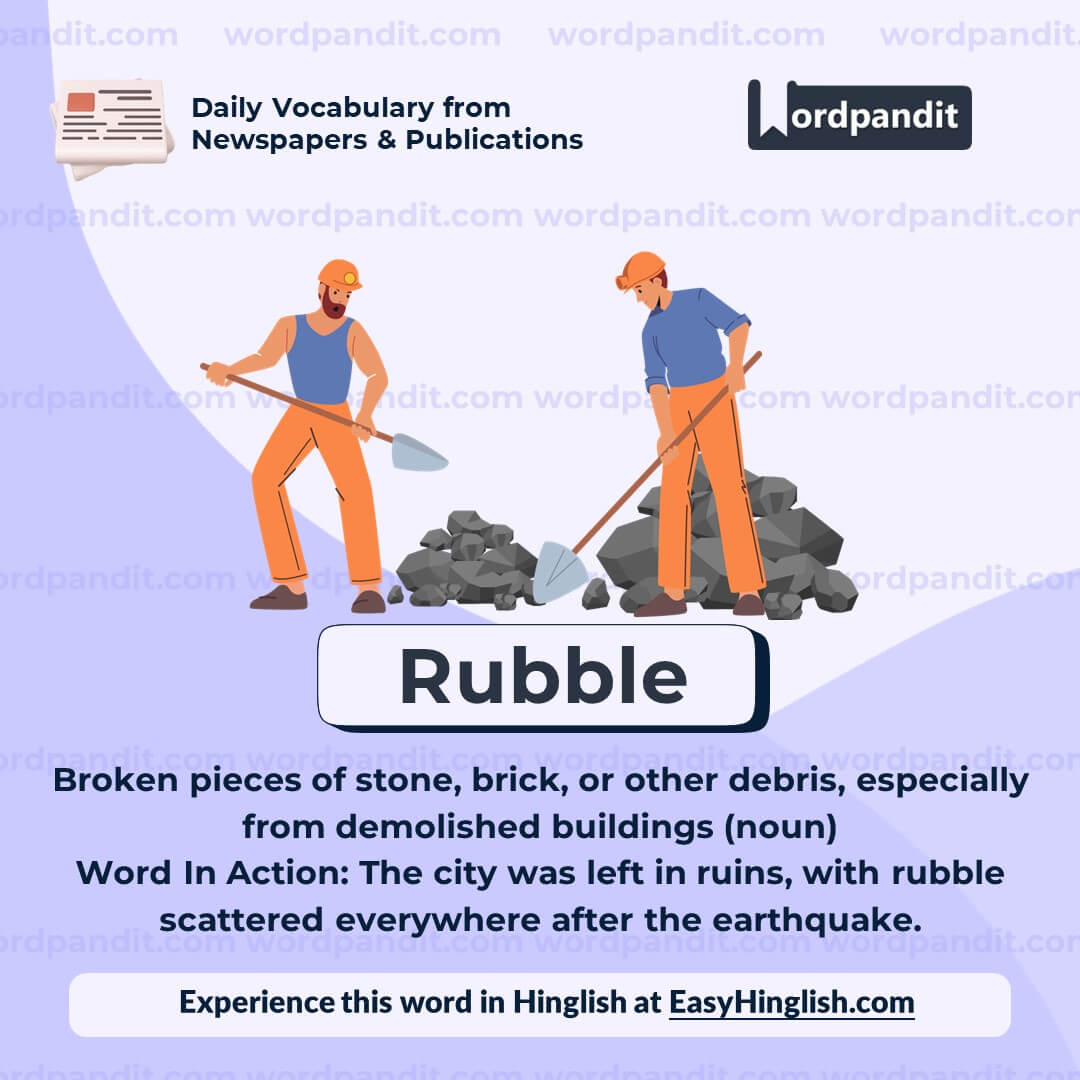
WORD-1: Rubble
Context:
"Entire villages appear to have been reduced to rubble, with trees growing in places where houses once stood." - The Wire
Explanatory Paragraph:
The word "rubble" refers to the broken pieces of stone, brick, or other materials that remain after a building or structure has been destroyed or demolished. It paints a vivid picture of destruction, often after natural disasters, war, or demolition work. In the context above, it highlights the complete devastation of villages, emphasizing the absence of previous structures.
Meaning: Broken fragments of stone, brick, etc., especially from demolished buildings (noun)
Pronunciation: ruh-buhl
Difficulty Level: ⭐⭐ Beginner
Etymology: From Middle English "rubel" or "rubble," likely from Old French "ruble" (refuse or waste)
Prashant Sir's Notes:
Remember "rubble" as the aftermath of destruction—what’s left when something significant has collapsed. It's often associated with war zones, earthquakes, or major demolitions. Visualize a ruined building with only debris left behind.
Synonyms & Antonyms:
Synonyms: debris, wreckage, ruins, fragments, remains
Antonyms: structure, construction, edifice, building
Usage Examples:
- The rescue teams searched through the rubble for survivors.
- After the bombing, the once-busy market was reduced to rubble.
- The archaeologists carefully dug through ancient rubble to find artifacts.
- They cleared the rubble before starting construction of the new school.
Cultural Reference:
"From the rubble of war, nations have rebuilt stronger and more united." — A common narrative in post-conflict documentaries and historical texts.
Think About It:
How can physical 'rubble' serve as a metaphor for emotional or societal breakdowns in literature or real life?
Quick Activity:
Write a short paragraph describing a scene after a storm using the word "rubble" at least twice.
Memory Tip:
Think of "rubble" as "ruins + bubbles" — everything burst and broken like soap bubbles after a crash or collapse.
Real-World Application:
Used in journalism and disaster reports, "rubble" helps convey the severity of destruction after earthquakes, wars, or explosions. It's also common in architectural restoration and urban planning contexts.
WORD-2: Besieged
Context:
"Instead, Israeli authorities continue to actively block MSF and other humanitarian organisations from providing lifesaving assistance to people besieged and bombarded." - The New Indian Express
Explanatory Paragraph:
The word "besieged" is often used in contexts involving war or crisis. Literally, it means to surround a place with armed forces in order to capture it or force its surrender. Metaphorically, it can also describe people under extreme pressure or constant attack. In the context above, it refers to civilians trapped in a war zone, unable to escape or receive aid due to military encirclement and ongoing violence.
Meaning: Surrounded and under attack or pressure (verb, past participle)
Pronunciation: bih-seejd
Difficulty Level: ⭐⭐⭐ Intermediate
Etymology: From Middle English "besiegen," from be- (around) + siegen (to seat, to sit or remain in place during an attack)
Prashant Sir's Notes:
Think of "besieged" in two ways—physically (surrounded by enemy forces) and emotionally or situationally (overwhelmed by problems or demands). It’s a powerful word that conveys urgency, helplessness, and confinement.
Synonyms & Antonyms:
Synonyms: surrounded, trapped, encircled, harassed, under attack
Antonyms: free, liberated, safe, unconfined
Usage Examples:
- The besieged city had no access to food or medicine for weeks.
- She felt emotionally besieged by constant criticism at work.
- The fort was besieged for months before it finally surrendered.
- Healthcare workers rushed to aid the besieged communities after the conflict erupted.
Cultural Reference:
“The city of Sarajevo was besieged for nearly four years during the Bosnian War, making it one of the longest sieges in modern warfare.” — Historical accounts
Think About It:
Can being 'besieged' emotionally or socially be as damaging as being besieged in a physical conflict? How do we recognize and respond to both forms?
Quick Activity:
Write two sentences: one using “besieged” in a military context and another in an emotional or psychological context.
Memory Tip:
“Be-seized” sounds like “be seized”—imagine being seized or surrounded from all sides—that's being besieged.
Real-World Application:
Commonly used in news reports and humanitarian discussions, “besieged” captures the severity of blocked access, trapped populations, or overwhelming crises. It’s also used metaphorically in business, mental health, or academic stress contexts.
WORD-3: Abating
Context:
"It has since evolved into a series of retaliatory attacks, creating a cycle of unrest that shows no signs of abating." - The Wire
Explanatory Paragraph:
"Abating" refers to the process of something becoming less intense or severe. It is often used to describe the reduction of negative conditions such as violence, pain, anger, or weather phenomena. In the context above, the sentence expresses concern that the unrest is ongoing and not diminishing in intensity—it shows no signs of slowing down or calming.
Meaning: Becoming less intense or widespread; diminishing (verb, present participle of "abate")
Pronunciation: uh-bay-ting
Difficulty Level: ⭐⭐ Beginner
Etymology: From Old French "abatre" meaning "to beat down," which comes from Latin "battuere" (to beat)
Prashant Sir's Notes:
Abating is a very useful verb when describing reduction in intensity. You’ll often see it in news reports, especially in reference to conflict, storms, or public tension. If something is abating, it’s calming down, fading, or weakening.
Synonyms & Antonyms:
Synonyms: diminishing, subsiding, easing, decreasing, waning
Antonyms: intensifying, escalating, increasing, rising
Usage Examples:
- The storm finally began abating after hours of heavy rainfall.
- His anger showed no signs of abating despite the apology.
- The protests continued for weeks without abating.
- Pain from the injury was slowly abating after the medication kicked in.
Cultural Reference:
"The Great Depression showed no signs of abating until major policy reforms were implemented." — Economic history texts
Think About It:
Why do certain conflicts or social tensions resist abating, even when efforts are made to resolve them?
Quick Activity:
Think of a situation in your life or in the news where something was abating. Write one sentence describing it using the word “abating.”
Memory Tip:
Think of "abating" like “a-bate” — as in bait being taken away. The intensity is being pulled back, like a fishing line being reeled in.
Real-World Application:
"Abating" is frequently used in legal, medical, political, and environmental contexts to describe a decrease in severity—like abating a nuisance, abating pain, or abating violence.
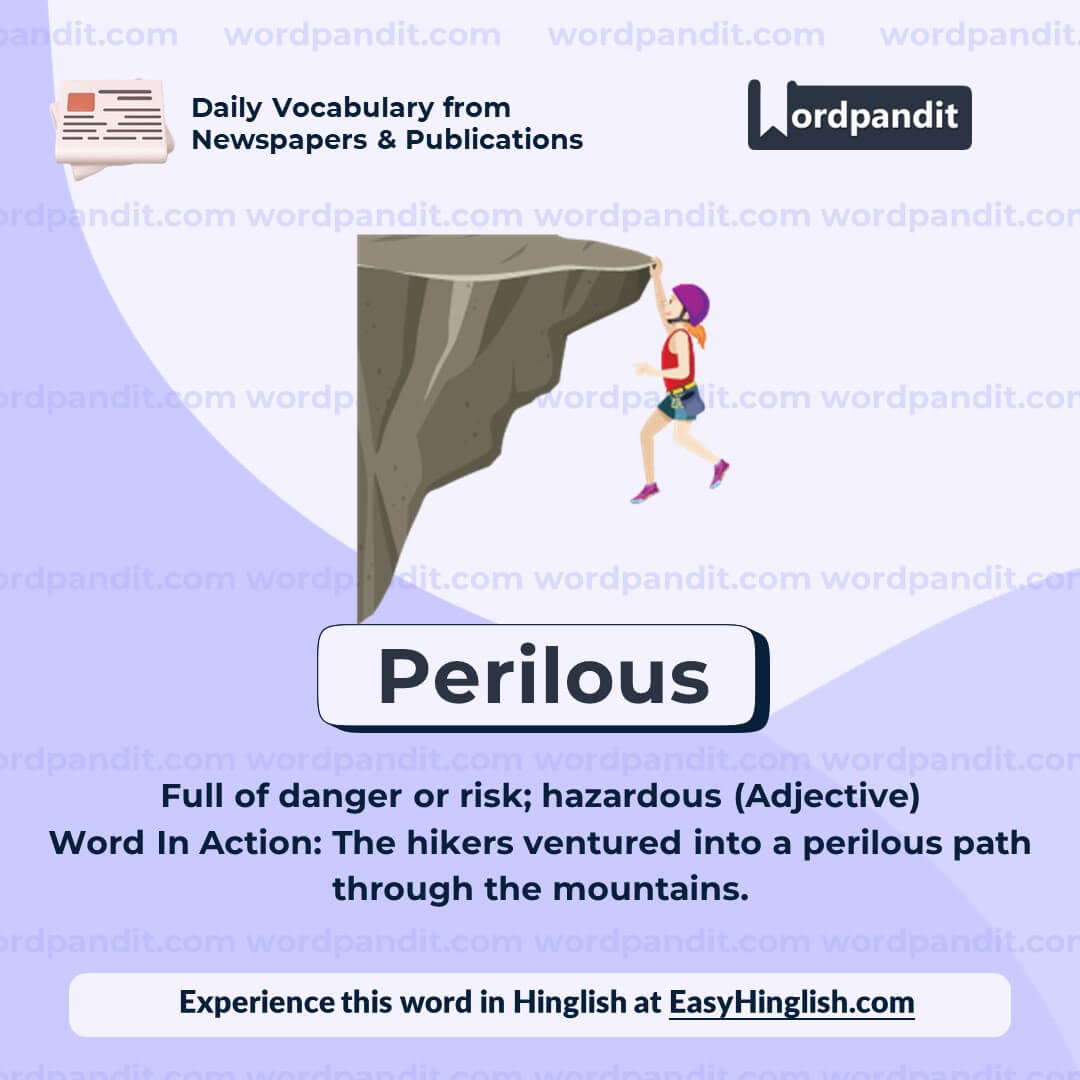
WORD-4: Perilous
Context:
"These unofficial borders have turned into perilous frontiers, where crossing over can have fatal consequences." - The Wire
Explanatory Paragraph:
The word "perilous" describes something that is full of danger or risk. It emphasizes the seriousness of a threat and is often used to warn or alert someone to the potential for harm. In the context of the sentence, it paints a vivid picture of how unstable and life-threatening the situation has become at these unofficial borders—crossing them can lead to severe or even fatal consequences.
Meaning: Full of danger or risk (adjective)
Pronunciation: peh-ruh-luhs
Difficulty Level: ⭐⭐⭐ Intermediate
Etymology: From Old French "perilous," derived from Latin "periculosus" (dangerous), from "periculum" meaning danger
Prashant Sir's Notes:
When you see "perilous," think of "peril" (danger). It is a formal or literary word often used in news reports, historical texts, and adventure stories. Use it when describing serious threats, not small everyday risks.
Synonyms & Antonyms:
Synonyms: dangerous, hazardous, risky, unsafe, treacherous
Antonyms: safe, secure, harmless, protected
Usage Examples:
- The hikers ventured into a perilous mountain trail just before sunset.
- Speaking out against the regime was a perilous act of bravery.
- They crossed the river under perilous conditions during the flood.
- She made a perilous journey through the war-torn region to reunite with her family.
Cultural Reference:
"Frodo and Sam set out on a perilous quest to destroy the One Ring." — *The Lord of the Rings* by J.R.R. Tolkien
Think About It:
What drives people to take perilous risks, even when they are aware of the potential consequences?
Quick Activity:
List three professions that involve perilous situations and explain why each one is considered risky.
Memory Tip:
Remember: "Perilous = Peril + us" — When danger (peril) is around us, things are perilous.
Real-World Application:
"Perilous" is used in journalism, storytelling, and political analysis to highlight serious threats—like perilous journeys of refugees, perilous decisions in leadership, or perilous conditions in disaster zones.
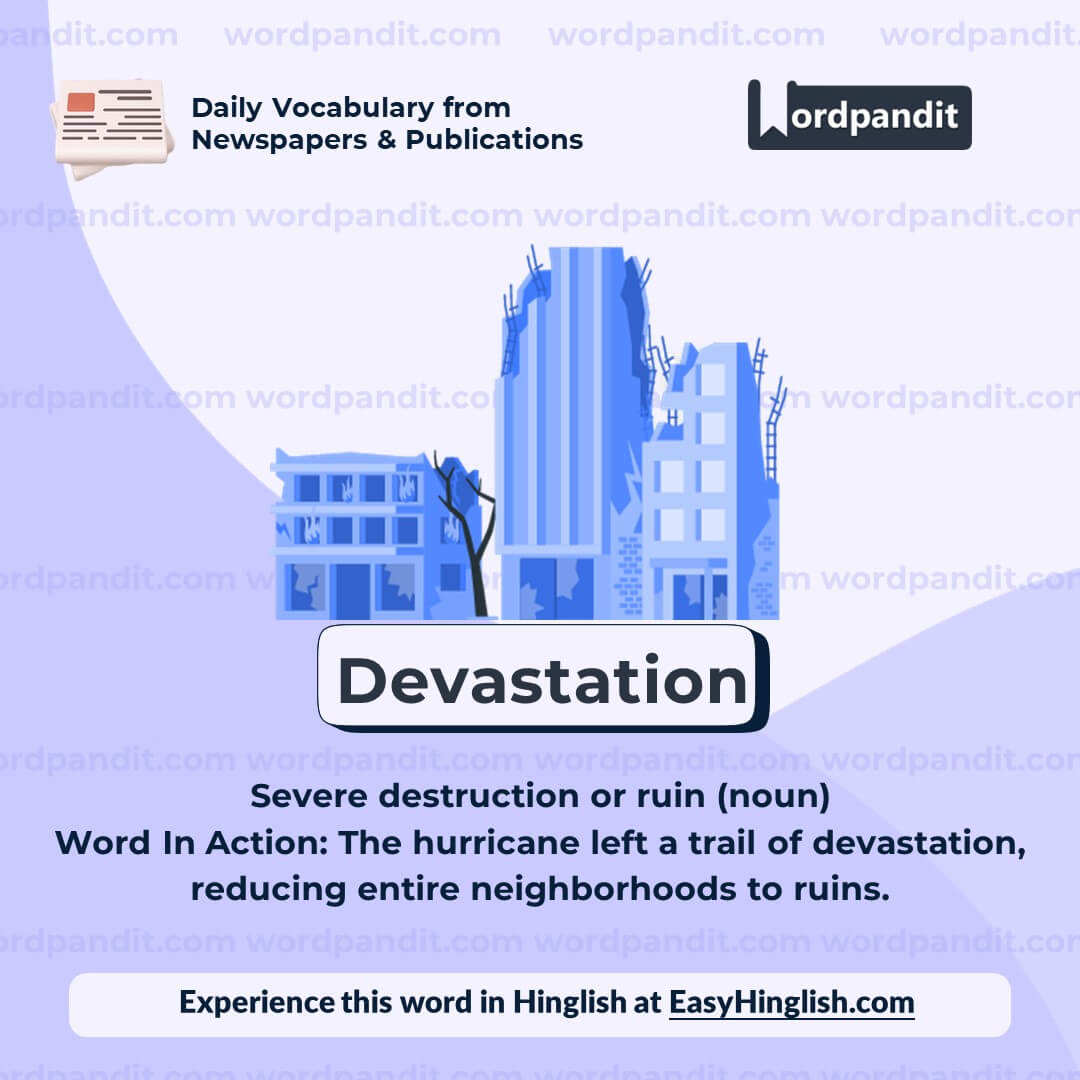
WORD-5: Devastation
Context:
"Following satellite images captured by The Wire reveal the full extent of the devastation. These images were captured in early 2025." - The Wire
Explanatory Paragraph:
"Devastation" refers to extreme destruction and ruin, often caused by war, natural disasters, or large-scale attacks. The word suggests not only physical damage but also emotional and social loss. In the sentence above, it emphasizes the severity of the destruction seen in the satellite images—possibly ruined buildings, scorched land, or collapsed infrastructure. It's a powerful word used to convey a sense of overwhelming loss or wreckage.
Meaning: Great destruction or damage (noun)
Pronunciation: deh-vuh-stay-shuhn
Difficulty Level: ⭐⭐ Beginner
Etymology: From Latin "devastatio," from "devastare" meaning "to lay waste"
Prashant Sir's Notes:
"Devastation" is often the aftermath of a calamity—think of towns flattened by a tornado or villages reduced to rubble in war. It’s not just physical; emotional devastation can describe deep psychological damage too.
Synonyms & Antonyms:
Synonyms: destruction, ruin, desolation, wreckage, havoc
Antonyms: restoration, repair, renewal, reconstruction
Usage Examples:
- The earthquake left a trail of devastation across the region.
- The emotional devastation after losing her family was unimaginable.
- Wildfires have caused widespread devastation in recent years.
- The war brought devastation to entire cities and displaced millions.
Cultural Reference:
"The devastation of Hiroshima and Nagasaki marked a turning point in world history." — Historical accounts of World War II
Think About It:
How does the experience of devastation—physical or emotional—change the way individuals and societies rebuild?
Quick Activity:
Choose a recent natural disaster or conflict from the news. Write one sentence using "devastation" to describe its impact.
Memory Tip:
Devastation = “de” (down) + “vast” (huge) → Think of a vast area brought down to ruin.
Real-World Application:
"Devastation" is a key term in disaster reporting, humanitarian aid, and psychological health. It helps express the scale and seriousness of loss—whether physical damage to cities or emotional damage to communities.


