

Daily Vocabulary from Indian Newspapers and Publications
Welcome to Wordpandit’s Indian Vocabulary Hub
At Wordpandit, we understand the importance of staying rooted in the local context while expanding your language skills. This section focuses on enriching your vocabulary with words and phrases drawn from India’s leading newspapers and publications, ensuring you're learning vocabulary that is practical, relevant, and uniquely Indian.
Why Indian Sources Matter
We believe that the best way to master any language is by immersing yourself in local content. That’s why we carefully curate vocabulary from top Indian publications, including:
- The Hindu
- The Times of India
- The Economic Times
- Hindustan Times
- Live Mint
- The Indian Express
- And many others...
Stay Updated, Stay Relevant
With daily updates from Indian news sources, you’ll be consistently learning words that reflect the trends and shifts in Indian society and culture. Our focus is to provide vocabulary that enhances your understanding of the language in an Indian context.
How Wordpandit Supports Your Goals
Whether you’re preparing for exams, aiming to improve your professional communication, or simply want to stay connected with the latest Indian vocabulary, Wordpandit is here to guide you every step of the way.
Learn with a Practical Approach
Our interactive learning methodology includes real-world examples, engaging activities, and context-specific usage to ensure that every word becomes part of your active vocabulary.
Dive into Indian Vocabulary Today!
Why Choose Wordpandit?
Practical Learning: Focus on words you'll actually encounter in real-world reading, enhancing your comprehension and communication skills.
Diverse Content: From current affairs to scientific breakthroughs, our varied sources expose you to vocabulary across multiple domains.
Effortless Integration: Make Wordpandit a part of your daily routine. Just a few minutes each day can significantly boost your lexicon over time.
Your Path to Vocabulary Mastery
- Visit our Daily Vocabulary section regularly
- Explore new words and their usage in context
- Practice incorporating these words into your own writing and speech
- Track your progress as your vocabulary expands
Start Your Journey Today
Embark on your vocabulary enhancement journey with Wordpandit. By consistently engaging with our daily posts, you'll build a robust vocabulary that serves you well in academic, professional, and personal contexts.
Remember, a word a day keeps linguistic limitations at bay. Make Wordpandit your daily companion in the quest for vocabulary excellence!
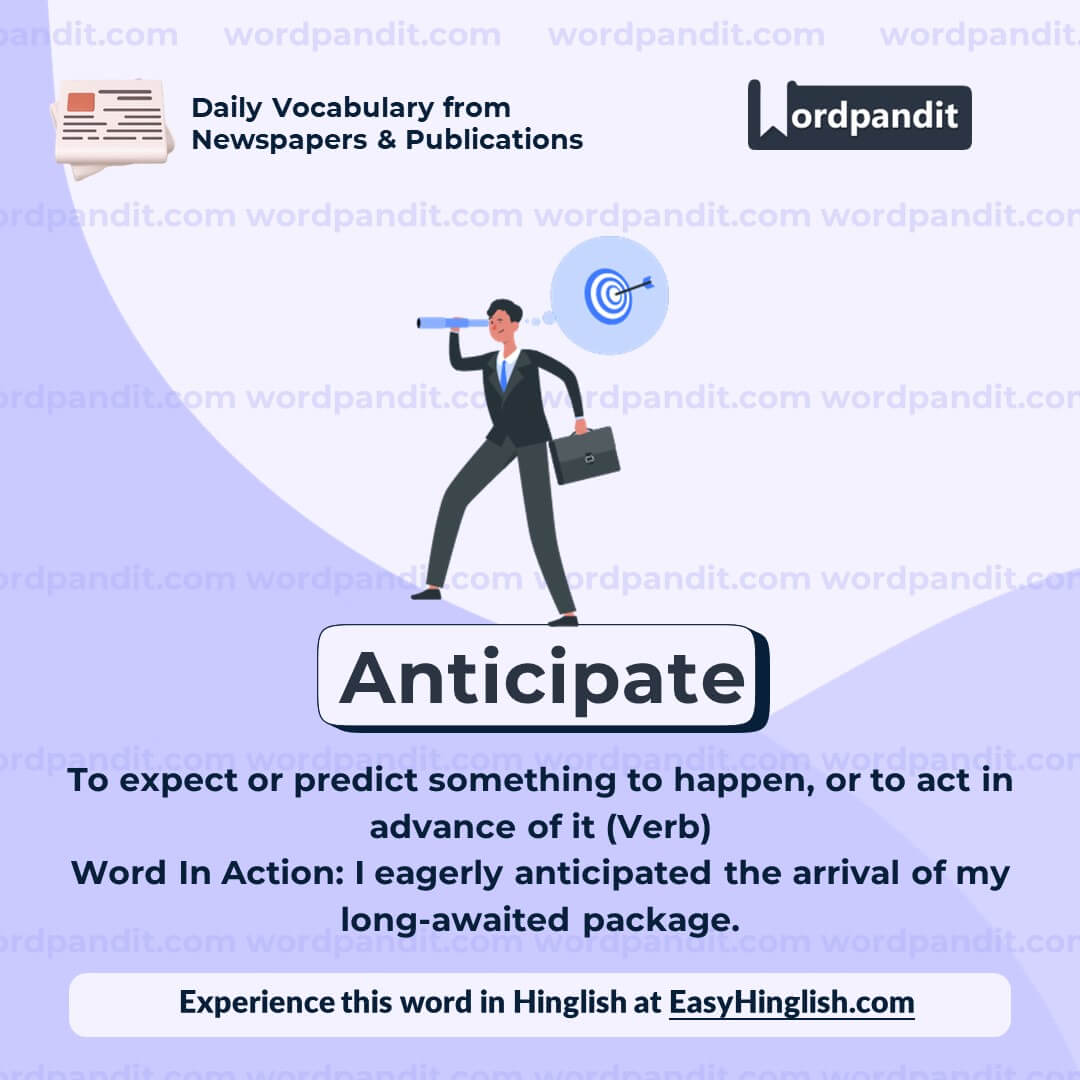
WORD-1: Anticipate
Context:
"For many, the prospect of artificial general intelligence or AGI now seems more real, urgent and closer than anticipated." - The Wire
Explanatory Paragraph:
"Anticipate" means to expect something to happen or to be ready for it before it actually occurs. In the context of the sentence, people believed AGI would take longer to arrive, but now it appears to be approaching sooner than they originally thought. The word suggests a sense of planning or mental preparation in advance.
Meaning: To expect or look ahead to something (Verb)
Pronunciation: an-TISS-uh-pate
Difficulty Level: ⭐⭐ Beginner to Intermediate
Etymology: From Latin anticipatus, past participle of anticipare, meaning "to take before, forestall"
Prashant Sir's Notes:
“Anticipate” implies more than just passive waiting—it suggests planning or mentally preparing for an event. In exams, anticipate questions by reviewing past papers. In life, anticipate challenges to stay ahead.
Synonyms & Antonyms:
Synonyms: expect, foresee, predict, prepare for, await
Antonyms: doubt, ignore, miss, overlook, be surprised by
Usage Examples:
- We anticipate heavy traffic during the holiday weekend.
- The company anticipated strong demand for the new smartphone model.
- She anticipated his reaction and chose her words carefully.
- Scientists anticipate a major breakthrough in climate research within the next decade.
Cultural Reference:
"Do not anticipate trouble or worry about what may never happen. Keep in the sunlight." - Benjamin Franklin
Think About It:
How does anticipating a problem change the way we respond to it—and can it sometimes lead to unnecessary stress?
Quick Activity:
Write down three things you anticipate happening this week, and explain how you are preparing for each of them.
Memory Tip:
“Anticipate” sounds like “anti + sip + eight”—imagine you're so ready for the guests at 8 PM that you've already made the drinks (“anti-sip” at eight!).
Real-World Application:
In project management, teams must anticipate potential risks and delays to ensure successful delivery. In daily life, anticipating traffic or weather helps in planning better commutes or trips.
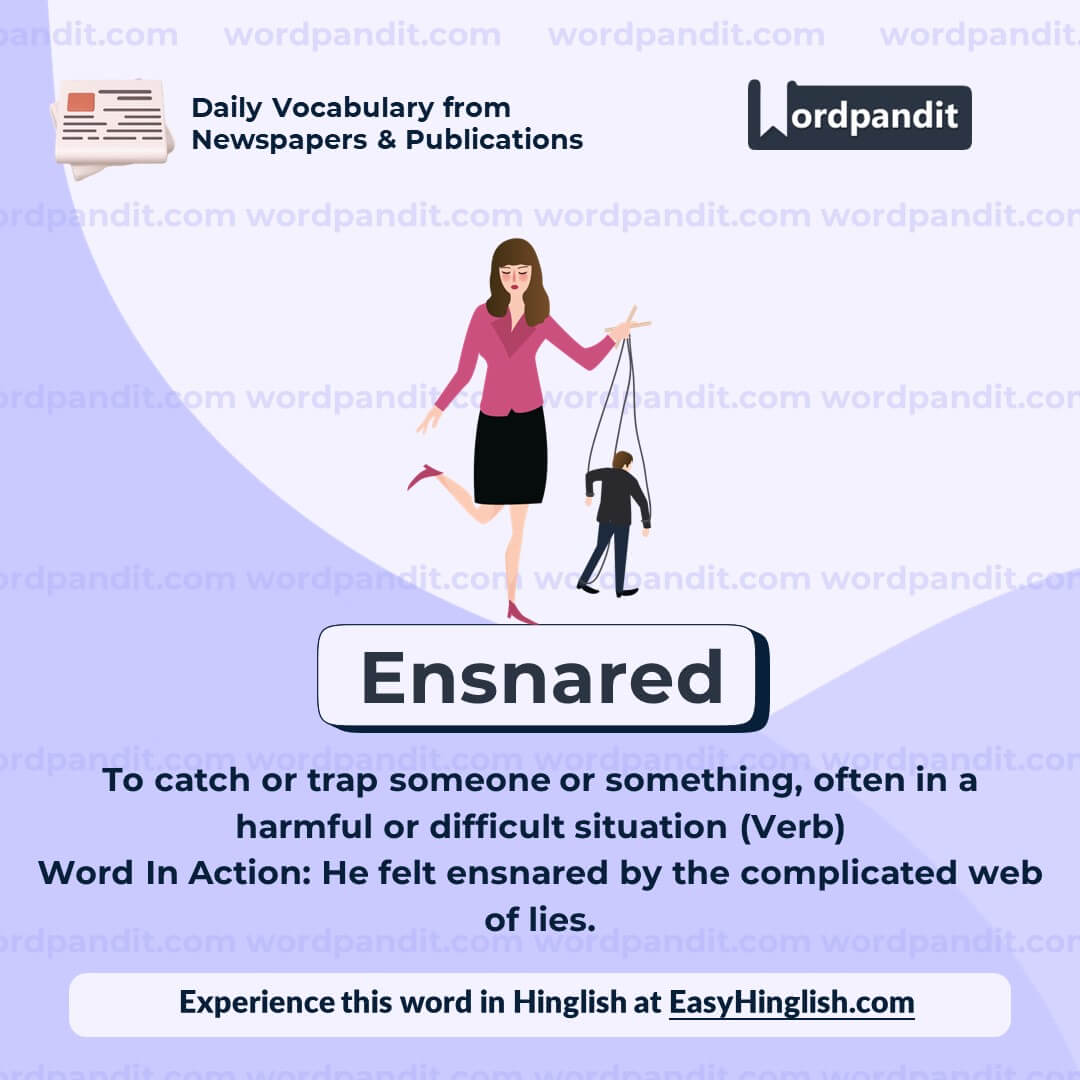
WORD-2: Ensnared
Context:
"For over 14 months, the people of Gaza have endured unimaginable suffering, ensnared in what can only be described as a death trap." - The Wire
Explanatory Paragraph:
"Ensnared" means being trapped or caught, often in a difficult or dangerous situation from which escape is very hard. In the sentence, it describes the people of Gaza being stuck in a deadly situation that they cannot get out of, almost like being caught in a trap or web with no clear way to freedom or relief.
Meaning: To be caught or trapped, often in a harmful or restricting situation (Verb - Past Tense)
Pronunciation: en-SNAIRD
Difficulty Level: ⭐⭐⭐ Intermediate
Etymology: From Middle English snaren, from Old Norse snara meaning "a noose or snare"
Prashant Sir's Notes:
"Ensnared" is powerful in emotional and political contexts. It's more than just being physically trapped—it's about being caught in a web of problems, violence, or systems where escape seems impossible. Use it to describe complex struggles, not just literal traps.
Synonyms & Antonyms:
Synonyms: trapped, caught, entangled, cornered, imprisoned
Antonyms: freed, released, liberated, escaped
Usage Examples:
- The rabbit was ensnared in the hunter's net before it could flee.
- He became ensnared in a series of financial scams and legal troubles.
- Many young people are ensnared by the false glamour of fast fame on social media.
- She found herself emotionally ensnared in a toxic relationship.
Cultural Reference:
In Greek mythology, Hephaestus ensnared Ares and Aphrodite in an invisible net to expose their affair to the gods—an early example of emotional and physical entrapment in storytelling.
Think About It:
Can someone be mentally or emotionally ensnared without realizing it? How can one recognize such invisible traps?
Quick Activity:
Write a short paragraph (3–4 lines) describing a situation—real or imagined—where someone is ensnared, using the word naturally.
Memory Tip:
Think of “ensnared” as being “in a snare”—a trap. If you’re ensnared, you’re stuck in something just like an animal in a net.
Real-World Application:
“Ensnared” is commonly used in journalism, literature, and legal contexts to describe people caught in war zones, unjust systems, or complex emotional states. It’s useful for conveying helplessness and lack of escape.
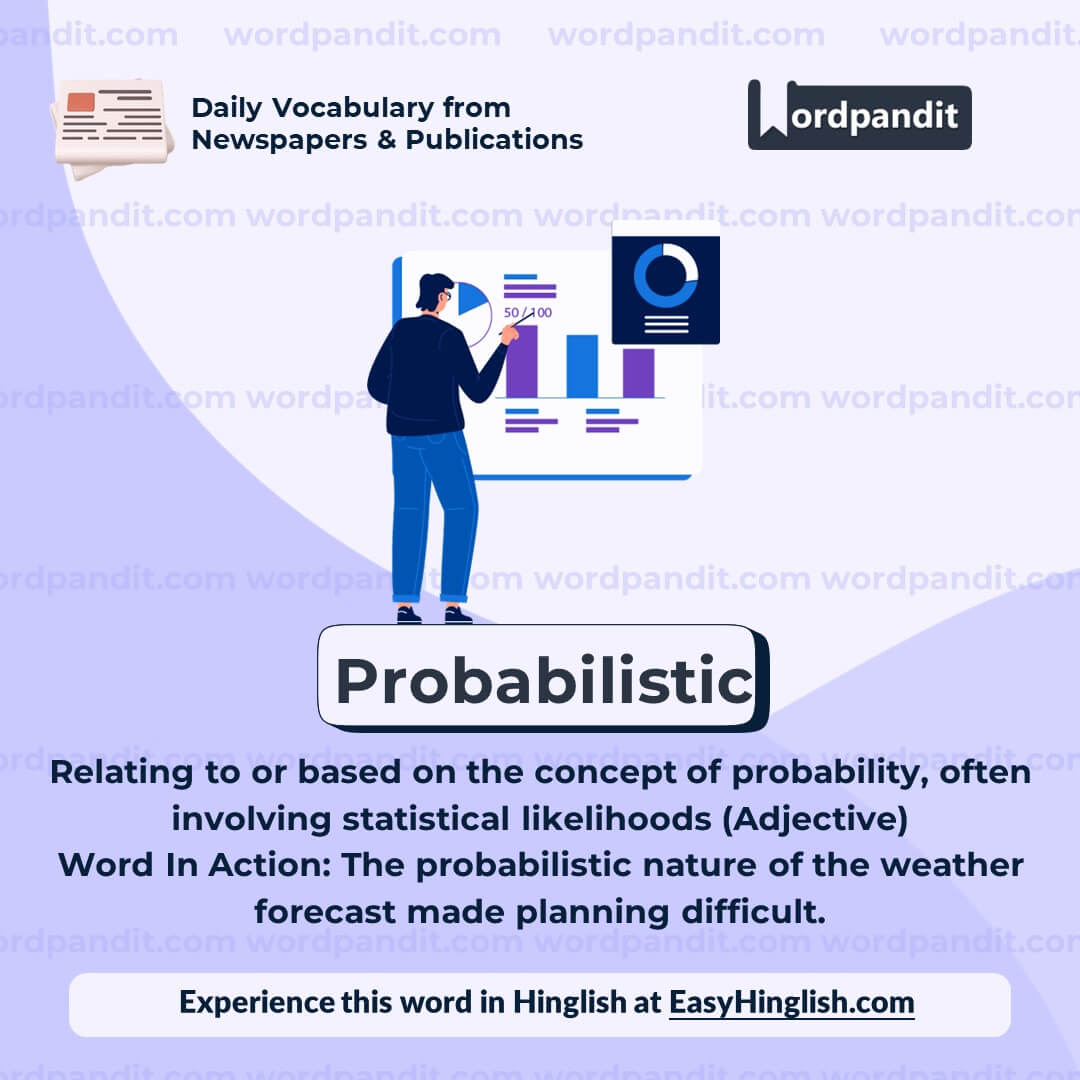
WORD-3: Probabilistic
Context:
"It was 'trained' on millions of examples of human text, constructing probabilistic 'rules' about which combinations of words are most likely." - The Wire
Explanatory Paragraph:
"Probabilistic" refers to something that is based on or involves probability—the likelihood or chance of something happening. In the context of AI or language models, "probabilistic rules" mean that the system doesn’t follow fixed rules but instead makes predictions based on what is most likely, using patterns found in large amounts of data. It emphasizes uncertainty and statistical likelihood over certainty.
Meaning: Based on or involving probability or randomness (Adjective)
Pronunciation: pro-buh-buh-LIS-tik
Difficulty Level: ⭐⭐⭐ Intermediate
Etymology: From "probability" + suffix "-istic", meaning "related to or characterized by"
Prashant Sir's Notes:
“Probabilistic” is key in understanding modern technologies like AI, where outcomes aren’t guaranteed but are judged by likelihood. It’s also useful in everyday reasoning—life rarely follows certainty, but patterns and probabilities help guide decisions.
Synonyms & Antonyms:
Synonyms: statistical, likely, chance-based, non-deterministic
Antonyms: deterministic, certain, definite, guaranteed
Usage Examples:
- The weather forecast is based on a probabilistic model, not a certainty.
- Modern encryption techniques often use probabilistic algorithms to enhance security.
- Her investment strategy was guided by a probabilistic understanding of market trends.
- Language models like ChatGPT generate responses using probabilistic associations between words.
Cultural Reference:
In the movie *Moneyball* (2011), the use of probabilistic data to choose baseball players revolutionized the sport—demonstrating that data-driven predictions can outperform intuition.
Think About It:
Should decisions in fields like law or medicine be guided more by probabilistic data or by individual judgment and experience?
Quick Activity:
List three real-world systems that rely on probabilistic thinking (e.g., weather forecasts), and describe how probability influences their outcomes.
Memory Tip:
Think of “probabilistic” as “probability + logic”—decisions based on chances, not certainties.
Real-World Application:
In AI, weather prediction, finance, and medicine, probabilistic models are used to assess risks, forecast events, and guide decisions where outcomes are uncertain. Understanding probabilistic reasoning is crucial in the age of data.
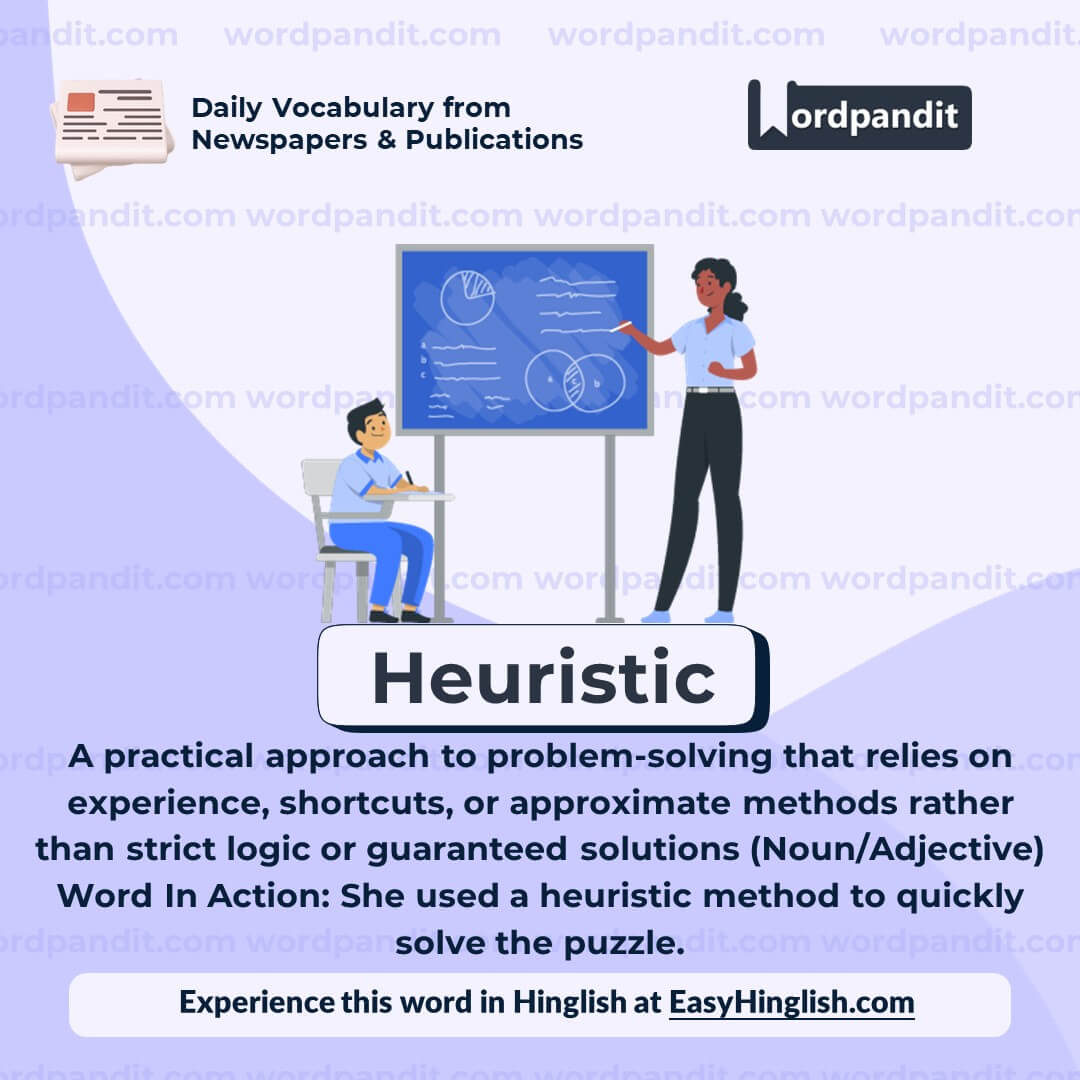
WORD-4: Heuristic
Context:
"It would then choose the 'best' according to some loosely defined rule, or 'heuristic'." - The Wire
Explanatory Paragraph:
"Heuristic" refers to a practical method or approach used to make decisions or solve problems quickly and efficiently, even if it's not perfect or guaranteed to be optimal. In the context of AI, a heuristic is a simplified rule or guideline the system uses to decide which output is most appropriate. It helps navigate complex choices without having to analyze every possible option in depth.
Meaning: A practical problem-solving method or rule of thumb used for quick decision-making (Noun/Adjective)
Pronunciation: hyoo-RIS-tik
Difficulty Level: ⭐⭐⭐ Intermediate
Etymology: From Greek heuriskein, meaning "to find" or "discover"; the same root as in "eureka"
Prashant Sir's Notes:
A heuristic is like a shortcut your brain or a system uses when time or resources are limited. It won’t always get you the perfect answer, but it often gets you a “good enough” solution faster. Think of it as smart approximation—very useful in exams, coding, or even real-life decision-making.
Synonyms & Antonyms:
Synonyms: rule of thumb, shortcut, approximation, guideline
Antonyms: algorithm, exact method, formulaic approach
Usage Examples:
- He used a simple heuristic to choose the shortest route: avoid traffic signals.
- Many students develop their own heuristics for answering multiple-choice questions.
- The AI applies a heuristic to prioritize the most relevant search results.
- Heuristics help humans make decisions quickly, though not always accurately.
Cultural Reference:
In behavioral economics, Daniel Kahneman and Amos Tversky studied how people rely on mental heuristics—like the “availability heuristic”—to make judgments quickly, often leading to cognitive biases. Their work revolutionized how we think about decision-making.
Think About It:
When might relying on a heuristic be more harmful than helpful—especially in areas like law, medicine, or hiring?
Quick Activity:
Write down one heuristic you use in your daily life (e.g., choosing what to eat, managing time). Is it always effective?
Memory Tip:
Heuristic comes from the same root as “eureka!”—it’s about discovering smart, fast solutions. Think: “Hurry-stick = Heuristic” for quick decisions!
Real-World Application:
Heuristics are everywhere—in product recommendations, game strategies, hiring processes, and personal choices. In AI, they help systems function efficiently when exhaustive calculation isn’t practical.
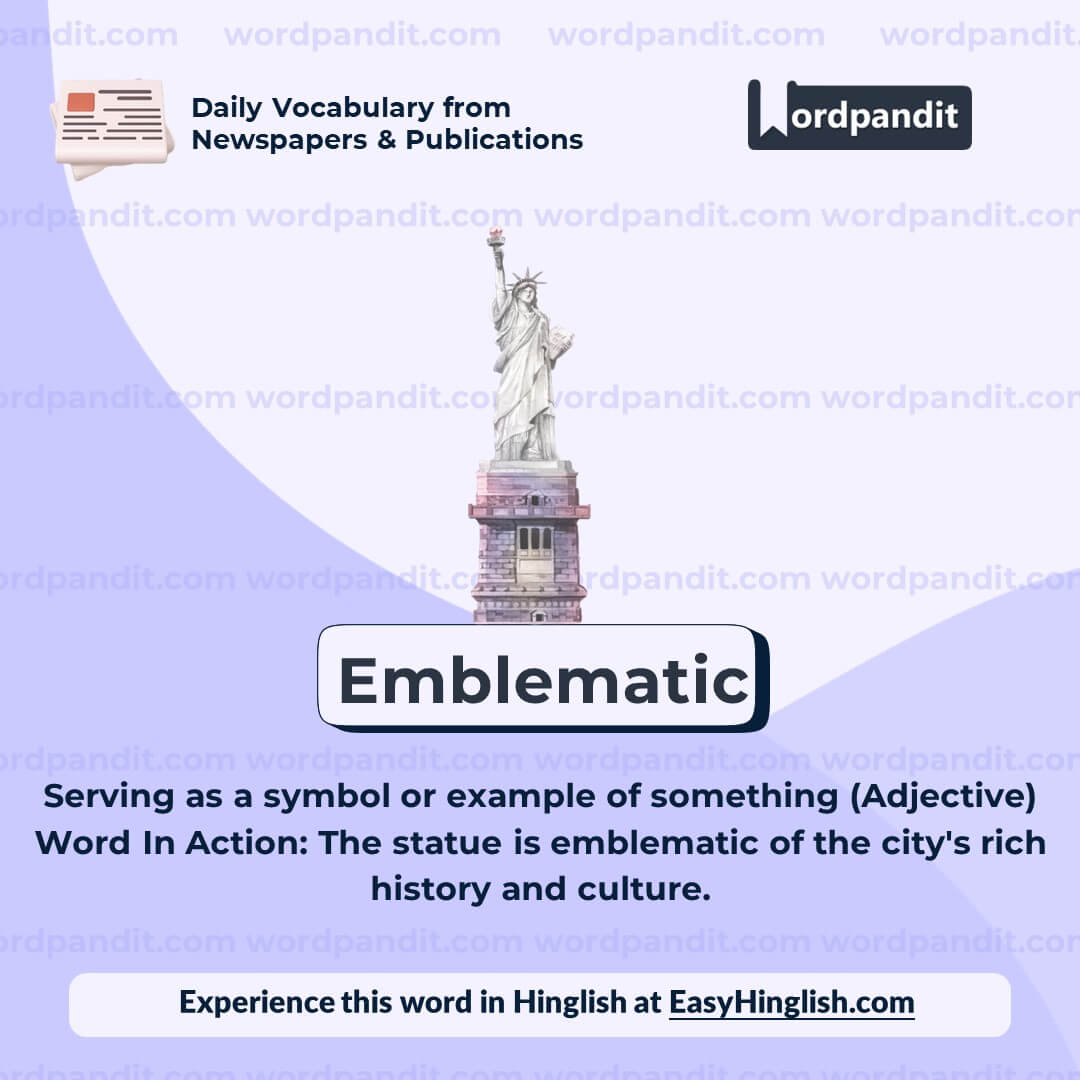
WORD-5: Emblematic
Context:
"The chips are down, I rise up!” This statement, emblematic of Donald Trump’s defiant spirit, reflects the essence of his bold approach to politics and economics." - The Wire
Explanatory Paragraph:
"Emblematic" means symbolic or representative of a particular quality, idea, or group. In the sentence above, Trump's bold declaration is described as "emblematic" of his overall political style—it captures or stands for his broader defiant and confrontational approach. When something is emblematic, it’s not just an example; it is an icon or symbol of a bigger concept.
Meaning: Serving as a symbol or representative of something (Adjective)
Pronunciation: em-bleh-MA-tik
Difficulty Level: ⭐⭐⭐ Intermediate
Etymology: From French emblématique, from Latin emblema meaning "inlaid work, ornament", metaphorically extended to mean "symbol"
Prashant Sir's Notes:
Use “emblematic” when you want to say that something stands for or powerfully expresses a larger idea. It's commonly used in politics, literature, and analysis. For example, “The Statue of Liberty is emblematic of American freedom.”
Synonyms & Antonyms:
Synonyms: symbolic, representative, iconic, indicative, suggestive
Antonyms: literal, unrelated, insignificant, unrepresentative
Usage Examples:
- The peace dove is emblematic of non-violence and harmony.
- Her victory was emblematic of a larger shift in public opinion.
- The crumbling buildings are emblematic of the city’s long decline.
- That song became emblematic of an entire generation's mood and identity.
Cultural Reference:
The Berlin Wall, once emblematic of Cold War division, became a symbol of unity and freedom after its fall in 1989.
Think About It:
What objects, phrases, or images do you consider emblematic of your generation or country—and why?
Quick Activity:
Pick a photo or symbol (e.g., the Olympic rings, a national flag). Describe in one sentence what it is emblematic of.
Memory Tip:
Think of “emblem” (a symbol) and add “-atic” — so “emblematic” = something that acts like an emblem or symbol.
Real-World Application:
In journalism, speeches, and cultural analysis, “emblematic” is used to connect a specific example to a broader trend. Recognizing emblematic moments helps interpret deeper meanings in events and symbols.


