


Daily Vocabulary from International Newspapers and Publications
Expand Your Vocabulary with Wordpandit’s Global Vocabulary Hub
At Wordpandit, we are committed to helping you develop a truly global vocabulary by drawing from some of the most respected international publications. This section is designed to keep you ahead of the curve by introducing you to words that define global conversations and trends.
The Power of Global Sources
To help you think and communicate on a global scale, we curate vocabulary from renowned international sources, such as:
- The New York Times
- The Washington Post
- BBC
- The Guardian
- The Economist
- Scientific American
- Psychology Today
- And many more...
Stay Global, Stay Competitive
Our daily updates from international publications ensure you are consistently exposed to new words that reflect global news and developments, making sure your vocabulary is not only current but also globally relevant.
Enhance Your Global Perspective
Whether you’re preparing for international exams, aiming to excel in global business communication, or want to enhance your language skills for personal growth, Wordpandit offers the resources you need to thrive in a global context.
Effective Learning, Global Reach
Our learning methodology combines global examples, memory aids, and interactive activities, allowing you to internalize new words effectively and apply them in real-world scenarios.
Begin Your Global Vocabulary Journey Now!
Why Choose Wordpandit?
Practical Learning: Focus on words you'll actually encounter in real-world reading, enhancing your comprehension and communication skills.
Diverse Content: From current affairs to scientific breakthroughs, our varied sources expose you to vocabulary across multiple domains.
Effortless Integration: Make Wordpandit a part of your daily routine. Just a few minutes each day can significantly boost your lexicon over time.
Your Path to Vocabulary Mastery
- Visit our Daily Vocabulary section regularly
- Explore new words and their usage in context
- Practice incorporating these words into your own writing and speech
- Track your progress as your vocabulary expands
Start Your Journey Today
Embark on your vocabulary enhancement journey with Wordpandit. By consistently engaging with our daily posts, you'll build a robust vocabulary that serves you well in academic, professional, and personal contexts.
Remember, a word a day keeps linguistic limitations at bay. Make Wordpandit your daily companion in the quest for vocabulary excellence!

WORD-1: Figments
Context:
"How true to life, they would always remain figments, unlike the imperceptible particles I detected in the laboratory. I could never empathize with protons, electrons and other particles, but they remained more real than the complex protagonists of Spanish literature." - Aeon
Explanatory Paragraph:
"Figments" refers to things that exist only in the imagination and are not real or tangible. In the sentence above, the author contrasts fictional characters—who, despite their depth, are products of imagination—with subatomic particles that, while abstract, have measurable existence. This highlights the tension between emotional resonance and physical reality.
Meaning: Something invented or imagined; a fabrication (Noun)
Pronunciation: FIG-muhnts
Difficulty Level: ⭐⭐ Moderate
Etymology: From Latin *figmentum*, meaning “something formed or invented,” from *fingere* (“to form, devise”)
Prashant Sir's Notes:
Think of "figments" as mental creations—imaginary stories, ideas, or even dreams that don't exist in physical reality. It’s often used in phrases like “a figment of your imagination.”
Synonyms & Antonyms:
Synonyms: illusion, fabrication, hallucination, fantasy, invention
Antonyms: reality, fact, truth, actuality
Usage Examples:
- Her fear of monsters under the bed was just a figment of her imagination.
- The conspiracy theory was dismissed as a figment created to mislead the public.
- He claimed to see ghosts, but most people believed they were mere figments.
- The plot of the novel was a brilliant figment of the author’s imagination.
Cultural Reference:
"Figment the dragon" is a character from Disney's Epcot theme park, symbolizing imagination and creativity. He represents the idea that what we imagine can have a meaningful impact. - Disney
Think About It:
Can figments of our imagination influence our real-world decisions or behavior? If so, how?
Quick Activity:
List three figments from your childhood imagination (e.g., imaginary friends, monsters, dream worlds). Then, describe how they influenced your thinking or emotions at the time.
Memory Tip:
FIGments are like mental "figures"—they're shaped in your mind but don’t exist in the real world.
Real-World Application:
Understanding "figments" is useful when analyzing fiction, distinguishing imagination from reality, or identifying delusions in psychological contexts. It also helps in critical thinking and media literacy.
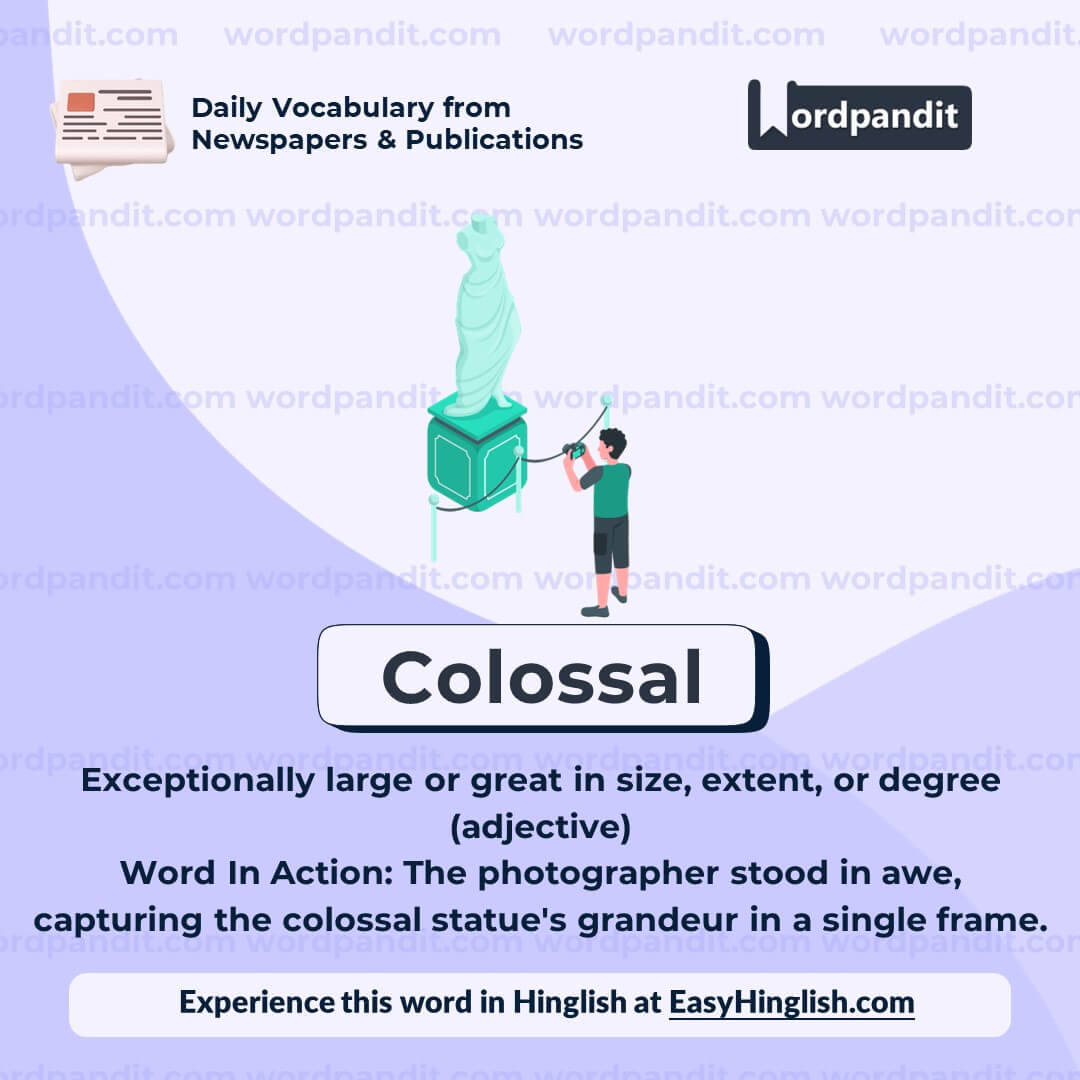
WORD-2: Colossal
Context:
"The New Japanese Minimalism (2015) reframed clutter as a dire threat to mental health and spiritual growth. They have become colossal hits in the United States and other countries. However, as the world turns to Japan to tidy up." - Aeon
Explanatory Paragraph:
"Colossal" is used to emphasize the massive size, scale, or impact of something. In the context above, the term highlights the immense popularity and influence of the Japanese minimalism movement internationally. The word often carries a sense of awe or impressive enormity, whether physical, emotional, or metaphorical.
Meaning: Extremely large or great; enormous (Adjective)
Pronunciation: kuh-LOSS-uhl
Difficulty Level: ⭐⭐ Moderate
Etymology: From Latin *colossus*, meaning “a giant statue,” derived from Greek *kolossos*
Prashant Sir's Notes:
Use "colossal" when you want to exaggerate size or significance—whether it's a colossal mistake, a colossal achievement, or even a colossal amount of clutter. It adds dramatic weight to your description.
Synonyms & Antonyms:
Synonyms: gigantic, enormous, immense, massive, monumental
Antonyms: tiny, insignificant, small, modest
Usage Examples:
- The company suffered a colossal loss after its data was leaked.
- The statue stood at the park's center, a colossal tribute to the city's founder.
- Her performance was a colossal success, earning standing ovations around the world.
- They faced a colossal challenge in trying to rebuild the village after the flood.
Cultural Reference:
The *Colossus of Rhodes* was one of the Seven Wonders of the Ancient World—a colossal bronze statue symbolizing strength and resilience. - Ancient Greek History
Think About It:
In a world that increasingly values minimalism, are “colossal” achievements or possessions still seen as desirable—or do they represent excess?
Quick Activity:
Write down three "colossal" things in your life—these could be challenges, achievements, regrets, or goals. Reflect on how their size or impact shaped you.
Memory Tip:
Think of "colossal" as "colossus-sized"—anything so big that it’s hard to ignore!
Real-World Application:
"Colossal" is often used in media, business, and science to describe scale—colossal profits, colossal disasters, colossal changes in climate—making it a versatile word for both dramatic storytelling and technical contexts.
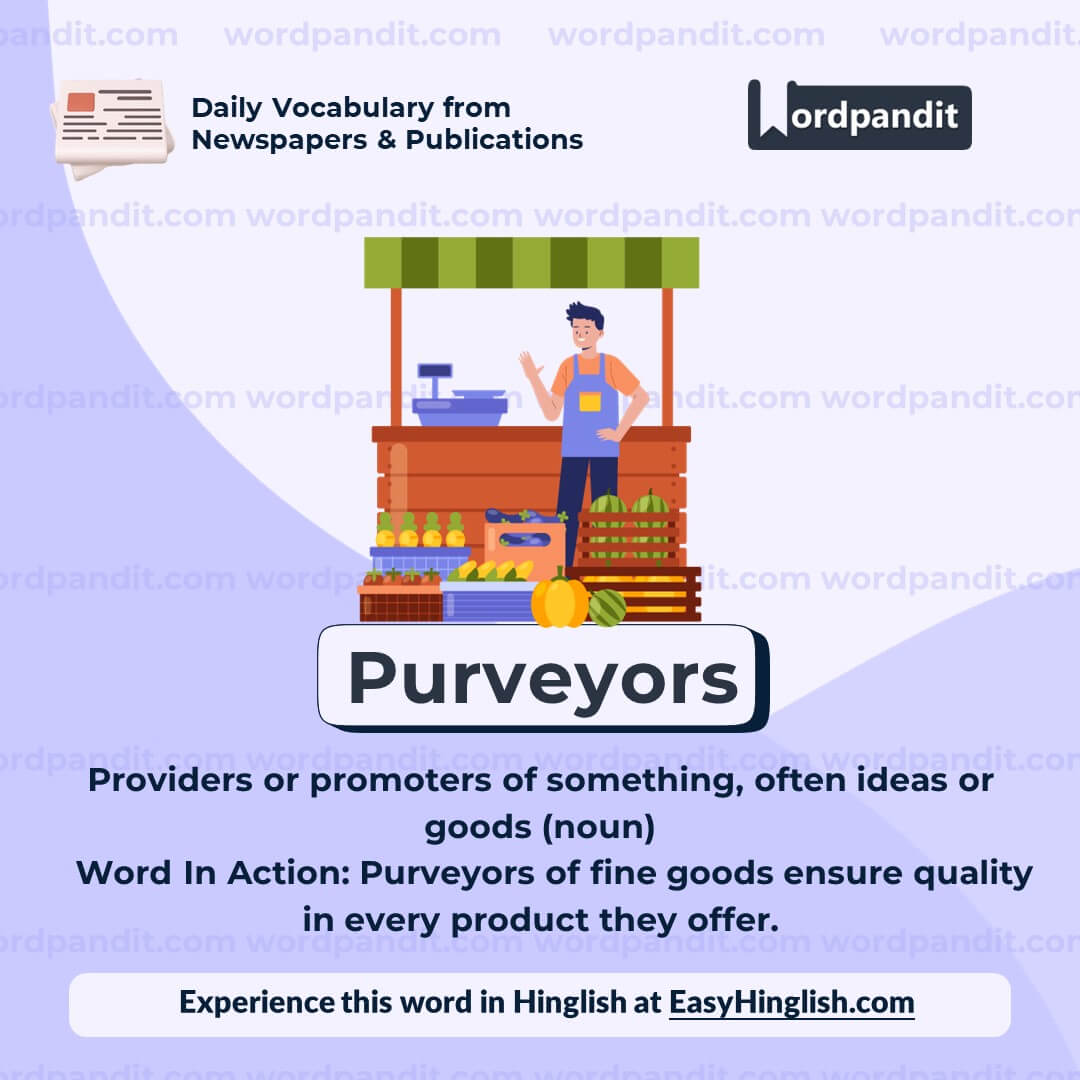
WORD-3: Purveyors
Context:
"I was, almost certainly wrong. Both are the purveyors of real and imagined worlds. Both are interrogators of the intangible, posing some of our broodiest questions about existence." - Aeon
Explanatory Paragraph:
"Purveyors" are people or entities that supply, deliver, or promote something—whether it's physical goods, ideas, or experiences. In this context, the term refers to individuals or creators who bring both real and imagined worlds to life, acting as conduits between abstract thought and human understanding. They don’t just provide things; they shape perspectives and cultural imagination.
Meaning: People or organizations that supply or spread something (especially ideas, goods, or viewpoints) (Noun)
Pronunciation: per-VAY-ers
Difficulty Level: ⭐⭐⭐ Intermediate
Etymology: From Anglo-French *purveier*, meaning “to provide,” from Latin *providere* ("to foresee, provide")
Prashant Sir's Notes:
Think of a "purveyor" not just as a seller but as a spreader—someone who delivers ideas, stories, goods, or even culture to others. Writers, artists, chefs, and influencers can all be purveyors in different ways.
Synonyms & Antonyms:
Synonyms: provider, supplier, distributor, promoter, vendor
Antonyms: consumer, receiver, buyer, audience
Usage Examples:
- The artist was a purveyor of surreal landscapes and emotional symbolism.
- News channels are often purveyors of public opinion, whether intentionally or not.
- He built his reputation as a purveyor of gourmet coffee and rare blends.
- The festival gathered purveyors of global street food into one vibrant space.
Cultural Reference:
In medieval England, a "purveyor" was a royal officer who acquired supplies for the monarchy—an early form of procurement. Today, the term often applies to those who "supply" culture, like filmmakers or designers. - British History Online
Think About It:
In the digital age, who do you think are the most influential purveyors of ideas—and how does that shape what we believe?
Quick Activity:
List three purveyors in your life (they could be teachers, YouTubers, or authors). What do they supply—information, inspiration, entertainment?
Memory Tip:
Purveyor = Provider. Both start with “P” and relate to the act of supplying something.
Real-World Application:
The term “purveyor” is useful in marketing, journalism, arts, and education—any field where content, values, or goods are delivered to an audience. Recognizing purveyors helps in understanding influence and flow of ideas in society.
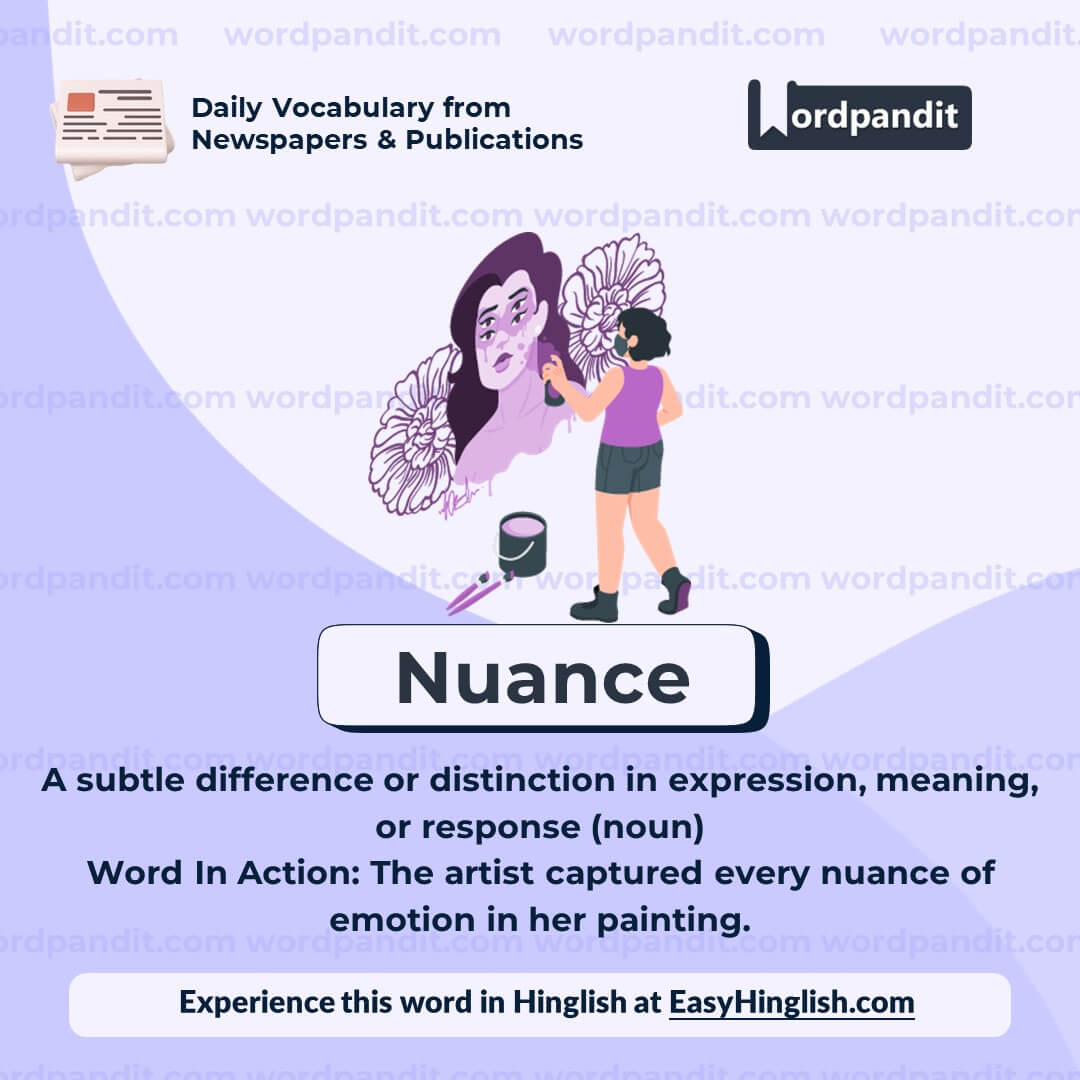
WORD-4: Nuance
Context:
"That reveals a far more complex and nuanced relationship with stuff, one that suggests minimalism and clutter aren’t opposites, but two sides of the same coin." - Aeon
Explanatory Paragraph:
"Nuance" refers to a subtle distinction or variation in meaning, feeling, tone, or expression. In the sentence above, it highlights the idea that our relationship with material things isn't just black and white (minimalism vs. clutter), but contains shades of complexity and subtlety. Nuance invites us to look deeper and acknowledge that real understanding often lies in the grey areas.
Meaning: A subtle difference or distinction in expression, meaning, or response (Noun)
Pronunciation: NOO-ahns or NYOO-ahns
Difficulty Level: ⭐⭐⭐ Intermediate
Etymology: From French *nuance*, meaning “shade” or “slight difference,” from Latin *nubes* meaning “cloud”
Prashant Sir's Notes:
Always pay attention to the "nuance" in what people say. It's the slight tone, pause, or phrasing that changes the meaning. Great readers, writers, and thinkers are sensitive to nuance because it shows depth and sophistication.
Synonyms & Antonyms:
Synonyms: subtlety, distinction, refinement, shade, variation
Antonyms: bluntness, obviousness, clarity, directness
Usage Examples:
- The actor’s performance was full of nuance, capturing the character’s inner turmoil beautifully.
- She appreciated the nuance in his argument, even though she disagreed with the conclusion.
- To master diplomacy, one must understand the nuance of every gesture and word.
- The debate lacked nuance and quickly devolved into shouting matches.
Cultural Reference:
In jazz music, nuance is everything—musicians play with tone, rhythm, and silence in subtle ways to convey emotion beyond the written notes. - NPR Jazz Profiles
Think About It:
Why do you think modern conversations (especially online) often miss nuance? How does that impact communication?
Quick Activity:
Choose a sentence like “I’m fine.” and write three different ways it could be interpreted based on nuance—tone, facial expression, or context.
Memory Tip:
Nuance sounds like "new-ants"—imagine ants crawling in slightly different directions, each adding a subtle variation to the pattern.
Real-World Application:
"Nuance" is crucial in literature, law, diplomacy, and everyday relationships. Understanding it helps prevent miscommunication and allows for more empathetic, thoughtful interactions.
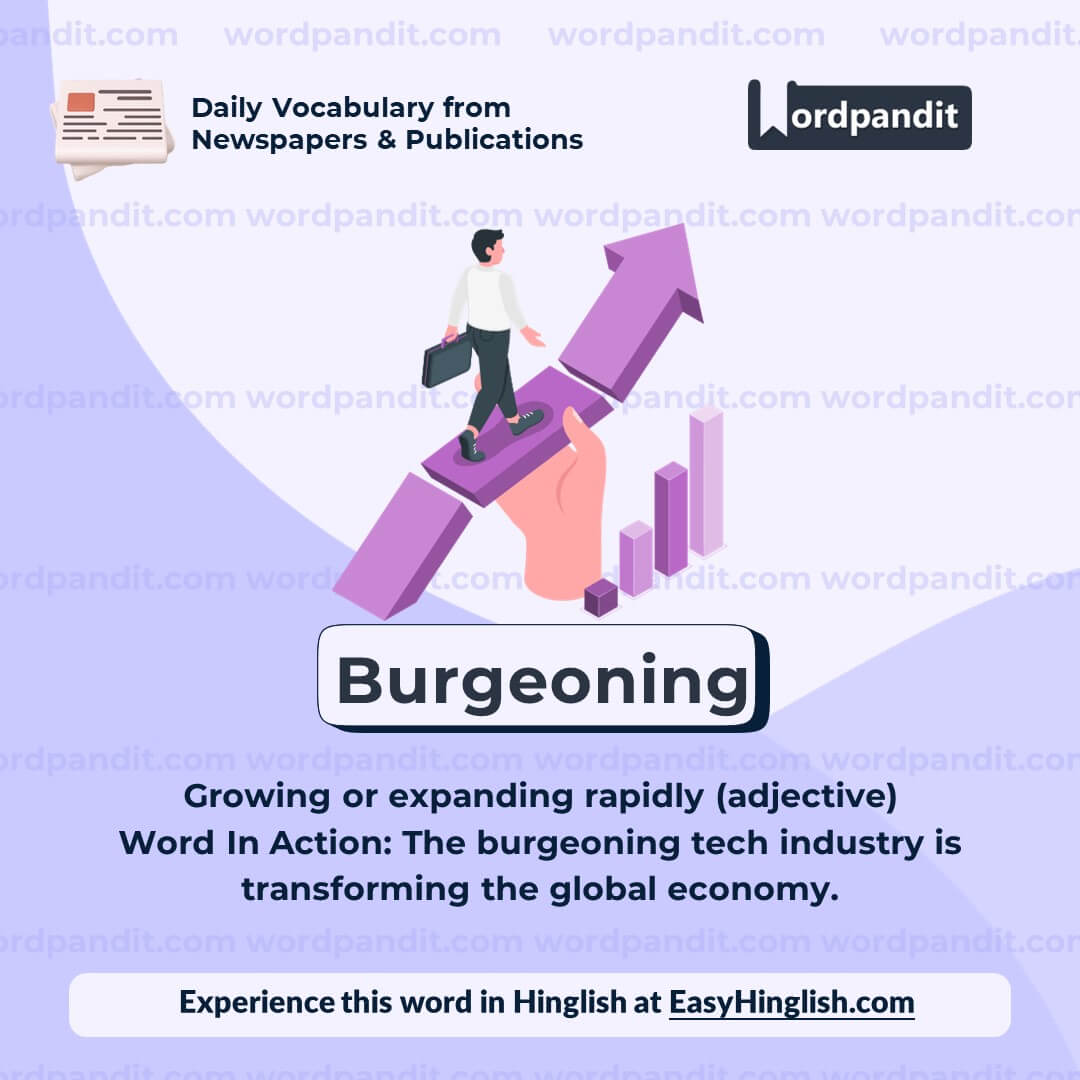
WORD-5: Burgeoning
Context:
"Though the country remained difficult to visit in person, the opening allowed a burgeoning Pacific trade to bring Japanese wares to the citizens of the world by the literal boatload." - Aeon
Explanatory Paragraph:
"Burgeoning" describes something that is growing rapidly or beginning to flourish. In the sentence above, it highlights the fast-developing and expanding nature of Pacific trade, particularly in connection with Japan. The word conveys a sense of newness, momentum, and potential—a force just beginning to reveal its full impact.
Meaning: Beginning to grow or develop rapidly; flourishing (Adjective/Present participle of the verb "burgeon")
Pronunciation: BUR-juh-ning
Difficulty Level: ⭐⭐⭐ Intermediate
Etymology: From Old French *bourgeonner* (“to bud, sprout”), from *bourgeon* meaning “bud”
Prashant Sir's Notes:
Think of "burgeoning" like a bud turning into a flower—it’s about something just starting but showing signs of rapid development. Whether it’s a burgeoning economy, industry, or relationship, this word carries a sense of optimistic growth.
Synonyms & Antonyms:
Synonyms: growing, expanding, flourishing, thriving, blossoming
Antonyms: declining, shrinking, fading, withering, stagnating
Usage Examples:
- The city is known for its burgeoning tech industry and vibrant startup culture.
- There’s a burgeoning interest in sustainable fashion among young consumers.
- Her burgeoning talent as a pianist caught the attention of music schools nationwide.
- Social media platforms have become a space for burgeoning communities to connect globally.
Cultural Reference:
In the late 1990s, Silicon Valley was a symbol of the burgeoning digital economy—tech companies were springing up and transforming global communication and commerce. - Wired Magazine
Think About It:
What are some burgeoning trends or industries today that might reshape the future in the next decade?
Quick Activity:
Name two areas in your own life that are currently burgeoning (e.g., skills, relationships, interests), and write one sentence about how you plan to nurture them.
Memory Tip:
Think of a "bud" that’s "burgeoning" into a flower—both start with “B” and involve early, rapid growth.
Real-World Application:
"Burgeoning" is a common term in journalism, economics, business, and culture writing. It helps describe dynamic shifts in industries, movements, and global interactions—essential for interpreting change and progress.


