

Daily Vocabulary from Indian Newspapers and Publications
Welcome to Wordpandit’s Indian Vocabulary Hub
At Wordpandit, we understand the importance of staying rooted in the local context while expanding your language skills. This section focuses on enriching your vocabulary with words and phrases drawn from India’s leading newspapers and publications, ensuring you're learning vocabulary that is practical, relevant, and uniquely Indian.
Why Indian Sources Matter
We believe that the best way to master any language is by immersing yourself in local content. That’s why we carefully curate vocabulary from top Indian publications, including:
- The Hindu
- The Times of India
- The Economic Times
- Hindustan Times
- Live Mint
- The Indian Express
- And many others...
Stay Updated, Stay Relevant
With daily updates from Indian news sources, you’ll be consistently learning words that reflect the trends and shifts in Indian society and culture. Our focus is to provide vocabulary that enhances your understanding of the language in an Indian context.
How Wordpandit Supports Your Goals
Whether you’re preparing for exams, aiming to improve your professional communication, or simply want to stay connected with the latest Indian vocabulary, Wordpandit is here to guide you every step of the way.
Learn with a Practical Approach
Our interactive learning methodology includes real-world examples, engaging activities, and context-specific usage to ensure that every word becomes part of your active vocabulary.
Dive into Indian Vocabulary Today!
Why Choose Wordpandit?
Practical Learning: Focus on words you'll actually encounter in real-world reading, enhancing your comprehension and communication skills.
Diverse Content: From current affairs to scientific breakthroughs, our varied sources expose you to vocabulary across multiple domains.
Effortless Integration: Make Wordpandit a part of your daily routine. Just a few minutes each day can significantly boost your lexicon over time.
Your Path to Vocabulary Mastery
- Visit our Daily Vocabulary section regularly
- Explore new words and their usage in context
- Practice incorporating these words into your own writing and speech
- Track your progress as your vocabulary expands
Start Your Journey Today
Embark on your vocabulary enhancement journey with Wordpandit. By consistently engaging with our daily posts, you'll build a robust vocabulary that serves you well in academic, professional, and personal contexts.
Remember, a word a day keeps linguistic limitations at bay. Make Wordpandit your daily companion in the quest for vocabulary excellence!
WORD-1: Defiant
Context:
"The chips are down, I rise up!” This statement, emblematic of Donald Trump’s defiant spirit, reflects the essence of his bold approach to politics and economics." - The Wire
Explanatory Paragraph:
The word "defiant" describes someone who boldly resists authority, challenges norms, or refuses to obey rules, often with a visible or vocal attitude. It signals a willingness to stand one's ground, even in the face of criticism, opposition, or difficult circumstances. Whether seen as rebellious or courageous, a defiant person typically acts with firm conviction, rejecting submission or passivity.
Meaning: Boldly resistant or challenging authority or opposing force (Adjective)
Pronunciation: dih-FY-uhnt
Difficulty Level: ⭐⭐ (Basic-Intermediate)
Etymology: From Old French 'desfier' meaning 'to challenge, defy', derived from Latin 'dis-' (away) + 'fidare' (to trust).
Prashant Sir's Notes:
Use "defiant" to describe behavior that pushes back—whether it's a child's refusal to follow rules or a leader standing firm against criticism. It often carries a slightly rebellious or confrontational tone.
Synonyms & Antonyms:
Synonyms: rebellious, resistant, unyielding, confrontational, uncooperative
Antonyms: compliant, submissive, obedient, agreeable, yielding
Usage Examples:
- The student gave a defiant glare when asked to put his phone away during class.
- In a defiant speech, the activist refused to back down despite threats.
- She stood defiant in the courtroom, refusing to apologize for her actions.
- His defiant tone shocked the board members during the heated discussion.
Cultural Reference:
"Though she be but little, she is fierce." — A quote from Shakespeare’s *A Midsummer Night’s Dream*, often used to celebrate defiant strength in unexpected individuals.
Think About It:
When does being defiant become a strength, and when does it become a liability? Can defiance be both heroic and destructive?
Quick Activity:
Think of a real or fictional character known for being defiant (e.g., Rosa Parks, Katniss Everdeen). Write two sentences describing how their defiance shaped their story.
Memory Tip:
Think of "defiant" as "defy + ant"—an ant boldly standing up against a boot! It may be tiny, but it won’t back down!
Real-World Application:
"Defiant" is commonly used in political discussions, legal situations, or personal conflicts to describe someone who refuses to conform or yield under pressure. It's a powerful word in news articles, character descriptions, and motivational contexts.
WORD-2: Commence
Context:
"Erupted in Palestine and Zionist militias commenced what was later termed Plan Dalet – a systematic ethnic cleansing of Arab neighbourhoods, towns and villages from areas within the territory." - The Wire
Explanatory Paragraph:
The word "commence" means to begin or start something. It is often used in formal or official contexts, such as ceremonies, operations, or projects. When something commences, it marks the initiation of an action or event. This word emphasizes the beginning point of a process that is likely to continue or unfold over time.
Meaning: To begin or start (Verb)
Pronunciation: kuh-MENS
Difficulty Level: ⭐ (Basic)
Etymology: From Old French ‘comencier’, based on Latin ‘cominitiare’—‘com’ (together) + ‘initiare’ (to initiate, begin)
Prashant Sir's Notes:
"Commence" is a more formal or polished alternative to "start" or "begin." It’s frequently seen in academic, legal, or ceremonial contexts. Replace “start” with “commence” when you want your language to sound more refined.
Synonyms & Antonyms:
Synonyms: begin, start, initiate, launch, inaugurate
Antonyms: end, finish, conclude, terminate, cease
Usage Examples:
- The graduation ceremony will commence at 10 a.m. sharp.
- Work on the new metro line is set to commence next month.
- They commenced the investigation without delay.
- The wedding commenced with a traditional musical performance.
Cultural Reference:
"Commencement" is the term often used for graduation ceremonies in American universities—symbolizing not an end, but the beginning of a new chapter in students’ lives.
Think About It:
Why do we often celebrate the end of one phase (like graduation) with a ceremony called a "commencement"? What does that suggest about how we view beginnings and endings?
Quick Activity:
Replace the word “start” with “commence” in three sentences you’ve written today. Observe how the tone shifts.
Memory Tip:
Think: “Common Entrance exams commence at 9 a.m.” – All three “C”s help lock in the meaning: Common + Commence + Clock time = Beginning of an event.
Real-World Application:
You’ll encounter "commence" in official communications, academic writing, and formal announcements. It's useful in professional emails, event planning, legal documents, and public notices to convey a polished tone.
WORD-3: Pursuant
Context:
"The lines of this ceasefire within mandatory Palestine came to be known as the “green line”. In 1967, pursuant to the so-called Six Days War, Israel occupied the entirety of mandatory Palestine." - The Wire
Explanatory Paragraph:
"Pursuant" is a formal word used to indicate that something happens as a result of or in accordance with something else—usually a law, action, or formal decision. In legal and official writing, it's often used to connect a cause and its consequence. For example, saying "pursuant to the agreement" means "as a result of" or "in accordance with the agreement."
Meaning: In accordance with or as a result of something (Adjective/Preposition)
Pronunciation: pur-SOO-uhnt
Difficulty Level: ⭐⭐⭐ (Advanced)
Etymology: From Old French *poursuivant*, present participle of *poursuivre* (to pursue), which comes from Latin *prosequi* (to follow, pursue).
Prashant Sir's Notes:
"Pursuant" is commonly used in legal, governmental, and policy language. It can seem overly formal in everyday conversation but is highly valuable in legal writing, contracts, or formal reports where precision and causality matter.
Synonyms & Antonyms:
Synonyms: in accordance with, following, in line with, under, according to
Antonyms: contrary to, inconsistent with, against, despite
Usage Examples:
- Pursuant to the agreement, both parties must meet once a month.
- The arrest was made pursuant to a warrant issued by the court.
- Pursuant to her resignation, the company issued a press release.
- The rule was added pursuant to recommendations from the ethics committee.
Cultural Reference:
Legal contracts and government documents in many countries frequently use phrases like "pursuant to Article 5" to indicate actions taken under a specific clause or provision—highlighting the formal and legal nature of the term.
Think About It:
Why do you think legal and formal writing often uses words like "pursuant" instead of simpler alternatives like "after" or "because of"? Does this increase clarity or make texts less accessible?
Quick Activity:
Rewrite the following sentence using "pursuant": "Following the new policy, all employees must update their passwords monthly."
Memory Tip:
Think of "pursuant" as "pursue + ant" — the ant pursues something that follows. So "pursuant" means something that follows from a prior event or rule!
Real-World Application:
"Pursuant" is frequently used in contracts, official reports, court rulings, and administrative documents. Knowing this word helps in reading and understanding legal texts, formal letters, and policy documents with greater accuracy.
WORD-4: Disengagement
Context:
"With this renewed focus on protectionism and disengagement, the question arises: what will this mean for the future of global trade and the US economy?" - The Wire
Explanatory Paragraph:
"Disengagement" refers to the process of withdrawing or detaching from involvement, commitment, or participation in something. It can occur in various contexts—political, emotional, military, or economic. For example, when a country reduces its participation in international trade or alliances, it is practicing disengagement. The term often implies a deliberate and strategic step back from active involvement.
Meaning: The act of withdrawing or detaching from involvement or commitment (Noun)
Pronunciation: dis-en-GAYJ-ment
Difficulty Level: ⭐⭐ (Intermediate)
Etymology: From the French *désengager* (to release), derived from Latin *dis-* (apart) + *engagier* (to bind or pledge)
Prashant Sir's Notes:
"Disengagement" is especially important in discussions of foreign policy, business strategy, and mental health. It represents a pulling away, often to avoid risk, conflict, or overcommitment. It's the opposite of being fully invested or involved.
Synonyms & Antonyms:
Synonyms: withdrawal, separation, detachment, retreat, isolation
Antonyms: involvement, engagement, participation, commitment, interaction
Usage Examples:
- The government announced a policy of gradual military disengagement from the region.
- Her emotional disengagement from the team made collaboration difficult.
- Corporate disengagement from global markets has raised concerns among investors.
- He practiced mindfulness to prevent mental disengagement during long meetings.
Cultural Reference:
In 2005, Israel carried out the “Gaza Disengagement Plan,” unilaterally withdrawing settlements and military presence from the Gaza Strip—marking a major political and strategic move widely covered in international media.
Think About It:
Is disengagement always a sign of retreat, or can it be a strategic choice for long-term strength? Can stepping back sometimes create space for deeper progress?
Quick Activity:
List three areas in life (e.g., social media, work, politics) where disengagement might be healthy—and three where it might be harmful. Reflect on why the effect differs.
Memory Tip:
Disengagement = “dis” (away) + “engage” (involve) → Think: “disengage from a fight” = step away or withdraw from being involved.
Real-World Application:
Disengagement is a crucial concept in international diplomacy, workplace psychology, and education. Whether a nation steps back from a treaty or an employee feels mentally checked out, recognizing disengagement helps assess risks and build strategies for re-engagement or change.
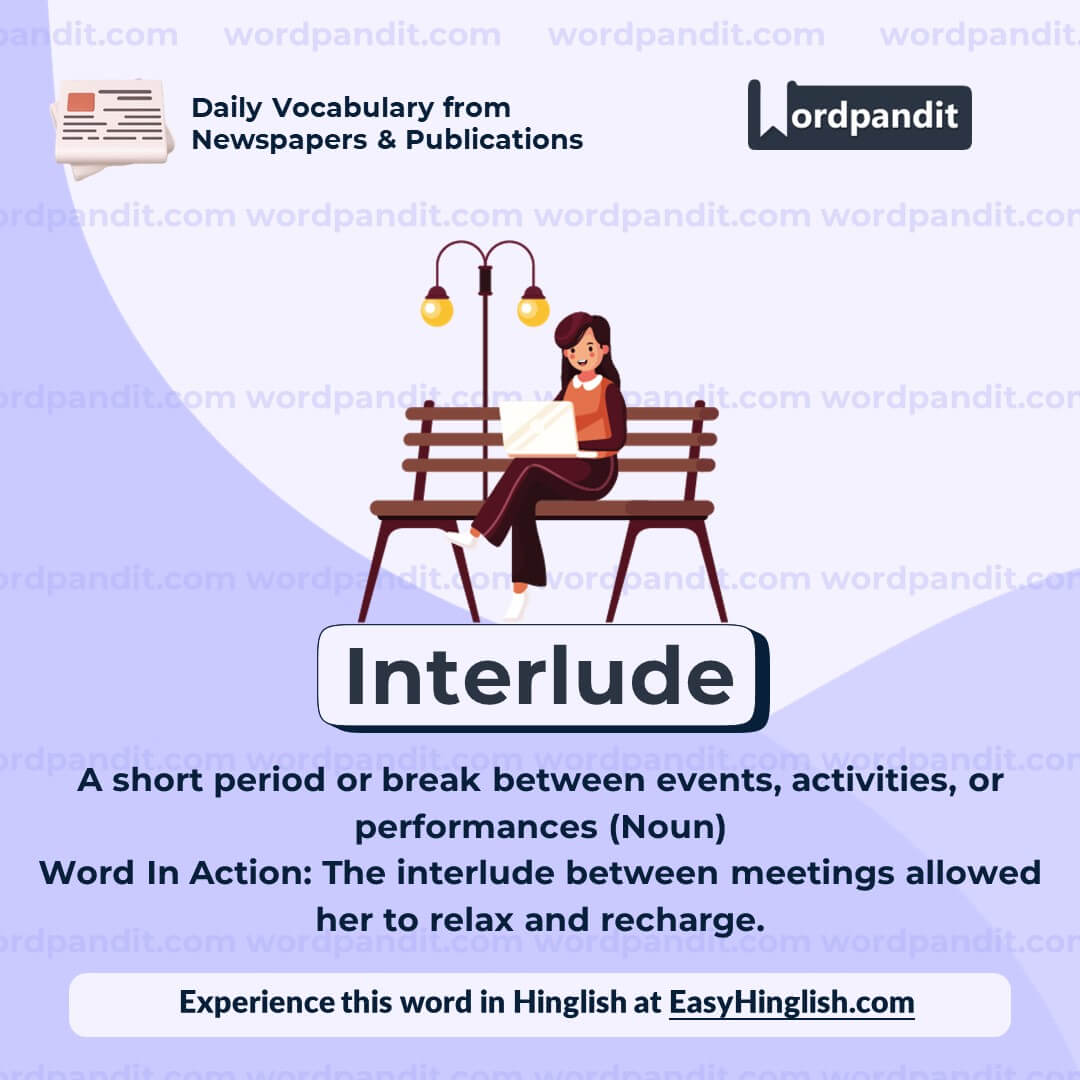
WORD-5: Interlude
Context:
"President Trump prepares to take charge on January 20 after a short-lived interlude, his approach to the ‘tariff games’." - The Wire
Explanatory Paragraph:
The word "interlude" refers to a short period of time that interrupts a longer, continuous process. It can be a pause, a break, or a brief transition—whether in music, theater, politics, or life. It may provide relief, contrast, or a moment of calm. In the context of politics, it often signifies a temporary phase before a major shift or return to action.
Meaning: A short period of time between events; an interruption or pause (Noun)
Pronunciation: IN-ter-lood
Difficulty Level: ⭐⭐ (Intermediate)
Etymology: From Latin *interludium* — *inter* (between) + *ludus* (play), originally referring to short performances between plays
Prashant Sir's Notes:
Think of an interlude as a “breather” in the middle of action—whether in real life or artistic performances. In political language, it can refer to a temporary change or pause before something resumes with force or clarity.
Synonyms & Antonyms:
Synonyms: pause, break, interval, intermission, lull
Antonyms: continuation, permanence, sequence, stretch
Usage Examples:
- The musical interlude between acts gave the audience a chance to relax.
- They enjoyed a peaceful interlude during their otherwise hectic vacation.
- The ceasefire was merely an interlude before fighting resumed.
- His short interlude in the private sector taught him valuable business lessons.
Cultural Reference:
In classical music concerts, interludes are often instrumental sections between vocal parts, allowing emotional or tonal transitions—famous in operas by composers like Wagner and Verdi.
Think About It:
Do we sometimes underestimate the value of short interludes in life—those pauses between commitments, careers, or decisions? Could they be more essential than they appear?
Quick Activity:
Write about an “interlude” in your own life—a pause between two major events. What did you learn or experience during that time?
Memory Tip:
Interlude = “inter” (between) + “lude” (play) → Imagine a mini-play or break *between* acts—an interlude is a short pause in a longer drama.
Real-World Application:
"Interlude" is often used in journalism, literature, and formal speech to refer to short transitional periods. Recognizing such moments in personal or professional life can help people reflect, reset, or realign their goals.


