

Daily Vocabulary from Indian Newspapers and Publications
Welcome to Wordpandit’s Indian Vocabulary Hub
At Wordpandit, we understand the importance of staying rooted in the local context while expanding your language skills. This section focuses on enriching your vocabulary with words and phrases drawn from India’s leading newspapers and publications, ensuring you're learning vocabulary that is practical, relevant, and uniquely Indian.
Why Indian Sources Matter
We believe that the best way to master any language is by immersing yourself in local content. That’s why we carefully curate vocabulary from top Indian publications, including:
- The Hindu
- The Times of India
- The Economic Times
- Hindustan Times
- Live Mint
- The Indian Express
- And many others...
Stay Updated, Stay Relevant
With daily updates from Indian news sources, you’ll be consistently learning words that reflect the trends and shifts in Indian society and culture. Our focus is to provide vocabulary that enhances your understanding of the language in an Indian context.
How Wordpandit Supports Your Goals
Whether you’re preparing for exams, aiming to improve your professional communication, or simply want to stay connected with the latest Indian vocabulary, Wordpandit is here to guide you every step of the way.
Learn with a Practical Approach
Our interactive learning methodology includes real-world examples, engaging activities, and context-specific usage to ensure that every word becomes part of your active vocabulary.
Dive into Indian Vocabulary Today!
Why Choose Wordpandit?
Practical Learning: Focus on words you'll actually encounter in real-world reading, enhancing your comprehension and communication skills.
Diverse Content: From current affairs to scientific breakthroughs, our varied sources expose you to vocabulary across multiple domains.
Effortless Integration: Make Wordpandit a part of your daily routine. Just a few minutes each day can significantly boost your lexicon over time.
Your Path to Vocabulary Mastery
- Visit our Daily Vocabulary section regularly
- Explore new words and their usage in context
- Practice incorporating these words into your own writing and speech
- Track your progress as your vocabulary expands
Start Your Journey Today
Embark on your vocabulary enhancement journey with Wordpandit. By consistently engaging with our daily posts, you'll build a robust vocabulary that serves you well in academic, professional, and personal contexts.
Remember, a word a day keeps linguistic limitations at bay. Make Wordpandit your daily companion in the quest for vocabulary excellence!
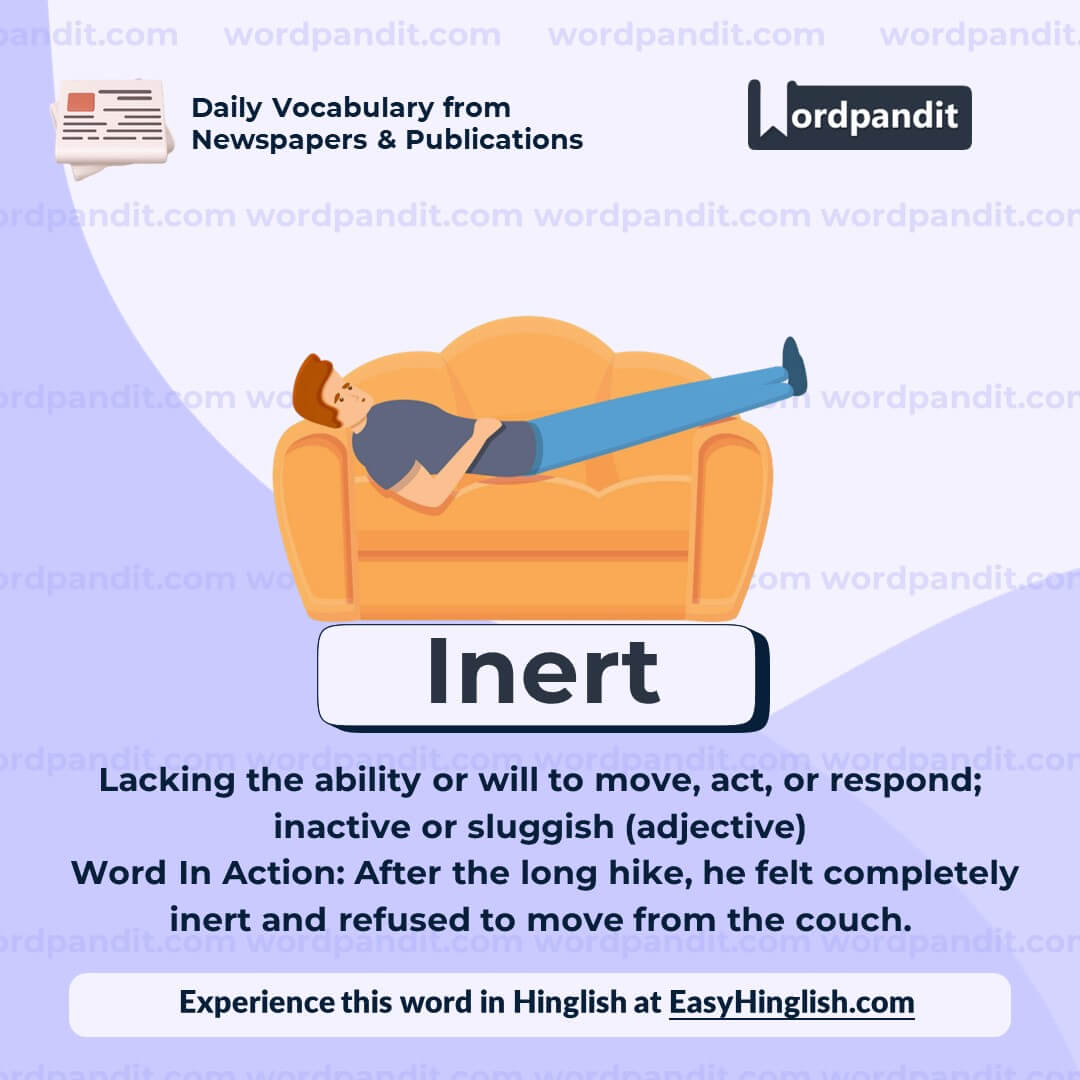
WORD-1: Inert
Context:
"Remains a country that’s highly reactive and rarely proactive, whose policy makers remain inert until a catastrophe occurs. While retributive justice has its place, it serves merely as symptomatic treatment, failing to address root causes." - The Wire
Explanatory Paragraph:
The word "inert" refers to something or someone that lacks the ability or willingness to move, act, or respond. In the context of policymaking, calling leaders "inert" suggests they are passive, unresponsive, or slow to act unless provoked by a crisis. This term often carries a negative connotation, implying a lack of initiative or effectiveness in addressing issues proactively.
Meaning: Lacking the ability or strength to move or act; inactive or sluggish (Adjective)
Pronunciation: in-URT
Difficulty Level: ⭐⭐ Basic to Intermediate
Etymology: From Latin "iners," meaning unskilled or idle, formed from "in-" (not) + "ars" (skill or art).
Prashant Sir's Notes:
"Inert" is a powerful descriptive word for stagnation or inactivity. In exams or essays, use it to criticize ineffective systems, inactive institutions, or unresponsive leadership.
Synonyms & Antonyms:
Synonyms: inactive, motionless, stagnant, unresponsive, immobile
Antonyms: active, dynamic, responsive, energetic, lively
Usage Examples:
- The committee remained inert despite growing public outcry for reform.
- After the medication, he felt mentally alert but physically inert.
- Economic policies stayed inert even as the recession deepened.
- His inert reaction to the crisis revealed his lack of leadership.
Cultural Reference:
"Science fiction often portrays bureaucracies as inert, bogged down by red tape, even when alien invasions are imminent." - Pop Culture Commentary
Think About It:
Can institutional inertia be more dangerous than bad leadership? Why do some systems resist movement even in the face of crisis?
Quick Activity:
List three public institutions you feel have been "inert" recently. Suggest one action each could take to become more proactive.
Memory Tip:
Think of "inert" as "in-earth"—something buried and not moving. Easy way to remember its immobility!
Real-World Application:
"Inert" is often used in political and business commentary to describe situations where delay or passivity causes harm. Whether referring to governments, boards, or individuals, it's a concise way to criticize a lack of timely action.

WORD-2: Acquitting
Context:
"Sanap gave the ruling while acquitting two boys who were convicted for stalking a minor girl by following her." - The Wire
Explanatory Paragraph:
The word "acquitting" is used in legal contexts and refers to declaring someone not guilty of a criminal charge. When a judge or jury acquits a person, it means that after reviewing all the evidence, they have determined there is not enough proof to convict them of the crime. In the context above, the boys were legally cleared of the charges brought against them.
Meaning: To formally declare someone not guilty of a criminal charge (Verb)
Pronunciation: uh-KWIT-ing
Difficulty Level: ⭐⭐ Moderate
Etymology: From Old French ‘aquiter’ meaning "to settle, pay, or absolve", derived from Latin ‘ad-’ (to) + ‘quietus’ (free, clear).
Prashant Sir's Notes:
Legal vocabulary often appears in news articles and official reports. Understanding terms like "acquitting" helps in decoding the outcome of judgments and their implications on justice. Always connect such terms to courtroom procedures.
Synonyms & Antonyms:
Synonyms: exonerating, absolving, clearing, vindicating
Antonyms: convicting, sentencing, condemning
Usage Examples:
- The court ended the trial by acquitting the accused due to lack of evidence.
- Despite public outrage, the jury ended up acquitting the celebrity of all charges.
- The judge surprised many by acquitting the defendant after new testimony came to light.
- Acquitting someone does not always mean they were innocent; it only means the evidence was insufficient to prove guilt.
Cultural Reference:
"If the glove doesn't fit, you must acquit." – A famous line from the defense in the O.J. Simpson trial, which became a cultural symbol of courtroom drama. - Court TV Archives
Think About It:
Should the concept of “reasonable doubt” always result in acquitting someone, even when public opinion believes they are guilty?
Quick Activity:
Match the legal terms to their meanings: (1) Acquit, (2) Convict, (3) Sentence, (4) Appeal. Now write a short paragraph using at least two of them correctly.
Memory Tip:
Think of “acquitting” as making someone “quit” the case — they’re released from it, free of charges.
Real-World Application:
Understanding the term “acquitting” is useful when reading or watching news related to high-profile court cases, legal reports, or studying law. It helps interpret the outcome of trials accurately.

WORD-3: Amateurish
Context:
"Replacement of the iconic 1971 war surrender painting in the Chief of Army Staff’s lounge by an amateurish mishmash is a matter of concern for one big reason – the complete erosion of Indian Army’s professionalism." - The Wire
Explanatory Paragraph:
The term "amateurish" is used to describe something that lacks the quality, skill, or polish expected from a professional. It implies a lack of experience or refinement, often suggesting that the result is clumsy, poorly executed, or unfit for serious standards. In the context above, the use of "amateurish" criticizes the new painting as lacking artistic or symbolic value, thereby diminishing the prestige and professionalism expected in a military setting.
Meaning: Lacking professional skill or polish; clumsy or unskilled (Adjective)
Pronunciation: AM-uh-chur-ish
Difficulty Level: ⭐⭐ Basic to Intermediate
Etymology: From French "amateur," meaning "lover of" or "non-professional," ultimately from Latin "amator" (lover).
Prashant Sir's Notes:
Use "amateurish" to describe efforts or outputs that fall short of expectations due to lack of skill. Especially useful in critique writing, art reviews, and commentary on leadership or decisions that lack finesse.
Synonyms & Antonyms:
Synonyms: unskilled, crude, clumsy, unprofessional, inexperienced
Antonyms: professional, polished, skillful, refined, expert
Usage Examples:
- The video editing looked amateurish compared to industry standards.
- Her amateurish attempt at cooking ended in a burnt, inedible mess.
- The presentation felt rushed and amateurish, failing to impress the investors.
- Critics dismissed the novel as amateurish, citing weak character development and plot holes.
Cultural Reference:
"In filmmaking, audiences quickly sense when something feels amateurish—poor lighting, stiff acting, or clunky dialogue can break immersion instantly." - Indie Film Review
Think About It:
Is there a place for amateurish efforts in professional spaces, or should only expert-level work be accepted in high-stakes environments?
Quick Activity:
Think of a time you saw or did something that felt "amateurish." Write 2–3 lines explaining what could have been improved to make it more professional.
Memory Tip:
Remember: "Amateurish" sounds like "I'm a tourist"—someone who doesn’t know their way around—just like a non-professional!
Real-World Application:
"Amateurish" is commonly used in critiques—of films, artwork, speeches, performances, and designs—where standards are expected to be high. It helps express disappointment in efforts that fall short of professional quality.
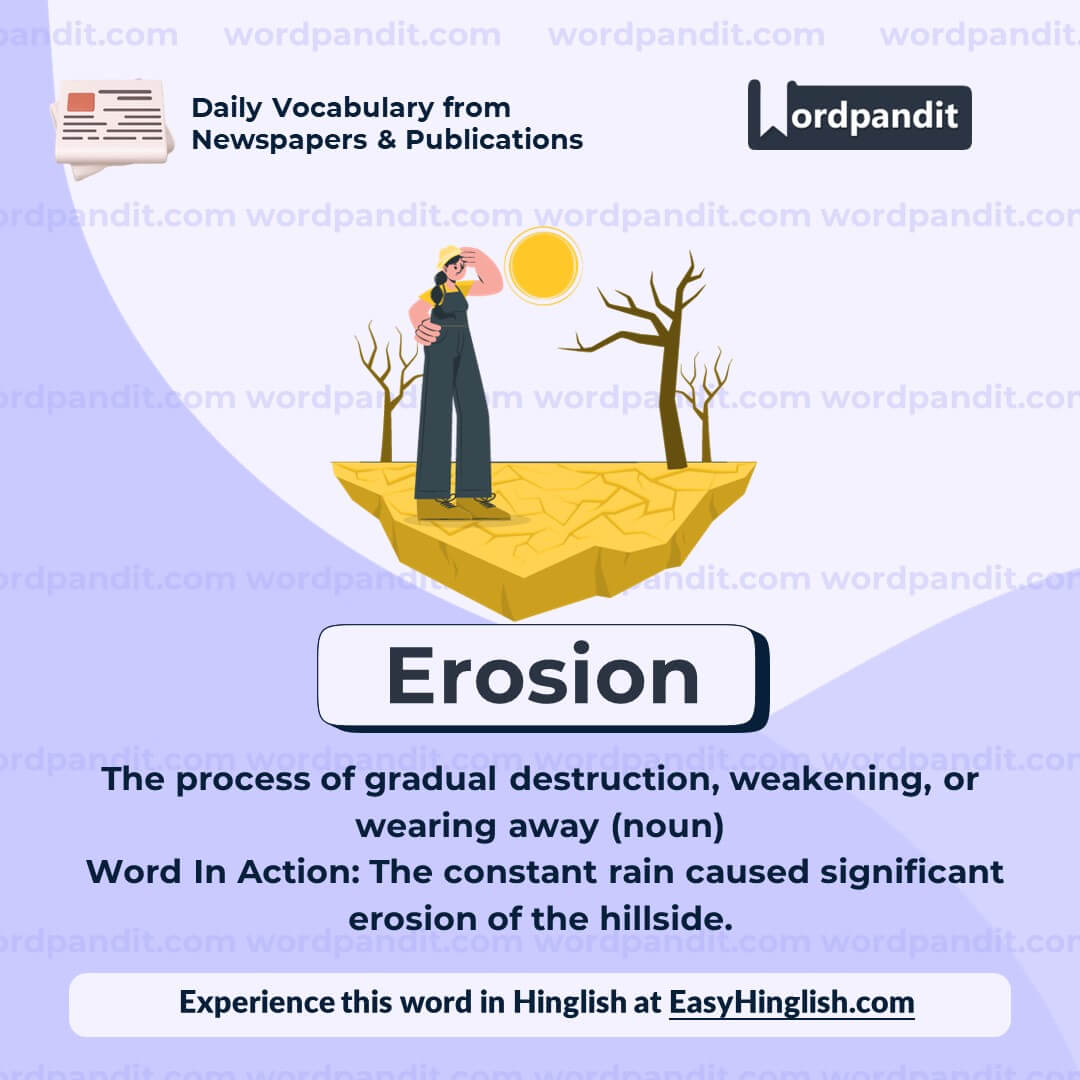
WORD-4: Erosion
Context:
"Replacement of the iconic 1971 war surrender painting in the Chief of Army Staff’s lounge by an amateurish mishmash is a matter of concern for one big reason – the complete erosion of Indian Army’s professionalism." - The Wire
Explanatory Paragraph:
The word "erosion" typically refers to the gradual wearing away of something. While it is commonly used in geological contexts (like soil erosion), it can also describe the slow decline or weakening of abstract qualities such as trust, values, or, in this case, professionalism. In the sentence above, "erosion" suggests a concerning and steady decline in the standards and values that once defined the Indian Army's professional identity.
Meaning: The gradual decline, weakening, or destruction of something (Noun)
Pronunciation: ih-ROH-zhun
Difficulty Level: ⭐⭐ Basic to Intermediate
Etymology: From Latin "erosionem," meaning "a gnawing away," from "erodere" – to eat away or wear away.
Prashant Sir's Notes:
Don't limit "erosion" to geography—it’s equally powerful when discussing abstract losses like erosion of values, freedom, rights, or integrity. Use it for impactful writing in editorials or essays.
Synonyms & Antonyms:
Synonyms: deterioration, decline, decay, weakening, disintegration
Antonyms: strengthening, growth, development, restoration, reinforcement
Usage Examples:
- The constant political infighting led to the erosion of public trust in the system.
- Coastal erosion is threatening homes built too close to the shoreline.
- The teacher warned against the slow erosion of moral values in modern society.
- Long-term neglect caused a serious erosion of the company’s reputation.
Cultural Reference:
"The erosion of democratic norms is a slow process—but one that becomes clear only in hindsight." - The Atlantic
Think About It:
What aspects of modern life do you think are most at risk of erosion—freedom, privacy, values, or something else? Why?
Quick Activity:
Make a two-column list: one with things that have faced erosion in society (e.g., empathy, trust), and one with ways to strengthen them.
Memory Tip:
Think of "erosion" as something being "eaten away" over time—like a cliff slowly crumbling into the sea.
Real-World Application:
"Erosion" is used across disciplines—from environmental science to politics and social commentary. Understanding its broader use helps in academic writing, debates, and analytical essays.

WORD-5: Endeavour
Context:
"New painting is perhaps a product of Project Udbhav, which is a collaborative endeavour of the Indian Army and the United Services Institution of India, seeking to ‘integrate age-old wisdom with contemporary military pedagogy.’" - The Wire
Explanatory Paragraph:
The word "endeavour" refers to a serious or determined effort to achieve a goal, often something ambitious or noble. It suggests planning, commitment, and purpose. In the example given, the term is used to describe a cooperative project between two military institutions aiming to blend traditional wisdom with modern education in military practice, reflecting a thoughtful and meaningful initiative.
Meaning: A purposeful or determined attempt or effort to achieve something (Noun); to try hard to do or achieve something (Verb)
Pronunciation: en-DEV-er
Difficulty Level: ⭐⭐ Basic to Intermediate
Etymology: From Old French "endeverer," based on "devoir" meaning duty, which came from Latin "debere" – to owe or to be obliged.
Prashant Sir's Notes:
"Endeavour" is a classy, formal alternative to "effort." Use it in academic writing, speeches, and official communication to sound polished and purposeful. Also note the spelling difference—British English uses “endeavour,” American English uses “endeavor.”
Synonyms & Antonyms:
Synonyms: effort, attempt, undertaking, pursuit, venture
Antonyms: idleness, inactivity, apathy, neglect
Usage Examples:
- The team’s scientific endeavour led to a breakthrough in renewable energy.
- She always endeavours to give her best in every assignment.
- Launching a startup is a risky yet rewarding endeavour.
- The astronauts’ mission was hailed as a noble endeavour for humanity.
Cultural Reference:
"Space Shuttle Endeavour, named after the British ship HMS Endeavour, symbolizes human curiosity and the effort to explore beyond known frontiers." - NASA Archives
Think About It:
What is one personal endeavour you’ve undertaken that shaped your values or perspective?
Quick Activity:
Write 2–3 lines about a global endeavour (e.g., climate action, space exploration, peacebuilding) that inspires you and explain why.
Memory Tip:
Think of "endeavour" as “in-duty-ever”—someone always putting in effort because they feel a strong sense of responsibility.
Real-World Application:
"Endeavour" is often used in professional, academic, and motivational contexts to describe meaningful work or mission-driven action. Mastering its use helps in essay writing, speeches, interviews, and formal communication.


