

Daily Vocabulary from International Newspapers and Publications
Expand Your Vocabulary with Wordpandit’s Global Vocabulary Hub
At Wordpandit, we are committed to helping you develop a truly global vocabulary by drawing from some of the most respected international publications. This section is designed to keep you ahead of the curve by introducing you to words that define global conversations and trends.
The Power of Global Sources
To help you think and communicate on a global scale, we curate vocabulary from renowned international sources, such as:
- The New York Times
- The Washington Post
- BBC
- The Guardian
- The Economist
- Scientific American
- Psychology Today
- And many more...
Stay Global, Stay Competitive
Our daily updates from international publications ensure you are consistently exposed to new words that reflect global news and developments, making sure your vocabulary is not only current but also globally relevant.
Enhance Your Global Perspective
Whether you’re preparing for international exams, aiming to excel in global business communication, or want to enhance your language skills for personal growth, Wordpandit offers the resources you need to thrive in a global context.
Effective Learning, Global Reach
Our learning methodology combines global examples, memory aids, and interactive activities, allowing you to internalize new words effectively and apply them in real-world scenarios.
Begin Your Global Vocabulary Journey Now!
Why Choose Wordpandit?
Practical Learning: Focus on words you'll actually encounter in real-world reading, enhancing your comprehension and communication skills.
Diverse Content: From current affairs to scientific breakthroughs, our varied sources expose you to vocabulary across multiple domains.
Effortless Integration: Make Wordpandit a part of your daily routine. Just a few minutes each day can significantly boost your lexicon over time.
Your Path to Vocabulary Mastery
- Visit our Daily Vocabulary section regularly
- Explore new words and their usage in context
- Practice incorporating these words into your own writing and speech
- Track your progress as your vocabulary expands
Start Your Journey Today
Embark on your vocabulary enhancement journey with Wordpandit. By consistently engaging with our daily posts, you'll build a robust vocabulary that serves you well in academic, professional, and personal contexts.
Remember, a word a day keeps linguistic limitations at bay. Make Wordpandit your daily companion in the quest for vocabulary excellence!
WORD-1: Evading
Context:
"My OCD is insidious and shape-shifting, evading conscious awareness or control. It seems to have a will of its own. Except that, of course, it is a part of me." - Aeon
Explanatory Paragraph:
The word "evading" refers to the act of avoiding something, often in a skillful, sneaky, or deliberate way. In the context of the quote, the author describes their OCD as something that escapes or dodges their conscious efforts to control or even fully perceive it. The word paints a picture of something elusive, always slipping away just as you try to grasp it — which makes it particularly fitting for describing difficult-to-manage thoughts or conditions.
Meaning: Avoiding or escaping something, often cleverly or sneakily (Verb)
Pronunciation: ih-VAY-ding
Difficulty Level: ⭐⭐ Beginner to Intermediate
Etymology: From Latin "evadere" — *e* (out of) + *vadere* (to go), meaning "to escape or go out of."
Prashant Sir's Notes:
“Evading” often shows up in psychological, criminal, or strategic contexts. It implies action with intent — not just avoiding randomly, but with thought or trickery. In exams, know the subtle difference between “avoiding” (more general) and “evading” (implies active or even deceptive avoidance).
Synonyms & Antonyms:
Synonyms: Avoiding, dodging, eluding, sidestepping, escaping
Antonyms: Confronting, facing, meeting, encountering
Usage Examples:
- The suspect kept evading the police by changing locations frequently.
- She had a habit of evading tough questions in interviews.
- The company was accused of evading taxes through offshore accounts.
- His eyes kept evading hers, hinting at discomfort or guilt.
Cultural Reference:
"The Matrix" (1999) featured Neo evading bullets in slow motion — an iconic visual metaphor for skillfully escaping danger.
Think About It:
Why do people sometimes choose to evade certain responsibilities or truths instead of confronting them?
Quick Activity:
Write two sentences using “evading” — one related to a physical situation (like sports or police) and one related to an emotional or psychological context.
Memory Tip:
Think of “evading” as someone *e-VADE*-ing a problem — they V-A-D-E (Vanishing And Dodging Everything).
Real-World Application:
In daily life, “evading” is often used in news reports about crime, politics, or law — such as someone evading arrest, evading taxes, or evading accountability in leadership.
WORD-2: Frittering
Context:
"You too might find yourself frittering away those precious hours on life admin and social media." - Aeon
Explanatory Paragraph:
"Frittering" refers to wasting something gradually and often thoughtlessly—usually time, money, or energy—on unimportant things. In the given context, it paints a picture of how easily we lose valuable time doing minor, often pointless activities like managing small tasks or endlessly scrolling through social media. It emphasizes not just the loss, but the slow and almost unnoticed way in which it happens.
Meaning: To waste time, money, or energy on trivial or unimportant matters (Verb)
Pronunciation: FRIT-uh-ring
Difficulty Level: ⭐⭐ Intermediate
Etymology: From the 18th-century verb "fritter," meaning to break into small fragments or squander little by little; likely from earlier noun meaning "fragments."
Prashant Sir's Notes:
“Frittering” has a strong connotation of gradual and often unnoticed loss. It’s ideal for describing modern distractions. Use it when you want to talk about wasting something valuable over time—particularly time or energy—on things that feel necessary in the moment but add up to nothing.
Synonyms & Antonyms:
Synonyms: Squandering, wasting, dissipating, misusing, idling away
Antonyms: Conserving, saving, investing, utilizing, optimizing
Usage Examples:
- He spent the whole weekend frittering away time instead of finishing his project.
- We often fritter our attention on emails instead of focusing on deep work.
- She regretted frittering her bonus on impulsive shopping sprees.
- Don't fritter away your energy on people who don’t value your efforts.
Cultural Reference:
In the film *Dead Poets Society* (1989), the famous quote "Carpe diem — seize the day!" encourages students to stop frittering away time and make their lives extraordinary.
Think About It:
How much of your day is truly spent on meaningful activities, and how much is frittered away without you realizing it?
Quick Activity:
List three common things you tend to fritter time or money on. For each, write one strategy to reduce that habit.
Memory Tip:
Think of “frittering” as *fritter = little bits* — like tiny snacks or crumbs of time disappearing bit by bit throughout your day.
Real-World Application:
The term is widely applicable in productivity, personal finance, and time management discussions. Coaches and planners often warn against frittering away limited resources, especially in an age full of digital distractions.
WORD-3: Trivial
Context:
"Perhaps you’ve criticised a long-suffering partner about stupid, trivial things, to the point you worry they may actually pack up and leave." - Aeon
Explanatory Paragraph:
The word “trivial” is used to describe things that are insignificant, minor, or unimportant. In the given context, it refers to petty issues or small annoyances that don’t really matter in the larger scheme of a relationship, yet can become points of repeated criticism. Though "trivial" matters may seem harmless on the surface, focusing on them excessively can damage relationships or distract from what truly matters.
Meaning: Of little value or importance; insignificant (Adjective)
Pronunciation: TRIH-vee-uhl
Difficulty Level: ⭐ Beginner
Etymology: From Latin *trivialis*, meaning "commonplace" or "ordinary," originally referring to something found at a crossroads (*tri* = three + *via* = road).
Prashant Sir's Notes:
“Trivial” is a high-utility word for daily conversations, essays, and exams. It contrasts beautifully with words like “significant” or “profound.” Use it when you want to show that something is not worth stressing over — especially when discussing priorities or emotional intelligence.
Synonyms & Antonyms:
Synonyms: Insignificant, petty, minor, unimportant, negligible
Antonyms: Significant, important, meaningful, substantial, major
Usage Examples:
- She was upset over a trivial misunderstanding that could have been cleared up with a quick conversation.
- It’s unwise to waste energy on trivial matters when big decisions await.
- The team argued over trivial details instead of focusing on the main goal.
- He has a habit of turning trivial complaints into dramatic confrontations.
Cultural Reference:
The term “trivia” (plural of trivial) is used in popular culture for fun facts and games — like in “pub trivia nights” — highlighting the idea of things that are interesting but not necessarily important.
Think About It:
Why do people sometimes fixate on trivial matters when more serious issues are at stake?
Quick Activity:
List two examples of “trivial” things that often cause unnecessary arguments. Then write how you would reframe or ignore them to keep peace.
Memory Tip:
“Trivial” sounds like “trivia” — small bits of information that are fun but not essential. If it’s trivia, it’s trivial!
Real-World Application:
“Trivial” is often used in workplaces, relationships, and academic writing to downplay the importance of minor issues. Knowing when to call something “trivial” can help with conflict resolution and prioritization.
WORD-4: Hindrance
Context:
"When we are given a shot – blowing it, or subtly hindering our chances. The puzzle is why so many of us perpetually find ourselves getting in our own way and disrupting our best-laid plans." - Aeon
Explanatory Paragraph:
“Hindrance” refers to something or someone that gets in the way of progress, slows you down, or makes it harder to achieve your goals. In the context provided, the author is reflecting on self-sabotage — how people often, whether consciously or unconsciously, become a hindrance to their own success. The word suggests an obstacle that may not always be external; it can be internal doubts, habits, or fears that hold us back.
Meaning: Something that delays or obstructs progress or achievement (Noun)
Pronunciation: HIN-druns
Difficulty Level: ⭐⭐ Intermediate
Etymology: Derived from Middle English “hinderen,” meaning “to harm or delay,” with Germanic roots related to the idea of being behind or delayed.
Prashant Sir's Notes:
“Hindrance” is often used when you want to express that something is slowing you down or blocking you from reaching a goal. It can refer to both physical and psychological obstacles. Always remember the distinction: a “hindrance” doesn’t necessarily stop you — it just makes the journey more difficult.
Synonyms & Antonyms:
Synonyms: Obstacle, barrier, impediment, obstruction, interference
Antonyms: Aid, help, assistance, support, advantage
Usage Examples:
- Lack of funding became a major hindrance to the completion of the project.
- Her anxiety acted as a hindrance to her performance in the interview.
- Sometimes, your own mindset can be the biggest hindrance to growth.
- The poor road conditions were a serious hindrance to transportation in the area.
Cultural Reference:
In Shakespeare’s *Hamlet*, the protagonist's overthinking becomes a hindrance to action — famously reflected in the line “Thus conscience does make cowards of us all.”
Think About It:
What internal hindrances—like fear, doubt, or procrastination—are keeping you from achieving your goals?
Quick Activity:
Identify one hindrance you’ve faced this week. Write down a way to overcome or reduce its impact going forward.
Memory Tip:
Think: *Hindrance* comes from “hinder” — to *hold back*. If something *hinders*, it becomes a *hindrance* — it’s in your way!
Real-World Application:
“Hindrance” is commonly used in discussions about productivity, personal growth, and business planning. Recognizing what's acting as a hindrance allows individuals and teams to troubleshoot and move forward effectively.
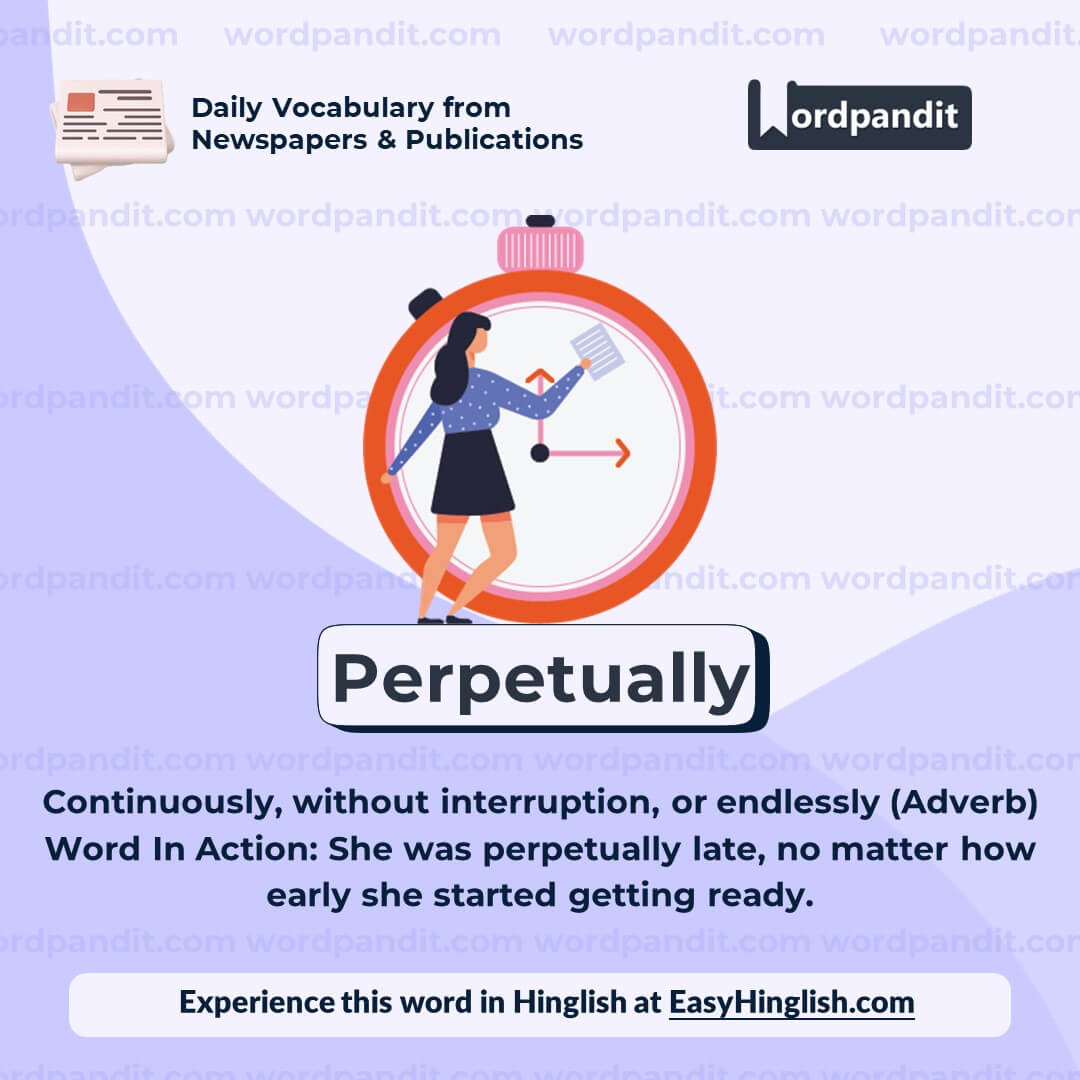
WORD-5: Perpetually
Context:
"When we are given a shot – blowing it, or subtly hindering our chances. The puzzle is why so many of us perpetually find ourselves getting in our own way and disrupting our best-laid plans." - Aeon
Explanatory Paragraph:
“Perpetually” is an adverb used to describe something that happens continuously, repeatedly, or seemingly without end. In the context above, it refers to how people often, time and again, sabotage their own efforts. The word adds a sense of frustration and inevitability, as if the pattern never changes — highlighting how self-sabotage can become a persistent habit unless consciously addressed.
Meaning: In a way that continues endlessly or repeatedly without significant interruption (Adverb)
Pronunciation: per-PECH-oo-uh-lee
Difficulty Level: ⭐⭐ Intermediate
Etymology: From Latin *perpetuus* meaning “continuous” or “uninterrupted,” combined with the adverbial suffix *-ly*.
Prashant Sir's Notes:
“Perpetually” is stronger than “often” or “frequently.” It suggests a loop — something that keeps happening. In essays, it’s useful for describing ongoing problems or habits. Pair it with verbs like “struggle,” “complain,” “repeat,” or “worry” for a powerful emotional effect.
Synonyms & Antonyms:
Synonyms: Constantly, endlessly, repeatedly, incessantly, always
Antonyms: Occasionally, rarely, intermittently, temporarily, infrequently
Usage Examples:
- He is perpetually late, no matter how many reminders he gets.
- The machine runs perpetually unless it’s manually shut off.
- She lives in a state of perpetually questioning her own decisions.
- They were perpetually arguing about the same issues in their relationship.
Cultural Reference:
In Greek mythology, Sisyphus is condemned to perpetually roll a boulder uphill, only for it to roll back down each time — symbolizing endless, repetitive struggle.
Think About It:
What habits or thought patterns do you perpetually fall into, and how might you break the cycle?
Quick Activity:
Write a sentence about a personal habit using the word “perpetually.” Now rewrite it by replacing “perpetually” with a synonym — how does the tone change?
Memory Tip:
Think: *Perpetually = Permanent + Actually* — something that’s actually permanent or ongoing!
Real-World Application:
“Perpetually” is often used in psychological discussions, workplace feedback, or personal development contexts to describe chronic behaviors or ongoing challenges — such as perpetually missing deadlines or perpetually seeking approval.


