

Daily Vocabulary from International Newspapers and Publications
Expand Your Vocabulary with Wordpandit’s Global Vocabulary Hub
At Wordpandit, we are committed to helping you develop a truly global vocabulary by drawing from some of the most respected international publications. This section is designed to keep you ahead of the curve by introducing you to words that define global conversations and trends.
The Power of Global Sources
To help you think and communicate on a global scale, we curate vocabulary from renowned international sources, such as:
- The New York Times
- The Washington Post
- BBC
- The Guardian
- The Economist
- Scientific American
- Psychology Today
- And many more...
Stay Global, Stay Competitive
Our daily updates from international publications ensure you are consistently exposed to new words that reflect global news and developments, making sure your vocabulary is not only current but also globally relevant.
Enhance Your Global Perspective
Whether you’re preparing for international exams, aiming to excel in global business communication, or want to enhance your language skills for personal growth, Wordpandit offers the resources you need to thrive in a global context.
Effective Learning, Global Reach
Our learning methodology combines global examples, memory aids, and interactive activities, allowing you to internalize new words effectively and apply them in real-world scenarios.
Begin Your Global Vocabulary Journey Now!

Why Choose Wordpandit?
Practical Learning: Focus on words you'll actually encounter in real-world reading, enhancing your comprehension and communication skills.
Diverse Content: From current affairs to scientific breakthroughs, our varied sources expose you to vocabulary across multiple domains.
Effortless Integration: Make Wordpandit a part of your daily routine. Just a few minutes each day can significantly boost your lexicon over time.
Your Path to Vocabulary Mastery
- Visit our Daily Vocabulary section regularly
- Explore new words and their usage in context
- Practice incorporating these words into your own writing and speech
- Track your progress as your vocabulary expands
Start Your Journey Today
Embark on your vocabulary enhancement journey with Wordpandit. By consistently engaging with our daily posts, you'll build a robust vocabulary that serves you well in academic, professional, and personal contexts.
Remember, a word a day keeps linguistic limitations at bay. Make Wordpandit your daily companion in the quest for vocabulary excellence!
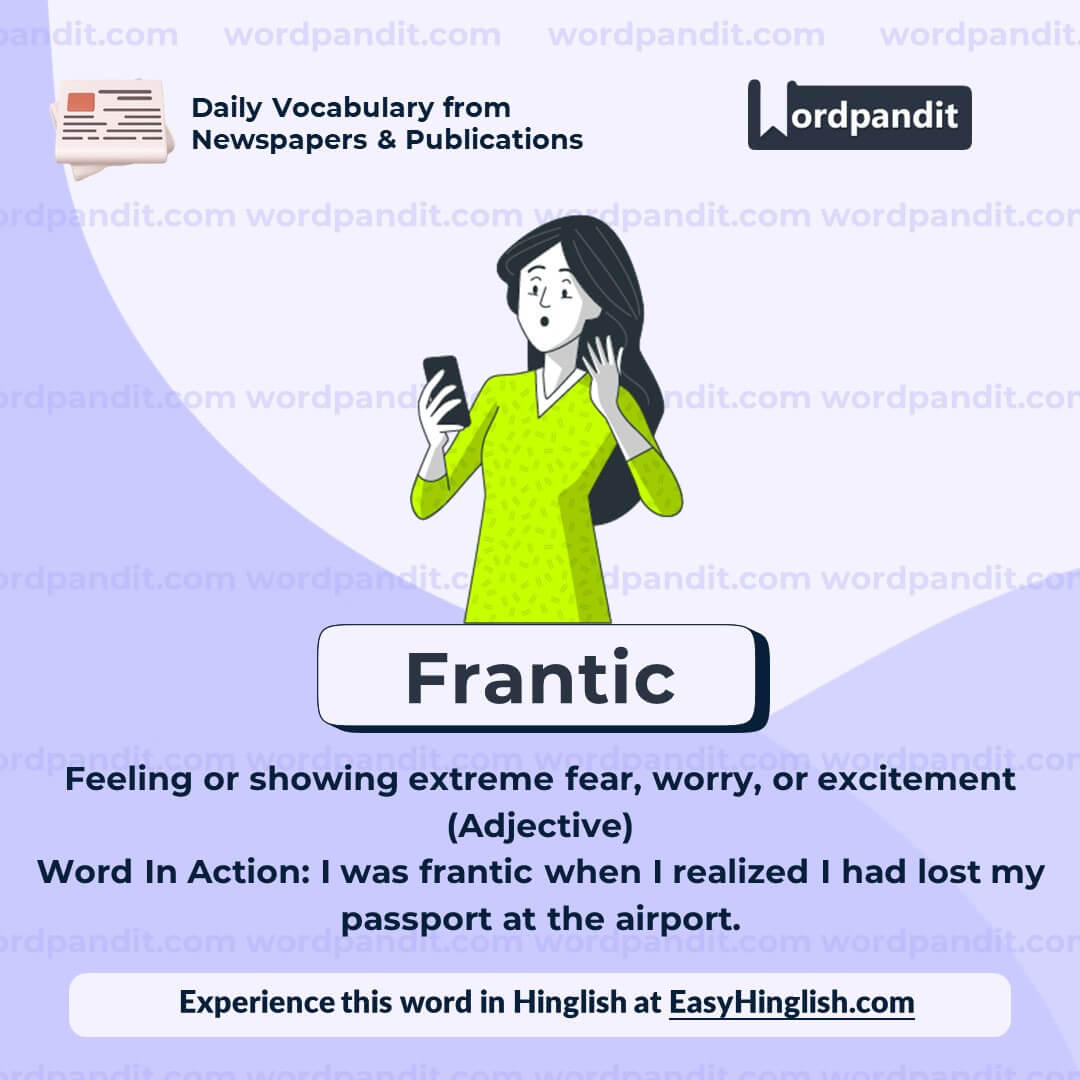
WORD-1: Frantic
Context:
"After the alarm went off, there was a frantic rush to evacuate the building before the fire spread." - CNN Breaking News
Explanatory Paragraph:
The word "frantic" is used to describe a state of wild and hurried activity, often driven by fear, anxiety, or desperation. When someone is frantic, they are so overwhelmed by emotion or urgency that they act in a highly agitated and unorganized way. The word can apply to people, actions, or even atmospheres that feel chaotic or out of control.
Meaning: Wild or distraught with fear, anxiety, or other emotions; frenzied or hurried (Adjective)
Pronunciation: FRAN-tik
Difficulty Level: ⭐⭐ Beginner to Intermediate
Etymology: Originated in the late Middle English period, from Old French *frentik*, based on Latin *phreneticus*, from Greek *phrenitikos*, meaning 'delirious'.
Prashant Sir's Notes:
"Frantic" is a powerful adjective that conveys emotional urgency. It often describes high-stress scenarios like emergency situations or emotional breakdowns. Think of it as a word painting a picture of chaos or desperation.
Synonyms & Antonyms:
Synonyms: frenzied, panicked, hysterical, agitated, wild, distraught
Antonyms: calm, composed, relaxed, peaceful, serene
Usage Examples:
- The mother was frantic when she couldn't find her child in the crowded market.
- In a frantic attempt to meet the deadline, the team worked through the night.
- She gave him a frantic wave as the train pulled away from the platform.
- The dog's frantic barking alerted the neighbors to the intruder.
Cultural Reference:
"The frantic energy of New York City in the 1980s was captured brilliantly in films like *After Hours* and *Wall Street*." - Film Studies Archive
Think About It:
Why do you think people often become frantic under pressure, and how can we train ourselves to remain calm instead?
Quick Activity:
Write down three real-life situations where someone might act in a frantic way. Then, rewrite the scenarios to show how they could respond more calmly.
Memory Tip:
Think: "Frantic = Freaking out + Panic." The word sounds like "frenzy" and helps you remember it's all about emotional chaos.
Real-World Application:
Use "frantic" to describe emergency situations in storytelling, reports, or journalism where the urgency and stress of the moment are key. For example, news reporters may describe rescue efforts as frantic during natural disasters.
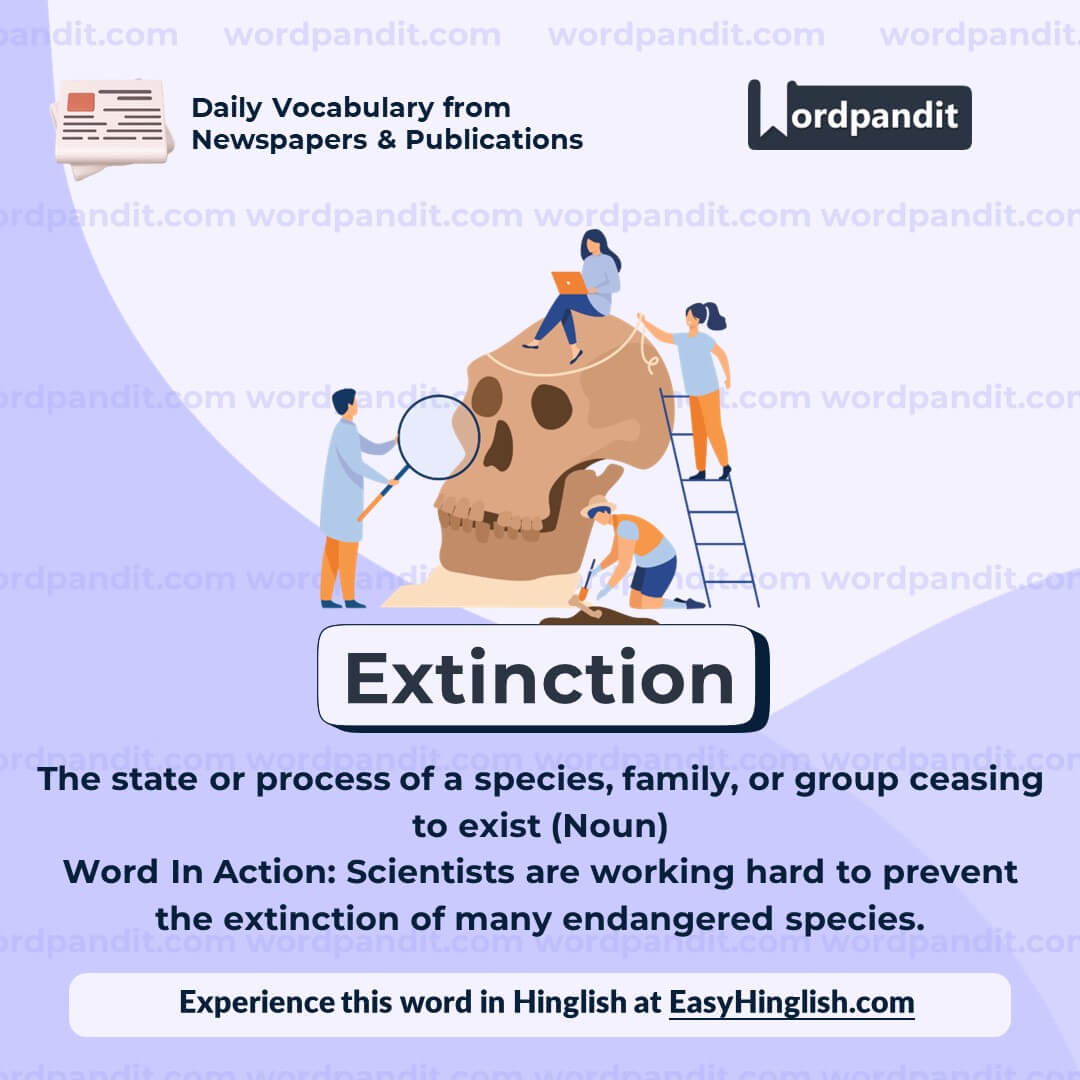
WORD-2: Extinction
Context:
"Species are, for want of a better term, easy. Look, for instance, at how we speak about extinction." - Aeon
Explanatory Paragraph:
"Extinction" refers to the complete disappearance of a species, organism, or phenomenon. When something becomes extinct, it no longer exists anywhere on Earth. Most commonly, we use the term in ecological or biological contexts, where animals or plants die out due to changes in climate, habitat loss, or human activity. However, "extinction" can also be used metaphorically for the fading or disappearance of customs, languages, or ideas over time.
Meaning: The state or process of a species, family, or larger group ceasing to exist (Noun)
Pronunciation: ek-STINK-shun
Difficulty Level: ⭐⭐ Intermediate
Etymology: From Latin *extinctio(n-)*, from *extinguere* meaning ‘quench’ or ‘put out’ (as in putting out a fire).
Prashant Sir's Notes:
“Extinction” is a heavy word — it signals an irreversible end. In environmental contexts, it reminds us of our responsibility to protect biodiversity. Beyond biology, the word captures any permanent disappearance, including of cultures or ideas.
Synonyms & Antonyms:
Synonyms: eradication, elimination, annihilation, disappearance, dying out
Antonyms: survival, continuation, existence, preservation, resurgence
Usage Examples:
- Many scientists warn that human activity is accelerating the extinction of thousands of species.
- The extinction of the dodo is often cited as a classic example of human-driven ecological loss.
- Some fear that with the digital age, the extinction of handwritten letters is inevitable.
- After the meteor strike, dinosaurs faced rapid extinction across the planet.
Cultural Reference:
"Jurassic Park" popularized the concept of extinction and genetic resurrection, asking whether extinct species should be revived if science allows. - Pop Culture Review
Think About It:
What do we lose — beyond just biology — when a species or a culture goes extinct?
Quick Activity:
List five species, traditions, or languages you’ve heard are endangered. Then, choose one and research how efforts are being made to prevent its extinction.
Memory Tip:
Think: “Exit + gone = Extinction.” Once something is extinct, it’s exited existence — permanently.
Real-World Application:
"Extinction" is widely used in environmental discussions, scientific reports, and documentaries to emphasize the urgency of conservation. Understanding the term helps people engage in debates on climate change, biodiversity, and ecological preservation.

WORD-3: Enriched
Context:
"Offers not only scientific clarity and variety, but an enriched view of the living world and our relationship with it." - Aeon
Explanatory Paragraph:
"Enriched" refers to something that has been made better, more meaningful, or more valuable. It often implies improvement by adding quality, depth, or nutrients—whether we are talking about knowledge, experiences, relationships, or even physical substances. In the context of the quote, an "enriched view" means a deeper, more insightful perspective of the natural world and humanity’s place within it.
Meaning: Improved or enhanced in quality, value, or significance (Verb – past participle of “enrich”)
Pronunciation: en-RICHED
Difficulty Level: ⭐ Beginner
Etymology: From Old French *enrichir*, based on Latin *in-* (into) + *riche* (rich), meaning “to make rich or more valuable.”
Prashant Sir's Notes:
"Enriched" is a versatile word. It can refer to intellectual, emotional, or material improvement. Use it to describe any situation where something has become fuller, deeper, or more rewarding. It's especially useful in academic, cultural, or emotional discussions.
Synonyms & Antonyms:
Synonyms: enhanced, deepened, improved, elevated, refined
Antonyms: diminished, depleted, reduced, impoverished
Usage Examples:
- Traveling to different cultures has enriched her understanding of humanity.
- This course is designed to provide an enriched learning experience for advanced students.
- Iron-enriched cereals help combat nutritional deficiencies in children.
- His life was enriched by the friendships he formed during college.
Cultural Reference:
Many museums advertise “enriched experiences” through interactive exhibits and audio guides, offering deeper cultural understanding to visitors. - Museum Marketing Journal
Think About It:
What experiences in your life have truly enriched your perspective, and why do you think they had such a lasting impact?
Quick Activity:
Write down three things that have enriched your education—these could be books, teachers, or life events. Describe how each one added value to your learning.
Memory Tip:
Think of "enriched" as “made rich”—whether with knowledge, nutrients, or emotions.
Real-World Application:
"Enriched" is often used in educational settings, nutritional labeling, personal development, and even art and culture reviews. Understanding this word helps in both formal and everyday discussions where enhancement or improvement is the key idea.
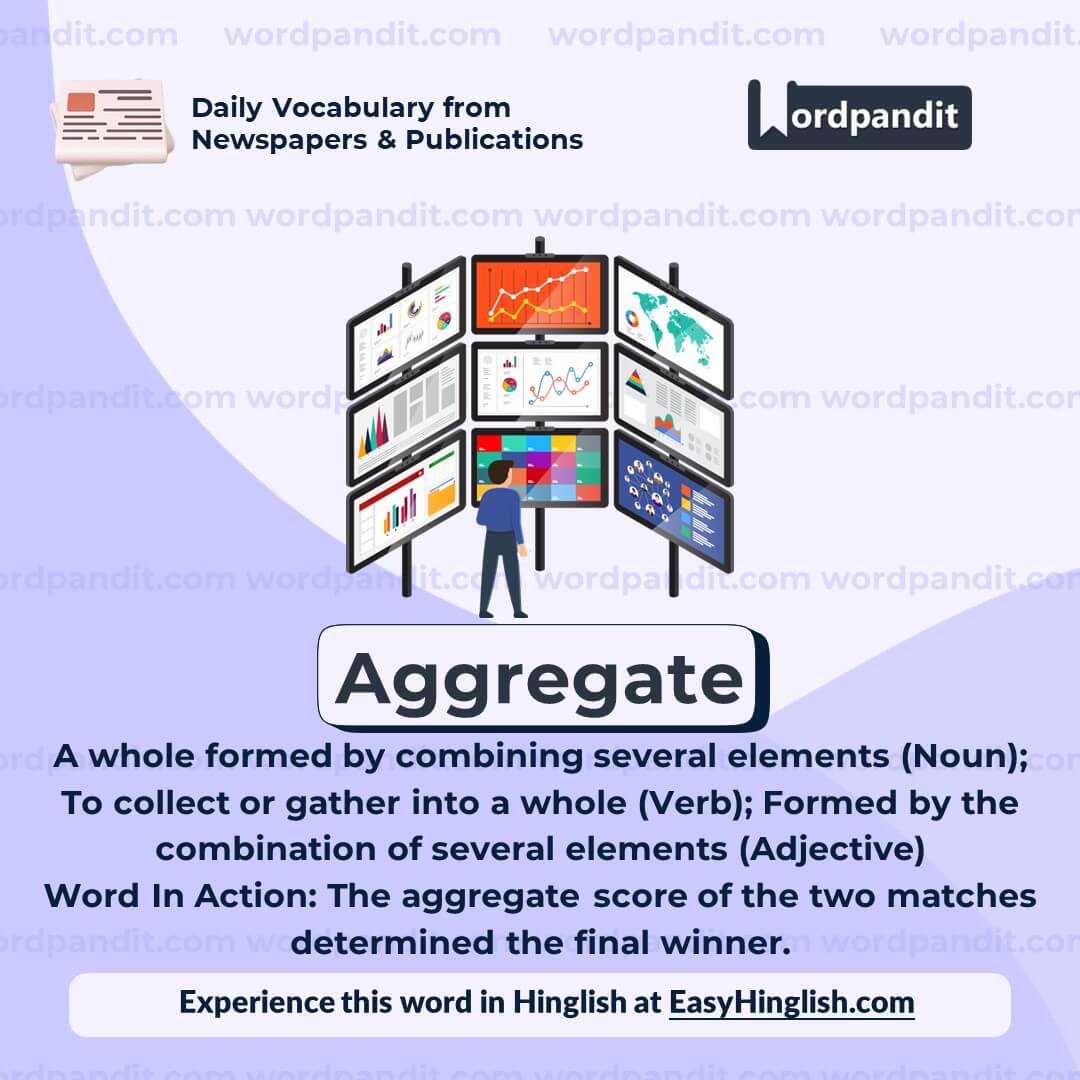
WORD-4: Aggregate
Context:
"Species has long been the basic unit of zoology. Ernst Mayr’s 1951 definition still fits: ‘An aggregate of interbreeding natural populations which are not only reproductively isolated from other such aggregates but also ecologically specialised sufficiently so as not to compete with other such species.’" - Aeon
Explanatory Paragraph:
The word "aggregate" refers to a collection or total formed by combining several separate elements. It emphasizes the idea of individual units brought together into a whole. In biology, as used in the context above, it describes a group of natural populations that are treated as one unit because of shared reproductive and ecological traits. More broadly, "aggregate" is a versatile word used in mathematics, business, science, and everyday language to describe grouped or summarized data, ideas, or entities.
Meaning: A whole formed by combining several separate elements (Noun); Formed or calculated by combining many separate items (Adjective); To gather into a whole (Verb)
Pronunciation: AG-ri-gate
Difficulty Level: ⭐⭐⭐ Intermediate
Etymology: From Latin *aggregare* meaning ‘to add to’, from *ad-* (to) + *gregare* (to collect into a flock), from *grex* (flock).
Prashant Sir's Notes:
"Aggregate" is a word you will encounter in academic writing—especially in science, statistics, and economics. Learn all three forms: noun (a group), verb (to gather), and adjective (total or combined). Understanding its root — meaning “to bring together” — helps grasp all usages.
Synonyms & Antonyms:
Synonyms: collection, total, cluster, accumulation, assemblage
Antonyms: individual, component, unit, separation, disintegration
Usage Examples:
- The survey data was presented in aggregate form to show national trends.
- Concrete is made from an aggregate of sand, gravel, and cement.
- The company aggregated user feedback from multiple platforms to improve its app.
- In biology, species are often described as aggregates of similar organisms sharing traits.
Cultural Reference:
Many news platforms act as aggregators, collecting stories from various sources into one place—think of Google News or Flipboard. This shows the everyday relevance of the word. - TechCulture Weekly
Think About It:
When we talk about groups—whether in society, economics, or biology—what do we lose or gain by viewing individuals as part of an aggregate?
Quick Activity:
Make a list of five "aggregates" you interact with in daily life (e.g., your social circle, a team, a playlist). Then write one sentence about how the individual parts contribute to the whole.
Memory Tip:
Think of "aggregate" as a “gathered group”—it sounds like “a great gate” collecting things together.
Real-World Application:
"Aggregate" is common in academic writing, data analysis, financial reporting, and even sports (e.g., “aggregate score”). Understanding this term improves your grasp of summaries, totals, and group-level analysis in various fields.
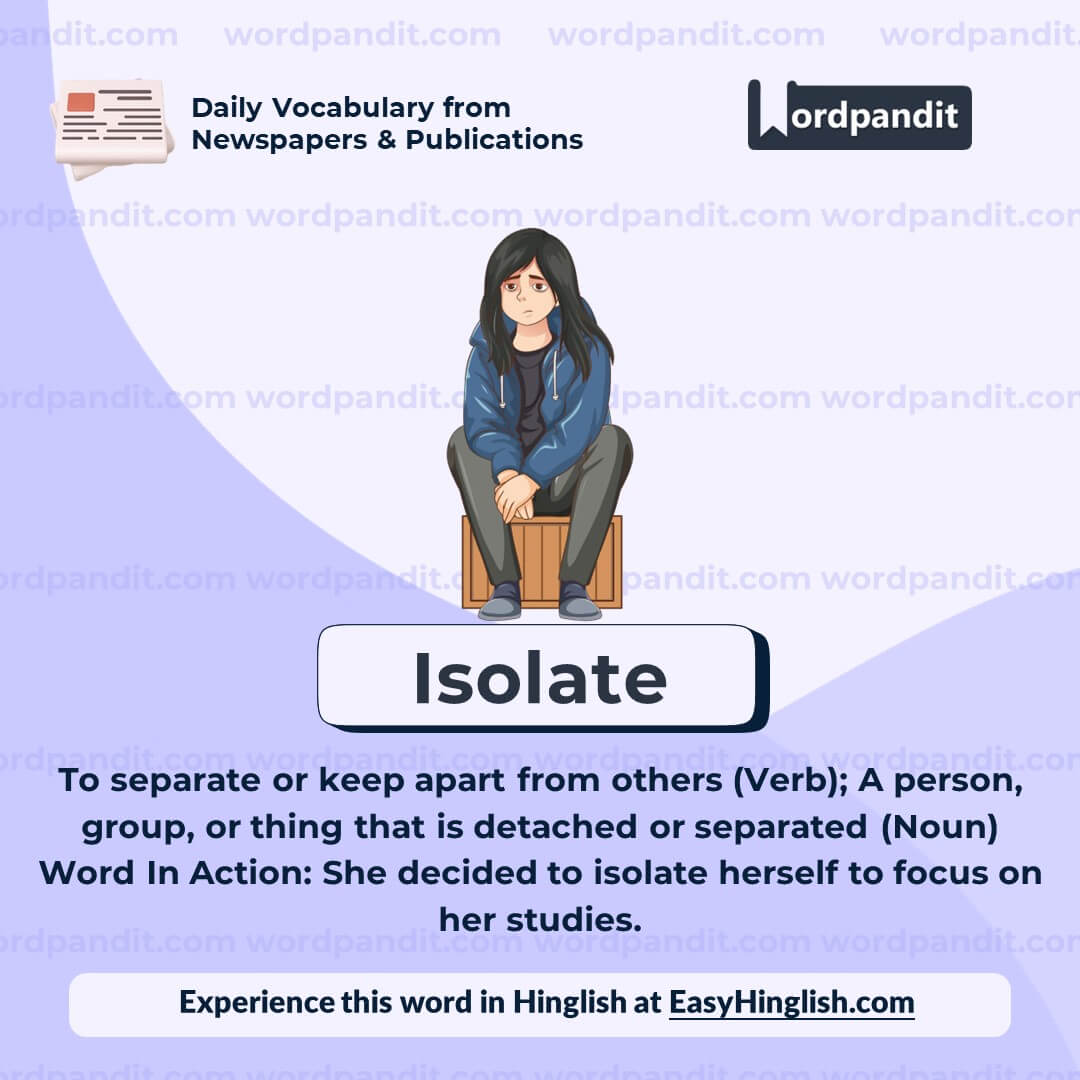
WORD-5: Isolate
Context:
"Species has long been the basic unit of zoology. Ernst Mayr’s 1951 definition still fits: ‘An aggregate of interbreeding natural populations which are not only reproductively isolated from other such aggregates but also ecologically specialised sufficiently so as not to compete with other such species.’" - Aeon
Explanatory Paragraph:
"Isolate" means to separate something or someone from others. In biology, particularly in the context of species, it refers to reproductive isolation — the inability of one group to successfully breed with another. This separation prevents the mixing of genes and allows different species to evolve independently. Outside of science, "isolate" can also mean to detach someone socially, emotionally, or physically, like when someone is quarantined or cut off from a group.
Meaning: To set apart from others; to separate physically, socially, or biologically (Verb)
Pronunciation: EYE-suh-late
Difficulty Level: ⭐⭐ Beginner to Intermediate
Etymology: From Latin *insula* meaning "island," leading to *isolatus*, meaning "made into an island" — suggesting separation or detachment.
Prashant Sir's Notes:
The root idea behind "isolate" is to "make into an island" — to keep apart. In biology, this concept is key to understanding how species form. In real life, we use it often in social and medical contexts too, like during disease outbreaks or emotional withdrawal.
Synonyms & Antonyms:
Synonyms: separate, detach, segregate, quarantine, seclude
Antonyms: connect, integrate, unite, include, join
Usage Examples:
- The virus was quickly isolated in the lab to prevent further contamination.
- Emotional trauma can cause people to isolate themselves from others.
- Geographical barriers can isolate populations, leading to the formation of new species over time.
- He felt isolated at the new school until he made some friends.
Cultural Reference:
During the COVID-19 pandemic, "isolation" became a globally recognized term, as millions were required to isolate to stop the spread of the virus — highlighting both the scientific and emotional dimensions of the word. - Global Health Review
Think About It:
Can isolation lead to growth or evolution — whether in species, individuals, or ideas? When might isolation be beneficial, and when might it be harmful?
Quick Activity:
Think of two scenarios — one where isolation is helpful (e.g., focusing on a task) and one where it’s harmful (e.g., feeling lonely). Describe both in a sentence each.
Memory Tip:
“Isolate” sounds like “island” — think of something being cut off like an island in the sea.
Real-World Application:
"Isolate" is commonly used in science (especially biology and medicine), psychology, and social commentary. Whether discussing disease control, emotional health, or species formation, understanding the term is crucial in academic and real-life discussions.


