

Daily Vocabulary from Indian Newspapers and Publications
Welcome to Wordpandit’s Indian Vocabulary Hub
At Wordpandit, we understand the importance of staying rooted in the local context while expanding your language skills. This section focuses on enriching your vocabulary with words and phrases drawn from India’s leading newspapers and publications, ensuring you're learning vocabulary that is practical, relevant, and uniquely Indian.
Why Indian Sources Matter
We believe that the best way to master any language is by immersing yourself in local content. That’s why we carefully curate vocabulary from top Indian publications, including:
- The Hindu
- The Times of India
- The Economic Times
- Hindustan Times
- Live Mint
- The Indian Express
- And many others...
Stay Updated, Stay Relevant
With daily updates from Indian news sources, you’ll be consistently learning words that reflect the trends and shifts in Indian society and culture. Our focus is to provide vocabulary that enhances your understanding of the language in an Indian context.
How Wordpandit Supports Your Goals
Whether you’re preparing for exams, aiming to improve your professional communication, or simply want to stay connected with the latest Indian vocabulary, Wordpandit is here to guide you every step of the way.
Learn with a Practical Approach
Our interactive learning methodology includes real-world examples, engaging activities, and context-specific usage to ensure that every word becomes part of your active vocabulary.
Dive into Indian Vocabulary Today!

Why Choose Wordpandit?
Practical Learning: Focus on words you'll actually encounter in real-world reading, enhancing your comprehension and communication skills.
Diverse Content: From current affairs to scientific breakthroughs, our varied sources expose you to vocabulary across multiple domains.
Effortless Integration: Make Wordpandit a part of your daily routine. Just a few minutes each day can significantly boost your lexicon over time.
Your Path to Vocabulary Mastery
- Visit our Daily Vocabulary section regularly
- Explore new words and their usage in context
- Practice incorporating these words into your own writing and speech
- Track your progress as your vocabulary expands
Start Your Journey Today
Embark on your vocabulary enhancement journey with Wordpandit. By consistently engaging with our daily posts, you'll build a robust vocabulary that serves you well in academic, professional, and personal contexts.
Remember, a word a day keeps linguistic limitations at bay. Make Wordpandit your daily companion in the quest for vocabulary excellence!
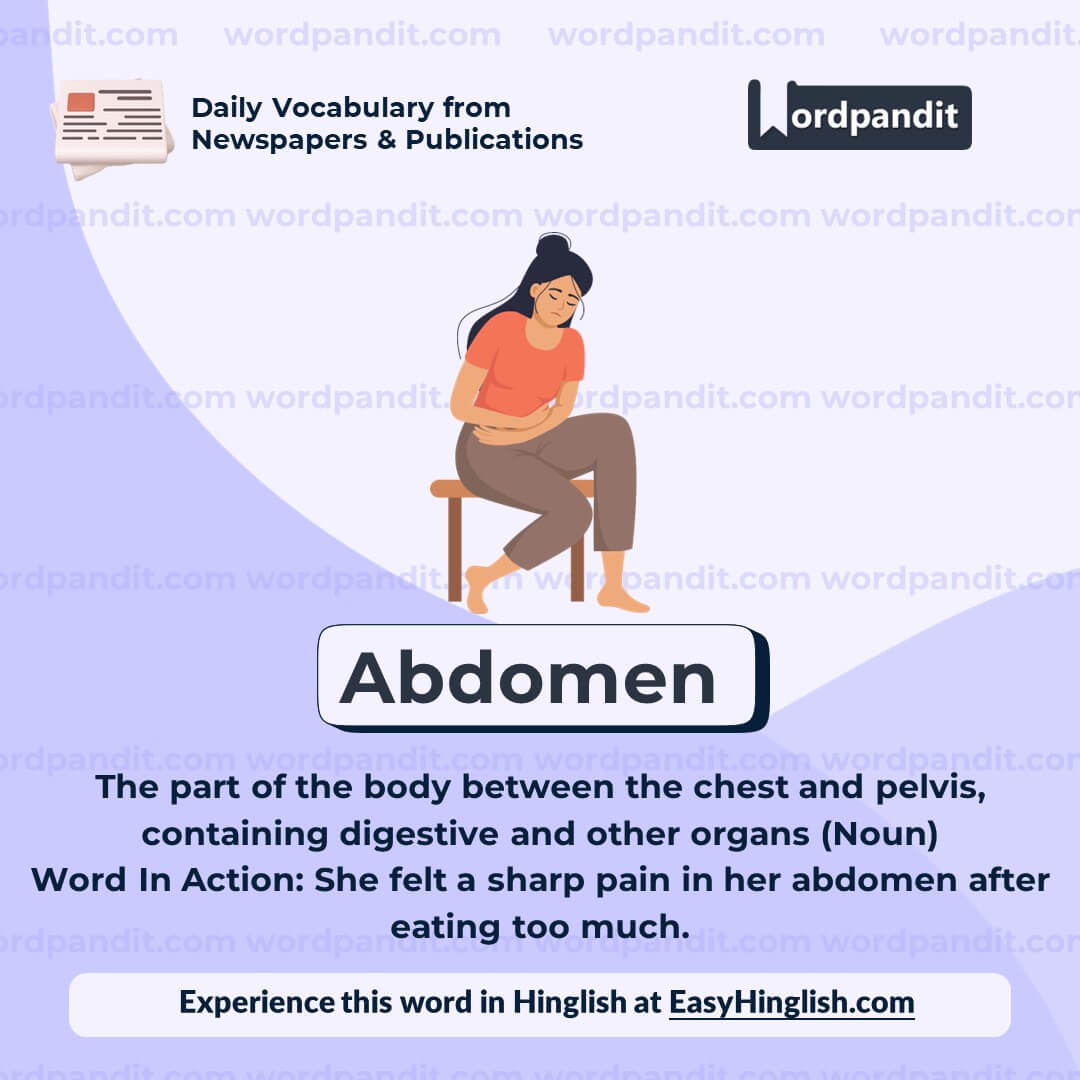
WORD-1: Abdomen
Context:
"The officer said that Wagay suffered injuries in the abdomen and his wife and her sister’s daughter were hit in the legs." - The Wire
Explanatory Paragraph:
The word "abdomen" refers to the part of the body between the chest and the pelvis. It contains vital organs such as the stomach, intestines, liver, and kidneys. When someone suffers an injury in the abdomen, it can be serious because this area houses many critical systems. The word is commonly used in medical or anatomical discussions but is also found in news reports or everyday language when describing body parts.
Meaning: The part of the body between the chest and pelvis that contains digestive organs. (Noun)
Pronunciation: AB-duh-muhn
Difficulty Level: ⭐⭐ Beginner
Etymology: From Latin *abdomen*, meaning "belly" or "paunch."
Prashant Sir's Notes:
This is a basic anatomical term, frequently used in both layman's and medical language. Make sure to distinguish it from "stomach," which is an organ, whereas "abdomen" refers to a region.
Synonyms & Antonyms:
Synonyms: belly, stomach area, midsection, gut
Antonyms: chest, head, limbs (contextual)
Usage Examples:
- He complained of sharp pain in his abdomen after the meal.
- The athlete suffered a muscle strain in her lower abdomen during the match.
- Doctors examined the patient’s abdomen for signs of internal bleeding.
- Martial artists often strengthen their abdomen to absorb impact better.
Cultural Reference:
"Strong core, strong body — everything starts from the abdomen." – Common theme in modern fitness culture.
Think About It:
Why do you think the abdomen is considered such a critical part of the body in both medicine and fitness?
Quick Activity:
Label the parts of the human abdomen on a blank diagram. Can you identify where the liver, stomach, and intestines are located?
Memory Tip:
Think of "abs" in "abdomen"—it’s the area where people work out to get "six-pack abs."
Real-World Application:
Knowing the term "abdomen" helps in describing health symptoms accurately to doctors or understanding news reports about injuries or medical events.
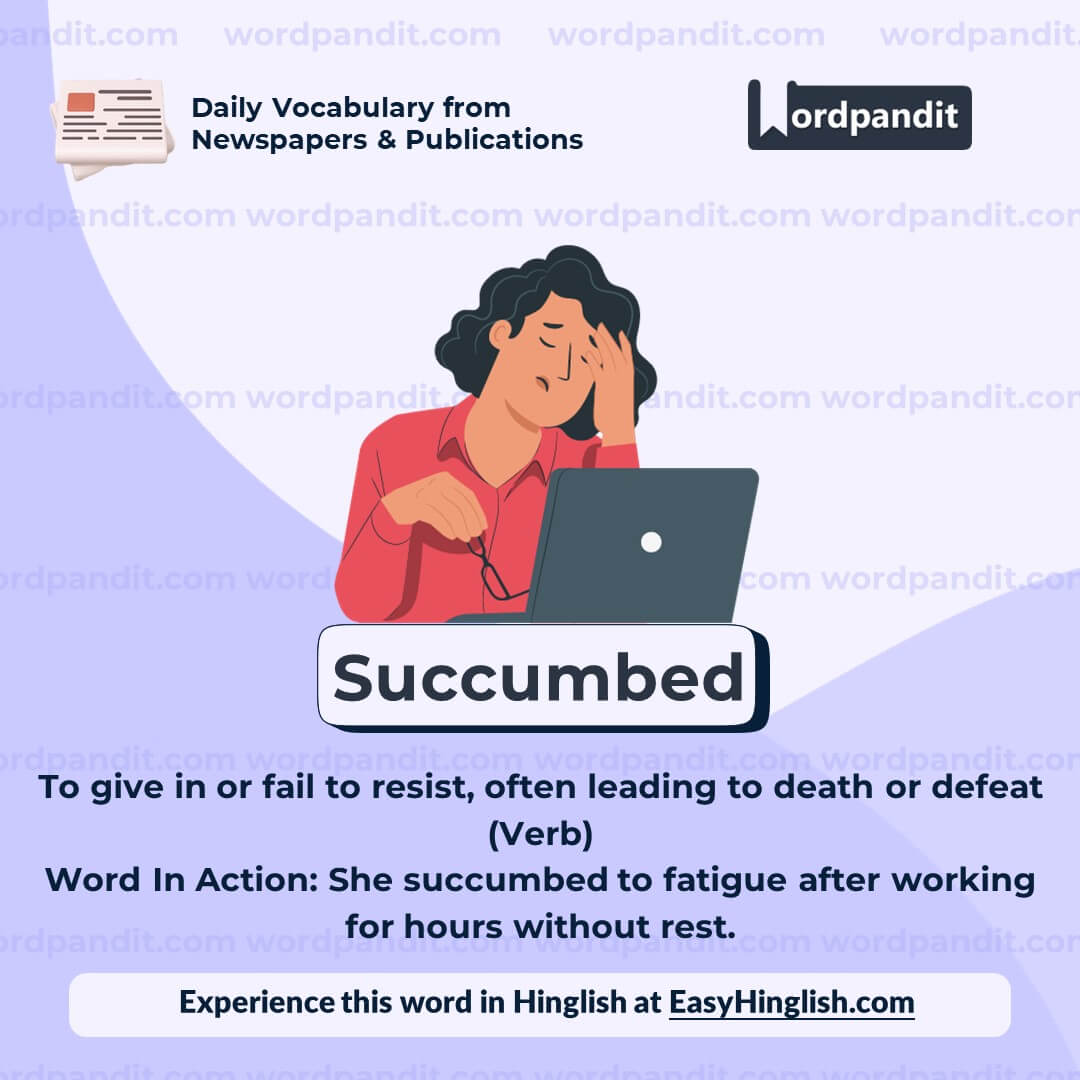
WORD-2: Succumbed
Context:
"The victims were taken to hospital where Wagay succumbed to injuries while his wife and the girl are stable,” the officer said, without divulging more details." - The Wire
Explanatory Paragraph:
The word "succumbed" is used when someone gives in to a stronger force or ultimately dies from an illness, injury, or condition. In this context, it means that Wagay could not survive the injuries and passed away. The term often carries a formal or serious tone, especially in news reports or medical discussions, and emphasizes the inability to resist or overcome a fatal situation.
Meaning: To die or to fail to resist a pressure, illness, or force. (Verb)
Pronunciation: suh-KUMD
Difficulty Level: ⭐⭐⭐ Intermediate
Etymology: From Latin *succumbere*, meaning “to lie under,” from *sub-* (under) + *cumbere* (to lie down).
Prashant Sir's Notes:
"Succumbed" is a formal and often euphemistic way of saying someone died, particularly after a struggle (like with injuries or disease). It can also be used metaphorically to describe giving in to temptation or pressure.
Synonyms & Antonyms:
Synonyms: yield, give in, surrender, pass away, die
Antonyms: resist, survive, overcome, fight off
Usage Examples:
- After a long battle with cancer, she finally succumbed to the disease.
- Many soldiers succumbed to exhaustion during the harsh winter campaign.
- He succumbed to temptation and ate the entire chocolate cake.
- Despite their efforts, the company succumbed to market pressure and shut down.
Cultural Reference:
"He who fights with monsters should look to it that he himself does not become a monster… and if you gaze long into an abyss, the abyss also gazes into you." — Friedrich Nietzsche. Many interpret this as a warning against succumbing to darkness while fighting it.
Think About It:
Is there a difference between giving up and succumbing? When does acceptance become surrender?
Quick Activity:
Write two short sentences using “succumbed” — one literal (about death or illness) and one metaphorical (about temptation or pressure).
Memory Tip:
Think of “succumb” as “sink under” — when you succumb, you go under the weight of something you can’t resist.
Real-World Application:
The word is commonly used in news, medical contexts, and literature to describe a person’s death or defeat. Understanding it can help you read formal reports or express vulnerability in writing more precisely.
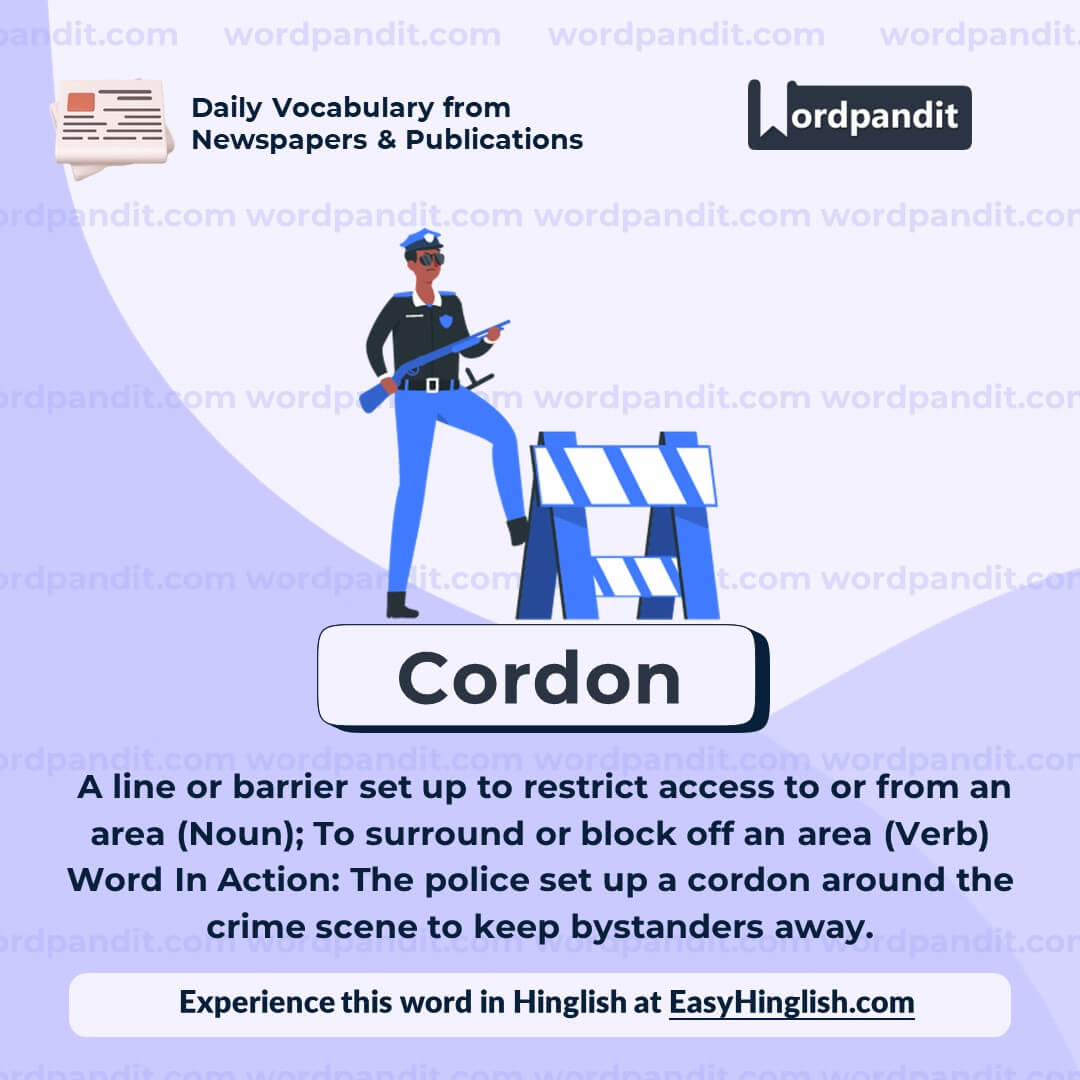
WORD-3: Cordon
Context:
"Following the incident, a spontaneous shutdown was observed in the area while a massive cordon and search operation was launched by security forces to hunt down the attackers which was underway when this report was filed." - The Wire
Explanatory Paragraph:
The word "cordon" refers to a line or circle of police, soldiers, or guards preventing access to or from an area. It is often used in military or security-related contexts, especially during emergencies, investigations, or conflict situations. In the given sentence, it indicates that security forces surrounded the area to contain and search for the suspects. The term can also be used metaphorically to describe any type of restricted or controlled zone.
Meaning: A line or barrier established by authorities to control access to or from an area. (Noun)
Pronunciation: KOR-dun
Difficulty Level: ⭐⭐⭐ Intermediate
Etymology: From French *cordon*, meaning "ribbon" or "small rope", from Latin *chorda*, meaning "cord."
Prashant Sir's Notes:
This word often appears in conflict-related or security scenarios, particularly in journalistic or military reports. Remember: to "cordon off" an area means to block it with personnel or tape. It’s both a noun and a verb.
Synonyms & Antonyms:
Synonyms: barrier, perimeter, blockade, enclosure, security line
Antonyms: opening, access, entry, passage
Usage Examples:
- The police set up a cordon around the building after receiving a bomb threat.
- Rescue workers cordoned off the area to prevent bystanders from interfering.
- A cordon of soldiers surrounded the village during the night operation.
- They cordoned off the crime scene to preserve evidence.
Cultural Reference:
In disaster movies and real-world crises alike, the term "cordon sanitaire" has been used for public health zones established to contain disease outbreaks — seen during Ebola and COVID-19 containment efforts.
Think About It:
What are the ethical implications of cordoning off entire neighborhoods during investigations or health emergencies?
Quick Activity:
Use the phrase “cordon off” in two different sentences: one related to law enforcement, and another in a metaphorical context.
Memory Tip:
Think of “cordon” as a “cord” or rope creating a boundary — often used to block access.
Real-World Application:
Understanding the term helps in following news reports, especially those involving emergencies, security threats, or crowd control situations. It’s also useful in professions related to law enforcement, crisis management, and journalism.
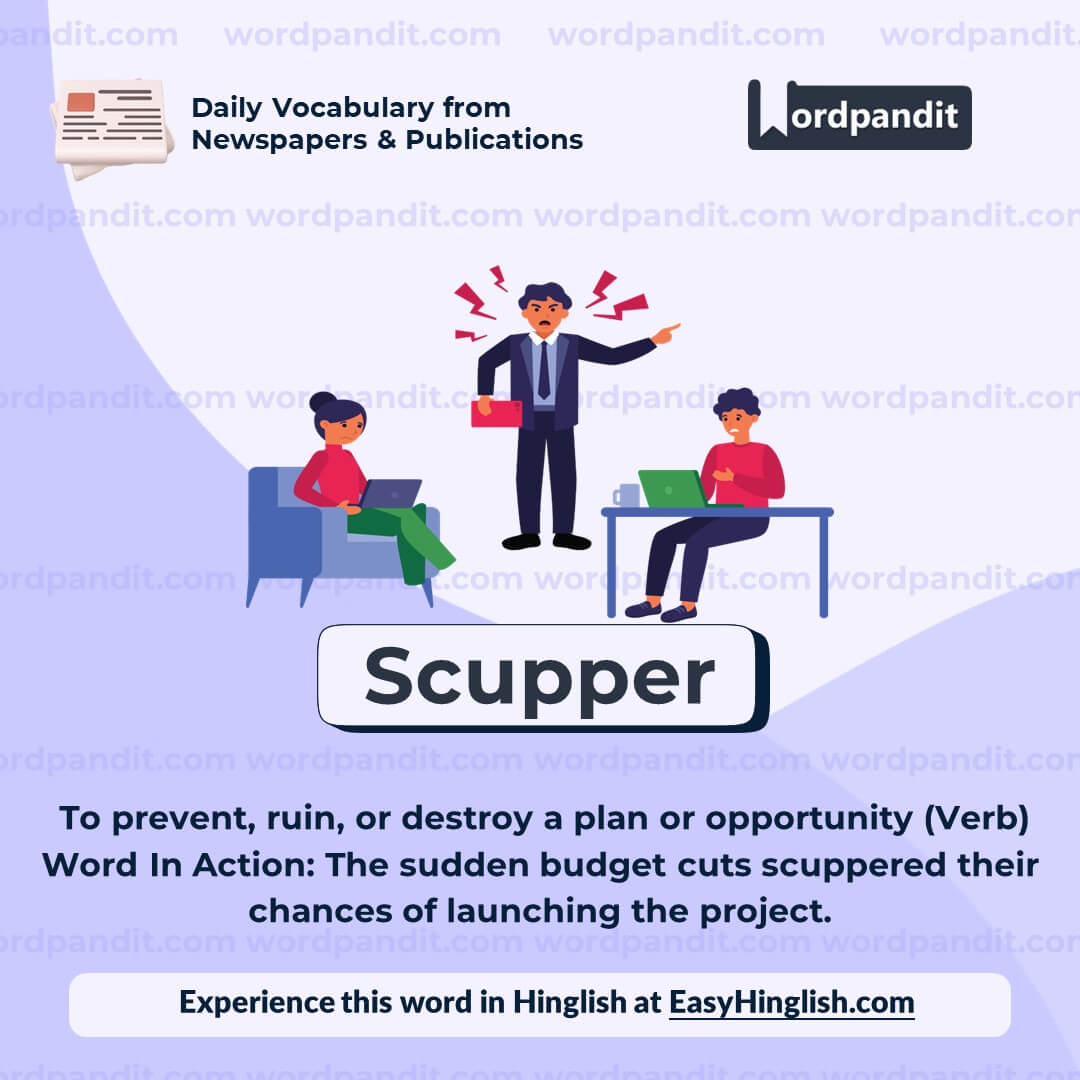
WORD-4: Scupper
Context:
"Returning to war would also scupper any short-term chance of a deal between Israel and Saudi Arabia — a major international achievement that Netanyahu has long coveted." - Telegraph India
Explanatory Paragraph:
The word "scupper" is used in this context to mean ruining or preventing something from happening. It suggests that the return to war would destroy the possibility of a diplomatic deal, effectively rendering it impossible. The term is often used in political, business, or negotiation contexts to describe plans or efforts that have been derailed or blocked unexpectedly, usually by external forces.
Meaning: To ruin, prevent, or put an end to something. (Verb)
Pronunciation: SKUH-pur
Difficulty Level: ⭐⭐⭐ Intermediate
Etymology: Originally a nautical term from the Middle Dutch *schoper*, meaning "drain" or "hole in a ship's side" — later metaphorically used to describe causing a plan to sink or fail.
Prashant Sir's Notes:
Though originally a naval term, “scupper” has evolved into a vivid verb in everyday English to describe foiling someone’s plans. Use it instead of common terms like “ruin” or “destroy” for more expressive writing, especially in editorial or analytical writing.
Synonyms & Antonyms:
Synonyms: ruin, foil, sabotage, wreck, derail, upset
Antonyms: support, facilitate, promote, assist, enable
Usage Examples:
- Heavy rains scuppered the team’s chances of completing the match.
- The scandal scuppered his chances of winning the election.
- Unexpected budget cuts scuppered the launch of the new project.
- Her careless remark nearly scuppered months of delicate negotiations.
Cultural Reference:
In UK political commentary, the term "scupper" is frequently used in headlines — for instance, “Rebels scupper Brexit bill” — to describe dramatic political defeats or upsets.
Think About It:
Is it always negative to scupper something, or can it sometimes be a necessary disruption to prevent a greater problem?
Quick Activity:
Think of a plan you've made recently — now write a sentence imagining how that plan could be scuppered by unforeseen circumstances.
Memory Tip:
Think of "scupper" as a "sinker" — like a leak in a ship that causes everything to go down. It sinks your plans!
Real-World Application:
This word is useful in business, politics, journalism, and everyday conversation to describe situations where efforts or negotiations are unexpectedly derailed or blocked.
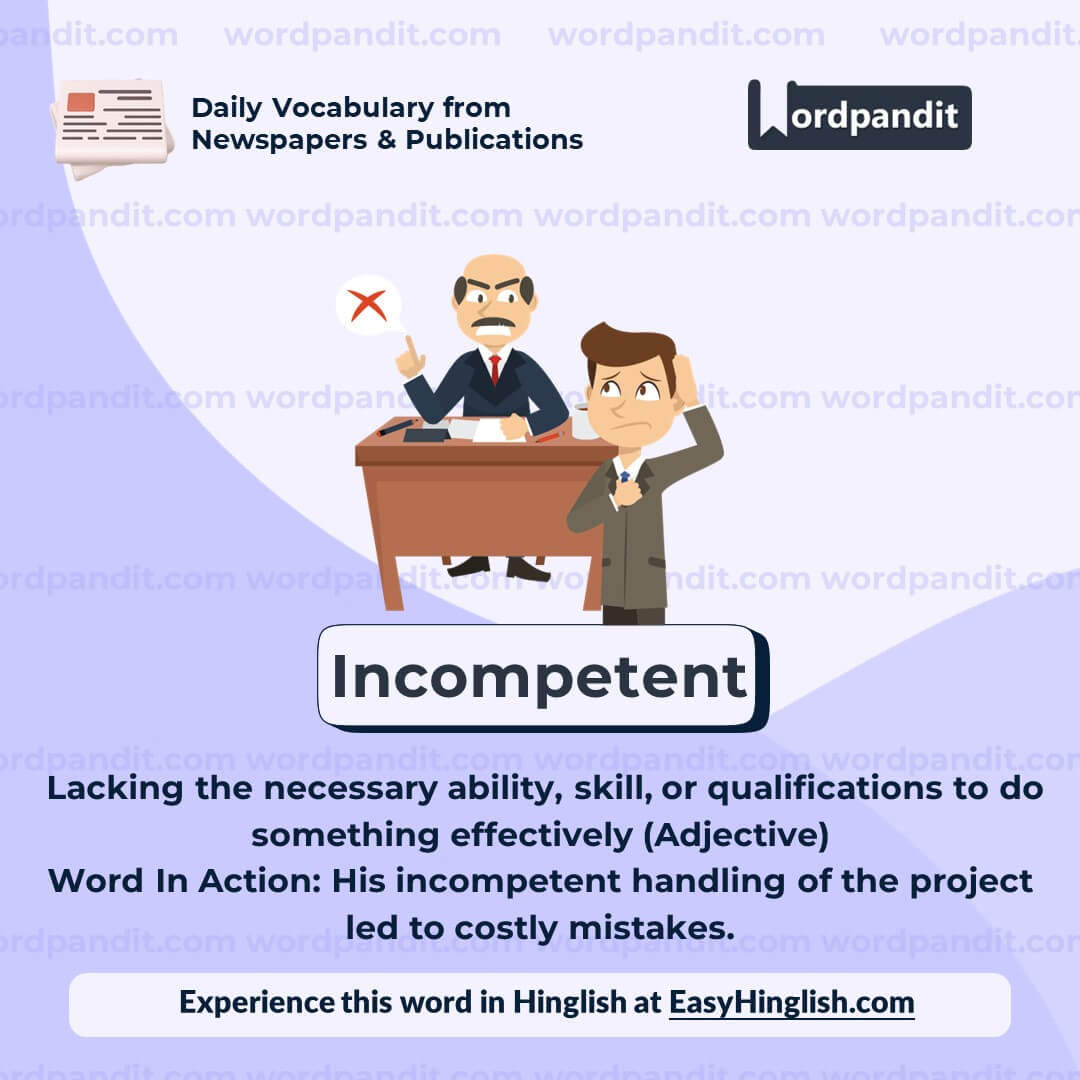
WORD-5: Incompetent
Context:
"But Israeli leaders see the authority as corrupt and incompetent and have dismissed the idea of giving it a major role in Gaza, at least for now." - Telegraph India
Explanatory Paragraph:
The word "incompetent" describes someone who lacks the necessary skills, knowledge, or ability to do a job or task properly. In the context above, it implies that the authority is seen as incapable of managing responsibilities effectively. The term is often used in political, professional, or administrative contexts to criticize performance or qualifications.
Meaning: Lacking the ability, skill, or knowledge to do something successfully. (Adjective)
Pronunciation: in-KOM-puh-tuhnt
Difficulty Level: ⭐⭐ Beginner
Etymology: From Latin *incompetens*, meaning "not suitable" — *in-* (not) + *competens* (suitable, capable).
Prashant Sir's Notes:
This is a strong, often negative term used to critique someone's performance or authority. Be cautious using it in professional contexts unless absolutely justified. Useful for describing failure in leadership or responsibility.
Synonyms & Antonyms:
Synonyms: unskilled, incapable, unqualified, inept, unfit
Antonyms: capable, competent, skilled, efficient, qualified
Usage Examples:
- The manager was fired for being completely incompetent at handling team issues.
- Appointing an incompetent official to oversee the crisis only worsened the situation.
- Her incompetence in using the software delayed the entire project.
- The pilot was declared incompetent after failing multiple safety checks.
Cultural Reference:
The term "incompetent" has often been used in political satire and media critiques — for instance, in shows like *Yes, Minister* and *The Office*, where characters are portrayed as hilariously or dangerously unfit for their roles.
Think About It:
Can someone be considered incompetent in one context but highly competent in another? How does the environment shape perception of ability?
Quick Activity:
Write two contrasting sentences: one showing someone as incompetent in a task, and another showing them as competent in a different situation.
Memory Tip:
Break it down: "in-" means "not," and "competent" means "capable" — so "incompetent" literally means "not capable."
Real-World Application:
Common in professional and political discourse, the term helps in evaluating or critiquing performance — whether in job interviews, reviews, debates, or opinion pieces.


