

Daily Vocabulary from International Newspapers and Publications
Expand Your Vocabulary with Wordpandit’s Global Vocabulary Hub
At Wordpandit, we are committed to helping you develop a truly global vocabulary by drawing from some of the most respected international publications. This section is designed to keep you ahead of the curve by introducing you to words that define global conversations and trends.
The Power of Global Sources
To help you think and communicate on a global scale, we curate vocabulary from renowned international sources, such as:
- The New York Times
- The Washington Post
- BBC
- The Guardian
- The Economist
- Scientific American
- Psychology Today
- And many more...
Stay Global, Stay Competitive
Our daily updates from international publications ensure you are consistently exposed to new words that reflect global news and developments, making sure your vocabulary is not only current but also globally relevant.
Enhance Your Global Perspective
Whether you’re preparing for international exams, aiming to excel in global business communication, or want to enhance your language skills for personal growth, Wordpandit offers the resources you need to thrive in a global context.
Effective Learning, Global Reach
Our learning methodology combines global examples, memory aids, and interactive activities, allowing you to internalize new words effectively and apply them in real-world scenarios.
Begin Your Global Vocabulary Journey Now!

Why Choose Wordpandit?
Practical Learning: Focus on words you'll actually encounter in real-world reading, enhancing your comprehension and communication skills.
Diverse Content: From current affairs to scientific breakthroughs, our varied sources expose you to vocabulary across multiple domains.
Effortless Integration: Make Wordpandit a part of your daily routine. Just a few minutes each day can significantly boost your lexicon over time.
Your Path to Vocabulary Mastery
- Visit our Daily Vocabulary section regularly
- Explore new words and their usage in context
- Practice incorporating these words into your own writing and speech
- Track your progress as your vocabulary expands
Start Your Journey Today
Embark on your vocabulary enhancement journey with Wordpandit. By consistently engaging with our daily posts, you'll build a robust vocabulary that serves you well in academic, professional, and personal contexts.
Remember, a word a day keeps linguistic limitations at bay. Make Wordpandit your daily companion in the quest for vocabulary excellence!
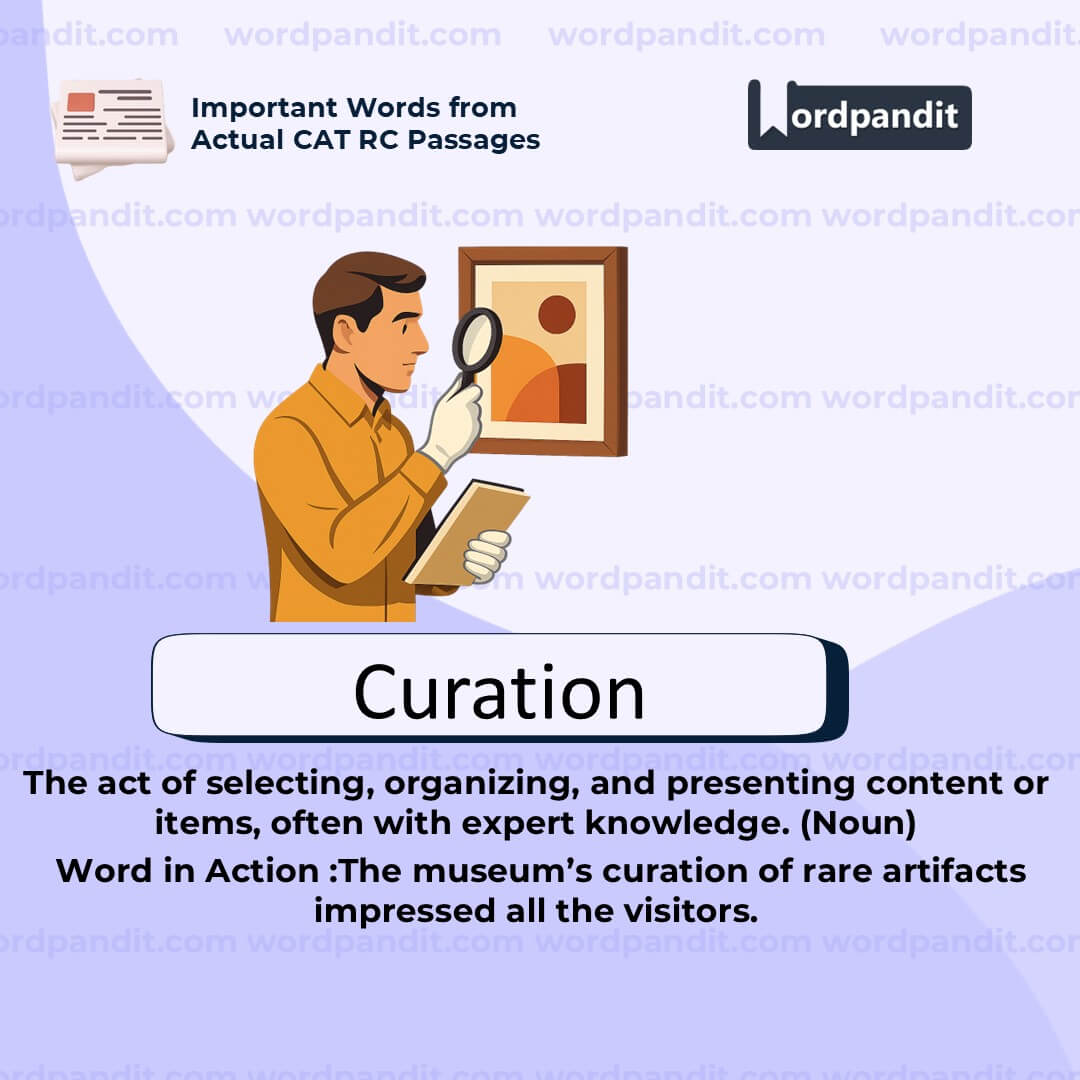
WORD-1: Curation
Context:
"The ambitious curation by the photography academic Michel Poivert gathers together 17 projects at Brussels’ Hangar gallery." - The Guardian
Explanatory Paragraph:
"Curation" refers to the thoughtful selection, organization, and presentation of items—typically in a museum, gallery, or digital space. A curator brings together materials to form a cohesive experience or narrative, often focusing on a theme or purpose. It involves both artistic and intellectual judgment, ensuring that what is presented is meaningful and engaging for the audience.
Meaning: The act of selecting and organizing content or items for presentation (noun)
Pronunciation: kyoo-RAY-shun
Difficulty Level: ⭐⭐ Beginner to Intermediate
Etymology: Derived from the Latin word curare, meaning “to care for” — originally used in the context of caretaking or guardianship in religious and artistic settings.
Prashant Sir's Notes:
Always connect "curation" to care and thoughtful selection. Whether it’s an art show, a playlist, or a newsletter, curation is about quality over quantity—intention over randomness.
Synonyms & Antonyms:
Synonyms: selection, organization, compilation, arrangement, exhibition planning
Antonyms: neglect, disorganization, randomness, disregard
Usage Examples:
- The curation of the museum's new wing reflects a modern perspective on ancient artifacts.
- Spotify's algorithmic curation makes discovering new music effortless.
- Her social media feed is a meticulous curation of aesthetic travel photos.
- The exhibition's success lay in the thoughtful curation of both local and international artists.
Cultural Reference:
"In the age of information overload, content curation has become as valuable as content creation." – Paraphrased from digital media commentary
Think About It:
Is curation more about the objects chosen or the story those choices tell?
Quick Activity:
Think of a playlist, photo album, or exhibition you’ve seen or created. List three reasons why you chose those specific items. How does this reflect your own curatorial thinking?
Memory Tip:
Think of “curation” like “curing” a story—just like a chef curates a menu or a doctor carefully selects a treatment plan, a curator shapes an experience with care.
Real-World Application:
Professionals in fields like art, fashion, digital content, museums, and education use curation daily to create meaningful and engaging experiences. Even social media influencers act as curators of lifestyle and aesthetics.
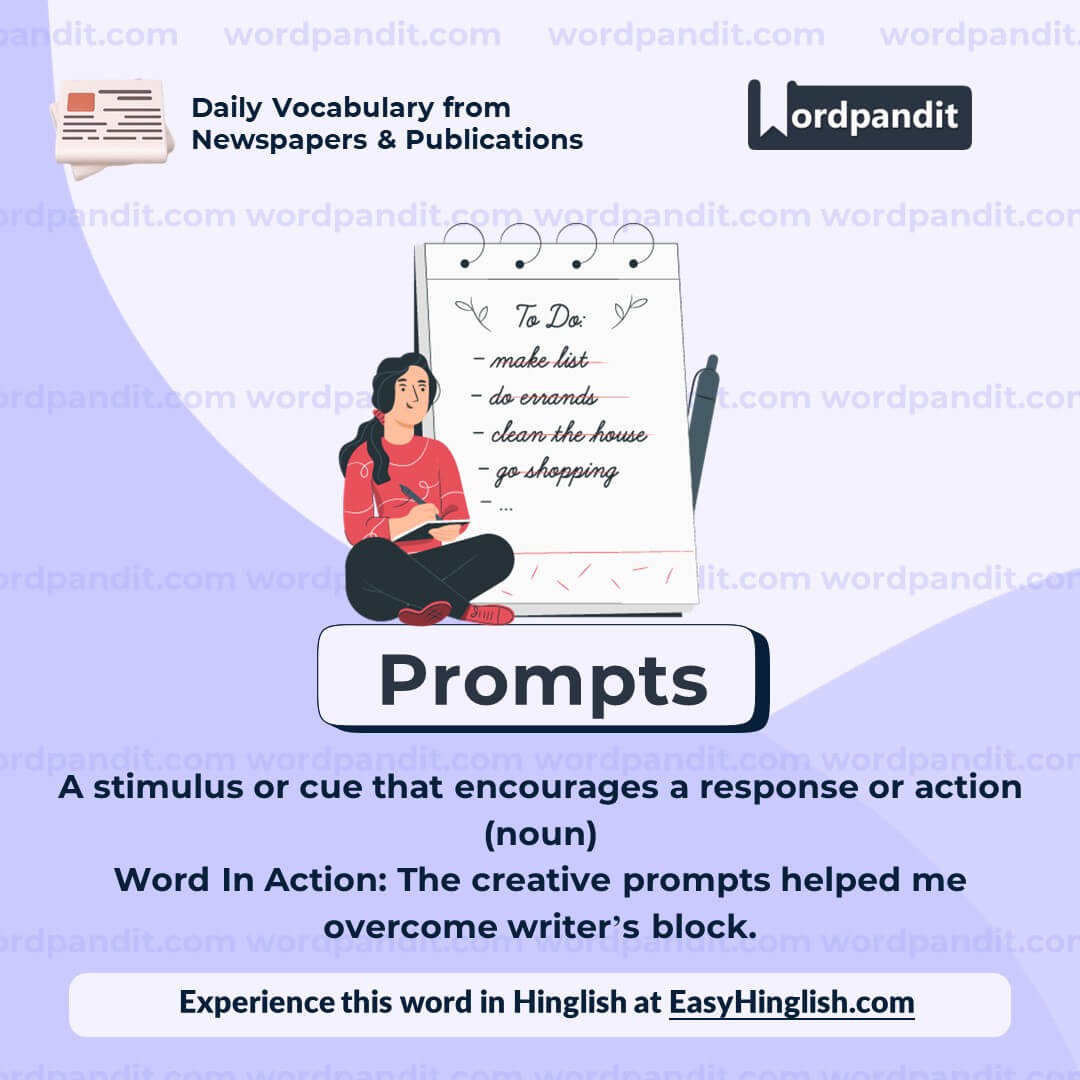
WORD-2: Prompts
Context:
"Using the software’s literal language prompts, they wanted to see how they could recreate some of the world’s most famous photographs." - The Guardian
Explanatory Paragraph:
In this context, "prompts" refer to specific instructions or input commands given to software, particularly generative tools like AI, to produce a desired result. Prompts guide the tool on what to create—whether it's an image, a piece of writing, or a response. They act as the bridge between human intention and machine execution, making clarity and precision in prompt design crucial.
Meaning: Cues, commands, or instructions that guide a response or action (noun, plural of "prompt")
Pronunciation: prompts
Difficulty Level: ⭐⭐ Beginner to Intermediate
Etymology: From Latin promptus, meaning "brought forth" or "ready," evolving through Old French and Middle English to mean a cue or trigger for action.
Prashant Sir's Notes:
In modern tech and education, "prompt" has gained special importance—especially with AI tools. Think of it as the spark that lights the engine of response. A good prompt is like a good question—it brings out the best answers.
Synonyms & Antonyms:
Synonyms: cue, trigger, instruction, signal, suggestion
Antonyms: silence, inhibition, delay, discouragement
Usage Examples:
- The AI model responded creatively to detailed text prompts.
- She gave him prompts to help him continue his story during the presentation.
- Writing prompts can be great tools to overcome creative blocks.
- Clear prompts make it easier for software to generate accurate results.
Cultural Reference:
"In the age of generative AI, prompts are becoming a new digital literacy." – TechCrunch (paraphrased)
Think About It:
If prompts determine outcomes, how much of the final result belongs to the human versus the machine?
Quick Activity:
Write a prompt for an AI image generator to create a "futuristic city at sunset." Then, modify the prompt to add a new element (e.g., flying cars). How does the change affect the result?
Memory Tip:
Think of a stage actor forgetting lines and receiving a "prompt" from backstage—just like AI needs a prompt to begin its "performance."
Real-World Application:
Prompts are used in AI tools (like ChatGPT), education (writing prompts), psychology (therapeutic cues), and even gaming (action hints). Mastering prompts helps you get better results from digital tools and unlock creative potential.
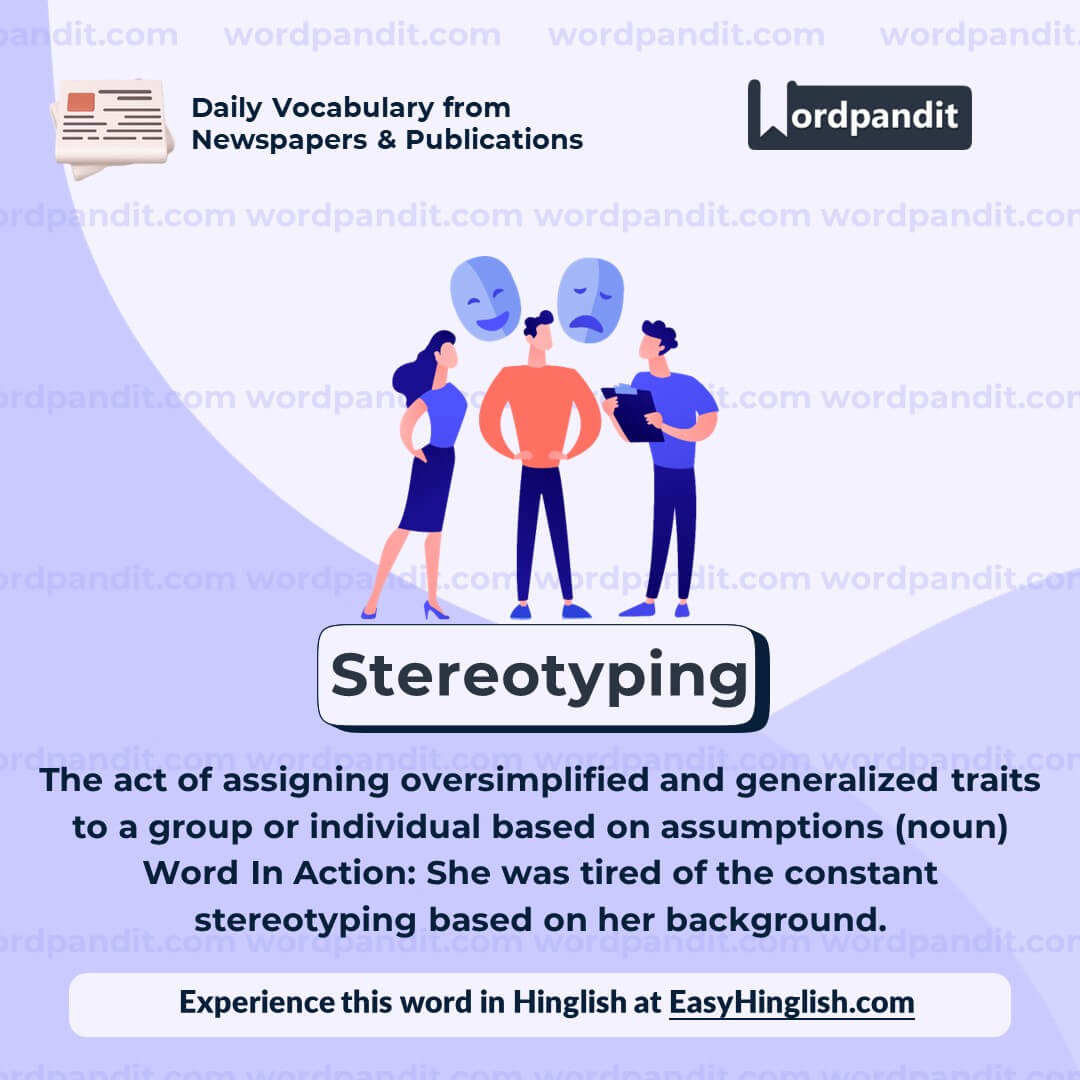
WORD-3: Stereotyping
Context:
"The work was made between 2022 and 2023 and really highlighted the flaws and prejudices in source data, questioning the role of the internet in appropriation and stereotyping." - The Guardian
Explanatory Paragraph:
"Stereotyping" refers to the act of making generalized and often oversimplified assumptions about individuals or groups based on characteristics like race, gender, nationality, profession, or other identifiers. These assumptions may not reflect reality and often lead to unfair treatment or biased judgments. In modern discussions, stereotyping is often criticized because it reinforces harmful beliefs and limits people’s understanding of diversity and individuality.
Meaning: The act of assigning fixed, generalized traits to a group or individual, often without regard for individual differences (noun/verb)
Pronunciation: STEH-ree-oh-typ-ing
Difficulty Level: ⭐⭐⭐ Intermediate
Etymology: From Greek stereos (solid) + typos (impression). Originally used in printing, it evolved to describe fixed ideas or mental “impressions” about people.
Prashant Sir's Notes:
Remember, a stereotype is like a stamp—once applied, it sticks, whether or not it’s accurate. Stereotyping narrows our perception and should always be challenged with empathy and facts.
Synonyms & Antonyms:
Synonyms: generalization, categorization, labeling, assumption, bias
Antonyms: open-mindedness, individuality, fairness, objectivity
Usage Examples:
- The film was criticized for stereotyping women as emotional and weak.
- Educational programs are now focusing on breaking racial stereotyping in classrooms.
- Stereotyping often stems from lack of exposure to diverse perspectives.
- We must move beyond stereotyping and see people as individuals, not categories.
Cultural Reference:
"Stereotypes are fast and easy, but they are lies, and the truth takes its time." – Glennon Doyle (from her book Untamed)
Think About It:
Have you ever caught yourself believing a stereotype? What helped you question or unlearn it?
Quick Activity:
List three common stereotypes you've heard about a profession, gender, or culture. Then, write a counter-example for each that disproves the stereotype.
Memory Tip:
Think of a “stereo” system playing just one tune over and over—that’s what stereotyping does: repeats the same idea without variation, even when it doesn't fit.
Real-World Application:
Stereotyping affects areas such as hiring, media portrayal, education, and social interactions. Recognizing and challenging stereotypes can lead to more inclusive workplaces, accurate storytelling, and fair treatment for all.

WORD-4: Explode
Context:
"These things don't work, I've had them many times, and on occasion, they break, they explode." - BBC
Explanatory Paragraph:
"Explode" typically refers to something bursting violently and suddenly, often with a loud sound, due to internal pressure or force. It can describe both physical events (like a bomb or balloon exploding) and emotional or metaphorical ones (like someone exploding in anger or a trend suddenly gaining popularity). In the sentence from the BBC, it is used literally to describe an object that can physically burst or detonate under certain conditions.
Meaning: To burst or shatter violently and suddenly, typically with noise and force (verb)
Pronunciation: eks-PLOHD
Difficulty Level: ⭐ Beginner
Etymology: From Latin explodere, meaning "to drive out by clapping," originally used in the theatre to reject a bad performance; later evolved to mean "burst out with noise."
Prashant Sir's Notes:
"Explode" is not just about bombs! Think of popcorn, emotions, or viral videos—they all can ‘explode’ in different ways. Context tells you if it's literal or metaphorical.
Synonyms & Antonyms:
Synonyms: detonate, burst, erupt, blow up, ignite
Antonyms: collapse, deflate, implode, fizzle, extinguish
Usage Examples:
- The faulty battery caused the phone to explode in the user's hand.
- He exploded with anger after hearing the unfair decision.
- The firecracker exploded with a loud bang and lit up the sky.
- Her popularity exploded after the viral video was released.
Cultural Reference:
"Boom! Goes the dynamite" became a popular phrase in internet culture, often used humorously to describe something that has suddenly exploded—either literally or in terms of impact. - Internet Meme Culture
Think About It:
Why do you think we use "explode" so often in non-violent or emotional contexts, like "exploding with laughter" or "exploding in popularity"?
Quick Activity:
Write two sentences using "explode"—one literal (physical) and one metaphorical (emotional or abstract). Compare how the meaning shifts based on the context.
Memory Tip:
Think of a balloon getting bigger and bigger until—POP! That’s a classic image to remember what “explode” means: sudden, loud, and forceful!
Real-World Application:
"Explode" is used in news reports (explosions, accidents), emotional descriptions (exploding with joy or rage), business (sales exploded), and tech (devices overheating and exploding). Recognizing how it’s used helps in understanding tone and urgency.
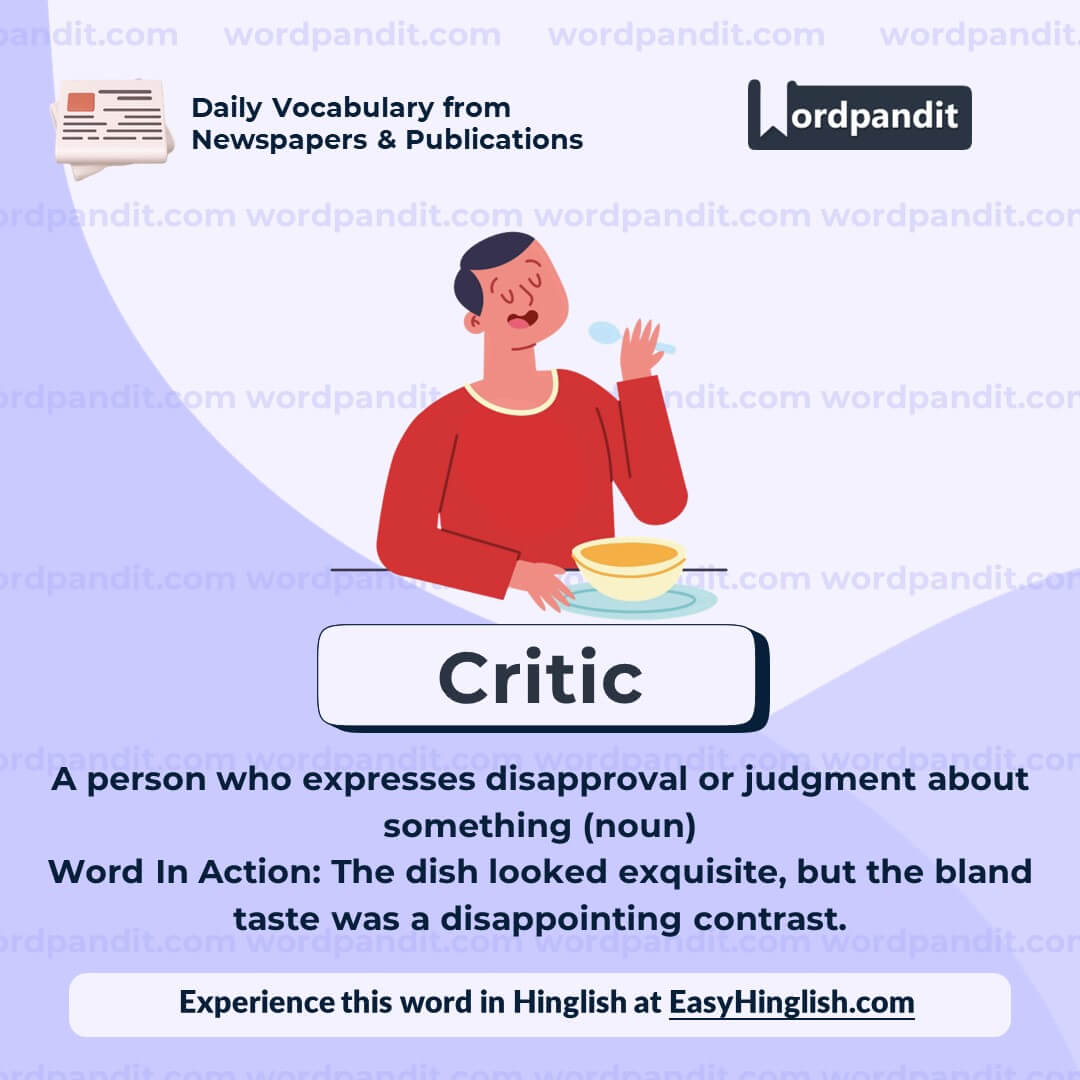
WORD-5: Critic
Context:
"Trump has been a long-standing critic of paper straws." - BBC
Explanatory Paragraph:
The word "critic" refers to a person who expresses disapproval or judgment about something, often by analyzing its flaws or shortcomings. Critics can be professional (such as film or art critics) or informal (such as someone who frequently shares opinions). In the context above, it implies that Trump has repeatedly spoken against or shown dislike for paper straws, possibly citing practical or ideological reasons.
Meaning: A person who expresses an unfavorable opinion or judgment about something (noun)
Pronunciation: KRIT-ik
Difficulty Level: ⭐ Beginner
Etymology: From Greek kritikos, meaning "able to judge," from the root krinein, "to separate or decide."
Prashant Sir's Notes:
Don’t confuse a “critic” with someone who always complains. A true critic offers insight, analysis, and perspective—whether in arts, politics, or everyday issues. Criticism, when constructive, leads to improvement.
Synonyms & Antonyms:
Synonyms: evaluator, reviewer, detractor, commentator, judge
Antonyms: supporter, admirer, advocate, fan, proponent
Usage Examples:
- She is a well-known film critic who writes for a national newspaper.
- Many critics argue that the new policy is ineffective and rushed.
- He has always been a vocal critic of modern architecture.
- Constructive critics help artists grow and improve their work.
Cultural Reference:
In the Pixar film Ratatouille, the feared food critic Anton Ego ultimately learns that critics should not just judge but also support creativity and risk-taking—a turning point in how we view criticism today.
Think About It:
Can someone be a critic without being negative? What makes criticism helpful versus harmful?
Quick Activity:
Pick a product or movie you've experienced recently. Write two sentences: one as a critic offering a valid critique, and another as a fan. Compare the tone and purpose.
Memory Tip:
Think of a “critic” as someone who gives a “critical” opinion—either good or bad—but based on judgment, not just emotion. “Critic” and “critical” go hand-in-hand.
Real-World Application:
Critics play essential roles in journalism, arts, politics, and social media. Whether reviewing films, evaluating products, or challenging government policies, critics shape public opinion and stimulate meaningful dialogue.


