

Daily Vocabulary from International Newspapers and Publications
Expand Your Vocabulary with Wordpandit’s Global Vocabulary Hub
At Wordpandit, we are committed to helping you develop a truly global vocabulary by drawing from some of the most respected international publications. This section is designed to keep you ahead of the curve by introducing you to words that define global conversations and trends.
The Power of Global Sources
To help you think and communicate on a global scale, we curate vocabulary from renowned international sources, such as:
- The New York Times
- The Washington Post
- BBC
- The Guardian
- The Economist
- Scientific American
- Psychology Today
- And many more...
Stay Global, Stay Competitive
Our daily updates from international publications ensure you are consistently exposed to new words that reflect global news and developments, making sure your vocabulary is not only current but also globally relevant.
Enhance Your Global Perspective
Whether you’re preparing for international exams, aiming to excel in global business communication, or want to enhance your language skills for personal growth, Wordpandit offers the resources you need to thrive in a global context.
Effective Learning, Global Reach
Our learning methodology combines global examples, memory aids, and interactive activities, allowing you to internalize new words effectively and apply them in real-world scenarios.
Begin Your Global Vocabulary Journey Now!

Why Choose Wordpandit?
Practical Learning: Focus on words you'll actually encounter in real-world reading, enhancing your comprehension and communication skills.
Diverse Content: From current affairs to scientific breakthroughs, our varied sources expose you to vocabulary across multiple domains.
Effortless Integration: Make Wordpandit a part of your daily routine. Just a few minutes each day can significantly boost your lexicon over time.
Your Path to Vocabulary Mastery
- Visit our Daily Vocabulary section regularly
- Explore new words and their usage in context
- Practice incorporating these words into your own writing and speech
- Track your progress as your vocabulary expands
Start Your Journey Today
Embark on your vocabulary enhancement journey with Wordpandit. By consistently engaging with our daily posts, you'll build a robust vocabulary that serves you well in academic, professional, and personal contexts.
Remember, a word a day keeps linguistic limitations at bay. Make Wordpandit your daily companion in the quest for vocabulary excellence!
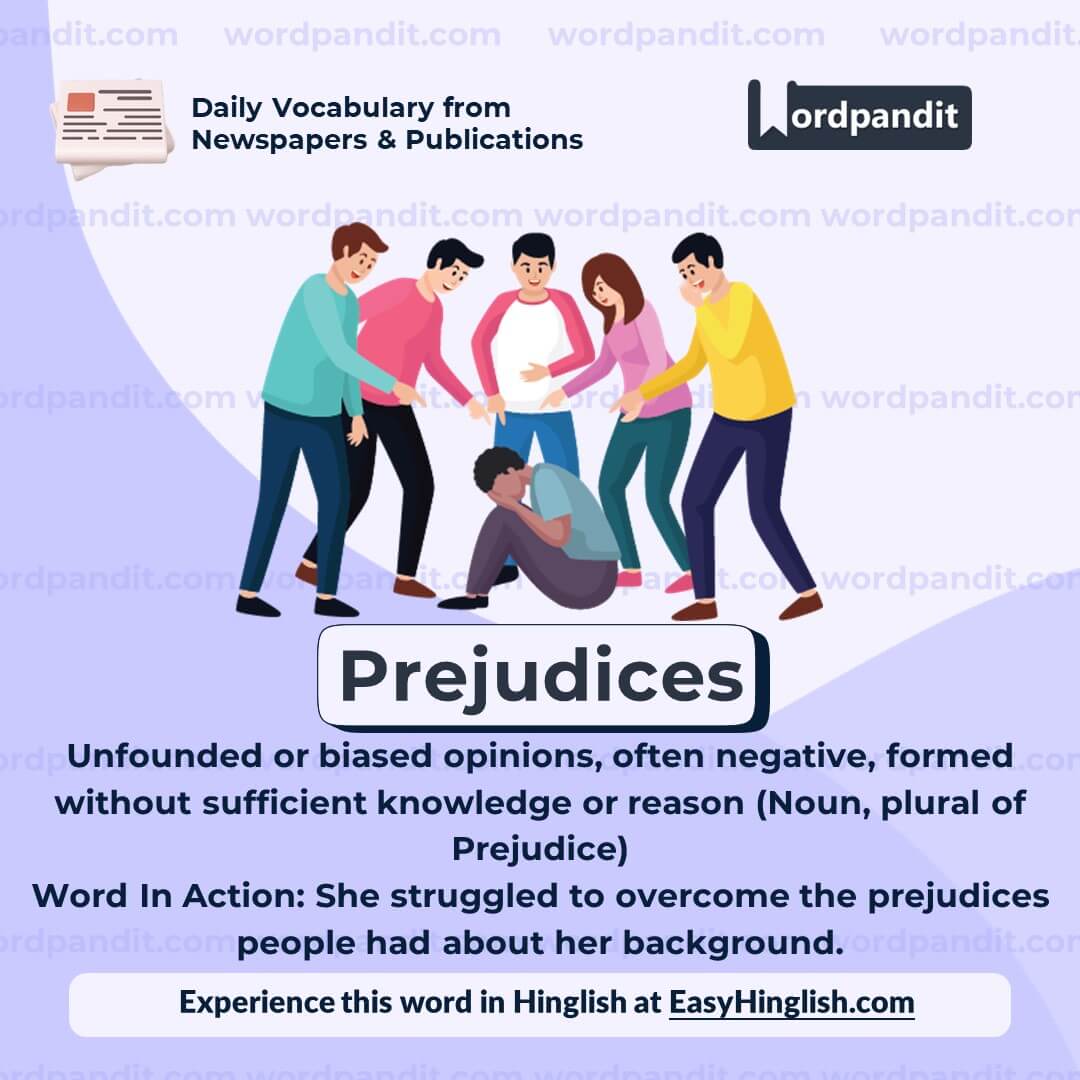
WORD-1: Prejudices
Context:
"The work was made between 2022 and 2023 and really highlighted the flaws and prejudices in source data, questioning the role of the internet in appropriation and stereotyping." - The Guardian
Explanatory Paragraph:
The word "prejudices" refers to opinions or feelings formed beforehand, often without proper knowledge, facts, or experience. These are usually negative and directed at people, groups, or ideas based on race, gender, religion, or other characteristics. In the context of the sentence, "prejudices in source data" suggests that certain biases or unfair judgments are embedded in the data, possibly influencing how people or cultures are represented online.
Meaning: Preconceived opinions or judgments, especially those that are not based on reason or actual experience (Noun - plural)
Pronunciation: prej-uh-diss-iz
Difficulty Level: ⭐⭐ Beginner
Etymology: From Latin *praejudicium*, meaning "prior judgment" or "decision in advance"
Prashant Sir's Notes:
Prejudices are mental blocks that stop us from seeing others fairly. Always ask yourself: am I reacting based on facts or assumptions? This word is often used when discussing social justice, media bias, or historical perspectives.
Synonyms & Antonyms:
Synonyms: Biases, preconceptions, stereotypes, partialities, discriminations
Antonyms: Fairness, objectivity, impartiality, tolerance, open-mindedness
Usage Examples:
- We must confront our own prejudices to build a more inclusive society.
- The jury was dismissed due to concerns about racial prejudices.
- Children often adopt the prejudices of adults without understanding them.
- His decisions were clouded by deep-rooted prejudices against outsiders.
Cultural Reference:
"Prejudice, not being founded on reason, cannot be removed by argument." - Samuel Johnson
Think About It:
In what ways can unconscious prejudices shape the way we interact with others, even when we believe we are being fair?
Quick Activity:
Write down 3 types of prejudice you have seen in media, school, or society. Reflect on how they affected the people involved.
Memory Tip:
Think of "pre-judge" — to judge before knowing. "Prejudices" are pre-judgments without facts.
Real-World Application:
Understanding and addressing prejudices is crucial in workplaces, education, and policymaking to ensure fairness, equality, and respectful representation of all individuals and communities.
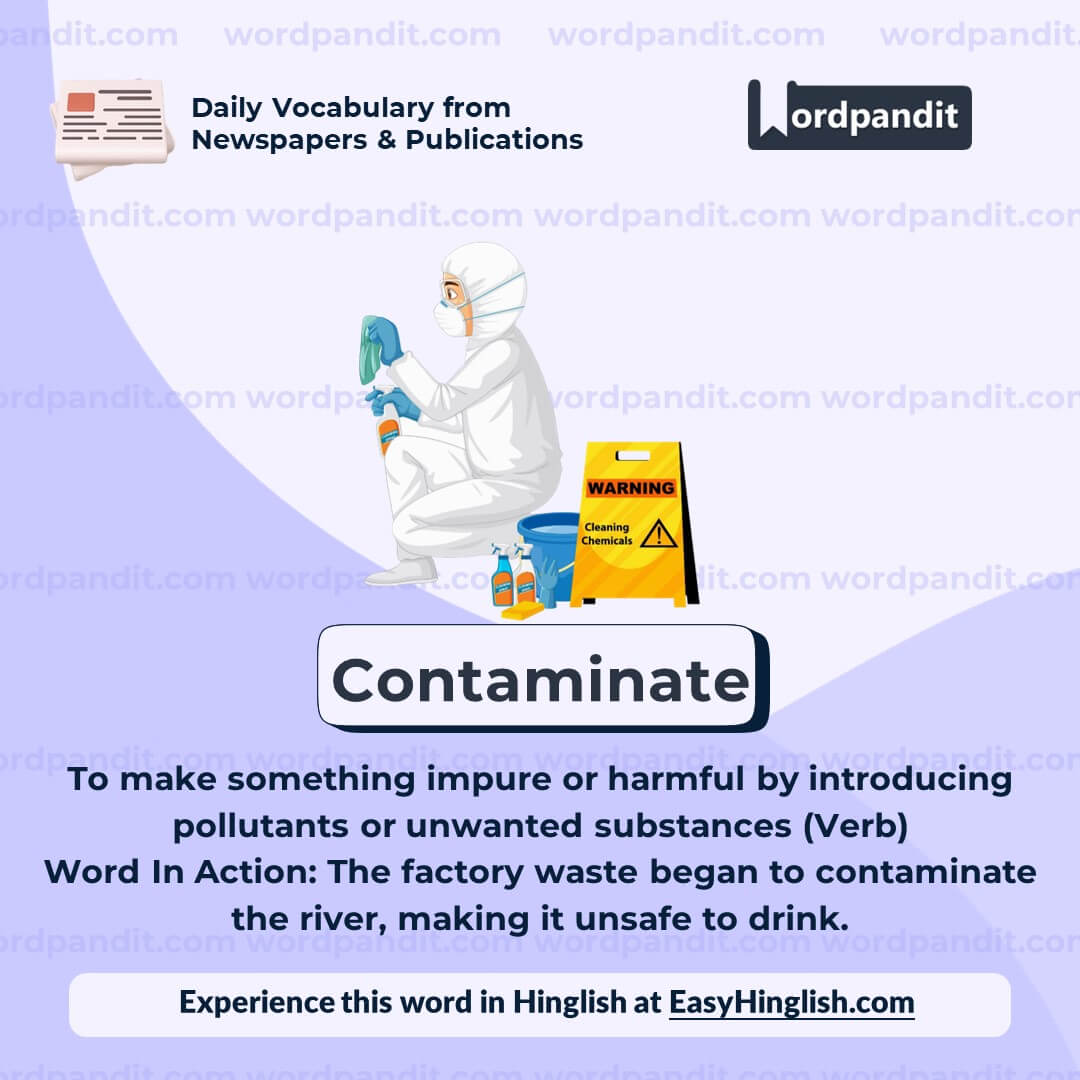
WORD-2: Contaminate
Context:
"PFAS can stay in the environment for decades, contaminate water supplies and cause a variety of health issues." - BBC
Explanatory Paragraph:
The verb "contaminate" refers to the process of making something impure, unclean, or harmful by adding something unwanted or dangerous to it. In environmental contexts, this often means the introduction of pollutants into natural resources such as water, air, or soil. In the sentence, the word indicates how PFAS (harmful chemicals) can pollute water sources and thereby pose risks to human and animal health.
Meaning: To make something impure or unsafe by adding harmful or unwanted substances (Verb)
Pronunciation: kuhn-TAM-uh-nayt
Difficulty Level: ⭐⭐ Beginner
Etymology: From Latin *contaminare*, meaning "to defile, pollute, or corrupt"
Prashant Sir's Notes:
Contaminate is often used in scientific, environmental, and health contexts. It's important to understand its serious implications—pollution, toxicity, infection, and overall danger to living beings and ecosystems.
Synonyms & Antonyms:
Synonyms: Pollute, taint, infect, spoil, sully
Antonyms: Purify, cleanse, sanitize, disinfect, sterilize
Usage Examples:
- Dumping industrial waste can contaminate rivers and harm aquatic life.
- One sick worker can contaminate an entire batch of food in a factory.
- Leaking pipes may contaminate the soil with toxic chemicals.
- Researchers are working to find ways to decontaminate polluted groundwater.
Cultural Reference:
"We have modified the environment so radically that we must now modify ourselves to exist in this new environment." — Norbert Wiener, referencing human impact including contamination.
Think About It:
Should companies be held criminally responsible for knowingly contaminating natural resources? Why or why not?
Quick Activity:
List 3 ways in which contamination can affect daily life (think: food, water, air). Then, suggest one possible solution for each.
Memory Tip:
Think of “contaminate” as “con + tamper + innate” — something natural is tampered with and becomes harmful.
Real-World Application:
Understanding the concept of contamination is essential in public health, environmental science, and food safety. From water treatment plants to hospital hygiene, the goal is to prevent contamination to ensure safety and well-being.
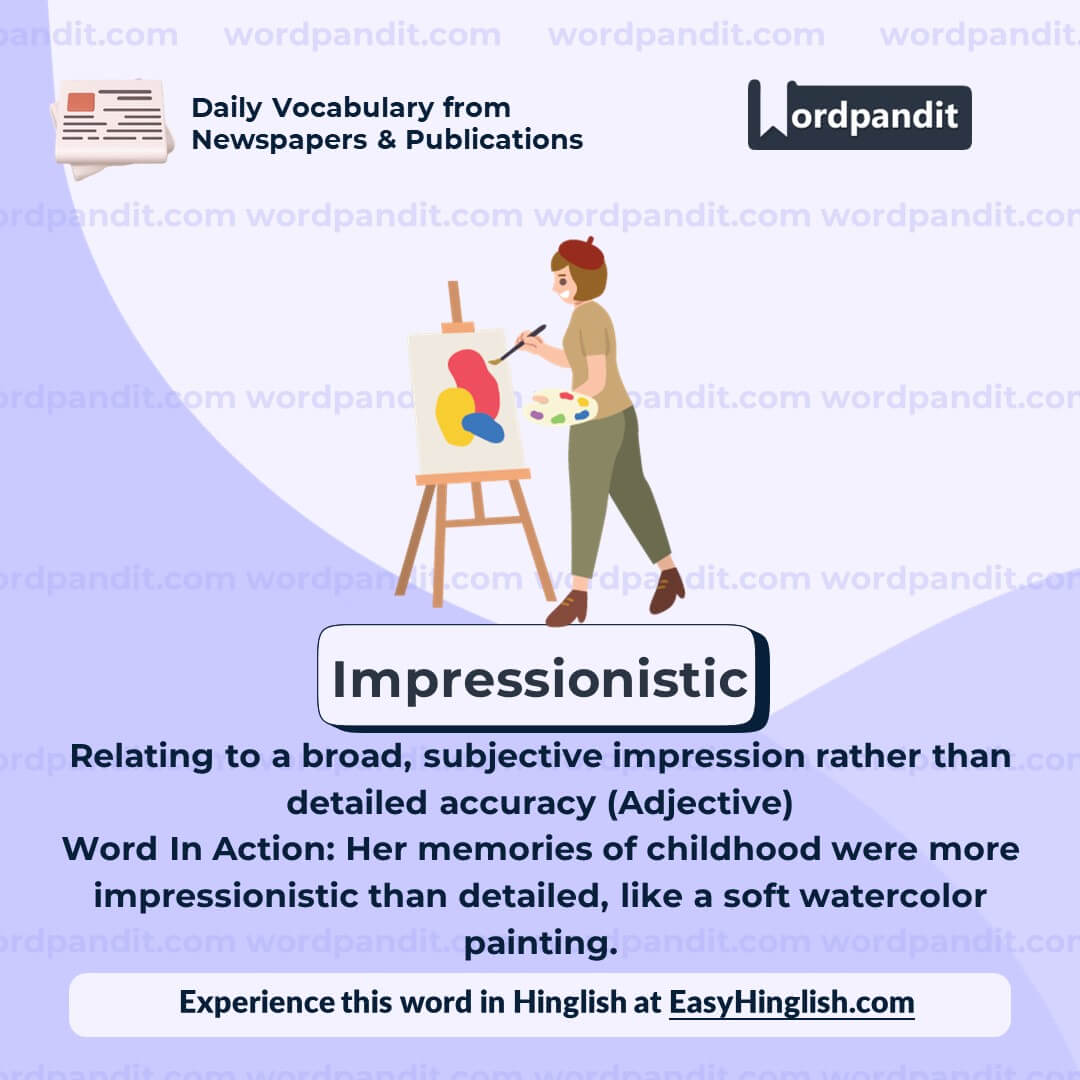
WORD-3: Impressionistic
Context:
"These impressionistic images tapped into a psychological narrative that refreshed the veterans’ interpretations of conflict." - The Guardian
Explanatory Paragraph:
"Impressionistic" refers to something that is based more on general feelings or impressions than on detailed facts or clear structures. It often conveys a subjective, emotional, or artistic interpretation rather than a literal or precise one. In art, the term is linked to the Impressionist movement, which aimed to capture fleeting moments and sensory experiences. In the context above, the "impressionistic images" evoke emotions and psychological reflections, offering a more personal and abstract understanding of conflict for the veterans.
Meaning: Based on subjective impressions rather than detailed accuracy or facts (Adjective)
Pronunciation: im-PRESH-uh-niss-tik
Difficulty Level: ⭐⭐⭐ Intermediate
Etymology: From French *impressionniste*, referring to the art movement "Impressionism" in the late 19th century, rooted in the Latin word *imprimere* meaning "to press into or imprint"
Prashant Sir's Notes:
This word is useful not only in discussing art but also in describing writing styles, interpretations, or any experience that is more emotional than analytical. Think: a blurry memory, an abstract painting, or a poetic description — all are impressionistic.
Synonyms & Antonyms:
Synonyms: Vague, interpretive, expressive, subjective, suggestive
Antonyms: Detailed, literal, realistic, factual, objective
Usage Examples:
- The novelist adopted an impressionistic style to convey the protagonist's inner turmoil.
- Her painting wasn't exact but offered an impressionistic view of the sunset.
- The documentary was less factual and more impressionistic, focusing on personal experiences.
- He gave an impressionistic account of the event, filled with emotion but lacking specifics.
Cultural Reference:
Impressionism was pioneered by artists like Claude Monet and Edgar Degas, who sought to capture the fleeting effects of light and color — a major departure from the detailed realism of earlier art movements.
Think About It:
Can an impressionistic portrayal sometimes reveal deeper truths than a purely factual one? Why might emotions offer clarity that facts cannot?
Quick Activity:
Write a 3-line impressionistic description of a place you remember from childhood. Focus on feelings, colors, and sensory memories instead of facts.
Memory Tip:
Think of “impressionistic” as something that leaves an “impression” rather than giving a clear picture — like a blurry but emotional photo.
Real-World Application:
"Impressionistic" is used in literature, film, journalism, and therapy to describe expressions that prioritize emotion, mood, or perception over strict detail — especially when exploring complex human experiences.
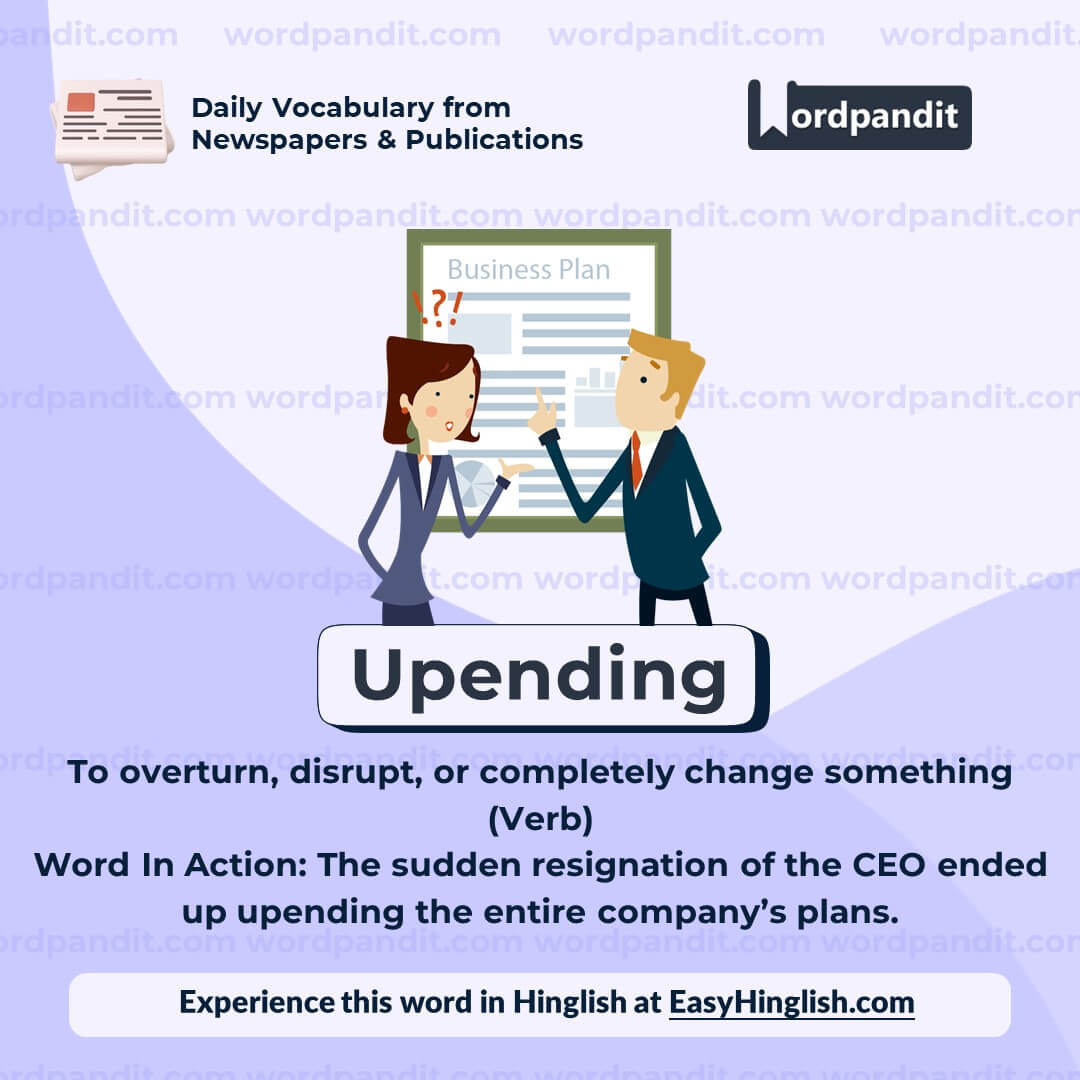
WORD-4: Upending
Context:
"However, as Moye explains, she’s not upending a tradition, but simply putting her own spin on pottery’s history as an accessible ‘folk language’ that’s rarely shied away from matters of sex." - Aeon
Explanatory Paragraph:
"Upending" refers to turning something upside down or dramatically changing it, often in a disruptive or surprising way. While the literal meaning involves physically flipping something over, it is commonly used in a metaphorical sense to describe challenging or overturning established ideas, traditions, or systems. In the sentence, Moye is said not to be upending — or radically overthrowing — tradition, but instead reshaping it through her personal perspective.
Meaning: To overturn or disrupt the normal order or position of something (Verb - present participle)
Pronunciation: up-END-ing
Difficulty Level: ⭐⭐⭐ Intermediate
Etymology: From Middle English *up- + enden* ("to end or finish"), evolving into the physical sense of turning something upside down or metaphorically reversing norms
Prashant Sir's Notes:
Upending is a powerful word when discussing change, revolution, or reinterpretation. It suggests not just modifying something but possibly transforming its structure entirely. Great for essays on innovation, culture, or social movements.
Synonyms & Antonyms:
Synonyms: Overturning, disrupting, transforming, toppling, reversing
Antonyms: Preserving, maintaining, continuing, sustaining, reinforcing
Usage Examples:
- The new startup is upending the traditional taxi industry with its ride-sharing model.
- Climate change is upending weather patterns across the globe.
- Her bold designs are upending fashion norms and challenging stereotypes.
- Technology is rapidly upending how we communicate and work.
Cultural Reference:
In the tech world, companies like Uber and Airbnb are known for upending traditional industries by introducing disruptive business models that redefine convenience and accessibility.
Think About It:
Can upending a long-held tradition lead to progress, or does it risk losing cultural identity? Where should we draw the line?
Quick Activity:
List two examples of modern inventions or ideas that have upended traditional ways of doing things. Briefly explain how.
Memory Tip:
Imagine literally flipping a table "up-end" — it’s dramatic and changes everything! That’s what “upending” a system or idea feels like.
Real-World Application:
The term “upending” is frequently used in media, tech, politics, and culture to describe major disruptions — from revolutionary apps to social movements that challenge the status quo.
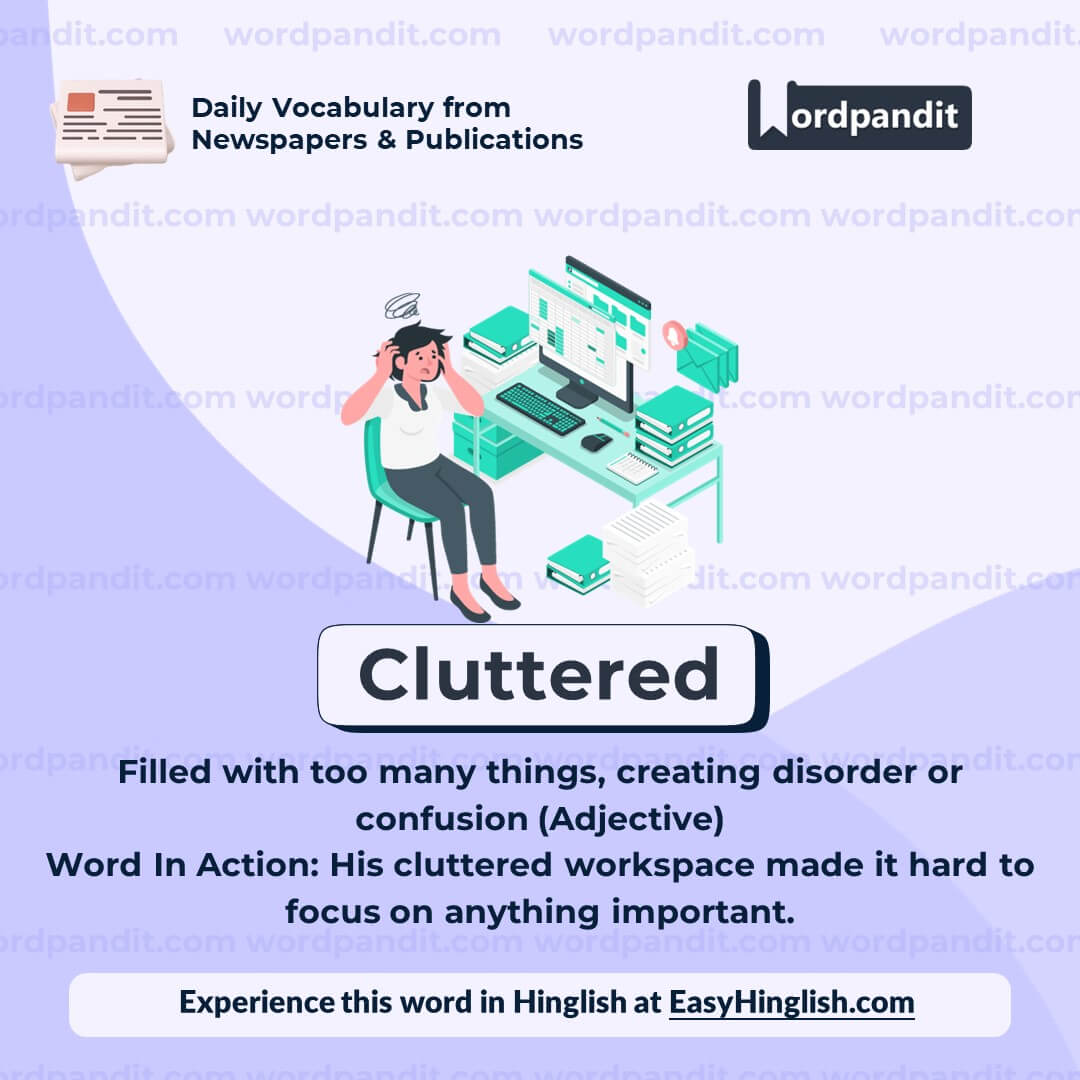
WORD-5: Cluttered
Context:
"Telling her story from the cluttered yurt in the Bulgarian countryside that she now calls home, Irvine explains why, throughout her life, she has chosen unconventional paths as a means of protecting herself from feeling overwhelmed by a modern world she saw as imbued with too many prescriptions and, indeed, too many choices." - Psyche
Explanatory Paragraph:
The word "cluttered" describes a space or situation filled with too many things, often in a disorganized or messy way. It can also refer metaphorically to mental or emotional states that feel chaotic or overloaded. In the sentence above, the "cluttered yurt" suggests a living space that is densely packed with belongings or objects, possibly reflecting a contrast with the speaker’s desire to escape the overwhelming complexity of modern life.
Meaning: Filled with too many things, often in a messy or disorganized manner (Adjective)
Pronunciation: KLUT-urd
Difficulty Level: ⭐ Beginner
Etymology: From Middle English *clotter* meaning “to coagulate,” later evolving to refer to disorderly accumulation
Prashant Sir's Notes:
“Cluttered” is not just about physical mess—it also applies to thoughts, schedules, or designs. A cluttered mind, a cluttered inbox, or a cluttered room — they all suggest overwhelm and the need for clarity or simplicity.
Synonyms & Antonyms:
Synonyms: Messy, chaotic, disorganized, jumbled, crowded
Antonyms: Tidy, organized, neat, minimalist, streamlined
Usage Examples:
- Her desk was so cluttered with papers that she couldn't find her notes.
- A cluttered home often reflects a cluttered mind.
- The website looked cluttered, making it hard for users to navigate.
- He spent the weekend decluttering his cluttered garage.
Cultural Reference:
Marie Kondo, author of *The Life-Changing Magic of Tidying Up*, popularized the idea of decluttering spaces to improve mental and emotional well-being — advocating that one should only keep things that “spark joy.”
Think About It:
Do our external environments mirror our internal states? Can decluttering your surroundings lead to greater mental clarity?
Quick Activity:
Pick one small area of your room (like a drawer or shelf). Spend 10 minutes decluttering it. Notice how the process makes you feel afterward.
Memory Tip:
Cluttered sounds like “clogged” — both suggest things being stuck, blocked, or too full. Cluttered = blocked by stuff!
Real-World Application:
The concept of cluttered spaces is key in interior design, mental health therapy, and productivity coaching. Creating clean, organized environments often helps reduce stress and boost focus.


