

Daily Vocabulary from Indian Newspapers and Publications
Welcome to Wordpandit’s Indian Vocabulary Hub
At Wordpandit, we understand the importance of staying rooted in the local context while expanding your language skills. This section focuses on enriching your vocabulary with words and phrases drawn from India’s leading newspapers and publications, ensuring you're learning vocabulary that is practical, relevant, and uniquely Indian.
Why Indian Sources Matter
We believe that the best way to master any language is by immersing yourself in local content. That’s why we carefully curate vocabulary from top Indian publications, including:
- The Hindu
- The Times of India
- The Economic Times
- Hindustan Times
- Live Mint
- The Indian Express
- And many others...
Stay Updated, Stay Relevant
With daily updates from Indian news sources, you’ll be consistently learning words that reflect the trends and shifts in Indian society and culture. Our focus is to provide vocabulary that enhances your understanding of the language in an Indian context.
How Wordpandit Supports Your Goals
Whether you’re preparing for exams, aiming to improve your professional communication, or simply want to stay connected with the latest Indian vocabulary, Wordpandit is here to guide you every step of the way.
Learn with a Practical Approach
Our interactive learning methodology includes real-world examples, engaging activities, and context-specific usage to ensure that every word becomes part of your active vocabulary.
Dive into Indian Vocabulary Today!

Why Choose Wordpandit?
Practical Learning: Focus on words you'll actually encounter in real-world reading, enhancing your comprehension and communication skills.
Diverse Content: From current affairs to scientific breakthroughs, our varied sources expose you to vocabulary across multiple domains.
Effortless Integration: Make Wordpandit a part of your daily routine. Just a few minutes each day can significantly boost your lexicon over time.
Your Path to Vocabulary Mastery
- Visit our Daily Vocabulary section regularly
- Explore new words and their usage in context
- Practice incorporating these words into your own writing and speech
- Track your progress as your vocabulary expands
Start Your Journey Today
Embark on your vocabulary enhancement journey with Wordpandit. By consistently engaging with our daily posts, you'll build a robust vocabulary that serves you well in academic, professional, and personal contexts.
Remember, a word a day keeps linguistic limitations at bay. Make Wordpandit your daily companion in the quest for vocabulary excellence!
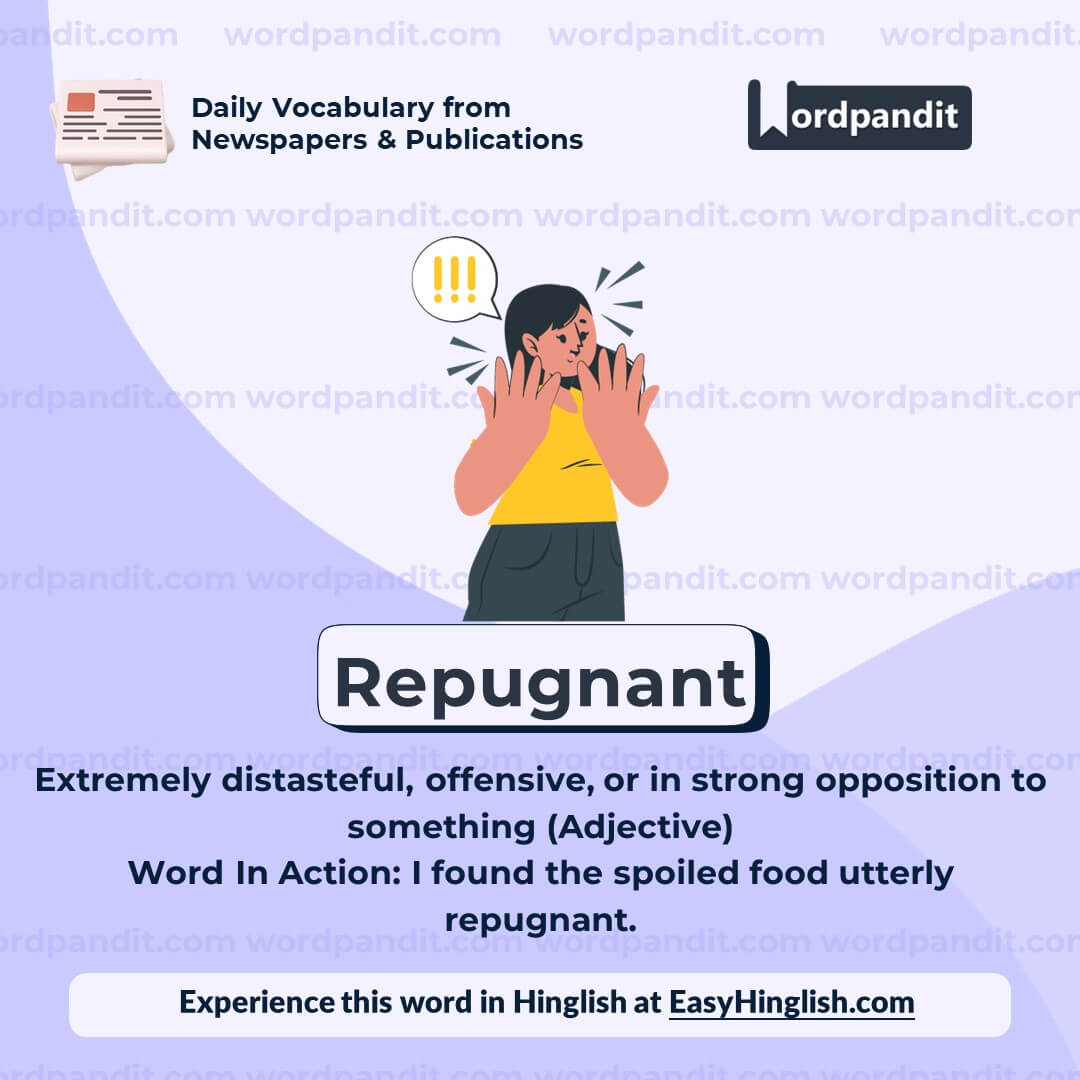
WORD-1: Repugnant
Context:
"Earlier in the day, when the bench asked Attorney General (AG) R Venkataramani as to why the governor was silent for years and why did he not communicate with the government, the AG said the governor had not acted outside his jurisdiction by withholding assent and by referring the bills to the President after finding them repugnant (to central laws)." - New Indian Express
Explanatory Paragraph:
The word repugnant is used to describe something that is extremely distasteful, offensive, or in strong conflict with something else. In legal or political contexts, it often refers to a law or action that is incompatible or contradictory with an existing rule, norm, or superior authority. In the provided context, the bills were described as repugnant to central laws, meaning they clashed or were inconsistent with national legislation.
Meaning: Extremely offensive, unacceptable, or in conflict (Adjective)
Pronunciation: rih-PUG-nuhnt
Difficulty Level: ⭐⭐⭐ Intermediate
Etymology: From Latin repugnantem, present participle of repugnare, meaning "to oppose, resist."
Prashant Sir's Notes:
This word is frequently used in legal and moral contexts. Always associate it with strong aversion or contradiction. Try to identify whether it refers to something emotionally offensive or legally conflicting—it fits both areas!
Synonyms & Antonyms:
Synonyms: offensive, revolting, distasteful, abhorrent, objectionable
Antonyms: agreeable, pleasant, acceptable, delightful, compatible
Usage Examples:
- The idea of animal cruelty is repugnant to most people.
- His behavior was morally repugnant and drew widespread condemnation.
- The bill was struck down as it was repugnant to the constitutional framework.
- She found the proposal so repugnant that she immediately withdrew her support.
Cultural Reference:
"All cruelty springs from weakness." - Seneca. Many historical leaders have used 'repugnant' to label ideologies they found morally or politically unacceptable.
Think About It:
What makes certain ideas or actions universally repugnant, while others may be considered acceptable depending on cultural or legal contexts?
Quick Activity:
List two actions or laws you believe are repugnant. Now explain why they conflict with either your moral values or a national law.
Memory Tip:
Think: "PUGs (pugnacious dogs) fight back when something is REPUGNANT!" — 'Repugnant' means something you want to resist or reject strongly.
Real-World Application:
‘Repugnant’ is frequently used in legal judgments and political commentary to describe laws, acts, or behaviors that contradict higher laws or moral standards. Recognizing this term can help in interpreting legal or policy-related news more critically.
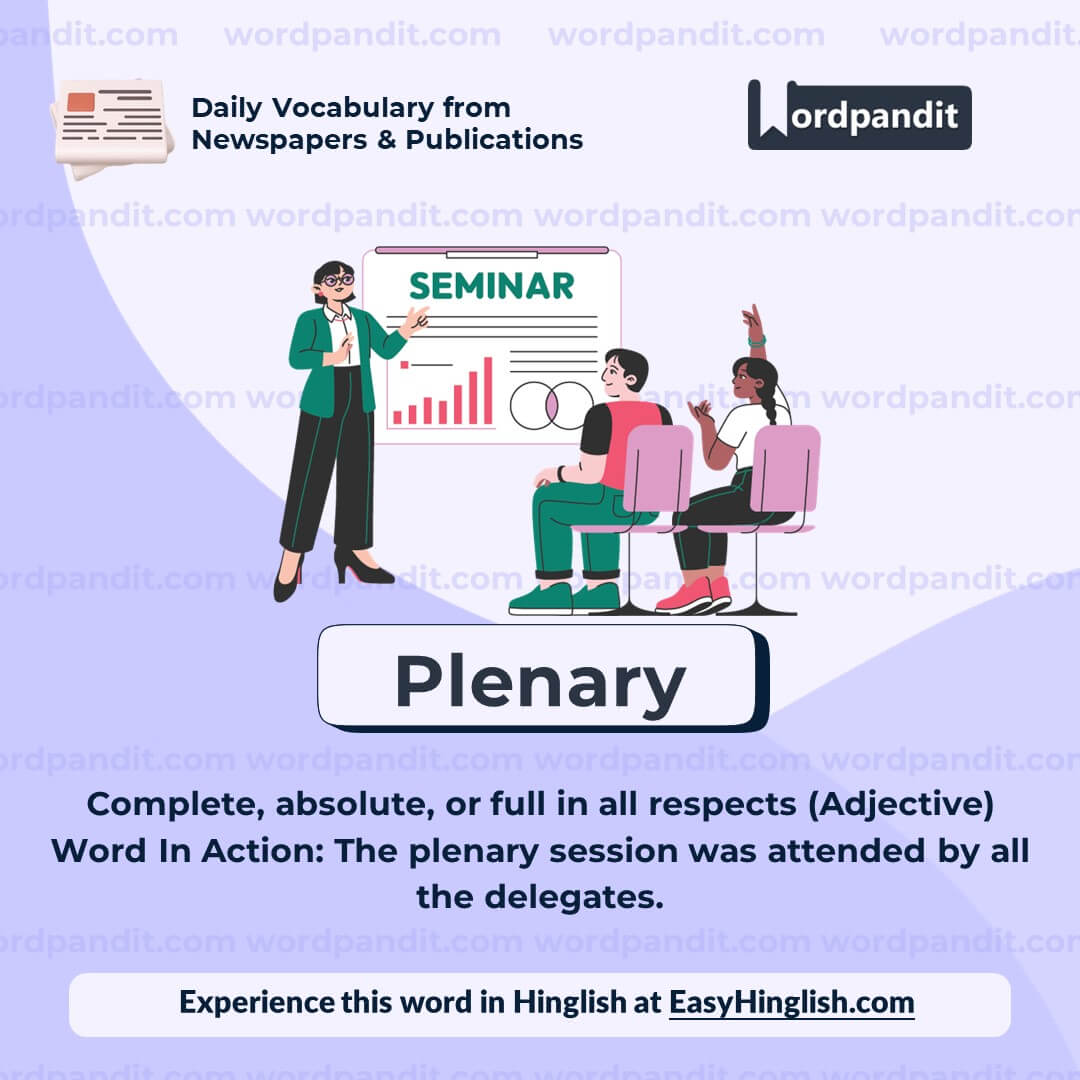
WORD-2: Plenary
Context:
"The state functions in its own domain through plenary powers and there is supremacy of Parliamentary democracy." - New Indian Express
Explanatory Paragraph:
The word plenary refers to something that is complete, full, or absolute in nature. In legal and governmental contexts, it is often used to describe powers or authority that are not limited or restricted—total authority within a particular domain. In the given context, the phrase "plenary powers" means the state exercises complete and unqualified powers within its jurisdiction under the framework of a parliamentary democracy.
Meaning: Full, complete, or absolute; unrestricted in scope or authority (Adjective)
Pronunciation: PLEE-nuh-ree
Difficulty Level: ⭐⭐⭐ Intermediate
Etymology: From Late Latin plenarĭus, meaning "complete, full," derived from Latin plenus ("full").
Prashant Sir's Notes:
This is a formal word, often seen in legal, academic, and governmental discussions. Think of “plenary session” in conferences or “plenary power” in constitutional law — both imply full, undivided authority or participation.
Synonyms & Antonyms:
Synonyms: absolute, full, unrestricted, complete, unqualified
Antonyms: limited, partial, restricted, conditional, incomplete
Usage Examples:
- The constitution grants plenary powers to the legislature in certain matters.
- A plenary session of the conference will be held tomorrow to address all delegates.
- The board has plenary authority to make financial decisions without external approval.
- She spoke at the plenary meeting attended by all member nations.
Cultural Reference:
At the United Nations General Assembly, the "plenary meetings" are those where all member states participate equally — a key feature of diplomatic equality in international relations.
Think About It:
Is it always beneficial for any individual or institution to have plenary power, or should authority always be balanced by checks and oversight?
Quick Activity:
Look up the agenda of a recent international conference. Can you find mention of a "plenary session"? What topics were discussed there?
Memory Tip:
Think: “Plenty” = Full. If something is plenary, it’s full or complete in power or attendance—just like a “plenty-ful” authority!
Real-World Application:
Understanding the term 'plenary' is helpful in legal studies, political science, and professional conferences. It signals whether a body or meeting has full authority or participation, helping you gauge the importance of the decision or event.
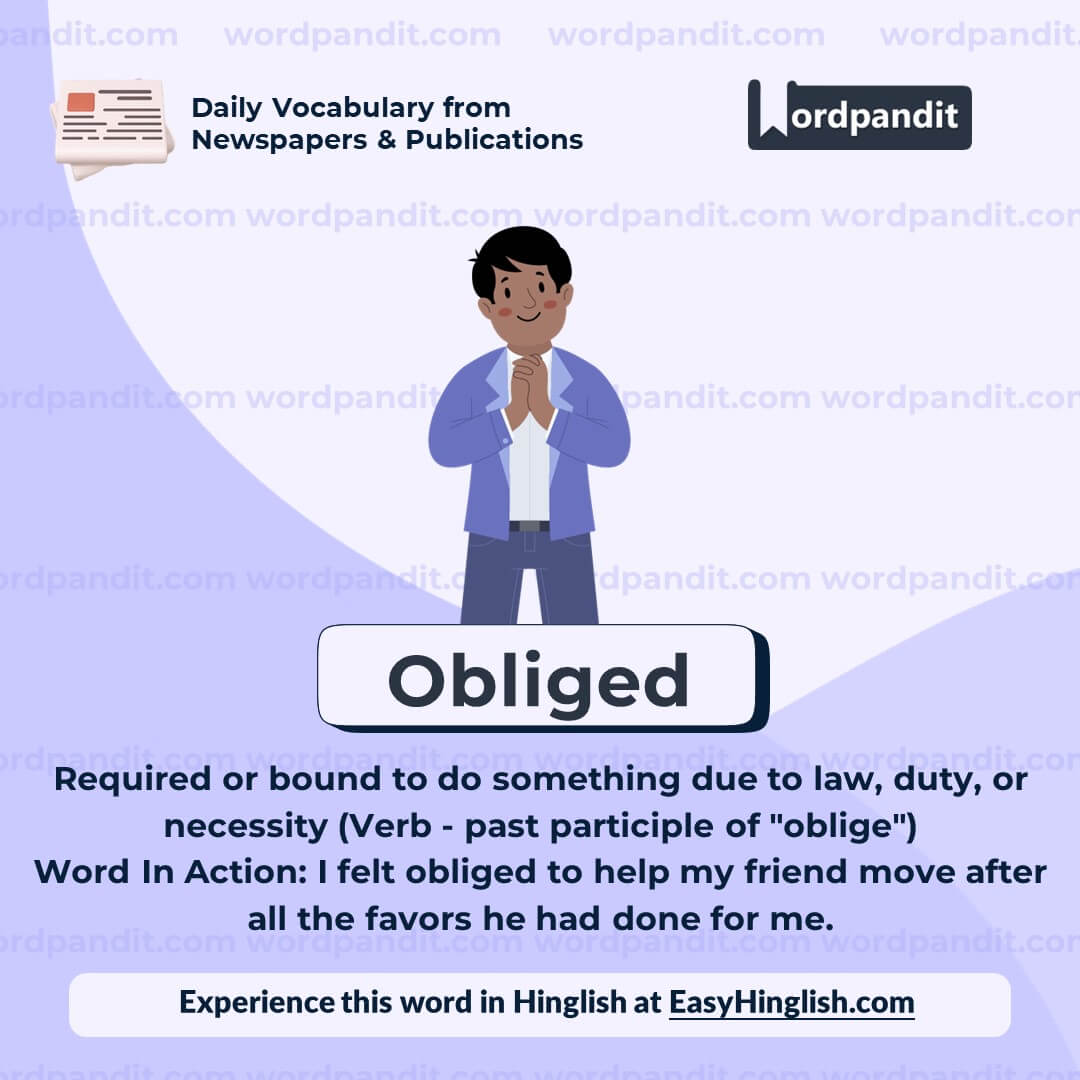
WORD-3: Obliged
Context:
"The governor lacked any discretion aside from being obliged to act on the aid and advice of the state council of ministers, he added." - New Indian Express
Explanatory Paragraph:
The word obliged refers to being legally or morally bound to do something. It implies a duty or requirement that someone must fulfill, either because of rules, expectations, or social conventions. In the given context, the governor was not free to act independently but was obliged—meaning required or compelled—to follow the recommendations of the state council of ministers.
Meaning: Required to do something because of a law, rule, or duty (Verb – past tense)
Pronunciation: uh-BLYJD
Difficulty Level: ⭐⭐ Basic
Etymology: From Old French obliger, from Latin obligare, meaning "to bind."
Prashant Sir's Notes:
“Obliged” is often used in formal or polite language. It shows either a duty (as in legal/political contexts) or gratitude (e.g., "I'm much obliged"). Be clear about the usage — context determines the meaning.
Synonyms & Antonyms:
Synonyms: required, compelled, bound, mandated, duty-bound
Antonyms: free, exempt, voluntary, optional, unrestricted
Usage Examples:
- Citizens are obliged to follow the laws of the land.
- The teacher felt obliged to report the incident to the principal.
- As per the constitution, the president is obliged to act on the advice of the cabinet.
- He was much obliged for their kind hospitality.
Cultural Reference:
In British English, “much obliged” is a polite and formal way of saying “thank you,” often heard in classic literature or period dramas like Downton Abbey.
Think About It:
Should public officials always be obliged to follow protocol, or should they be allowed discretion in exceptional circumstances?
Quick Activity:
Write two sentences using “obliged”—one showing duty and one showing gratitude. Compare the tone in each sentence.
Memory Tip:
Think of “obliged” as being “tied” by rules or gratitude — if you’re obliged, you can’t ignore it!
Real-World Application:
Understanding the term "obliged" helps in reading legal documents, contracts, or political statements where duties and responsibilities are defined. It also adds a polite and formal tone to your English in thank-you notes and formal communication.
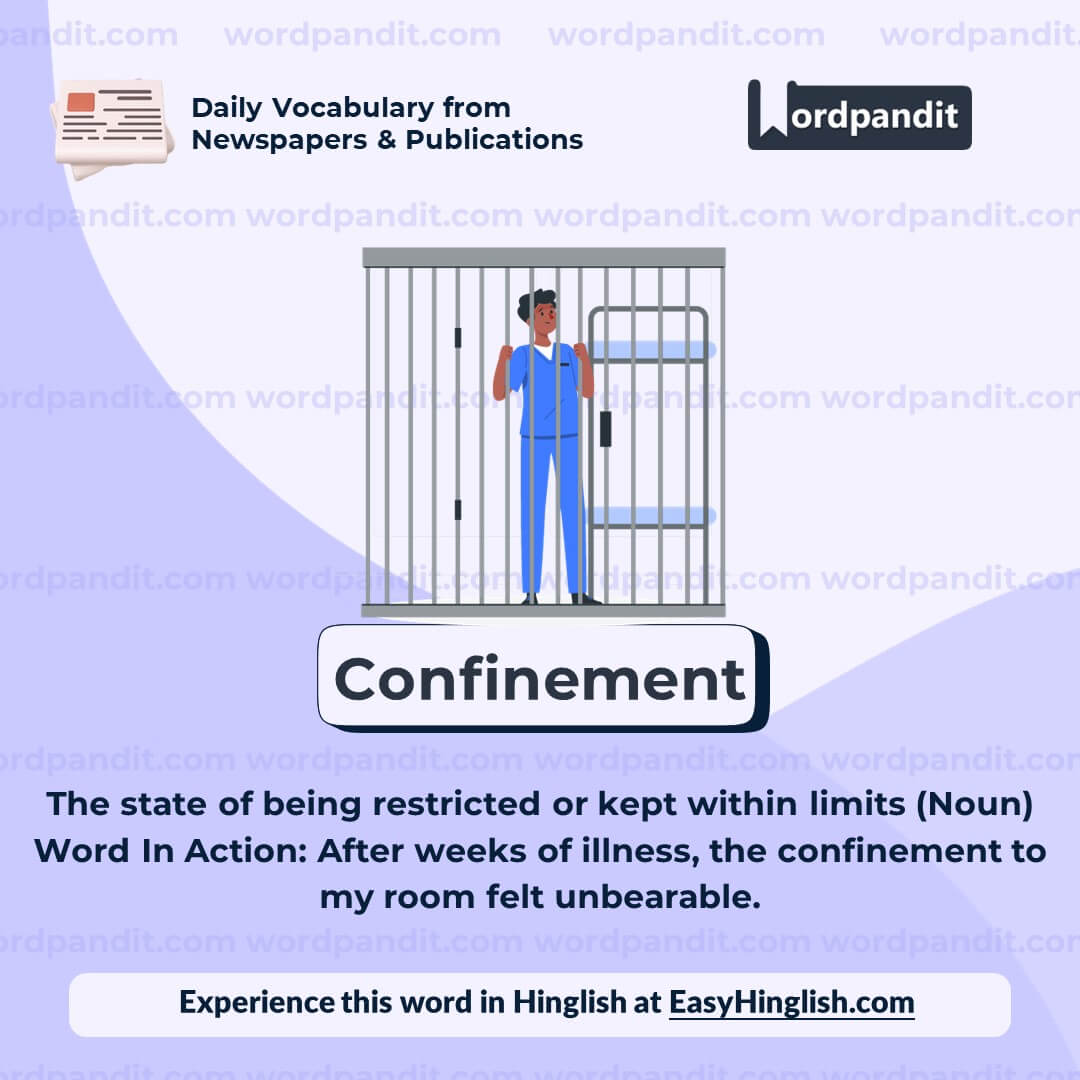
WORD-4: Confinement
Context:
"The solitary confinement." - The Wire
Explanatory Paragraph:
The word confinement refers to the state of being kept within limits or boundaries, often physically restricted. In a prison or legal context, it means being held in a cell or space, especially in isolation, as in “solitary confinement.” This form of isolation is typically used as a punishment, where a prisoner is separated from others for extended periods, sometimes causing psychological stress. More generally, the term can also refer to restrictions due to illness, pregnancy, or quarantine.
Meaning: The state of being restricted or imprisoned; limited within bounds (Noun)
Pronunciation: kuhn-FINE-ment
Difficulty Level: ⭐⭐ Basic
Etymology: From Old French confinement, from Latin confinare, meaning "to border or enclose."
Prashant Sir's Notes:
This word is particularly important in discussions about justice, human rights, and health. While we often hear it in the phrase “solitary confinement,” it also appears in medical or emotional contexts, such as confinement during childbirth or during lockdowns.
Synonyms & Antonyms:
Synonyms: imprisonment, restriction, incarceration, detention, isolation
Antonyms: freedom, liberty, release, escape, openness
Usage Examples:
- He spent five years in solitary confinement for violating prison rules.
- The doctor advised strict confinement during the final stages of pregnancy.
- Due to the contagious disease, the patient was kept in confinement.
- Protesters argued that prolonged confinement without trial was a violation of human rights.
Cultural Reference:
In the popular HBO series The Wire, “solitary confinement” is portrayed as a psychological punishment used in prisons, highlighting the emotional and mental toll it takes on inmates.
Think About It:
Should solitary confinement be used in modern prison systems, or does it amount to psychological torture?
Quick Activity:
Think of a situation where someone experiences non-physical confinement (emotional, social, etc.). Write a short paragraph describing it using the word “confinement.”
Memory Tip:
Confinement = Can’t Find Movement — when you're confined, you’re stuck in one place with little or no freedom to move.
Real-World Application:
“Confinement” is a critical word in discussions about prison reform, public health, and personal freedom. Understanding its usage helps in debates about rights, law enforcement practices, and healthcare protocols.
WORD-5: Anaemic
Context:
"The anaemic food." - The Wire
Explanatory Paragraph:
The word anaemic literally refers to a medical condition where a person has a deficiency of red blood cells or hemoglobin, leading to tiredness and weakness. However, in figurative use, which is the case here, it describes something weak, lacking in substance, energy, or color. When food is described as “anaemic,” it suggests that it is pale, bland, or nutritionally poor—unappetizing or lacking flavor and visual appeal.
Meaning: Lacking in color, strength, or vitality; pale or weak (Adjective)
Pronunciation: uh-NEE-mik
Difficulty Level: ⭐⭐ Basic
Etymology: From French anémique, from Greek anaimia, meaning "lack of blood" (an- ‘without’ + haima ‘blood’)
Prashant Sir's Notes:
This is a great example of a medical term being used metaphorically. Watch out for such uses in literature or journalism. If a thing or idea is called “anaemic,” it’s being criticized for lacking life, power, or richness.
Synonyms & Antonyms:
Synonyms: weak, pale, lifeless, insipid, bland
Antonyms: robust, strong, vibrant, flavorful, hearty
Usage Examples:
- The team’s anaemic performance disappointed the fans.
- She pushed the anaemic vegetables around her plate with clear disinterest.
- Critics described the film as visually anaemic and emotionally flat.
- His anaemic handshake didn’t leave a strong impression.
Cultural Reference:
In The Wire, describing prison meals as “anaemic” reflects the harsh, lifeless, and unappetizing conditions inmates endure—both physically and psychologically.
Think About It:
Why do we often use physical or medical terms like “anaemic” to describe emotional or artistic experiences?
Quick Activity:
Find a sentence from a book or article where a physical condition is used metaphorically (e.g., anaemic, paralyzed, feverish). Note how it adds meaning or tone.
Memory Tip:
Think: Anaemic = “No energy” — just like someone with anaemia feels tired and weak, anaemic food or effort feels dull and lifeless.
Real-World Application:
In writing and journalism, describing something as “anaemic” is a vivid way to criticize its lack of strength or appeal. It’s commonly used in food reviews, political commentary, and performance evaluations.


