

Daily Vocabulary from International Newspapers and Publications
Expand Your Vocabulary with Wordpandit’s Global Vocabulary Hub
At Wordpandit, we are committed to helping you develop a truly global vocabulary by drawing from some of the most respected international publications. This section is designed to keep you ahead of the curve by introducing you to words that define global conversations and trends.
The Power of Global Sources
To help you think and communicate on a global scale, we curate vocabulary from renowned international sources, such as:
- The New York Times
- The Washington Post
- BBC
- The Guardian
- The Economist
- Scientific American
- Psychology Today
- And many more...
Stay Global, Stay Competitive
Our daily updates from international publications ensure you are consistently exposed to new words that reflect global news and developments, making sure your vocabulary is not only current but also globally relevant.
Enhance Your Global Perspective
Whether you’re preparing for international exams, aiming to excel in global business communication, or want to enhance your language skills for personal growth, Wordpandit offers the resources you need to thrive in a global context.
Effective Learning, Global Reach
Our learning methodology combines global examples, memory aids, and interactive activities, allowing you to internalize new words effectively and apply them in real-world scenarios.
Begin Your Global Vocabulary Journey Now!

Why Choose Wordpandit?
Practical Learning: Focus on words you'll actually encounter in real-world reading, enhancing your comprehension and communication skills.
Diverse Content: From current affairs to scientific breakthroughs, our varied sources expose you to vocabulary across multiple domains.
Effortless Integration: Make Wordpandit a part of your daily routine. Just a few minutes each day can significantly boost your lexicon over time.
Your Path to Vocabulary Mastery
- Visit our Daily Vocabulary section regularly
- Explore new words and their usage in context
- Practice incorporating these words into your own writing and speech
- Track your progress as your vocabulary expands
Start Your Journey Today
Embark on your vocabulary enhancement journey with Wordpandit. By consistently engaging with our daily posts, you'll build a robust vocabulary that serves you well in academic, professional, and personal contexts.
Remember, a word a day keeps linguistic limitations at bay. Make Wordpandit your daily companion in the quest for vocabulary excellence!
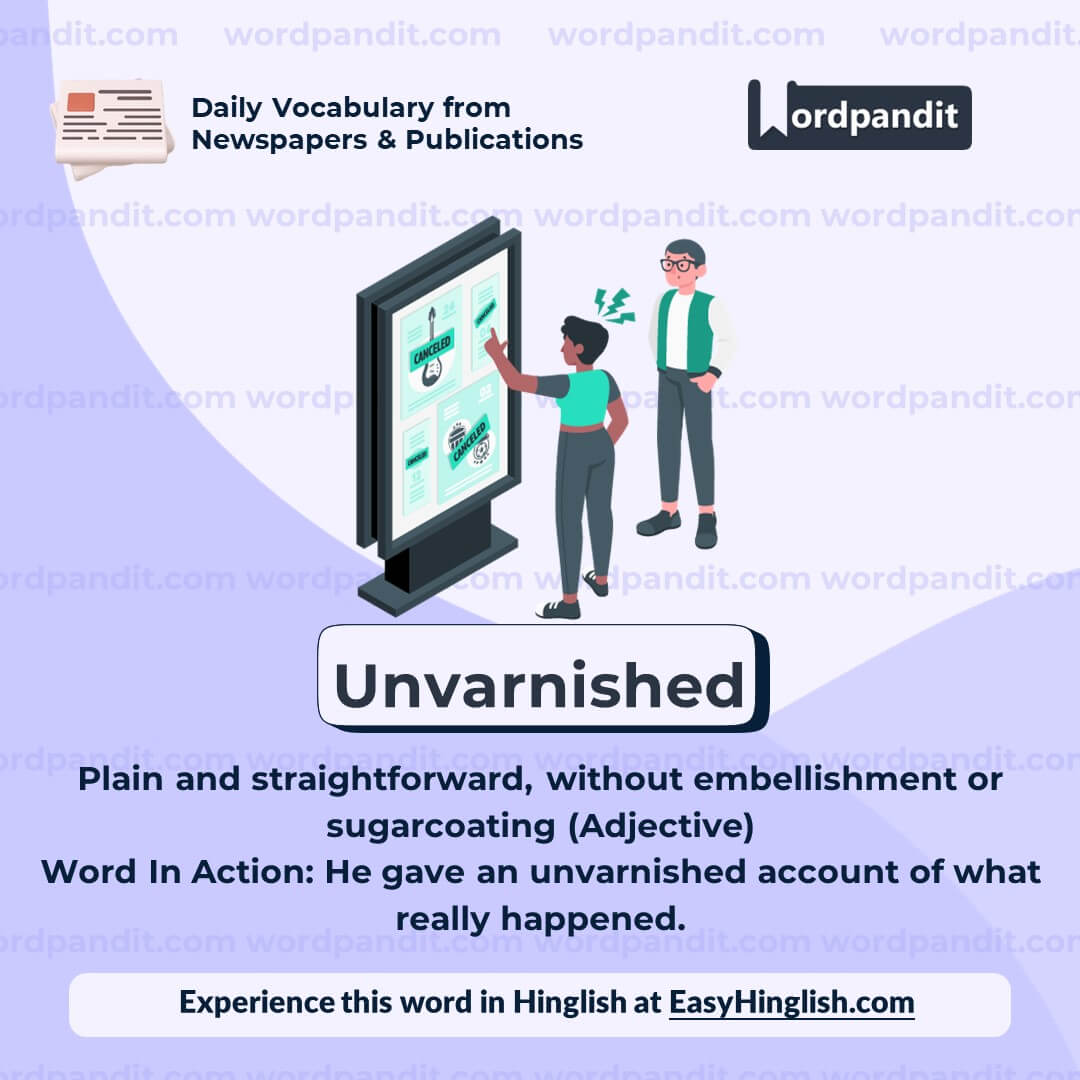
WORD-1: Unvarnished
Context:
"Far from a tale of romantic ‘Eat, Pray, Love’ self-actualisation through travel, Irvine instead offers her idiosyncratic outlook with unvarnished honesty, detailing preferences that some might find lonely or perhaps self-centred, but nonetheless tug at more universal tensions between drives for security, belonging and freedom." - Psyche
Explanatory Paragraph:
The word “unvarnished” refers to something presented in a raw, direct, and honest manner, without any attempt to gloss over or embellish the truth. It often implies a refreshing sincerity or brutal candor. When someone speaks with "unvarnished honesty," they're telling it like it is — no sugarcoating, no polishing, just the plain truth as they see it.
Meaning: Plain and straightforward; not embellished or polished (Adjective)
Pronunciation: un-VAHR-nisht
Difficulty Level: ⭐⭐ Moderate
Etymology: Derived from the prefix “un-” (not) + “varnished” (coated or polished with varnish); figuratively meaning something not glossed over or made to look better than it is.
Prashant Sir's Notes:
Think of unvarnished like an old piece of wood—no polish, no paint—just raw and natural. When applied to speech or writing, it means plain, direct, and unfiltered. It's useful when describing someone or something that’s refreshingly or brutally honest.
Synonyms & Antonyms:
Synonyms: blunt, direct, candid, plainspoken, unfiltered, frank
Antonyms: polished, embellished, sugar-coated, tactful, refined
Usage Examples:
- She gave an unvarnished account of her childhood, including the painful moments.
- The journalist was praised for his unvarnished reporting on political corruption.
- In his farewell speech, the CEO offered unvarnished reflections on both the company's successes and failures.
- He appreciated her unvarnished opinion, even though it was hard to hear.
Cultural Reference:
"Unvarnished truth is seldom welcome, especially when it disturbs comfortable illusions." – A paraphrased idea often explored in political commentary and literature.
Think About It:
Why do you think people often prefer a varnished version of reality over the unvarnished truth?
Quick Activity:
Write two short descriptions of a recent personal experience: one “varnished” (sugar-coated) and one “unvarnished” (raw and honest). Compare how each makes you feel.
Memory Tip:
Think of “varnish” as a shiny coating on wood. If something is “unvarnished,” it lacks that shine—just like unvarnished speech lacks gloss or sugar-coating.
Real-World Application:
Unvarnished communication is essential in journalism, therapy, and leadership—fields where honesty can lead to growth, healing, and trust.
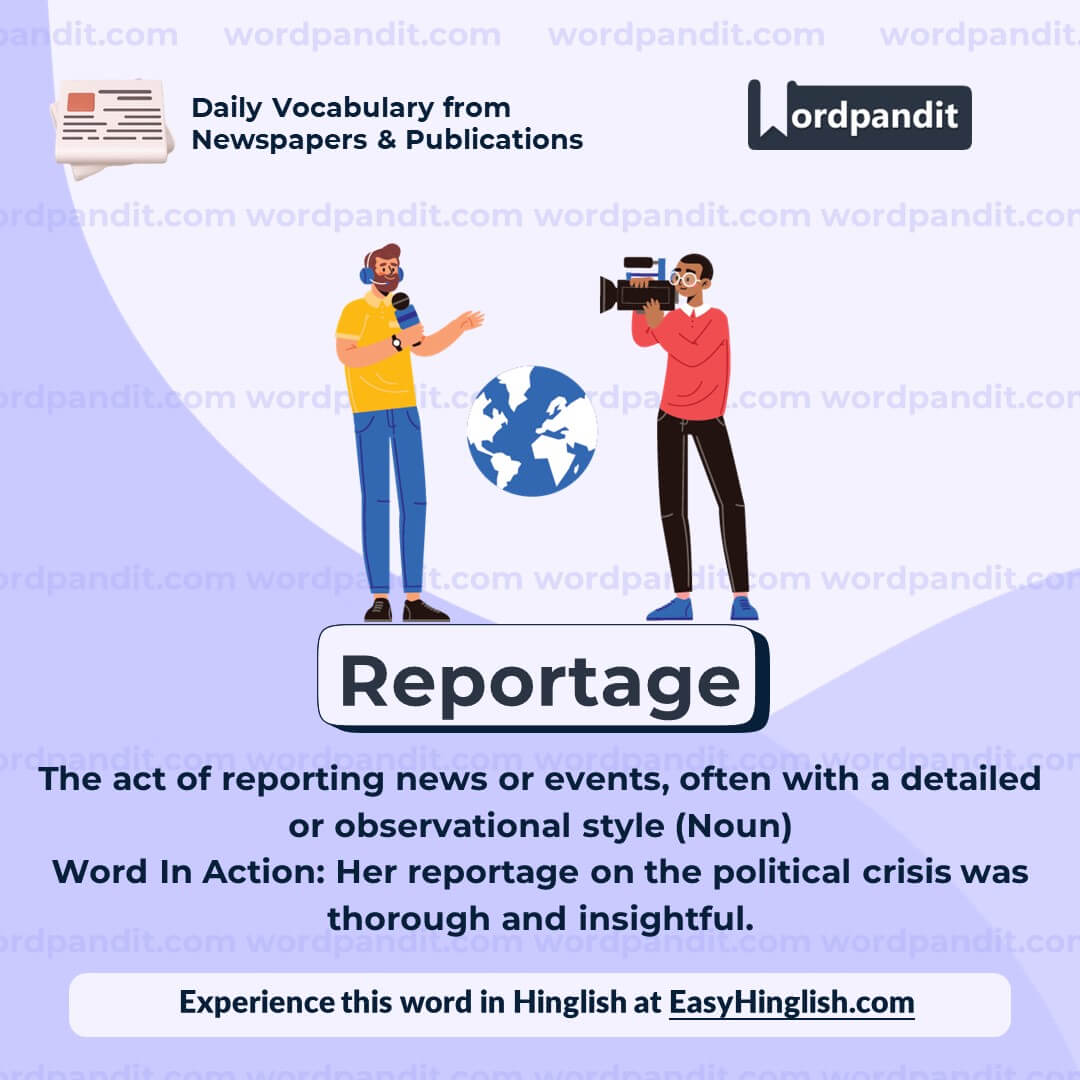
WORD-2: Reportage
Context:
"From reportage to street photography, his computer-generated reflections play, often with humour, on techniques in colour printing and aesthetic that defined an era." - The Guardian
Explanatory Paragraph:
“Reportage” refers to the act or style of reporting news, especially through journalistic writing, photography, or visual storytelling. It emphasizes factual, observational coverage of real events, often with vivid detail and a sense of immediacy. In creative fields like photography or art, reportage can also imply documentary-style work that seeks to capture the essence of a moment or social reality.
Meaning: The reporting of news or factual events, especially in a journalistic style (Noun)
Pronunciation: reh-POHR-tahzh
Difficulty Level: ⭐⭐ Moderate
Etymology: From French “reportage,” meaning "a report," derived from "reporter" (to report). Entered English usage in the early 20th century.
Prashant Sir's Notes:
Think of reportage as the backbone of journalism — it’s about going to the field, observing events as they happen, and relaying them truthfully. In visual arts, it captures reality through an artistic lens, often revealing deeper societal truths.
Synonyms & Antonyms:
Synonyms: journalism, coverage, documentation, reporting, dispatch
Antonyms: fiction, fabrication, invention, misreporting
Usage Examples:
- Her reportage from the war zone earned international acclaim for its courage and clarity.
- The exhibition combines artistic imagery with strong elements of reportage.
- Good reportage demands accuracy, empathy, and a strong sense of ethics.
- His reportage on the refugee crisis shed light on a largely ignored humanitarian issue.
Cultural Reference:
"Photojournalists like James Nachtwey are celebrated for their powerful reportage capturing human suffering and resilience in war-torn regions." – Referenced in TIME magazine retrospectives.
Think About It:
Can reportage truly be objective, or does the perspective of the reporter always influence the story?
Quick Activity:
Pick a current news event. Write a brief reportage-style paragraph describing it as if you were witnessing it firsthand.
Memory Tip:
Think of "reportage" as "report + collage" — a collage of real events reported in vivid detail.
Real-World Application:
Reportage is essential in journalism, documentary photography, and even investigative filmmaking — wherever factual storytelling is key to informing the public.

WORD-3: Injunction
Context:
"On Monday, he said the White House had defied a preliminary injunction that the judge issued after 23 Democratic state attorneys general filed a lawsuit to stop the funding freeze." - BBC
Explanatory Paragraph:
An “injunction” is a legal order issued by a court that requires someone to do or stop doing a specific action. It is often used to prevent harm or maintain the status quo while a legal issue is being resolved. Injunctions can be temporary (preliminary) or permanent, depending on the stage of the legal proceedings. They are powerful legal tools used to enforce rights or prevent injustices.
Meaning: A legal order requiring a person or entity to do or refrain from doing a specific act (Noun)
Pronunciation: in-JUNK-shun
Difficulty Level: ⭐⭐⭐ Intermediate
Etymology: From Latin “injungere” meaning “to join, impose, or command,” via Old French and Middle English “injunction.”
Prashant Sir's Notes:
Injunctions are like legal red lights — they tell someone to stop or act in a specific way, or face legal consequences. Courts use them when urgent intervention is needed to prevent harm, especially in disputes over property, contracts, or civil rights.
Synonyms & Antonyms:
Synonyms: court order, mandate, ruling, directive, prohibition
Antonyms: permission, authorization, allowance, sanction
Usage Examples:
- The environmental group filed for an injunction to halt construction on the protected land.
- The judge issued an injunction preventing the company from releasing the disputed product.
- Violating a court injunction can result in severe penalties or contempt of court charges.
- She sought an injunction against her former employer for breach of contract.
Cultural Reference:
"The Supreme Court’s decision to uphold the injunction against the travel ban marked a turning point in the legal debate over executive power." – Paraphrased from legal commentary in The New Yorker.
Think About It:
Should courts be able to issue injunctions that have wide-reaching political or social consequences? Where should the line be drawn?
Quick Activity:
Imagine a situation where someone’s actions are causing harm to others. Write two lines explaining why a court might issue an injunction in that case.
Memory Tip:
Think of “injunction” as an “instruction + junction”—a command that stops or redirects an action at a critical legal junction.
Real-World Application:
Injunctions are commonly used in civil lawsuits to prevent actions like demolitions, data leaks, or business takeovers while legal issues are being resolved.
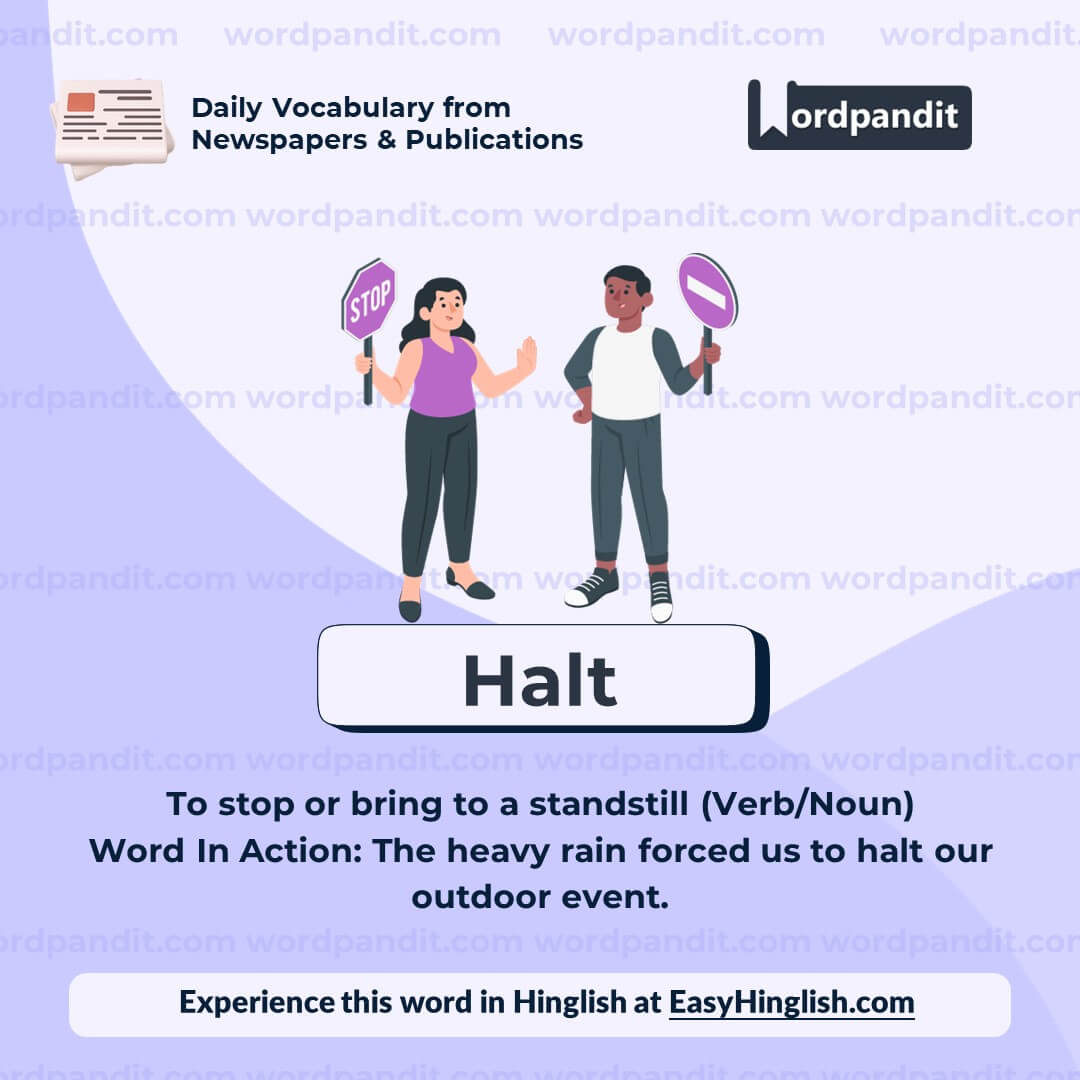
WORD-4: Halt
Context:
"The White House rescinded a memo that outlined more detail on what would be frozen but said it was still planning to halt funding." - BBC
Explanatory Paragraph:
“Halt” means to stop or bring something to a stop. It can refer to both physical actions, like halting a vehicle, and abstract actions, like halting a plan or funding. The word often implies a deliberate or sudden pause, usually in response to a command, decision, or obstacle. In official or formal contexts, especially in politics or administration, it signals a serious interruption of activity or progress.
Meaning: To stop or cease movement or progress (Verb); a stop or pause (Noun)
Pronunciation: hawlt
Difficulty Level: ⭐ Basic
Etymology: From Old High German “halten” meaning “to hold,” through Middle English “halten,” which evolved into “halt” as both a verb and a noun.
Prashant Sir's Notes:
Use “halt” when something comes to a complete stop, especially by order or due to necessity. It’s simple, punchy, and often used in military or administrative language. Think “Halt! Who goes there?” — that classic command to stop.
Synonyms & Antonyms:
Synonyms: stop, cease, pause, terminate, discontinue
Antonyms: continue, proceed, advance, resume
Usage Examples:
- The government decided to halt the construction due to environmental concerns.
- The train came to a sudden halt as an animal crossed the tracks.
- He raised his hand to signal the troops to halt immediately.
- The company announced it would halt production until safety issues were resolved.
Cultural Reference:
"Halt! Hammerzeit!" — A famous phrase from the 1990 MC Hammer song “U Can’t Touch This,” showing the word’s cultural presence in pop music.
Think About It:
In what situations should a person or society choose to halt progress for the greater good?
Quick Activity:
List three things in your daily life that you might want to halt temporarily and explain why.
Memory Tip:
Picture a red "HALT" sign at a checkpoint — strong, immediate, and commanding. Easy to remember as a complete stop.
Real-World Application:
In policy decisions, business operations, or even relationships, the ability to halt something — whether temporarily or permanently — is essential for reevaluation, safety, or ethical considerations.
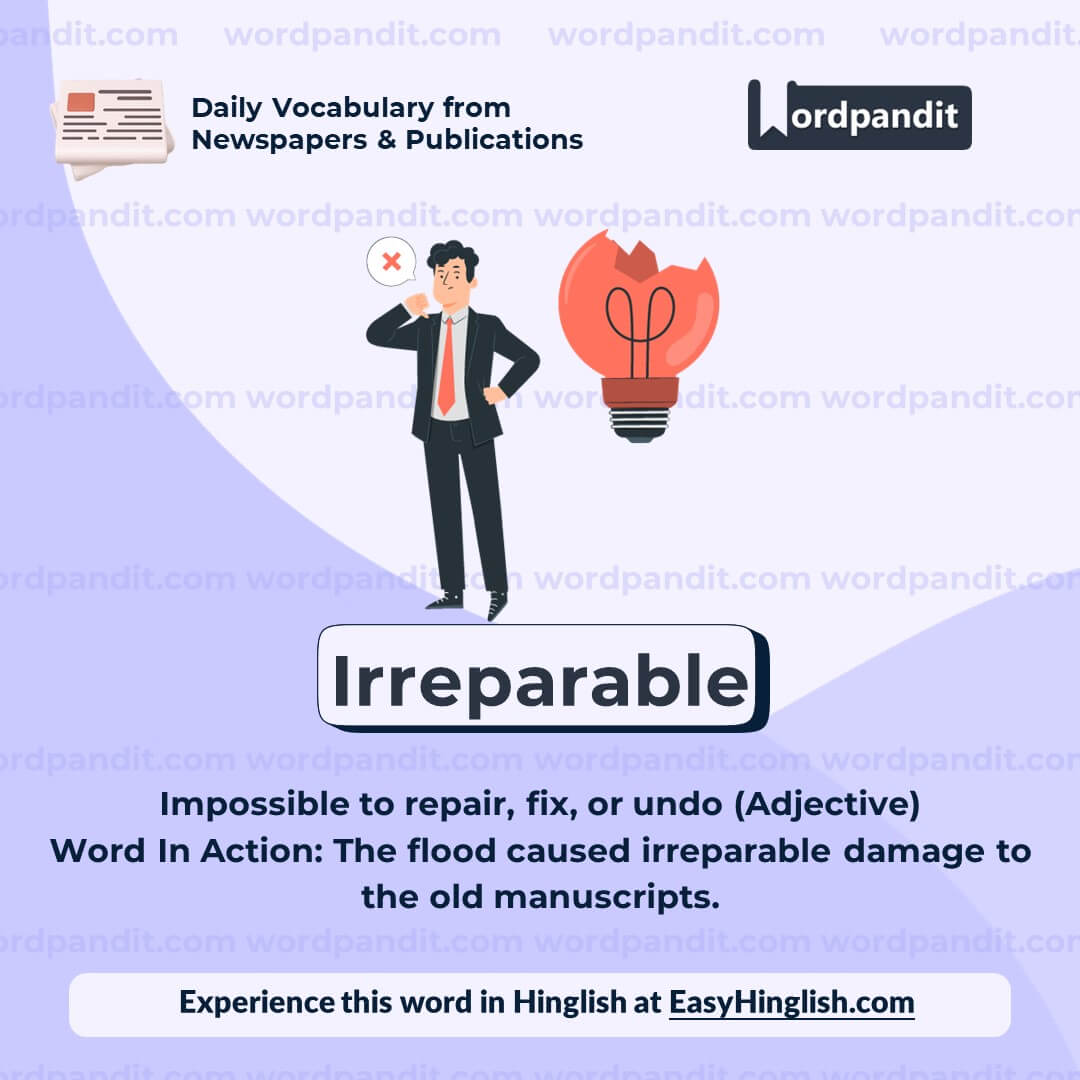
WORD-5: Irreparable
Context:
"The broad freeze, the judge said, was 'likely unconstitutional and has caused and continues to cause irreparable harm to a vast portion of this country.'" - BBC
Explanatory Paragraph:
“Irreparable” describes something that cannot be repaired, restored, or made right again. It is most often used in serious contexts involving permanent damage or loss—physical, emotional, legal, or environmental. If a harm is said to be “irreparable,” it means that no remedy or compensation can fully fix the damage done, making prevention critical in such cases.
Meaning: Impossible to repair or fix; not able to be corrected or made whole again (Adjective)
Pronunciation: ih-REH-puh-ruh-buhl
Difficulty Level: ⭐⭐⭐ Intermediate
Etymology: From Late Latin “irreparabilis” — “in-” (not) + “reparabilis” (able to be repaired), from “reparare” meaning “to make ready again.”
Prashant Sir's Notes:
Think of “irreparable” as a permanent break — like a shattered glass that can’t be glued back. In legal or emotional contexts, this word adds weight and urgency, signaling that the damage is beyond repair and must be avoided in the first place.
Synonyms & Antonyms:
Synonyms: irreversible, permanent, incurable, unfixable, hopeless
Antonyms: reparable, fixable, temporary, curable, reversible
Usage Examples:
- The fire caused irreparable damage to the historic library.
- Her betrayal left an irreparable rift in their friendship.
- The court intervened to prevent irreparable harm to the environment.
- Some reputations suffer irreparable harm after a single scandal.
Cultural Reference:
In legal contexts, the phrase “irreparable harm” is commonly used in court rulings when granting injunctions, as seen in high-profile environmental and civil rights cases across U.S. legal history.
Think About It:
What kinds of damage in society—whether to nature, relationships, or institutions—do you think are truly irreparable?
Quick Activity:
Write two examples (real or imagined) of situations where irreparable damage might occur. Explain why they can't be fixed.
Memory Tip:
Break down “irreparable” into “ir-” (not) + “repairable”—so it literally means “not repairable.” Easy to remember as something beyond fixing.
Real-World Application:
The term “irreparable” is crucial in law, especially when courts must act quickly to prevent damage (like environmental destruction or human rights violations) that cannot be undone later.


