

Daily Vocabulary from International Newspapers and Publications
Expand Your Vocabulary with Wordpandit’s Global Vocabulary Hub
At Wordpandit, we are committed to helping you develop a truly global vocabulary by drawing from some of the most respected international publications. This section is designed to keep you ahead of the curve by introducing you to words that define global conversations and trends.
The Power of Global Sources
To help you think and communicate on a global scale, we curate vocabulary from renowned international sources, such as:
- The New York Times
- The Washington Post
- BBC
- The Guardian
- The Economist
- Scientific American
- Psychology Today
- And many more...
Stay Global, Stay Competitive
Our daily updates from international publications ensure you are consistently exposed to new words that reflect global news and developments, making sure your vocabulary is not only current but also globally relevant.
Enhance Your Global Perspective
Whether you’re preparing for international exams, aiming to excel in global business communication, or want to enhance your language skills for personal growth, Wordpandit offers the resources you need to thrive in a global context.
Effective Learning, Global Reach
Our learning methodology combines global examples, memory aids, and interactive activities, allowing you to internalize new words effectively and apply them in real-world scenarios.
Begin Your Global Vocabulary Journey Now!

Why Choose Wordpandit?
Practical Learning: Focus on words you'll actually encounter in real-world reading, enhancing your comprehension and communication skills.
Diverse Content: From current affairs to scientific breakthroughs, our varied sources expose you to vocabulary across multiple domains.
Effortless Integration: Make Wordpandit a part of your daily routine. Just a few minutes each day can significantly boost your lexicon over time.
Your Path to Vocabulary Mastery
- Visit our Daily Vocabulary section regularly
- Explore new words and their usage in context
- Practice incorporating these words into your own writing and speech
- Track your progress as your vocabulary expands
Start Your Journey Today
Embark on your vocabulary enhancement journey with Wordpandit. By consistently engaging with our daily posts, you'll build a robust vocabulary that serves you well in academic, professional, and personal contexts.
Remember, a word a day keeps linguistic limitations at bay. Make Wordpandit your daily companion in the quest for vocabulary excellence!
WORD-1: Prolific
Context:
"A prolific writer and editor, Robbins aligned with the hippie sensibilities of the 1960s, writing books under his guiding philosophy of 'serious playfulness' – outlandish characters, absurd metaphors and fantastical prose, like a hit of literary LSD." - The Guardian
Explanatory Paragraph:
The word "prolific" is used to describe someone or something that produces a large amount of work, results, or offspring in a relatively short period of time. When used in a creative or professional context—such as writing, painting, or research—it suggests not only productivity but also consistent output of meaningful or high-quality work. A prolific writer, for example, is someone who writes many books, articles, or stories, often over a long and productive career.
Meaning: Producing many works or results; highly productive (Adjective)
Pronunciation: pro-LIF-ik
Difficulty Level: ⭐⭐☆ Intermediate
Etymology: From Latin prolificus, meaning “fruitful,” from proles (offspring) and facere (to make or do)
Prashant Sir's Notes:
Think of 'prolific' as someone who doesn’t just dabble—they *create constantly*. Whether it's an artist, a researcher, or a sportsperson, being prolific means output is your identity. But don’t confuse quantity with mindless repetition—prolific implies meaningful, consistent productivity.
Synonyms & Antonyms:
Synonyms: productive, creative, abundant, fertile, fruitful
Antonyms: unproductive, barren, scarce, lazy, fruitless
Usage Examples:
- She was a prolific painter, producing over 500 works in her lifetime.
- The scientist is known for his prolific contributions to climate research.
- Despite his young age, the musician has already had a prolific career.
- Apple trees are prolific in this region due to the ideal climate.
Cultural Reference:
"Stephen King is one of the most prolific authors of our time, with more than 60 novels and hundreds of short stories to his name." - Literary Review
Think About It:
In today’s world of information overload, is being prolific always a good thing? Can too much output dilute the quality of one's work?
Quick Activity:
List three people you consider prolific in their fields (e.g., music, science, art). For each, write one sentence explaining why.
Memory Tip:
Think of "pro" (like a professional) + "lific" (like "traffic" = a lot!) → A professional who produces a lot = *prolific*.
Real-World Application:
In job interviews or performance reviews, describing yourself as “prolific” in areas like writing, coding, or designing can convey that you not only produce results but do so consistently and effectively.
WORD-2: Contentment
Context:
"Love easily confuses us because it is always in flux between illusion and substance, between memory and wish, between contentment and need." - The Guardian
Explanatory Paragraph:
Contentment is the state of being at peace with what one has. It means feeling satisfied and not constantly yearning for more. Unlike happiness, which can be momentary and external, contentment is deeper and more internal—an acceptance of the present without anxiety about the future or regrets about the past. In emotional or philosophical discussions, contentment often contrasts with desire or need, as seen in the quote above.
Meaning: A state of peaceful happiness or satisfaction (Noun)
Pronunciation: kuhn-TENT-muhnt
Difficulty Level: ⭐⭐☆ Intermediate
Etymology: From Old French contentement, from Latin contentus meaning “satisfied”
Prashant Sir's Notes:
Think of contentment as a calm lake—undisturbed by wind or storms. It’s not about giving up ambition, but about finding peace in what you already have. In today’s world of constant comparison, cultivating contentment is a mental superpower.
Synonyms & Antonyms:
Synonyms: satisfaction, fulfillment, peace, ease, serenity
Antonyms: dissatisfaction, restlessness, desire, discontent, unhappiness
Usage Examples:
- She leaned back in her chair with a sigh of contentment after a long day's work.
- True contentment doesn't come from wealth, but from appreciating what you already have.
- He found contentment in the quiet simplicity of rural life.
- Yoga and meditation are known to increase emotional balance and contentment.
Cultural Reference:
"Health is the greatest gift, contentment the greatest wealth, faithfulness the best relationship." – Attributed to the Buddha
Think About It:
Is contentment the opposite of ambition, or can both coexist in a balanced life?
Quick Activity:
Write down three things you have right now that bring you contentment. Reflect on why they matter to you.
Memory Tip:
“Contentment” contains “content” — when you feel *content*, you're not seeking more—you’re *happy with the content* of your life.
Real-World Application:
In mental health practices, fostering contentment is key to reducing stress and anxiety. Gratitude journaling, mindfulness, and minimalism are popular tools used to cultivate contentment in daily life.
WORD-3: Infants
Context:
"This is especially important for infants and young children whose brains are still developing in the first years of life." - Psychology Today
Explanatory Paragraph:
The word "infants" refers to very young children, typically those under one year of age, though it can sometimes include children up to two years old. Infants are in a crucial stage of physical, emotional, and cognitive development. During this period, their brains grow rapidly, and early experiences play a major role in shaping their future learning, behavior, and health. The term is often used in medical, developmental, and parenting contexts to highlight the importance of nurturing care during early life.
Meaning: Very young children or babies, especially those under one year old (Noun)
Pronunciation: IN-fuhnts
Difficulty Level: ⭐☆☆ Basic
Etymology: From Latin infans, meaning “unable to speak,” from in- (not) + fari (to speak)
Prashant Sir's Notes:
“Infant” comes from the idea of one who cannot yet speak. That’s a helpful way to think about it—not just in terms of age, but in terms of dependency and early development. Infancy is the most sensitive phase for emotional and physical nurturing.
Synonyms & Antonyms:
Synonyms: babies, newborns, toddlers (in broader sense), little ones
Antonyms: adults, elders, grown-ups, adolescents
Usage Examples:
- Infants require constant care, especially in their first few months.
- The clinic offers vaccinations for infants and young children.
- Proper nutrition during infancy can affect lifelong health.
- Many parenting books focus on understanding the needs of infants.
Cultural Reference:
"It takes a village to raise a child" — an African proverb that highlights the communal effort needed in nurturing infants and children.
Think About It:
What role does society play in ensuring that infants receive the care and stimulation they need in their earliest years?
Quick Activity:
Write a short paragraph explaining why the first year of life is so critical for an infant’s development.
Memory Tip:
“Infant” starts with “in” and “fan” — imagine a baby inside a fan (silly image!) to remind you it means a *very young child who is just starting life*.
Real-World Application:
Understanding the needs of infants is crucial for parents, pediatricians, teachers, and policymakers who work to create supportive environments for early childhood development.
WORD-4: Stimulate
Context:
"Scientists believe that brain activity during REM sleep (which is the stage of sleep when the brain is most active) helps stimulate the visual system which doesn’t get a lot of stimulation in the first few months of life." - Psychology Today
Explanatory Paragraph:
The word "stimulate" refers to causing something to become more active or alert. It can be used in both physical and mental contexts—stimulating a nerve, stimulating economic growth, or stimulating curiosity, for example. In the context of brain development or the visual system, "stimulate" means encouraging activity, growth, or function. It often implies an external trigger or influence that activates or energizes a system or individual.
Meaning: To encourage or increase activity or growth in something; to activate (Verb)
Pronunciation: STIM-yuh-layt
Difficulty Level: ⭐⭐☆ Intermediate
Etymology: From Latin stimulatus, past participle of stimulare meaning “to goad or urge,” from stimulus (a goad or spur)
Prashant Sir's Notes:
Think of “stimulate” like pressing the gas pedal in a car—it makes things go! Whether you're stimulating the brain with puzzles or the economy with spending, the idea is to create movement, activity, or growth.
Synonyms & Antonyms:
Synonyms: activate, encourage, energize, arouse, excite, spark
Antonyms: suppress, dull, weaken, hinder, discourage
Usage Examples:
- The new teacher used games and activities to stimulate students' interest in science.
- Caffeine can temporarily stimulate the nervous system and reduce drowsiness.
- Reading to infants helps stimulate brain development.
- The government introduced policies to stimulate economic growth after the recession.
Cultural Reference:
"Education is not the filling of a pail, but the lighting of a fire." — William Butler Yeats, emphasizing how true education should stimulate the mind, not just provide information.
Think About It:
In a world full of constant stimulation—screens, noise, notifications—how do we distinguish between *useful* stimulation and *overstimulation*?
Quick Activity:
List three things that stimulate your mind or creativity. Next to each, write how they influence your thinking or mood.
Memory Tip:
Think of “stimulate” as “starting the motor” — it’s like giving something a jolt or push to get going. “Stim” = start!
Real-World Application:
Understanding how to stimulate learning, growth, or behavior is essential in fields like education, marketing, psychology, and parenting. It helps professionals design better environments and strategies to encourage positive action and development.
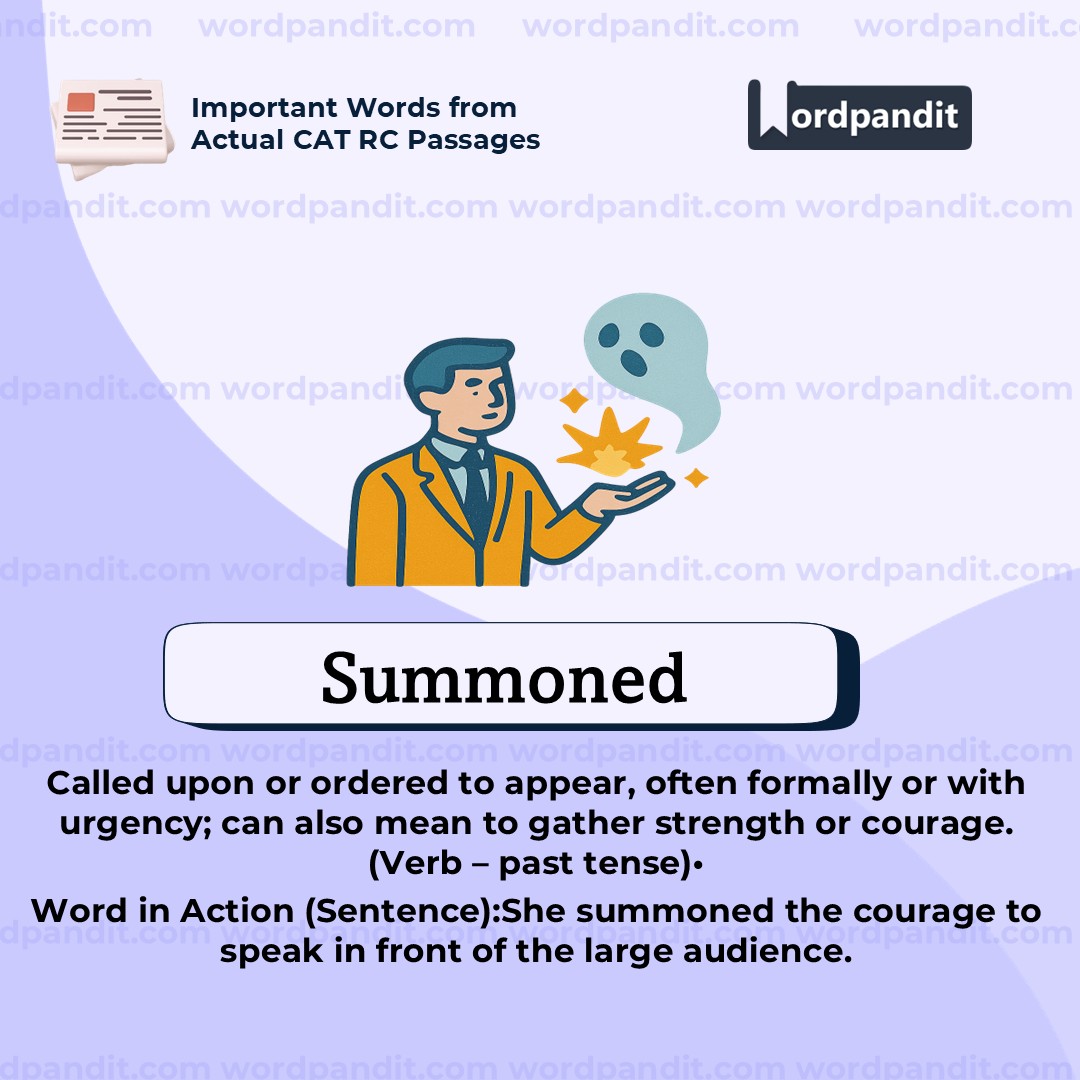
WORD-5: Summoned
Context:
"Evoking a children’s book that’s been summoned to motion, her BAFTA-award winning short film Grandad Was a Romantic features a young girl recalling how her grandfather – an exceptional athlete and irrepressible charmer – fell in love with her grandmother’s picture, travelled great distances to seek her hand in marriage and eventually started a family with her." - Psyche
Explanatory Paragraph:
The word "summoned" typically means to call someone to appear or to call something into action. In a literal sense, it can refer to calling a person to a meeting or a court. In more figurative or creative usage—like in the context above—it refers to bringing something to life, evoking, or calling forth a sense, image, or atmosphere. Saying a book is "summoned to motion" suggests it has come alive or been animated in a powerful and imaginative way.
Meaning: Called or brought forth, especially with intent or authority (Verb – past tense)
Pronunciation: SUM-uhnd
Difficulty Level: ⭐⭐☆ Intermediate
Etymology: From Latin summonere, meaning “to call, send for,” from sub- (secretly) + monere (to warn, advise)
Prashant Sir's Notes:
“Summoned” isn’t just for courtrooms or fantasy novels. You can summon courage, summon a memory, or even summon creativity. Think of it as intentionally *calling something into being*, either physically or mentally.
Synonyms & Antonyms:
Synonyms: called, invoked, evoked, beckoned, requested
Antonyms: dismissed, banished, ignored, overlooked
Usage Examples:
- He was suddenly summoned to the principal's office for an urgent matter.
- The witch summoned a storm with a wave of her hand.
- The smell of rain summoned childhood memories of playing outside.
- She summoned all her courage before stepping onto the stage.
Cultural Reference:
In J.K. Rowling’s Harry Potter series, the spell “Accio” is used to summon objects, emphasizing the magical and intentional aspect of calling something to oneself.
Think About It:
What emotions or memories can be *summoned* by a particular place, smell, or song in your life?
Quick Activity:
Write a sentence using “summoned” to describe bringing forth a feeling, memory, or person—real or imaginary.
Memory Tip:
“Summoned” sounds like “summons” — both involve being *called*. Imagine a magic spell or a courtroom letter—something is being called *into presence*.
Real-World Application:
In real life, “summoned” is often used in professional or legal settings (e.g., “summoned to a meeting”), but it’s also common in literature, fantasy, and personal reflection when describing the act of evoking thoughts, feelings, or memories.


