

Daily Vocabulary from International Newspapers and Publications
Expand Your Vocabulary with Wordpandit’s Global Vocabulary Hub
At Wordpandit, we are committed to helping you develop a truly global vocabulary by drawing from some of the most respected international publications. This section is designed to keep you ahead of the curve by introducing you to words that define global conversations and trends.
The Power of Global Sources
To help you think and communicate on a global scale, we curate vocabulary from renowned international sources, such as:
- The New York Times
- The Washington Post
- BBC
- The Guardian
- The Economist
- Scientific American
- Psychology Today
- And many more...
Stay Global, Stay Competitive
Our daily updates from international publications ensure you are consistently exposed to new words that reflect global news and developments, making sure your vocabulary is not only current but also globally relevant.
Enhance Your Global Perspective
Whether you’re preparing for international exams, aiming to excel in global business communication, or want to enhance your language skills for personal growth, Wordpandit offers the resources you need to thrive in a global context.
Effective Learning, Global Reach
Our learning methodology combines global examples, memory aids, and interactive activities, allowing you to internalize new words effectively and apply them in real-world scenarios.
Begin Your Global Vocabulary Journey Now!

Why Choose Wordpandit?
Practical Learning: Focus on words you'll actually encounter in real-world reading, enhancing your comprehension and communication skills.
Diverse Content: From current affairs to scientific breakthroughs, our varied sources expose you to vocabulary across multiple domains.
Effortless Integration: Make Wordpandit a part of your daily routine. Just a few minutes each day can significantly boost your lexicon over time.
Your Path to Vocabulary Mastery
- Visit our Daily Vocabulary section regularly
- Explore new words and their usage in context
- Practice incorporating these words into your own writing and speech
- Track your progress as your vocabulary expands
Start Your Journey Today
Embark on your vocabulary enhancement journey with Wordpandit. By consistently engaging with our daily posts, you'll build a robust vocabulary that serves you well in academic, professional, and personal contexts.
Remember, a word a day keeps linguistic limitations at bay. Make Wordpandit your daily companion in the quest for vocabulary excellence!
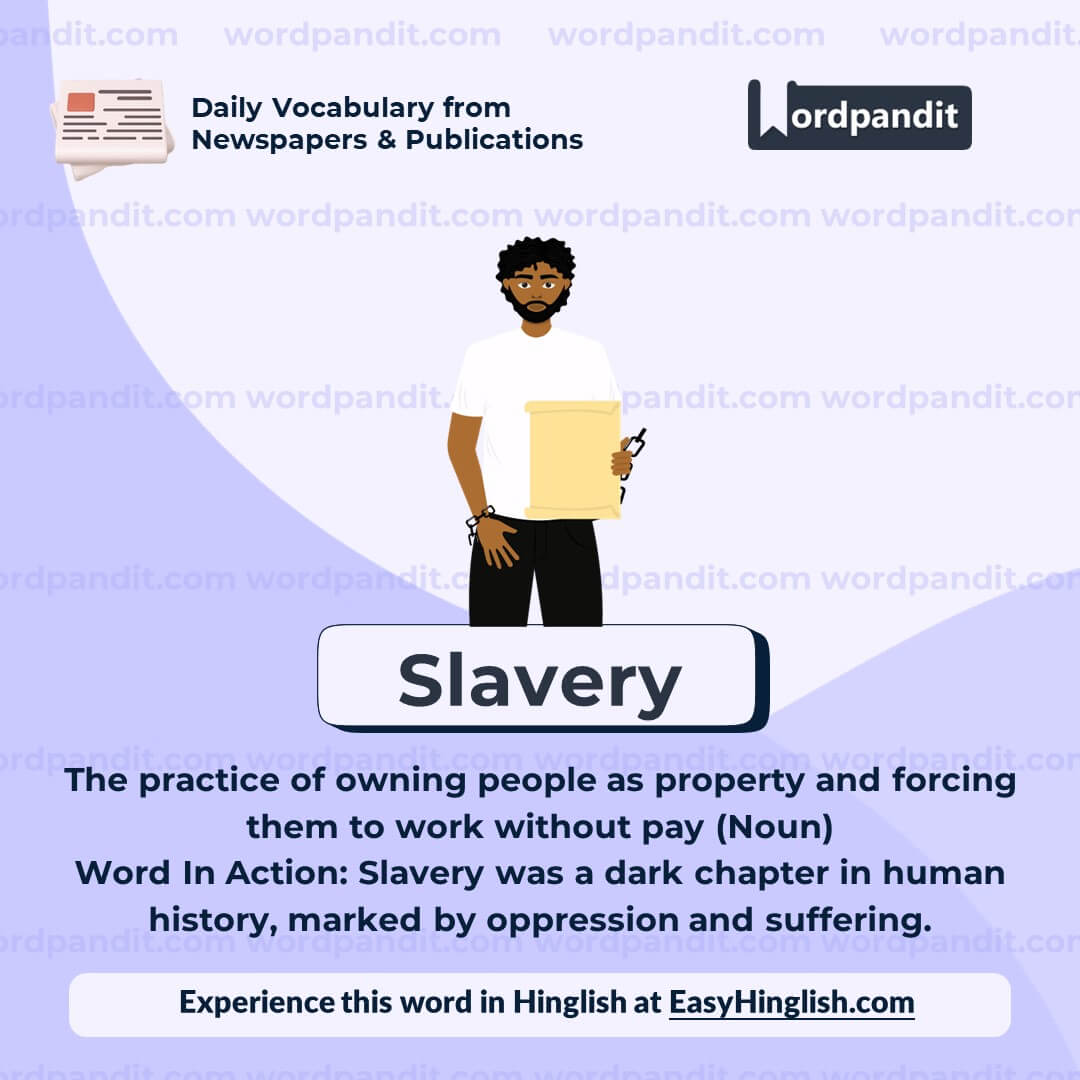
WORD-1: Slavery
Context:
"The time of his writing in 1865, had escaped slavery in Tennessee and was living in freedom in Ohio." - Aeon
Explanatory Paragraph:
Slavery refers to a condition in which individuals are owned by others, deprived of personal freedom, and forced to work without consent. Historically, it has been a system of severe oppression where people were treated as property. The sentence above refers to someone who had escaped such a life of bondage and gained freedom—highlighting the transition from oppression to liberation. Understanding the concept of slavery is vital for recognizing the long-standing struggles for human rights and dignity.
Meaning: The state of being a slave; a system in which people are treated as property and forced to work (Noun)
Pronunciation: SLAY-vuh-ree
Difficulty Level: ⭐⭐⭐ Intermediate
Etymology: Derived from the word "slave," which has roots in Medieval Latin "sclavus," originally referring to Slavs, many of whom were enslaved during the early Middle Ages.
Prashant Sir's Notes:
Slavery is more than just a historical term—it symbolizes deep-rooted injustice and dehumanization. Even today, forms of modern slavery exist, such as human trafficking and forced labor. When learning this word, always remember its emotional and social weight.
Synonyms & Antonyms:
Synonyms: bondage, servitude, oppression, captivity, subjugation
Antonyms: freedom, liberty, emancipation, independence
Usage Examples:
- Millions of Africans were taken from their homelands and forced into slavery during the transatlantic slave trade.
- Her research focuses on the psychological effects of slavery and its long-term impact on descendants.
- Although slavery was officially abolished, some forms of modern-day slavery still persist worldwide.
- Escaping slavery was a courageous and dangerous act that required immense strength and resilience.
Cultural Reference:
"Whenever I hear anyone arguing for slavery, I feel a strong impulse to see it tried on him personally." – Abraham Lincoln
Think About It:
What forms of "slavery" still exist today, and how can societies work together to eliminate them completely?
Quick Activity:
List five words or phrases that you associate with "slavery" and then write a short paragraph using at least three of them.
Memory Tip:
Think of the word “slave” within “slavery”—it reminds you that slavery is the condition of being a slave.
Real-World Application:
Understanding the history and implications of slavery is essential in law, history, human rights advocacy, and education. It informs discussions on racial justice, reparations, and social equity.
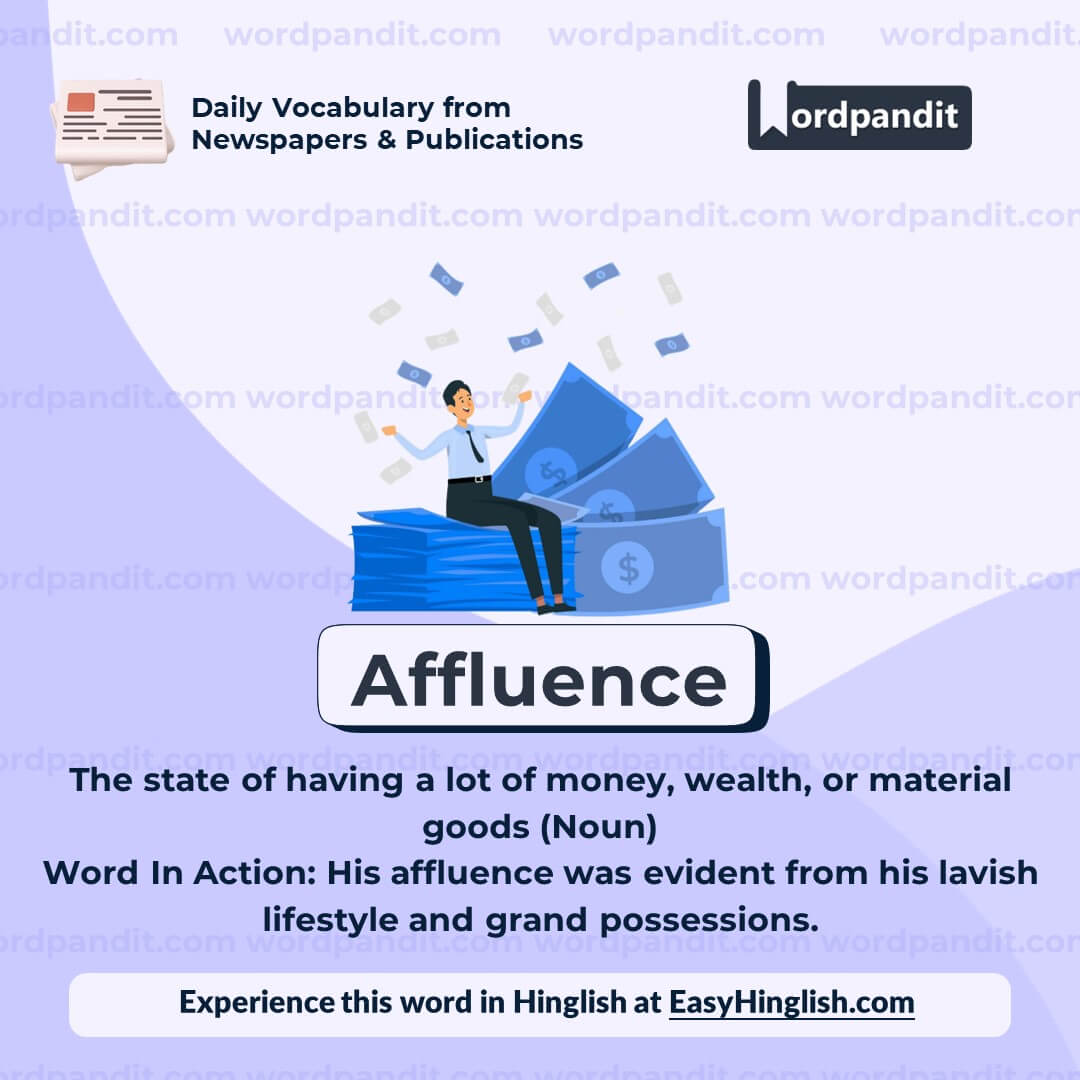
WORD-2: Affluence
Context:
"Who are poor are all around us. Poverty exists in every community, often lives right next door to (or in the houses of) those with immense affluence." - Aeon
Explanatory Paragraph:
Affluence refers to having a great deal of wealth, material goods, or financial resources. It describes a lifestyle characterized by comfort, luxury, and abundance. In the context above, the term highlights the sharp contrast between the lives of the poor and those with considerable wealth, often existing side-by-side in the same community. Understanding this word helps us grasp social and economic disparities in modern society.
Meaning: The state of having a lot of money, wealth, or material possessions (Noun)
Pronunciation: AFF-loo-uhns
Difficulty Level: ⭐⭐⭐ Intermediate
Etymology: From Latin "affluentia," meaning "a flowing toward," from "affluere" (to flow toward), suggesting abundance or wealth flowing in.
Prashant Sir's Notes:
Affluence doesn’t just mean having money—it also implies a lifestyle of ease, privilege, and often insulation from hardship. But it can be deceptive; someone may appear affluent while struggling financially. Think of affluence as both visible wealth and hidden realities.
Synonyms & Antonyms:
Synonyms: wealth, prosperity, riches, opulence, abundance
Antonyms: poverty, destitution, scarcity, indigence, neediness
Usage Examples:
- The affluence of the neighborhood was evident in its sprawling mansions and designer boutiques.
- Despite her affluence, she remained humble and committed to philanthropic causes.
- He grew up in affluence but chose a modest lifestyle dedicated to service.
- Affluence often brings comfort, but not necessarily happiness.
Cultural Reference:
"In societies where affluence grows, so too does the distance between those who have and those who have not." – A reflection commonly discussed in modern sociology and economics literature.
Think About It:
Does affluence come with a responsibility to help those who are less fortunate? Why or why not?
Quick Activity:
Write two sentences: one describing a scene of affluence, and one showing poverty. Compare the mood and imagery in both.
Memory Tip:
Think of "affluence" as a “flow” (from its Latin root) of wealth—imagine money flowing in like a river to someone’s bank account.
Real-World Application:
The term “affluence” is often used in economics, sociology, and media when analyzing consumer behavior, wealth distribution, and social inequality. It is key in understanding the gap between rich and poor.
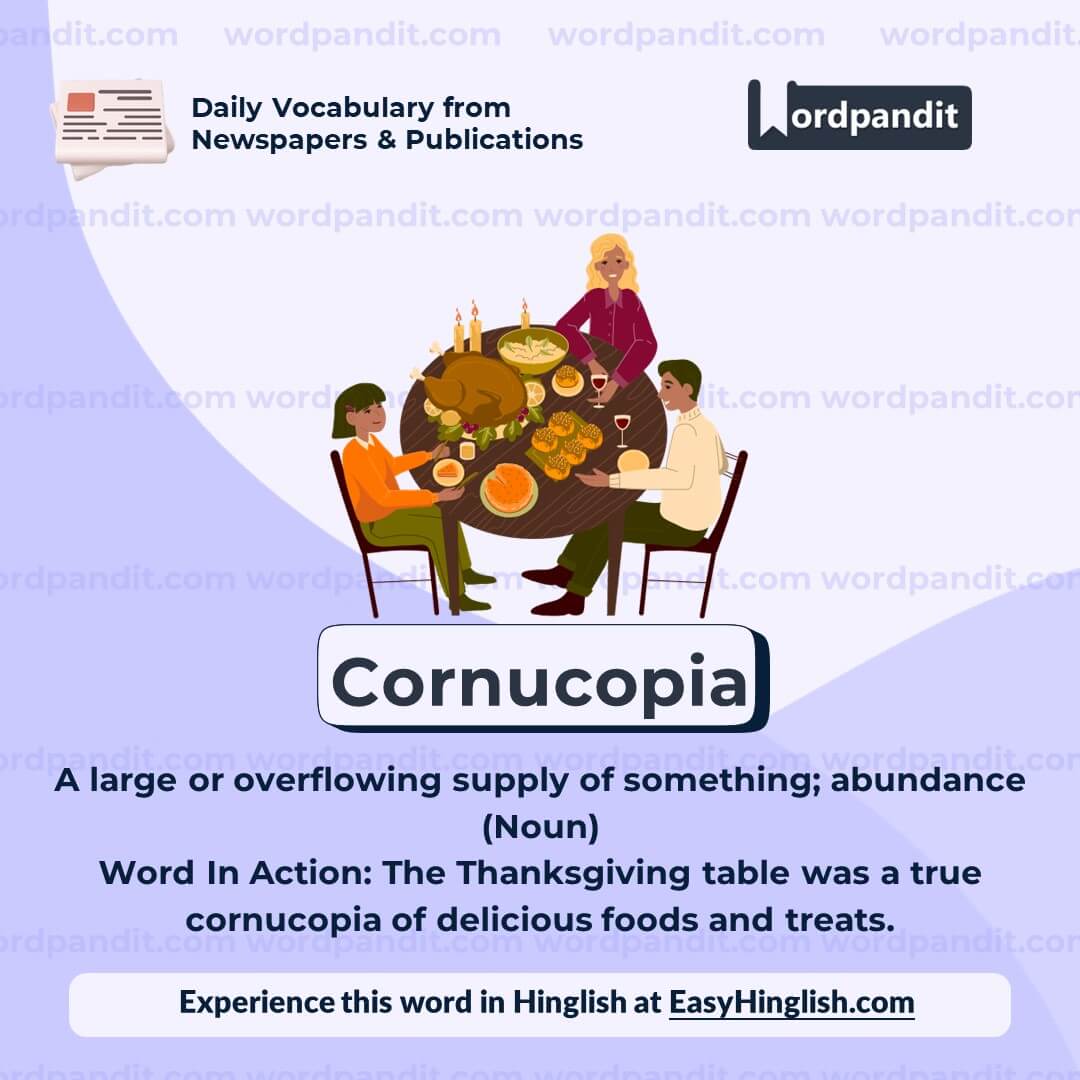
WORD-3: Cornucopia
Context:
"There’s a reasonable chance that, instead of a cornucopia of explicit sex, your browser showed a paragraph of white text against a black background." - Aeon
Explanatory Paragraph:
The word "cornucopia" traditionally refers to a horn-shaped container overflowing with fruits and flowers, symbolizing abundance and nourishment. In modern usage, it has come to mean an abundant supply of something. In the context above, the word is used metaphorically to suggest an overwhelming amount or variety—here, ironically contrasted with the lack of such content. This word paints a vivid image of plentifulness and is often used to describe richness, not just in material terms but also in experiences, emotions, or information.
Meaning: An abundant supply or overflowing quantity of something (Noun)
Pronunciation: kor-nuh-KOH-pee-uh
Difficulty Level: ⭐⭐⭐ Intermediate
Etymology: From Latin “cornu copiae,” meaning “horn of plenty”; traditionally associated with the mythological horn that could magically refill itself with food and drink.
Prashant Sir's Notes:
Cornucopia is a great example of a word that evolved from mythology into common speech. Think of it whenever you want to describe something in excess or abundance—be it food, knowledge, or digital content. It's especially useful in essays or creative writing.
Synonyms & Antonyms:
Synonyms: abundance, profusion, plenty, overflow, wealth
Antonyms: scarcity, lack, deficiency, dearth
Usage Examples:
- The garden was a cornucopia of colors in the springtime.
- The internet provides a cornucopia of information at your fingertips.
- The buffet offered a cornucopia of culinary delights from around the world.
- Her imagination was a cornucopia of fantastical ideas and vivid stories.
Cultural Reference:
The cornucopia is a symbol often used during Thanksgiving celebrations in the United States, representing a bountiful harvest and prosperity.
Think About It:
Can too much of a good thing—too great a cornucopia—actually become overwhelming or counterproductive?
Quick Activity:
List three things in your life you would describe as a "cornucopia." Write one sentence about each.
Memory Tip:
Picture a giant horn spilling over with fruits, sweets, and riches—this is your mental image of a cornucopia, or a source of endless abundance.
Real-World Application:
"Cornucopia" is often used in journalism, marketing, and literature to emphasize variety and richness, whether describing a product range, cultural offering, or digital content.
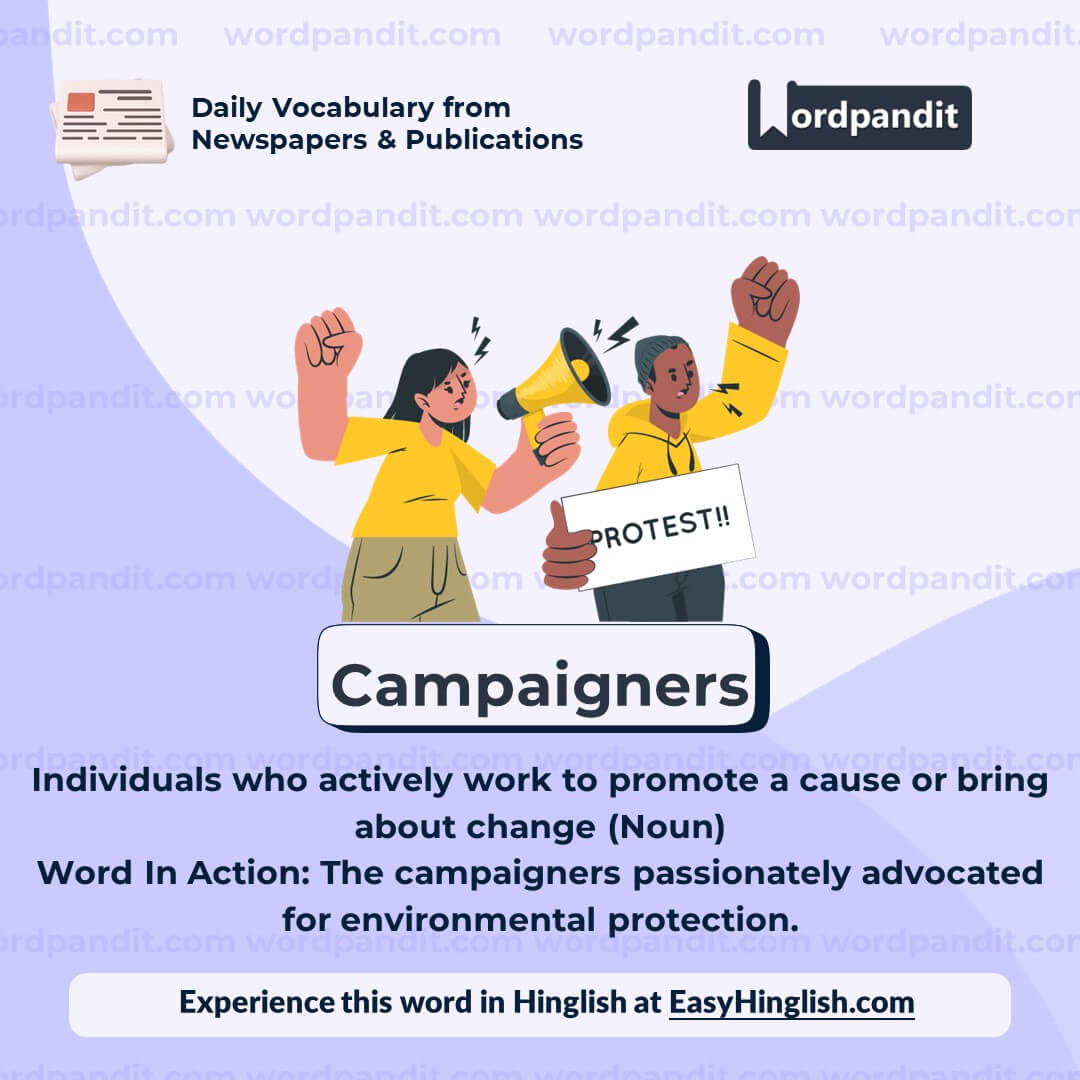
WORD-4: Campaigners
Context:
"The judgement has been met with anger, as activists, lawyers and campaigners renew their calls to criminalise marital rape in India." - BBC
Explanatory Paragraph:
Campaigners are individuals who actively work to promote a cause, bring about change, or raise awareness about social, political, environmental, or human rights issues. These people often organize protests, petitions, and awareness programs to influence public opinion or policy. In the context above, campaigners are those advocating for the legal recognition of marital rape as a crime in India, highlighting their role in pushing for legal and social reforms.
Meaning: People who actively work to promote a cause or bring about social or political change (Noun)
Pronunciation: kam-PAYN-urz
Difficulty Level: ⭐⭐ Basic
Etymology: From the word "campaign," which comes from the French “campagne” and Latin “campus” meaning “field” — originally used in military contexts, now applied to organized efforts for causes.
Prashant Sir's Notes:
Think of campaigners as "doers" — people who don’t just talk about problems but take action. They're vital in democratic societies because they keep pressure on systems to evolve and address injustices.
Synonyms & Antonyms:
Synonyms: activists, advocates, reformers, lobbyists, organizers
Antonyms: bystanders, spectators, apathists, nonparticipants
Usage Examples:
- Environmental campaigners gathered outside the parliament to protest deforestation laws.
- Campaigners played a critical role in securing voting rights for women.
- Animal rights campaigners urged the public to boycott products tested on animals.
- Social media has become a powerful tool for campaigners to reach large audiences.
Cultural Reference:
Famous campaigners like Mahatma Gandhi, Martin Luther King Jr., and Greta Thunberg have significantly shaped history through their relentless advocacy for justice and change.
Think About It:
What makes someone step forward as a campaigner while others stay silent in the face of injustice?
Quick Activity:
Choose a cause you care about. Write a two-sentence mini-campaign message that could be shared on social media to raise awareness.
Memory Tip:
Think of "campaigners" as the people behind every social "campaign" — like generals in a battle, but fighting with ideas, not weapons.
Real-World Application:
Campaigners influence public opinion, shape laws, and hold authorities accountable. Whether through street protests, digital petitions, or media outreach, they play a key role in civil society and democracy.
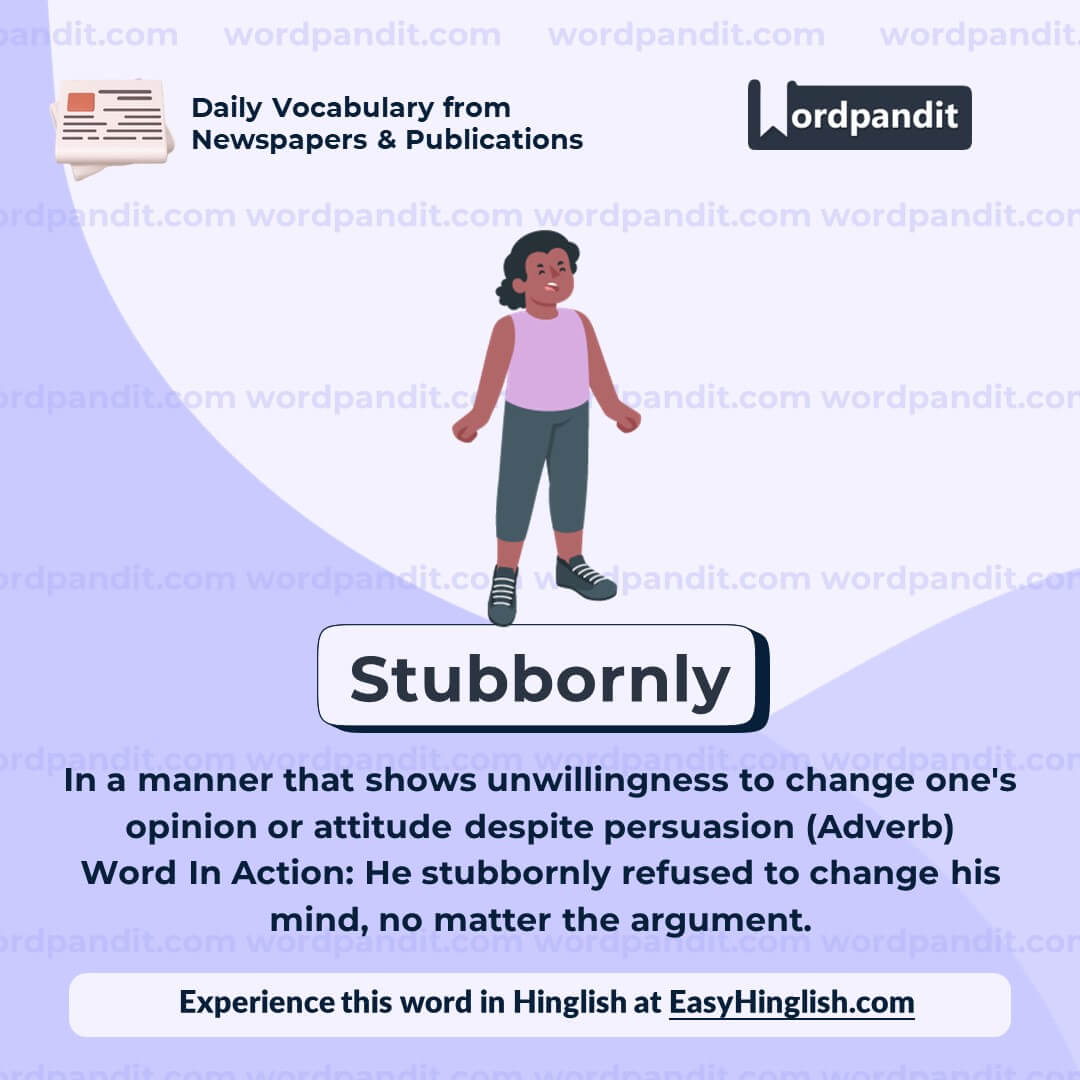
WORD-5: Stubbornly
Context:
"The controversial order has also brought back into the spotlight the issue of marital rape in a country which has stubbornly refused to criminalise it." - BBC
Explanatory Paragraph:
“Stubbornly” is an adverb that describes doing something with strong determination, often in a way that resists change, logic, or persuasion. In the context above, it emphasizes how persistently and unreasonably the country has refused to criminalize marital rape, despite public outcry and calls for reform. The word conveys not just persistence, but a kind of rigid unwillingness to reconsider or evolve on an issue.
Meaning: In a way that shows dogged determination not to change one’s attitude or position (Adverb)
Pronunciation: STUB-burn-lee
Difficulty Level: ⭐⭐ Basic
Etymology: From the word “stubborn,” of Middle English origin, meaning “unyielding” or “obstinate,” possibly related to the Old French “estuborn.”
Prashant Sir's Notes:
“Stubbornly” is a double-edged word. It can be positive when someone is firm in their principles, but negative when someone refuses to adapt or listen to reason. Context decides its tone—so read carefully!
Synonyms & Antonyms:
Synonyms: obstinately, persistently, doggedly, rigidly, unyieldingly
Antonyms: willingly, compliantly, flexibly, receptively
Usage Examples:
- He stubbornly refused to apologize, even after realizing he was wrong.
- The government has stubbornly ignored the growing calls for reform.
- She pursued her dreams stubbornly, undeterred by multiple failures.
- Despite clear evidence, he stubbornly held on to his outdated beliefs.
Cultural Reference:
The phrase “stubborn as a mule” is a common idiom in English, often used to describe people who refuse to change their views or behaviors regardless of logic or persuasion.
Think About It:
When does “stubbornness” become a strength, and when does it become a weakness? How can you tell the difference?
Quick Activity:
Write a short dialogue where one person is being stubborn and the other is trying to convince them to change their mind. Underline where “stubbornly” would fit in.
Memory Tip:
Link “stubbornly” to the image of a mule standing firm no matter how much you pull—it just won’t budge. That’s “stubbornly” in action!
Real-World Application:
“Stubbornly” is useful in essays, debates, and reports when describing resistance to change—whether in people, policies, or institutions. It helps convey both tone and attitude in critical writing.


