

Daily Vocabulary from International Newspapers and Publications
Expand Your Vocabulary with Wordpandit’s Global Vocabulary Hub
At Wordpandit, we are committed to helping you develop a truly global vocabulary by drawing from some of the most respected international publications. This section is designed to keep you ahead of the curve by introducing you to words that define global conversations and trends.
The Power of Global Sources
To help you think and communicate on a global scale, we curate vocabulary from renowned international sources, such as:
- The New York Times
- The Washington Post
- BBC
- The Guardian
- The Economist
- Scientific American
- Psychology Today
- And many more...
Stay Global, Stay Competitive
Our daily updates from international publications ensure you are consistently exposed to new words that reflect global news and developments, making sure your vocabulary is not only current but also globally relevant.
Enhance Your Global Perspective
Whether you’re preparing for international exams, aiming to excel in global business communication, or want to enhance your language skills for personal growth, Wordpandit offers the resources you need to thrive in a global context.
Effective Learning, Global Reach
Our learning methodology combines global examples, memory aids, and interactive activities, allowing you to internalize new words effectively and apply them in real-world scenarios.
Begin Your Global Vocabulary Journey Now!

Why Choose Wordpandit?
Practical Learning: Focus on words you'll actually encounter in real-world reading, enhancing your comprehension and communication skills.
Diverse Content: From current affairs to scientific breakthroughs, our varied sources expose you to vocabulary across multiple domains.
Effortless Integration: Make Wordpandit a part of your daily routine. Just a few minutes each day can significantly boost your lexicon over time.
Your Path to Vocabulary Mastery
- Visit our Daily Vocabulary section regularly
- Explore new words and their usage in context
- Practice incorporating these words into your own writing and speech
- Track your progress as your vocabulary expands
Start Your Journey Today
Embark on your vocabulary enhancement journey with Wordpandit. By consistently engaging with our daily posts, you'll build a robust vocabulary that serves you well in academic, professional, and personal contexts.
Remember, a word a day keeps linguistic limitations at bay. Make Wordpandit your daily companion in the quest for vocabulary excellence!
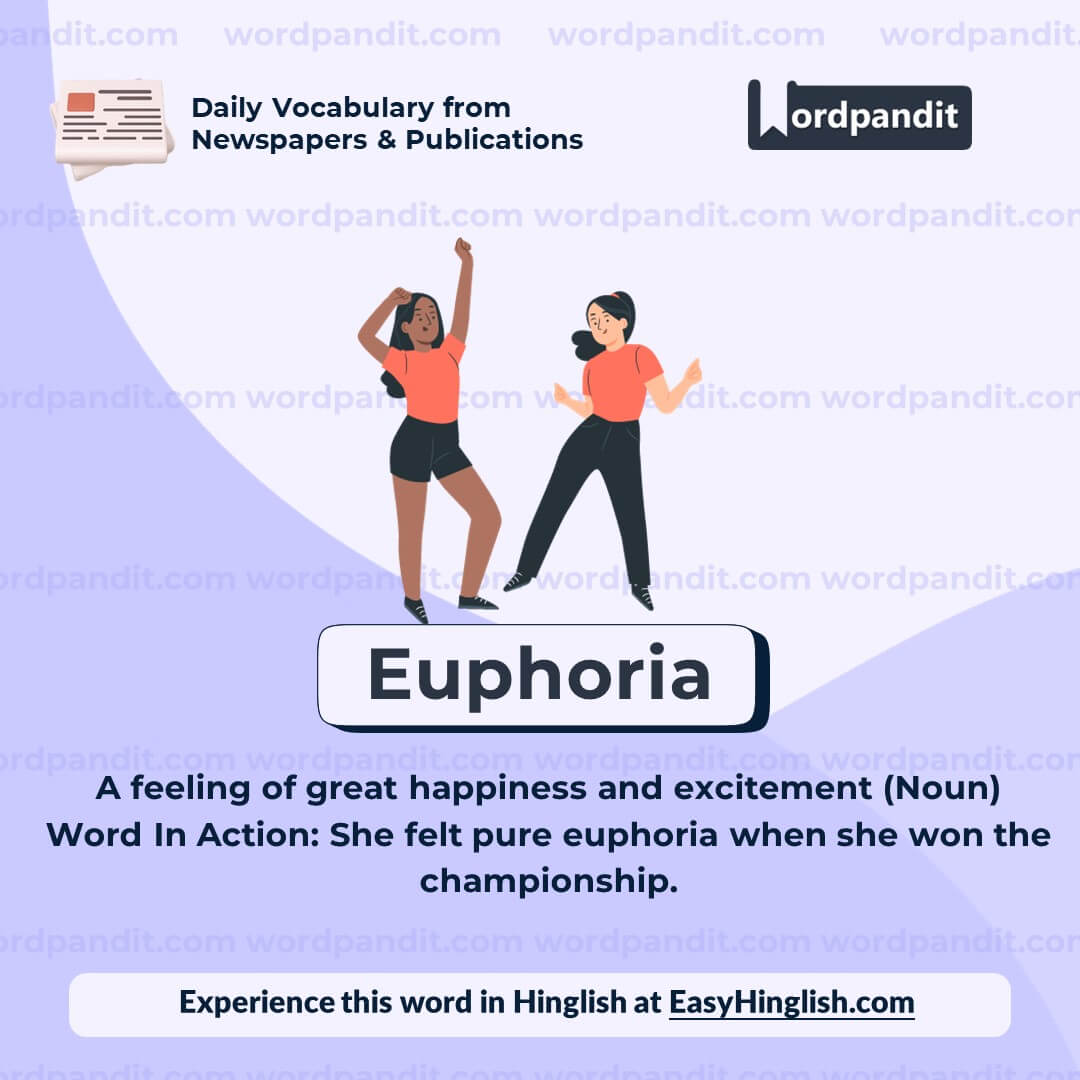
WORD-1: Euphoria
Context:
"Once I’d stepped out of the building, the euphoria of the party took all of two seconds to fade." - Aeon
Explanatory Paragraph:
"Euphoria" refers to a feeling of intense happiness or excitement, often overwhelming and sometimes fleeting. It's that emotional high one experiences during moments of celebration, success, or joy—like after winning a competition, hearing good news, or enjoying an unforgettable event. However, as the quote suggests, this feeling can sometimes vanish as quickly as it appears, reminding us that euphoria is often temporary.
Meaning: A state of intense happiness and self-confidence (Noun)
Pronunciation: yoo-FOR-ee-uh
Difficulty Level: ⭐⭐⭐ Intermediate
Etymology: From Greek "euphoros" meaning "healthy" or "bearing well", from "eu-" (well) + "pherein" (to bear).
Prashant Sir's Notes:
Euphoria is a word that captures the emotional high we sometimes chase—like the peak of a good mood. Be careful not to confuse it with lasting happiness; it's usually short-lived and often triggered by external events.
Synonyms & Antonyms:
Synonyms: elation, ecstasy, bliss, exhilaration, jubilation
Antonyms: misery, despair, gloom, depression, melancholy
Usage Examples:
- There was a wave of euphoria in the stadium after the home team scored the winning goal.
- She was in a state of euphoria after getting accepted into her dream university.
- The euphoria of finishing the marathon kept him smiling for days.
- Despite the initial euphoria of the promotion, the job's demands soon became overwhelming.
Cultural Reference:
"The word 'euphoria' became central to the rave culture of the 1990s, where music, lights, and community created unforgettable emotional highs." - Cultural Studies Journal
Think About It:
Is euphoria something we should chase, or should we be wary of relying on such fleeting highs for happiness?
Quick Activity:
Write down a personal memory where you felt euphoria. What triggered it? How long did it last?
Memory Tip:
Think of the word "euphoria" as "EU-topia" for your feelings—it's an emotional utopia you temporarily enter when extremely happy.
Real-World Application:
The word "euphoria" is often used in psychology, media reviews, and everyday conversation to describe emotional peaks—whether in relationships, drug experiences, or political movements.
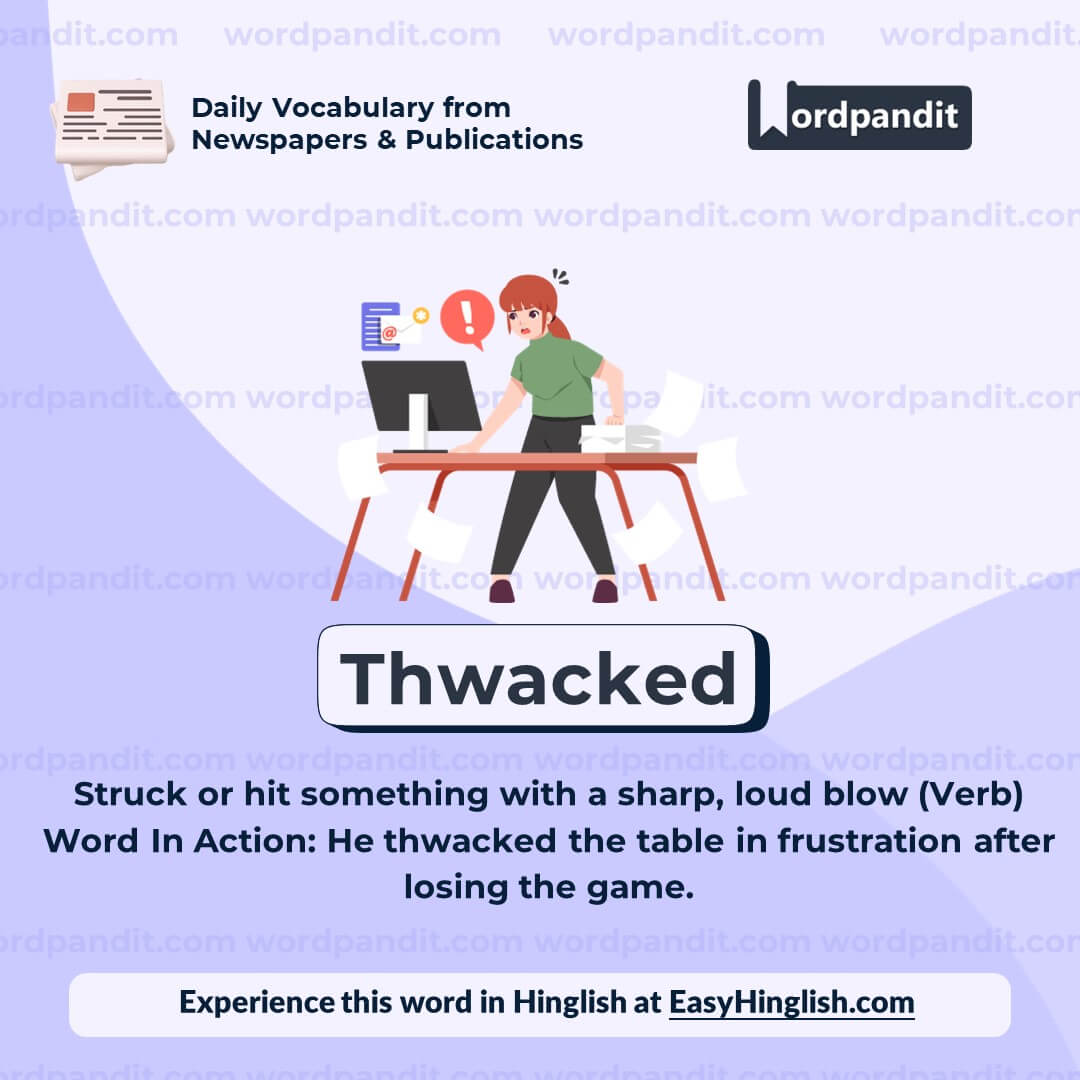
WORD-2: Thwacked
Context:
"I could just make out the contours of a motorbike scooting towards me at full speed. Before I knew it, a hand had thwacked my chest." - Aeon
Explanatory Paragraph:
"Thwacked" is a vivid verb used to describe a sharp, sudden, and often loud blow or hit. It usually conveys both the physical action and the sound of impact. In the sentence above, the use of "thwacked" immediately communicates a forceful, perhaps unexpected, strike to the chest — possibly intended to stop or alert someone. It’s a punchy word (no pun intended!) that adds dramatic intensity to the action.
Meaning: Hit forcefully with a sharp or loud sound (Verb)
Pronunciation: thwakt
Difficulty Level: ⭐⭐ Basic
Etymology: Possibly imitative in origin; "thwack" is a sound word (onomatopoeia), recorded since the 17th century in English.
Prashant Sir's Notes:
"Thwacked" is an example of onomatopoeia—a word that mimics the sound it describes. It’s an excellent word to use when writing action scenes or emphasizing physical contact with dramatic effect.
Synonyms & Antonyms:
Synonyms: smack, whack, slap, bash, wallop
Antonyms: caress, pat, stroke, tap
Usage Examples:
- The newspaper thwacked against the door as it landed with a thud.
- He thwacked the tennis ball across the court with surprising force.
- The soldier thwacked his boots together and stood at attention.
- She thwacked the fly with a rolled-up magazine, ending its buzzing tyranny.
Cultural Reference:
"Comic books often use words like 'thwack!' or 'pow!' to emphasize action sequences and bring a visual punch to the panels." - Pop Culture Lexicon
Think About It:
Why do we often associate certain sounds with specific actions—and how does that influence the words we invent or use?
Quick Activity:
Write a short 3-sentence action scene that uses "thwacked" in context. Try to create a sense of movement and urgency.
Memory Tip:
Imagine the loud "THWACK!" sound in a cartoon when someone gets hit — that’s exactly what this word represents!
Real-World Application:
"Thwacked" is useful in storytelling, journalism, or even informal conversations when you want to add vividness or humor to a physical action.
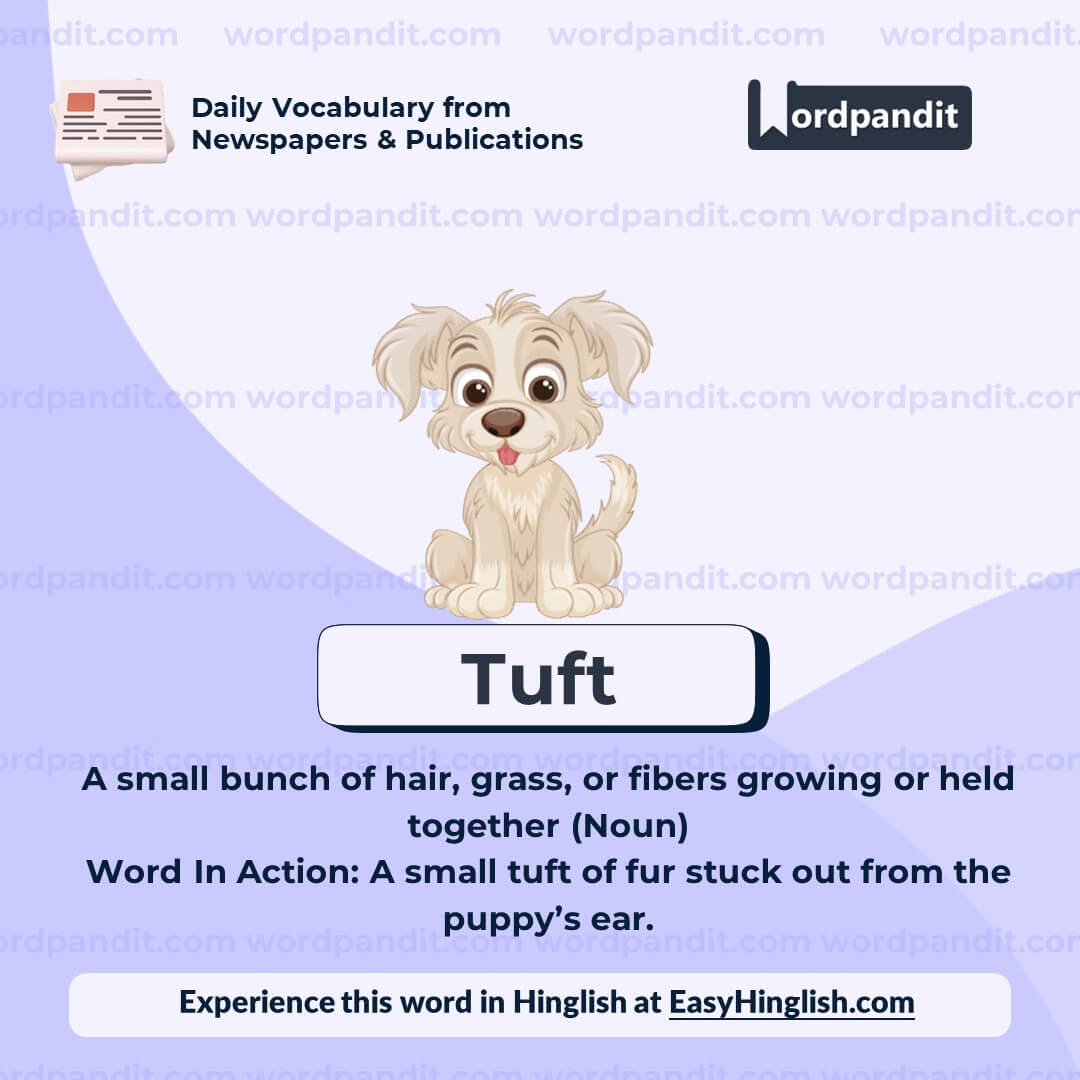
WORD-3: Tuft
Context:
"Tuft of hair on top, double chin bulging from the bottom, the offending arm held out like a weapon." - Aeon
Explanatory Paragraph:
A "tuft" refers to a small bunch or clump of something—typically hair, grass, feathers, or fibers—growing closely together or gathered at one base. It's often used to describe uneven or scattered growth that stands out, like a lone patch of hair on a bald head or a clump of grass on otherwise barren land. In the sentence above, the phrase "tuft of hair" helps paint a vivid picture of someone with only a small, perhaps scraggly, patch of hair remaining—contributing to a somewhat humorous or critical description.
Meaning: A small bunch or clump of something, especially hair, grass, or threads (Noun)
Pronunciation: tuhft
Difficulty Level: ⭐⭐ Basic
Etymology: From Middle English "tofte," related to Old French "touffe" (tuft of hair or grass); possibly of Germanic origin.
Prashant Sir's Notes:
Tuft is a visually descriptive word. When writing descriptive passages, especially about appearance or nature, this word adds texture and specificity. Think of it as a way to draw focus to one small yet distinct feature.
Synonyms & Antonyms:
Synonyms: clump, bunch, cluster, wad, patch
Antonyms: strand, thread, line, smoothness
Usage Examples:
- A single tuft of grass grew stubbornly between the cracks in the pavement.
- The baby had a tuft of soft, dark hair at the crown of her head.
- He wore a jacket with tufts of fur lining the collar.
- The old cushion had tufts of stuffing poking out from the seams.
Cultural Reference:
"In many Looney Tunes cartoons, a character like Elmer Fudd is often drawn with a single tuft of hair on an otherwise bald head, adding a comical visual touch." - Animation Studies Journal
Think About It:
Why do small, seemingly insignificant physical features—like a tuft of hair—often become central to how we remember or describe someone?
Quick Activity:
Look around your room or outside your window and find an example of a "tuft." Describe it in a sentence using vivid adjectives.
Memory Tip:
Think of a *tuft* as something you can *tug*—both start with "tu" and both involve a small bit of something you can pull or see sticking out.
Real-World Application:
"Tuft" is commonly used in personal descriptions, wildlife writing, textile design, and even botany. It helps bring specificity and texture to writing or speech.
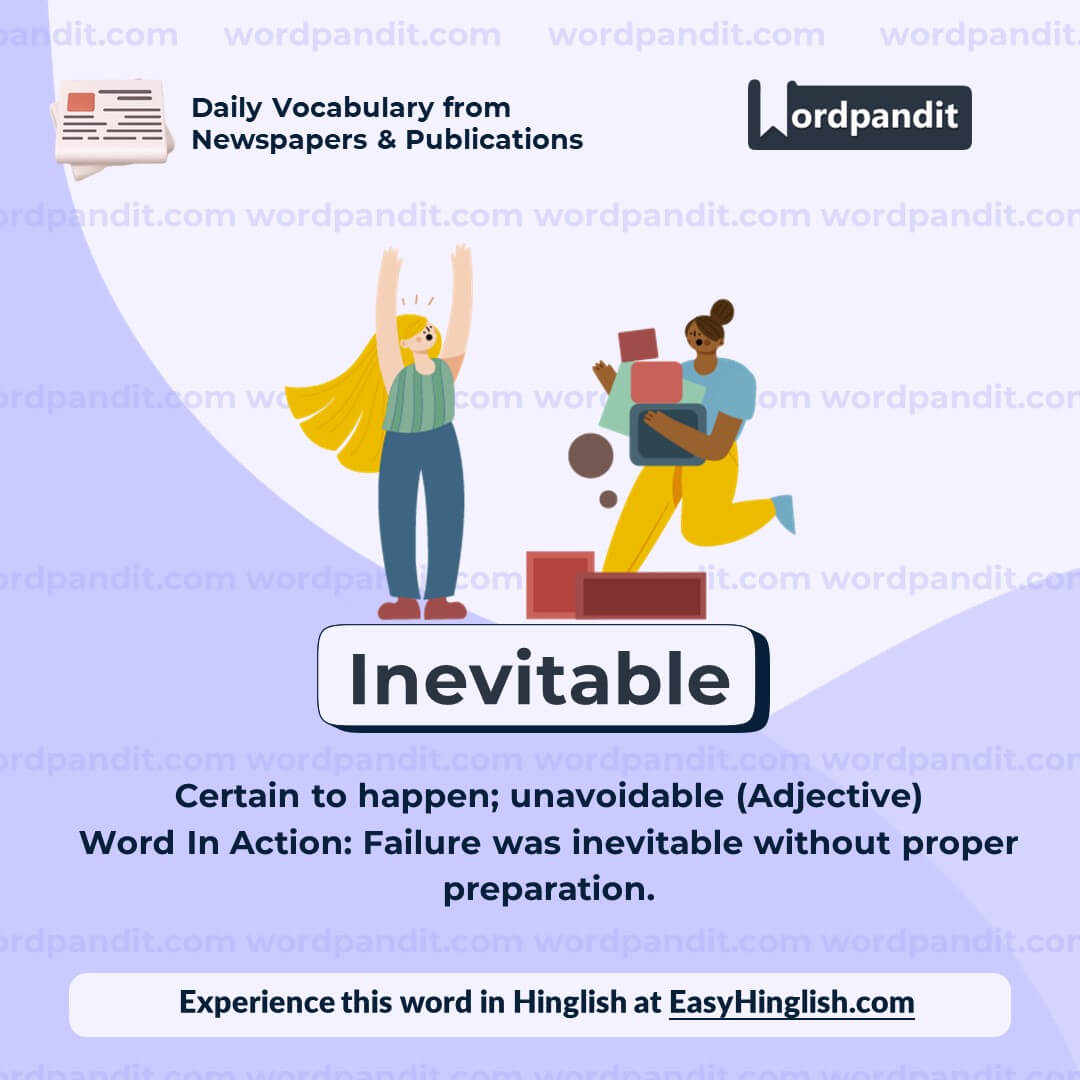
WORD-4: Inevitable
Context:
"The rapid advancement of technology made the automation of many jobs inevitable, leaving workers to adapt to new roles." - Aeon
Explanatory Paragraph:
"Inevitable" describes something that is certain to happen and cannot be avoided. It suggests a sense of fate or natural consequence, often used when discussing future outcomes that result from current trends or actions. In the sentence above, it conveys that technological progress has reached a point where job automation is no longer a possibility—it's a certainty. The word carries both practicality and finality, urging preparation or acceptance.
Meaning: Certain to happen; unavoidable (Adjective)
Pronunciation: in-EV-uh-tuh-buhl
Difficulty Level: ⭐⭐⭐ Intermediate
Etymology: From Latin "inevitabilis" meaning "unavoidable," from "in-" (not) + "evitabilis" (avoidable).
Prashant Sir's Notes:
This is a power word—useful in arguments, essays, and discussions. When you want to show that a certain consequence cannot be stopped or delayed, "inevitable" is your go-to word. It adds finality and seriousness to your point.
Synonyms & Antonyms:
Synonyms: unavoidable, certain, inescapable, destined, fated
Antonyms: avoidable, uncertain, preventable, doubtful
Usage Examples:
- Death and taxes are often joked about as the only inevitable things in life.
- Given the rising temperatures, climate migration seems inevitable in some regions.
- The team’s loss felt inevitable after their captain was injured early in the game.
- With so many delays, cancellation of the project became inevitable.
Cultural Reference:
"I am inevitable." — A famous quote from the character Thanos in Marvel's *Avengers: Endgame*, symbolizing unstoppable destiny. - Marvel Studios
Think About It:
If something is truly inevitable, does it remove our responsibility to act—or increase it?
Quick Activity:
List three current trends (in society, tech, environment, etc.) that you believe are leading to inevitable changes. Explain why.
Memory Tip:
Break it into: “in” (not) + “evitable” (avoidable) → "inevitable" = *not avoidable* — simple logic, clear meaning!
Real-World Application:
"Inevitable" is often used in debates, policy discussions, business forecasting, and personal reflections to describe changes, outcomes, or consequences that are bound to happen. Recognizing the inevitable helps in planning ahead.
WORD-5: Aegis
Context:
"The environmental project was launched under the aegis of the United Nations, ensuring it received global support and resources." - Aeon
Explanatory Paragraph:
"Aegis" refers to protection, backing, or support—especially by a powerful organization or authority. When something is done under the aegis of a group, it means it’s operating with their endorsement, guidance, or sponsorship. In the given context, the United Nations is the authoritative body providing legitimacy and resources for the project, giving it both global recognition and structural support. The word carries a formal, prestigious tone, often used in international, governmental, or institutional settings.
Meaning: Protection, sponsorship, or guidance, especially from an organization or authority (Noun)
Pronunciation: EE-jis
Difficulty Level: ⭐⭐⭐⭐ Advanced
Etymology: From Latin *aegis*, from Greek *aigis* meaning "shield of Zeus," associated with divine protection.
Prashant Sir's Notes:
This is a sophisticated, formal word—excellent for essays, reports, and academic writing. Use "aegis" when you want to highlight the protection, legitimacy, or authority behind an initiative or action.
Synonyms & Antonyms:
Synonyms: patronage, sponsorship, backing, guidance, auspices
Antonyms: opposition, abandonment, neglect, disapproval
Usage Examples:
- The new education policy was developed under the aegis of UNESCO.
- Scientific research under the aegis of the national laboratory gained global attention.
- The charity operates under the aegis of a prominent humanitarian organization.
- Peace talks were held under the aegis of international diplomatic bodies.
Cultural Reference:
In Greek mythology, the aegis was a protective shield associated with Zeus and Athena, symbolizing divine power and invincibility. Today, it metaphorically represents institutional protection. - Classical Mythology Archives
Think About It:
Does acting under someone's aegis reduce independence, or does it enable greater influence and reach?
Quick Activity:
Identify three major initiatives (social, scientific, or educational) currently happening under the aegis of global institutions. Write one sentence for each using "aegis."
Memory Tip:
Think of "Aegis" as a mighty “Eagle” (both start with “E”) flying overhead, shielding and guiding from above—just like the Greek gods did with their shield.
Real-World Application:
"Aegis" is often used in formal writing—government reports, academic papers, and news articles—to indicate that an action or project is being carried out with the support or protection of a powerful institution or authority.


