

Daily Vocabulary from Indian Newspapers and Publications
Welcome to Wordpandit’s Indian Vocabulary Hub
At Wordpandit, we understand the importance of staying rooted in the local context while expanding your language skills. This section focuses on enriching your vocabulary with words and phrases drawn from India’s leading newspapers and publications, ensuring you're learning vocabulary that is practical, relevant, and uniquely Indian.
Why Indian Sources Matter
We believe that the best way to master any language is by immersing yourself in local content. That’s why we carefully curate vocabulary from top Indian publications, including:
- The Hindu
- The Times of India
- The Economic Times
- Hindustan Times
- Live Mint
- The Indian Express
- And many others...
Stay Updated, Stay Relevant
With daily updates from Indian news sources, you’ll be consistently learning words that reflect the trends and shifts in Indian society and culture. Our focus is to provide vocabulary that enhances your understanding of the language in an Indian context.
How Wordpandit Supports Your Goals
Whether you’re preparing for exams, aiming to improve your professional communication, or simply want to stay connected with the latest Indian vocabulary, Wordpandit is here to guide you every step of the way.
Learn with a Practical Approach
Our interactive learning methodology includes real-world examples, engaging activities, and context-specific usage to ensure that every word becomes part of your active vocabulary.
Dive into Indian Vocabulary Today!

Why Choose Wordpandit?
Practical Learning: Focus on words you'll actually encounter in real-world reading, enhancing your comprehension and communication skills.
Diverse Content: From current affairs to scientific breakthroughs, our varied sources expose you to vocabulary across multiple domains.
Effortless Integration: Make Wordpandit a part of your daily routine. Just a few minutes each day can significantly boost your lexicon over time.
Your Path to Vocabulary Mastery
- Visit our Daily Vocabulary section regularly
- Explore new words and their usage in context
- Practice incorporating these words into your own writing and speech
- Track your progress as your vocabulary expands
Start Your Journey Today
Embark on your vocabulary enhancement journey with Wordpandit. By consistently engaging with our daily posts, you'll build a robust vocabulary that serves you well in academic, professional, and personal contexts.
Remember, a word a day keeps linguistic limitations at bay. Make Wordpandit your daily companion in the quest for vocabulary excellence!
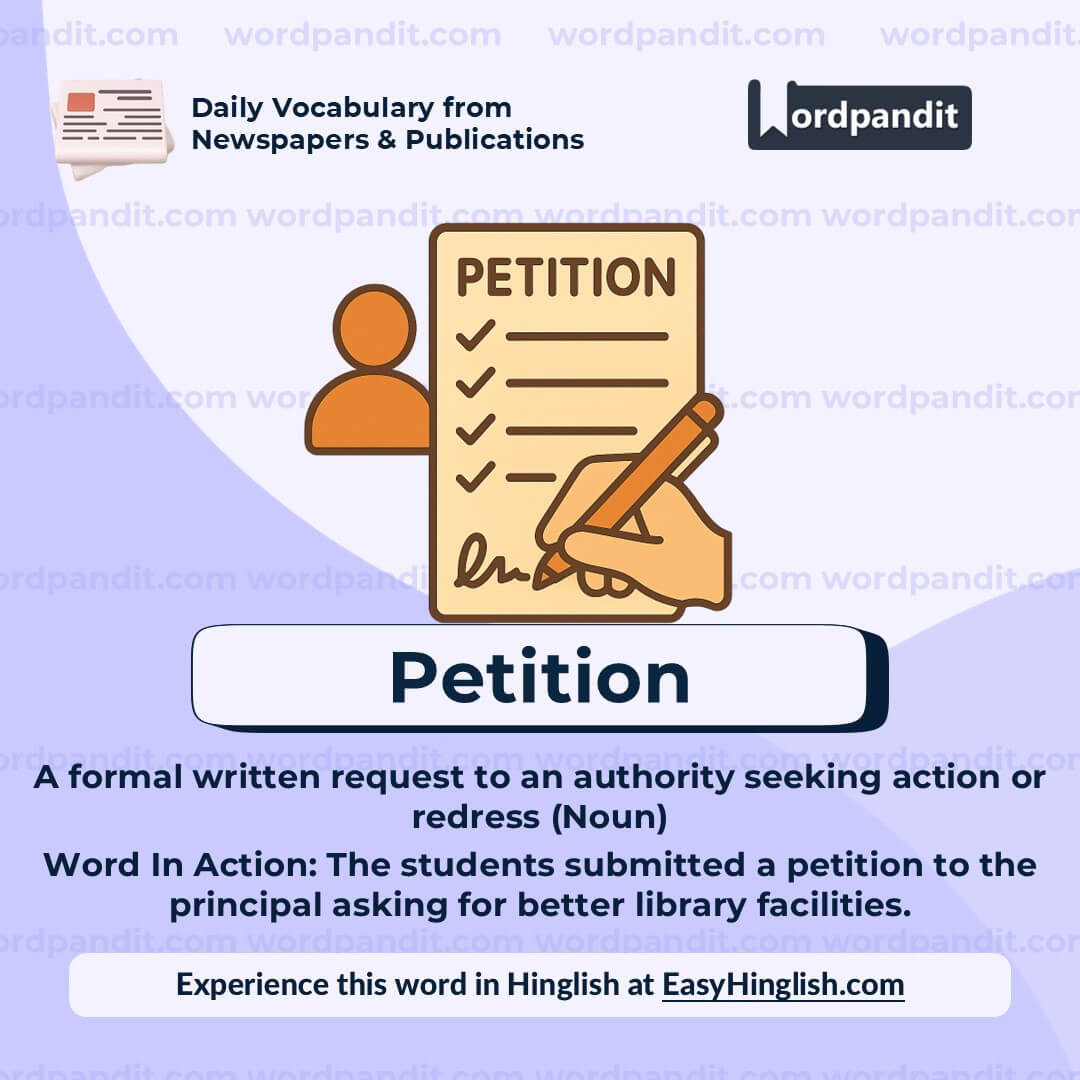
WORD-1: Petition
Context:
"In response to a petition by a non-profit assailing derogatory remarks by online figures against disabled persons, the Court issued instructions that further a problematic trend of the judiciary egging on the state to encroach on legal grey areas with statutory restrictions that undermine constitutionally guaranteed rights." - The Hindu
Explanatory Paragraph:
A petition is a formal written request made to an authority, often a court or government body, asking for a specific action or decision. Petitions are a way for individuals or groups to express concerns, seek justice, or advocate for change. They can be legal, political, or social in nature and typically involve a collective appeal or a plea for redress of grievances.
Meaning: A formal written request to an authority seeking action or redress (Noun)
Pronunciation: puh-tih-shun
Difficulty Level: ⭐⭐ (Basic to Intermediate)
Etymology: From Old French peticion, derived from Latin petitio meaning "a request" or "a solicitation."
Prashant Sir's Notes:
Think of a petition as a formal request where people collectively or individually ask a higher authority to intervene. It is widely used in legal and civic contexts and is a powerful tool for public participation in governance.
Synonyms & Antonyms:
Synonyms: request, appeal, plea, entreaty, application
Antonyms: command, order, decree, demand
Usage Examples:
- The villagers submitted a petition demanding clean drinking water in their area.
- The environmental group filed a petition in the Supreme Court to stop illegal mining.
- Students circulated a petition to extend the college library hours during exams.
- The petition was signed by thousands, urging the government to strengthen disability rights.
Cultural Reference:
"Petitions have historically played a crucial role in democratic societies—whether in the American civil rights movement, the Indian independence struggle, or modern online campaigns, they represent collective voices seeking change." - Civic Studies Reference
Think About It:
Do petitions truly influence government and judicial decisions, or do they often remain symbolic gestures of dissent?
Quick Activity:
Create a mock petition for a cause you care about (e.g., planting more trees, improving school facilities). Write the opening statement of your petition in two lines.
Memory Tip:
Remember: "Petition" comes from "petitioners" who are asking for something. Think of "petition" as a polite but firm "please" in a formal context.
Real-World Application:
In real life, petitions are used to initiate legal cases, campaign for social reforms, or draw attention to community needs. For example, online platforms like Change.org have made petitions a powerful tool for global advocacy.
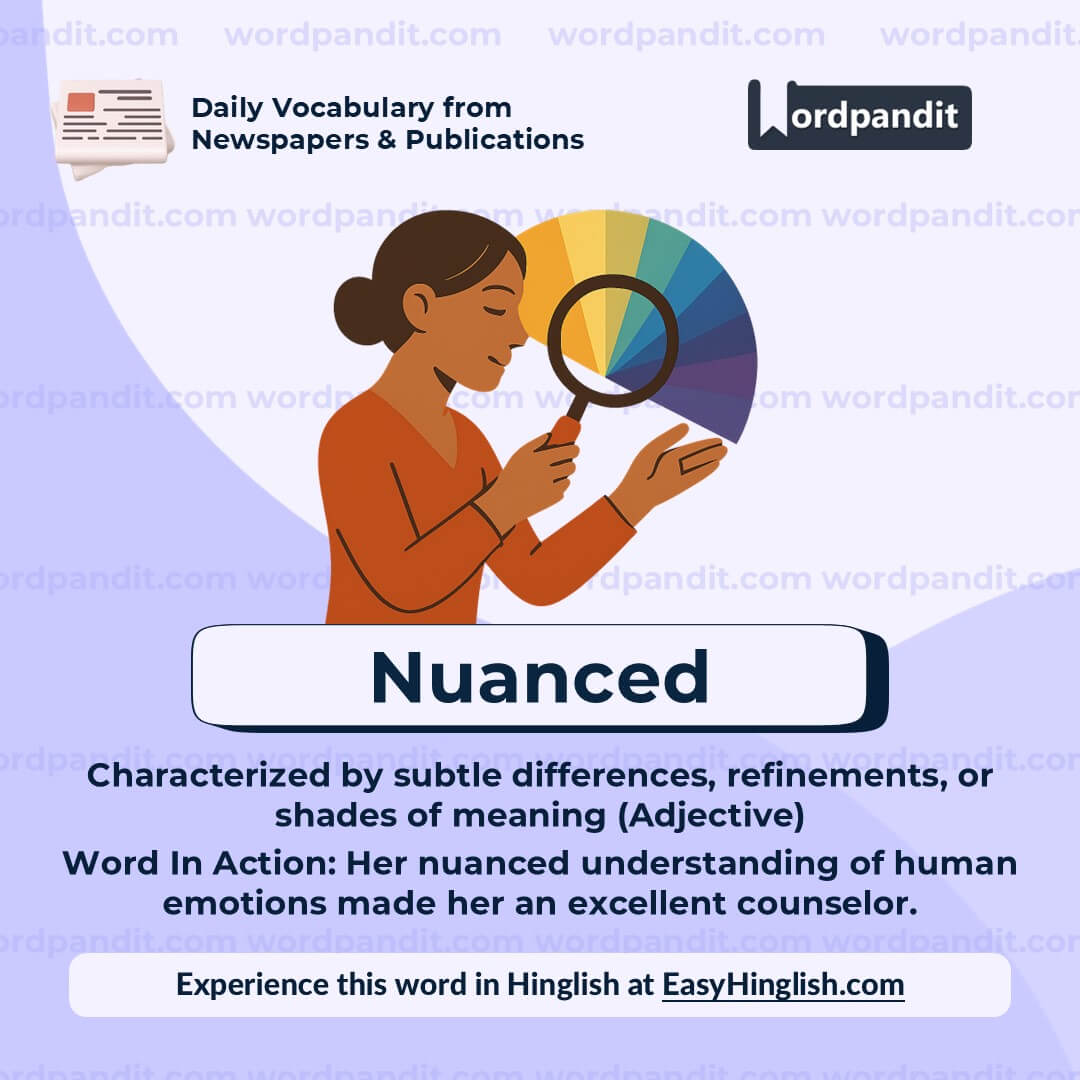
WORD-2: Nuanced
Context:
"They also provide a more nuanced way to address the ‘nested’ concentration risk within UPI — namely, the dominance of a few third-party application providers (TPAPs)." - Economic Times
Explanatory Paragraph:
The word nuanced describes something that is not simple or black-and-white, but rather has subtle distinctions, fine details, or delicate shades of meaning. When a solution, perspective, or argument is called nuanced, it means it considers complexities instead of offering an overly simplified view.
Meaning: Characterized by subtle differences, refinements, or shades of meaning (Adjective)
Pronunciation: noo-ahnst / nyoo-ahnst
Difficulty Level: ⭐⭐⭐ (Intermediate to Advanced)
Etymology: From French nuance, meaning "shade" or "slight difference," derived from Latin nubes meaning "cloud."
Prashant Sir's Notes:
"Nuanced" is an important word to capture complexity. In exams, writers often praise nuanced arguments, as they recognize multiple perspectives rather than oversimplifying. Whenever you hear "nuanced," think of layers and shades, like different shades of the same color.
Synonyms & Antonyms:
Synonyms: subtle, refined, delicate, layered, sophisticated
Antonyms: blunt, obvious, simplistic, crude
Usage Examples:
- Her nuanced explanation of the conflict helped both sides see each other’s concerns more clearly.
- The actor gave a nuanced performance, capturing both strength and vulnerability.
- A nuanced strategy is required to balance economic growth with environmental concerns.
- Unlike sensational media reports, the research paper presented a nuanced view of the issue.
Cultural Reference:
"Great literature is always nuanced—it avoids clear-cut villains and heroes, instead portraying human beings in all their contradictions." - Literary Criticism Reference
Think About It:
Why do you think modern debates on politics and social media often lack nuance, even though real-world problems are rarely simple?
Quick Activity:
Pick a common statement like "Technology is good." Now rewrite it in a nuanced way by adding conditions, exceptions, or perspectives.
Memory Tip:
Think of "nuance" as "new-angles." A nuanced idea shows many new angles instead of a single viewpoint.
Real-World Application:
In business, policymaking, or law, nuanced thinking is crucial. For example, financial regulations must strike a nuanced balance between preventing risks and encouraging innovation.
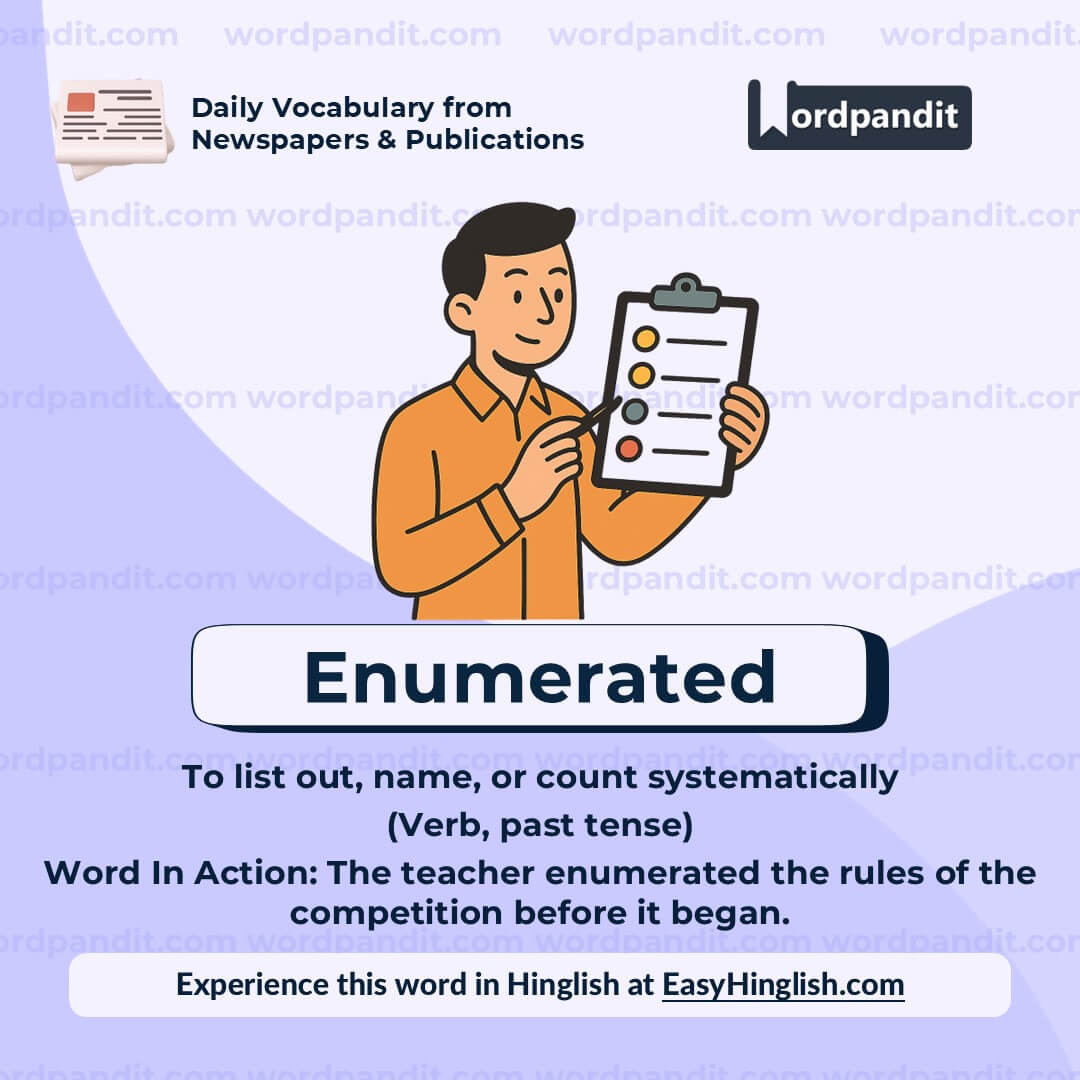
WORD-3: Enumerated
Context:
"If this is done, it will be the first time that the PVTGs are enumerated separately since the category was introduced." - Indian Express
Explanatory Paragraph:
The word enumerated means to mention things one by one in a list or to count them clearly and systematically. It is often used in formal, academic, or legal contexts to indicate that specific items, groups, or categories are identified and recorded individually.
Meaning: To list out, name, or count systematically (Verb, past tense)
Pronunciation: ih-noo-muh-ray-ted
Difficulty Level: ⭐⭐⭐ (Intermediate)
Etymology: From Latin enumerare, meaning "to count out" (e- "out" + numerus "number").
Prashant Sir's Notes:
Whenever you see "enumerated," think of a step-by-step list or things being counted distinctly. In law and governance, "enumerated powers" are those specifically listed in the constitution. In general, it’s a formal way of saying "counted or listed in detail."
Synonyms & Antonyms:
Synonyms: list, count, itemize, specify, catalog
Antonyms: overlook, ignore, generalize
Usage Examples:
- The teacher enumerated the steps of the experiment so students wouldn’t miss any detail.
- The constitution enumerates the rights guaranteed to every citizen.
- The survey enumerated the number of households in each district.
- The manager enumerated several reasons for the delay in launching the project.
Cultural Reference:
"In constitutional law, 'enumerated powers' are those specifically listed in a governing document, such as the U.S. Constitution, distinguishing them from implied powers." - Political Science Reference
Think About It:
Does enumerating rights or powers make them stronger and more secure, or does it risk excluding important rights that are not listed?
Quick Activity:
Make a quick enumeration of five things you want to achieve this month. Write them as a numbered list to practice the meaning of the word.
Memory Tip:
Think of "enumerated" as "numbered." Both share the root "numer-" meaning number. If something is enumerated, it’s numbered or listed.
Real-World Application:
Governments enumerate populations during censuses, laws enumerate specific rights, and reports enumerate data points to make them clear and organized.
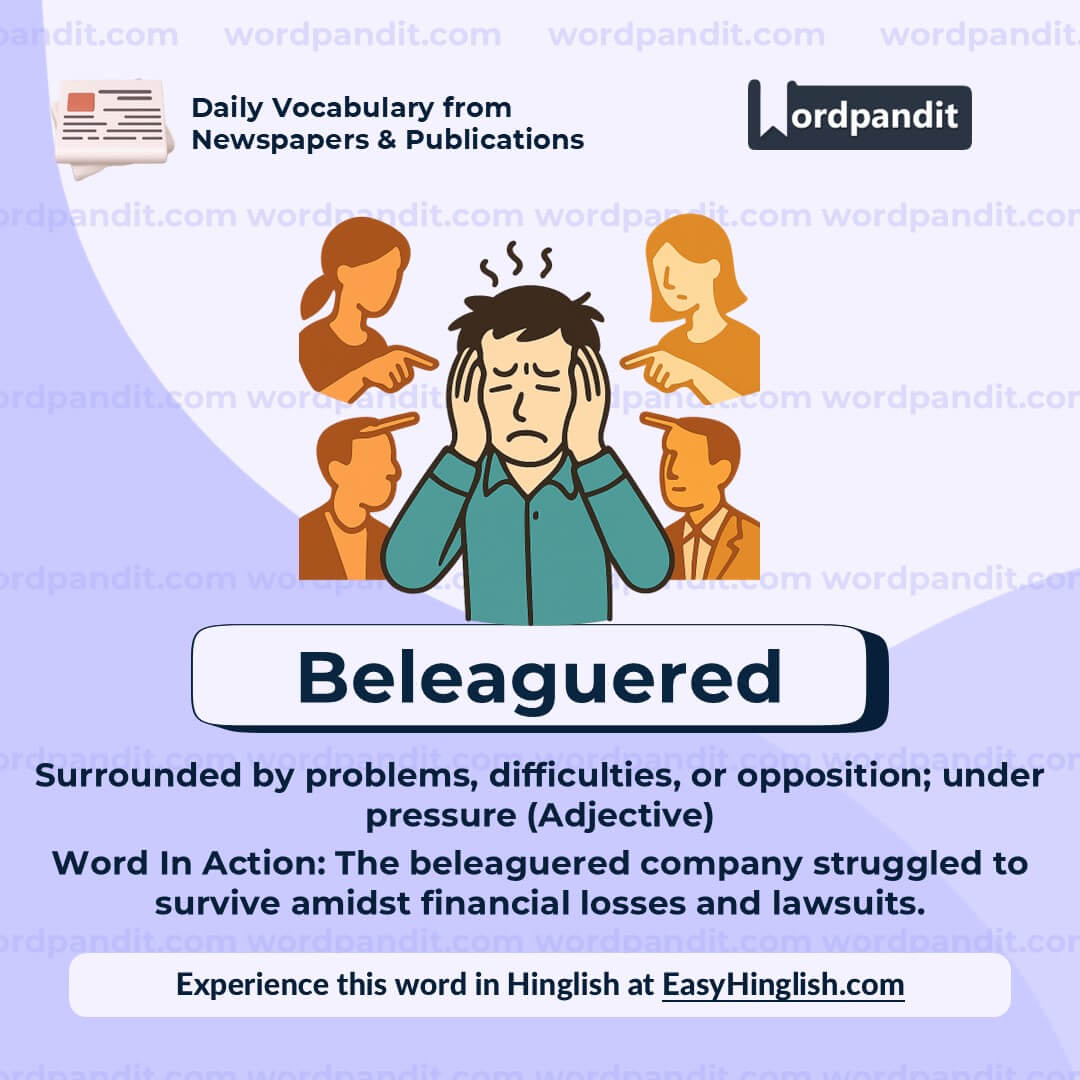
WORD-4: Beleaguered
Context:
"Intel is struggling financially and technologically, hence called 'beleaguered.'" - Economic Times
Explanatory Paragraph:
The word beleaguered is used to describe someone or something that is under persistent difficulty, pressure, or trouble. Originally meaning “surrounded by enemies” in a military sense, today it is often used figuratively for companies, people, or institutions that are weighed down by challenges, criticism, or crises.
Meaning: Surrounded by problems, difficulties, or opposition; under pressure (Adjective)
Pronunciation: bih-lee-gurd
Difficulty Level: ⭐⭐⭐⭐ (Advanced)
Etymology: From Dutch belegeren, meaning "to besiege," linked to the military sense of surrounding a place with armed forces.
Prashant Sir's Notes:
"Beleaguered" is a powerful adjective. Think of a fortress under siege, constantly attacked from all sides. In modern writing, it often describes struggling companies, politicians facing scandals, or individuals overwhelmed by problems.
Synonyms & Antonyms:
Synonyms: besieged, troubled, harassed, embattled, burdened
Antonyms: thriving, prosperous, flourishing, untroubled
Usage Examples:
- The beleaguered company announced another round of layoffs in an attempt to survive the downturn.
- After weeks of scandal, the beleaguered politician finally resigned.
- The small town was beleaguered by repeated floods and natural disasters.
- The coach stood by his beleaguered team, offering encouragement despite constant losses.
Cultural Reference:
"During World War II, several European cities were described as 'beleaguered' as they were literally under siege, cut off from supplies and surrounded by enemy forces." - Historical Reference
Think About It:
Why do you think words with military origins like "beleaguered" are often used in business and politics today? Does it change how we perceive challenges?
Quick Activity:
Write two short headlines using the word "beleaguered"—one about a company and one about a person in public life.
Memory Tip:
Link "beleaguered" to "be-league-red": imagine a football team (league) surrounded and struggling, with the scoreboard flashing red because they’re losing badly.
Real-World Application:
In journalism, "beleaguered" is a favorite adjective to describe struggling companies, troubled leaders, or crisis-hit nations. It conveys both difficulty and a sense of being surrounded by problems.
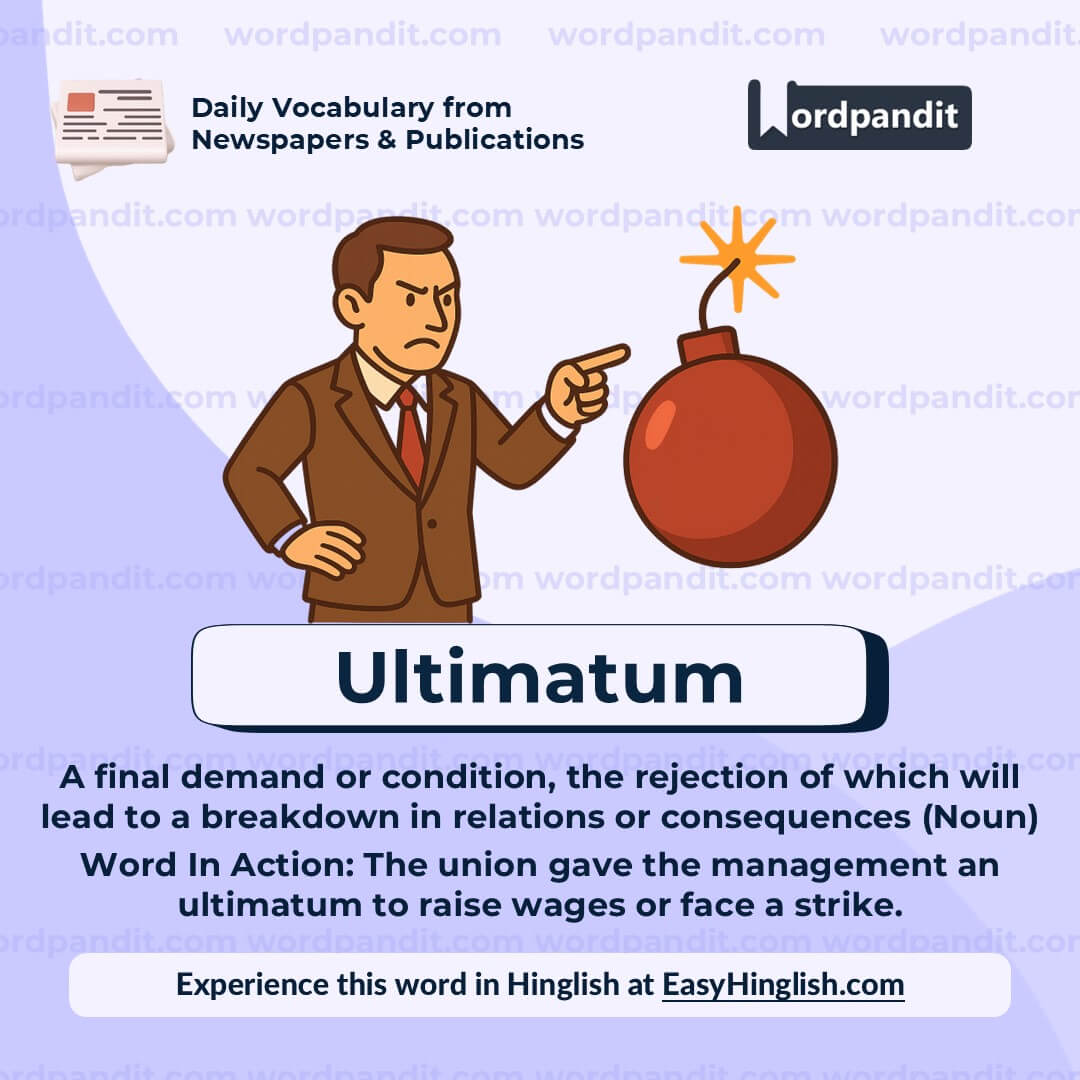
WORD-5: Ultimatum
Context:
"The CEC issued an ultimatum to the LoP — either provide a sworn affidavit or apologise." - Economic Times
Explanatory Paragraph:
An ultimatum is a final demand or statement of terms, often given with the implication that failure to comply will result in negative consequences. It is usually strict, non-negotiable, and signals that no further discussion will take place unless the demand is met. In politics, business, or even personal life, an ultimatum is a way of putting strong pressure on the other party to act.
Meaning: A final demand or condition, the rejection of which will lead to a breakdown in relations or consequences (Noun)
Pronunciation: ul-tuh-may-tum
Difficulty Level: ⭐⭐ (Basic to Intermediate)
Etymology: From Latin ultimatum, meaning "final," derived from ultimus ("last").
Prashant Sir's Notes:
An ultimatum is like the last card someone plays — a final "do this or else" condition. It often carries a sense of threat or finality. Remember: when you hear "ultimatum," think of the last possible offer before a conflict escalates.
Synonyms & Antonyms:
Synonyms: final demand, decree, order, command, condition
Antonyms: request, proposal, suggestion, option
Usage Examples:
- The workers gave management an ultimatum: improve safety standards or face a strike.
- The teacher issued an ultimatum to the noisy class — settle down or lose break time.
- The government delivered an ultimatum to the rebels to surrender within 48 hours.
- She gave her friend an ultimatum — stop spreading rumors or end the friendship.
Cultural Reference:
"Ultimatums are common in international diplomacy, where one country demands compliance from another under threat of sanctions or war. For example, before World War I, Austria-Hungary issued an ultimatum to Serbia." - History Reference
Think About It:
Do ultimatums strengthen negotiations by forcing decisions, or do they harm relationships by removing room for dialogue?
Quick Activity:
Write one humorous ultimatum you could give a friend (e.g., "Share your fries or I won’t talk to you for an hour!").
Memory Tip:
Think of "ultimatum" as "ultimate demand" — the very last step before consequences follow.
Real-World Application:
Ultimatums are widely used in diplomacy, law, labor negotiations, and even personal relationships. They signify a turning point where decisions must be made quickly and seriously.


