

Daily Vocabulary from Indian Newspapers and Publications
Welcome to Wordpandit’s Indian Vocabulary Hub
At Wordpandit, we understand the importance of staying rooted in the local context while expanding your language skills. This section focuses on enriching your vocabulary with words and phrases drawn from India’s leading newspapers and publications, ensuring you're learning vocabulary that is practical, relevant, and uniquely Indian.
Why Indian Sources Matter
We believe that the best way to master any language is by immersing yourself in local content. That’s why we carefully curate vocabulary from top Indian publications, including:
- The Hindu
- The Times of India
- The Economic Times
- Hindustan Times
- Live Mint
- The Indian Express
- And many others...
Stay Updated, Stay Relevant
With daily updates from Indian news sources, you’ll be consistently learning words that reflect the trends and shifts in Indian society and culture. Our focus is to provide vocabulary that enhances your understanding of the language in an Indian context.
How Wordpandit Supports Your Goals
Whether you’re preparing for exams, aiming to improve your professional communication, or simply want to stay connected with the latest Indian vocabulary, Wordpandit is here to guide you every step of the way.
Learn with a Practical Approach
Our interactive learning methodology includes real-world examples, engaging activities, and context-specific usage to ensure that every word becomes part of your active vocabulary.
Dive into Indian Vocabulary Today!

Why Choose Wordpandit?
Practical Learning: Focus on words you'll actually encounter in real-world reading, enhancing your comprehension and communication skills.
Diverse Content: From current affairs to scientific breakthroughs, our varied sources expose you to vocabulary across multiple domains.
Effortless Integration: Make Wordpandit a part of your daily routine. Just a few minutes each day can significantly boost your lexicon over time.
Your Path to Vocabulary Mastery
- Visit our Daily Vocabulary section regularly
- Explore new words and their usage in context
- Practice incorporating these words into your own writing and speech
- Track your progress as your vocabulary expands
Start Your Journey Today
Embark on your vocabulary enhancement journey with Wordpandit. By consistently engaging with our daily posts, you'll build a robust vocabulary that serves you well in academic, professional, and personal contexts.
Remember, a word a day keeps linguistic limitations at bay. Make Wordpandit your daily companion in the quest for vocabulary excellence!
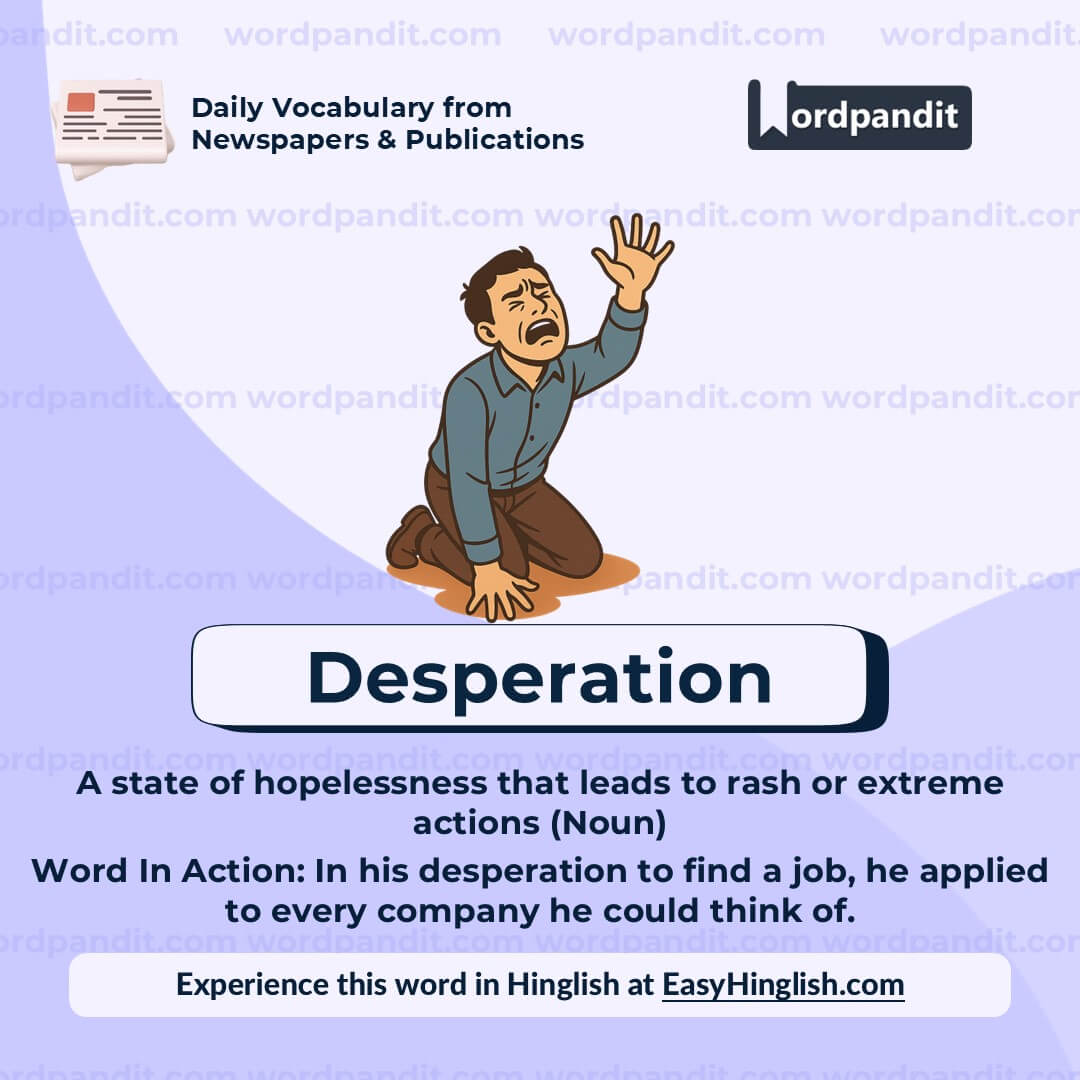
WORD-1: Desperation
Context:
"Many enterprising Indians have left the shores of Gujarat over the centuries in search of fortune and opportunity. India of the 2020s is, however, making them leave in desperation." - Indian Express
Explanatory Paragraph:
Desperation is a strong feeling of hopelessness that pushes people to act in ways they normally wouldn’t. It arises when people feel cornered or see no other way out. For instance, someone might leave their home country not just for better prospects, but because their situation has become so unbearable that any change seems better than staying. In the quote above, the word "desperation" suggests that individuals are leaving not out of excitement, but out of necessity and despair.
Meaning: A state of hopelessness that leads to rash or extreme actions (Noun)
Pronunciation: des-puh-RAY-shun
Difficulty Level: ⭐⭐ Basic
Etymology: From Latin *desperare*, meaning "to lose hope", which came through Old French into English.
Prashant Sir's Notes:
Desperation is not just about being sad—it's about the intensity of being stuck or trapped. Look for how people’s decisions change when they’re desperate—this can be a powerful tool to understand character motivations in stories or even societal trends.
Synonyms & Antonyms:
Synonyms: hopelessness, despair, anguish, distress, misery
Antonyms: hope, confidence, optimism, assurance, contentment
Usage Examples:
- In a moment of desperation, she sold her wedding ring to buy medicine for her child.
- He spoke with the desperation of someone who had run out of time and options.
- The rising unemployment rates have led to a sense of desperation among the youth.
- Desperation can drive people to make reckless decisions they later regret.
Cultural Reference:
"Desperation is sometimes as powerful an inspiration as genius." - Benjamin Disraeli
Think About It:
Can desperation ever be a productive force, or does it always lead to poor decisions?
Quick Activity:
Write down a situation (real or imagined) where someone makes a bold decision out of desperation. What are the consequences?
Memory Tip:
Think of "Desperate Housewives" – the TV show title hints at characters driven by intense emotions and hopeless situations.
Real-World Application:
Understanding "desperation" helps in analyzing migration patterns, financial decisions, or even political movements where people act under pressure with limited choices.

WORD-2: Shores
Context:
"Many enterprising Indians have left the shores of Gujarat over the centuries in search of fortune and opportunity. India of the 2020s is, however, making them leave in desperation." - Indian Express
Explanatory Paragraph:
The word "shores" literally refers to the land bordering a sea, ocean, or large body of water. In the context of this sentence, however, "shores" is used figuratively to mean the homeland or native country—specifically Gujarat, a coastal region in India. When someone “leaves the shores,” it often implies migration or departure from one’s native land, often across seas or borders.
Meaning: The land along the edge of a sea, lake, or other large body of water (Noun, plural)
Pronunciation: shorz
Difficulty Level: ⭐ Basic
Etymology: From Old English *scor*, meaning "coast, land bordering a sea"; related to Old Norse *skor*.
Prashant Sir's Notes:
Notice how "shores" can be both literal and metaphorical. It's a powerful image in literature and news, symbolizing leaving home or venturing into the unknown. Look out for such symbolic use—it often carries emotional or cultural weight.
Synonyms & Antonyms:
Synonyms: coast, beach, waterfront, seashore, bank
Antonyms: inland, interior, center, heartland
Usage Examples:
- They walked along the quiet shores, listening to the gentle waves.
- Many immigrants left the shores of their homeland in search of a better life.
- Storms battered the eastern shores throughout the week.
- The ship finally reached the shores of a distant land.
Cultural Reference:
"Give me your tired, your poor, your huddled masses yearning to breathe free… I lift my lamp beside the golden door!" — from the poem inscribed at the base of the Statue of Liberty, symbolizing the welcoming of immigrants to American shores.
Think About It:
Why do you think writers and poets often use the word “shores” instead of just “land” or “country”?
Quick Activity:
Write two sentences using “shores”—one literal (geographic) and one metaphorical (symbolic). Share with a classmate or teacher.
Memory Tip:
Imagine standing on the edge of a beach—the **shore** is the **edge** of where land meets sea. Think: *"Surely the shore is where the sea ends."*
Real-World Application:
“Shores” is commonly used in discussions around migration, geography, climate impact (coastal erosion), and tourism. It appears frequently in literature and speeches about national identity or exploration.
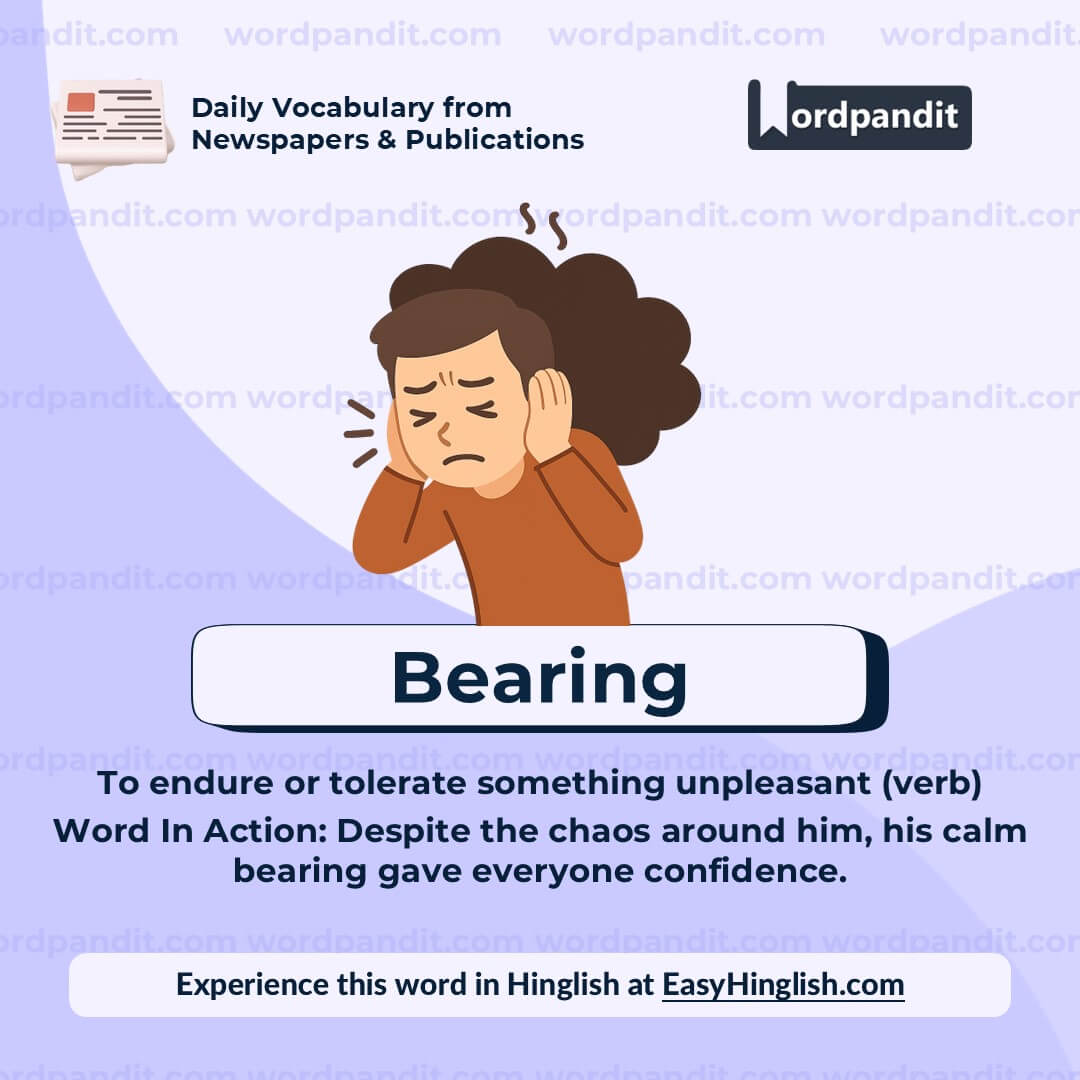
WORD-3: Bearing
Context:
"If desperate Indians are jumping ship and bearing ordeals in search of decent livelihood, the country’s wealthy, the so-called “high net worth individuals” (HNIs), are buying golden visas to settle overseas." - Indian Express
Explanatory Paragraph:
The word "bearing" in this context refers to enduring or tolerating something difficult, such as hardships or ordeals. It implies the ability or willingness to carry a burden or go through unpleasant experiences without giving up. It’s often used to describe emotional or physical resilience in challenging situations.
Meaning: To endure or tolerate something unpleasant (verb)
Pronunciation: BAIR-ing
Difficulty Level: ⭐⭐ Beginner
Etymology: From Old English "beran," meaning "to carry," related to the Proto-Germanic "beranan."
Prashant Sir's Notes:
"Bearing" is often used to express emotional strength and resilience. Think of it as carrying something heavy — whether it’s pain, responsibility, or burden. It’s also a word that shows up in many idioms and fixed phrases, so watch out for contextual meanings.
Synonyms & Antonyms:
Synonyms: endure, tolerate, withstand, brave, stomach
Antonyms: resist, reject, avoid, surrender, escape
Usage Examples:
- She bore the pain of the injury without shedding a tear.
- They are bravely bearing the financial losses after the pandemic.
- He could no longer bear the constant criticism from his peers.
- Bearing such a heavy responsibility at a young age made her mature quickly.
Cultural Reference:
"We must accept finite disappointment, but never lose infinite hope." — Martin Luther King Jr. This quote captures the essence of bearing pain and disappointment while maintaining strength and hope. - Civil Rights Era Reference
Think About It:
What is one difficult experience in your life that you had to bear, and how did it change you?
Quick Activity:
Write two sentences using "bearing" — one where it refers to emotional endurance, and another where it refers to a physical burden.
Memory Tip:
Think of a bear carrying a heavy load on its back — if a bear can bear it, so can you! The image will help you link “bearing” with “carrying” or “enduring.”
Real-World Application:
"Bearing" is frequently used in both formal and informal conversations, especially when discussing emotional strength, hardship, or patience. It appears in newspapers, novels, motivational talks, and everyday discussions about challenges in life.
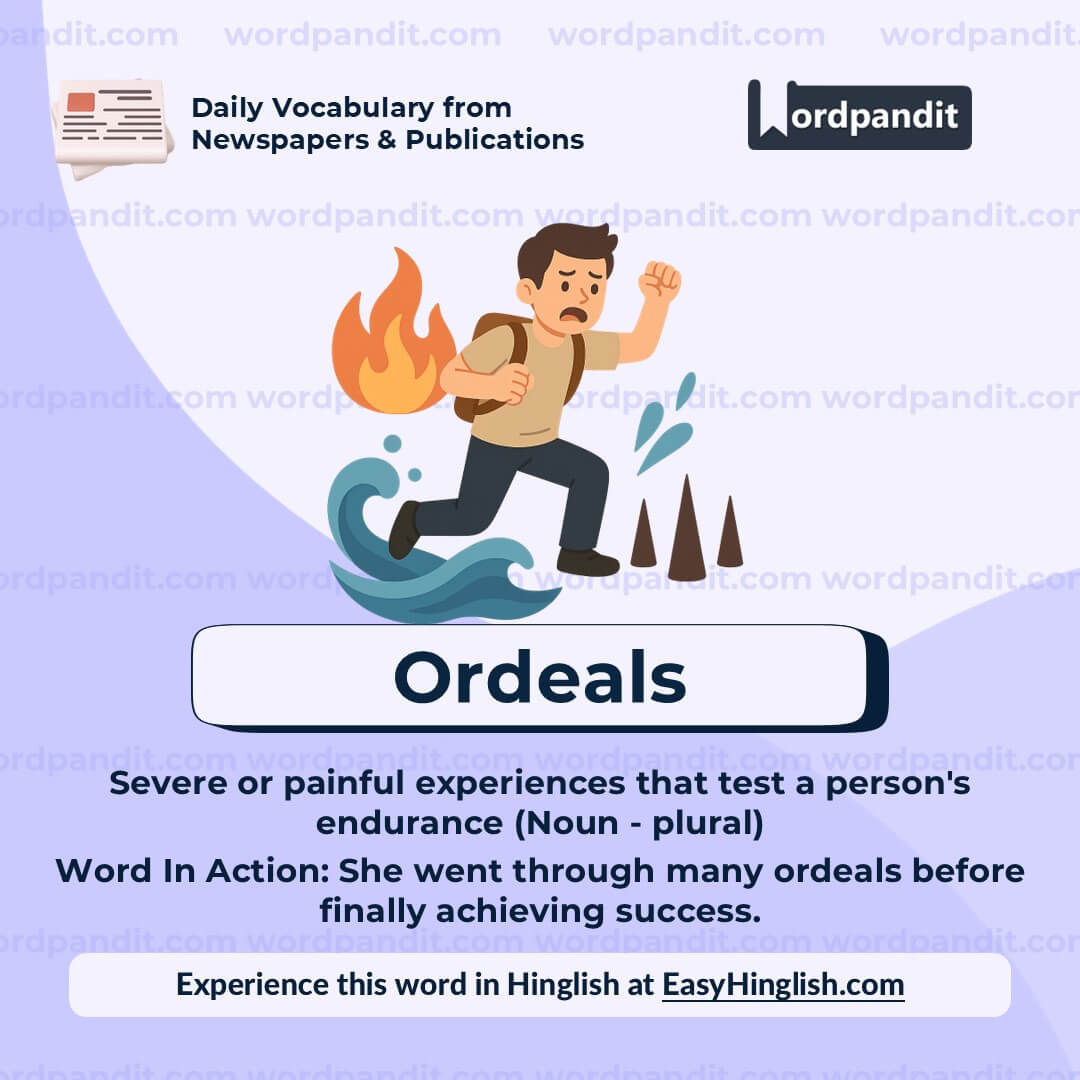
WORD-4: Ordeals
Context:
"If desperate Indians are jumping ship and bearing ordeals in search of decent livelihood, the country’s wealthy, the so-called “high net worth individuals” (HNIs), are buying golden visas to settle overseas." - Indian Express
Explanatory Paragraph:
The word "ordeals" refers to very difficult or painful experiences that test a person’s strength, patience, or courage. In the given sentence, it emphasizes the hardships and suffering that people are enduring while trying to find a better life. These ordeals could include long travel, dangerous working conditions, discrimination, or even being separated from family. The use of "ordeals" adds weight to the emotional and physical toll behind migration.
Meaning: Severe or painful experiences that test a person's endurance (Noun - plural)
Pronunciation: or-DEELS
Difficulty Level: ⭐⭐ Basic
Etymology: From Old English *ordāl*, originally referring to an ancient practice of judgment by painful trial (like walking over fire); evolved to mean any severe test or trial.
Prashant Sir's Notes:
"Ordeals" is a strong word that adds intensity to any situation. When you use this word, you're highlighting not just a challenge, but one that deeply affects or tests someone. It’s especially useful in storytelling, journalism, or essays on resilience and survival.
Synonyms & Antonyms:
Synonyms: hardship, trial, suffering, agony, tribulation
Antonyms: comfort, relief, pleasure, ease, blessing
Usage Examples:
- Surviving the long winter without food was one of the worst ordeals they had ever faced.
- The refugee described her ordeal of crossing the border on foot for three days.
- He went through the ordeal of multiple surgeries and months of recovery.
- Public speaking was always an ordeal for her, despite years of practice.
Cultural Reference:
The term “trial by ordeal” was a medieval judicial practice where innocence was tested by subjecting a person to painful experiences—like holding hot iron or being thrown into water. Surviving meant divine approval.
Think About It:
Do modern societies still subject people to "ordeals," even if they are no longer physical? What might these look like?
Quick Activity:
Write a list of three situations—one personal, one social, and one historical—that could be described as ordeals. Explain why.
Memory Tip:
Think of "ordeal" as a deal with pain—*or*-deal = *"oh really? that deal?"* —a sarcastic take on facing something tough.
Real-World Application:
"Ordeals" is often used in news reports, biographies, and documentaries to describe personal or collective hardship. It's helpful in academic writing and real-life storytelling to express serious struggle.
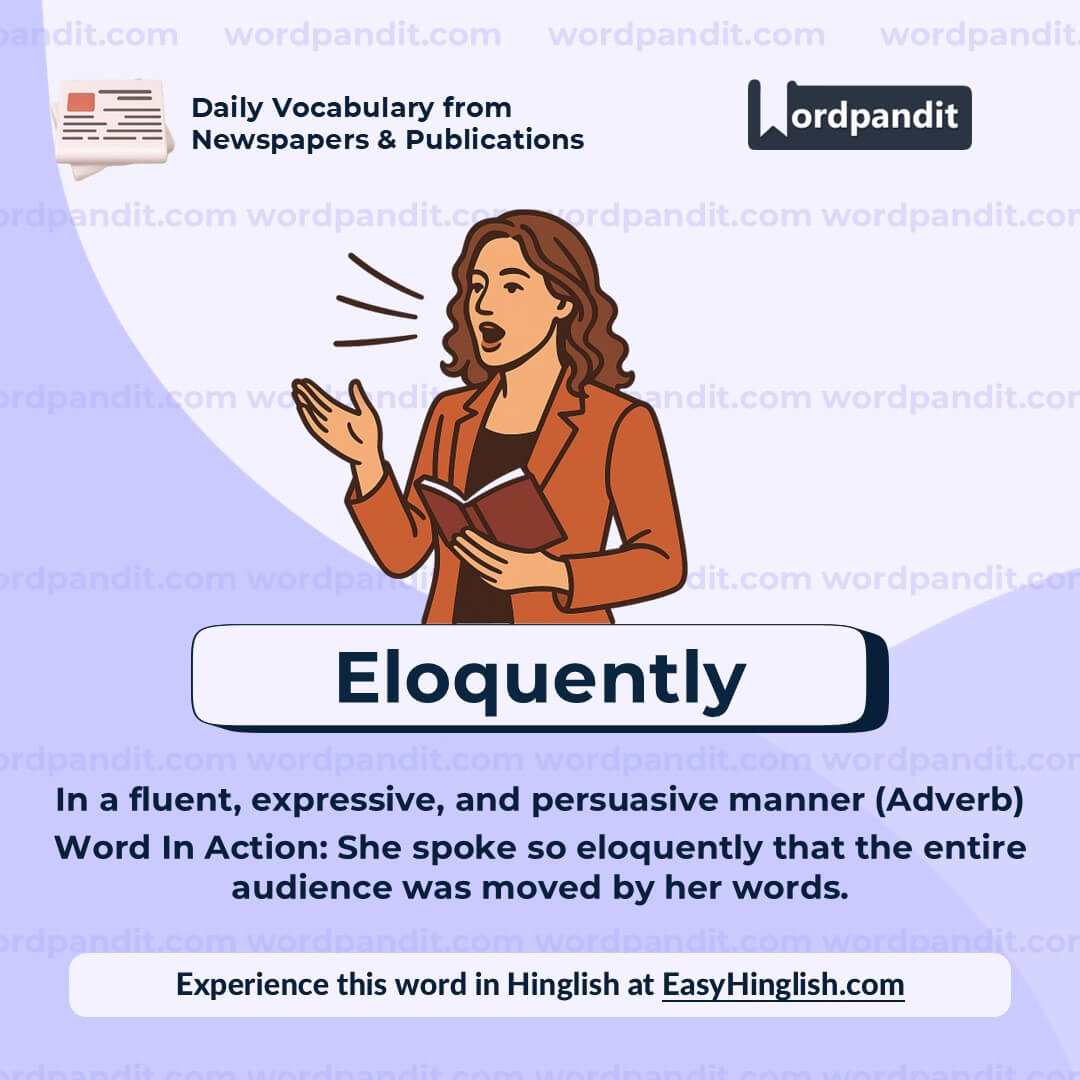
WORD-5: Eloquently
Context:
"Time was when Indians complained about enforced migration. Novelists and historians have written eloquently about the fate of 'indentured labour', lured from their villages with the false promise of a better life and then pushed into slavery and drudgery. That was British India." - Indian Express
Explanatory Paragraph:
"Eloquently" describes the manner in which someone expresses their thoughts or emotions—clearly, effectively, and often beautifully. When someone writes or speaks eloquently, their words move people, evoke emotion, and bring clarity to complex issues. In the context above, it highlights how deeply and powerfully writers have portrayed the tragic lives of indentured labourers, helping readers feel the pain and injustice through compelling language.
Meaning: In a fluent, expressive, and persuasive manner (Adverb)
Pronunciation: EL-oh-kwuhnt-lee
Difficulty Level: ⭐⭐⭐ Intermediate
Etymology: From Latin *eloquentia*, meaning "fluency, speaking out"; from *eloqui* ("to speak out").
Prashant Sir's Notes:
Don’t confuse “eloquently” with “elaborately.” Eloquence is about impact, not length. When someone expresses a deep truth with few words that move others—that’s eloquence. It's a powerful tool for writers, leaders, and public speakers.
Synonyms & Antonyms:
Synonyms: articulately, persuasively, expressively, fluently, gracefully
Antonyms: awkwardly, inarticulately, clumsily, haltingly, vaguely
Usage Examples:
- She spoke eloquently about the importance of mental health awareness.
- The documentary eloquently captures the struggles of rural communities.
- He eloquently defended his position during the debate, winning over many skeptics.
- The poet eloquently described the beauty of a setting sun over the Himalayas.
Cultural Reference:
Barack Obama was often praised for speaking eloquently in his public addresses, especially his 2008 victory speech, which inspired millions through both content and delivery.
Think About It:
Is being eloquent more about vocabulary, structure, emotion, or clarity? Which do you value most in communication?
Quick Activity:
Write 2–3 sentences describing your hometown eloquently—use emotional or vivid language to connect with the reader.
Memory Tip:
Think: *“Eloquent” = Elegant + Fluent* — when someone speaks with elegance and fluency, they do it *eloquently*.
Real-World Application:
"Eloquently" is useful in describing public speeches, powerful writing, film narration, storytelling, and formal communication. It’s often used in reviews, news articles, and academic analysis to praise expressive skill.


