

Daily Vocabulary from International Newspapers and Publications
Expand Your Vocabulary with Wordpandit’s Global Vocabulary Hub
At Wordpandit, we are committed to helping you develop a truly global vocabulary by drawing from some of the most respected international publications. This section is designed to keep you ahead of the curve by introducing you to words that define global conversations and trends.
The Power of Global Sources
To help you think and communicate on a global scale, we curate vocabulary from renowned international sources, such as:
- The New York Times
- The Washington Post
- BBC
- The Guardian
- The Economist
- Scientific American
- Psychology Today
- And many more...
Stay Global, Stay Competitive
Our daily updates from international publications ensure you are consistently exposed to new words that reflect global news and developments, making sure your vocabulary is not only current but also globally relevant.
Enhance Your Global Perspective
Whether you’re preparing for international exams, aiming to excel in global business communication, or want to enhance your language skills for personal growth, Wordpandit offers the resources you need to thrive in a global context.
Effective Learning, Global Reach
Our learning methodology combines global examples, memory aids, and interactive activities, allowing you to internalize new words effectively and apply them in real-world scenarios.
Begin Your Global Vocabulary Journey Now!

Why Choose Wordpandit?
Practical Learning: Focus on words you'll actually encounter in real-world reading, enhancing your comprehension and communication skills.
Diverse Content: From current affairs to scientific breakthroughs, our varied sources expose you to vocabulary across multiple domains.
Effortless Integration: Make Wordpandit a part of your daily routine. Just a few minutes each day can significantly boost your lexicon over time.
Your Path to Vocabulary Mastery
- Visit our Daily Vocabulary section regularly
- Explore new words and their usage in context
- Practice incorporating these words into your own writing and speech
- Track your progress as your vocabulary expands
Start Your Journey Today
Embark on your vocabulary enhancement journey with Wordpandit. By consistently engaging with our daily posts, you'll build a robust vocabulary that serves you well in academic, professional, and personal contexts.
Remember, a word a day keeps linguistic limitations at bay. Make Wordpandit your daily companion in the quest for vocabulary excellence!
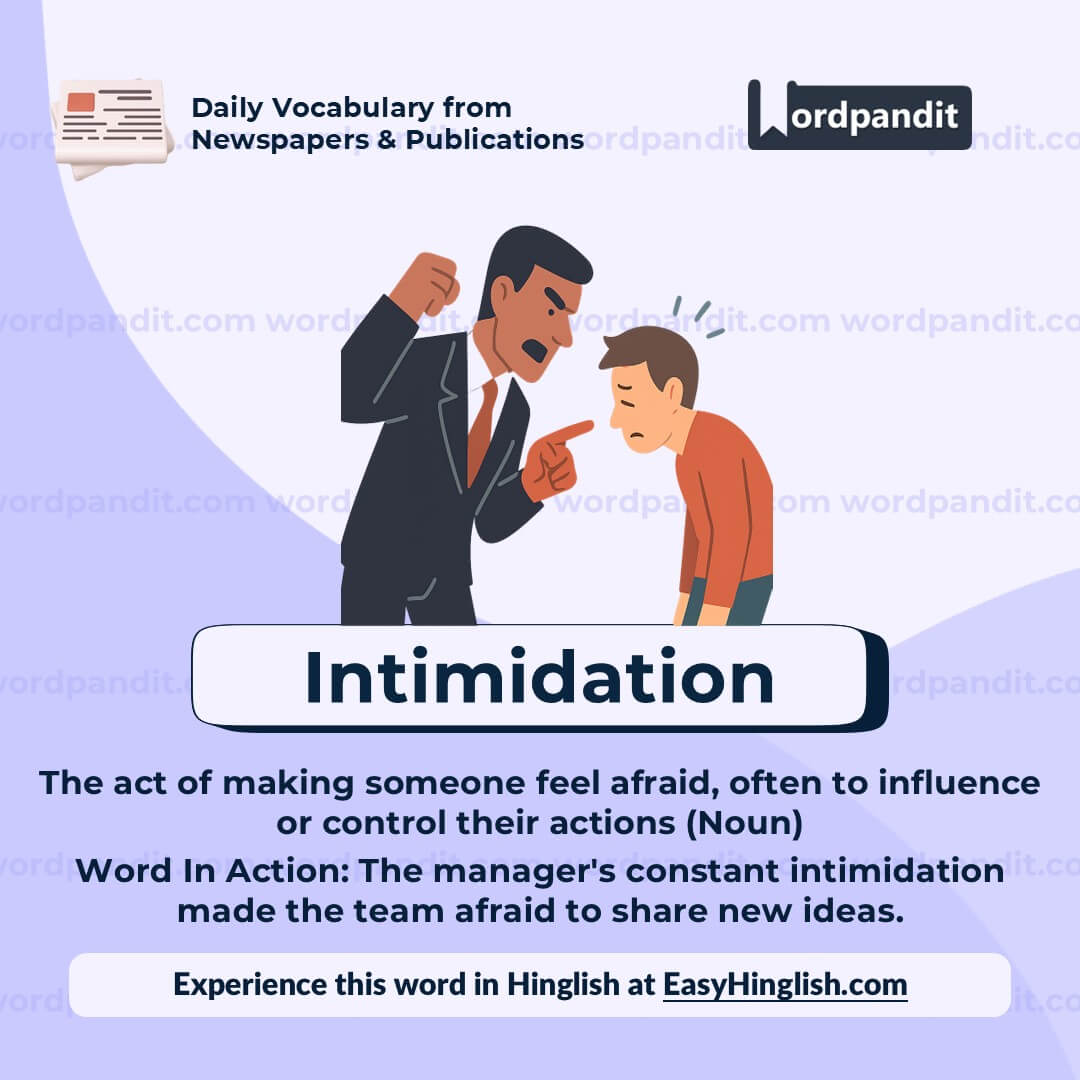
WORD-1: Intimidation
Context:
"Chutkan’s gag order tried to balance Trump’s First Amendment rights to assail the prosecution with the need to protect witnesses and court personnel from intimidation and potential violence." - Washington Post
Explanatory Paragraph:
The word intimidation refers to the act of frightening or threatening someone in order to control their behavior, silence them, or force them to act in a certain way. It often carries a sense of fear, pressure, or coercion being applied to others, either through words, actions, or implied threats.
Meaning: The act of making someone feel afraid, often to influence or control their actions (Noun)
Pronunciation: in-tih-muh-DAY-shun
Difficulty Level: ⭐⭐ (Basic to Intermediate)
Etymology: Derived from the Latin word "intimidare," meaning "to frighten," which combines "in-" (into) and "timidus" (fearful).
Prashant Sir's Notes:
This word is commonly used in legal, political, and workplace settings. Remember that intimidation is not just physical—it can be verbal, psychological, or even social pressure. Connect it with situations where fear is used as a tool of control.
Synonyms & Antonyms:
Synonyms: bullying, threatening, coercion, harassment, pressure
Antonyms: encouragement, reassurance, support, comfort
Usage Examples:
- The employee filed a complaint after facing repeated intimidation from her manager.
- The team remained calm despite the crowd’s loud intimidation tactics.
- Leaders must ensure that intimidation is not used as a means of silencing dissent.
- He tried to hide his fear, refusing to yield to intimidation.
Cultural Reference:
"Fear is the main source of superstition, and one of the main sources of cruelty. To conquer fear is the beginning of wisdom." - Bertrand Russell (on how fear and intimidation shape human behavior)
Think About It:
Why do you think intimidation is often more effective than actual violence in controlling people’s actions?
Quick Activity:
Write down two scenarios: one where intimidation is used in a positive sense (e.g., a sports opponent feeling intimidated by skill) and one where it is used negatively (e.g., workplace bullying).
Memory Tip:
Think of "timid" (shy or fearful). Intimidation makes others feel timid—scared or powerless.
Real-World Application:
Intimidation is often discussed in legal cases, politics, and workplace relations. Understanding this word helps in recognizing and addressing unfair power dynamics, whether in schools, offices, or larger social structures.
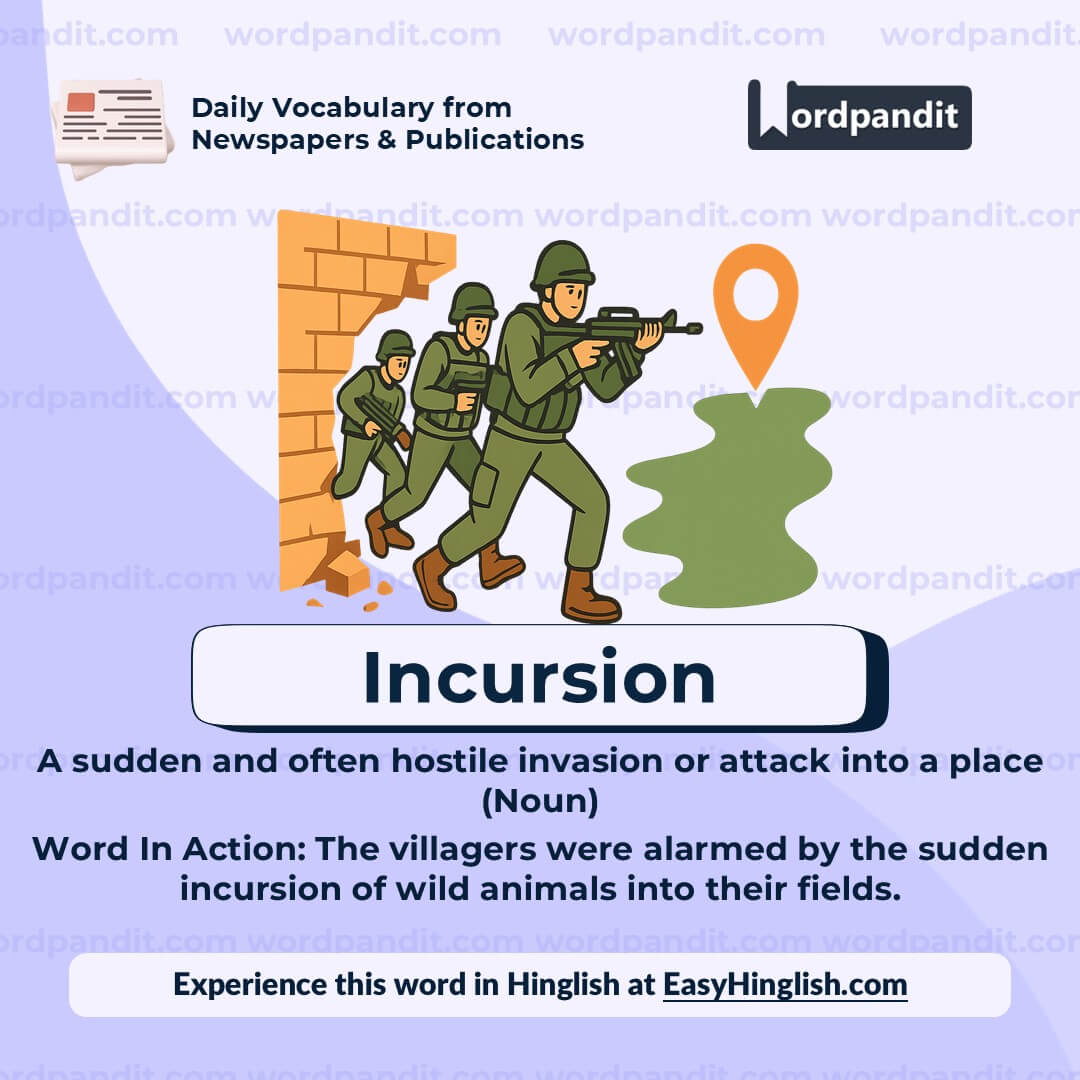
WORD-2: Incursion
Context:
"The incident marks a significant escalation, as it represents Israel’s deepest incursion into Lebanese territory since 8 October and its most significant attack since July 2006." - Guardian
Explanatory Paragraph:
The word incursion refers to a sudden, brief, or hostile entry into a place, usually by military forces but sometimes used metaphorically for any unwelcome intrusion. It suggests crossing a boundary without permission, often linked with aggression, invasion, or disruption.
Meaning: A sudden and often hostile invasion or attack into a place (Noun)
Pronunciation: in-KUR-shun
Difficulty Level: ⭐⭐⭐ (Intermediate)
Etymology: From Latin "incurrere" meaning "to run into" or "invade," formed from "in-" (into) + "currere" (to run).
Prashant Sir's Notes:
Think of incursion as a softer word than “invasion.” It may be temporary or tactical. The word is common in military and political news but can also describe metaphorical invasions, like “a technological incursion into daily life.”
Synonyms & Antonyms:
Synonyms: invasion, raid, intrusion, attack, assault
Antonyms: retreat, withdrawal, defense, exit
Usage Examples:
- The soldiers carried out a brief incursion across the border before retreating.
- Many locals viewed the company’s expansion as an incursion into their traditional way of life.
- The hacker’s incursion into the bank’s database caused widespread panic.
- The protest was seen as an incursion into the usually calm political climate of the city.
Cultural Reference:
In history, the Viking incursions into England during the 9th century reshaped politics, trade, and culture, showing how short but aggressive entries can change societies.
Think About It:
When does a brief incursion cross the line and become a full-scale invasion? How do words shape our perception of conflict?
Quick Activity:
Write one military example and one metaphorical example of “incursion” in two different sentences to reinforce its dual usage.
Memory Tip:
Think of “incursion” as “in + rush in.” It’s someone or something rushing into your space without welcome.
Real-World Application:
The term is widely used in international news to describe border conflicts, military actions, or cyberattacks. In daily contexts, it can also describe intrusions into privacy, culture, or traditions.
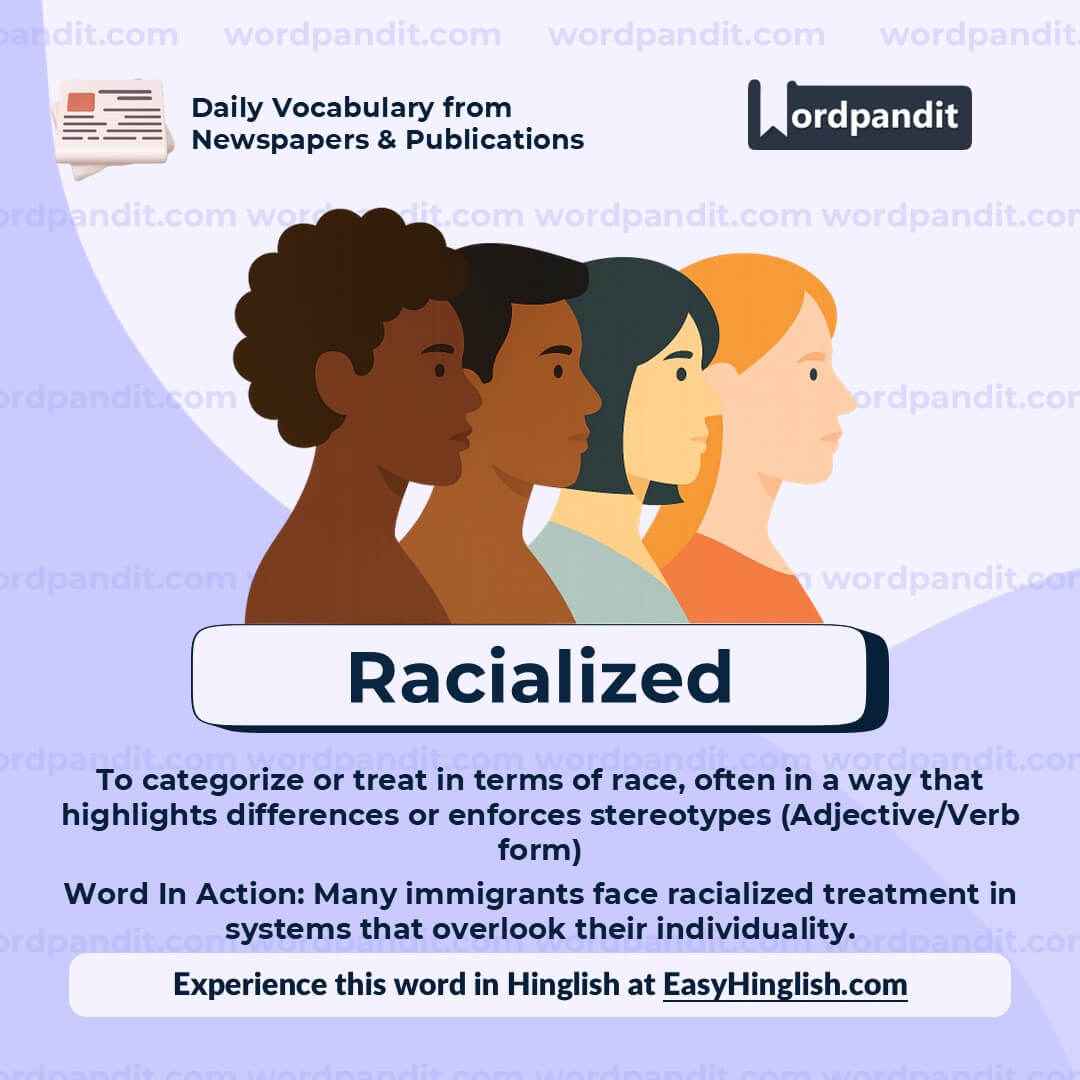
WORD-3: Racialized
Context:
"D.E.I. is “bad” because it supplants merit for diversity and it empowers the racialized federal government to stick its hands into an institution that produces the cultural elite." - New York Times
Explanatory Paragraph:
The word racialized refers to the process or condition of being defined, categorized, or treated in terms of race. It highlights how social, political, or institutional systems assign racial meaning or significance to people, groups, or even government institutions, often resulting in stereotypes, discrimination, or systemic inequalities.
Meaning: To categorize or treat in terms of race, often in a way that highlights differences or enforces stereotypes (Adjective/Verb form)
Pronunciation: RAY-shuh-lized
Difficulty Level: ⭐⭐⭐ (Intermediate)
Etymology: Derived from “racial” (pertaining to race) + “-ize” (to make or cause to be) + “-ed” (past participle form). The term developed in modern sociological and cultural studies.
Prashant Sir's Notes:
This word is often used in academic, political, and social justice discussions. It is important to note that “racialized” doesn’t just mean “about race”—it refers to a process where race becomes the defining lens, often leading to marginalization. Connect it with terms like “gendered” or “stereotyped.”
Synonyms & Antonyms:
Synonyms: categorized, stereotyped, labeled, discriminated, segregated
Antonyms: de-racialized, equalized, integrated, neutral
Usage Examples:
- Many immigrant communities have been racialized through unfair policies and media portrayals.
- The debate highlighted how certain professions become racialized in public perception.
- Social movements aim to challenge racialized systems of inequality.
- Describing crime in racialized terms can reinforce harmful stereotypes.
Cultural Reference:
Scholars in critical race theory often study how institutions and cultures are racialized—showing how concepts like law, education, or media are shaped by assumptions about race.
Think About It:
How does labeling a group as “racialized” change the way we understand both their challenges and society’s responsibility toward them?
Quick Activity:
Write two sentences: one showing how an individual can be racialized in everyday life, and another showing how an institution can be racialized.
Memory Tip:
Think: “racialized = made about race.” The suffix -ized signals that something is being turned into or defined by race.
Real-World Application:
The term “racialized” is widely used in discussions of policy, education, policing, and healthcare to describe systemic inequalities that arise when race becomes the central framework for categorizing people or institutions.
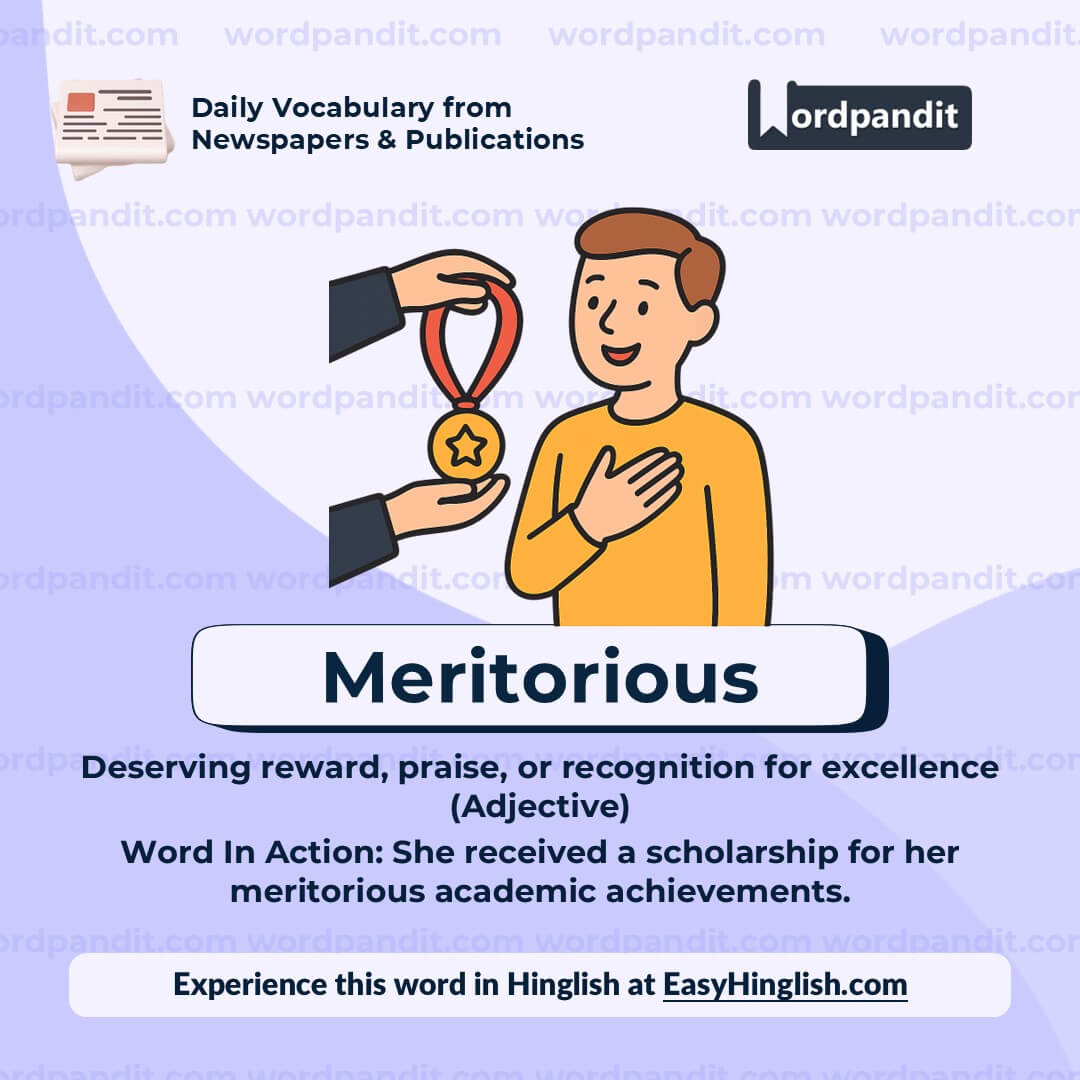
WORD-4: Meritorious
Context:
"Whether higher education is less meritorious now than it was in some unspecified past cannot be measured." - New York Times
Explanatory Paragraph:
The word meritorious describes something that is deserving of praise, reward, or recognition because of its value, quality, or worth. It often refers to actions, achievements, or qualities that are admirable and worthy of honor. In academic or professional settings, it is linked with fairness and excellence.
Meaning: Deserving reward, praise, or recognition for excellence (Adjective)
Pronunciation: mehr-ih-TOHR-ee-us
Difficulty Level: ⭐⭐ (Basic to Intermediate)
Etymology: From Latin "meritorius" meaning "earning wages, deserving," derived from "meritum" (merit, desert, worth).
Prashant Sir's Notes:
Whenever you see meritorious, think of “merit.” This word is used positively, often in formal or academic contexts—like meritorious service, meritorious performance, or meritorious student. It carries the sense of being earned through effort or ability.
Synonyms & Antonyms:
Synonyms: praiseworthy, commendable, admirable, worthy, creditable
Antonyms: undeserving, blameworthy, unworthy, dishonorable
Usage Examples:
- The soldier received a medal for his meritorious service in battle.
- She was recognized for her meritorious contributions to scientific research.
- The teacher praised the students for their meritorious efforts during the project.
- Not all hard work is equally meritorious; some stands out for its real impact.
Cultural Reference:
In many countries, civil servants and military personnel receive Meritorious Service Awards—formal honors given to individuals who perform duties above and beyond expectations.
Think About It:
Should society always reward meritorious actions, or are there cases where recognition is overlooked despite true merit?
Quick Activity:
Write down three qualities or actions in daily life that you think are meritorious but often go unnoticed (e.g., honesty, kindness, hard work).
Memory Tip:
Link meritorious with “merit” → if something has merit, it is meritorious, or worthy of praise.
Real-World Application:
The term is frequently used in academia, law, and public service to evaluate work, actions, or qualifications. For example, scholarships may be awarded on a meritorious basis, meaning based on ability and achievement rather than need or connections.
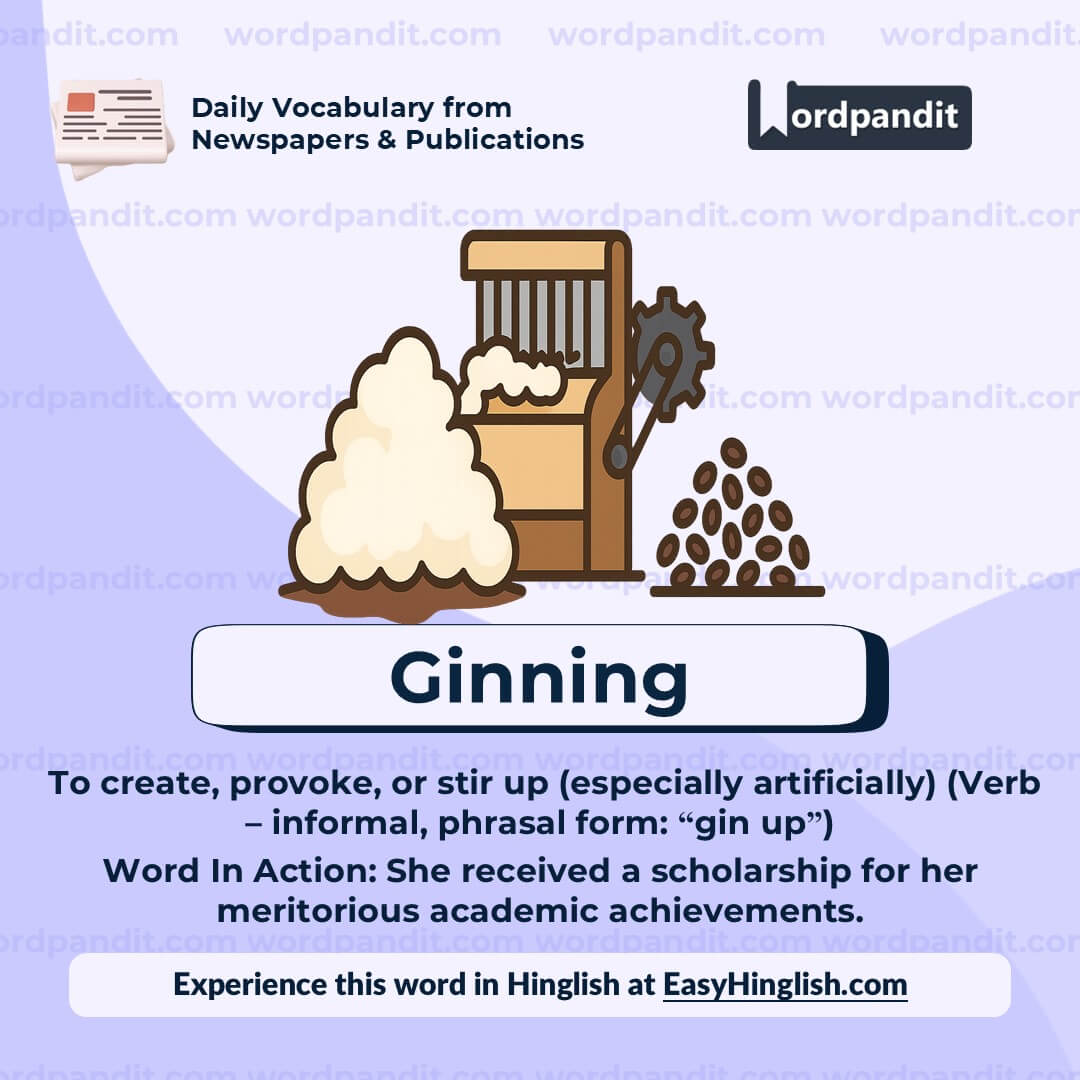
WORD-5: Ginning
Context:
"Rufo explained his plan for ginning up controversy about higher education’s most prestigious universities in an interview on the heels of Dr. Gay’s resignation, explaining that it was a coordinated, strategic attack that used narrative, financial and political leverage." - New York Times
Explanatory Paragraph:
The word ginning here comes from the informal phrase “gin up”, which means to stir up, generate, or create something—often artificially or with manipulation. It is commonly used when someone deliberately tries to provoke strong emotions, controversy, or excitement rather than letting them arise naturally.
Meaning: To create, provoke, or stir up (especially artificially) (Verb – informal, phrasal form: “gin up”)
Pronunciation: JIN-ing
Difficulty Level: ⭐⭐⭐ (Intermediate)
Etymology: Likely from the idea of a “gin” (a trap or snare) or “engine,” referring to contriving or manufacturing something. The expression “gin up” gained popularity in American English in the 19th–20th centuries.
Prashant Sir's Notes:
“Ginning up” is a very American idiom. Remember, it’s rarely neutral; it implies manufacturing excitement, outrage, or support, often with exaggeration. Think of it as “whipping up” emotions or controversy.
Synonyms & Antonyms:
Synonyms: stir up, whip up, provoke, incite, manufacture
Antonyms: calm down, suppress, defuse, settle
Usage Examples:
- The politician was accused of ginning up fear to win votes.
- Marketers often gin up excitement before a new product launch.
- She accused the media of ginning up controversy where none really existed.
- The coach tried ginning up team spirit before the final match.
Cultural Reference:
The phrase “gin up” is often heard in U.S. political commentary, where strategists are said to gin up outrage or gin up support among voters to influence elections.
Think About It:
Do you think ginning up controversy is ever justifiable—for example, if it draws attention to a real issue—or is it always manipulative?
Quick Activity:
Write two sentences using “gin up”: one in a political context and another in a personal/social context (like a party or event).
Memory Tip:
Think of “gin up” like “engine up”—you’re revving something artificially to create extra energy or noise.
Real-World Application:
“Ginning up” is often used in meSdia, politics, and marketing, where leaders, advertisers, or journalists deliberately stir emotions or controversy to gain attention, support, or influence public opinion.


