

Daily Vocabulary from Indian Newspapers and Publications
Welcome to Wordpandit’s Indian Vocabulary Hub
At Wordpandit, we understand the importance of staying rooted in the local context while expanding your language skills. This section focuses on enriching your vocabulary with words and phrases drawn from India’s leading newspapers and publications, ensuring you're learning vocabulary that is practical, relevant, and uniquely Indian.
Why Indian Sources Matter
We believe that the best way to master any language is by immersing yourself in local content. That’s why we carefully curate vocabulary from top Indian publications, including:
- The Hindu
- The Times of India
- The Economic Times
- Hindustan Times
- Live Mint
- The Indian Express
- And many others...
Stay Updated, Stay Relevant
With daily updates from Indian news sources, you’ll be consistently learning words that reflect the trends and shifts in Indian society and culture. Our focus is to provide vocabulary that enhances your understanding of the language in an Indian context.
How Wordpandit Supports Your Goals
Whether you’re preparing for exams, aiming to improve your professional communication, or simply want to stay connected with the latest Indian vocabulary, Wordpandit is here to guide you every step of the way.
Learn with a Practical Approach
Our interactive learning methodology includes real-world examples, engaging activities, and context-specific usage to ensure that every word becomes part of your active vocabulary.
Dive into Indian Vocabulary Today!

Why Choose Wordpandit?
Practical Learning: Focus on words you'll actually encounter in real-world reading, enhancing your comprehension and communication skills.
Diverse Content: From current affairs to scientific breakthroughs, our varied sources expose you to vocabulary across multiple domains.
Effortless Integration: Make Wordpandit a part of your daily routine. Just a few minutes each day can significantly boost your lexicon over time.
Your Path to Vocabulary Mastery
- Visit our Daily Vocabulary section regularly
- Explore new words and their usage in context
- Practice incorporating these words into your own writing and speech
- Track your progress as your vocabulary expands
Start Your Journey Today
Embark on your vocabulary enhancement journey with Wordpandit. By consistently engaging with our daily posts, you'll build a robust vocabulary that serves you well in academic, professional, and personal contexts.
Remember, a word a day keeps linguistic limitations at bay. Make Wordpandit your daily companion in the quest for vocabulary excellence!
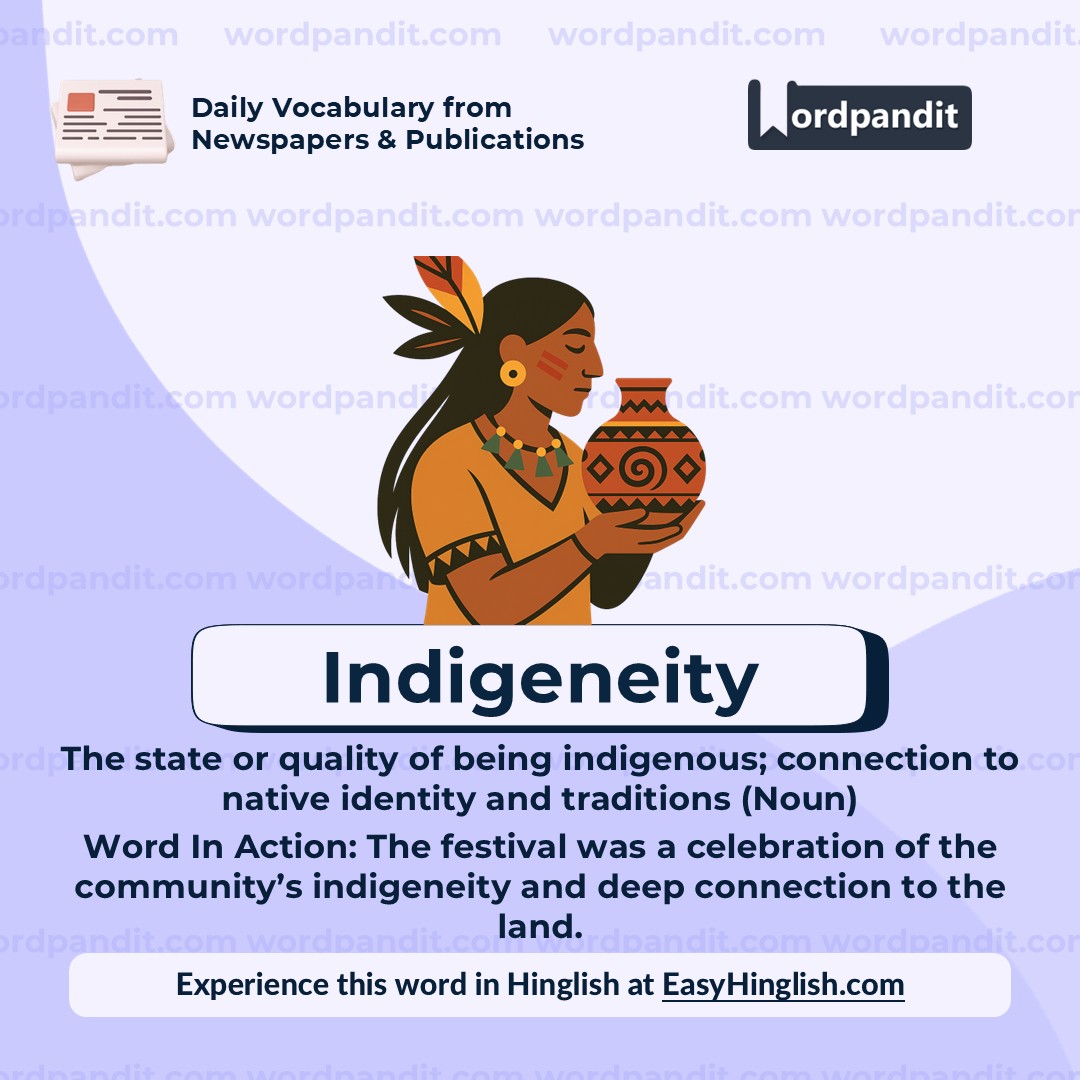
WORD-1: Indigeneity
Context:
"To appreciate why JPS and his brand of indigenous knowledge will be missed we only have to look at what passes in the name of indigeneity today." - Indian Express
Explanatory Paragraph:
Indigeneity refers to the condition, quality, or state of being indigenous. It highlights the cultural identity, traditions, and belonging of native people to their original lands. The word is often used in academic, political, and social contexts to recognize the unique heritage and rights of indigenous groups in contrast to outside or colonial influences.
Meaning: The state or quality of being indigenous; connection to native identity and traditions (Noun)
Pronunciation: in-di-jee-nee-uh-tee
Difficulty Level: ⭐⭐⭐⭐ Advanced
Etymology: Derived from the word "indigenous" (from Latin *indigenus* meaning "native, sprung from the land") with the suffix "-ity" to form an abstract noun.
Prashant Sir's Notes:
This word is often used in cultural studies and anthropology. It goes beyond just being "native" — it implies an identity rooted in history, traditions, and resistance to external dominance.
Synonyms & Antonyms:
Synonyms: nativeness, aboriginality, autochthony, cultural rootedness
Antonyms: foreignness, alienness, colonial identity, non-native
Usage Examples:
- Scholars often debate how indigeneity should be defined in a globalized world.
- The festival was a celebration of local indigeneity expressed through songs and rituals.
- Her research focuses on the indigeneity of tribal communities in Central India.
- Questions of indigeneity are central to discussions on land rights and cultural preservation.
Cultural Reference:
"Indigeneity is not just about being native; it is about carrying the memory, language, and struggle of a people." - A common theme in postcolonial studies
Think About It:
How does the idea of indigeneity challenge the forces of globalization and cultural homogenization?
Quick Activity:
Write two sentences using the word "indigeneity" — one in an academic context and one in a personal reflection about culture or heritage.
Memory Tip:
Think of "indigenous" (native) + "-ity" (state of being) → Indigeneity = the state of being indigenous.
Real-World Application:
The word is widely used in discussions about indigenous rights, cultural preservation, environmental movements, and policies protecting tribal communities from exploitation.
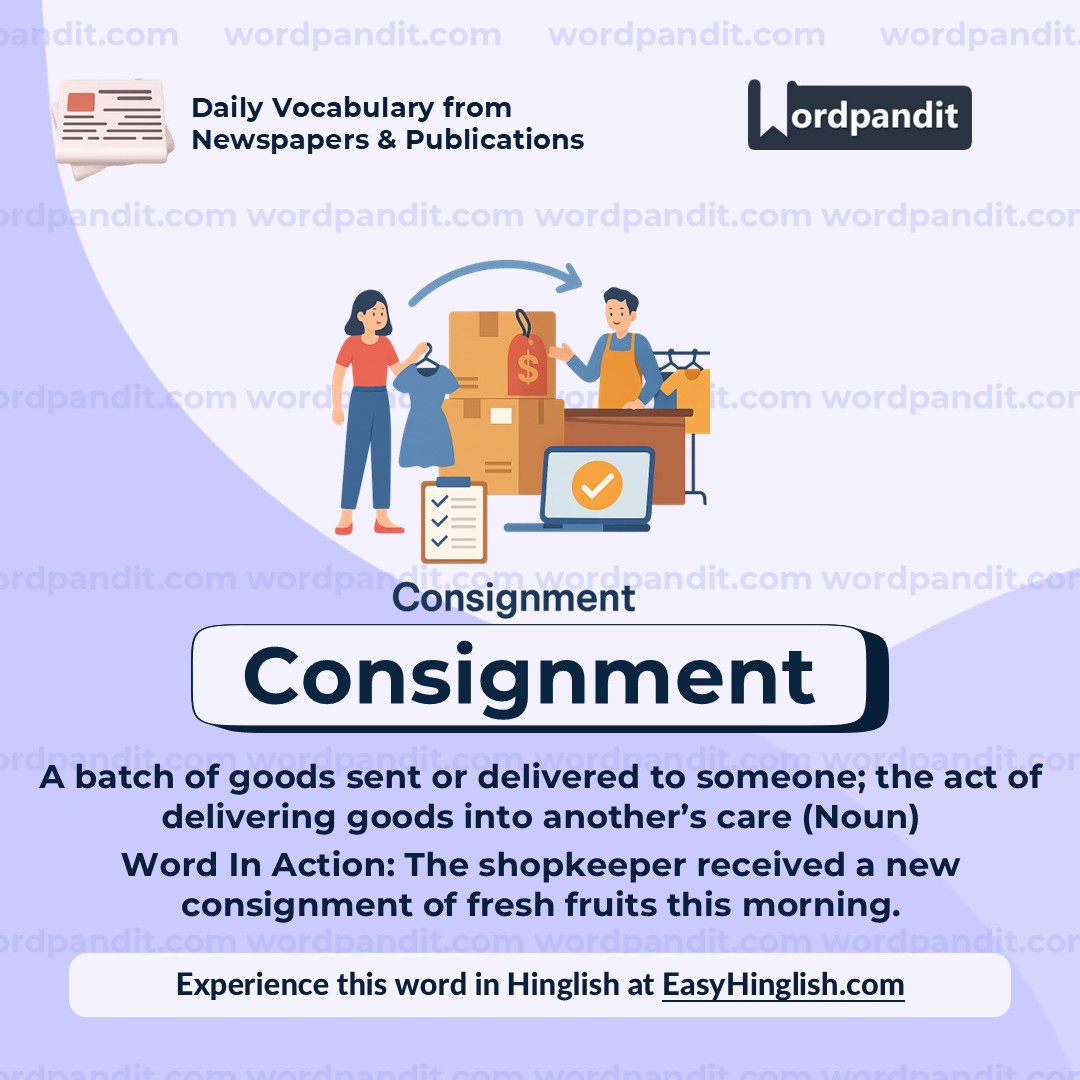
WORD-2: Consignment
Context:
"Vehicles will have to be more expensive (think of iron rods or glass being transported while half of the consignment is protruding out of the vehicle or overcrowded school vans ferrying children), properly vetted drivers will demand a higher premium and last but not least, fares and freight charges will have to increase." - Hindustan Times
Explanatory Paragraph:
A consignment is a batch of goods that is delivered, transported, or sent from one place to another, usually for the purpose of sale or distribution. It can also refer to the act of entrusting goods to another party (like a dealer or shipping company) to sell or deliver on behalf of the sender. The word is common in trade, logistics, and supply chain discussions.
Meaning: A batch of goods sent or delivered to someone; the act of delivering goods into another’s care (Noun)
Pronunciation: kun-sine-ment
Difficulty Level: ⭐⭐ Moderate
Etymology: From French *consigner* meaning "to hand over, deliver," derived from Latin *consignare* (to seal, to hand over officially).
Prashant Sir's Notes:
Important business and logistics term. Remember: a "consignment" is not just the goods, but also the process of sending goods to someone else for delivery or sale. It shows up often in trade-related articles.
Synonyms & Antonyms:
Synonyms: shipment, delivery, cargo, dispatch, lot
Antonyms: retention, hoarding, keeping, withholding
Usage Examples:
- The company received a large consignment of textiles from Turkey.
- The damaged consignment had to be returned to the supplier.
- He sent a consignment of books to the fair, hoping to sell them quickly.
- The customs officer checked the consignment before allowing it through the port.
Cultural Reference:
In international trade, the term "consignment stock" refers to goods that remain the property of the supplier until they are sold by the distributor. This model is common in global supply chains.
Think About It:
How does the concept of consignment change the risk-sharing relationship between a manufacturer and a distributor?
Quick Activity:
Imagine you own a small handicrafts business. Write two sentences explaining how you would use consignments to sell your products in different cities.
Memory Tip:
Think of "sign" in consignment → you *sign over* goods to someone else for transport or sale.
Real-World Application:
Consignments are crucial in business logistics, e-commerce, and export-import trade, where goods are regularly transported in batches and tracked through shipping documents.
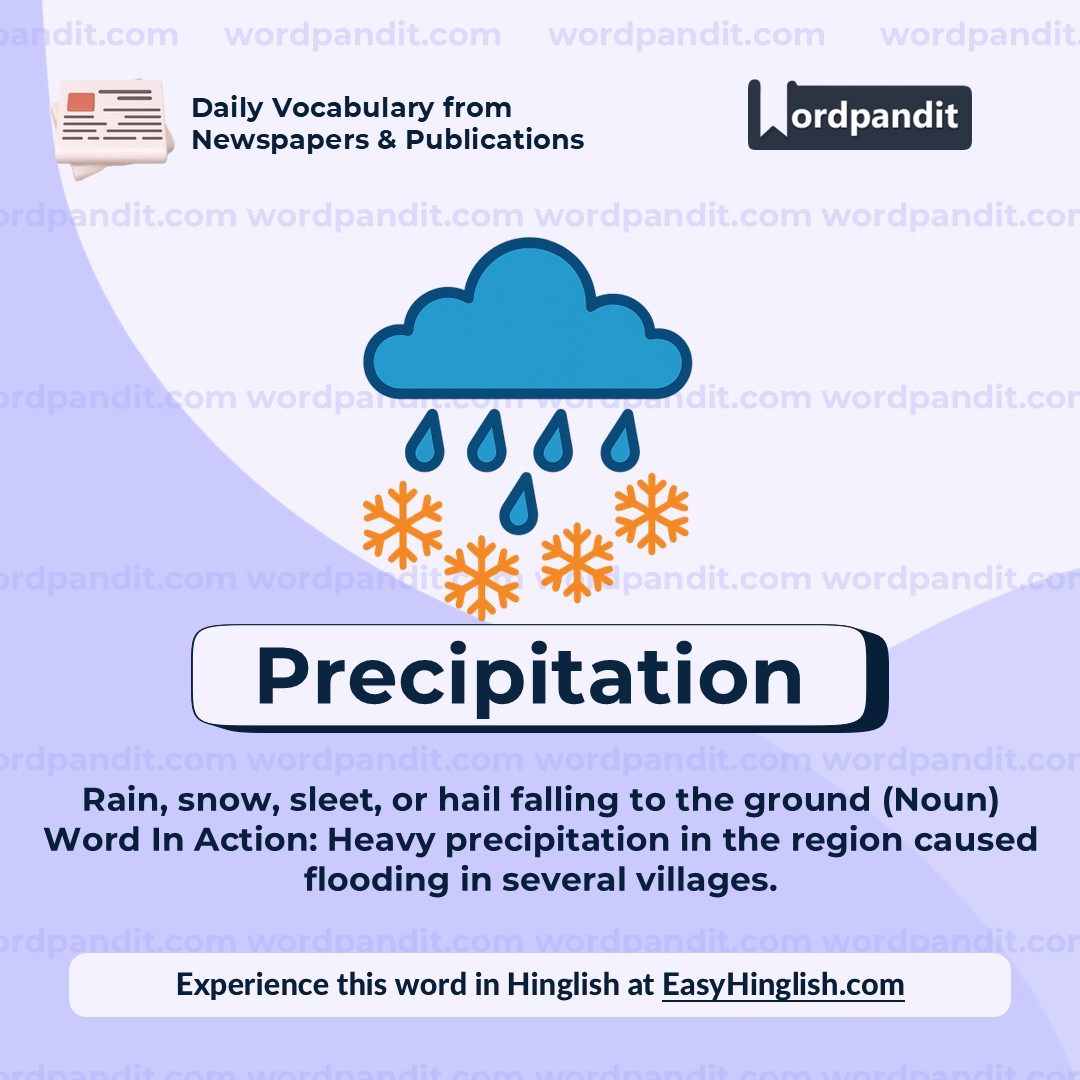
WORD-3: Precipitation
Context:
"The truck drivers' strike is neither the first nor will it be the last precipitation on this front." - Hindustan Times
Explanatory Paragraph:
Precipitation generally means rainfall, snow, or other forms of water falling from the sky. But in a broader sense, it also refers to something happening suddenly or being brought about quickly. In the given context, the strike is described as a "precipitation," meaning a sudden occurrence, disruption, or disturbance that affects the situation at hand.
Meaning: (1) Rain, snow, sleet, or hail falling to the ground; (2) A sudden or rapid occurrence of an event or action (Noun)
Pronunciation: pre-sip-i-tay-shun
Difficulty Level: ⭐⭐⭐ Intermediate
Etymology: From Latin *praecipitare* ("to throw down headlong"), later evolving in English to mean both "falling from the sky" and "hasty occurrence."
Prashant Sir's Notes:
Don’t confuse precipitation only with rainfall. In formal writing, it often means something that happens suddenly or hastily. The context here is political/economic disturbance, not weather.
Synonyms & Antonyms:
Synonyms: downfall, deluge, disruption, outbreak, onset
Antonyms: calm, delay, stability, postponement
Usage Examples:
- Heavy precipitation is expected in the northern states this winter.
- The sudden precipitation of violence shocked the community.
- Economic crises often arise from the precipitation of multiple smaller issues.
- The scientist measured the level of precipitation collected over the week.
Cultural Reference:
In climate science, "precipitation patterns" are closely studied as indicators of global warming and climate change. Beyond science, the word often appears in political and economic commentary to signify sudden upheavals.
Think About It:
Why do you think the same word "precipitation" is used for both rainfall and sudden disruptive events? What is the underlying similarity?
Quick Activity:
Create two sentences with "precipitation": one describing weather, and another describing a sudden event in politics or society.
Memory Tip:
Think of "precipitation" as something that "falls suddenly" — whether it is rain from the sky or an event that drops into our lives unexpectedly.
Real-World Application:
In everyday life, precipitation is used in weather forecasts. In academic and professional contexts, it describes chemical reactions (where solids "precipitate" out) or sudden social/political developments.

WORD-4: Compliance
Context:
"The government were to successfully address regulation failure, one must accept the fact that compliance with such regulations will lead to a huge increase in the cost of road transport in the country." - Hindustan Times
Explanatory Paragraph:
Compliance refers to the act of obeying rules, regulations, or standards. It can also imply cooperation or submission to authority. In business, law, and governance, compliance ensures that individuals and organizations follow established rules, whether they are safety regulations, financial laws, or ethical standards. In the given context, compliance with transport regulations means strictly following safety and legal requirements, even if it increases costs.
Meaning: The act or process of conforming to rules, standards, or requirements (Noun)
Pronunciation: kum-pli-uhns
Difficulty Level: ⭐⭐ Moderate
Etymology: From Latin *complere* ("to fill up, complete"), later through Old French *complir* and English "comply," meaning "to act in accordance with."
Prashant Sir's Notes:
A very common word in corporate, legal, and governance contexts. Remember: compliance is about "playing by the rules" — whether those are laws, regulations, or even informal guidelines.
Synonyms & Antonyms:
Synonyms: obedience, adherence, conformity, observance, submission
Antonyms: defiance, resistance, violation, disobedience, rebellion
Usage Examples:
- The company was fined for non-compliance with safety standards.
- Strict compliance with environmental laws is necessary to protect natural resources.
- The school requires compliance with its uniform policy.
- Compliance officers monitor whether organizations follow legal and financial regulations.
Cultural Reference:
In global business, "compliance departments" play a crucial role in ensuring corporations adhere to anti-corruption laws, environmental guidelines, and international trade standards. After major corporate scandals (like Enron), compliance became a buzzword worldwide.
Think About It:
Is strict compliance with rules always the best approach, or can it sometimes hinder creativity and innovation?
Quick Activity:
Write one sentence showing compliance in a school setting and another in a corporate setting.
Memory Tip:
Think of "comply" as "complete the rules" → Compliance means completing what rules demand.
Real-World Application:
Compliance is central in industries like banking, healthcare, transport, and IT, where strict rules are enforced to protect people, data, and systems from harm or fraud.
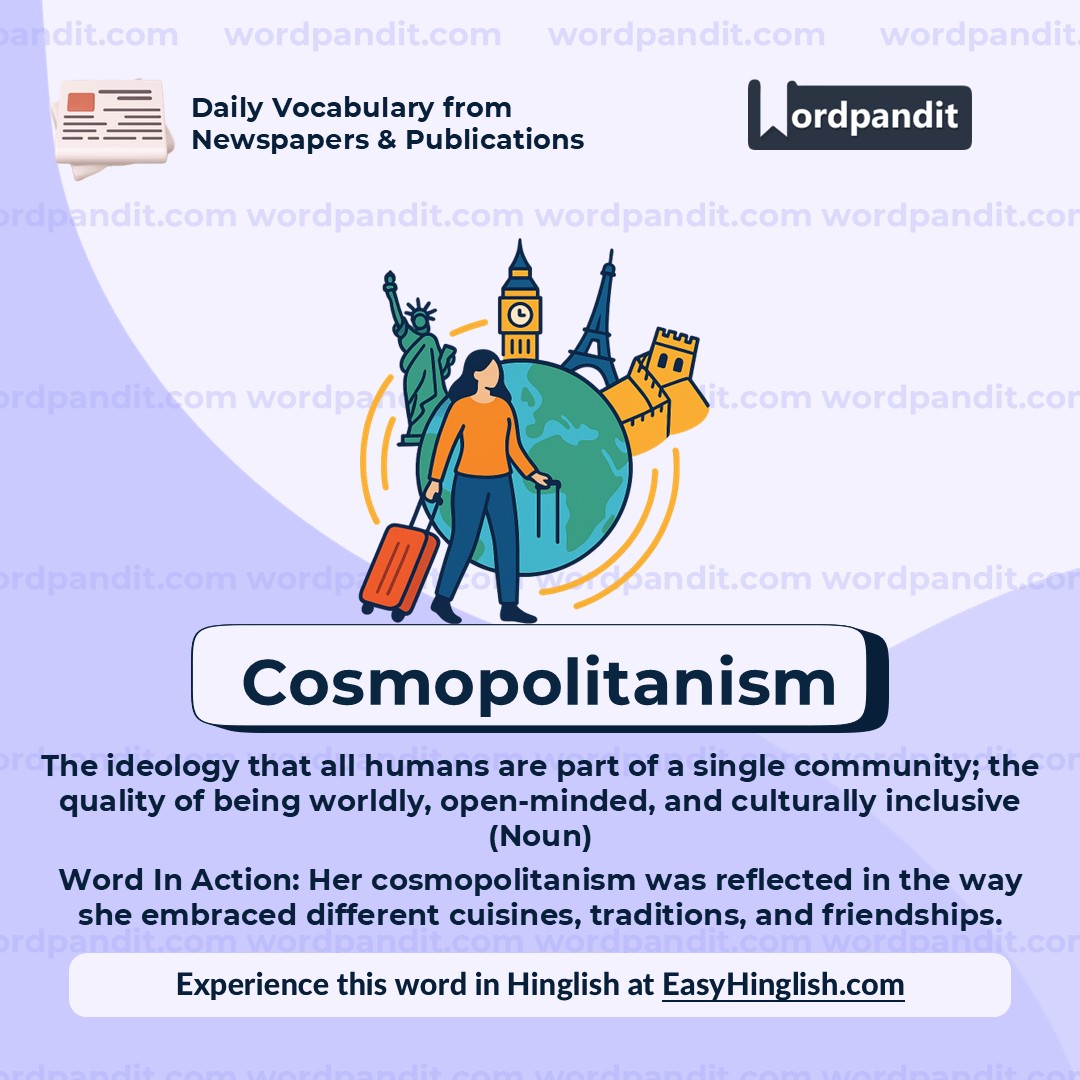
WORD-5: Cosmopolitanism
Context:
"The new fashion of a false cosmopolitanism and false humanitarianism that nevertheless reproduces the old power relations between the imperial West and the rest." - Indian Express
Explanatory Paragraph:
Cosmopolitanism is the idea or philosophy that all human beings belong to a single global community, regardless of national, cultural, or political boundaries. It emphasizes openness to diverse cultures, tolerance, and a sense of global citizenship. However, as the context highlights, sometimes so-called cosmopolitanism may be "false" — used superficially to hide inequalities and preserve old hierarchies.
Meaning: The ideology that all humans are part of a single community; the quality of being worldly, open-minded, and culturally inclusive (Noun)
Pronunciation: koz-mo-pol-i-tuh-nizm
Difficulty Level: ⭐⭐⭐⭐ Advanced
Etymology: From Greek *kosmos* ("world") + *polites* ("citizen") → "citizen of the world." The philosophical roots go back to the Stoics and later Enlightenment thinkers like Kant.
Prashant Sir's Notes:
Cosmopolitanism is often praised in literature, philosophy, and international relations. But beware — sometimes it is critiqued as elitist, shallow, or masking inequality. It’s an important word in global politics, philosophy, and culture studies.
Synonyms & Antonyms:
Synonyms: worldliness, globalism, internationalism, multiculturalism, universalism
Antonyms: parochialism, nationalism, provincialism, insularity
Usage Examples:
- Her cosmopolitanism was evident in her ability to adapt to cultures across Asia, Europe, and Africa.
- Cosmopolitanism promotes the idea of shared responsibility for global issues like climate change.
- Critics argue that cosmopolitanism sometimes ignores local traditions and values.
- The city’s food culture reflects a vibrant cosmopolitanism, blending cuisines from around the world.
Cultural Reference:
Philosopher Immanuel Kant advocated a form of cosmopolitanism in his essay *Perpetual Peace*, envisioning a world where nations coexist peacefully as part of a larger human community.
Think About It:
Can true cosmopolitanism exist in a world still divided by economic inequality, nationalism, and political power struggles?
Quick Activity:
Write two short sentences: one showing cosmopolitanism as a positive force (openness, tolerance) and one showing a critical view of it (elitism, superficiality).
Memory Tip:
Break it down: *Cosmos* = world, *Politan* = citizen → Cosmopolitanism = being a “citizen of the world.”
Real-World Application:
Cosmopolitanism is key in discussions about globalization, human rights, international law, and multicultural societies, where global cooperation is prioritized over narrow nationalism.


