

Daily Vocabulary from International Newspapers and Publications
Expand Your Vocabulary with Wordpandit’s Global Vocabulary Hub
At Wordpandit, we are committed to helping you develop a truly global vocabulary by drawing from some of the most respected international publications. This section is designed to keep you ahead of the curve by introducing you to words that define global conversations and trends.
The Power of Global Sources
To help you think and communicate on a global scale, we curate vocabulary from renowned international sources, such as:
- The New York Times
- The Washington Post
- BBC
- The Guardian
- The Economist
- Scientific American
- Psychology Today
- And many more...
Stay Global, Stay Competitive
Our daily updates from international publications ensure you are consistently exposed to new words that reflect global news and developments, making sure your vocabulary is not only current but also globally relevant.
Enhance Your Global Perspective
Whether you’re preparing for international exams, aiming to excel in global business communication, or want to enhance your language skills for personal growth, Wordpandit offers the resources you need to thrive in a global context.
Effective Learning, Global Reach
Our learning methodology combines global examples, memory aids, and interactive activities, allowing you to internalize new words effectively and apply them in real-world scenarios.
Begin Your Global Vocabulary Journey Now!

Why Choose Wordpandit?
Practical Learning: Focus on words you'll actually encounter in real-world reading, enhancing your comprehension and communication skills.
Diverse Content: From current affairs to scientific breakthroughs, our varied sources expose you to vocabulary across multiple domains.
Effortless Integration: Make Wordpandit a part of your daily routine. Just a few minutes each day can significantly boost your lexicon over time.
Your Path to Vocabulary Mastery
- Visit our Daily Vocabulary section regularly
- Explore new words and their usage in context
- Practice incorporating these words into your own writing and speech
- Track your progress as your vocabulary expands
Start Your Journey Today
Embark on your vocabulary enhancement journey with Wordpandit. By consistently engaging with our daily posts, you'll build a robust vocabulary that serves you well in academic, professional, and personal contexts.
Remember, a word a day keeps linguistic limitations at bay. Make Wordpandit your daily companion in the quest for vocabulary excellence!
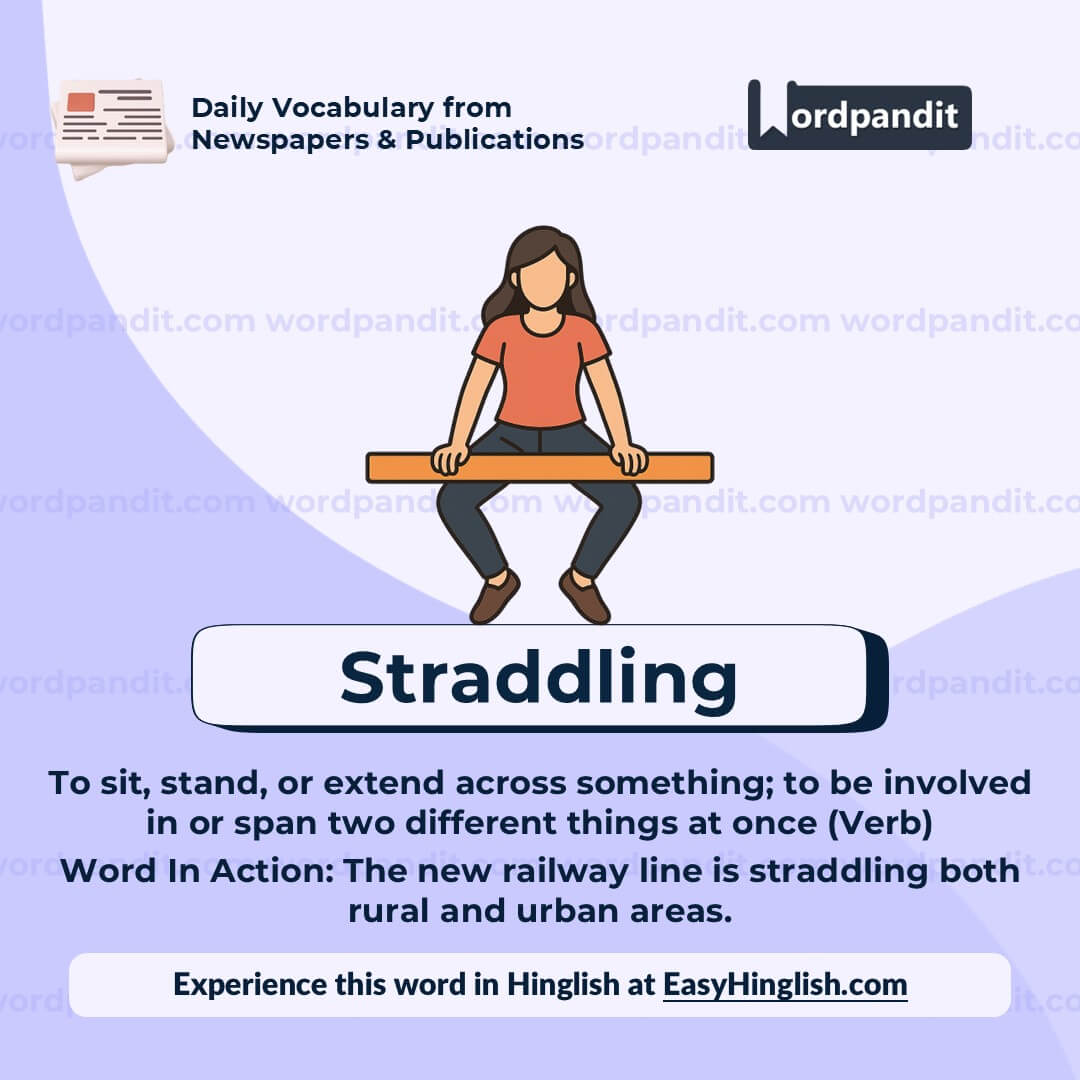
WORD-1: Straddling
Context:
"With a general election now on the horizon, MPs are starting to talk about the prospect of strikes straddling two administrations." - Guardian
Explanatory Paragraph:
The word straddling refers to being positioned across or on both sides of something, whether literally (like sitting with a leg on each side of a horse) or figuratively (like spanning two different periods, situations, or ideas). In the given context, it suggests that strikes may extend over, or overlap with, two different political administrations.
Meaning: To sit, stand, or extend across something; to be involved in or span two different things at once (Verb)
Pronunciation: STRAD-ling
Difficulty Level: ⭐⭐ Moderate
Etymology: From Middle English stradlen, derived from "stride" (to step or walk with long steps) + the suffix "-le" denoting frequentative action. The sense of being across two things developed over time.
Prashant Sir's Notes:
Think of "straddle" as having one leg on each side—this image helps connect both the literal and figurative meanings. It’s often used in contexts where something spans or overlaps two sides, phases, or categories.
Synonyms & Antonyms:
Synonyms: span, bridge, extend across, overlap, bestride
Antonyms: separate, divide, detach, isolate
Usage Examples:
- The mountain straddles the border between two countries.
- She found herself straddling the line between friendship and love.
- The company’s strategy straddles both traditional retail and online markets.
- His career straddles the fields of science and literature.
Cultural Reference:
"Many artists straddle genres, creating new forms of music that blend tradition with innovation." - Cultural commentary on fusion music
Think About It:
When does “straddling” become a strength, allowing one to bridge two worlds, and when does it become a weakness, showing indecision or lack of commitment?
Quick Activity:
Write three sentences where you use the word "straddling" in different contexts—one physical, one emotional, and one professional.
Memory Tip:
Visualize someone riding a horse with one leg on each side—this image of “straddling” will help you recall the meaning of spanning or overlapping.
Real-World Application:
In real life, "straddling" often describes situations like organizations operating across industries, policies spanning two governments, or people balancing multiple roles at once.

WORD-2: Interagency
Context:
"The District also approved more than $11 million to support the office of deputy mayor for public safety and justice, which will 'develop and lead interagency public safety initiatives that improve the quality of life in the District.'" - Washington Post
Explanatory Paragraph:
The word interagency refers to cooperation or activities involving two or more government agencies working together. It is often used in contexts where coordination is needed to address complex issues, such as security, health, or environmental concerns. In the given context, "interagency public safety initiatives" means projects where multiple government offices or departments collaborate to improve safety and quality of life in the city.
Meaning: Involving or occurring between two or more agencies, especially government agencies (Adjective)
Pronunciation: in-ter-AY-jen-see
Difficulty Level: ⭐⭐ Moderate
Etymology: From the prefix "inter-" meaning "between" or "among" + "agency" (from Latin agere, meaning "to act or to do"). The term developed in modern governance to describe cross-agency collaboration.
Prashant Sir's Notes:
Think of interagency as a word that highlights teamwork among agencies. Whenever you see "inter-", it usually means "between"—so interagency = between agencies.
Synonyms & Antonyms:
Synonyms: cross-agency, collaborative, cooperative, joint
Antonyms: independent, unilateral, isolated, standalone
Usage Examples:
- The disaster required an interagency response involving health, police, and fire departments.
- An interagency task force was created to tackle cybercrime.
- Effective interagency cooperation can save time and resources in large-scale projects.
- The mayor emphasized the importance of interagency collaboration to improve housing policies.
Cultural Reference:
"Interagency task forces are common in the U.S. for combating terrorism, where different arms of government must coordinate seamlessly." - Public policy commentary
Think About It:
Why do you think interagency collaboration is often challenging, even when all parties are working toward the same goal?
Quick Activity:
List three situations in your community or country where interagency cooperation would be essential (e.g., natural disasters, large events, public health crises).
Memory Tip:
Break the word into "inter" (between) + "agency" (organizations). Imagine agencies shaking hands across a table—this visual reinforces the idea of interagency cooperation.
Real-World Application:
In real-world governance, interagency efforts are critical for solving complex issues like climate change, terrorism, or pandemics, where no single agency has all the expertise or resources to act alone.
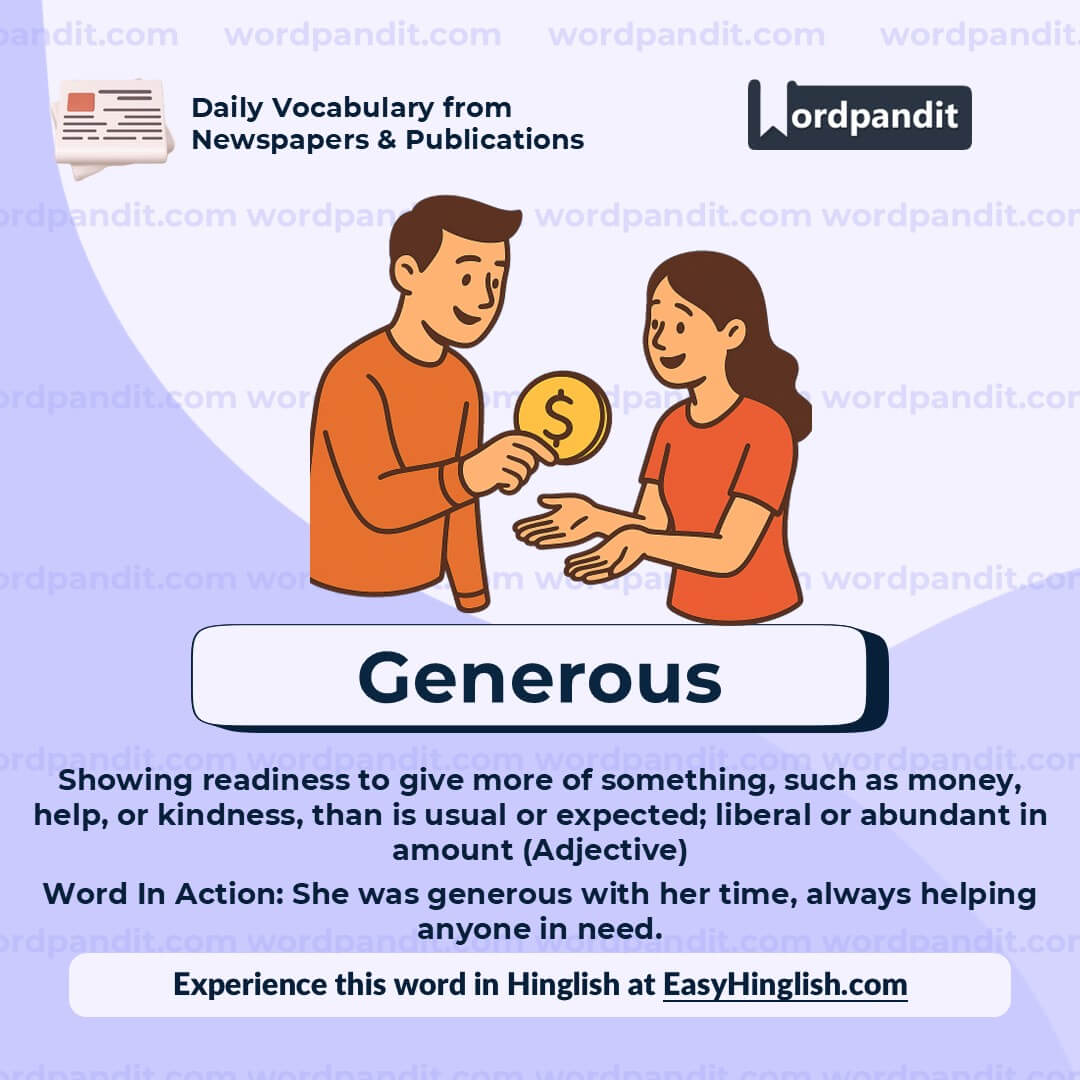
WORD-3: Generous
Context:
"Meanwhile shadow health secretary Wes Streeting is giving little sign that Labour would be more generous and must know that if he does, junior doctors will only be encouraged to wait this government out, with painful consequences for patients." - Guardian
Explanatory Paragraph:
The word generous describes someone who is willing to give more—whether it be money, time, kindness, or resources—than is strictly necessary or expected. It can also refer to something larger or more abundant than usual. In the political context here, it means being more giving or lenient in terms of financial offers or concessions to junior doctors.
Meaning: Showing readiness to give more of something, such as money, help, or kindness, than is usual or expected; liberal or abundant in amount (Adjective)
Pronunciation: JEN-er-us
Difficulty Level: ⭐ Basic
Etymology: From Latin generosus, meaning "of noble birth, magnanimous," from genus (race, stock, kind). The sense shifted to "giving freely, unselfish" in later English usage.
Prashant Sir's Notes:
Generosity is not limited to money—it includes time, attention, compassion, or opportunities. Remember, being generous doesn’t always mean being wealthy; it means being willing to give beyond self-interest.
Synonyms & Antonyms:
Synonyms: charitable, liberal, kind, bountiful, magnanimous
Antonyms: stingy, selfish, miserly, mean, tightfisted
Usage Examples:
- She is always generous with her time, helping anyone in need.
- The restaurant served generous portions of food.
- His generous donation funded the construction of a new library.
- It was generous of you to forgive him so quickly.
Cultural Reference:
"No one has ever become poor by giving." - A famous line often attributed to Anne Frank, highlighting the lasting value of generosity.
Think About It:
Can someone be too generous? At what point does generosity risk harming the giver rather than helping the receiver?
Quick Activity:
Write down three non-monetary ways you can be generous in your daily life (for example, with your patience, encouragement, or time).
Memory Tip:
Think of the word "gen-" in "generous" as related to "give." Generous people "give" more than they take.
Real-World Application:
Generosity plays a role in personal relationships, leadership, business ethics, and social responsibility. Leaders who are generous with credit, businesses that are generous with customer service, and individuals generous with kindness often build stronger trust and loyalty.
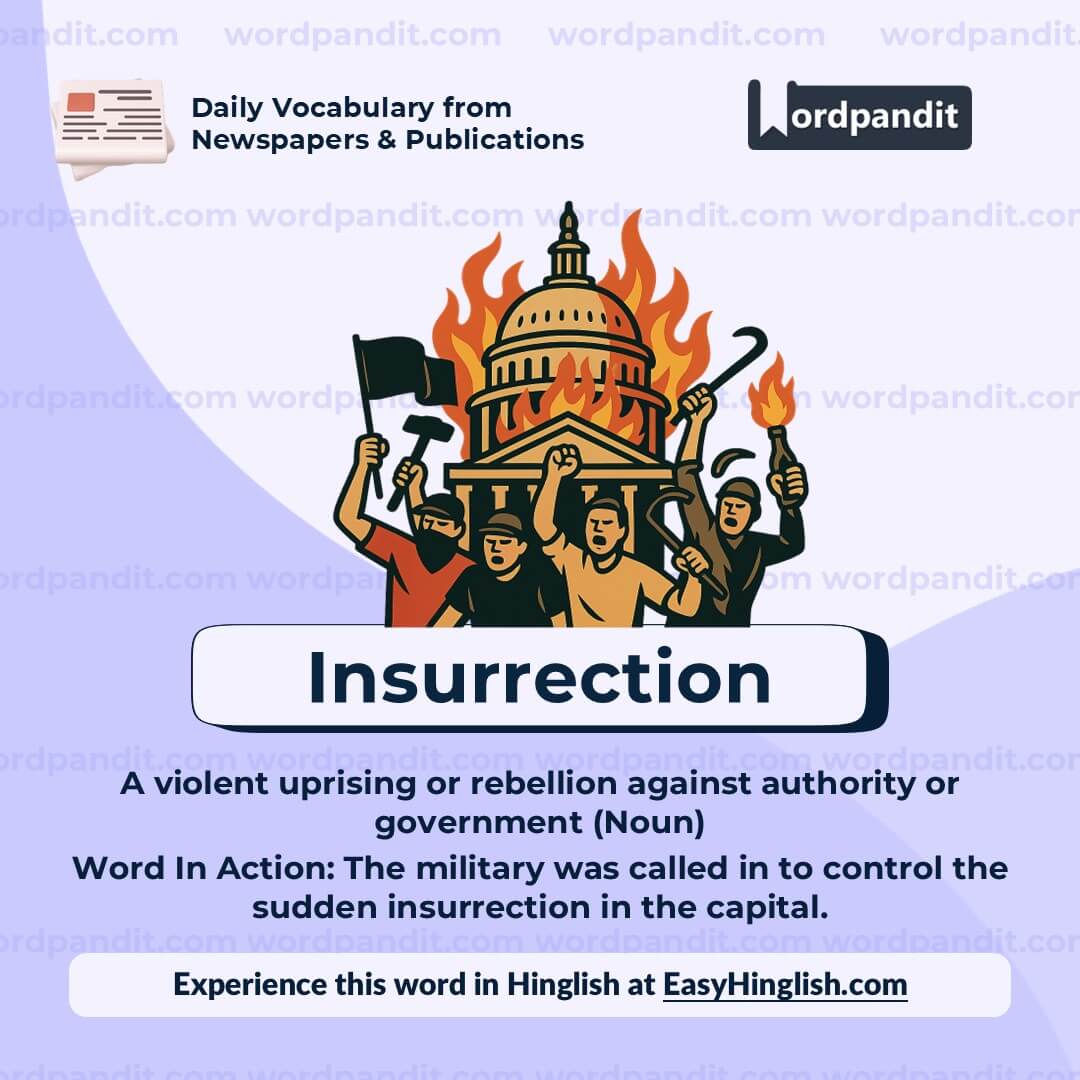
WORD-4: Insurrection
Context:
"A Post-University of Maryland poll published this week shows a sizable share of Americans accept lies about the 2020 election and the insurrection that followed on Jan. 6, 2021." - Washington Post
Explanatory Paragraph:
The word insurrection refers to a violent uprising or organized attempt by a group of people to rebel against authority, often against a government. Unlike a peaceful protest, an insurrection involves force, disruption, and attempts to overthrow or challenge established power. In the given context, it refers to the violent attack on the U.S. Capitol on January 6, 2021, where rioters attempted to disrupt the certification of the presidential election results.
Meaning: A violent uprising or rebellion against authority or government (Noun)
Pronunciation: in-suh-REK-shun
Difficulty Level: ⭐⭐⭐ Intermediate
Etymology: From Latin insurrectio, meaning "a rising up," from insurgere ("to rise against"), formed from in- (against) + surgere (to rise).
Prashant Sir's Notes:
Think of "insurrection" as a stronger word than "protest." It involves force, violence, and active rebellion against authority. It's closer in meaning to "uprising" or "revolt."
Synonyms & Antonyms:
Synonyms: uprising, rebellion, revolt, mutiny, coup
Antonyms: obedience, submission, peace, compliance, loyalty
Usage Examples:
- The government declared a state of emergency to suppress the insurrection.
- History books are filled with accounts of insurrections that changed nations.
- The insurrection was fueled by misinformation and deep political divides.
- Several insurrectionists were arrested and charged with serious crimes.
Cultural Reference:
"The French Revolution began as an insurrection against monarchy, eventually reshaping the course of European history." - Historical commentary
Think About It:
At what point does civil disobedience cross the line into insurrection, and how should societies distinguish between the two?
Quick Activity:
Write two sentences: one using "insurrection" in a historical context, and another using it in a modern political context.
Memory Tip:
Break the word into "in-" (against) + "surrect" (rise). Insurrection literally means "to rise up against" authority.
Real-World Application:
The term "insurrection" is widely used in law, politics, and history to describe events where groups attempt to overthrow or violently challenge governments, making it a key concept in understanding social and political movements.
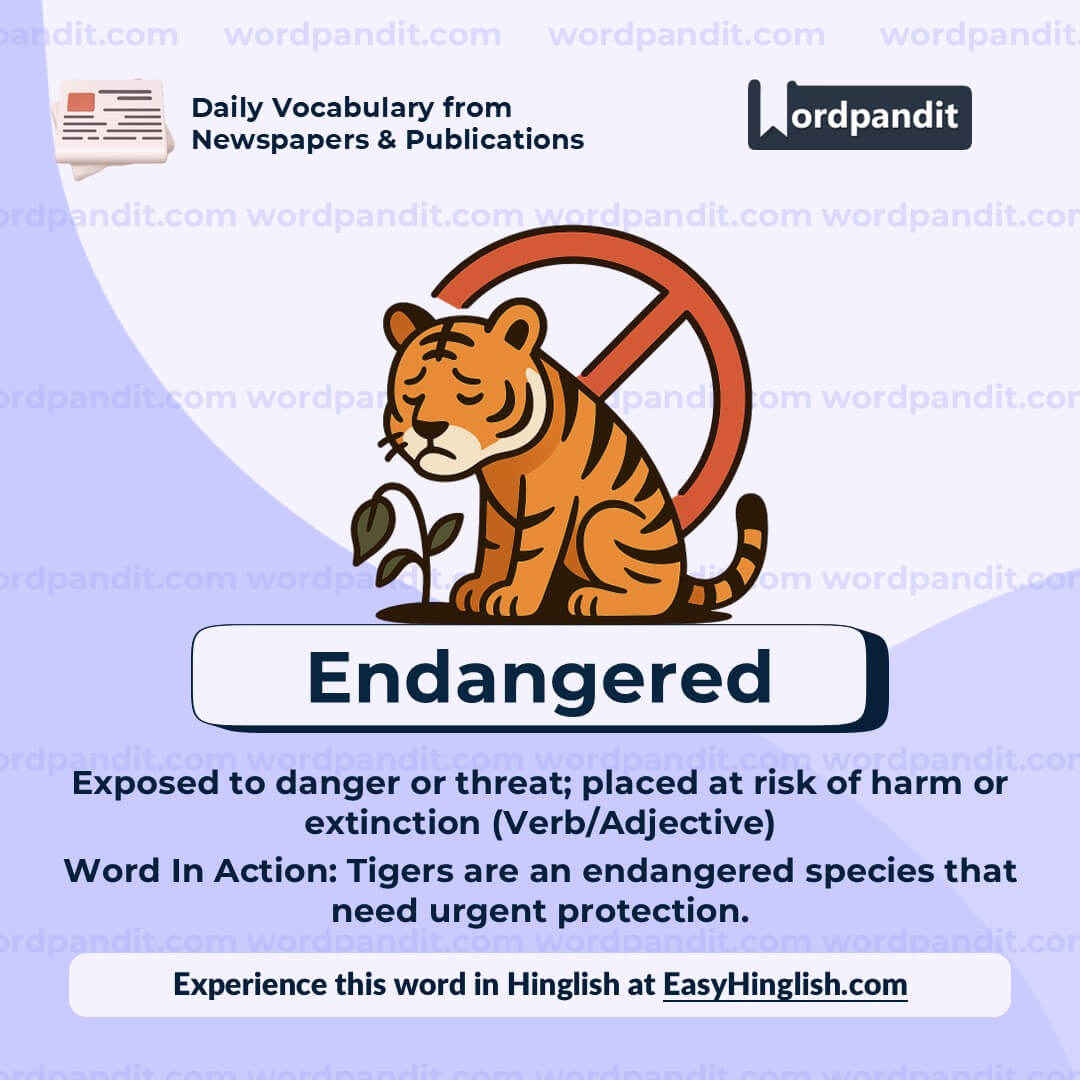
WORD-5: Endangered
Context:
"His reckless words endangered my family and everyone at the Capitol that day.” - Washington Post
Explanatory Paragraph:
The word endangered means placed at risk of harm, danger, or loss. It can be used for both people and things—whether describing individuals put in physical danger or species whose survival is threatened. In the given context, the speaker means that reckless language created a situation that put lives at risk.
Meaning: Exposed to danger or threat; placed at risk of harm or extinction (Verb/Adjective)
Pronunciation: en-DAYN-jurd
Difficulty Level: ⭐ Basic
Etymology: From Old French endangerer ("to put in danger"), formed from Latin in ("in") + danger. The modern sense evolved into describing both immediate threats and long-term risks.
Prashant Sir's Notes:
Remember, "endangered" is often heard in two contexts: daily life (putting someone at risk) and environmental issues (endangered species). The core meaning remains the same: being in danger.
Synonyms & Antonyms:
Synonyms: threatened, at risk, unsafe, imperiled, vulnerable
Antonyms: protected, safe, secure, sheltered
Usage Examples:
- The reckless driver endangered everyone on the road.
- Many species are endangered due to habitat destruction.
- By spreading false information, he endangered the trust within the community.
- Neglecting safety rules endangered the entire project team.
Cultural Reference:
"The giant panda was once one of the most endangered species in the world, but global conservation efforts have helped increase its population." - Environmental report
Think About It:
Do words and actions endanger people in equal measure, or is physical endangerment fundamentally different from emotional or psychological risk?
Quick Activity:
Write one sentence where "endangered" refers to a person, and another where it refers to an animal or species.
Memory Tip:
Think of "endangered species." If you remember that phrase, you’ll easily connect "endangered" with the idea of being in danger or at risk.
Real-World Application:
The term "endangered" is commonly used in legal, environmental, and safety contexts—ranging from endangered workers in unsafe conditions to endangered species in ecological conservation.


