

Daily Vocabulary from Indian Newspapers and Publications
Welcome to Wordpandit’s Indian Vocabulary Hub
At Wordpandit, we understand the importance of staying rooted in the local context while expanding your language skills. This section focuses on enriching your vocabulary with words and phrases drawn from India’s leading newspapers and publications, ensuring you're learning vocabulary that is practical, relevant, and uniquely Indian.
Why Indian Sources Matter
We believe that the best way to master any language is by immersing yourself in local content. That’s why we carefully curate vocabulary from top Indian publications, including:
- The Hindu
- The Times of India
- The Economic Times
- Hindustan Times
- Live Mint
- The Indian Express
- And many others...
Stay Updated, Stay Relevant
With daily updates from Indian news sources, you’ll be consistently learning words that reflect the trends and shifts in Indian society and culture. Our focus is to provide vocabulary that enhances your understanding of the language in an Indian context.
How Wordpandit Supports Your Goals
Whether you’re preparing for exams, aiming to improve your professional communication, or simply want to stay connected with the latest Indian vocabulary, Wordpandit is here to guide you every step of the way.
Learn with a Practical Approach
Our interactive learning methodology includes real-world examples, engaging activities, and context-specific usage to ensure that every word becomes part of your active vocabulary.
Dive into Indian Vocabulary Today!

Why Choose Wordpandit?
Practical Learning: Focus on words you'll actually encounter in real-world reading, enhancing your comprehension and communication skills.
Diverse Content: From current affairs to scientific breakthroughs, our varied sources expose you to vocabulary across multiple domains.
Effortless Integration: Make Wordpandit a part of your daily routine. Just a few minutes each day can significantly boost your lexicon over time.
Your Path to Vocabulary Mastery
- Visit our Daily Vocabulary section regularly
- Explore new words and their usage in context
- Practice incorporating these words into your own writing and speech
- Track your progress as your vocabulary expands
Start Your Journey Today
Embark on your vocabulary enhancement journey with Wordpandit. By consistently engaging with our daily posts, you'll build a robust vocabulary that serves you well in academic, professional, and personal contexts.
Remember, a word a day keeps linguistic limitations at bay. Make Wordpandit your daily companion in the quest for vocabulary excellence!
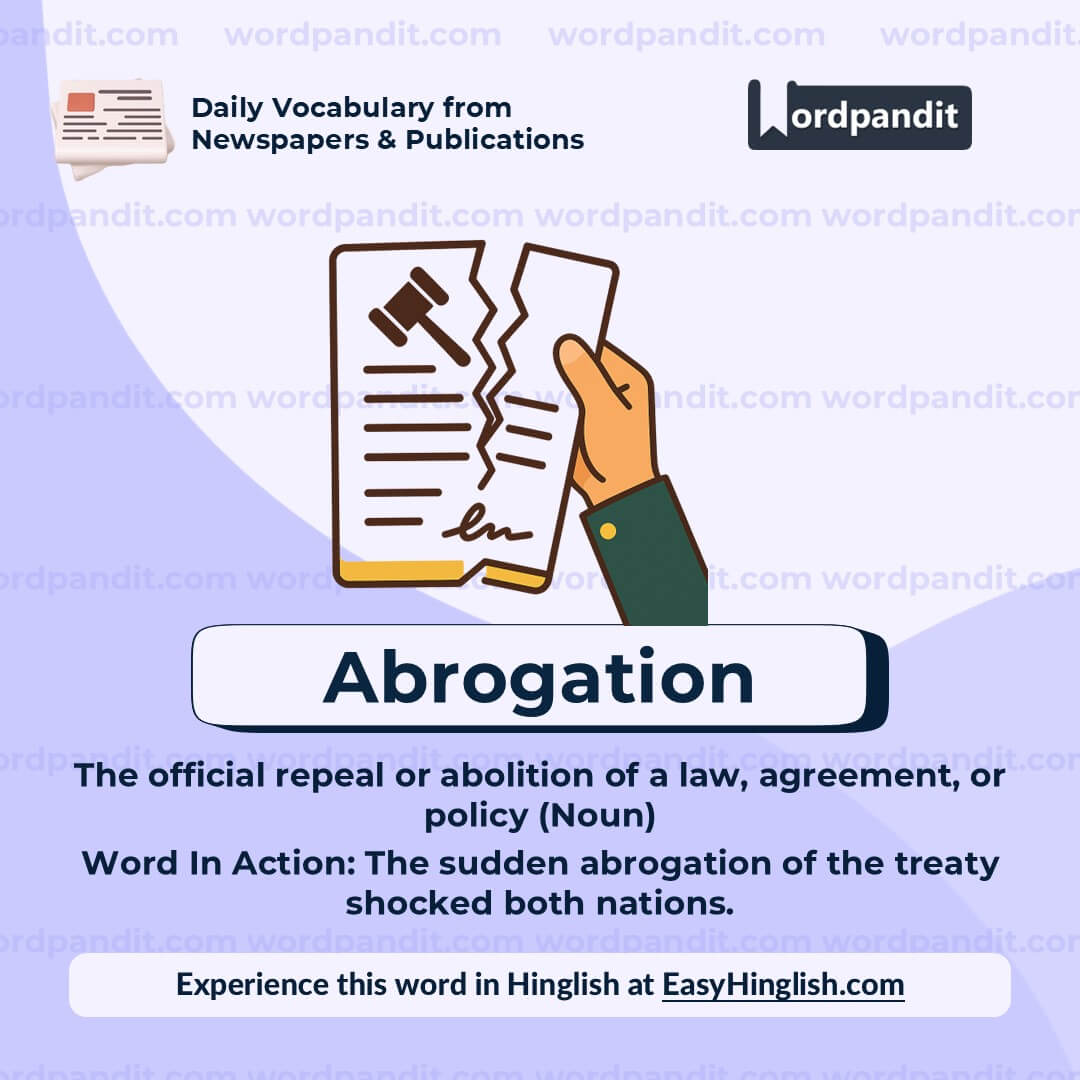
WORD-1: Abrogation
Context:
"The abrogation of Article 370, cultural restoration is underway in Jammu and Kashmir at 123 identified places." - Hindustan Times
Explanatory Paragraph:
The word abrogation refers to the formal ending, cancellation, or abolition of a law, policy, agreement, or practice by an authority. It is usually done by a government or legal body through an official declaration. For example, when a law is repealed because it is outdated or no longer needed, it is said to be abrogated.
Meaning: The official repeal or abolition of a law, agreement, or policy (Noun)
Pronunciation: ab-ro-gay-shun
Difficulty Level: ⭐⭐⭐ Intermediate
Etymology: Derived from the Latin word abrogare, meaning "to repeal" (from "ab-" meaning "away" + "rogare" meaning "to propose a law").
Prashant Sir's Notes:
"Abrogation" is often used in political, legal, and constitutional contexts. It does not mean physical destruction, but rather the formal nullifying of authority or law.
Synonyms & Antonyms:
Synonyms: repeal, annulment, revocation, cancellation, abolition
Antonyms: enforcement, enactment, approval, ratification
Usage Examples:
- The abrogation of the outdated trade law allowed new businesses to flourish more easily.
- The treaty’s abrogation led to tension between the two neighboring countries.
- The abrogation of certain colonial-era rules was celebrated as a step toward modernization.
- Many activists demanded the abrogation of discriminatory practices embedded in the system.
Cultural Reference:
"In 1971, the abrogation of the Indo-Soviet Treaty would have drastically changed India’s Cold War stance." - Historical Analysis
Think About It:
Is abrogation always a sign of progress, or can it sometimes lead to instability and conflict?
Quick Activity:
Write a short paragraph using the word "abrogation" to describe a historical or modern event where a law or agreement was canceled.
Memory Tip:
Think of "abrogation" as "a-broken rule" — a law or rule that has been broken or officially ended.
Real-World Application:
Students of law, history, and political science frequently encounter the term "abrogation" when studying the repeal of laws, constitutional amendments, and international treaties. It is also used in everyday discussions about government reforms and policy changes.
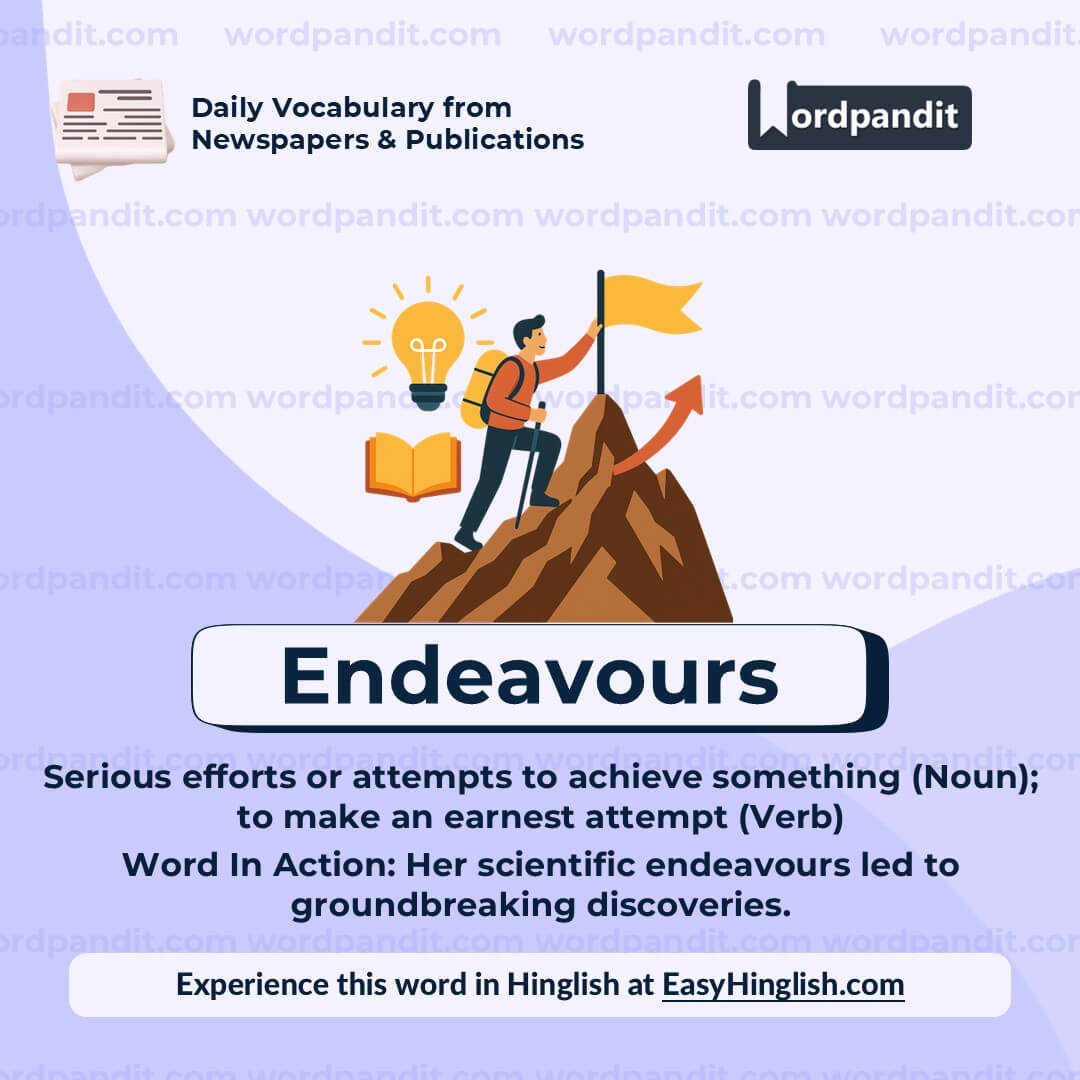
WORD-2: Endeavours
Context:
"The third head provides for the development of training modules on disability for party workers and endeavours to include PwDs at all levels of a political party." - Indian Express
Explanatory Paragraph:
The word endeavours refers to serious attempts or efforts made to achieve a goal. It conveys a sense of determination and commitment toward doing something meaningful, often despite challenges. When someone "endeavours" to do something, they put in hard work, dedication, and persistence.
Meaning: Serious efforts or attempts to achieve something (Noun); to make an earnest attempt (Verb)
Pronunciation: en-dev-ers
Difficulty Level: ⭐⭐ Basic to Intermediate
Etymology: From Middle English endeveren, derived from the phrase "in dever," meaning "in duty." It suggests putting oneself under obligation or duty to accomplish something.
Prashant Sir's Notes:
Think of "endeavours" as "sincere efforts." It is not just trying casually, but attempting with full dedication and purpose.
Synonyms & Antonyms:
Synonyms: attempts, efforts, undertakings, ventures, pursuits
Antonyms: neglect, idleness, inaction, avoidance
Usage Examples:
- The scientist’s endeavours led to a groundbreaking discovery in renewable energy.
- Despite many failures, her endeavours to start her own company finally succeeded.
- The charity’s endeavours brought education to thousands of underprivileged children.
- He always endeavours to be fair and honest in his professional dealings.
Cultural Reference:
"Man’s endeavours to conquer space reflect the human spirit of exploration." - Commentary on Space Age Achievements
Think About It:
Do great endeavours always need to succeed to be valuable, or is the effort itself meaningful?
Quick Activity:
Write three sentences about your personal goals using the word "endeavours." Example: "My endeavours in learning a new language have been rewarding."
Memory Tip:
Link "endeavours" with "in-deeds" — efforts are shown not in words, but in deeds.
Real-World Application:
The word "endeavours" is often used in professional speeches, motivational talks, and academic writing to highlight purposeful efforts, especially in fields like politics, science, business, and personal development.
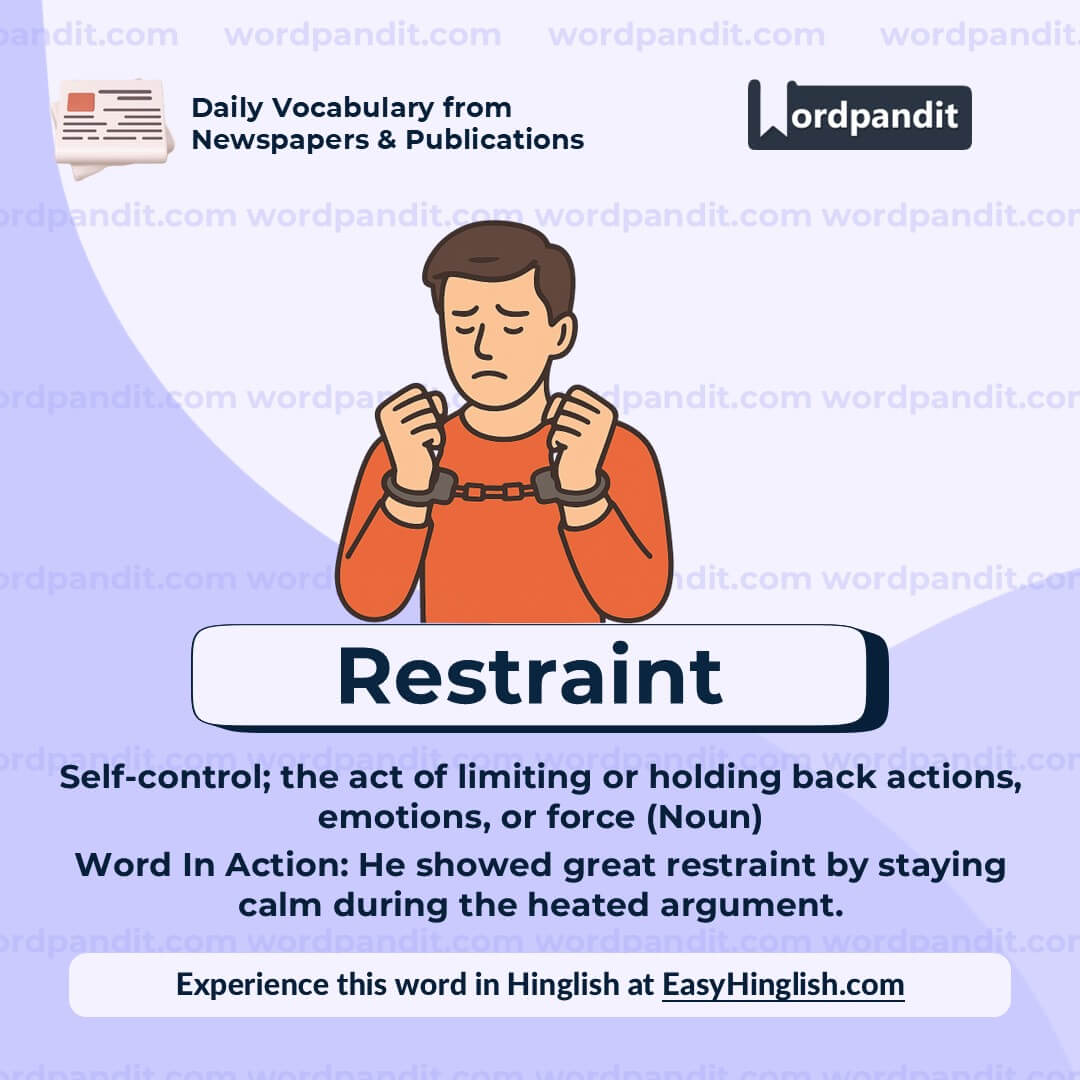
WORD-3: Restraint
Context:
"Both nations have not escalated the stand-off to a shooting war. Will this restraint be maintained by Beijing in 2024?" - Indian Express
Explanatory Paragraph:
The word restraint refers to the act of holding back, controlling, or limiting actions, emotions, or behavior. It is often associated with self-control, moderation, and the ability to avoid impulsive or extreme actions. In political and diplomatic contexts, "restraint" often means avoiding aggression or escalation despite provocation.
Meaning: Self-control; the act of limiting or holding back actions, emotions, or force (Noun)
Pronunciation: ri-straynt
Difficulty Level: ⭐⭐ Basic to Intermediate
Etymology: From Old French restreinte, from Latin restringere meaning "to bind back" or "to check."
Prashant Sir's Notes:
"Restraint" is about control — whether it is emotional restraint (not reacting in anger), financial restraint (not overspending), or political restraint (avoiding war). It is the opposite of acting recklessly.
Synonyms & Antonyms:
Synonyms: self-control, moderation, discipline, inhibition, limitation
Antonyms: excess, indulgence, impulsiveness, liberty, abandon
Usage Examples:
- She showed great restraint by not responding to the unfair criticism.
- The police exercised restraint while handling the angry protestors.
- Financial restraint helped the company survive during the economic crisis.
- Diplomatic restraint often prevents conflicts from escalating into wars.
Cultural Reference:
"Gandhi’s philosophy of restraint and non-violence inspired global movements for civil rights and freedom." - Historical Commentary
Think About It:
Is restraint always a strength, or can it sometimes prevent necessary action?
Quick Activity:
Write two sentences where you describe situations in which showing restraint is more powerful than reacting immediately.
Memory Tip:
Think of "restraint" as "restrict" — to restrict yourself from going too far.
Real-World Application:
The word "restraint" is widely used in diplomacy, law enforcement, and personal development. It represents controlled responses in high-pressure situations, making it a valuable skill in both professional and personal life.
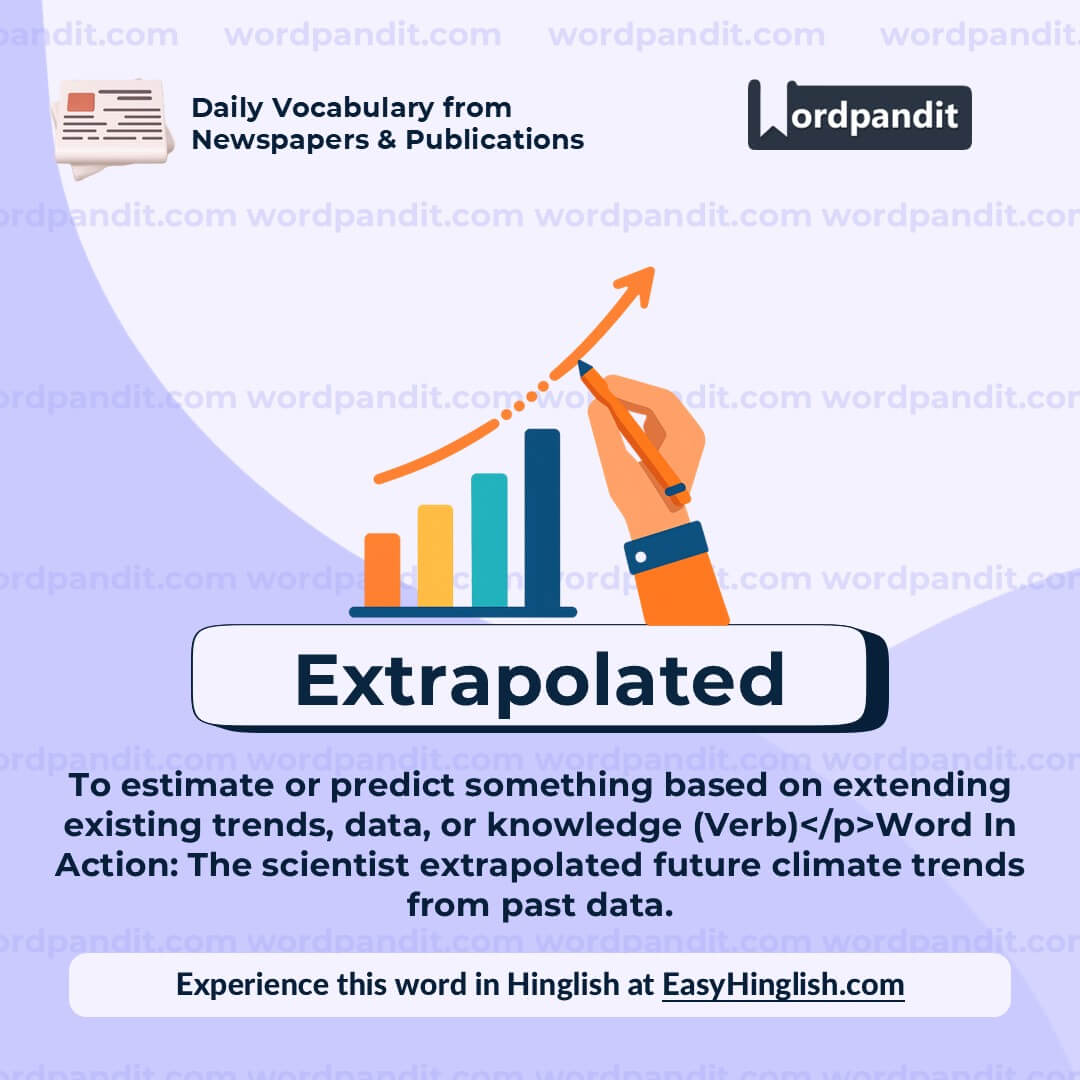
WORD-4: Extrapolated
Context:
"The last two years are too recent to be consigned to 'history' but some of the most significant punctuations of 2022 and 2023 in the strategic domain could be extrapolated to the composite Indian national security challenge in the year ahead." - Indian Express
Explanatory Paragraph:
The word extrapolated refers to the act of extending known data, trends, or facts into an unknown area to predict or estimate what might happen in the future. It is often used in research, science, strategy, and planning. For example, if you know the sales of a company for the last three years, you can extrapolate the likely sales for the next year by looking at the pattern.
Meaning: To estimate or predict something based on extending existing trends, data, or knowledge (Verb)
Pronunciation: ex-trap-o-lay-ted
Difficulty Level: ⭐⭐⭐ Intermediate
Etymology: From Latin extra ("outside") + polare ("to polish, smooth out"). The modern sense developed in mathematics in the 19th century, meaning "to infer or extend beyond known values."
Prashant Sir's Notes:
Extrapolation is like making an educated guess. It is different from guessing blindly — you use patterns or data you already know to predict something new.
Synonyms & Antonyms:
Synonyms: infer, deduce, project, predict, forecast
Antonyms: ignore, miscalculate, overlook, misconceive
Usage Examples:
- The scientist extrapolated future climate patterns from decades of weather data.
- From the student’s consistent grades, the teacher extrapolated that he would perform well in the final exams.
- The company extrapolated sales growth for the next quarter based on current customer trends.
- Analysts extrapolated possible security risks from recent geopolitical developments.
Cultural Reference:
"Economists often extrapolate future economic conditions by studying past recessions and recoveries." - Academic Commentary
Think About It:
How reliable is extrapolation when predicting human behavior, which can be unpredictable and emotional?
Quick Activity:
Look at your study performance in the last three months. Try to extrapolate what your performance will look like in the next three months if you keep the same habits.
Memory Tip:
Think of "extrapolated" as "extra + plotted" — you take data already plotted on a graph and extend it further.
Real-World Application:
Extrapolation is used in many fields — scientists extrapolate data to make predictions, economists extrapolate trends to forecast markets, and policymakers extrapolate from past events to prepare for the future.
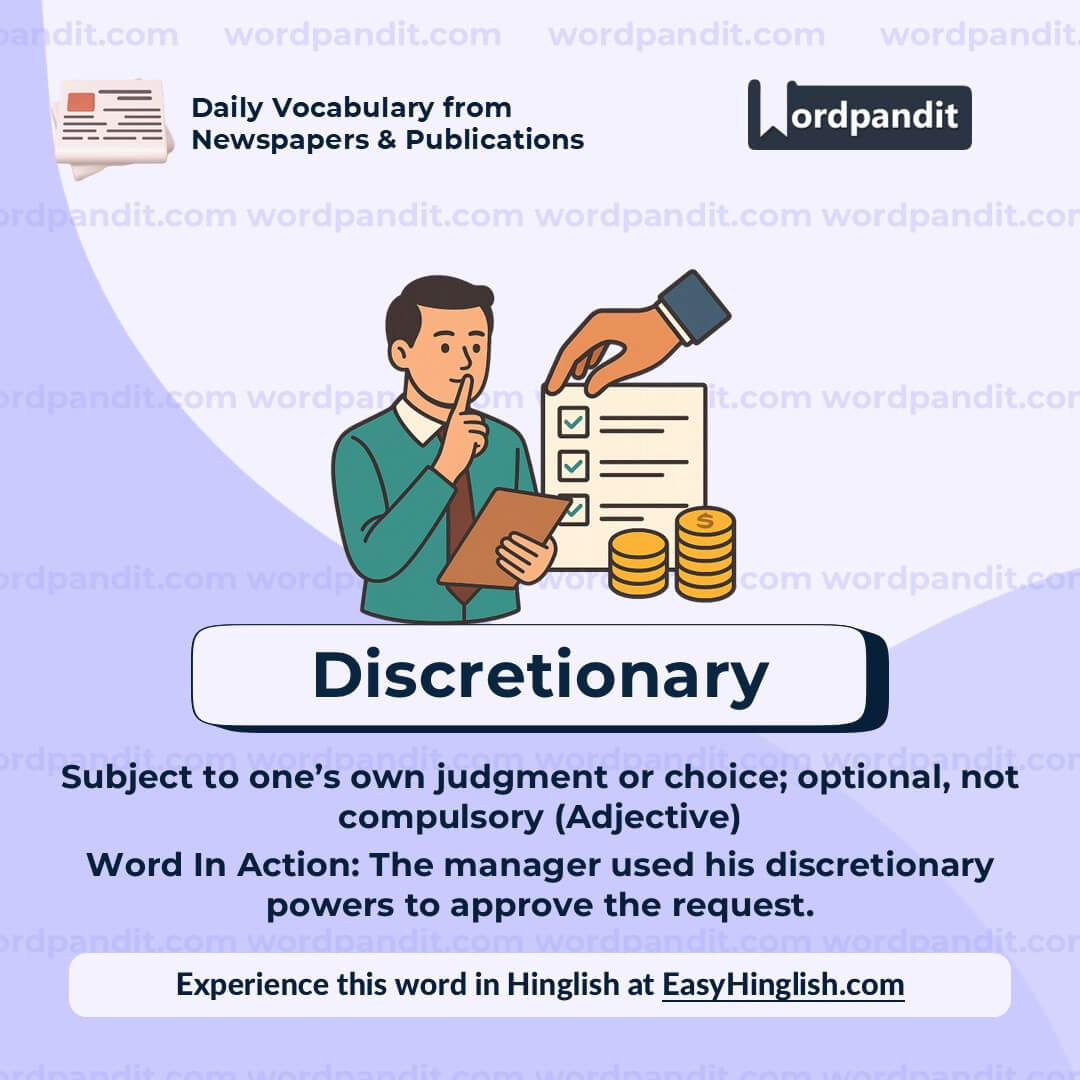
WORD-5: Discretionary
Context:
"The political party framework, are still incorporated in discretionary terms, for example, using 'may.' A uniform mandate under all three heads is needed." - Indian Express
Explanatory Paragraph:
The word discretionary refers to something that is left to individual choice, judgment, or decision rather than being mandatory or fixed by law. When an action, power, or resource is described as discretionary, it means people in authority can decide how, when, or whether to use it. For example, a government’s discretionary powers give it flexibility to act in special circumstances.
Meaning: Subject to one’s own judgment or choice; optional, not compulsory (Adjective)
Pronunciation: dis-kresh-uh-nair-ee
Difficulty Level: ⭐⭐⭐ Intermediate
Etymology: From Latin discretio meaning "separation, discernment, power to decide." The modern usage relates to the ability to choose freely.
Prashant Sir's Notes:
Remember: Discretionary = optional. When laws use words like "may" instead of "shall," they grant discretion — a choice rather than an obligation.
Synonyms & Antonyms:
Synonyms: optional, voluntary, flexible, elective, non-mandatory
Antonyms: compulsory, mandatory, obligatory, binding
Usage Examples:
- The judge used her discretionary powers to reduce the sentence.
- Many companies provide employees with a discretionary bonus based on performance.
- Parents have discretionary authority over how to allocate their household budget.
- Discretionary spending often decreases during economic downturns.
Cultural Reference:
"In government budgets, discretionary spending refers to the portion that lawmakers can adjust each year, unlike mandatory programs such as pensions or debt payments." - Economic Studies
Think About It:
Should leaders have wide discretionary powers, or should rules be fixed to prevent misuse?
Quick Activity:
Write two examples from your life where you have discretionary choices — one in studies and one in daily habits.
Memory Tip:
Think of "discretionary" as "decision + optional" — decisions that you can choose freely.
Real-World Application:
The term "discretionary" is commonly used in law, governance, business, and finance. For example, central banks often have discretionary powers to adjust interest rates, and companies set aside discretionary budgets for special projects or bonuses.


